

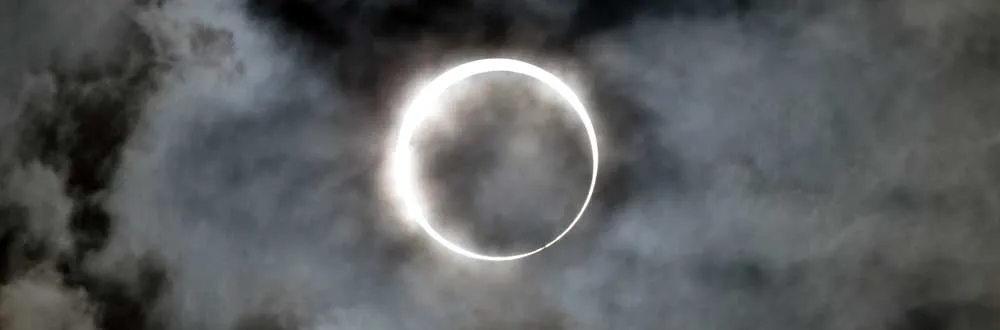
The only time you’ll ever see the sun’s outer atmosphere is during a full solar eclipse, when sun itself is completely covered. That hazy ring is called the corona, from the Latin word for “crown” — just like the little crown on a bottle of Corona beer. Plus, the phrase throw the baby out with the bathwater contains a vivid image of accidentally tossing something — and so does the phrase to fly off the handle. But where did we get the expression to hell in a handbasket? Also: Biscuit Belt vs. Pine Belt, streely, pizza, tuckered out, FOOSH, and sorry, Charlie!, and how to pronounce via. This episode first aired July 15, 2017.
Transcript of “Smile Belt”
You’re listening to A Way with Words, the show about language and how we use it. I’m Grant Barrett.
And I’m Martha Barnette. We’ve heard a lot of talk lately about the Rust Belt,
And there’s also the Bible Belt in this country, but one belt that I didn’t realize existed is the
Smile Belt. What’s the Smile Belt? Places where it’s often sunny. No, the Smile Belt extends from
The West Coast down across the bottom of the United States and then up the East Coast. What
What do they have in common?
That’s what I’m trying to figure out.
I have read a whole bunch of different sources on marketing.
People in business who are trying to market either fish tacos or cars or furniture.
And they’re all talking about the Smile Belt.
As a region that they’re trying to do business in.
Yes.
Okay.
And it’s just like the image you might imagine.
A shape of a smile.
A shape of a smile.
Are they all ocean states or sea states except for the one bordering Mexico?
Not across the bottom.
Wow, yeah.
If you’re in marketing, you’ve got to let us know, why is this a region?
Why is this a target?
But there are lots of different regions like that in this country.
There’s a pine belt in Mississippi.
You’ve heard of the biscuit belt?
That gets loosened the more biscuits.
Well, it’s the region where people tend to really like their biscuits.
Oh, okay.
They have big bellies and a little obesity problem.
So the biscuit belt probably overlaps with the smile belt.
A little bit, yeah.
Well, here’s what I’m guessing.
I’m guessing that we have listeners who have a particular region in their area that is also defined as a belt.
A kind of belt.
Yeah, we would love to hear about it.
Yeah, what’s the belt that you live in?
What do you identify?
What does the Chamber of Commerce put on the sign when it welcomes people to town?
The something belt.
What is that something?
Email words@waywordradio.org.
Talk to us on Twitter @wayword.
Or find us on Facebook.
Just look for the A Way with Words Facebook group.
Hello, you have A Way with Words.
Hi, how are you?
This is Lindsay calling from Omaha, Nebraska.
Hi, Lindsay from Omaha.
Hello, Lindsay.
What’s up?
What can we help with?
So recently I’ve given a big presentation to over 100 people, and it was a presentation
On how to use our product, and I didn’t even realize I’d said it.
But apparently during my presentation, I had pronounced the word V-I-A incorrectly.
I received some feedback that said you gave a great presentation, but you mispronounced
The word V-I-A, and they said, I want you to know that so you don’t make that mistake
Again in the future.
And I guess I didn’t realize there was an incorrect way to pronounce it.
Wait a second.
Wait, let’s talk about…
Was this your employer?
Yeah.
Was this your employer?
Your boss?
It was actually a customer.
No, it was a customer’s feedback on my presentation after I was helping them.
Wait, so wait, did they stand up in the middle of the room surrounded by all your audience
And tell you this?
No.
Oh my gosh, I would have been mortified.
No, they sent an email after the fact.
Just to you.
They sent you an email.
That’s nicer.
I was worried that they hadn’t taken anything else away except that they had a quibble about your pronunciation of a word.
No, and that was the only piece of feedback.
And it just said, you know, hey, I love language, and I just want you to know you pronounced it incorrectly, so you might want to fix that for the future.
Oh, my goodness gracious.
So what did you say?
I say, and I don’t know if this is correct, but I’ve always said it, I say via.
We’re going to solve this problem via the new product that we’re releasing in March, something like that.
Exactly.
Yeah.
And, Lindsay, can you give us an idea of what kind of business you’re in?
I’m in the tech industry.
Okay.
Okay.
But you should have said VEA.
They think it should be VEA?
Yeah.
And she spelled it with big capital V-E-E dash A.
Oh, my goodness.
All right.
And what kind of expert is she?
I don’t know.
That’s why I figured I’d ask the real experts to see if I was right or wrong so I could fix it if I needed to.
I’ve got good news for you.
First of all, you don’t have to take language advice from a customer.
The customer is always right.
The second thing is there are two standard pronunciations of this word,
And they overlap greatly, and it’s not altogether clear to anyone which one is the most correct at all times.
Throughout the English-speaking world, people say both via and via.
There is a general kind of separation of the two pronunciations.
You probably say via, if you’re using the proposition.
Okay.
So we are solving this problem via the new product we’re releasing in March.
You probably will say via if you’re talking about a street or a road or some landmark like that,
Or if you’re actually using the word from Italian or Spanish or other languages that have this word in it.
And that’s generally most of the time people will do it that way.
But it’s not altogether clear because it’s still a little bit tinged as a foreignism to most people which circumstances mean you pronounce it which way.
Interesting.
So you’ve got some outs there is all that I’m saying.
I’m guessing that you were pronouncing it the first way that Grant was talking about, though, right?
You said via, right?
Yep, yep.
I think my example was you would contact this person via this program or this way.
I do not have a problem with that at all.
I don’t have a problem with that either.
As a professional language person, no, I think you were fine.
And I think, did they give a reasoning for preferring via in that sentence?
They used the term American English.
They said in American English, the correct pronunciation is via.
Can I be snarky for just a second with you?
Just the three of us.
Absolutely.
Just the three of us.
Sometimes people have personal preferences that they like to pass off as universal rules.
Those people should be ignored.
I like that.
Okay.
I agree.
But I felt so nervous, like I had done something wrong, and I had never even considered that
I was saying it incorrectly.
Oh, my gracious.
And do you have to deal with this person again, Lindsay?
No, I don’t believe so.
Did they buy your product?
I had given the presentation, so they didn’t need to.
That had already been done.
Okay.
But I did respond, and all it said was, I thank you for your feedback.
Great.
That’s smart.
That’s nice.
That’s right.
And then you stewed about it and called us.
I did.
That’s exactly what I did.
Yes.
Well, again, we both think you’re fine the way that you said it.
The outs that you have are that there’s two standard pronunciations.
There’s a little bit of separation in whether or not you’re talking about the noun via or the preposition via.
But for the most part, most people feel that it’s a little foreign in their brain without really thinking about it and may try to foreignize it or hyper-foreignize it a little bit.
And that might lead them to the via pronunciation,
Whereas the via one might be more generally used.
But you’re saying that the via,
That the preposition can be pronounced either way.
Yeah, it can be.
Via is more common, but it can,
There are tons and tons of evidence
For this being pronounced both ways
By the most educated speakers of English,
The most educated writers,
The most august personalities that you can think of.
Right, so sort of like often and often.
Yeah, exactly.
Two coexisting pronunciations.
So you’re cool, Lindsay.
You’re cool, Lindsay.
In more ways than one.
Oh, good.
Good.
I’m so glad I’m not wrong.
And so that would be really hard to change at this point in my game to flip the script on how I pronounce it.
So I’m so glad I don’t have to do that.
And if you get any more pushback on this, you send them to us.
We’ll straighten them out.
All right?
I will.
Absolutely.
Thank you so much.
All right.
Take care.
Thanks, Nancy.
Bye.
You’ve been thinking about something.
It’s been galling you.
It’s a language question where somebody criticized your speech or your writing.
You think you’re right.
Give us a call.
We’ll try to prove it.
Hello.
You have A Way with Words.
Yes. Hi, this is Phil Chandler. I’m from Huntsville, Alabama.
Hi, Phil. Welcome to the show.
Hey, Phil.
How can we help?
Well, I’ve heard this phrase all my life. I’ve heard it mainly from my parents and family members.
It’s to hell in a handbasket. And I use that phrase all the time, but when I use it at work, like projects gone to hell in a handbasket, all of my team, they’ll start laughing at me and they’ll say, I’ve never heard that before.
So I don’t know if it’s maybe not that common these days, but I see it online as well.
But, you know, I’ve always used it all my life and just wonder where it came from.
Phil, can I ask what kind of work you do?
I’m in finance and working with projects and so forth.
Okay.
Yeah.
And so when…
No, I’m not in politics.
Okay.
All right.
But still in finance, if something goes to hell in a handbasket, that’s not a good thing, huh?
It is well and truly gone to hell then, hasn’t it?
Exactly.
And you’re saying your younger colleagues don’t know what that means.
Did you say younger? Or you just said your other colleagues?
Yeah.
Most of my younger colleagues, they’ve never heard it.
People around my age, and I’ll just say I’m over 50, I have an AARP card.
Congratulations.
Yeah, but most people in my age group, they’ve heard it before or used it.
But when I use it at work, and I’m the king of colloquial euphemisms, but they’ve never heard it.
Is that right? That’s interesting.
Well, they must live bland and boring lives if they don’t have that kind of color around them.
Or maybe their lives are great and nothing goes down on a hand. They’ve had no need for the phrase. Good for them.
Phil, I can’t tell you how many times we’ve gotten emails and phone calls from people who say the English language is going to hell in a handbasket.
Yeah, so in our world, hell in a handbasket is really common.
It’s like the go-to phrase when people want to say, kids, today the language is just being ruined.
Well, it’s good to know I’m not the only one that uses it.
Oh, no, not at all.
Not at all, not at all.
In fact, this phrase has been around since at least the Civil War.
Mm-yeah.
Okay.
Yeah, and we’re not really sure about the origin of it.
Why handbasket?
Yeah, why handbasket?
I mean, some people have suggested that maybe it’s because a handbasket is something light that you can carry easily, you know, and you’re going to get to hell really quickly.
Right.
You’re imagining like Little Red Riding Hood with a handbasket just kind of skipping gately along towards the mouth of the wolf, right?
Towards the mouth of the gates of hell.
But you’re in that basket and she’s like, la, la, la, just like swinging the basket with no care in the world.
Right.
Right, right.
Yeah, I’ve done a little research of mine, and it said that it could possibly come from old English terms or phrases where, you know, you have the guillotine.
And this may be a Hollywood deal where it’s derived really from Hollywood.
But, you know, where the king or queen is in the guillotine and it comes down, their head goes into the basket.
Into the basket.
And that person, theoretically, is going to hell.
Yeah.
There’s a giant gap, though, between the era of the guillotine and the American Civil War.
And also it is an American expression and not from the continental Europe languages.
Yeah, so you’re right to be skeptical of that.
It was really popularized, too, in the early 1960s by the humorist H. Allen Smith.
He wrote a lot of books.
He was really, really popular, especially in the 40s, 50s, and early 60s.
He was an American humorist who wrote things like Life in a Putty Knife Factory.
And his autobiography in 1962 was called To Hell in a Handbasket, which I think is a great name for an autobiography, right?
Exactly.
So, Phil, does that help?
Yeah, it does help.
I’m glad that I’m not the only one that uses it.
Not at all.
Hopefully it isn’t a phrase that’s dying out because I think it’s kind of comical.
Well, thank you both very much.
Take care, Phil.
I appreciate it.
Okay, take care.
You too.
Bye-bye.
Email words@waywordradio.org.
Felicia Fadlon wrote us from Los Angeles to share a linguistic heirloom.
Her mother, Janet Myers, was from a farm in Franklin County, Indiana.
And the phrase is, stop letting the penguins out.
Do you know this?
No, that’s new to me.
That’s what you say to a kid who’s standing in front of the open fridge for too long.
And Felicia says, I now laugh when I catch myself saying it to my own kids, stop letting the penguins out.
Totally taking that.
I know.
I can just imagine if I were four years old and I had somebody say, stop letting the penguins out, I would be pushing the door shut so quickly.
And it turns out she thought that it was her family’s own expression, but not at all.
Lots of people say it.
Lots of people say it.
In fact, I found online stop letting the penguins out refrigerator magnets.
That’s cool.
And what I love about it as a parent is that anytime you can inject humor in telling a child what to do, you’re more likely to get the result you want.
Right.
And you want that door closed.
You’re listening to A Way with Words, the show about language and how we use it.
I’m Martha Barnette.
And I’m Grant Barrett.
And here he is, John Chaneski, our quiz guy in New York.
Hi, John.
Hi, Grant.
Hi, Martha.
Now, you guys know, when I talk about puzzles or quizzes or trivia with people, I avoid using the word hard because it seems to only have a bad connotation to most people.
People always ask me, is your trivia hard?
And I always say it’s challenging because that’s what fits my philosophy of puzzles and games.
Challenge yourself.
Try.
Play.
Don’t be intimidated.
Go and do it.
Right?
So, since I don’t get a lot of use out of the word hard, I thought I’d use it in this quiz.
What I did, I looked up a whole bunch of synonyms and near synonyms of the word hard.
So this is my really hard quiz.
Okay.
All right.
For example, the titular character of a popular Netflix series is described with this adjective, even in the title.
In other words, she’s the hard Kimmy Schmidt.
Unbreakable.
Yes, exactly.
Hard, unbreakable.
Very good.
So I’ll give you some variations on the word that we’re going for, and then also a use of the word in other words.
Okay.
All right.
Here we go.
This word for a state of matter is used as an adjective that describes electronics that use semiconductor devices instead of electron tubes.
In other words, it’s a hard state radio.
Solid state.
Yes, solid state radio.
Very good.
This word can mean a company.
It’s often used to describe cheese or a handshake.
Though you might say hard cheese, you’d rarely say hard handshake.
Firm.
Yes, firm.
Very good.
Hard is firm.
This word is an adjective that describes revolutionaries or others engaged in defiance.
It can also mean not likely to be affected by.
In other words, my watch is water hard to 50 meters.
Proof.
No, resistant.
Water is resistant.
That’s what we’re getting to rebels.
Revolutionaries and rebels are resistant, yes.
This word means having the properties of a mixture of iron and carbon.
In another sense, or in other words, you might be a fan of the 70s rock band Hard Dan.
Steely.
Steely Dan.
Steely.
Steely Dan.
This word means powerful or done with a great deal of force.
In other words, you might be nostalgic for the cartoon hero Hardmouse.
Mighty.
Mighty Mouse.
Mighty. Mighty. Mighty is hard.
This word means difficult to bear or unpleasant.
In other words, try to stay out of the way of the hard reaper.
Grim.
Grim, yes.
This word can be a noun meaning the back of the boat or an adjective meaning unsympathetic and severe.
In other words, you might be a fan of Howard Hard.
Howard Stern.
Howard Stern is right.
Finally, this word can refer to a problem that’s like a tangled rope.
In other words, you might look to hard pine for lumber that’s used in paneling and furniture.
Naughty.
Naughty is correct.
Naughty is high.
You guys spelled with a K.
Yes, exactly.
K-N-O-T-T-Y.
You guys found that hard quiz to be pretty easy, I think.
Yeah, sure.
Yeah, easier than usual.
You threw us some softballs.
We’re in trouble next week, though, I bet.
Okay, we’ll see.
John, thank you so much.
Thanks, buddy.
Thanks, guys.
Bye-bye.
Take care.
This is a show where we talk about language in all its glory.
So call us, 877-929-9673, or send us your stories about language to words@waywordradio.org.
Hello, you have A Way with Words.
Hi, this is Noelle calling from Jericho, Vermont.
Hello, Noelle.
Welcome to the show.
So I am calling with a funny question about the expression, sorry, Charlie.
We used to say it to my son a lot, and it started out as a funny thing and then turned into a nickname, and now we actually call him Charlie.
And I was just wondering where that may have originated from.
So now it’s a nickname for your child?
Yes. So Charlie was actually born with the name Mia. And as the years went on, Charlie expressed feelings about being a male and not a female.
Okay.
And so when we started to kind of make those changes, Mia wasn’t a very fitting name for a male. And so we had been saying sorry, Charlie, to him so much that we just started calling him Charlie.
How nice is that?
Oh, wow.
What kind of context would you say that in?
Sorry, Charlie.
Oh, just, you know, in the simple, like, no, sorry, you can’t do that, or sorry, you can’t have that fifth cookie.
Sorry, Charlie.
-huh, -huh.
And Charlie was born in what year?
2008.
Okay.
So, eight years old.
Oh, gosh, relatively recent.
I’m sure that lots and lots of our listeners are thinking back to an old commercial for Star Kissed Tuna right now.
Oh, okay.
Did you ever see these commercials for Star Kissed Tuna that had Charlie the Tuna in them?
I didn’t, but when I mentioned this whole thing to my mom, she brought that up.
Yeah.
I just wanted to kind of wait and hear what you guys had to say.
I’m 31, so I don’t know if that commercial was before my time.
Well, not completely, but maybe mostly.
Yeah, they started back in 1961.
And they were these animated commercials featuring this tuna named Charlie.
And he was sort of what you might describe as a hipster.
He had these cool clunky glasses.
A beatnik maybe for the area.
Yeah, a beatnik.
The beret, I remember.
A beret on a fish.
It was a Greek fisherman’s hat.
It was a Greek fisherman’s hat.
He was stylish.
Chunky glasses.
He thought that he was really cool and he thought that he had really good taste.
But the thing was that Starkist Tuna was looking for tuna that tasted good.
Yeah, that was the line, right?
The announcer always said, sorry, Charlie.
Yeah, and there were many, many, many, I think about 80 versions of these commercials that would run over the years.
And every single time in the commercial, he would be full of hope going toward a hook, hoping that he would be caught and used by the Starkist Tuna Company, which is sort of weird.
You know, that reminds me of all those restaurants you see with happy cows outside that serve steak or happy chickens.
That was his fondest dream.
And he just never, never got it.
And a little sign would come down.
You can see these.
On the hook, right?
Yeah, on the hook.
Go to the Star Kiss Tuna website because they have a whole history on Charlie because they’re very proud of him.
And he’s still their mascot.
He sold lots and lots and lots of tuna that way.
Yeah, he’s still their mascot, although I think they’ve dropped that kind of commercial.
Yeah.
And his voice was very distinctive.
It was like Charlie.
Like a New Yorker, Brooklyn.
Yeah, it was Herschel Bernardi, who was the star of the TV show Arnie for many years.
People may remember that as well.
Sorry, Charlie.
Starkist doesn’t want tuna with good taste, but tuna that tastes good.
That was the line.
That’s so great.
Well, thank you guys so much.
I really had fun with that.
Yeah, sure.
That’s great.
Thanks a lot.
Thanks for sharing your famous story, too.
Bye-bye.
Bye-bye.
Thanks, guys.
Bye.
Do you know the word bolt hole?
Yes, from Sherlock Holmes.
I figured you probably would because of all your British…
Well, no, Sherlock Holmes is what I read when I’m sick. It’s my go-to. It makes me feel better.
Oh, I thought you watched Columbo on TV.
Well, I have watched Columbo on TV, but Sherlock Holmes has bolt holes all around London. There’s like little rooms and places that he’s set aside so that when he’s on the trail of somebody, he can change a costume or eat a snack or sleep a little bit without leading them back to his home.
Right, right.
That’s exactly it. And that’s how people use it, mainly in Britain, to describe some place where they can just get away from everybody.
I need a bolt hole. And apparently it has to do with holes in the ground that little animals will bolt out of if you flush them out.
Oh, interesting.
Isn’t that cool? That makes a lot of sense.
A bolt hole. Bolt hole. Everybody needs a bolt hole.
Talk to us on Twitter @wayword.
Hello, you have A Way with Words.
Hi.
Hi.
This is Marlis calling, and I’m calling from Cambridge, Wisconsin.
Hey, Marlis, welcome. Welcome to the show. How can we help?
I have a question about a word that my mother used to use. Now, she was a widow with six children, and she didn’t want us to look slovenly. She wanted us to be nice and clean, not to embarrass her. So she used to tell us to be sure and wash our hair so that it wouldn’t be streely. She didn’t want her children to have streely hair.
Streely?
Streely.
I’ve never heard of that anywhere before except from my mother.
Interesting. And Marlis, how did she spell it?
I have no idea. It was just verbal orders to the children. No streely hair.
No streely hair.
Was she from Wisconsin as well?
No, no.
She was from northern Minnesota.
Northern Minnesota.
Any Irish heritage there?
Oh, yes. Both her side and my father’s side. Mostly Irish.
I ask, and it’s good to have the confirmation, because streel-y ultimately comes from an Irish word meaning unkempt.
Really?
Yeah, yeah. So a streel is somebody who is unkempt. Their personal appearance is in disrepair, so to speak.
And unkempt is another word she used frequently. We were not to be unkempt.
Yeah, the older synonym for it, by the way, for a streel, the noun is slut, which has nothing to do with sexual proclivities.
It just has to be, slut used to mean you’re just like you’re personally, physically, slovenly, yeah.
Careless about your appearance or even dirty about your appearance.
And so this streel came to the United States and the adjective form isn’t quite as common as the noun form, but it pops up here and there.
But almost always there’s an Anglo-Irish connection.
The roots are usually pretty apparent there that it was handed down through the generations when somebody ultimately came from Ireland.
Well, it could have been also, my father’s parents were both born in Ireland.
Oh, interesting.
So it could have come into her, you know.
Through him.
Language from my father.
So it’s sometimes spelled S-T-R-E-E-L.
It’s also sometimes spelled S-T-H-R-E-E-L.
And that more closely reflects what I believe the Irish pronunciation would be, which is a little more like striil, something like that.
So the voice TH in there.
And before that, in the Gaelic, it comes from words that have to do with flapping or flailing or dragging.
And this refers to banners, for example, that might not be well attached.
Or imagine a ribbon that has come undone.
Or the hem of a skirt that is trailing in the dirt.
Or laces that aren’t completely fastened.
Well, I know, but we weren’t to have oily, like stringy hair.
And that’s what she meant.
I can see that.
So you have the stringy hair that’s not neat and cared for and maybe tied up or put in a bun or something.
Oh, that’s so interesting.
I had no idea.
I thought she made that up.
No.
So often these family words tend to have larger cultural implications.
We can kind of find the plug in the history that you connect to.
It’s like the puzzle piece under the couch.
We fetched that for you and we plugged you into the larger language puzzle.
Thank you.
I wondered about that.
Now you know, Maris.
Now I do.
Thank you so much.
Our pleasure.
Thank you for calling.
Really appreciate it.
Bye.
Bye-bye.
So a streel is a person, usually a woman of low character.
And then streely is someone of low character or disreputable behavior or slovenly appearance.
Right.
Do you remember years ago on the show we had a woman who, she lived in Newfoundland,
And she had a T-shirt company that had a name like Two Streels or something.
They were reclaiming the term.
Oh, that’s interesting.
I don’t remember that,
But I do know that this term has been recorded on Prince Edward Island, which isn’t far.
Yeah, there you go.
Yeah.
Yeah, they were selling T-shirts with words from Newfoundland English, like twacking.
Do you know twacking?
No, I don’t know twacking.
It means shopping.
Shopping? Nice.
Yeah, I used to have a twacking T-shirt.
Twacking.
Call us with your linguistic heirlooms, 877-929-9673, or send them to us in email.
That address is words@waywordradio.org, or share them on our Facebook group.
Here’s an Irish saying that I really like, although I find it hard to say.
He’s not as slow as he walks easy.
He’s not as slow as he walks easy?
It means give him the benefit of the doubt that he might come across as kind of dim-witted,
But watch out, he’s really dumb like a fox.
So, for example, Columbo might say, I’m not as slow as I walk easy.
I’m not as slow as I walk easy.
By the way, you can talk with us and other listeners on our Facebook group.
Just look for A Way with Words.
Hello, you have A Way with Words.
Hello.
Hi, who’s this?
This is George Weller, Stansted, Quebec.
Hi, George. Welcome to the show.
Hi, George.
Hi.
Well, I was wondering about fly off the handle.
Sometimes when people get obsessed, maybe my wife or somebody, and I say, don’t go and fly off the handle.
Now, I’m a private pilot, and I know on Halloween there’s witches with brooms and whatnot.
And I was wondering if maybe fly off the handle came from a witch flying off the handle of her broom.
Boy, I never thought about that image of flying off the handle, meaning riding a broomstick through the sky
And then flying off the handle somehow, just getting a little crazy
Or getting a little overly excited about Halloween?
Yeah, maybe having a little too much to drink or something.
So that’s what flying off the handle means to you, just a general excitement?
I use flying off the handle as somebody gets all uptight about something or other
And does sort of lose control a little bit.
Oh, interesting.
The origin of it is pretty darn literal,
But it refers to a tool like an axe or a pick or something like that.
You know, you’re using it really vigorously, but the head on it is loose,
And it just goes flying off the handle.
-huh. That’s actually happened to me.
The metal head of the axe has come off of the handle.
Didn’t injure anybody.
No, no.
But it went flying through the air?
Yeah.
And that’s exactly it.
That’s exactly the idea behind don’t fly off the handle.
It’s a bad thing.
Mm-And dangerous.
Yeah.
It’s got a couple hundred years to it, more or less, right?
Yeah, around since early 19th century, I think.
Yeah.
Well, that’s when a lot of wood was being caught, I guess.
Indeed.
George, thank you so much for your call. Really appreciate it.
Well, thank you.
Take care.
Okay, bye.
Bye-bye.
Maybe you’ve moved someplace new and they talk kind of funny,
Or now you feel like you talk funny.
Give us a call. We’ll talk all about it.
Hello, you have A Way with Words.
Hi, I’m Gabriel from Arlington, Texas.
Hi, Gabriel. Welcome to the show.
Hello, Gabriel.
What’s up?
So I was at Olive Garden one day, and I ordered some pizza.
And I thought, I only see pizza on menus of American and Italian places.
So I thought, maybe another country made pizza, but Italy made it better.
So where did pizza originate?
So you’re saying when you go to, what, a Chinese restaurant, you don’t see pizza?
Yes.
Or when you go to a barbecue restaurant, no pizza?
No.
Okay.
Yeah, Gabriel, you’ve asked a wonderful question that has a whole lot of history behind it.
Because there have been forms of flatbread covered with good stuff, tasty stuff like pizza, for a very long time. All the way back at least a thousand years in Italy, there was a kind of flatbread that had a name that sounded sort of like pizza.
But you know what? Pizzas as we know it didn’t come about in Italy until the 15th century because they didn’t have tomatoes in Italy at all. Tomatoes are native to this part of the world, to South America. And so when the explorers started bringing back tomatoes in the 15th century, then people started using them in different dishes. And they weren’t that popular at first. A lot of people thought, oh, that’s just a gross foreign food. Let’s not use it.
But especially in southern Italy, they started spreading this sauce on a flat bread and calling it pizza. And adding things that they already had, which is a good sausage and good cheese and good other vegetables.
Yeah. Gabriel, what do you like on your pizza?
I like pepperoni and sausage.
Sure.
Okay. Classic. You’re a meat man. Classic. And did you know that they just created the world’s largest pizza here in California?
What? Really? Where?
I didn’t know that. Is there any left? Are there leftovers?
No, this was really cool. This was just a few weeks ago in Fontana, California. They made this pizza that made it into the Guinness Book of World Records, Gabriel. And it was about a foot and a half wide, but it was really, really, really long. It wasn’t round. It was like this really long one, longer than a mile.
Wow.
Oh, wow. That’s crazy. How crazy is that? And a lot of tomatoes.
Yeah. That’s crazy.
Yeah, and it weighed more than an elephant. And it was just kind of this crazy thing that all these people did, but then they boxed it up and took it to food banks and gave it away to people.
Well, Gabriel, you asked something I think is also important. Like, why is this such an American tradition? You know, it’s a question for a food expert, right? Why did Americans take so wonderfully to this foreign dish? Why does it feel so much like ours now?
I don’t really know.
Yeah, it didn’t come over here until the late 19th century in Italian immigrants in the Northeast.
Yeah, but it’s a good comfort food, right? Don’t you feel better after you eat it?
Yes, I do. Thank you so much for your call. Really appreciate it. Call us again sometime with another question, all right?
Okay. Thank you.
Take care.
Thanks, Gabriel.
Bye-bye.
Bye.
877-929-9673. One language, many voices. Why we say what we say and how. Stay tuned.
Support for A Way with Words comes from Jack and Caroline Raymond, proud sponsors of Wayword, Inc., the nonprofit that produces and distributes this program.
You’re listening to A Way with Words, the show about language and how we use it. I’m Grant Barrett.
And I’m Martha Barnette.
Anytime you’re talking about a total solar eclipse, there’s all this great language that gets repeated. And one of my favorite words associated with an eclipse is the word corona.
Corona and not the beer, but related to the word for the beer.
Well, yes. Crown, right? It comes from the Latin word corona, which means crown. And the corona is the sun’s upper atmosphere, which you see only when the moon completely blocks out the rest of the sun.
In a full eclipse.
Yeah. And you can learn new things about the sun that you can’t really tell otherwise because it’s not as bright.
Exactly. Interesting.
But what’s cool about the word corona, it actually gives us the word crown, which comes from the Latin. It’s also related to the word coronation then.
Okay. That makes sense. You put the crown on the king or queen’s head.
Yeah. And you mentioned corona beer. If you look at a bottle of corona beer, it’s got a crown on it.
And the other corona in our language is coronary arteries. Because the coronary arteries sort of wreath around the heart. And the early crowns, of course, were like wreaths, you know. So it’s like a wreath of arteries around the heart.
And in fact, the word coroner is also related to the word corona.
No, no, no.
No, the word coroner also goes back to the word corona because originally a coroner was an officer of the crown.
Oh, interesting.
Had all these different duties.
But over time, those duties narrowed to just dealing with dead bodies.
Interesting.
And in my mind now, I’m singing the Simon and Garfunkel song, Rosie, the Queen of Corona.
Right? Queen of Corona.
Yeah. All the way back to Latin.
Interesting.
That’s outstanding.
I thought you were going to go and talk about penumbras and stuff and throw a lot of shade.
Well, penumbra means literally, from Latin words, it means almost shadow because it’s not complete, right?
Umbra shows up in the word umbrella.
Right.
And the pen is like in the word peninsula, which is an almost island, like Florida is an almost island.
Nice.
Yeah.
I heard what you were doing there, making a joke about throwing shade.
And literally when you’re talking about taking umbrage at something, it’s like you’re offended by the shade that somebody is throwing.
That’s outstanding.
You know, there might be something to this Latin thing.
We should look into that.
Yeah, maybe people should study Latin.
It’s weird how often that comes up when we talk about word origins.
I know.
And Greek, too, like the word eclipse, for example, comes from Greek words that literally mean an abandonment.
Ooh.
A falling away.
I mean, can you imagine how traumatic that would have been?
If you didn’t know it was coming, right? Back in the day.
Yeah, and you didn’t know it was going to be over.
Right.
Abandonment.
That’s crazy.
Well, as you can hear, we talk about word histories all the time on the show.
Language is complicated and interesting and thoroughly connected to the history of the human race.
Find out more.
Call us 877-929-9673.
Hello, you have A Way with Words.
Hi, my name is Mary. I’m calling you from Veldia, Nebraska.
Welcome to the show.
What can we do for you?
I help out with the Chinese students at my university, and one of them asked a question about the flying tuckered out, and for the life of me, I couldn’t think of an answer to give them, and I felt so bad.
I thought maybe that tuckered out was like a bastardization of tired out, but that seemed a little bit off to me.
So what can you do for me?
Yeah.
And this is a term that has sort of an obscure history.
A lot of people have associated it with the notion of the term tucked, which can refer to an animal like a dog or a horse that is extremely malnourished and therefore, you know, slow in general.
And they get this sort of look around their ribs where it looks as if the skin is sort of tucked there because they’re just so very thin.
You know, their body kind of narrows at that point.
And so I know a lot of people have associated it, yeah, with that tucked look in animals.
Yeah, I never would have thought of that.
Yeah, it’s actually mildly horrifying.
Yes, indeed.
And you’ll often find in the historical record that tucker alone just exists as a verb without the out.
So you can tucker someone or something or something can be tuckered without out in there at all.
Going back to the early-ish to mid-1800s.
And then there’s an older, much, much older verb.
Now, I’d say obsolete or at least archaic in English.
The verb tuck alone, T-U-C-K, often meant to criticize or condemn or even beat someone, to punish, to chastise.
And in the way that I could see someone kind of adopting that body protection stance that very much looks like your limbs are tucked in.
My personal opinion is that there is some interplay between the verb tucker and the verb, the now archaic verb tuck, that kind of leads us to the modern understanding of being tuckered out.
Well, English has a really violent history.
Oh, yeah. Welcome to humanity.
It does, and particularly in relation to how we have treated animals over the centuries.
There’s a whole talk I can give about that.
Because the story I was reading with them that had that slang term in it was not horrifying at all.
And so now I’m not really sure how to bring that up with them, but I’ll figure it out.
Well, we can give you a little linguistics lesson that you can take to them.
You can talk to them about the concept of amelioration.
And so language often goes through this process of words that are really negative or really severe becoming a little more positive or a little more neutral, at least.
And that’s where we find them in the modern language.
Yeah, I wouldn’t say you shouldn’t use the term at all.
No.
I mean, it’s been ameliorated.
Yeah, it’s been ameliorated.
And its history and its etymology don’t have to overwhelm our modern understanding of the word.
So, Mary, thank you for calling us about this.
And let us know if you encounter anything else in your classroom.
Thanks very much.
Bye-bye.
Bye.
Well, maybe you’ve been talking with people who speak English as a second language, or maybe you speak English as a second or third or fourth language yourself, and some word has caught your ear and you’re wondering about it.
Give us a call, 877-929-9673, or send it to us in email.
That address is words@waywordradio.org.
Hello, you have A Way with Words.
Hi there.
This is Carlton Crutchfield, and I’m calling from Minneapolis, Minnesota.
Hello, Carlton.
Welcome.
Hi, Carlton.
Welcome to the show.
What can we do for you?
Well, I teach at St. Cloud State University in central Minnesota, and I teach undergraduates in the Herberger Business School.
I’m a lecturer in business law, and I recently, in a lecture, used an idiom, a phrase.
Don’t throw the baby out with the bathwater.
And when I used that phrase with the average age 20 in my lecture, the average age of my students around 20 years old, literally hands went up in the air, faces became twisted, and they were just astonished and I think repelled by the phrase.
And I discerned their discomfort, and I said, have you ever heard that before?
And no one raised their hand.
I have 36 students, and not one raised their hand.
And then I felt very old.
I thought there’s a generational gap.
And then it got me thinking, what is the history and usage of that phrase?
And whether or not there’s a gap between generations in the use of that phrase.
And Carlton, are these all native English speakers?
Oh, yeah.
Well, I would say 90 to 95 percent of them, yeah.
So it is an age gap then, surely, or a life experience gap.
Maybe that’s the better way to put it.
They just haven’t done enough reading yet, right?
Throwing any babies out with bathwater.
Give them a few more decades and they’ll encounter it.
But I bet they’re all seeing it now.
They’ve all seen it a million times since they heard you say it.
Yeah.
Well, I didn’t use it again.
Okay.
Because it really seemed to create discomfort.
It’s almost like the imagery made them uncomfortable.
And I thought, well, there’s got to be a better way to say the same idea.
I really couldn’t think of something that certainly that memorable or that catchy or that impactful.
Well, you know, I had the same experience when I was five years old of being traumatized by my mother saying something about throwing the baby out with the bathwater.
But I was five years old. I wasn’t 20.
Yeah. Well, I don’t know. I was really surprised by it. And that’s what prompted my call.
And also I got a bit worried because I thought, are we losing? Are we losing something here?
Well, the language is always in flux and we can’t hold on to everything.
So, yeah, some stuff goes, some stuff stays, and it’s hard to control which is which.
But I will tell you, there’s a great history on this expression that will scratch every itch you ever had about the expression, throwing the baby out with the bathwater.
There is a chapter, an entire chapter, about 25 pages, in a book by Wolfgang Mieder.
It’s German, I believe.
It’s called Proverbs are Never Out of Season.
And the entire chapter is about the history of Don’t Throw the Baby Out with the Bathwater.
To summarize this whole amazing article, I mean, again, if you’ve ever wanted to get into etymological research, this chapter is perfect.
He traces it back to a writer in German who used it in 1512.
His name was Thomas Murner.
And then it was borrowed by Thomas Carlyle into English in the 1850s in one of his books.
And Thomas Carlyle probably was the popularizer of the expression in English.
And most of the uses we have all seem to derive from somebody who was aware or familiar with or a fan of Carlyle.
And then it’s been used ever since.
What’s really interesting is there’s a woodcut in the original 1512 book showing a woman throwing out the baby with the bathwater.
So in German, it literally meant the same thing that it means in English.
Some people have always been bothered by that violent imagery of a baby falling to the ground in the gray suds of soap or whatever.
But I could see how they might have a little bit of a problem if they weren’t familiar with it.
But the thing is, it is supposed to horrify you.
You are supposed to think that that’s a bad thing to do.
I don’t know what to say, but I was surprised that none of my students had heard that before.
Can you think of an alternative?
Yeah, there’s some old alternatives.
Well, obviously, as Wolfgang Mieder says, there’s the really bland to throw the good away with the bad.
But who wants to say that?
There’s no color in life in that.
He also lists to throw the helve after the hatchet, which basically means to throw the handle and the blade away at the same time, right?
And to throw the wheat with the chaff.
So instead of the stuff that you don’t want, you’re also throwing out the stuff that you do want, the wheat seeds, the wheat germ.
So those are the ones that he suggests.
Well, I’ve made notes.
I’ll try to integrate that into my lecture.
Yeah, Constance, I hear an extra credit assignment coming on.
I think you should assign that article to all your students.
Seriously.
Well, if I can link it to business law somehow, maybe I’ll be able to do that.
Thanks for the information.
I appreciate the show.
Take care.
Take care.
Bye-bye.
Keep up the good work.
Bye.
Bye-bye.
So we’re going to give you the assignment to teach Don’t Throw the Baby Out with the Bathwater to the people around you, including your kids and grandkids.
And we’ve got another assignment, which is to give us a call, 877-929-9673.
Or to send us an email to words@waywordradio.org.
We were talking earlier about eclipses,
And a really good resource for eclipse information is the website eclipse2017.org.
And there, Dan McGlon is an eclipse enthusiast,
And he’s got all this great language involving eclipses,
But I just wanted to read you his description of a corona because it’s so cool.
He writes,
All the sun’s light is blocked,
And you’re looking at the most beautiful thing you’re likely to ever see,
The solar corona shimmering around the moon’s disk brilliantly,
And which is only about as bright as the full moon.
It will look to you as though someone has painted the sky a deep blue black,
Has cut an impossibly black hole in it with a pair of scissors,
And then smeared, radiant, glowing, shimmering cotton candy around that hole.
No picture in the world can do justice to the sight you have before you,
And you will want to etch it into your memory forever.
That’s beautiful.
That’s an enthusiast, right?
Yeah, he’s so in love with the eclipse.
Yes.
Give us a call, 877-929-9673.
Hi, you have A Way with Words.
Hi, this is Haley Stout, and I’m calling from Flower Mound, Texas.
Welcome to the show. How can we help?
Well, I had a phrase that I’ve been curious about for some years, and I understand what it means, like the context that my son’s teacher used it in, but I was just wondering about the origin of it or where this phrase comes from.
And she was my son’s middle school teacher.
She was an older lady.
And when the kids would ask a question or she would ask a question and they would say, but, but I don’t, or but I can’t do, she would always say to them this phrase.
She would say, if all our butts were candied nuts, we’d all be fat for Christmas.
And it’s just kind of a funny phrase.
And I was just thinking about it the other day and then was listening to your program.
And I thought, well, I’m going to call in and see if they know anything about this.
So the story is that a kid or somebody will say, oh, but I can’t do it.
And then the adult says, if all our butts were candied nuts, we’d all be fat for Christmas.
So it’s just the way of saying, like, enough with your butts.
Just get on with it.
Yes, it was my son’s middle school teacher.
And was that there in Texas?
Yes, in Flower Mound.
In Flower Mound, okay.
Do you know if they happen to be a Cowboys fan?
I do not know if she was.
You know why I ask is because this phrase, as far as I know, in this particular form,
Was coined by Dandy Don Meredith, who played for the Cowboys for years
And then went on to be a commentator for Monday Night Football.
No kidding.
Yeah, so the first uses that we can find of this phrase in print in a variety of different formats are from 1970.
They’re always attributed to Dandy Don for like year after year.
He apparently was a pet phrase of his for quite a while.
And his version was, if if and buts were candy and nuts, what a Merry Christmas we would have.
Okay.
He said it a few other ways.
But what’s really interesting about this, he’s plugging in to a larger tradition in English that goes back eight or nine hundred years to using ifs, buts, and ands as plural nouns kind of in a series or it’s all together to kind of collectively refer to doubts about a situation.
Say in a political situation, you know, if the ifs and ors get their way, then we’re going to lose this election.
Or if the ands and the buts were anything serious, then the ballgame would have gone another direction.
So it’s really, really interesting that he’s touched on to a larger tradition of using these conjunctions as nouns, which they’re not really nouns.
And again and again, when he was describing a football game, somebody like, you know, if that pass had just made it three more yards and he’d be like, yeah, well, you know, if, ifs were candy, then we’d have a great Christmas.
Right.
And yeah, and I think this is just kind of her way of kind of keeping the kids going or keeping control or, you know, keeping them engaged or whatever.
She just, you know, didn’t want to really hear the excuses.
Well, do you know the other, there’s a more common kind of way, probably a lot of people are thinking about.
If wishes were horses.
If wishes were horses.
Do you know that one, Haley?
I don’t know that one, no.
Well, somebody says, I wish I didn’t have to do this.
And somebody else says, if wishes were horses, then beggars would ride.
And that’s a very common one in English.
Okay, yeah.
I’ve heard, I guess, variations of kind of the wishes one, but not the one with horses.
But they’re always about, we’ve got this doubt, or we’ve got this feeling that whatever’s happened could have gone a different way if only conditions have been different.
And obviously, we’d have no time machine to do that.
Well, that’s very interesting.
Yeah, sure.
Thanks so much for calling.
Our pleasure.
All right.
Well, thanks a lot.
Take care now.
We love listening to you guys.
Bye-bye.
Take care.
Well, we know there’s something that’s said in your house.
You’ve had the question in your mind for quite a while.
Now’s the time to call us, and we are going to help you solve it.
Email words@waywordradio.org or talk to us on Twitter @wayword.
I don’t know how I ever missed this medical acronym, FOOSH.
Do you know it?
Something, I don’t know, a fish out of water, a fish out of something?
No, no, it’s a type of injury on your upper extremity, that is your arm or hand.
It stands for fall on outstretched hand.
Ooh, ouch.
A FOOSH.
FOOSH.
Yeah, painful, right?
Yeah, that’s how I dislocated my shoulder in 2003.
You FOOSHed?
Yeah, I was on it.
I was roller skating.
Yeah, down I went.
Oh, my gosh.
Put the arm out to catch myself and popped right out.
That was a foosh.
Yeah, it was a foosh.
Want more A Way with Words?
Listen to years of past episodes at waywordradio.org.
Or find the show on any podcast app or on iTunes.
Our toll-free line is always open,
So leave us a message at 877-929-9673 and we’ll take a listen.
We’d love to get your messages at words@waywordradio.org
Or hit us up on Twitter @wayword and look for us on Facebook.
This program would not be possible without you.
Grant and I are out to change the way we listen and think about language,
And you’re making it happen.
Thanks also to senior producer Stefanie Levine, director and editor Tim Felten,
Director Colin Tedeschi, and production assistant Emma Kelman in San Diego.
In New York, we thank quiz guide John Chaneski
And that master of keeping it real, Paul Ruist at Argo Studios.
A Way with Words is an independent production of Wayword, Inc.
From the Recording Arts Center at Studio West in San Diego, I’m Martha Barnette.
And I’m Grant Barrett.
So long.
Bye-bye.
Support for A Way with Words comes from Lizanne, Fokion, and Chloe Potamiano’s Homem,
Proud sponsors of Wayword, Inc., the nonprofit that produces and distributes this program.
Belt Regions of the United States
 You probably know about the Rust Belt and the Bible Belt, but have you heard of the Smile Belt? How about the Biscuit Belt or the Pine Belt? The word belt is sometimes used to denote a loosely defined geographical area.
Pronunciation of Via
An Omaha, Nebraska, woman reports that a customer emailed her after a sales presentation to correct her pronunciation of the word via, meaning “through” or “by means of.” In this case, the customer wasn’t right: via can be pronounced either VEE-ah or VYE-uh. There’s a slight preference for the former if you’re talking about a road and the latter in the case of the method.
To Hell in a Handbasket
A Huntsville, Alabama, man finds that his younger co-workers have never heard the phrase going to hell in a handbasket. Although the expression is at least as old as the U.S. Civil War, its etymology remains unclear. In the early 1960s, the humorist H. Allen Smith helped popularize the phrase with his book To Hell in a Handbasket, a dubious title for an autobiography.
Close the Refrigerator
If you’re tired of telling youngsters to hurry up and close the refrigerator, try this admonishing them with this phrase or one like it: “Stop letting the penguins out!”
Synonyms of “Hard” Puzzle
Quiz Guy John Chaneski has a puzzle involving synonyms for the word hard. For example, the title of a popular Netflix series might otherwise be known as the Hard Kimmy Schmidt.
Sorry, Charlie
A Vermont family used to tease one of its members with the phrase “sorry, Charlie!” She’s surprised to learn that this catchphrase comes from a long-running series of TV commercials for canned tuna.
Bolt Holes
A bolt-hole is a place where you can escape to avoid people you don’t want to run into. This term for “a type of refuge” is used mainly in Britain, and refers to a place an animal might flee to if disturbed.
Streely
A listener in Cambridge, Wisconsin, says her mother, who is of Irish descent, used to tell her children to wash their hair so it wouldn’t be streely. This word derives from Irish for “unkempt,” and perhaps ultimately from a Gaelic term having to do with something “flapping” or “undone.”
Not as Slow as Someone Walks Easy
In Ireland, if you say someone’s not as slow as he walks easy, you mean he’s a whole lot smarter than he appears.
Fly off the Handle
A listener in Quebec, Canada, wonders about the origin of to fly off the handle, meaning “to lose control.” It refers to the image of the head of an axe becoming loose and flying through the air.
Etymology of Pizza
The word pizza derives from an Italian term at least a thousand years old for a type of savory flat bread. The type of pie we now think of as pizza, with tomato sauce, has been around since the 15th century, when tomatoes were first brought back to Europe from the New World.
Sun-Related Words and Their Relations
During a full solar eclipse you can see the sun’s glowing outer atmosphere, called the corona. In Latin, the term corona means “crown” or “garland.” It’s the source of coronation, as well as the coronary arteries that wreathe the human heart, and coroner, originally an officer of the Crown. Another eclipse-related term, penumbra, comes from Latin for “almost shadow,” and refers to the shadow cast by the earth or moon over an area where a partial eclipse is visible. A related word, umbrage, means “a sense of offense” or “resentment.”
Tuckered Out
To be tuckered out, or tired, is thought to derive from the image of a starved quadruped that’s so skinny and worn out that it has a “tucked” appearance just behind the ribs. It may have been influenced by an older verb tuck, meaning “to chastise.”
Throw Out the Baby with the Bathwater
A lecturer in business law in St. Cloud, Minnesota, is astonished to discover his students are unfamiliar with throw the baby out with the bathwater, meaning “to accidentally get rid of the good while getting rid of the bad.” You can find out pretty much everything you could ever possibly want to know about this phrase from an article by Wolfgang Mieder.
Luscious Eclipse Description
For a luscious description of exactly what you will see during a total solar eclipse, check out Dan McGlaun’s site, Eclipse 2017.
Ifs and Buts and Candied Nuts
A middle school teacher in Flower Mound, Texas, responds to students’ protests and excuses with if all our buts were candied nuts, we’d all be fat for Christmas. It’s probably a variation of a phrase popularized by former Dallas Cowboys star turned sports commentator Dandy Don Meredith, who often observed, “If ‘ifs’ and ‘buts’ were candy and nuts, wouldn’t it be a merry Christmas?” The practice of using ifs and buts as nouns goes back at least 900 years.
FOOSH
The medical term FOOSH is an acronym for a painful injury. It stands for “fell onto (his or her) outstretched hand,” which can lead to a broken wrist.
This episode is hosted by Martha Barnette and Grant Barrett, and produced by Stefanie Levine.
Photo by Takeshi Kuboki. Used under a Creative Commons license.
Book Mentioned in the Episode
| To Hell in a Handbasket by H. Allen Smith |
Music Used in the Episode
| Title | Artist | Album | Label |
|---|---|---|---|
| Mindbender | Barry Forgie | Stringtronics | Peer International Library Limited |
| Pushin Off | Magic In Threes | Magic In Threes | GED Soul Records |
| Unlimited Love | Alan Parker | Pan American Travelogue | Themes International Music |
| Assault Course | Johnny Pearson | Underscore Vm 2 | KPM Music |
| Incidental Backcloth No 3 | Keith Mansfield | Underscore | KPM Music |
| Trinity Way | Magic In Threes | Magic In Threes | GED Soul Records |
| Second Cut | James Clarke | The Trendsetters | KPM Music |
| Swamp Fever | John Cameron | Afro Rock | KPM Music |
| Volcano Vapes | Sure Fire Soul Ensemble | Out On The Coast | Colemine Records |

