

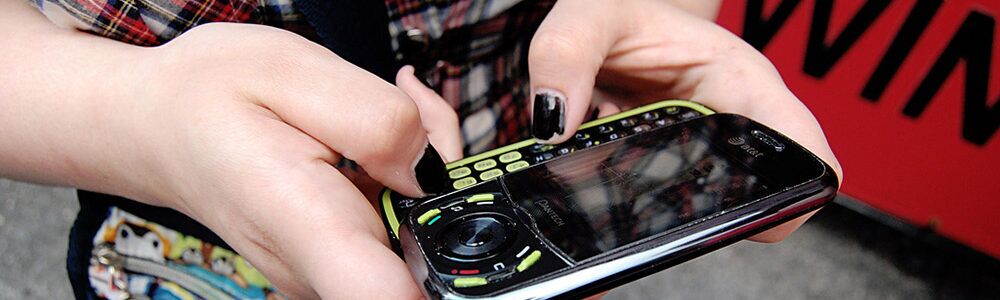
OMG, text messaging! It’s destroying the English language, corrupting young minds, turning us into illiterates. It’s probably shrinking the ozone layer, too. Or is it? In his new book, Txting: The Gr8 Db8, David Crystal offers a different perspective, one which linguists have shared for years: Far from obliterating literacy, texting may actually improve it. So put that in your message header and send it!
This episode first aired September 27, 2008.
Transcript of “The Txting Db8”
Support for A Way with Words comes from Mozi Online Backup.
Mozi protects your valuable computer files against data loss from hard drive crash, viruses, theft and other disasters.
Visit mozy.com.
You’re listening to A Way with Words.
I’m Grant Barrett.
And I’m Martha Barnette.
When it comes to the English language, few things get people as worked up these days as the whole phenomenon of text messaging.
All those abbreviations, all those misspelled words, it’s destroying the language and turning us into a nation of illiterates.
No, no.
I gather that you beg to differ, Grant.
And so does author David Crystal.
He’s a professor of linguistics in Britain and he’s written a surprising new book on this topic.
His book is called Texting the Great Debate, right?
Right.
I have a copy of this book and I have to tell you, it’s my new Bible.
The main thing he has to say is that all this talk about texting destroying language is bunk.
It’s not a big deal.
For one thing, this kind of playing with language isn’t new.
It’s just another form of playing with language that English speakers have always done.
Always.
Another thing, it’s not just young people.
Isn’t it funny how these big cries about language being destroyed always seem to blame the teenagers?
But you know what?
The first generation to use the internet in a real meaningful way, they’re in their 30s.
And they have kids of their own.
It’s not just young people doing this.
Everyone.
Who’s using all those Blackberries in the big corporations?
Good point, good point.
Another thing that he’s got to say here, which I think is incredibly interesting, is that when people use texting, they use relatively few abbreviations.
For example, the most common abbreviation, do you know what it is?
No.
X, meaning kiss.
How hard is that to understand?
If I said, see you, xxx, you know exactly what I’m talking about, right?
And that’s really old.
That’s not new at all.
That’s right, and that’s another thing he’s got to say.
You’ll find that the acronym BFF, for Best Friends Forever, is brought up again and again and again in news stories that talk about the destruction of language by texting, right?
But BFF dates to the 1950s.
It does?
I didn’t know that.
It does indeed.
But the main thing to understand about what’s happening with texting is that people want to be understood.
That’s their main goal here.
And the only time that they’re going to do something that’s really wacky and really hard to understand is when they’re in a hurry, or showing off, or they’re feeling silly or whimsical.
And that’s a very small percentage of the time.
Well, I tell you what, this book is a real eye-opener, and we’re going to talk about it a little bit more later in the show.
It’s called Texting the Great Debate.
And we’ll put more information about that on our website.
That’s at waywordradio.org.
And if you have a question about any aspect of language, give us a call.
The number is 1-877-929-9673.
That’s 1-877-WAYWORD, or you can send us an email.
The address is words@waywordradio.org.
Hello, you have A Way with Words.
Hi, this is Amelia, and I’m calling from Milwaukee, Wisconsin.
Well, hello, Amelia.
What’s going on?
Well, I have something that’s both a question and a pet peeve.
Oh, wow.
Okay.
And it’s about food.
All right, what is it?
Okay, well, so I live in the Midwest, and I’ve seen on a number of menus throughout Wisconsin, mostly at like kind of down homey type of restaurants, beef served with au jus sauce, or served, something served, you know, as a side of, with a side of au jus sauce, which I know is wrong.
I mean, because you can’t say with au jus sauce.
What’s the sauce called?
-huh.
And how high were you?
We weren’t at all.
Oh, okay.
Oh, Amelia, Amelia.
So let’s just clarify here, because it might be hard for the listeners to understand what you’re saying, but you’re talking about the French phrase au jus, two words, right?
Yes, that’s correct.
And it’s, I’ve seen it a couple of different ways.
It’s either like the real thin, brothy sauce that comes with roast beef, or here in the Midwest, it’s also like a thicker gravy that’s served with like sliced beef and like mashed potatoes all in one plate.
Are you a French speaker from way back?
Do you speak French?
I don’t speak any French.
Okay.
Well, that puts you in league and in agreement with most of America.
So right there, we’re onto something.
The reason that you have a problem with this, it’s a peeve, is because you know, though, even though you don’t speak French, that au jus already means with the juice or with the sauce, right?
Right.
So you’re saying with the sauce sauce.
Right.
Yeah, with sauce sauce.
Yeah, it’s like ATM machine, right?
Exactly.
Yeah.
Because the machine is in there twice, and you’re like, “Oh, wait a second.
You can’t do that.”
Right.
So something like that is a mescaline mix.
Oh, right.
It’s another French one.
Right.
Because mescaline, it’s a Provençal word, already means mixed salad, right?
Right.
So why say it twice?
But there’s two things happening here with au jus and with mescaline.
And the first one is that they’re no longer French.
So we borrowed them into English, and now we’re doing English things to them, evil English things to them, American things even.
Well, the English, the French, you know, they don’t get along.
Yeah, they don’t.
But so the French language no longer really has too much of a say on what happens to these words.
Okay.
And it’s a good thing, too, because au jus, for example, now actually is often treated as a noun and actually means meat sauce.
Wow.
Right.
So it doesn’t just mean, you know, with sauce or with juice.
It actually is the thing itself.
Really?
And you’ll find this in established cookbooks.
That’s creepy.
By professionals, by people who’ve actually trained in France.
Yeah, I think of English as the language that goes around at a party and takes things off of everybody’s plate.
An apple.
Right, I’ll have one of those snail crackers, and I’ll have a little bit of your soda and some of this whiskey.
The other thing that’s happening, the second thing that’s happening here, let’s just talk about au jus and not mescaline, is it’s what we call, and here’s a little wonky term for you, a postpositive adjective.
Oh.
Yeah, but what that means is, it’s really simple, the adjective comes after the noun.
Okay.
And we usually don’t have that in English.
There are only a handful of words that most people, that that can happen to in English.
And so when people encounter that, there’s a problem.
Beef au jus might actually be such a thing where the beef is the adjective and the au jus is the noun.
Because you might say, “Today’s special is the beef au jus thinly sliced.”
So it’s kind of unclear if you don’t speak French what the heck the au jus is doing after the beef.
Maybe it’s the noun, and beef is describing the noun.
Okay.
Oh my gosh.
Wow.
So you could see how somebody would go, “I don’t know, I’m making the best sense if I can with the normal English rules.”
Because a postpositive adjective, that is an adjective that comes after the noun, is a really rare beast.
So in other words, Amelia is right about the French strictly speaking.
I mean, if you’re saying au jus sauce, you’re saying…
It’s redundant and it’s not necessary.
Right, but what you’re saying is that it’s already here in English.
It doesn’t matter anymore.
Yeah, it’s sort of second generation.
Yeah, and when you look at it, instead of being peeved, what I would encourage, and this is the way I think about all the stuff that peeves me, is just say, “Hey, look at that.
There it is again, this cool thing that English did to this foreign word.”
Just say, “Here’s evidence that we’ve borrowed again,” and just kind of accept the fact.
Now you have a story to tell when you see it instead of just peeving and seething.
Right, and then you order the Ratatouille or something.
Right, but something else.
Okay.
Well, Amelia, thanks for an interesting question.
I’m hungry now.
Yeah, thank you for clearing it up for me.
I appreciate it.
You’re welcome.
Thanks for listening.
Okay, take care.
Bye-bye.
Okay, thanks.
Bye-bye.
Bye.
We love food questions.
You probably knew that already.
So if you’ve got some, give us a call.
That’s 1-877-WAYWORD.
Or send those emails to words@waywordradio.org.
Hello, you have A Way with Words.
Hi, Martha and Grant.
This is Larry in San Diego.
Well, you got a doozy of a question for us, I hope.
I have a question, and it is, do the three toes between the big toe and the little toe have common names, analogous, I guess, to the way each of the fingers has a common name?
You mean like Mo, Larry, and Curly?
And my name’s included in that group, yes.
Oh, there we go.
Way to go, Grant.
I’m sorry, I meant Joe.
Or Curly Joe, the chimp.
Larry, why in the world would you be wondering about that?
About a month ago, I and my daughter and a friend of hers and their respective dogs, we went for a walk over in Coronado.
And when I got home, I found a whole bunch of sand in my left sock and an already broken blister on the toe next to my big toe.
And I got tired of referring to the toe next to my big toe and thought, surely that toe must have a name.
But I looked in all of the dictionaries I have, I went to a podiatry website of some kind.
I couldn’t find any name for that toe or, indeed, any of the toes other than the big toe, which I found out has three names.
So that’s when I contacted you.
Oh, Larry.
Well, do tell, what are those three names of the big toe?
The big toe and the great toe and the hallux.
Nice word, right?
H-A-L-L-U-X.
Correct.
Larry, first of all, I’m really sorry about your toe.
But I’m really happy that you called because this is precisely the kind of question that we love to think about at all hours of the night.
What, Grant?
Martha, I have a life.
All right, one of us does.
Well, Larry, I tell you what, this is kind of one of those good news, bad news things, okay?
Okay.
So the bad news is that, as far as I know, there aren’t any names for those particular toes, those three toes between the big one and the little one.
But the good news is that you’re not alone.
This has bothered people in the past, and in fact, a few years ago, a medical student from Yale University wrote to the New England Journal of Medicine and said, we need names for these things.
We’re doctors.
We need names for those particular toes like the one you’re talking about.
And so this medical student proposed five Latin names for each of your toes, and each of those names began with the Latin element porcellus.
Oh, my God.
What’s that, mushroom or something?
No, it’s P-O-R-C-E-L-L-U-S.
What’s that mean?
Well, you guys, porcellus means, I mean, it’s Latin for little piggy.
Oh, there you go.
And he had names for each of the toes.
And Larry, the toe that you were having trouble with, that’s your porcellus domi.
That’s the little piggy who stayed home.
Oh, okay.
So I think you should just, you know, if people are sympathizing with you or you want to complain about it, I think you should just tell people I have a blister on my porcellus domi.
They’ll never ask for details.
Well, Martha, if I went to the gym and told people I had a blister on my porcellus domi, I think they’d wonder why I was talking about that in public.
And none of them would get in the jacuzzi with me.
No, no, it sounds like something that’s seeping and oozing, doesn’t it?
Oh, you guys are killing me.
You guys are killing me.
But wait, wait, Martha, how did it turn out?
Did the medical establishment agree that these would be, henceforth, the names for the toes?
Good question.
Well, some of the colleagues of this young man started using the term, and a few orthopedic surgeons, supposedly.
But, you know, for some reason they just never caught on.
Well, Larry, do you think you’re going to use porcellus domi?
I’m sorry, Martha, no.
All right, well, I did my best, Larry.
Okay, well, thank you very much.
Thank you so much for calling, Larry.
All right, take care.
Bye-bye.
The number is 1-877-929-9673.
And you can email us.
The address is words@waywordradio.org.
You’re listening to A Way with Words.
I’m Martha Barnette.
And I’m Grant Barrett, and we’re joined now by our quiz guide, John Chonesky.
John, have a seat.
Oh, should I take this one right here?
Yeah, no, that’s mine.
Oh, that’s the ornately carved one with all the velvet that’s yours?
No, that’s Martha’s.
Mine’s the one that’s about four inches lower to the left there.
Okay, I’m just going to sit right here on this folding chair, if that’s okay.
Well, Jim, what did you bring for us?
Well, I have brought you a show-warming present called Curtailments.
You brought a show-warmer?
Show-warming present.
Program-warming present.
It’s going to warm the cockles of your heart, I hope.
It’s called Curtailments.
The following clues are based on a type of wordplay called a “curtailment.”
A “curtailment” is when you remove the last letter of a word and get a new word.
For example, if you take the word “punt” and remove the last letter, you get the word “pun.”
Pun, right.
I thought a “curtailment” was like a cease and desist order.
There does exist that.
I’m sure you’re familiar with that.
But I’ll read you a sentence with two blanks.
The longer word is appropriate in one blank.
The shorter word fits in the other.
Remember, one word is a “curtailment” of the other.
Oh.
The first one’s pretty easy.
Let’s start off with that as an example.
I could tell my pigeon had flown the blank when I could no longer hear it blank.
Gotcha.
Oh, coop and coop.
Coop and coop.
I could tell my pigeon had flown the coop when I could no longer hear it coo.
There you go.
Okay.
Here’s the next.
The contract read, “This constitutes an agreement between John Jacob Jingleheimer Schmidt, hereafter referred to as the blank of the first blank, and Vandelay Industries.”
Okay.
Party of the first part.
Party and part.
Very simple, “curtailment.”
Here’s the next.
Oh, phew.
Oh, hone and honey.
Yay.
There you go.
There we go.
Oh, yeah.
Sometimes the longer word is first.
Sometimes the shorter word is first.
Yeah, that was a little tricky.
Switch it around.
They honed their stingers to defend their honey.
Very good.
Okay.
Hone and honey.
Here’s the next.
My boss tried to blank the blank into having an affair with her, but I returned from my vacation early and he moved on to his next job.
Secretary and no.
Blank and blank.
My boss tried to blank the blank into having an affair with her, but I returned from my vacation early and he moved on to his next job.
Oh,
You have it?
Temp the temp.
Temp the temp is very good, yes.
Nicely done there.
Temp the temp.
That’s a scandalous clue.
I loved it.
Yeah.
Yeah.
Here’s the next.
Not quite as scandalous.
After — I take that back.
It’s sort of scandalous.
After the opera, we snuck backstage to find the temperamental blank passed out on a large cushiony blank.
The diva on the diva — on the divan or divan.
How do you say that?
I say divan, but then and again, you know, I’m probably wrong.
I say couch.
That’s not a word I’ve ever said out loud.
Probably not.
It’s one of those words.
No one ever says it.
You’re right.
You find it in like 1800s novels.
Have you been reading Anthony Trollope or something recently?
I read some — what do they call them again?
Corset — bodice rippers.
Been reading those bodice rippers.
Yeah.
Diva and divan, yes.
Now, this last one has three blanks.
It’s what we call a progressive curtailment.
I think you’ll get it pretty easily.
Oh, man, that scene in the Christmas carol where Scrooge sees Tiny Tim’s crutch leaning on the blank.
You could blank my blank beating a mile a minute.
You could hear my heart.
Oh, okay.
So hearth.
Hear my heart.
Oh, hear my heart.
Exactly.
Heart and hear.
Progressive curtailment.
Well, is that the last one?
That was like the fireworks at the end of the fireworks display, where everything’s going off.
Boom, boom, boom, boom.
Yeah, that’s right.
They just throw everything in.
I just threw everything in there.
Thanks very much.
That was fantastic.
I’m glad you enjoyed it.
Thank you.
I’m glad you enjoyed it as much as fireworks.
Thanks, John.
That was a great quiz, as always, and we’ll see you again next week.
Thanks, guys.
See you next week.
Okay.
Thanks, John.
Well, if you have a question about language, give us a call.
The number is 1-877-9299673.
That’s 1-877-WAYWORD, and of course, you can always send us e-mail to words@waywordradio.org.
Hello, you have A Way with Words.
Hi, this is Liz in Stevens Point, Wisconsin.
Hiya, Liz.
What’s going on?
Well, so I’m calling. I moved to the central Wisconsin area about five years ago, and I live in Stevens Point, which has a really, really, really strong Polish influence.
And I came across, in the first couple months that I was living here, people asking me what my name is from home. And it would either be, “What’s your name from home? Who are you from home? Do you know who she is from home?” Things like that.
And the first time I was asked, I had no idea. My response was, “Ford Atkinson,” that being my hometown. And after a long back and forth, and lots of me trying to figure out what they were asking, it finally realized that they were asking me my maiden name.
And so my question is, is this some sort of Polish translation, or is it just a Wisconsinism or a central Wisconsinism? Is it used in other parts of the country that have strong Polish influences, or what’s the deal? What’s your name from home, or who are you from home? That’s what they were asking?
Yep.
I tell you, there is a Polish expression that sounds something like “żdomu.” Now, I’m not a Polish speaker, but that’s an approximation. And Liz, you’ll see this in genealogies, for example, if you research your Polish heritage on the web.
You’ll see this expression, and it’s used in the same way that we use in English the word spelled N-E-E. Are you familiar with that?
Oh, I certainly am, because my mom’s maiden name is “Nee.”
No!
That’s true. It makes genealogy a little difficult on the Internet with our family.
Liz’s mom was “Nae Nee”?
Yep.
How do you pronounce that?
It’s “Nee,” N-E-E, so everybody in our family is “Nae Nee.”
What are the odds? I’m sure that’s an old joke to you, but I’m loving it over here.
Oh, I still think it’s hilarious.
Oh, that’s fantastic! Martha, what was that Polish phrase again? Can you spell that in Latin characters?
Well, it’s actually two words. It’s Z-space-D-O-M-U, and it’s pronounced something like “żdomu.” So the “domu,” I’m speculating, is close to the Latin word for “home,” then.
Hello! Because domicile, right?
Right, domestic, exactly. And so the idea with that expression is roughly translated as maybe “from home” or “from the house of.” And so I can see how you would transfer that idea to English.
And so this is what we call, and I’ve used this word on the show before, a “calque.” C-A-L-Q-U-E, right?
I think so. Where something in one language is translated exactly and literally into another language.
Exactly. I know this exists in Michigan and Wisconsin, but when I lived in Greenpoint in New York City, which is very, very Polish, I mean, it’s so Polish that when I would go into places, they would speak to me in Polish because they thought I was Polish.
I never heard that, but then I wasn’t doing genealogy there. So these are English speakers. Do they still speak any Polish?
There are a lot of people who still speak a little bit of Polish, like everybody in town knows the word for beer is “piva.”
Oh, really? But I mean, these are people that have been, their families have been here for generations. And there’s even people in my generation, say like late 20s, early 30s, who have lived here their entire life who use it.
Now, usually it’s people, you know, 60s and older who use it commonly.
Really? But people who’ve grown up in this town say it all the time. Like there was a bartender I know who said, “Oh, yeah, she’s rowdy. It’s because she’s a Wojciechowski from home.”
I gotta say that the Polish names don’t really look that great on paper, but when you say them, they have a rhythm, don’t they?
Oh, they’re hilarious. Not hilarious, but they’re very fun to say.
Well, thanks for calling this to our attention.
Yeah, thank you. So basically the answer is it’s not used really very many places other than here in Michigan, huh?
Not that I know of. It’s a great local expression. You’re basically a field worker out there, Liz, and you’ve discovered something that people who study dialects would love to learn more about.
That’s excellent.
Well, thank you so much for the opportunity.
Okay, thanks a lot.
You’re welcome.
Thanks for calling.
Bye-bye.
Everyone in Wisconsin and Michigan, you’re welcome to call us at 1-877-929-9673 and tell us what you know about what’s your name from home or maybe something else that comes from Polish.
Or you can email us.
The address is words@waywordradio.org.
Hello, you have A Way with Words.
Hello, Martha.
This is Alex from Redondo Beach, California.
Do you have a question for us?
Oh, yes, I most certainly do.
We have an 11-month-old daughter, and she has a penchant for throwing things and dropping things on the floor and grabbing things she isn’t supposed to like 11-month children are supposed to do.
My girlfriend calls her a holy terror.
When I asked her to clarify the meaning, she said it was a euphemism for the devil.
I insisted that it should be then unholy terror.
We argued about it for a while, and I decided to contact the experts to settle the argument and find out the origin and the meaning of the expression, and if it is a substitution for the devil, shouldn’t it be unholy rather than holy?
That’s a big ticket you’re asking there, and you didn’t want to fight in front of the girl, right?
That’s the whole reason you come to us.
That’s right.
So, which one of you says that that means it’s a euphemism for the devil?
My girlfriend does.
But your little angel isn’t a devil, really, right?
Yeah, yeah, yeah, a little angel that destroys a lot of stuff, you know.
Right, right.
Aren’t they all?
Here’s what’s happening in this case.
Holy isn’t holy.
It doesn’t mean consecrated.
It doesn’t mean consecrated any more than honking big diamond ring means the ring is beeping and hooting its way through traffic.
Holy, like honking, is an intensifier.
All it does is mean more terror.
And actually, we’re not even really talking about real terror, are we?
No, not really.
We’re not talking about a real terror.
I mean, a real terror is like a mudslide or an asteroid hitting the earth.
That’s a real terror.
Right.
So, we’re not actually talking about the devil here.
And it’s actually, all it is a way of saying is she’s a terror, which means that she wreaks havoc on the world.
And actually, that itself is kind of joking and jocular, and you don’t even really mean that.
It’s not like she’s burning down buildings or, you know, running through town shooting people or something like that.
She’s an 11-month-old.
Right, right.
Yeah, I thought it was something like, you know, when people drop negating suffixes from, say, “I could care less” versus saying “I couldn’t care less.”
Because, you know, she said it was the devil.
Not a bad guess.
It really isn’t a bad guess because sometimes these expressions get passed down, and it’s only when you look at them closely that you start to realize, “Hey, there’s something interesting happening here.”
Yeah.
So, it’s not the euphemism for the devil that much.
No, no, it’s not.
I mean, it’s an exaggeration.
Yeah, an exaggeration.
It’s an exaggeration.
That’s right.
It’s meant to be a funny and kind exaggeration, the same way you might call a good friend, you know, if you see him on the street and you haven’t seen him in a couple of years.
You know, you might say, “Oh, there you are, you old SOB. How nice to see you.”
You don’t really mean he’s an SOB.
It’s just a way of jokingly showing that you have a really close connection to this person and you recognize that everything they do in the world isn’t perfect, but you still love them all the same.
Right.
Well, Alex, it sounds like you have your hands full, but I’m sure happily so.
Yes.
Thank you.
All right.
Thank you for calling.
Bye-bye.
Okay.
Bye-bye.
If you’ve got a question about language, grammar, usage, spelling, pronunciation, old sayings, something that Grandma used to say, give us a call, 1-877-929-9673.
That’s 1-877-WAYWORD.
Or email us.
The address is words@waywordradio.org.
Hi, you have A Way with Words.
Hi, this is Rissa and I’m calling from Madison, Wisconsin.
Hello, Rissa.
What’s going on in Madison, Wisconsin?
Well, I saw a sign at the airport a while back just past the security checkpoint that said “Recombobulation Area.”
Excuse me?
Recombobulation?
Yes.
Recombobulation.
I know.
I looked at it several times and couldn’t believe it myself.
And that’s at Mitchell International?
Yes.
Okay, there in Milwaukee.
Well, did you recombobulate?
Well, I was actually dropping a friend off, so she recombobulated.
I see.
But what we were trying to figure out is where did — well, obviously, where did “discombobulate” come from originally?
And I always thought discombobulation was a mental state of confusion, not like a physical state of having your shoes off and your bags unpacked and all of that.
So the whole idea that TSA would invent a new word based on another invented word, where did it come from?
It discombobulated you.
It discombobulated me.
Well, that’s a good question.
I mean, the word is a joke, just like putting the sign up was a joke.
“Recombobulate” is a joke, you mean?
Yeah, I mean, “discombobulate” has been around since at least the 1830s in this country, which was this time of this wonderful linguistic exuberance.
I mean, we play with language all the time, but there was this period of time when a lot of words came into being like “absquatulate,” which means to leave.
To run off.
Yeah, to run off.
And there were words that kind of sound like what they mean and sound sort of fancy too, like “absquatulate,” and “discombobulate” came around during that period of time.
And nobody knows if it comes from “discompose” or “discomfort.”
I hear sort of a bit of the bobble in there too, but maybe that’s my own imagination.
What do you think, Grant?
It was “discomboborate” in the early days, right?
Yeah, I’ve also seen “discombobricate.”
So it’s just this silly, goofy, made-up word, and I think the airport people there in, where is it, Madison or Milwaukee?
Milwaukee.
I think they were just having fun too, and I remember reading news reports where they were saying, “Yeah, we’re just trying to lighten the mood, it’s so serious here,” you know?
I think we need more of that.
I think we need more “recombobulation” areas, don’t you?
If you’ll pardon the expression, flying sucks enough as it is, so let’s put a little humor where it can do the most good, right?
And I love the fact that the “recombobulate,” somebody thought about it, right?
They said, “Oh, ‘discombobulate’ is funny, but how can we top it?”
I think it’s terrific, and I understand what you’re saying about, you’re saying, “Is it a grammatical word, is it an accurate word?”
I understood it.
Did you understand it, Rissa, when you were standing there?
Oh, yeah.
Yeah.
Oh, definitely.
It’s got meaning, it can be written down, it can be said aloud, and it imparts meaning, therefore it’s a word.
And it makes you laugh.
Yeah.
All right, well, Rissa, thank you so much for bringing this word to our attention.
I think we all agree that it’s a funny word.
Yes, we do.
All right, thanks a lot.
Thanks very much.
All right, bye-bye.
Bye-bye.
Well, if you’ve got a new word that you encountered that you want to talk to us about, we’d love to hear about it.
The number is 1-877-929-9673.
You can also always send us an email to words@waywordradio.org.
We spoke earlier about David Crystal’s new book that debunks the idea that text messaging is somehow destroying English.
But I’ll tell you what, Grant, there’s one aspect, which is the etiquette surrounding texting, not really what’s on the screen, but the whole etiquette around it.
Oh, I see.
When it’s appropriate.
Well, yeah, yeah.
And Lynn Truss, the British author who wrote “Eat, Shoots, and Leaves” about punctuation, she speaks for me on this issue.
She recently complained about this in print.
And she wrote, “In America now, where nearly everyone seems to own a blackberry, there’s a new facial expression I’ve observed, which involves a fixed smile and panicky swiveled eyes, which means I am still listening to you, but I can see I have a message, but I am honestly still listening to you.
I will read the message later, so tell me again, what did you say?
I wish I could read my bleeping message.”
Yeah, yeah, I know that one.
You’ve seen that look, right?
And there’s a variant of that, it’s when you go out to dinner with people and all these phones appear on the table.
It’s like they came with the silverware, you know?
It’s plate, napkin, fork, knife, and phone.
That’s right.
Right next to everyone, and they’re all looking down at the plate, like every couple of minutes to look down, like, “Dude, nobody’s called you.
Everyone in your life who’s important to you is right here.
Put the phone away.”
Exactly.
Or they look and it’s something funny and they snicker and they don’t tell you what it’s about.
It drives me crazy.
Right, right.
Because then they have to explain the whole backstory of how they’ve been text messaging somebody in Thailand for weeks and they think that they’re Brad Pitt and whatever.
Well, there’s the other side of the etiquette of the phone, and that is I’ve started to get advertisements in text message form, stuff I did not sign up for.
And that’s evil.
I get enough of that in every other part of my digital life.
I don’t need that on my phone.
Oh, that’s horrible.
It’s illegal, but how do you catch them?
Well, I’m with you, Martha.
There’s something to be said about face-to-face communication that is unmediated by a digital device, right?
Absolutely.
Here we are talking to each other over the microphone.
That’s right.
And if you want to talk with us over the phone, give us a call.
The number is 1-877-929-9673.
Support for A Way with Words comes from National Geographic Books, publisher of I’m Not Hanging Noodles From Your Ears, a collection of intriguing idioms from around the world by Jag Bala.
Learn more at shopng.com/noodles.
You’re listening to A Way with Words.
I’m Grant Barrett.
And I’m Martha Barnette.
Grant, week after week, our quiz guys, John Cieneski and Greg Pliska, give us a hard time with those quizzes, don’t they?
Oh, boy, do they.
But, you know, I think we do pretty well.
Although, sometimes I suspect that they’re giving us softballs.
They could be, but, you know, if they made it too hard, it would take out all the fun.
So, you and I have been planning.
And plotting.
And we’re happy to announce that now we’re going to get our revenge.
We are going to puzzle the puzzlers.
Both John and Greg are members of the National Puzzlers League.
That’s an organization of puzzle creators and solvers.
These are diehard fans of crosswords, Scrabble, word games, you name it.
Anyway, each week we’re going to challenge a member of the Puzzlers League to play our slang quiz.
And we’ll get a chance to see how they do on our turf.
On our turf?
Aqueduct?
Pimlico?
Belmont?
No, no, no, they’ll all be right here.
And we have our first member of the National Puzzlers League on the phone right now.
Today’s contestant is Deb Amlin from Springfield, New Jersey.
Hi, Martha, how are you?
Hi, Deb.
Hello, Deb.
Hi, Grant.
So, Deb, tell us, what kind of puzzler are you?
I am a crossword constructor.
Constructor?
Ooh.
Yes, I wear a hard hat.
You do?
Okay, well, Deb, if you’re ready to play, then we’ll start, all right?
I am ready.
Okay, let me tell you how we play slang this.
Grant will give you a sentence with a blank in it.
Then he’ll give you three slang words that might fill in that blank.
And your job will be to figure out which of those slang words fits best.
Now, I haven’t seen the quiz, so I’ll be joining you so we can try to figure it out together, okay?
Okay, we’ll double team them.
All right, that sounds good.
Well, here we go.
Here’s the first part of the quiz.
Men, I want you to fan out, find the enemy’s 20, and then report back to base at O blank 30.
So, what goes in that blank?
Is it O sharp 30, O dark 30, or O hard 30?
It’s a military situation, imagine.
Right.
I would imagine that if it’s military, they want you to be right on time, and unless I’m mistaken, I would guess that it would be O hard 30.
O hard 30.
Martha, do you agree with that?
And the other options were dark 30 and…
Sharp 30, O sharp 30, O dark 30, or O hard 30.
Grant, could I hear the sentence one more time?
Sure.
Men, I want you to fan out, find the enemy’s 20, and then report back to base at O blank 30.
Well, I think I can rule out dark.
Are you sure?
I just, I have a friend who used to complain about having to catch a plane at O dark 30.
On a regular basis.
Okay.
But I don’t know.
Unless I’m mistaken, we’re going for something that would sort of be exactly at a certain time.
Oh, so then sharp 30 would be…
Either that or hard 30.
Hard, that sounds more military, don’t you think?
It does sound military.
Well, we have no idea, Grant.
In other words, we’re going around in circles here.
I’m bringing in the helicopter to rescue you now.
My best guess would be hard.
Unfortunately, the one that you decided wasn’t the right one is the right one.
It’s O dark 30.
In the military…
My face should have listened to you.
The military is all about precision, but it’s also one of these things where you can plan and plan and plan, and then all of your plans are for naught.
O dark 30 just means an indeterminate time after it gets dark.
Here’s the second one.
Here we go.
Okay.
We know it was you who told the papers the warden was corrupt.
Now get ready for a little blank.
We’re going to transfer you from prison to prison until you don’t know where you are.
What goes in that blank?
Now get ready for a little diesel therapy, or get ready for a little rubber ranging, or get ready for a little federal holiday.
So the last line is the key here.
We’re going to transfer you from prison to prison until you don’t know where or who you are.
Don’t forget it’s slang.
Well, that sounds like something the federal government would do.
I mean, that sounds fairly federal to me.
Let me read those again.
The first one was diesel therapy, the second one was rubber ranging, and the third one was federal holiday.
Which of these describes maybe transferring somebody from prison to prison just to confuse them or disorient them?
Right, right.
As a form of punishment.
Well, you know, my sense of logic failed me last time.
What do you think, Martha?
I think it’s federal holiday because having once been sequestered on jury duty, we took a tour of some of the wackiest hotels in Manhattan, and that’s like a federal holiday.
That sounds like a story.
I don’t know exactly.
You know, diesel therapy could fit in there.
Rubber ranging doesn’t sound right to me, but then again, I was wrong last time.
Yeah, I would cross out the rubber ranging, but then I’m really torn between diesel therapy and federal holiday.
All right, well, here I come in, here’s the bell.
There’s a silent bell here.
Oh, man.
It is indeed diesel therapy.
Oh, wow.
And the kind of the slangy part behind this term is that they drive you around on a diesel bus, and so it’s therapy by diesel engine.
There’s a similar term that they use in parts of California, greyhound therapy, and this refers to taking homeless people, loading them up on a bus, a charter bus, and then busing them to another town and dumping them off in the town square there.
Interesting.
Well, Deb, I want to thank you for being such a good sport and playing along.
It was my pleasure.
It was nice to talk to you both.
Super duper.
Thank you for playing today, Deb.
Thank you.
Take care.
All right, bye-bye.
Bye-bye.
You can find out more about the National Puzzlers League at puzzlers.org.
You can also join us here on the show with your questions or comments about slang or anything else language-related.
Call us at 1-877-9299673 or send an e-mail to words@waywordradio.org.
Hello, you have A Way with Words.
Hi, my name’s Robert Craddick from La Mesa, and I have a question about a type of word that’s actually a combination of two words.
Oh, yeah?
Yeah, we call them Reese’s Peanut Butter Cup words for lack of a better defined term, and we’re hoping you can maybe give us a clue here.
Reese’s Peanut Butter Cup words.
Yeah, someone shoved chocolate into your peanut butter, and you end up with something different than both of them that was really good.
Oh, yeah, yeah, right, right.
You got chocolate in my peanut butter.
You got peanut butter in my chocolate.
Do they still run those commercials, or are we talking about some—I think it’s just floating around in my mind.
Yeah, mine, too.
Mine, too.
I wonder if — Grant, are you old enough to remember those commercials?
Oh, sure, absolutely.
Okay.
Those were like, what, late ’70s, early ’80s maybe?
Yeah, something like that, yeah.
My wife here in La Mesa is out with a group of women, and they’re practicing for a run, and my wife came up with this term called — what they’re doing is “walkers,” meaning that they’re walking and jogging intermittently.
And I wasn’t privy to what she was talking about until she filled me in on the walk part, and then the jogger part came to me.
But I brought the question back to our library and asked my library staff if they knew of a word that describes those kind of combinations for like when biology and chemistry become biochemistry.
And we couldn’t come up with one.
And I guess we could go and research it, but the old saying goes, “A cobbler’s kids get no shoes.”
We don’t really have time to do our own research.
We’re answering questions for other people.
See.
So that’s why we emailed you.
So you’re outsourcing your library reference work?
Yes.
Okay.
Keeping it in this country.
Well, we have an answer.
Yes, we do.
Actually, we have lots of answers, don’t we?
But I’ll tell you my favorite word for this, Robert, which is “portmanteau word.”
Portmanteau.
That sounds like a fine postprandial.
P-O-R-T-M-A-N-T-E-A-U.
Portmanteau.
And that refers to an old-fashioned stiff suitcase, the kind that is hinged in the middle and opens into two halves, and then you pack your clothes and you put those two halves back together.
Okay.
It’s a word that Lewis Carroll coined.
You know, Lewis Carroll, “Alice in Wonderland,” and “Jabberwocky,” he has all those funny words in that poem, “Jabberwocky.”
Yes, yes.
Right.
He called those portmanteau words, which I just love.
I love the image of the suitcase with two halves carrying meaning in either half.
I’d like that too.
Yeah, portmanteau words.
Although, they’ve gone by different names, haven’t they, Grant?
Like telescope words.
Right.
And in linguistics, we tend to use the more boring term of “blend.”
Blend.
Yeah.
And in linguistics also, we’ve broken them down into multiple kinds of blends.
And I won’t get into the details here, but it’s definitely a phenomenon that’s been examined for 70 or 80 years because this is one of the ways in which we neologize.
It’s more common in the last 100 years than it ever was before that.
It simply wasn’t common to take two words with meaning and put them together.
Isn’t that interesting?
But it’s cool.
Blends are cool.
Portmanteau words are cool.
I’m like Martha.
I love the fact that Lewis Carroll identified this and felt that it was such a treat for him to do as a writer that he needed to point out to people that it was interesting and that he also created a name for it.
He was a heavy neologizer.
Well, fun.
So, Robert, take Portmanteau back to your staff and see what they make of it.
I will certainly do that.
All right.
Thanks for calling, Robert.
Well, thank you both.
Okay.
Bye-bye.
Bye-bye.
Well, if you’ve got a question for us about the name for a phenomenon, you’ve got an idea but you don’t know how to put a name to it, give us a call at 1-877-929-9673 or send an email to words@waywordradio.org.
Hello.
You have A Way with Words.
Hi.
This is Paula calling from Indianapolis.
Hi, Paula.
Welcome.
Well, thank you.
I have a question about the expression “hairy eyeball.”
It was an expression that my brother used frequently when he was getting that look from my parents that they were giving him the hairy eyeball.
Sure.
And I thought it was specific to my generation.
And at work the other day, a young lady used it and I looked at her in surprise and I said, “Where did you hear that?”
And she had heard it from her father who is presumably about my age.
-huh.
So I’m wondering how wide the usage is and how it originated.
I have an idea of why that was the expression.
Oh, well, let’s hear that idea.
When a person is giving somebody the hairy eyeball, their head is often tilted down and then they’re looking up at the person.
So they’re actually almost looking through their eyebrows.
Oh, I see.
So there’s a — right, because I actually — I do that look to my son and he has started to imitate me but it’s because I’m looking over the top of my glasses.
Can you frown at him better over the top of your glasses?
Yeah, well, my wife says that the two of us, me and my son, have the same scowl.
It’s definitely the hairy eyeball, though.
I know exactly the look you’re talking about.
I don’t think my father ever used that.
It’s well covered by the slang dictionaries.
It’s got a history of 40 to 50 years, we know for certain.
I bet it’s older than that.
Any work that I’d ever done in trying to dig up its history didn’t turn up anything earlier than, say, 1961.
I don’t know much more about it.
I don’t think it’s regionally localized.
I don’t think it belongs in a particular part of the country.
It is interesting, though, that you’ve pinned it on a generation.
I think that young people today would understand it, but I don’t think they would use it usually.
Yes, I asked my son about it and he’s 20.
He said, “Yes, I know what you mean. I would not use it myself.”
They might be more likely to use the stink eye or the skunk eye.
Do you know those variants?
No, but this young lady that I talked with at work said that in her family they also called it the stink face.
The stink face.
There’s a certain kind of scowl that you might do if you smell something nasty, right?
Right.
I was shocked the first time I heard this.
I think I must have been out of high school and I just thought it was the grossest thing I’d ever heard.
So of course I went to look up the origin of it and my recollection is that it’s somebody who’s looking at you sort of through squinted eyes, not so much the eyebrows.
So it might be eyelashes that they’re looking through?
Yeah, just kind of glaring at you with their eyes almost closed.
And it’s interesting to me that it’s not that old.
I mean, maybe 50 years or so.
Right.
Well, I hope we’ve helped a little bit, Paula.
Well, yeah, that was fun.
Super duper.
Thank you.
Thank you.
Bye-bye.
All right.
Thanks for calling.
We welcome your calls about language.
Call us about grammar, slang, punctuation, usage, whatever. 1-877-929-9673 or words@waywordradio.org.
Earlier we were talking about worries that text messaging is destroying young people’s ability to write.
But, Grant, I think a lot of people will be surprised by a growing body of research that suggests that, if anything, it’s enhancing people’s ability to write.
That’s right.
There’s one study that I saw that talked about the texting abilities of 11 to 24-year-olds, and what they found was a higher level of literacy among the students who texted the most.
That is amazing.
And earlier this year, Sally Tagliamonti and Derek Dennis of the University of Toronto released a study that is just another one in a long line of such studies that had a lot of really interesting things to say that somehow never really make it to the popular press when it comes to talking about texting.
For example, all these texting habits that people have, they’re not creating a new language that will replace English.
It’s really just English under a different disguise.
There’s nothing really remarkable.
They also found something that I thought was most interesting to me, and they made a point of talking about it, which is that when we text, we tend to mix our language registers.
Do you know what I mean by that?
Different levels of language, right?
Yeah, so you might use the words “shall” and “will,” and then right after that, say “gonna” instead of “going to,” all in even the same sentence.
So what we find with texting, because it’s such an abbreviated form of language, is that we’re looking for the words that have high impact but don’t take a lot of struggle to write.
So “shall” is a really great, strong word that talks about the future and something that you’re going to do, and then “gonna” is just a really tight way of saying “going to,” so it’s all about expediency and maximum impact per keystroke.
Right, so it’s not so much about the English language contracting or becoming more impoverished.
If anything, it’s expanding, right?
I mean, that’s sort of the point.
Yeah, and it’s expanding in the same way that offline English does.
The English that’s in newspapers, the English that’s in books, or the English that you might speak on the telephone to your parents.
English is a body moving in certain directions, and texting isn’t part of that movement.
It shows all the signs that all the kinds of English are undergoing.
Does that make sense?
Look at this a different way.
Texting and the abbreviations in texting is just a tiny, tiny, tiny little fragment of all the English there is.
And to make such a big to-do out of it really overstates its importance.
And then, within texting, abbreviations and emoticons and all these other short forms of language account for only 3% of all of the words used in texting.
Yeah, that was shocking.
Shocking statistic.
It’s a tiny little low number out of a tiny little part of English.
And so to give it this big “harrumph, oh, it’s destroying English” really kind of overstates the case.
Well, if you’d like to talk about any aspect of language, give us a call.
The number is 1-877-929-9673.
You can also send us an email to words@waywordradio.org and join us on our discussion forum at waywordradio.org/discussion.
That’s our show for this week.
Support for our program comes from MOSI Online Backup.
Got data?
Visit mozy.com.
If you didn’t get on the air today, don’t worry.
You can leave us a message anytime, day or night.
Call 1-877-929-9673.
Or email your questions to words@waywordradio.org.
Or you can join the conversations going on right now in our discussion forum.
That’s at waywordradio.org/discussion.
Stefanie Levine is our senior producer.
Our technical director and editor is Tim Felten.
Tim also engineered our theme music.
Kurt Konan produced it.
We’ve had production help this week from Michael Bagdasian.
From Studio West in San Diego, I’m Martha Barnette.
And from the Argo Network in New York City, I’m Grant Barrett, inviting you to join us next week right here on A Way with Words.
So long.
See ya.
Either, either, either, neither, neither. Let’s call the whole thing off. You like potato and I like potato. You like tomato and I like tomato. Potato, potato, tomato, tomato. Let’s call the whole thing off. But oh, if we call the whole thing off, then we must part. And oh, if we ever part, then that might break my heart.
Texting Improves Literacy
 OMG, text messaging! It’s destroying the English language, corrupting young minds, turning us into illiterates. It’s probably shrinking the ozone layer, too. Or is it? In his new book, Txting: The Gr8 Db8, David Crystal offers a different perspective, one which linguists have shared for years: Far from obliterating literacy, texting may actually improve it. So put that in your message header and send it!
Au Jus Sauce
The French phrase au jus means with sauce, which is why it drives some diners to distraction when a menu lists beef with “au jus sauce.” A Wisconsin listener calls to say this phrase sets her teeth on edge. The hosts order up an answer fresh from the “Waiter, There’s a Redundancy in My Soup!” Department.
Porcellus Domi
In medical parlance, your big toe is your hallux. But what about the other four? Do they have anatomical names as well? A San Diego man who hurt the toe next to his big toe is tired of referring to his injured digit as “the toe next to my big toe,” and wants the proper medical term. How does porcellus domi grab you? Prehensily?
Curtailments Game
Quiz Guy John Chaneski presents a letter-shaving game called “Curtailments.” In this game, Grant and Martha leave everything on the floor.
Name From Home
A caller from Stevens Point, Wisconsin, was puzzled when she moved there and locals asked, “What’s your name from home?” meaning, “What’s your maiden name?” The community has a strong Polish heritage and she wonders if there’s a connection. It’s a good hunch. Martha explains why.
Holy vs. Unholy Terror
Say you have a particularly rambunctious child. Okay, a little hellion. Is it proper to describe the little devil as a holy terror? Or might it be more correct and more logical to call him an unholy terror? A Los Angeles caller thinks it’s the latter.
Discombobulated
If you’ve flown from Milwaukee’s Mitchell International Airport recently, you may have noticed an odd but official-looking sign that reads: “RECOMBOBULATION AREA.” A caller from Madison was discombobulated to see it, then started wondering about the roots of such words.
Texting Etiquette
The real problem with texting isn’t how it affects language, but what it does to social interaction. Is there anything more annoying when you’re trying to have a conversation than watching your companion’s eyes flitting to his phone when he sees that a text message just arrived? The hosts discuss the need for a new text-messaging etiquette.
Hairy Eyeball
A caller wonders about a term used by her family when someone gives you a certain look: the hairy eyeball. Grant and Martha try to shed some light on the phrase.
Diesel Therapy at O-Dark-Thirty
Let’s say that you’re getting diesel therapy at o-dark-thirty. What are you getting and when are you getting it? A New Jersey contestant from the National Puzzlers’ League learns the meaning of these terms in this week’s slang quiz.
Portmanteau Word Blends
What do you call a word made from a blend of two other words, like motel from motor and hotel? A listener says his term for them is “Reese’s Peanut Butter Cup words,” after the old commercial: “You got chocolate in my peanut butter! You got peanut butter in my chocolate!” But he wonders if there’s another, more established term. The hosts introduce him to the word portmanteau.
Text-Messaging Research
When it comes to text messaging and its effect on English, the linguistic apocalypse is not nigh. Quite the contrary, in fact. Grant talks about some eye-opening research about text-messaging and teen literacy.
This episode is hosted by Martha Barnette and Grant Barrett, and produced by Stefanie Levine.
Photo by Zoe. Used under a Creative Commons license.
Book Mentioned in the Episode
| Txting: The Gr8 Db8 by David Crystal |

