

Decisions by dictionary editors, wacky wordplay, and Walt Whitman’s soaring verse. How do lexicographers decide which historical figures deserve a mention or perhaps even an illustration in the dictionary? The answer changes with the times. • There’s a tweet about basketball that uses every letter of the alphabet at least once. Turns out there’s an entire Twitter feed full of tweets that pull off that same linguistic trick! • A Walt Whitman poem that crosses time, space, and experience. • Friday Wednesday vs. Wednesday Friday, actress vs. actor, balling the jack, à la mode, and grab the brass ring. This episode first aired October 21, 2017.
Transcript of “Hunk Waffle”
You’re listening to A Way with Words, the show about language and how we use it. I’m Grant Barrett.
And I’m Martha Barnette. Here are a couple of tweets that showed up in my Twitter feed.
One of them goes, how to become sober instantly. Mix three tablespoons of raw apple cider vinegar into 16 ounces of orange juice and drink quickly.
A gross.
Okay.
B, what does that have to do with language?
Let me give you another tweet.
My body just been taking any opportunity to detox since I quit smoking. I sweat like crazy for every little thing and use the bathroom 24-7.
Oh, I know.
Light bulb.
Right.
Both of those tweets have every letter of the alphabet.
You always guess this.
I don’t always guess it.
Every time I try these on you, you always guess that.
But yes.
But the reason I know this is because I know the guy who made those tweets happen in your feed.
Yes, it’s from the Twitter feed Pangram Tweets by your colleague Jesse Scheidlauer.
Right, who used to work for the Oxford English Dictionary.
And he somehow set up this bot that goes all over the web and scours it for tweets that contain every single letter of the alphabet.
So far more interesting than the quick brown fox jumping over the lazy sleeping dog, you get things like that.
And they’re called Pangrams.
Pangrams.
And it doesn’t mean only the 26 letters because some of them are duplicated more than once.
But they’re in there at least once.
At least once, yes.
I’ve seen people complaining that they should only have each letter one time.
But that’s nearly impossible to do.
No, that’s too hard.
Yeah, that’s too hard.
That’s too hard.
But Pangram Tweets is this weird keyhole view of the Internet.
You just see all this weird stuff coming in that’s united by this one thing.
Every single one of them has 26 letters.
So I highly recommend it just for a little fun in your feed.
Yeah, you can find out more.
Just go to at Panagram Tweets on Twitter, and you can have a lot more language from us.
We talk about linguistics, slang, new words, old sayings, speaking and writing well, and disputes with copy editors.
Email words@waywordradio.org.
Or find us on Facebook.
Just look for A Way with Words.
Hello, you have A Way with Words.
Hi, this is Charles, and I’m calling from Exotic Rochester, New York.
Exotic Rochester.
Absolutely.
What’s so exotic about Rochester?
That’s got to be a rhetorical question.
Everybody knows.
Home of Susan B. Anthony, Frederick Douglass, George Eastman.
Okay.
Historical paradise.
There you go.
Right.
So what’s going on in exotic Rochester there in terms of language?
Well, there’s quite a throwdown going here.
I work in an ad agency where I’m a senior copywriter, and I’m having a bit of a battle with the head copywriter, Jen, who’s listening in, by the way, just off to the side of me, just to make sure I don’t misrepresent her.
Oh, good news.
Very eager about that.
Anyway, we were trying to figure out what do you call those kind of weeks where you have a vacation coming and you have time off.
For example, if I’m taking Thursday and Friday off, Wednesday is my last day of the week.
So my Wednesday is the last day I’m going to come in.
And so for me, that’s now magically a Friday.
So I like to say that it’s a Wednesday Friday.
It’s a Wednesday that is now magically turned into a Friday.
Now, Jen, being the proofreader and the copy editor, she says, no, technically, the day is, it’s got to be a Friday, Wednesday, because the Friday’s acting as an adjective or something like that.
It’s a grammar thing, so I lost interest.
It’s a grammar thing, so I lost interest.
No, that cannot be allowed.
She believes she’s right.
I believe I am right, because to me it just sounds more fun to say, you know, it’s a Wednesday, Friday.
It was a Wednesday, but now it’s a Friday.
And she said, it might be more fun to say, but you’re just technically wrong.
And we wanted to weigh in here, and not that either one of us are ever going to give in to this, because all that’s really up to stake now is the ability to give eye rolls to each other, which is the office equivalent of like a drop kick or something.
Or a mic drop.
So to summarize, you’ve got a short week.
It ends for you on a Wednesday.
You’ve been calling it a Wednesday Friday.
She’s been calling it a Friday Wednesday.
Correct.
I have a question.
Are you hyphenating these?
Wow, that brings up a whole other battle.
I might do it because I like hyphens.
Jen shaking her head saying there’s just no way she would do that.
Oh, no.
So now you’re fighting about that.
Wednesday, Friday, Friday, Wednesday.
I want to talk about tofu for a second.
What?
Yeah.
The reason I want to talk about tofu because I think we need to get away from these days of the week and start thinking about where this happens in other parts of language.
Okay.
Well, I want to talk about soy.
Oh, soy is the same thing, right?
So we take tofu and we make tofu dogs and tofu burgers, right?
Tofurky, which is tofu, tofu turkey, like tofu.
And so what we’ve done here is we’ve added the noun tofu as an adjective, kind of.
It’s called an attributive noun in front of another noun to describe that noun.
And I think when we look at these examples of tofu, we see that Friday, Wednesday is the best choice here.
Because what we were describing is a Wednesday with Friday characteristics.
The Friday is acting like an attributive noun.
And if you had listened to your copy editor when she was talking about the grammar, you probably would have been persuaded.
Well, like her, I kind of phased out there.
But I did catch that you think that she’s on the correct path.
I do.
You should never challenge your copy editors.
No, that’s not true.
But I’m just saying they’re a very wise bunch and they know things.
Yeah.
And I will admit to be a hyphenating kind of guy, Jen would cross them out all the time.
Really?
Except, I’ll bet, if you’re using Friday, Wednesday to modify something else, like I’m wearing my Friday, Wednesday clothes.
Oh, yeah.
She’d let that go, I bet.
Sure, yeah.
Yeah.
Then you would hyphenate it because it’s attributive in that way.
So I guess in the end, while I was creative with it and had a lot of fun with it, I’m still technically wrong.
And I will have to admit this at the NEST agency meeting because everybody was very curious on where this was.
You guys were the final thing here before it came to dueling pistols.
Well, props to you for bringing it to our attention and just taking the chance that you might be wrong on national radio.
That’s such a harsh way of saying it, but I appreciate it. Thank you so much.
Bye, Charles.
Bye now.
Take care.
The thinking here is that Friday is the attributive describing noun because the Friday-ness of the Wednesday is what distinguishes that Wednesday from other Wednesdays.
Yes, I am actually following that.
Yes.
I tried.
I worked hard on that.
Right.
Friday, Wednesday.
Because otherwise it would be as if you had, say, Monday and Tuesday off and then your Friday was actually a Wednesday Friday, right?
Because you’re starting the week or something like that.
Yeah.
Right?
I just muddled it up some more.
Well, that’s what we do here.
But the soy and tofu comparisons are apt because we’ve taken nouns, and nouns frequently in English take a position as an adjective where they describe other nouns.
Right.
Right?
Right.
Think about car seat, right?
Both of those are nouns, and yet we’re talking about a kind of seat that’s in a car.
Right.
Restaurant critic.
Yes.
Exactly.
We know you have a dispute at your workplace, and we’d love to try to solve it.
So give us a call, 877-929-9673, or send us an email.
That address is words@waywordradio.org.
Hello, you have A Way with Words.
Hi, this is Katie.
I’m calling from Fort Worth.
Hi, Katie.
Welcome to the show.
Hello, Katie.
Fort Worth, Texas, I take it.
Yes.
Great.
What’s up?
Well, I have had a running debate with any friends I make and just random people from the street about the pronunciation of a certain fruit.
It’s a banana.
I was going to say it’s the same thing.
No, I’ve always pronounced it apricot.
But over the years, I’ve met people who said apricot.
And we would argue, and all of my friends were very stubborn.
So we’ll just go back and forth over it until the end of time if we had the opportunity.
So I thought I would just call and maybe settle the debate once and for all.
Oh, good luck. Good luck with that.
And I have this mental picture of you walking up to random people on the street and asking them how they pronounce.
Poking your finger in their chest going, listen here, mister.
With a fruit in your other hand.
It’s tricky, though.
We have to write the word out, and we’ll both, like, whoever the opposite person with me will both be like, how do you pronounce this?
And show them the piece of paper, and then wait with very intense expressions.
Really?
Yes.
No, seriously, you’re actually doing this?
Oh, yeah.
What?
Wait, all right, so let’s clarify.
Let’s unpack this.
And Texas is a, you can carry arms in Texas, right?
Open carry speech.
And it’s either apricot or apricot carry as well.
Wait, so you say what?
I say apricot, but my parents, I was born in Texas and raised here, but my parents are both from Colorado and Kansas.
So I didn’t know if maybe it was a regional thing because most of my friends down here whose parents were born in Texas and they were born in Texas.
Say apricot. I do have a friend who uses them interchangeably, like depending on the situation,
Kind of like neither neither. But she doesn’t know why she does it.
And where did your friend grow up, the one who does that?
Well, Texas. And her parents are from Texas.
Texas as well. And it’s interesting because your comments are pretty consistent
With the dialect map that was created by Josh Katz from North Carolina State University.
You may remember when this was a really big deal on the Internet a couple of years ago.
People were taking quizzes to see what kind of dialect they had,
And there were these red, white, and blue maps.
Do you remember seeing these on the…
I do vaguely, yeah, I remember that.
And one of the terms that he researched was the pronunciation of that fruit.
And you can actually find a picture of that map.
And sure enough, all across the northern part of the country, and including Colorado,
People are more likely to say apricot.
And farther south, people are more likely to say apricot.
Now, there are, you know, there are variations.
It’s sort of like what you were saying about either, either, neither, neither.
But it’s a pretty dramatic map, and you can find it online.
You might want to take a look at that.
Is there a background on which way is correct, though?
Which way is correct?
If I wanted to perhaps be right and then rub my friend’s face in this, how does that?
Okay, now you’re in the app camp, right?
Yes, I am.
Firmly.
Well, you know, if you look at the Oxford English Dictionary, the one pronunciation that they have in there is apricot.
When was that last updated?
First published in 1885.
So that entry has not been updated in more than 100 years.
Oh, no.
Not fully updated.
Let’s see.
Previous version.
Well, anyway, the point being that some dictionaries will tell you it’s one way,
And other dictionaries like Merriman-Webster will tell you that it’s either way.
So I’m afraid there’s not really a right or wrong.
It just sort of depends on where you are.
All righty-bye.
Yeah.
So where you are right there in Texas, you’re on pretty firm ground saying apricot.
Okay.
Interesting.
Yeah.
Yeah.
So what I think you should do is just print out a copy of this map and carry, you know,
Laminate it and carry that with you for the next time you’re talking to engaging some stranger in the pronunciation question.
Well, I will do that.
All right.
We’re happy to help you.
Good luck, Katie.
Thank you so much.
All righty.
Bye-bye.
Bye.
Well, if you’re walking up to strangers and asking them about a pronunciation or a point of grammar,
Maybe you should talk to us, 877-929-9673, or send us an email.
That address is words@waywordradio.org.
You are listening to A Way with Words, the show about language and how we use it.
I’m Martha Barnette.
And I’m Grant Barrett, and there’s a shadowy man in the distance, and here he comes.
It’s John Chaneski, our quiz guy.
Out of the shadows.
Hi, John.
Yes, I have been called shadowy before.
That’s true.
Hi, guys.
Hi.
Hi, Grant.
Hi, Martha.
Hello.
Hello.
You know, you guys are both lexicographers, right?
No.
I am.
No?
Oh, you are.
Grant is a lexicaraguer.
For good, maybe you can answer a question for me.
Isn’t the whole point of the dictionary that everything is in alphabetical order, right?
I don’t know if it’s the point.
It is an artifact of it.
Well, it’s an artifact.
Well, I’ve decided to do some reorganization.
I’ve taken some definitions and I’ve alphabetized each entry.
For example, I’ve taken what was previously a mess and I’ve turned it into the following.
And army, engaged, especially, in, in, military, one, service, the.
That’s the definition of the word soldier.
One engaged in military service and especially the army.
Much neater, you must admit.
It smells so much neater.
So I see.
You’ve taken all of the words in the definition and you’ve alphabetized them.
That’s right.
I have.
Oh, wow.
As per the dictionary.
Let’s see how quickly you can determine the answer.
You can guess as many times as you like during the clue.
How few words do you need to correctly guess the entry, okay?
Here’s a tip.
The answers are all nouns, and they are in alphabetical order as well, starting with A.
Okay, here we go.
A, for, men, monastery, of, superior, the.
A bishop, a friar, a monk?
Close.
Remember, the answers are in alphabetical order starting with A.
Oh, I see.
Abbott.
Yes, abbott.
I see.
The superior of a monastery for men.
Again, this is another one where if you write the words down, you look at them as sort of a word cloud.
Take too long to write, dude.
Well, I know, but some people out there, they have time.
How about this one?
A and baking, boiling, by, donut-shaped, firm.
Bagel.
Yes.
Firm made roll then traditionally.
A firm donut-shaped roll traditionally made by boiling and then baking.
Bagel.
So basically, we’re playing, I can name that tune.
Sort of, yeah.
Yeah.
Name that word tune, yeah.
Okay.
A, A and back for, four, F-O-U-R, having legs, one person, seat, typically.
A chair?
Chair, yes.
A seat, typically having four legs and a back for one person.
Oh, that kind of way.
So we’ve done A, B, C.
This next one begins with D.
That’s right.
Okay.
A as curtain, fabric for hangings.
Drape.
Drapes or drapery, yes.
Hangings of heavy fabric for use as a curtain.
I think these are much neater.
Here’s the next one.
And, and, close, day, early.
Evening?
Evening is right.
Latter, night, of, of, part, part, the, the, the.
The latter part and close of the day and early part of the night.
Next one.
Any five hand members of…
Finger.
Finger, yes.
Any of the five terminating members of the hand.
Terminating members of the hand.
Wow, that sounds like a killer.
It does.
Yeah, that’s pretty good.
Yeah, I think my next punk rock group is going to be terminating members of the hand.
Okay, you guys did fantastic.
I’m on my way out of here now.
Thanks, John.
John, thank you.
Talk to you next week.
Take care.
Keep it in alphabetical order, you guys.
Okay.
Bye.
Bye.
We do a lot of things with words here on this show, and we’d love for you to join in the fun.
So call us 877-929-9673 or send an email to words@waywordradio.org.
Hello.
You have A Way with Words.
Hey, how are you doing?
My name is Matthew.
I’m calling from Dallas, Texas.
Welcome to the show, Matthew.
How can we help?
So a couple of weeks ago, I was listening to the show, and you guys used a word, Pax, P-A-X.
And it was a familiar word because I grew up in Nairobi, Kenya,
And when we were young and we were playing, let’s say, a game of tag,
And someone’s laces came undone and they needed to take a break
Or they failed and they needed to take a break, they would say PAX,
And you’d probably cross your fingers.
That was like a more tangible expression that you are on PAX.
And so I just thought it was a coined word that we used to say, hey, pause,
But apparently it’s a real word, and it has roots.
So I wanted to contribute that word and see what you guys think about it,
What its origin is, and a little bit more about the word.
Oh, that’s super interesting.
So Pax, P-A-X, like the Latin word for peace.
Right, which is where it comes from.
P-E-A-C-E.
Nice, nice.
The category of words that it belongs to is truce terms.
These are kind of a folklore category for some things that kids use when they’re playing.
And they’re not widespread.
There is an entry for PACs used in this way for a playground truce or a kid’s truce in the Oxford English Dictionary.
But there are so many of these around the world in all the different languages and even in English.
So when I grew up, if we were sitting in front of the television and you needed to go to the bathroom or go get something and you didn’t want somebody to take your prime spot,
You would say, I freeze my seat.
And then you would go do your thing.
And the law of being a kid said that nobody could take your seat because you froze it.
Obviously, sometimes that didn’t work, but usually.
Do you know that one at all?
No, no, no, no.
There’s a really old one.
We may have talked about this on the show.
King’s X is another one.
King’s X was a term that people would say if they were, let’s say you’re playing tag and, again, you’ve got to tie your shoelace.
You might shout out King’s X or King’s X would be a place that you could touch and then they couldn’t get you or that they couldn’t control you.
Make you participate, yeah.
That’s an X like the letter X.
The letter X, that’s right.
Of course, there’s home base or truce or times.
Yeah, I was going to say,
I think what I said growing up was just time.
Like times out?
Yeah, just time.
Time.
And everything had to stop.
It’s just really interesting to see how far words travel.
And the interesting thing about English words that I’ve found,
I speak Swahili and other dialects,
But the interesting thing about English,
It’s the one word that has different meanings and different uses,
Whereas for us, we have a word for almost everything.
So we have a deeper pool of diction,
But then every word has one specific meaning.
For English, it’s a word that you can actually toil with
And roll around and use it for different uses.
So I think that’s really cool.
That is cool.
That’s super cool.
Just to find a word like PAX and see that it’s Latin-based,
And here we are in the streets of Nairobi,
So far away from any Latin word,
And have it used in the right way.
I think that’s really cool.
Couldn’t have said it better.
Exactly right.
Well, thank you very much.
Our pleasure, Matthew.
Oh, Matthew, thank you for your contribution.
Thanks for joining us.
Bye.
Bye.
There’s a list that I found of some more truce terms.
Scribs, skinch, cree, kings, full stop, or barley.
I don’t know any of those.
Yeah, but they all belong to different school groups,
Different times, and it’s almost always kids.
I mean, maybe you use them as an adult.
But they’re all about holding your place
Or having somebody temporarily stop the action or getting a chance to catch your breath before you go on to the next leg.
I love the image that Matthew was conjuring of these old kids in Nairobi saying Pax.
Yeah, coming down through the British tradition there and descending from Latin how many thousands of years ago.
Yeah, super cool.
Super cool.
Give us a call to talk about language in your part of the world.
877-929-9673 or send your stories about language in email to words@waywordradio.org.
Hi, you have A Way with Words.
Hi, Martha. Hi, Grant. This is Dawn Grand calling from Orono, Minnesota.
Hello.
Nice to have you here, Dawn. What can we help you with?
I’ve always wondered why we differentiate by gender for people whose profession is to act.
So actors and actresses.
And we don’t really do that for all other professions like doctors and doctresses.
We have painters and paintresses.
We don’t have painters and paintresses.
So I guess I’m just wondering why that is.
Dawn, what’s your preference?
If it were up to me, I would have it be actors, E-R-S, a person who acts.
Oh, A-C-T-E-R?
Right. Rather than actors and actresses.
Oh, that’s interesting. How did you come up with that one? I haven’t heard that solution.
No, I don’t know. It just makes more sense to me just in terms of, again, someone who’s a painter.
It’s just someone who paints a painter.
That’s interesting now that you mention it.
But you’re right, actor and actress.
We have those two terms, one male, one female, very gendered.
We don’t use the female gendered forms in many other places anymore, at least in American English.
Right.
Waitress is still lingering around, but server is taking a strong position, right?
Right, right.
I know a lot of women who act who prefer to be called an actor, but I also know some who prefer to be called actress.
Same here.
Same here.
I know some on both sides who have very strong feelings.
And the side-preferring actress, there’s a really good passage in a book that I want to quote to you, if that’s all right, that really kind of explains it.
Basically, what it says is acting was gendered as male for a very long time.
And so it was originally only actors.
And then when women entered the trade or the profession, then they came up with the new term act dress to specify the kind of exceptionality of women acting in a profession that had traditionally been male.
Because even the female roles were played by boys or young men for a long time.
And so now I’ve had women tell me point blank, they’re like, I feel like saying that I am an actress specifies my exceptionality and demonstrates my participation in the field that is still even now often seen as male and heavily skewed towards male-centered scripts, male-centered roles, male-centered audiences.
Right.
But I also know many women who act who far prefer to be called an actor.
Yeah, and their reasons?
Are that it should be gender neutral.
Right.
And I think the Academy Awards actually has a lot to do with that.
You know, it’s hard to imagine them giving an award for best female actor as opposed to best actress.
Right.
That kind of thing.
There’s a book written on gendered language, and it’s called Language and Gender.
By Penelope Eckert and Sally McConnell.
I don’t know how you say her other name,
Gannett or Gannett, G-I-N-E-T.
And this book deals with exactly these kinds of things,
These kind of curious places in English
Where we’ve ensconced and entrenched the maleness
That our society has had for thousands of years, right?
We inherited as far back as the written record goes.
Actress is a word really represents
Kind of this weird offshoot of the feminization
Of something that’s traditionally male.
And they have a lot to say on these sorts of things.
It’s really interesting.
That book is called Language and Gender.
Language and Gender.
I’ll have to check that out.
Don, I’m sure we’re going to hear a lot about this.
So I appreciate your starting the conversation.
Yeah.
Well, thank you so much again for taking my call.
Okay.
Thanks, Don.
All right.
Have a great day.
Take care.
Thank you.
Bye-bye.
Well, language is complicated and interesting.
If you’ve got thoughts on actor versus actress
Or other gendered professional terms,
Do call us, 877-929-9673.
Tell us an email, words@waywordradio.org, or talk about it on our Facebook group.
Just go to Facebook and search for A Way with Words.
I had an interesting etymological experience the other day in beautiful Balboa Park in San Diego.
I was riding the carousel there, which is one of the last of its kind.
It was built in 1910, and it’s this beautiful, beautiful old carousel.
I highly recommend riding it.
And it’s one of the last carousels that has this old-fashioned game associated with it,
Which is reaching for the brass ring.
You’re going around and around on the carousel, and there’s this arm that sticks out,
And there is a ring dangling from it, and you’re supposed to try to grab it as you go past.
And in the past, if you were able to grab that brass ring as you went by, then you got a prize.
And it was usually something like another ride on the carousel.
But anyway, that is fossilized in our language in the phrase grabbing the brass ring or having a shot at the brass ring, which means striving for the highest prize or more metaphorically living life to the fullest.
That’s super interesting.
Yeah, I had learned that from books, but I didn’t really grasp it, as it were, until I was riding the carousel in Balboa Park.
When you sent me that picture of you astride a mechanical horse, I was going to reply with, did you get the brass ring?
Oh, really?
Because I remember I had ridden that carousel.
Oh, really?
And it is a beautiful old carousel with a wooden enclosure and, you know, in the greenery of Balboa Park right near the zoo.
Yes.
It’s outstanding.
Yes.
And it’s not just horses.
It’s tiger.
There’s a tiger and chickens or roosters.
Yeah, yeah.
Yeah, it’s a real treat.
So the metal arm sticks out.
There’s a ring on it.
And if you grab it, you get a prize.
These days, you just get satisfaction.
But still.
Yeah, usually another ride.
Or a concussion.
Embedded in the language is our history.
Exactly.
Hi, you have A Way with Words.
Yes, hi.
My name’s David, and I’m calling from Tallahassee, Florida.
Hey, David, welcome.
Thank you so much.
I appreciate it.
I’m calling with a question about a turn of phrase.
It’s a particular turn of phrase that my father always used, and it was used in a context of speed.
And when someone would come past you in a hurry, he would say, that person is really bawling the jack.
And I’m just curious to know if you’ve ever run across us.
Balling the jack.
So this means they’re like going super fast?
Exactly.
So if you were on the road and someone went past you in a hurry, he would look at that person and say, wow, they’re really balling the jack.
And I’ve never had any idea what the reference was to.
You can puzzle it out from context, but I don’t know what the meaning of it was.
Did he work in railroads, perhaps?
He didn’t.
He married into a railroading family, though.
Interesting.
Well, it’s now historical, not much used, but there was a time in the early part of the 1900s, 1913 to be exact, where to ball the jack or balling the jack was a dance.
There was a big craze in the African-American community for doing this particular kind of dance.
And I don’t know exactly what the moves were, but apparently it involved a lot of energy.
And not long after that, the term starts to pop up all over America in a variety of contexts that have nothing to do with dancing, but almost always meaning to hurry or to be frenetic and sometimes meaning to take a risk or do something stupid.
And in railroading, the term stuck there and became to refer to, there’s a number of different uses, but the main one seems to be almost the equivalent of highballing something, which is to tell a train to go ahead, to signal that it’s all clear and they can go.
Although sometimes there’s a connotation there if you tell a train that can ball the jack, they’re saying go ahead as fast as you want, even though it’s risky.
So is highball connected to balling jack?
No, there’s no connection, even though some people have falsely made that connection.
But we’re certain it comes from the dance and it was borrowed into railroading, although the railroading people get a little shirty about this and insist that it started in railroading.
But the written record is very clear that it existed far earlier in the African-American community as a dance before it ever appeared in railroading.
That’s fascinating.
I really appreciate that you could shed some light on it.
My father is up in his 70s now and he has dementia, and I’m not able to go back and ask him where he first heard that term.
And I’ve never heard anyone else in our family use it before, but he used it so regularly I figured he must be drawing on a lot of experience with it from somewhere.
So that is absolutely fascinating.
The other one that I had thought might be a possibility is the game of jacks, knowing that it had a ball and required you to move quickly.
But I was far afield, so thank you for clarifying that for me.
Yeah, sure.
We’re not 100% sure what the bawling means here or the jack.
The written record shows that there’s no sexual connotation whatsoever, though it would be easy with modern ears and eyes to misread that slang.
Yeah, and it’s pretty widespread throughout the South and South Midlands for sure.
Well, perfect.
Yeah, I was a little uncertain what the modern connotation of that might mean, Grant, as you alluded to.
I was a little hesitant to call in with it, so I’m glad that it is much more prosaic than that.
It’s prosaic indeed.
Yes, definitely.
Fantastic.
Well, thank you all so much for helping me unravel a longstanding family mystery.
Thank you, David.
We really appreciate it.
Take care.
Great.
Thanks for your time.
Bye.
All right.
Bye-bye.
Email words@waywordradio.org.
Why we say what we say.
Stay tuned.
Support for A Way with Words comes from Jack and Caroline Raymond, proud sponsors of WayWord, Inc., the nonprofit that produces and distributes this program.
You’re listening to A Way with Words, the show about language and how we use it.
I’m Grant Barrett.
I’m Martha Barnette.
These days I keep going back again and again to poems, and particularly poems that involve the natural world, and I wanted to share one by Walt Whitman.
It’s called On the Beach at Night Alone, and it starts out on the beach with an image of the ocean as mother, and then it expands.
On the beach at night alone, as the old mother sways her to and fro, singing her husky song, as I watch the bright stars shining, I think a thought of the clef of the universes and of the future.
A vast similitude interlocks all.
All spheres, grown, ungrown, small, large, suns, moons, planets, all distances of place, however wide, all distances of time, all inanimate forms, all souls, all living bodies, though they be ever so different or in different worlds.
All gaseous, watery, vegetable, mineral processes, the fishes, the brutes, all nations, colors, barbarisms, civilizations, languages.
All identities that have existed or may exist on this globe or any globe.
All lives and deaths, all of the past, present, future, this vast similitude spans them and always has spanned and shall forever span them and compactly hold and enclose them.
Beautiful.
In other words, Grant, we’re all more connected than we think.
Sure.
It also sounds like he laid the groundwork for thinking about science fiction, what humans would be like on other planets.
Everywhere.
Everywhere.
It’s all connected.
The vast similitude.
Walt Whitman on the beach.
Alone.
Alone.
If you’ve got a poem you’d like to share with us, something favorite, send it an email to words@waywordradio.org or read it into our voicemail at 877-929-9673.
Hello, you have A Way with Words.
Hello, this is Sigrin Newell from Albany, New York.
Hi, Sigrin.
Welcome.
What can we do for you?
Hello, Grant.
Hey.
I was looking at the American Heritage Dictionary, and my eye was caught by the picture of a Korean woman who was the first female pole vaulter in the Olympics.
Why should she, of all people, be in the dictionary?
And that made me wonder about people in dictionaries, and I went browsing around, and it’s self-evident why famous people are there, but for others it’s not so clear.
Obscure French politicians, movie stars from the 1930s, and the Prime Minister of Australia from 1968.
So my question is, who decides how people are entered in the dictionary?
And how do the editors decide that someone is famous enough to warrant having their picture there?
And thirdly, if they want to put new people in, who decides how they get to take somebody out?
Wow, great questions.
And a question for you, Sigrun.
This was a photograph of the Korean polter?
That one was.
It was so long ago, now I can’t go back and find her without looking at every page of the dictionary.
But, yeah, she had her picture there as well.
It’s just her name, which is what surprised me.
They’re really good about having lots of pictures.
My favorite is the contortionist.
Right.
They’ve had good pictures in different editions of that.
Yeah, yeah.
I can answer this question with a little bit of authority because I happen to know the man in charge of American Heritage Dictionaries. His name is Steve Klein-Edler. And I have asked him this question about what are called encyclopedic entries. That’s how they refer to them in the business.
So you have the dictionary content and then anything that looks like it belongs in encyclopedia, say something that’s like a fully elaborated description of a country, including population and a date founded, and that’s more encyclopedic. And then the entries you’re talking about, the bios, definitely encyclopedic.
And American Heritage, like all the other dictionaries published in English and maybe probably in other languages, have over the years and over the editions reduced the amount of encyclopedic content. They’ve cut way back on it. Partly it’s due to encyclopedias doing the job better, but partly now that the Internet has been a thing in our lives for decades, it’s because the Internet is doing a job that the dictionary doesn’t have to bother to keep up with, if that makes sense.
Dictionaries are slow-moving ships. They update infrequently. And so they can quickly look dated, like you said, when they show some leader of a country from 1968 who hasn’t been in power for 50 years or, you know, that’s because they haven’t edited the dictionary.
So that said, in general, there’s less encyclopedic content, including in American Heritage. If you compare the fourth edition to the fifth edition, which is the current one, there are fewer entries. Things were taken out.
Now, who does that? Obviously, it’s the editors and the lexicographers and their internal policies. I know that when I worked for Oxford University Press, and I also worked for Cambridge University Press making dictionaries and a couple other companies making dictionaries, we had rules in-house where we decide what to include and what not to include. But they were often modified according to the needs of the moment.
For example, in the new Oxford American Dictionary, we wanted to include a lot of maps. And so we had all the maps made. But as we went to press, we realized that we needed to cut pages, and it’s very easy to cut out images in order to make the whole dictionary fit into the print size that you want. So that’s part of it. Part of it is just practical needs. What is going to work in print? What’s going to fit? And images and Nantuck Pedi Contek are very easy to cut.
So I’m picturing a committee, like I’ll raise you a Korean pole vaulter. How does that work? Well, part of you also, you try to be very sensitive to the zeitgeist. What is the culture feeling and thinking and has been thinking for the last few years? They’re very conservative instruments, dictionaries. And I don’t mean politically conservative. I mean in the more environmental sense of conservative where they try to keep and maintain and preserve.
So they’re very careful about including and excluding things. And so there’s not a lot of horse trading. It usually makes a lot of sense. You might have a Korean pole vaulter. Was she the first at something? Was she spectacular? Was her record, you know, she’d break a record that had been in place for 80 years? Does she go very well with other things on the page, for example? It just so happens this page also has, you know, some sport or her country or the city that she was born in. And then the way you get this really nice synchronicity of things kind of working together on a page.
And is it a good picture? Just like a newspaper will publish pictures just because sometimes because they’re amazing and not particularly because they’re newsworthy. Sounds like hanging paintings in a gallery so they have a dialogue with each other.
Yeah, it’s a little bit of having a dialogue. That said, dictionaries do make mistakes, and sometimes stuff lingers in a dictionary that should have been taken out a long time ago. It makes me want to go back to the dictionary and go through it again and start looking more carefully at all those pictures and all those entries just of the people.
If you want to learn more about how dictionaries are made in general, on the reference book section of our website, we have a list of books about lexicography, and they should be able to answer some of these questions.
Thank you. Sigmund, good to talk with you.
Okay. Bye-bye.
Bye-bye.
We talk about all kinds of things involving language, slang, and dictionaries, and word origins, and disputes at work.
Give us a call, 877-929-9673.
Or if you can’t wait, find our Facebook group.
Similar to pangrams, which have every letter of the alphabet, there are also super vocalics, which have every vowel, A-E-I-O-U, and sometimes Y.
And you can find a Facebook group called Super Vocalics where they talk about this.
Really?
Yeah.
Facebook group?
It’s only got like 350 followers, but every once in a while, just a post comes up, and there’s a sentence that has all the letters in it.
They’re making them up themselves?
All the vowels.
The last unicorn, for example.
The last unicorn?
Yeah.
Is it super vocalic?
Yeah, it doesn’t have a Y, but it has the standard A-E-I-O-U.
Oh, the unicorn lastly.
Most people encountered this term for the first time in the book Word Freak by Stephen Fatsis, if you remember that.
He talks about it, and this is a book about Scrabble and all the people who love it.
Right, right.
Super vocalics.
Hello, you have A Way with Words.
Hello, this is Herb, and I’m calling from Greenfield, Massachusetts.
Hi, Herb. Welcome to the show.
Hello, Herb. What’s going on?
Well, I’m calling about a question that involves two languages, English and French.
I was born in 1929 and went to an unusual public school where in the elementary grades we were taught both Latin and French.
So I had some smattering of French, and when I heard the words à la mode, I took that to mean stylish or custom, but I didn’t think it meant ice cream and was puzzled by that.
And I’ve always wondered why à la mode means ice cream.
Well, yes, so you probably have figured out that à la mode means basically in the fashion.
Right.
That’s what I thought it meant.
But why was the fashion ice cream?
Why wasn’t it lobster or something else?
Well, funny you should ask because long before we had a la mode, meaning with ice cream, particularly apple pie with ice cream.
Yes.
Long before that, we had things like beef a la mode in Britain.
As far back as the early 1700s, people would talk about beef a la mode.
That was not beef with ice cream.
No.
No, that would be interesting.
That would be very interesting.
It’s sort of a way of making a recipe sound more exotic, I think, you know, a la mode.
It’s more foreign because, I mean, what you’re doing with the apple pie is simply tossing on a dollop of ice cream.
So it goes all the way back to the Latin word modus, meaning manner or fashion or style, the same term that you see in our term MO, you know, modus operandi.
Yes.
I used to call it mode when I was much younger.
I would say, you know, mommy, can I have some mode on my pie?
But yeah, it’s just a little thing tacked on to make it sound fancier.
So it’s stuck with bee fallow mode, right?
And that we don’t really eat that, although you can find it in cookbooks.
But for some reason, even though there are many, I even found horse a la mode.
Yeah.
But for some reason, the idea of ice cream with pie stuck and was so popular.
Is this what I’m understanding?
Yes.
That the a la mode then stuck as well.
It kind of became a canonical dish that you could order in menus all across the country.
And therefore, the term spread with the food and became strictly associated with that sweet dish.
Right.
Fascinating.
There are a few claimants out there who people have said were the originators of Pi a la mode.
But all of the theories that I’ve looked into do not check out.
Either the evidence is lacking or the evidence is fake.
Or a lot of it is like Chamber of Commerce-style wishful thinking, where a town wants to claim a thing for its own just out of local pride.
Right, and that happens a lot with foods.
I mean, a lot of places will claim to be the home of the hamburger.
Or Louisville, my hometown, claims to be the home of the cheeseburger.
And I just, I mean, I love those folks,
But I just can’t imagine that that’s the first place that anybody thought
Of putting a dairy product on a hamburger.
Yeah, and the same with pie a la mode.
Once refrigeration became common in the United States,
The idea of ice cream with your pie isn’t a stretch.
Yes.
In fact, it’s a really great idea, in my opinion.
And off we go. Let’s go have some now.
Herb, it’s been a delight.
Well, you’re teaching me good stuff.
Yeah, sure.
I knew you would.
Lifelong learning.
We’re all about that, Herb.
Thanks for your call, man.
Thanks for calling.
Thank you.
All right.
Take care.
Bye-bye.
Bye.
Bye-bye.
Call us with your language question, 877-929-9673, or send it to us an email.
That address is words@waywordradio.org.
When you’re learning a foreign language for the first time, there are moments when you realize that it’s starting to click.
Maybe you dream in that language or you just spontaneously use a phrase that you haven’t really thought through.
There was a great example of this on our Facebook group.
Eric J. Wagner was talking about how he used to teach English in Japan.
And he said,
I knew a former student of mine had achieved a new level of English when he could not remember the term stud muffin.
He said hunk waffle.
And in so doing, gave himself a nickname that has stuck for nearly 30 years.
I just love that.
You’re thinking it’s like stud muffin.
What is it?
Hunk waffle.
That’s awesome.
Isn’t that beautiful?
That’s a new level.
Yeah, that’s beautiful.
Hunk waffle.
I think that happens as I get older with English, too.
Stud muffin hunk waffles.
It’s close enough.
By the way, if you are learning English as a second language, our Facebook group, just look for A Way with Words on Facebook,
Is filled with people who are willing to help you and give you advice and listen to you tell us about your hunk waffles.
Hello, you have A Way with Words.
Hi, this is Ginger Casanova from Eureka, California.
Hey, Ginger, how you doing?
What’s going on, Ginger?
My husband has a word that he uses sometimes when I’m doing something and I’m like, no, I can do it.
I can do it.
And he goes, I’m not getting involved.
That’s your bailiwick.
I said, where did that come from?
He goes, I don’t know.
It’s really old.
You know, I’ve used it for a long time.
And he’s from Portugal.
He came over here when he was 11.
And so I didn’t know if that was something to do with that.
But I was just curious.
And so my daughter and I had, you know, kind of looked it up with our phones and stuff.
But, you know, it gives me parts of baili and then part of wick.
But I thought, well, this is really cool.
I’ll call you guys and see what you come up with.
And we’re glad you did, Ginger.
Where did your husband learn his English?
He learned it when he came over here to the United States.
He was 11 when they came over here.
That’s interesting that he knew the term and you didn’t.
Yeah, I’ve never heard it before.
I said, what is that?
-huh, -huh.
So if you did some digging, then you may know that a bailiwick is in law.
It’s the district or jurisdiction of an official who used to be called either a bailie or a bailiff.
That’s what we found on their phones was something to do with bailiff.
Yeah, the term bailiff used to refer to a much larger area of responsibility.
Today we think of a bailiff as somebody who’s uniformed and in a courtroom and escorting people in and out and that kind of thing.
But a couple hundred years ago, it used to be that a bailie or a bailiff’s realm of responsibility was much bigger.
It’s a sort of municipal administrator or government official.
So if you’re saying that something is not in my bailiwick, then it’s not in the area over which I have responsibility, basically.
I love the wick part of this word because you see that word in a lot of other words.
It’s an old word that has to do with a dwelling place or a location.
It goes all the way back to Latin for the Latin word vicus, which means a group of dwellings or a village or something like that.
And you see that wick in other words, like Gatwick, the name of the town with the airport in Britain, or the witch in Greenwich.
So it’s a really cool element.
The bailey and the wick are two separate elements of that word.
The bailey being the official and the wick being the area.
I see what you mean.
Oh, my gosh, that’s so interesting.
Well, we’re glad you called to share it with us.
Thanks so much.
Thank you.
I appreciate it.
Okay.
Take care, Ginger.
Thank you.
Bye-bye.
Bye-bye.
Bye-bye.
We love to answer your questions about language, anything at all,
877-929-9673, email words@waywordradio.org,
Or join our Facebook group.
Just look for A Way with Words.
We were talking earlier about those pangrams that have every single letter of the alphabet in them.
And here’s a tweet that has them.
LeBron has played more career minutes than MJ, Shaq, Hakeem, Ewing, and others.
Crazy how we never expect him to get fatigued in a game.
Oh, that’s nice.
Nice basketball tweet.
I keep listening for the Z.
That’s what seals it for me.
And the X, right?
If there’s no Z in X, then it’s failed.
Right.
Yeah, crazy helps a lot.
And how do they get the X?
Oh, expect.
There we go.
Expect, yeah.
That’s cool.
So that’s a pangram.
You can find more at pangramtweets on Twitter.
Right.
Want more A Way with Words?
Listen to years of past episodes at waywordradio.org
Or find the show in any podcast app or on iTunes.
Our toll-free line is always open,
So leave us a message at 877-929-9673.
And we’ll take a listen.
We’d love to get your messages at words@waywordradio.org
Or hit us up on Twitter @wayword
And look for us on Facebook.
This program would not be possible without you.
Grant and I are out to change the way we listen
And think about language,
And you’re making it happen.
Thanks also to senior producer Stefanie Levine,
Director and editor Tim Felten,
Director Colin Tedeschi,
And production assistant Emma Kelman in San Diego.
In New York, we thank quiz guide John Chaneski
And that master of keeping it real, Paul Ruist at Argo Studios.
A Way with Words is an independent production of Wayword, Inc.
From the Recording Arts Center at Studio West in San Diego, I’m Martha Barnette.
And I’m Grant Barrett.
So long.
Bye-bye.
Support for A Way with Words comes from Lizanne, Fokion, and Chloe Potamiano’s HomeMem,
Proud sponsors of Wayword, Inc., the nonprofit that produces and distributes this program.
Pangrams
 A pangram is a sentence that uses every letter of the alphabet at least once. The Twitter feed @PangramTweets uses a bot to scour the internet for pangrammatic tweets, providing a weirdly wonderful window on what people write.
Friday Wednesday or Wednesday Friday?
A writer at an ad agency in Rochester, New York, has a dispute with his chief copy writer: If you’re taking off Thursday and Friday, is your last day of work that week a Wednesday Friday? Or is it a Friday Wednesday?
Pronunciation of Apricot
A Fort Worth, Texas, listener wonders about the pronunciation of the word apricot. Is that first syllable long or short? The answer depends on what part of the country you’re in. If you’re in the northern United States, for example, you’re far more likely to pronounce apricot with a long a.
Reordering Definitions Word Game
Quiz Guy John Chaneski’s puzzle takes the definition of a word, and then alphabetizes all the words in the definition. For example, the definition of one familiar noun consists of the following words, but not in alphabetical order: “and army engaged especially in in military one service the.” What’s the word?
Pax, a Truce Term
A man who grew up in Nairobi, Kenya, says that when he and his friends were playing a game of tag and wanted to take a break they would call “Pax!” This Latin word for peace used in this way is what’s called a truce term. Other non-obvious examples are king’s X, scribs, skinch, cree, barley, and I freeze my seat.
Actor vs. Actress
Why do we differentiate linguistically between an actor and an actress, but don’t make a similar distinction between a male doctor and a female one? The profession of being an actor was initially limited to men, so the word actress came later. For a helpful reference on this topic, check out Language and Gender by Penelope Eckert and Sally McConnell-Ginet.
Grab the Brass Ring
A ride on the carousel in San Diego’s Balboa Park has Martha pondering the origin of the phrases to grab the brass ring, meaning to achieve something difficult, and to reach for the brass ring, meaning to try hard to reach a goal, and by extension, to live life with gusto.
Ball the Jack
A Tallahassee, Florida, man says that when his father was passed by a speeding car, he’d say that the driver was balling the jack. In the early 20th century, a fast, high-energy dance among African-Americans was called balling the jack. The term was later adopted by those in the railroad industry.
Walt Whitman, “On the Beach at Night, Alone”
Martha reads Walt Whitman’s poem “On the Beach at Night, Alone.”
Why Do Some People Get Bios in Dictionaries?
A listener in Albany, New York, wonders who decides which historical personages deserve mention a dictionary, and how editors decide which of those people merit a photo or illustration? Grant explains the process by which lexicographers handle these encyclopedic entries.
À La Mode Origin
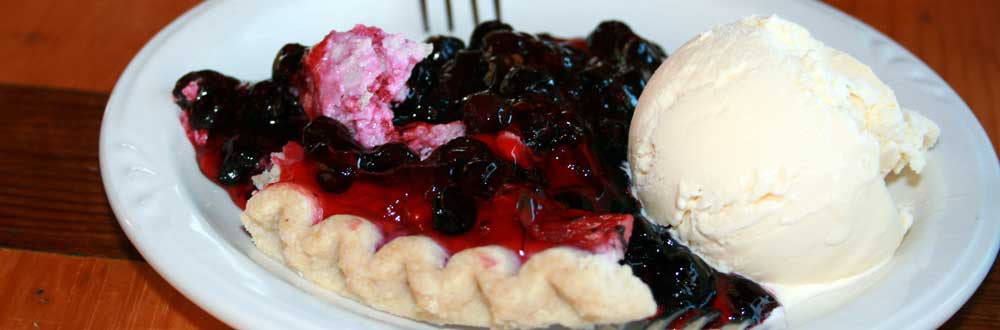
A slice of pie topped with ice cream is said to be served à la mode, a French phrase that means “in the fashion of.” A listener in Greenfield, Massachusetts, wants to know why.
Hunk Waffle? Close Enough
On our Facebook group, a member told the story of teaching English in Japan, where a student couldn’t remember the slang expression stud muffin, but came pretty close by substituting his own term, hunk waffle.
Bailiwick
A woman in Eureka, California, is curious about the term bailiwick. It comes from a Middle English word for bailiff, and wik, a Middle English word that means dwelling and is related to several English place names, such as Gatwick and Norwich.
Pangram Tweets
“LaBron has played more career minutes than MJ, Shaq, Hakeem, Ewing, and others. Crazy how we never expect him to get fatigued in a game.” That’s an astute observation about basketball, but it’s also a pangram, a sentence that uses every letter of the alphabet at least once. More on @PangramTweets.
This episode is hosted by Martha Barnette and Grant Barrett, and produced by Stefanie Levine.
Photo by Navin Rajagopalan. Used under a Creative Commons license.
Book Mentioned in the Episode
| Language and Gender by Penelope Eckert and Sally McConnell-Ginet |
Music Used in the Episode
| Title | Artist | Album | Label |
|---|---|---|---|
| Give It Up | Kool and The Gang | Kool And The Gang | De-Lite Records |
| Hunk of Funk | Jack McDuff | Hunk of Funk 7″ | Blue Note |
| Cissy Strut | Big John Patton | Blue Funk (Compilation) | Blue Note |
| The Jaunt | Poets of Rhythm | Discern / Define | Quannum Projects |
| Chunky | Ronnie Foster | Two-Headed Freap | Blue Note |
| Don’t Knock My Love | Ronnie Foster | Two-Headed Freap | Blue Note |
| Tic Tac Toe | Candido | Beautiful | Blue Note |
| Volcano Vapes | Sure Fire Soul Ensemble | Out On The Coast | Colemine Records |

