A magnificent new book celebrates the richness and diversity of 450 years of written and spoken English in what is now the United States. It’s called The People’s Tongue, and it’s a sumptuous collection of essays, letters, poems, lyrics, and much more, from colonial times to the present. Plus, the story behind the phrase what are the odds? And speaking of odds, what’s the chance that you might see an astrobleme? Well, whatever you do, don’t look up! Also: cut a chogi, yeti de freezer, far venire il latte alle ginocchia, a brain teaser about demonyms, oosh! vs. brr!, evolving names for pets, trim a tree, walk and chew gum, deep yogurt, and lots more.
This episode first aired April 1, 2023. It was rebroadcast the weekend of August 8, 2026.
Transcript of “Fair Dinkum (episode #1612)”
You’re listening to A Way with Words, the show about language and how we use it.
I’m Grant Barrett.
And I’m Martha Barnette.
If you want to describe people who have an overly high opinion of themselves, maybe they’re a little too self-congratulatory. There’s some handy Spanish slang that’ll do the trick.
In English, we might say somebody’s full of themselves. But in Argentina, you might describe such a person as Tarzan de Maceta, which translates as Tarzan of the flower pot.
Tarzan of the flower pot. Yeah. Or you might call them Yeti de freezer. The Yeti of the freezer. Yeah. You can also say the equivalent of Aquaman of the toilet.
Oh, no. Aquaman of the toilet. That’s terrible. And I got those from Adam Sharp. He’s an author of quirky books about words and trivia, including The Correct Order of Biscuits and Euphemisms That Get on My You-Know-Whats.
And you can follow him on social media. He’s always talking about these kinds of things, and they’re lots of fun.
Oh, that sounds lots of fun. I’m still thinking about Tarzan of the flower pot. He’s not king of the apes. What is he, king of the ants?
Yeah, such a great picture. And we know people like this. We do. You’re not one of them.
Martha and I are always collecting idioms from everywhere in the world. Toll free in the United States and Canada, 877-929-9673. And if you’re not in the United States or Canada, you can call us by WhatsApp. Find that number on our website at waywordradio.org/contact.
Hello, you have A Way with Words.
Hello, this is Gail Verena.
Hi, Gail Verena. Where are you calling from?
I am calling from Huntsville, Alabama.
Oh, Rocket City. Welcome to the show.
That’s right. Thank you.
What’s on your mind, Gail Brenna?
I’m wondering, I’m here. Sometimes whenever somebody is, I guess, saying someone is not smart or something, they say they cannot walk and chew gum at the same time.
Now, in my mind, I’m thinking, well, that is easy. Anyone who has a mouth can move up and down and chew gum. It’s like while they’re walking. It doesn’t make sense why they say this, so I’m called a shock.
So you can do it, and you assume others can do it.
Exactly. It does not make sense to me.
I’m hearing an accent, Gilverna. Where are you from?
I am from Uvarugia.
Okay, and do you have expressions like this in the other languages that you speak?
We have idioms, as you have, but they are nowhere near as outlandish as the ones I first hear.
Nowhere near.
All right, so this expression has some history to it, and I want to tell you about a couple of different times when it’s been well-known.
Back in the 1970s, President Lyndon Johnson was well known for a lot of coarse language. He was an earthy fellow. He was known to, off the record, use a lot of swearing and to speak exactly what was on his mind.
And at one point he said about Gerald Ford, another U.S. President, that he was so dumb he couldn’t fart and chew gum at the same time.
Oh, no.
But although a leader, a lot of people thought that was too coarse, and so they just quoted him as if he said, walk instead of fart.
But that wasn’t the earliest time that that was said, although it was a very significant time that that was said.
What it turns out is that there was a time in this country in the mid-1800s where chewing gum became very popular, especially for women and children.
And it was considered an unbecoming habit, something that you probably shouldn’t do.
And you will find in the newspapers of the period, these letters or these opinion columns where they talk about how ladies should not talk slang or bet on horse races or smoke cigarettes and chew gum.
And it was a thing that you weren’t supposed to do.
They would act as if chewing gum was this kind of hallmark of a low-class woman or a woman with no sophistication.
And you can see over time how chewing gum and these other bad habits, supposedly bad habits, were used as a shorthand to indicate the kind of woman who wasn’t very bright.
Oh.
Yeah, so women who chewed gum were considered the kind of woman who was undesirable.
In that she wasn’t sophisticated, she wasn’t educated, she probably was never going to make anything of herself, you wouldn’t want to date her or marry her.
I would not last in that world.
I would not. I would not. None of the women I would date would last in that world either, frankly.
And so over time you’ll see, here’s a newspaper from 1876. It’s just a little blurb.
It says, no woman can talk successfully who chews gum.
And they’re basically saying that women were too dumb to do both.
It’s just basically misogyny.
It’s a time and a place where women were considered inferior to men.
And certain segments of society had no problem just saying it plain.
And over time, the expression was broadened to refer to anyone, to men and children and anyone of any age and gender and background and stuff.
And so it stopped referring just to women.
But it started referring just to women mostly, and particularly young women.
And young women often take a lot of guff in our society because they tend to be the ones who adopt new language first and adopt new habits first and innovate with fashion and that kind of thing.
So they catch up a lot of abuse for doing things early and first.
I agree.
Yeah.
They will not last in this world, though.
This is the world of women empowerment, and it’s beautiful.
And that kind of mindset is blasphemy for this world.
Yeah, I agree.
So I’m glad you did not live here.
Yeah, I’m glad we live here and now.
I agree with you.
Gail Vrenna, thank you so much for your call.
Thank you.
This has been an honor.
Thank you so much.
I listen to you every day.
Well, call us again sometime.
We’d love to hear from you.
Thank you so much.
All right.
Take care.
Bye-bye.
Bye-bye.
Well, when you’re done to tune your gum, give us a call, 877-929-9673.
Hello.
You have A Way with Words.
Hi.
This is Bob Golis.
I’m calling from Mount Airy, North Carolina.
Hey, Bob.
Hi, Bob.
What’s up?
Hi.
A few years back, I moved from, I lived in Kansas for most of my adult life after I got out of the Navy, and I moved to East Tennessee.
So just the other side of the Blue Ridge or the Smokies from where I’m living now.
And I had a very nice neighbor.
And we had one of our rare snowstorms over there.
I stepped out.
We were going to help shovel each other’s walk.
And I walked up to him and he looked at me and he goes, oosh.
And I said, what?
And he says, well, it’s cold, oosh.
And I said, where I grew up, we said, brr.
And so he explained to me that that’s the way they say that there.
So I just wondered if you all had encountered this.
Is it regional there to Appalachia?
I mean, we were just right at the foothills of the Smokies there.
Well, it is particularly common in Appalachia.
And I do have some evidence that it’s heard in western North Carolina and in northern Alabama.
Over the years, we’ve heard from listeners about it.
Tiffany wrote to say she grew up using it in Arkansas.
However, Johanna, who grew up saying it in Alabama, as did her mother and others there, said her husband from Arkansas had never heard it.
So I don’t know.
Most people that we’ve heard from and that I’ve been able to find either are from North Carolina, Appalachia, or Northern Alabama.
There’s a biography by a woman named Cleo Hicks Williams called Gratitude for Shoes, Growing Up Poor in the Smokies.
And she includes Oosh and Ooshie.
And she was from Cherokee County, North Carolina.
And there’s a blog, a wonderful blog, called Blind Pig and the Acorn by Tipper Presley.
And it’s all about Appalachian culture.
And she’s got a great entry that includes mention of Oosh and Ooshie.
And she and her commenters all talk about whether or not they use it.
And a number of people know it.
And they’re from different parts of Appalachia.
And one person says they use Ushi-bushi to mean very, very cold.
So it is out there.
None of the major books that I have, none of the big dialect dictionaries include it.
But there’s enough evidence out there that we can draw a little bit of a dialect map and say that it does exist and kind of pin it to a geographic region.
So it is a thing.
So it’s more of a verbal word that you’ll encounter, but there’s not really much in print or documented.
No, no.
I found it very few printed sources at all.
Well, Bob, what I want to know is, does oosh work better than burr?
Because when I’m really cold, making a noise like that helps me feel like I’m a little bit warmer.
Does one of them work better than the other for you?
You know what?
I have actually used oosh because, you know, after you get exposed to it, it kind of works better than burr.
But, you know, burr to me almost sounds like you’re mimicking your teeth shattering or, you know, the shivering.
But oosh is just like you just blow it out and let everybody know how you’re feeling.
But, you know, we’ll do, Bob.
We’ll put the word out to our listeners who are all over.
And if other folks have used oosh or ooshie or something like that to mean cold, it’s kind of an interjection that you make when it’s cold out, they’ll let us know.
They’re pretty good about that.
Maybe we can draw a bigger map or a more precise one.
Well, I’ve really enjoyed our conversation.
I appreciate you listening to my commentary there.
Yeah, we appreciate it.
Thank you for sharing.
All right.
Have a wonderful afternoon.
Thank you.
You too.
Take care.
Be well.
Bye, Bob.
Thank you.
Yeah, if you know something about oosh or ooshie to mean cold, if it’s an expression to just blurt out anytime you’re shivering, let us know, 877-929-9673, or tell us about it in an email to words@waywordradio.org, or try another way to reach us.
There are lots of them at waywordradio.org/contact.
Kevin Helgard of Haver, Montana, sent us a great email about misunderstandings.
Kevin writes, many years ago, I was attending a conference at a hotel.
The original pastry order for the conference was four dozen donuts.
At the end of the first day, only about half of the pastries were consumed.
My boss asked the hotel meeting server to please cut the pastry order in half for the next day.
You know where this is going, Greg.
I do indeed.
Sure enough, we arrived the next day and there were four dozen donuts neatly cut in half.
Oops.
To the letter.
Oh, we love these language misunderstandings.
Give us a call with them.
Tell the story, 877-929-9673.
More about what you say and why you say it.
Stick around for more of A Way with Words.
You’re listening to A Way with Words, the show about language and how we use it.
I’m Martha Barnette.
And I’m Grant Barrett.
And here he is, the fabulous quiz guy, John Chaneski.
Hi, John.
Hey, Grant.
Hi, Martha.
Hey.
I have a quiz for you today that is a little more straightforward than most.
No tricks or jokes.
It’s a quiz about one of my favorite kinds of words, demonyms.
You’re familiar, I’m sure, with demonyms?
D-E-M-O.
N-Y-M-S.
N-Y-M, yeah.
Do either of you want to explain what a demonym is?
Sure, it’s a place name, more or less.
It’s actually the thing that you call the people who are from a place.
Right.
So American is a demonym for people from the United States of America.
That’s right.
For example, you both live in San Diego, so you are both?
San Diegans, yes.
San Diegans, right.
I live in Brooklyn, New York, so I am both?
A Brooklonian and Poe?
A Brooklinite.
A Brooklinite or a Brookliner.
Brookliner, yeah.
And also a New Yorker, right.
I’m going to see how much you know about denominations for people from different countries and cities.
We’ll primarily look at forms that are irregular constructions.
For example, someone from Boston is a Bostonian.
That’s a common construction.
Sure.
But the people who live in nearby Cambridge are known as what?
Cantabrigians?
Cantabrigians, right.
And the ones in the English Cambridge share that same name, right?
First, we’ll try some irregular demonyms that are very common and somewhat well-known.
If you’re from Dublin, you’re a Dubliner.
But if you’re from Glasgow?
Glaswegian.
Glaswegian, right.
Now, the U.S. Government printing office recommends the official demonym Indianan for someone from Indiana.
But Indiana residents prefer what?
Hoosier.
Go big red.
Go big red.
Nice.
If you’re from the island nation of Dominica, you’re Dominican.
But if you’re from the island nation of Cyprus, what are you?
Cypriot.
Cypriot, right.
If you’re from Iceland, you’re an Icelander.
But if you’re from the Netherlands…
Oh, you’re Dutch.
You’re Dutch, right.
I was afraid you were going to do something with Reykjavik or that volcano, and I thought we were going to be in big trouble.
Like I said, these are irregular, but they’re sort of well-known.
You would think with the land in there, it would be the Netherlander.
I’ve heard that sometimes, but Dutch, Dutch.
Now let’s try some that are a little more uncommon.
What about people who live in Munich?
Not munchkins.
You’re not far off.
Is it munchkins?
No, it’s munchners.
Munchners.
Munchners, yes.
What are people from the nation of Kosovo called?
Kosovars.
Kosovars, yes, very good.
People from the United Arab Emirates have their own demonym.
What is it?
Emirates?
Oh.
I don’t know.
Close.
Emirates?
Close.
It’s Emiratis.
Emiratis.
E-M-I-R-A-T-I-S.
Emiratis.
Very good.
Right.
Now, here are a few that, to me, are rather unusual.
Let’s try them out.
Oh, now these are the unusual ones?
Yeah, these are the unusual ones.
All right.
From the halls of Montezuma to the shores of Tripoli, where you will find what people?
I don’t know what.
I’ll tell you this one.
It’ll help you get the next one.
It’s Tripolitans.
Really?
Hello?
Yes, Tripolitans.
Tripolitans.
Now here’s the last one.
This last one, that one will help you get this one.
Similarly, if you’re from Minneapolis or Indianapolis, what can you be called?
Indianapolitan?
Yeah, Indianapolitan or Minneapolis.
Minneapolis.
Minneapolis.
Of course.
You can be called that if you can get somehow manage to get it out of your mouth.
You guys did very well.
That was a lot of fun, thanks for having me here.
Thank you, John.
Thanks for the quiz, John, as always.
If you’ve got a question about wordplay, grammar, puzzles, a thing that you think you can stump us with, call us, 877-929-9673 or send it in an email to words@waywordradio.org.
Hi there, you have A Way with Words.
Hi, this is Joe Montani calling from Tucson, Arizona, the old Pueblo.
Hi Joe, welcome to the show.
Thank you, Grant.
You know, well, I tell you what, I’m a scientist here, an astronomer.
Oh, really? That’s cool.
We, of course, you know, coming up in science, we have a lot of contact with mathematics, and out of necessity, and well, because it’s fun also.
But I have a question that’s been on my mind for many years, even though I’ve had plenty of opportunity to talk with mathematicians and other scientists.
I never put this question to them, nor have dictionaries or other sources of etymology been able to help me.
And that is the word odds, O-D-D-S.
Now, I mean, I’m not a gambler or a gamer or one who wagers, so I’ve never really used this in a practical way.
But of course we know that, well, it’s the ratio of probabilities.
One outcome of something might be probable to a certain extent, another one might be probable to another extent, and the ratio of those is the odds, which one will win out.
But where, where, oh, where does this word odds come from?
You know, again, in math, we know there are even numbers, odd numbers.
But I doubt it has anything to do with that.
But I’ll be delighted to learn otherwise or if that is the case.
Any ideas?
It does.
It does come from odds and evens.
All right, let’s say you have two stacks of coins, and they both have 10 coins in a stack.
Across the top, they’re perfectly even.
If you take one coin off of one stack, now they’re uneven.
They are, one of the stacks is now odd, all right?
Let’s say that you have four stacks and one of the stacks has one fewer coin than the other three stacks.
It is the odd stack.
It’s unusual, it’s odd, right?
It’s literally that same odd.
So it’s different.
And so what we’re talking about here is something that as odd is unusual, it’s different.
And it starts out as the opposite of even.
And odds came to refer to the difference between anything, any two things or more than one thing, to indicate that something was unequal.
And that’s what’s happening, just like you said, in gambling.
The odds is the ratio, that is the difference for and against a certain position, in the outcome of what is being bet on.
And so when we talk about the odds for and against something, that’s exactly what we’re talking about.
What is the outstanding different part of this wager? What is the unequal position that we might take that something will or won’t happen?
It’s all about what’s different or what’s unequal.
So it is odd. It’s unusual.
Okay, Grant. That does shed some light on it.
See, I hadn’t really considered that it would land on both sides of that question.
That is, that it would have a connection with the mathematical fact of something either being odd or even as a number.
And, and, here’s the big and, that it had something to do with the oddness of its strangeness or the difference between things.
That’s so interesting.
Yeah, when words develop new meaning, sometimes they become abstracted from their source.
And so they seem odd.
They seem unusual and strange.
But once we look into the path that they’ve taken to go from meaning one to meaning two, it starts to make more sense.
And then you kind of have your aha or eureka moment.
But I want to get back to your profession.
You said you’re an astronomer.
I imagine there in Tucson, if you drive out a ways, you’ll find plenty of places where there’s not a lot of urban light.
And you can see great distances into the universe.
Yeah, you’ve probably had your own ahas and eurekas, huh?
Yeah.
Oh, that’s certainly right.
You know, from early childhood on, I grew up on the East Coast, New Jersey, and started to use small telescopes there, and then to get bigger telescopes.
I couldn’t afford them, so I had to start making them, even as a kid.
I made my first one at age 13, larger and larger mirrors, you know, ground from scratch, literally from scratch, using abrasives and then polishing.
So that led to a career, which I’m very happy to be part of.
I think definitely what drew me to the field is the beauty of what you can see.
In other words, as an observer, simply the beauty of it.
And, of course, mathematics has a certain beauty of its own, which puts the two together.
And, wow, it’s a nice combination.
What are the odds of that?
Well, I imagine you have some lovely language that you can share with us in a future call.
And so, Joe, we’d love to hear some of that from you another time.
That would be an absolute delight.
And I look forward to it.
I want to thank you for putting my mind at rest.
Thanks so much.
I’ll be well.
The other day, David Finprock of Dallas, Texas, sent us a photo of a sign for the Sierra Madera Astrobleme.
And he knew that we would be excited about this, or at least I was, because I had no idea what an astrobleem was.
Sierra Madera astrobleem? Astrobleem.
That is an amazing sentence.
That is an astonishing series of sounds.
The Sierra Madera astrobleem.
That’s surely a space traveling vehicle, right?
Well, an astrobleem, it turns out, is a meteorite crater.
It comes from Greek words that literally mean star wound.
Oh, like blemish.
Bleem is in blemish.
They’re not related. I looked them up because that’s what I thought.
Blame in Greek is a wound caused by a missile.
Wow. That’s astonishing.
Sierra Madero Astroblame. And where is it?
It is in southwestern Picos County in Texas.
And don’t you just love that David saw that sign and knew that we would be all excited about it.
Thank you, David. You made my day. Maybe several.
Send us signs you’ve seen. words@waywordradio.org.
Hello. You have A Way with Words.
Oh, hello. Nice to be here.
This is Anna. I am calling from Seattle, Washington.
Hi, Anna. How are you?
Hi. Well, there are two particular expressions that I have heard here in America.
And the first one, if you don’t mind, I would like to introduce with the context of how I heard it.
Okay.
Okay, so I am from Hungary originally and came to America in 1980, arrived in Seattle in April of 1980.
And a very nice American family sort of sponsored us and took us under their wings and they were very nice.
And one day, I was only three weeks in America and my English was not very good.
I was 20, and I had two years of high school English under my belt.
And one morning, I was standing in a doorway, and the father of this family came towards me with a big smile on his face.
And coming down towards me, and very loudly, he yelled, how is it hanging?
And I was mortified.
How is what hanging?
I don’t have anything hanging.
Should I have something hanging?
Am I in trouble?
So by the time he reached me, I figured, okay, this is some sort of greeting.
But I was so confused.
And I’ve never heard this since then, but I’ve never forgot it.
And I would really like to know how this, a line like this, came to be a greeting.
Yeah, so the question, how’s it hanging, is not really a formal greeting.
It’s not something you’re going to hear when you talk to the president or your boss or something like that.
And, you know, if you look at dictionaries, they’ll explain that it was originally described as a man-to-man greeting, if that makes sense.
Oh, that does make sense.
It’s moved beyond that. It’s no longer man-to-man. It’s now more widespread, and it’s kind of lost to gender connotations.
Right. But I have not heard it since then, and so man-to-man, that does make sense.
Okay, well, thank you.
Another one with the same family, we spent our very first Christmas with them, and they kept talking about trimming the tree.
And I was also very confused, like, why would you want to cut off the branches of a tree that you’re about to decorate?
Right, and did they give you an explanation for that?
I don’t think I asked them.
I was just sitting there confused, and I watched them as they are decorating the tree, and later I came to understand that the trimming itself meant the decorating.
But still, the expression to this day confuses me.
Well, Ana, you’ve actually zeroed in on a really interesting word because the word trim in English probably comes from an old English word that meant to make firm or make strong or to arrange or prepare.
So, for example, you may have heard people talk about how you need to trim a sail on a boat.
And that means to adjust the lines on the boat that are attached to the sail to adapt to whatever conditions there are.
Or if you’re in good trim, you’re in good physical condition, you’re ready for anything.
And in the same way, if you’re making a Christmas tree ready for the holidays, you trim it.
Or think about Thanksgiving.
You have turkey with all the trimmings.
All the trimmings.
Yeah.
It’s what we call in English a contronym, which is a word that can have two different meanings for various historical reasons.
For example, the word cleave.
You know, a meat cleaver separates things, but you can also cleave to an idea, cleave to a spouse.
There are several words in English that do that.
For example, if you’re making Christmas cookies, you might dust the cookies with powdered sugar.
But if you’re dusting your house, you’re not spreading dust all over your house.
You’re taking away the dust.
That’s right.
You’re removing the dust.
So cool.
What a wonderful language.
I love English.
Anna, thank you so much for sharing your stories with us.
And call us again sometime, okay?
Thank you very much for your enlightening explanations.
All right.
Take care and be well.
Bye-bye.
Bye-bye.
Take care.
Bye-bye.
There are lots of ways to reach us on our website at waywordradio.org/contact, where you’ll find all of our past episodes and information about A Way with Words events.
Hello, welcome to A Way with Words.
Hi, I’m John Kunz. I’m from Duffield, Virginia.
Hi, John. Welcome to the show.
I guess I’ll put it this way. Here’s the picture.
There’s a bunch of Englishmen sitting at the pub, and they’re all raising their glasses or their mugs available to someone or something.
And they say, hear, hear. Hear, hear.
And why here, here? What does that mean?
You know, so that’s what I, that’s the question.
Well, John, I guess the question is, how do you think they’re spelling here, here?
Well, no, I’ve been preparing for this call, and I was going to tell you, I forgot to say, I said, I don’t know if it’s H-E-R-E or H-E-A-R. I’m assuming it’s the first one, H-E-R-E.
H-E-R-E?
No, actually, it’s the other one. It’s short for hear him, hear him. And it’s an old expression that people would use to call attention to what somebody is saying. You know, somebody’s saying something important and people would say, hear him, hear him. And it was used in the late 17th century in the British Parliament. And by the 18th century, it was just shortened to hear, hear. And, you know, if you ever watch those televised debates in the House of Commons, you know, you’ll hear people say hear, hear instead of applauding. Because interestingly enough, applause is usually forbidden in the British Parliament. And so they just say, yeah, yeah.
Actually, the rules of the British Parliament say, members must not disturb a member who is speaking by hissing, chanting, clapping, booing, exclamations or other interruption. But when not uttered until the end of a sentence, the cry of hear, hear offers no interruption of the speech. So people will say hear, hear instead of applauding. But if you’ve ever listened to Parliament, those guys are talking to each other. Somebody will say something, everybody will go, I don’t know, they’ll be talking back.
The other thing that came to mind, there was no PA systems back then. There were no PA systems back then. But you’re right about that noise that you hear in Parliament. Sometimes people use hear, hear in a negative way, just making noise. It’s an imperative that tells people to listen. It’s not H-E-R-E.
Huh.
Okay.
It’s more of a command.
Yeah. In fact, you’ll see that command in the King James Version of the Bible in 2 Samuel.
Yeah. A woman says, here, here, and then she goes on to say something to the people of the city.
Oh, well, that makes sense, too.
Okay.
Okay.
Well, I was wrong a couple of times.
No worries.
Yeah.
No worries.
It’s all good.
John, thank you so much for talking to us. We really appreciate it.
Thank you.
Thanks, sir.
Thanks, John. Take care. Be well.
Bye-bye.
Well, hear us, hear us. You can hear all of our episodes at waywordradio.org. And you can find all of our past episodes on every major podcast app. Just go to waywordradio.org slash listen to find out how.
This show’s about language seen through the lens of family, history, and culture. Stick around for more. You’re listening to A Way with Words, the show about language and how we use it. I’m Grant Barrett. And I’m Martha Barnette.
And this is the book that I am recommending to anybody who will listen if they love language. It’s called The People’s Tongue, Americans in the English Language. It’s edited by author and academic Ilan Stavans, and it’s this beautifully curated compendium of 450 years of English as it’s been spoken and written in what is now the United States. Now, these are all original texts. They’re from essays and articles and poems and songs and speeches and book chapters and more.
It starts with a love letter from colonial times that’s barely understandable because it contains so many conventions of late Middle English. And from there, the book moves on to text from a New England primer from 1687 that was used to teach children to read. And the collection moves up on into the present into what Stavans calls the ruckus of polyphony. And what a ruckus it is. This is a sweeping look at so many writers and speakers, so many views about language.
And just to give you a taste, there’s Noah Webster on spelling reform. There’s Thomas Jefferson on the usefulness of neologisms. There’s Simon Pukhagen, who was one of the most prominent Native American writers of the 19th century. And he writes about the limitations of translating indigenous words into English. And then there’s Thomas Hopkins’ Gallaudet on the beauty and eloquence of sign language. And Walt Whitman on slang, Emily Dickinson’s Sojourner Truth, Mark Twain, Bret Hart, James Baldwin, Isaac Basheva Singer, Zora Neale Hurston, William Faulkner.
There’s Toni Morrison’s magnificent lecture accepting the Nobel Prize for Literature. There’s David Foster Wallace on grammar and usage. And there’s Korean-American novelist Chang-rae Lee’s description of watching his mother struggle to learn English. And also Amy Tan on how her mother’s Chinese-accented English affected her own. And Richard Rodriguez gives a sensuous description of the difference between the sound of Mexican Spanish that he heard at home and the English that he heard out in public.
Louise Erdrich on learning Ojibwe, Jhumpa Lahiri on learning Italian, a gorgeous bilingual sestina by Dominican-American poet Julia Alvarez. There’s Adrienne Rich and Susan Sontag and Tony Kushner and Elon Stavans himself, who’s a Mexican-American writing about Spanglish. There’s Bob Dylan and Kendrick Lamar Grant. This is this exuberant, rambunctious, glorious melange of English as it is spoken and written in the United States. It’s just what I recommend is just keeping it close to you and reading a chapter a day. They’re relatively short and it’s just delicious.
Martha, your book recommendations rarely steer me wrong, and we do disagree. It’s for obvious reasons, just because of things like our taste in fiction. But this sounds like something that you and I will 100% agree on. Give me the title again.
It’s a new book, and it’s called The People’s Tongue, Americans in the English Language, edited by Elon Stavans. We will link to this on our website. We’d love it when you send us your book recommendations. Martha and I are constantly figuring out how to fit more books on our bookshelves and bedside tables. Please send your book recommendations to us, and maybe we’ll share them with everyone else.
words@waywordradio.org, or tell us on the telephone. 877-929-9673 is toll-free in the United States and Canada.
Hello, you have A Way with Words.
Yeah, hi. Hi, Martha.
Yeah, so this is Jerry, and I’m calling from the beautiful Shenandoah Valley in northern Virginia.
Oh, lovely. Well, welcome to the show, Jerry. What’s on your mind today?
Thank you. About 50 years ago, I was working on a ship and I happened to work with a bunch of Aussies, Kiwis. And I heard you guys talking about some Australian words the other day. And I learned a bunch of words while I was with them, which is, I used to call it a pipe wrench, but they called it a stilson. Because that’s the guy who made it. Wrenches, they call spanners. Adjustable wrenches, they call shifters.
But my Aussie friends had this phrase, and the phrase was fair dinkum. And I have always wondered, where did that ever come from? Fair dinkum.
So what context would you hear this in?
So fair dinkum is something that is absolutely 100% authentic beyond any question. You’re just, you’re standing behind it. You’re saying, oh, this is it. Well, you know, he’s a fair dinkum stand-up guy.
Oh, yeah, that’s a classic one.
Yeah, a fair dinkum Aussie is an Australian of the most ideal kind, right?
Absolutely, and I worked with some of the greatest. Did you ever hear someone called a fair dinkum Drongo?
Nope. Never heard anything like that.
A fair dinkum drongo is the worst sort of person, just the worst sort of simpleton. So, yeah, fair dinkum, that’s a classic Australianism. And as you said, used a little bit in New Zealand by the Kiwis, a classic, classic, classic expression. It’s two words, F-A-I-R and D-I-N-K-U-M. And we really should focus on dinkum because other words can appear in front of dinkum. So you could have straight dinkum or square dinkum as well.
Yeah, I figured out fair. I figured fair had to be pretty fair.
Yeah, but fair dinkum is the most common one, but square dinkum or straight dinkum. Dinkum originated in English dialects in Lincolnshire and Derbyshire and migrated with people from those regions to the Antipodes. And while it fell out of use in England, it continued to be used and grew in use in Australia and New Zealand. And originally it meant work or share of work. So saying something was fair dinkum, you meant kind of good job or it’s a well done. And it’s had a lot of variation and there’s a lot of subtlety in its use in Australia. But in general, like you said, it means authentic, on the level, legitimate, honest. And it can be used as an intensifier, just to emphasize something. So that’s the fair dinkum truth. It means that is definitely the truth.
But it’s just its own word?
Or how did it get from old English?
Yeah, it’s its own word.
That’s exactly right.
Well, I guess it didn’t change from old English to anything.
It just means what it means, right?
Yeah, we don’t know.
Its origins are lost in time.
But it did come over as a form of dialect from the old world to the Antipodes.
Oh, I’ll be darned.
And I was trying to tie it into Winky Dink or something like that.
There have been attempts to tie it into Chinese, but it is definitely not Chinese.
It did not come from China.
I just have to be satisfied with that.
Yeah, yeah.
Well, call us again sometime.
Sounds like a call for a bunch of folks who taught you another whole dialect.
Oh, yeah.
Yeah.
Well, you know, over the years, you learn a lot of different words.
All right.
Take care of yourself and be well.
All right.
Thank you very much.
Good talking to you.
Great.
Bye.
Bye-bye, Jerry.
You can reach us from anywhere in the world.
Go to waywordradio.org/contact to find all the different ways that you can do that.
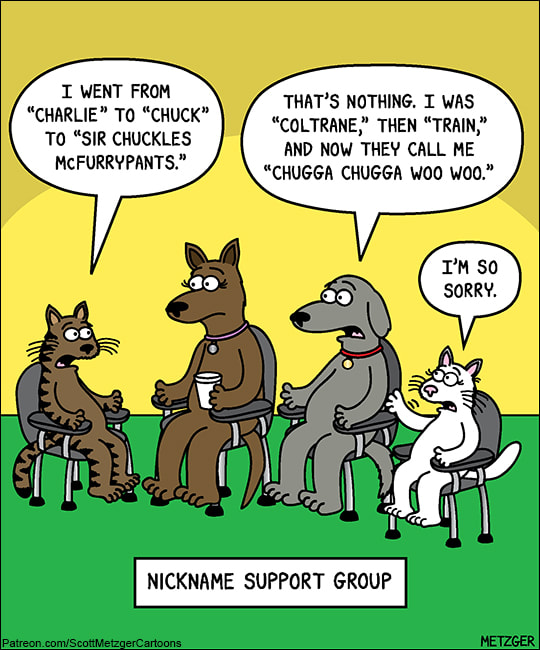
Scott Metzger draws a lot of funny cartoons about animals.
And recently I saw one of these cats and dogs who are sitting around in a nickname support group.
And the cat says, I went from Charlie to Chuck to Sir Chuckles McFurry Pants.
And the dog says, that’s nothing.
I was Coltrane, then Train, and now they call me Chugga Chugga Woo Woo.
And they just all look so sad.
And that is exactly what happens to pet nicknames.
Isn’t it?
But you kind of do that with people too, don’t you?
I call my wife six or seven sweet things.
Yeah, I was thinking about this because the names that I’ve given to pets historically have gone through those kinds of changes.
But of late, it’s more the intonation that I use.
I don’t change their names up so much.
Oh, really?
Okay.
Well, my cat Pearl, who’s a wild one, is Pearl and Pearly Whirly and Pearl Everlasting.
Pearl Everlasting.
And Pearly Gurly and Sweet Kitty and Little Baby and Baby Kitty.
Yeah, and I have Wolfgang.
Is that how you say it?
Yeah.
It’s just a different intonation.
You know, Wolfgang.
Maybe I’ll try that and see if he responds.
But you know what?
We’ve talked about this years ago on the show.
I think it would be funny to hear what other people experience in terms of changing your pet’s name.
Yeah, what’s the path your pet names have taken?
They started so simple, and then it got complex.
Or explain the whole sordid history in email words@waywordradio.org.
Hello, you have A Way with Words.
Hello, my name is Daniel.
I’m from Nicholasville, Kentucky, and thanks for having me on.
Welcome to the show, Daniel.
What can we do for you?
Well, my father was raised by his grandfather in rural Madison County, Kentucky,
And he had lots of sayings that he used as a farmer and a shop owner,
And one of them was when my dad got in trouble, he’d say, you’re in deep yogurt.
And I was just wondering where that came from.
Deep yogurt.
Was that a special kind of trouble that he was in or it was just regular old trouble?
It was just regular troubles.
Okay.
And how deep was that yogurt?
I don’t know.
He was a milkman.
Oh, was he now?
Okay.
So he knew yogurt.
You know, I’m thinking about all the other terms, Daniel, for this sort of thing.
I’m wondering if being in deep yogurt is worse than being in deep doo-doo.
Which is another.
I imagine it was a nicer way of saying that.
Yeah.
And we all know the term we can’t say on the air, which I think comes to mind.
A deep foo-foo is another way to put it.
Yeah.
Was your grandfather careful about his language?
He was.
He was raised in a Christian family.
They raised walker hounds.
Oh, that would explain some of it.
It’s definitely a nicer way, rather than using the four-letter word beginning with an S.
And you’ll find that deep yogurt gets the point across without having to offend anyone’s sensibilities.
Right.
But yeah, possibly by comparison to bird poo is the thing with deep yogurt,
Because yogurt does look a lot like you’ve been splattered by a pigeon, you know, if it spills on you.
Okay.
Thank you very much.
Yeah, our pleasure, Daniel.
Thank you for sharing your memories of Grandfather.
That’s what it was.
Anybody who’s careful with their speech and avoids those four-letter words
Is probably going to have a whole stock of those more polite expressions to express a little bit of dissatisfaction.
Okay.
Take care now.
You too. Bye.
Bye, Daniel.
I know we’ve got more than a few mischief-makers who got deep doo-doo when they were kids.
We’d love to hear the expressions your parents used when you were in trouble or the ones that you use with your children and grandchildren.
Let us know. 877-929-9673.
That’s toll free in the United States and Canada.
And if you’re somewhere else in the world, you can actually still call us by WhatsApp and some other ways.
Find out how. waywordradio.org contact.
Here’s a lovely thought from Leo Rosten’s Treasury of Jewish Quotations.
If you drop gold and books, pick up the books first, then the gold.
Yeah, the books will lead to acquiring more gold in any case.
Of course, the gold could lead to acquiring more books.
I don’t know.
Definitely acquiring more books.
I don’t know about more gold.
I think the point is that knowledge is everlasting and money is not.
That’s well said.
One of the favorite expressions that you live by?
Email us, words@waywordradio.org.
Hi there.
You have A Way with Words.
Hi, Vince here from Brooklyn.
Hey, Vince from Brooklyn.
Well, welcome to the show.
What can we do for you?
There was a Brooklynese saying that was on my mind.
I’ll give you some background first.
I was born in 1947.
In the early 1950s, growing up, a lot of the young men were returning back from Korea.
These were all the cousins, neighbors, and this affected the neighborhood, all these
Happening, all these nice young men back again.
And one of the things, as little kids who were five, six years old, we were very annoying,
And they would say to us, go cut a chugging.
That became the vernacular that I thought was Brooklynese
And was part of the vernacular of Brooklyn all the time.
It was used in my grammar school.
It was used in my high school.
What did it mean?
Can you say it again?
Cut a chogi.
It means beat it, you know, get away from there.
And in 1967, I’m stationed in Fort Rooker, Alabama.
I meet Fort Rooker, two MPs that just came back from Korea.
And, of course, I’m from Brooklyn.
They’re from Brooklyn.
You become very fast friends.
And they had a car.
And we were driving down the road, and the driver says to me, I’m in the backseat.
He says, Vince, which way do I go?
I said, Kotechogi.
He turns the car, makes the correct turn.
Then he turns to me and he says, where did you learn Korean?
I said, Korean?
I don’t know Korean.
He says, yeah, Kotechogi.
You told me that it’s Korean.
It is Korean.
I said, I thought it was Brooklynese.
He says, no, it’s Korean.
So that’s my story.
That’s hilarious.
So you didn’t realize that all those soldiers coming back from Korean
Were speaking something they’d picked up in the war.
Right.
In Korea, they picked it up in Korea.
They brought it back to the neighborhood.
They all had similar experiences, linguistically, I guess, in Korea.
And they brought it to the neighborhood.
And I just assumed, as a young man, being five, six years old,
That I was part of a vernacular.
That’s fantastic.
I mean, I used it in high school, even.
It’s not just old timers.
It’s still running around.
People still say cut a chogi or do a chogi or pull a chogi.
It’s still out there.
Chogi being spelled C-H-O-G-I or I-E or E-E or E-Y, sometimes with a double G.
Yeah, directly from Korean as early as the early 1950s.
It’s hard to say exactly which part of the Korean language it came from,
But it roughly came from a Korean phrase that meant go there.
Roughly.
Chogi means there
In Korean.
So basically, go that way.
And so it’s the kind of thing that might be shouted constantly
When people are giving directions or orders.
Well, I thank you very, very
Much, and I enjoy your show tremendously.
It’s tremendous both of you. You do a great job, and I thank you for that.
Yeah, our pleasure. Thanks for calling, Vincent.
You call us again sometime. Okay, fine.
I will call back.
Thank you very much for your answers.
Okay, bye-bye.
Bye-bye.
Call us to talk about language, 877-929-9673, or send your stories to words@waywordradio.org.
In Italian, if you’re describing something really boring, you can use a phrase that translates as, it makes milk come to my knees.
How weird is that?
What does that mean?
Well, that’s a good question, and nobody’s completely sure, but it may have to do with the idea of somebody’s really boring.
They’re going on and on, and it’s as if you’re sitting there beside a cow with a bucket, and you’re milking the cow, and you’re waiting for the milk to come up to your knees, and it’s taking a long, long time.
Oh, I see.
Yeah.
It’s parvenire il latte alle ginocchia.
Ginocchia.
Oh, that’s nice. I like that word. That means knees, I guess.
You can reach out to us. There are a lot of ways to do it, no matter where you are in the world.
Our team includes senior producer Stefanie Levine, engineer and editor Tim Felten, and quiz guide John Chaneski.
We’d love to hear from you, no matter where you are in the world. Go to waywordradio.org/contact.
Subscribe to the podcast, hear hundreds of past episodes, and get the newsletter at waywordradio.org.
Whenever you have a language story or question, our toll-free line is open in the U.S. and Canada.
Or send your thoughts to words@waywordradio.org.
A Way with Words is an independent production of Wayword, Inc., a nonprofit supported by listeners and organizations who are changing the way the world talks about language.
Special thanks to Michael Breslauer, Josh Eckels, Clare Grotting, Bruce Rogow, Rick Seidenwurm, and Betty Willis.
Thanks for listening. I’m Martha Barnette.
And I’m Grant Barrett. Until next time, goodbye.
Bye.
Thank you.
Tarzan of the Flowerpot
 If you want to describe people who have an overly high opinion of themselves, here’s some handy Spanish slang: In Argentina, you might describe such a person as Tarzán de maceta, or “Tarzan of the flowerpot.” You might also call them a Yeti de freeze r, or “Yeti of the freezer.” Another equivalent translates as “Aquaman of the toilet.” Adam Sharp, who collects such linguistic gems, is the author of quirky books about words and trivia, including The Correct Order of Biscuits (Amazon) and Euphemisms That Get on My You-Know-Whats. (Bookshop|Amazon).
Walk and Chew Gum at the Same Time
A caller from Russia wonders about the English idiom can’t walk and chew gum at the same time. What’s so hard about walking and chewing gum?
Oosh! It’s Cold!
Bob from Mount Airy, North Carolina, says that while growing up in Michigan, he and others said Brr! in cold weather. But where he lives now, he often hears people exclaim Oosh! As noted in Gratitude for Shoes: Growing up Poor in the Smokies (Bookshop|Amazon), both oosh and ooshey! are used in Appalachia to mean “It’s quite cold.” Tipper Pressley also discusses ooshie on her site The Blind Pig and the Acorn, a wonderful resource for all things Appalachian.
Cut the Order in Half
Kevin in Havver, Montana, shares a funny story about a misunderstanding that occurred at a conference when one of the organizers requested that a large order of doughnuts be cut in half. Oops.
People Who Live in Quizland Are Not Quizlings
Quiz Guy John Chaneski is puzzling over demonyms, those names people who reside in a particular area. For example, someone who lives in Brooklyn, New York, is a Brooklynite. People who live in Boston, Massachusetts, are called Bostonians, but what do you call those who live in nearby Cambridge?
What Are the Odds?
A retired astronomer in Tucson, Arizona, is curious about the expression What are the odds? The idea of odds meaning “the likelihood of something occurring,” goes back to the idea of odds and evens and something odd being the thing that’s different from the others.
Astrobleme
The Sierra Madera Astrobleme is a meteorite crater in Pecos County, Texas. Astrobleme derives from ancient Greek words that mean “a wound caused by a missile.”
Trimming the Tree But Not Cutting its Branches
When Ana first arrived in the United States from Hungary, she was taken aback when someone greeted her with the idiomatic expression How’s it hanging?. She was also puzzled by the expression trim the tree meaning to “adorn a Christmas tree with decorations.” Trim in this sense reflects the word’s much earlier sense, meaning “to prepare” something. If you trim the sail on a boat, for example, you adjust it to prepare it for new conditions. If you’re in good trim you’re in good physical condition, and an ideal military force will be in fighting trim. The word trim is a contranym, meaning it can have one of two opposite meanings, namely, “to subtract from” or “to add to.” Cleave and dust are two other examples of contranyms.
It’s “Hear, Hear!” Rather Than “Here, Here!”
Is it correct to toast someone with the words Here, here or Hear, hear? It’s Hear, hear, and it’s short for the imperative Hear him, hear him!
Rich and Wonderful Anthology of American English
The People’s Tongue: Americans and the English Language (Bookshop|Amazon) reflects 450 years of English as it has been spoken and written in what is now the United States. Edited by Ilan Stavans, this anthology of original texts—essays, articles, poems, songs, speeches, book chapters, television scripts, and more—reflects the richness, diversity, and exuberance of American English.
Fair Dinkum, Mate
Commonly heard in Australia, fair dinkum is used to describe something “authentic” or “legitimate.” This phrase is also used as an intensifier. Less common versions: square dinkum and straight dinkum. The expression fair dinkum drongo refers to “the worst sort of person.” Fair dinkum was originally a dialectal term in England, where dinkum referred to “a share of work,” and fair dinkum described “a job well done.”
A Flurry of Furry Nicknames
We’ve talked before about how names of our pets often evolve over time. Cartoonist Scott Metzger captured this idea in a drawing of a Nickname Support Group for dogs and cats.
You’ll Be in Deep Yogurt!
Daniel in Nicholasville, Kentucky, says his grandfather would warn that if he got in trouble, he’d be in deep yogurt. That’s probably just a euphemism for deep doo-doo, deep foo-foo, or an even stronger epithet piled high.
Who Is Just Carrying Around Gold, Anyway?
Among the proverbs in Leo Rosten’s Treasury of Jewish Quotations (Amazon): If you drop gold and books, pick up the books first, then the gold.
Cut a Chogie, Brookyn Boy
Vince from Brooklyn, New York, remembers growing up there and using the expression cut a chogi! to mean “beat it!” or “get away from here!” He’d assumed it was simply Brooklynese until years later in Alabama, when he used it and a returning service member asked where he’d learned Korean. This bit of slang shows up in the early 1950s among U.S. soldiers who picked it up during the Korean War. It likely stems from a rough translation of a Korean expression meaning “go there.” In Korean, cheogi or jeogi means “there.” In English, the word is variously spelled chogi, chogie, chogey, or chogee, and sometimes with a double g. Variants include pull a chogi and do a chogi.
Makes Milk Come Up to the Knees
The Italian idiom far venire il latte alle ginocchia literally means “to make milk come to the knees.” Figuratively, it means “to be really boring.” It’s been suggested that the phrase refers to the tedious process of sitting and milking a cow, as the milk bucket slowly fills up. But no one knows for sure.
This episode is hosted by Martha Barnette and Grant Barrett, and produced by Stefanie Levine.
Books Mentioned in the Episode
| The Correct Order of Biscuits by Adam Sharp (Amazon) |
| Euphemisms That Get on My You-Know-Whats by Adam Sharp (Bookshop|Amazon) |
| Gratitude for Shoes: Growing up Poor in the Smokies (Bookshop|Amazon) |
| The People’s Tongue: Americans and the English Language edited by Ilan Stavans (Bookshop|Amazon) |
| Treasury of Jewish Quotations by Leo Rosten (Amazon) |
Music Used in the Episode
| Title | Artist | Album | Label |
|---|---|---|---|
| Back Atcha! | The White Blinds | PRESHEATECHA! | F Spot |
| Fancy Pants | Bubbha Thomas & The Lightmen | Fancy Pants | Judnell |
| Miss Roberta | The White Blinds | PRESHEATECHA! | F Spot |
| Miss Roberta (con’t) | The White Blinds | PRESHEATECHA! | F Spot |
| On The Way Home | Bubbha Thomas & The Lightmen | Fancy Pants | Judnell |
| Cal High | The White Blinds | PRESHEATECHA! | F Spot |
| On The Clock | The White Blinds | PRESHEATECHA! | F Spot |
| Shakey Leg | The White Blinds | PRESHEATECHA! | F Spot |
| The Other Side | Sure Fire Soul Ensemble | Step Down | Colemine Records |