

Is it cool for parents to use their children’s slang? What’s wrong with the term illegal alien? Grant and Martha discuss possible alternatives. Yehudi refers to the mysterious character who holds up strapless dresses, turns the light on in the fridge, and does lots of other things we can’t see. But why Yehudi? Also, terms from the lexicon of anatomy, an idiom puzzle, putzing around, out of pocket, long in the tooth, the ancient roots of the folksy expression even a blind pig can find an acorn, and answers to the question, “What do you call the slobber marks a dog leaves on a window?” This episode first aired December 3, 2011.
Transcript of “Not Those Thongs”
You’re listening to A Way with Words. I’m Grant Barrett.
And I’m Martha Barnette.
In a recent episode, we talked about moments when the language we use is completely lost on someone from another generation.
You say a word, a phrase, and then you get back this blank stare and you realize, oh my gosh, this person is not old enough to catch the reference I just made.
And we asked for your examples and one word kept coming up again and again.
And it occurred to me, Grant, that it’s kind of a chronological shibboleth.
It’s something that really tells you where you stand on either side of the generational divide.
Okay, which one is it?
That word is thong.
Yes, thong.
We got an email from Bev Clement of Fort Worth.
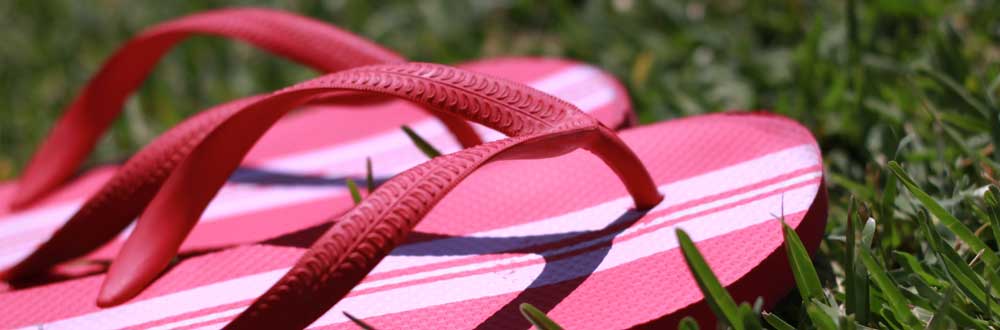
She wrote that she’s been struggling to break herself of the habit of thinking of a thong as something rubber that you wear on your feet.
Right.
She writes, my daughters insist that I not use the thongs word, which applies to panties now, not shoes.
And then from the other end of the generational divide, Shannon Lawson wrote, my Uncle Mike told me that I need to check out my Aunt Cassie’s thongs.
They have flowers on them.
I was very concerned.
And he meant the shoes.
Yeah, yeah.
Well, there were a couple like that.
Icebox is one that kept getting mentioned.
Icebox, definitely.
But the one that struck me the most was this intergenerational progression from the grandmother who says pocketbook, the mother who says purse, and then the granddaughter who says bath.
Yep, yep, yep.
And it’s not so much a disconnect as it just shows this progression through language, right?
Yeah, yeah.
But pocketbook, purse, which one do you use?
I tell you, when I was really small, I used pocketbook because my mother did.
And then I graduated to purse, and now I hear people younger than me saying big.
I just think of a piece of—
Nice big.
I think of a canvas bag with a drawstring.
I don’t think of, like, something fancy in leather that you bought on sale at Macy’s.
That’s interesting, right?
Yeah, interesting.
Who knew?
You know, we could talk all day about this.
The response has been huge.
We’re open to more of your suggestions of things that people say that you just don’t get or things that you say that they just don’t understand.
877-929-9673 or email words@waywordradio.org.
Hello, you have A Way with Words.
Hi, Grant.
This is Allie from San Diego.
Hi, Allie.
How are you doing?
I’m great.
How are you?
Super.
Welcome to the program.
How’s it going, Allie?
Last month, I was coming to pick up my son from school, and he was across the playground, and I was shouting his name over and over, and he wasn’t hearing me.
And so all of a sudden, I just instinctually, I yelled, dude.
And immediately, it got his attention and turned around, because why wouldn’t mom say dude?
His mom is the only one who would yell dude across the playground.
And it got me thinking about at what point is it going to be inappropriate for me to incorporate new slang or lingo into my vocabulary.
My husband and I own a surf shop, and so I’m constantly being exposed to new words, and I love it.
But I just felt, you know, as moms were turning around to look at me like, maybe I need to cool it on the dude and some of my other favorite words.
The moms were turning around to look at you?
Well, yeah, I don’t think most of them would have thought to yell dude across the playground.
They thought I was a little out of place, maybe.
But it worked.
Yeah.
It did work.
It did work.
But it’s not, I guess a lot of my vocabulary words aren’t words I hear the moms in my neighborhood using.
And so I’m just a little curious if you feel like there’s a hard and fast rule about what you need to start toning it down.
Or if as long as it flows naturally, it’s fair game.
I think the latter is totally it.
You’ve got to let it flow.
Let me rephrase your question.
When should I become square?
That’s what you asked me.
And I say never.
You had the right thing going.
You’ve got to rapport with your son.
You’re using the language he understands.
Job done.
And he’s fine with it, right?
Yeah.
You know what?
They have not given me any grief yet.
They love it when they run off the soccer field.
And I’m like, that is so beast.
You were ripping or, you know, mom’s going to give you a beat down in Bananagrams tonight.
Now, wait a minute.
Wait a minute.
Okay, I’m square.
I have no idea what you just said, that last one.
A beat down.
Like I’m going to kick your butt in Scrabble or Bananagrams or whatever.
Oh, in Bananagrams.
Okay, which is a game.
Bananagrams, that was my word.
I thought Bananagrams was some cool slang term I didn’t know, but it’s a game, right?
Allie, here’s specifically for you is why you personally are okay.
You’ve got two legitimate things in your life that give you new language all the time.
You work in a surf shop, for heaven’s sake.
How many people can say that?
That’s like a needle in your arm for slang, right?
It is.
It’s like heroin, you know.
It’s coming down the pipe all the time.
You’ve got three kids.
I mean, let’s just face it.
Kids bring home a lot of disease from school, but they also bring home a lot of new language.
And that’s a legitimate way, you know, with the colds and the flu that they bring home, they’re bringing home slang for you.
These are petri dishes of slang.
Yeah, absolutely.
They are petri dishes of slang.
And I guess as long as they’re not complaining about me picking it up, then I guess I’m good.
Right.
If they’re not mortified, you’re cooler than the other cougars.
I mean, moms.
Oh, okay.
I say carry on.
All right.
Well, I just didn’t know.
I mean, I figured that’s what you were going to say, but sometimes I guess I get a little self-conscious.
I do also have a graduate degree in British literature and was a former professor at some universities.
And so I have these wild wings of remorse about using slang as well.
It’s because the remorse comes from the feeling of transgression.
And I say ride that transgression for all that it’s worth.
Hang ten.
Walk on the wild side.
All right.
Allie, you sound super cool to me.
Thank you for calling.
Well, thank you so much, Grant and Martha.
I’m a big fan.
All right.
Take care.
Bye-bye.
Bye-bye.
Bye-bye.
Call us, 877-929-9673, or send an email to words@waywordradio.org.
Hello, you have A Way with Words.
Hi, this is Kathleen.
I’m calling from Coronado, California.
Hi, Kathleen.
Welcome.
Hey, welcome to the show.
Thanks so much.
What can we help with?
Well, I have a story about when I was a little girl.
I was kind of a curious kid.
And I asked my parents when I would open the refrigerator, the light would come on.
And I asked them how that happened.
And my mom told me that Yehudi lived in the refrigerator, and he was the one who turned on the light.
And I used to go and open that door and try and catch Yehudi turning on that light, but I was never able to.
Oh, cute.
He’s scurried for the butter dish, huh?
Yeah, he was hiding in there somewhere, and I’m not sure where.
Head on a little parka.
So Yehudi did it.
Yehudi is the one who turns the light on in the refrigerator.
I love this.
What do you know about the origins of that?
You know, I don’t know anything, and I was thinking about this the other day, and I was thinking, you know all the stories that you wished you’d asked your parents while they were still here?
Mm—
Sure do.
I didn’t ask, and so now I don’t have a way of knowing, because they’re the only ones I’ve ever known who heard of this story.
How interesting.
When were they born?
About what era are we talking about when they would have come into it?
They were born in the 20s, 1920.
And they’re both from Colorado, one from Pueblo and one from Colorado Springs, so small towns in Colorado.
Well, that certainly fits, and they sure weren’t the only people who used it.
No, let’s paint a picture here of the 1930s, pretty much the main entertainment.
It wasn’t television, it was radio.
And radio was gigantic then.
I mean, there was a film business, but radio was the thing that people did in the evening.
Radio was the thing that kind of bound us culturally together in a way that we hadn’t been bound together before, right?
Right.
Bob Hope had this radio show, and it was your typical variety show, a little comedy, some skits, a lot of goofing off,
A commentary on the news of the day in a kind of an inoffensive way.
Pretty much what you still see on Jay Leno’s show or the Conan O’Brien show, right?
Right.
And there was a guy there, one of the featured players, his name was Jerry Colonna.
Funny man, very funny.
Well, they were going to have a guest on the show, and his name was Yehudi Menuhin, right?
Yeah, he’s the musician, right?
The violinist.
And he was a child prodigy.
He came up.
He was quite a phenomenon.
He was brilliant.
He was great.
And, of course, his talent lended itself very well to radio, so he was always on these shows.
He was just kind of a featured player, featured guest.
He’d show up in New York in the studios and L.A. in the studios and play for these shows.
Any case, Jerry Kalana thought his name was funny, and he started saying on this show,
Who’s Yehudi? Who’s Yehudi? Yeah, again and again. It became a running gag, right? It became a catch
Phrase. And even when Yehudi Menuhin wasn’t on the show, he would still say it. And we’re talking
About a time when pretty much everyone listened to the same set shows. I mean, there were different
Networks, but we’re still talking two, three, maybe four big networks. Pretty much, you could
Count on everyone having heard this a couple of times, either directly or indirectly. And it became
A catchphrase. Songs were written that had this in it. It showed up in movies. It showed up all
Over the place. I mean, there are these letters to the editor in Life magazine from 1940, which is a
Couple of years after Jerry Kalana kind of got this catchphrase going, where people are trying
To explain to other who Yehudi is. It took on a life of its own beyond the violinist. And so,
As you found with your parents, and here’s the connection for you, people started coming up with these things that Yehudi did.
So Yehudi is the guy who holds up strapless gowns.
I like that.
So Yehudi is the guy who turns off the radio when you go under a bridge or an overpass.
Okay, yeah, yeah, yeah.
So he’s the man who wasn’t there.
He’s the man who wasn’t there.
Okay.
That’s fantastic.
Yeah, and there’s actually somebody mentions that in Life magazine.
So there’s all these letters to the editor in September of 1940 where people just keep coming up with these little jokey things.
And it became so popular to have Yehudi be the guy who was the cause of unexplained phenomena
That the military, when they started secret projects, they named them Project Yehudi.
Oh, I’ll be darned.
Yeah.
Isn’t that crazy?
So my dad was in the military.
I’m wondering his name.
Oh, interesting.
Which branch of the service?
He was in the Navy.
Hi.
It was a Navy project, right, Grant?
Yeah, it sure was.
Hey, hey.
He was a Navy pilot, so, you know, he could have gotten that information from a couple of different avenues, I guess.
How interesting. So this thing really took on a life of its own from the name of one violinist.
Yeah, it was big for at least a decade. I mean, it was a catchphrase that everyone knew in the 1940s.
Well, that’s the story, Kathleen. What do you think?
Great. Thanks so much. I really appreciate it.
All right. Thanks for calling.
Bye-bye.
Bye-bye.
So, Grant, we know that the word Yehudi in Hebrew means Jew.
Do we have any evidence at all that maybe there were anti-Semitic undertones to this expression?
No, I’ve looked high and low for it and found no evidence that it was overtly or even covertly used that way.
Even the slang dictionaries, which usually don’t shy away from this sort of thing,
They’ll just point-blank say that it’s a prejudicial or discriminatory or so forth kind of vulgar word.
There’s no mention of it there, so I don’t think so, no.
Call us with your language questions, 877-929-9673, or send an email to words@waywordradio.org.
Grant, do you know what the vermilion border is?
Ooh, nice.
Isn’t it nice?
Vermilion, what is that, a purplish?
It’s red, right?
Red, okay.
It’s the velvet rope that separates the outsiders from the insiders at Fashion Week.
Duh!
I don’t know.
No, it’s the line on your face where the lips meet the skin.
Very good.
Isn’t that great? The vermilion border.
Oh, I see. And makeup, that might be important, right?
Yeah, I never thought about that.
And do you know what the corner of your mouth is called?
What?
The wick.
The wick.
W-I-C-K. I learned both of those from a book called Carnal Knowledge,
A Naval Gazer’s Dictionary of Anatomy.
That’s by a friend of ours, Charles Hodgson, right?
Yes, yes, from Canada.
He’s got a lovely Canadian accent.
Yes. 877-929-9673 or send an email to words@waywordradio.org.
Support for A Way with Words comes from the University of San Diego,
Whose mission since 1949 has been to prepare students for the world as well as to change it.
More about the college and five schools of this independent Catholic university at sandiego.edu.
You’re listening to A Way with Words. I’m Grant Barrett.
And I’m Martha Barnette, and we’re joined now by our quiz guy, John Chaneski.
Hello, John.
Hi, Martha.
Hi, Grant.
How are you guys doing?
Hey, buddy.
What’s going on?
Oh, you know, it’s a nice fall day here, crisp fall day, and I just, I love New York street
Food.
I’m sorry.
I think I may have mentioned it before, but the roasted peanuts on the street.
Oh, you like that smell?
I love that stuff.
But you know what I like is the falafel stands on 6th Avenue.
Soft pretzels for me.
But, but, speaking of but, I had an idea for a puzzle.
But at the last minute, something else came to mind.
What came to mind was but.
This is a quiz about multi-word phrases that contain the word but.
B-U-T, one T.
Yes, it’s one single T.
Okay.
For example, if you throw a dart in a carnival game and you just miss the target,
The guy giving out prizes might say this.
Oh, close but no cigar. Thank you.
Close but no cigar.
When was the last time they gave out cigars at carnivals?
1912. You’re dating yourself.
People still say it.
Yes, I’m dating myself.
But let’s see how many of these you can get.
Some are phrases, some are sentences, but bear in mind that there are several different ways to use the word but.
Oh, okay.
So if you’re stuck, I’ll give you clues, of course.
Here’s the first one.
This phrase is often shouted as a description of a particularly good basketball throw.
That is, one that does not touch the backboard or rim at all.
Nothing but net.
Nothing but net.
String music.
Oh, nice.
String music.
Very sweet.
I grew up in Kentucky.
That’s the state religion, you know?
Oh, nice.
Here’s the next one.
This derogatory phrase describes a person who is lacking in wits.
It likens the person to a house.
The lights are on, but nobody’s home.
Yes, the lights are on, but nobody’s home.
Now, these are the purported last words said by American patriot Nathan Hale
After he was captured by the British and, of course, before he was hanged as a spy.
I have but one life to give for my country.
I only regret that I have but one life to give for my country.
This phrase is an unofficial term identifying a stage in the process of obtaining a Ph.D.
All but dissertation.
All but dissertation.
All but dissertation.
Occasionally, someone could use it after their name as a joke.
For instance, John Chaneski, ABD.
This amusing idiom is used to describe a situation in which the outcome is a certainty.
It may conjure up images of a noisy political contest.
Everything’s over but the shouting?
Yes, it’s all over but the shouting.
Very good.
This one’s a little tough, but I give you plenty of clues here.
Let’s see if you can get it.
This two-person English band, abbreviated EBTG, was formed in the 80s.
Everything but the girl.
Yes, everything but the girl.
I have lots of other clues to give, but you don’t need it.
Do you know where they got their name from?
I don’t know.
No.
They took their name from the slogan of a furniture shop called Turner’s, and the slogan read, for your bedroom needs, we sell everything but the girl.
Oh, really?
Did not know that.
They have some beautiful songs.
Yes.
Yeah.
This phrase is the title of a 1946 song, but it’s probably much older.
One possible origin is a joke involving a dim-witted poultry thief.
Nobody here but us chickens.
Ain’t nobody here but us chickens.
Very good, Martha.
Thank you.
Nice.
Okay, here’s the last one.
This final phrase is completely self-referential.
It’s typically used when introducing a long list of people to an audience.
Last but not least.
Last but not least.
Very good, Martha.
That was my last.
Oh, and that was the last clue.
That was it, yes.
That was my last but not least.
Such a card.
Butt quiz.
The butt quiz.
Thanks for the butt quiz, John.
Really appreciate it.
Good times.
This was a pleasure.
No buts about it.
If you’d like to talk about ifs, ands, buts, or any other part of speech, call us.
877-929-9673 or send an email to words@waywordradio.org.
Hello, you have A Way with Words.
Yes, hello.
This is Susan from Northeast Michigan.
Hi, Susan.
Welcome.
Well, my son, he loves to talk on the phone, so he’ll call me on Saturdays or whenever, you know, when he’s not working.
He works a lot.
But, you know, he’ll say, hi, Mom, what are you doing?
And I’ll say, well, oh, I’m just pucksing around.
And, you know, I’ve been saying that for years.
I never thought anything of it, but about a year ago, he’s like, oh, Mom, don’t say that.
That’s off color.
That’s disgusting, and I’m like, what?
I’m just putzing around, you know.
I’m like not really doing a lot, just kind of walking around the house doing a little bit of everything.
Well, Susan, first of all, let’s find out how old is your son?
Jason is 36 years old.
Okay, Jason is 36.
And what’s his problem with putzing around?
He has indicated that the word putz means a body part.
Yes, penis.
Putz comes from a Yiddish word for penis, right?
And that’s his problem with it?
Oh, yes, yes, yes.
Okay.
It’s true.
It’s true.
It does.
Yeah.
So he learned this somewhere in his 30s and then suddenly realized that his mother was an embarrassing creature and he could hardly stand to talk to her.
Is that what you’re saying?
Right.
Well, it doesn’t stop him from calling me.
Oh, I see.
Well, that’s good.
That part is good.
But, yes, that’s how he thinks of it.
That puts his penis and so then he takes it from there.
Okay.
So, yeah, little etymological knowledge is a dangerous thing.
Yes, it is.
And so his problem, he’s a little embarrassed because his mother’s using this language that somehow is sexualized in his mind.
And that kind of seems off limits for you, right?
Based on your mother-son relationship.
Yeah.
He doesn’t want to hear anything like that from you.
From his mother, right.
Right, that’s a good point.
It’s an interesting dilemma.
On one hand, Potts has long since left Yiddish and is now fully entrenched both as a noun and a verb in mainstream English.
And most English speakers have no clue whatsoever what the origin of the word is.
And that’s just fine.
-huh.
Yeah, the etymology of putz doesn’t have to really control the current modern contemporary meaning of it.
Right?
It can still just mean goofing around or doing a little bit of this and that.
Or if you called somebody a putz, it’s just going to mean they’re a fool or, you know, an idiot.
Right?
And it doesn’t have to mean penis anymore.
On the other hand, we are in a country where there are many people who, if they don’t speak Yiddish, at least they remember many Yiddish words from their parents and grandparents.
We’re probably talking more than a million people.
And there’s a very high likelihood that if you tell somebody that you’re putzing around, they will know what it meant in Yiddish.
They will know.
And so you put yourself in a predicament.
Now, he learned this secondhand, so does it count?
I don’t know.
Yeah, well, do you remember the New York Senator Alphonse D’Amato got into all kinds of hot water because he called the Democratic challenger, Charles Schumer, a putz head?
And some people took offense at that and some people didn’t.
Particularly in New York where Yiddish is a living language.
And again, even if you don’t speak it, you probably know a little bit about it, right?
Yeah.
I would say between you and your son, you’re perfectly fine.
And of course, on a national radio show where we can discuss these things clinically, you’re fine.
But if you ever get a chance to meet a rabbi in Temple, you probably want to avoid that word.
Okay, okay.
And that makes sense.
I mean, you know, we both actually, and my son reads a lot too, so I’m sure that’s how he thinks of it.
So that’s good advice.
Thank you, Karen.
Thanks for calling.
Oh, thank you so much, and thanks for having me.
Our pleasure.
Thanks, Susan.
Bye-bye.
Bye-bye.
877-929-9673, or send your emails to words@waywordradio.org.
Hello, you have A Way with Words.
Hi, this is Weijin Chang calling from San Diego.
Hi, Weijin. Welcome.
How are you doing?
Great.
How can we help you?
Well, I have a question that has come up on a number of occasions between my wife and myself.
My wife is a law student at USD, and I’m a teaching attending at UC San Diego.
So the question has also come up on rounds.
And the question is, what’s the most appropriate way to refer to an individual who is either what we’d call a legal alien or undocumented individual?
I know that there are legal terms that are most appropriate, but that may not necessarily be the most respectful or appropriate term to use in day-to-day conversation or, in our case, on rounds in the hospital.
So these are people who’ve come to the United States.
They are not naturalized.
They are not here with their official immigration paperwork.
Somehow they are here without the permission of the federal government.
That is correct.
And are you usually speaking about using this expression with the individuals themselves, or are you talking about them to somebody else?
Talking about them, yeah.
To colleagues?
Correct.
So, I mean, how this oftentimes comes up on rounds is in discussing funding for their care, and sometimes the difficulty of obtaining outpatient services for them.
And so it’s, you know, I think sometimes people outside of the medical setting find it amazing that we talk about these things in our care, and it’s not necessarily to provide different care, but actually to try to ensure that they do get the best care after they leave the hospital.
Sure.
Well, that’s an interesting question.
What does your wife have to say about this from a legal perspective?
Well, I think from her perspective, she feels like that these individuals oftentimes are referred to as illegal aliens in sort of legal terminology.
But she agrees that what could be an appropriate legal term is not necessarily the best term or the most respectable term to be used in day-to-day conversation or on medical rounds.
That’s a very good point.
I think she’s come right to the crux of this issue.
It’s interesting.
Brian Garner, who is a legal terminology expert, he’s written style guides and usage guides both for mainstream English and for the legal profession and edited Black’s Law Dictionary, makes a point of saying in all of the books that he’s edited that a legal alien is the best term in the legal profession.
And your point is that that might be a little off-putting both to the patients themselves and to other people who may say, well, how can you mark this person as only being a legal alien?
That’s not their primary state of being.
This is not the most that they’re about, right?
Is that kind of what you’re saying?
That’s correct, yeah.
Yeah, and you want to show a little humanity there because both of those words, illegal and alien, even though they’re terms of art within the legal profession, outside that profession, they have mainstream lay meanings that are kind of offensive, frankly.
True.
Lay meanings and layers of meanings.
Yeah.
Right.
Interesting.
Martha, what would you do if you were in this position?
If you had to speak to your colleagues about somebody who is in the country without the proper paperwork, what would you do?
I like your use of the term individual, and I like your use of the term person, especially in a context that’s a medical context where you’re worried about preserving the humanity of an individual.
I think casually I would say something like individual or person, maybe undocumented.
Is undocumented the word?
They may be documented.
Yeah, I know.
It gets tricky.
Yeah, what if their papers are expired?
They actually had them, but they overstayed.
Right.
Or their applications were rejected.
They’re in the system as a person with an identity.
Well, I think we can probably all agree that using illegal as a noun is not something that you want to do.
Right. And that’s something that really is jarring, I think, especially in political discourse, you know, from my perspective anyway.
I know that the AP Stylebook, at least the last time I checked in the news media, uses illegal immigrant.
But then the National Association of Hispanic Journalists, the last time I checked, uses undocumented immigrant or undocumented worker.
And that’s a different field, but they have the same kind of concerns that doctors would.
They are talking about people as human beings and not as pawns to be pushed through the legal system one way or the other.
There’s almost no way to handle this without somebody taking some kind of offense somewhere along the way, right?
Either the people who are in this country with the dubious circumstances,
Either the people on the political spectrum who don’t think they should be here at all,
The people who think that it’s fine for them to be here and they should be helped to stay here.
Somebody’s going to take offense at pretty much any one of these, and you can’t win,
Except to be sensitive to the audience that you’re speaking to at the particular moment.
Right.
My advice for you is, in the same way that the journalists have gotten together,
The Society of Professional Journalists earlier this year talked about this as a body
And came up with some resolutions where they preferred to avoid using illegal alien
And they recommended using illegal immigrant.
But I would recommend that perhaps it’s time for you to organize a mini-conference in your hospital
Of doctors and professionals who work with these patients
And to see what you can come up with as a consensus.
And then you at least would know amongst your colleagues
That you are all on the same page or mostly on the same page.
That’s a great idea, actually.
And certainly something I can maybe even do myself
Or, better yet, assign to a medical student.
Even better, free labor.
There you go.
Yeah, and then lock the door and say,
Nobody leaves till we resolve this.
Right.
Your grade depends on this.
Yeah.
Oh, there you go.
And if you do have this meeting or when you have this meeting, doctor, let us know and we’ll share it with all of our listeners.
Oh, yeah, definitely.
Thanks very much for the question.
And thanks for letting us kind of hash this out.
I know we didn’t really reach an answer, but I think we’re on the road to coming up with something that you can be more comfortable with.
Sounds good.
Thank you.
Thank you.
Thanks.
Bye-bye.
Bye-bye.
You can always find more about any of our shows at waywordradio.org or call us 877-929-9673.
We were talking earlier in the show, Grant, about language that you use that makes you realize that the other person is from another generation because they have no clue what you’re talking about.
Right.
We got an email from Mary Ellen Cordes of San Diego, and she writes,
I worked at a school for 33 years, and last year a young woman, a parent, asked me to leave a message for an individual.
I grabbed a post-it note and made the comment, what did we do without post-it notes?
She just looked at me and said, haven’t we always had them?
And Mary Helen writes, oops, I really felt old.
It’s hard to imagine not having post-it notes, but there was a time, boys and girls, when they did not exist.
877-929-9673 or send your emails to words@waywordradio.org.
Hello, you have A Way with Words.
Hello, this is Paul Martin in Carrollton, Texas.
Hi, Paul.
Hello, Paul.
How are you doing?
Hi.
I have an expression I recall from my grandfather.
I’m a senior, and I moved to live with my grandparents when I was about nine years old.
And Granddad had an expression of,
The old blind hog finally picked up an acorn.
And he would use this when he found something that had been exasperated about not being able to find,
Whether it was an implement in the garage or an answer to a thought.
It was something that had escaped him, maybe physically, and he’d suddenly found it, and this would pop out.
And where was this?
Was it also in Texas?
Yes, it was in Texas. It was in Fort Worth.
Okay.
It was interesting that he’s from that part of the country because Bill Clinton, the president, was well known for saying things like even a blind hog can find an acorn or even a blind pig can find an acorn.
He would say that if, say, he won a round of golf against somebody in a surprising way or won a card game and surprised everybody.
He’d say even a blind hog can find an acorn.
But it’s older than that, right?
I’ve never heard that.
Well, the idea of a blind animal turning up something goes all the way back to ancient Rome, if you can believe that, Paul.
Wow.
Really?
Yeah.
A hog or some other animal?
No, in ancient Rome, there was a Latin saying that indicated a blind dove or a pigeon sometimes finds a pea.
Wow, that’s amazing.
Like a little pea.
Yeah, and I know that in places like Estonia and Poland, there are versions of that as well,
Having to do with the blind hen finding a piece of grain.
I did know that it first appears in English in the middle of the 1800s, right?
I think it’s translated from a play by Friedrich Schiller, who was a poet and a kind of a contemporary of Goethe.
And so it showed up in French and German and English at about the same time.
I don’t know of any earlier instances in English, but it’s fairly widespread.
So it’s not localized to the American South.
It’s interesting that it goes back that far in time.
Yes, isn’t it?
At 8 to 10 years old, I had no reason to think about where to get this idea.
Right, right.
It was something that I learned from him and remembered.
And as I’ve listened to your program,
I’ve thought more and more about calling and trying to learn something about it.
Well, I love that, Paul.
This is the place where you can ask those questions you wish you asked your parents or your grandparents.
It really is.
It really is.
Thank you so much for calling, Paul.
I’m glad we were able to help you today.
Appreciate your help today.
Bye-bye.
Thank you.
Bye-bye.
877-929-9673 or send your emails to words@waywordradio.org.
Language, lore, and more.
Stay tuned.
Support for A Way with Words comes from National University,
Where flexible online classes let you earn your degree or credential on your schedule.
More at nu.edu.
You’re listening to A Way with Words. I’m Grant Barrett.
And I’m Martha Barnette.
A friend of mine just finished a major renovation project in her home,
And this took months, and her friends and I were following all of her progress on Facebook.
Recently, she made a really interesting post.
Backsplash.
Shoe molding.
Quarter sawn oak.
Sconce.
Grout.
Bullnose.
Trying to think about how many times I’ve spoken those words in the last few weeks
Compared to how many times I’ll say them in the future.
I may never say bullnose again in my whole life.
Wow.
So she’s got this temporary vocabulary that comes from having to have this intense experience of renovating her house.
Yeah.
To me, it sounded like poetry.
To me, it sounded exotic.
It does.
What’s a bullnose?
I’d love to know what a bullnose is.
I think it has to do with tile.
And she even said, because I got all excited about it, she said there’s even such a thing as demibullnose.
Oh, very nice.
So something to do with the shape maybe of the tile.
Yeah, yeah.
We’ll have to look that one up.
Maybe a corner tile or something like that.
But there are these parts of our lives as we get older where we encounter new vocabulary in big buckets.
It just pours in when you went to college, right?
Well, yeah.
Or take a new job.
Yeah, or get a pet, or maybe you get diagnosed with a medical condition and you become this reluctant expert.
And all of a sudden, all these words that never mattered to you before suddenly do.
When I had a baby, as a matter of fact, when we had our baby, all of this new language from the books and the classes and even the experience itself, I didn’t know that before, nor did I need to know it.
There was a post on Facebook just recently where a man says, “Meconium, I just learned this new word that I’ll never need to know again.”
And I’m like, I know that word because when my son was born, that was an important word for me to know.
Meconium.
And the only reason I know that word is because it comes from the Greek word for poppy.
Because it derives from the Greek for poppy juice, which is brown.
Yeah.
Yeah.
It’s a baby’s first poo.
Right.
But the thing is that all of a sudden you get a bucket of words dumped on you like that.
And then you can’t ever imagine not knowing them.
Yeah.
It’s crazy.
And when you start following a new sport or you have a new hobby.
Heck, when you have a new girlfriend or boyfriend, right?
Or you marry into a family who comes from a different part of the country or a different part of the world.
All this new stuff floods in.
You embrace it.
You know, if you want to talk to us about that, give us a call, 877-929-9673.
Describe the experience that you had where all this new vocabulary came pouring in all at once.
You can also tell us an email, words@waywordradio.org.
Hello, you have A Way with Words.
Hi, this is Danette calling from Indianapolis.
Hi, Danette. Welcome to the program.
Hi, Danette.
What can we help you with?
So, okay, a couple of years ago, a coworker and I were having a conversation, and in it she said that someone was out of pocket,
And I was a little bit confused because the phrase, the way I understood it, didn’t fit with the context of what she was talking about.
So I asked her what she meant, and she said that she meant that someone wasn’t available for communication.
And I had always understood it to mean that somebody was acting a bit out of line or disrespectfully.
And the person that I was talking to is Caucasian and I’m black.
So I kind of did a poll of all of my friends of both races.
And it kind of was a straight line that one group meant it to mean one thing and the other group understood it to mean the other thing.
And I didn’t know which meaning came first and where it came from.
Really interesting.
So you did your own field work.
I love that.
Yeah, that’s great.
That’s something that we try to get our listeners to do all the time.
Yeah, thanks for doing our job for us, Danette.
No, but you found it does.
This particular meeting does fall on racial lines.
African-American vernacular English has a lexicon. It has proverbs. It’s got vocabulary. It’s got syntax and everything. It’s got this whole, it’s a dialect of American English that has stuff that belongs only to it. And you found one of them. So cool. That’s awesome.
As far as we know, Martha, out of pocket has three main meanings, right? The first one is unavailable. You might say this in a business environment. Martha’s out of pocket. Can I take a message? Meaning she’s out of touch. I can’t reach her.
Right.
You might also say, in a business sense, that if I’m out of pocket right now, it means I’m spending my own money instead of the company’s money, and I’ll probably save my receipts and get reimbursed later.
But then, in the African-American vernacular context, in more informal, almost slang register, even within that dialect of English, out of pocket means… It means unruly, disrespectful, out of line, exactly the way you described it, Dan Head.
Okay. Very good. This is widespread across the United States.
I think it is. Yeah. I do see it here in the Berkeley Dictionary, which was published in 1994, so we know it popped up in California, right? I’ve heard it in some hip-hop music.
Well, the most recent song that I can think of is Jennifer Hudson had a song on her album where she was threatening to hit someone with her pocketbook, in which she said, you’re acting out of pocket, don’t make me hit you with my pocketbook.
Oh, really? Nice play on words. Beautiful. That’s great. But that’s the meaning of it. That’s great. They’re acting unusual or crazy or in a way that’s completely unacceptable.
Somehow it just means you’re not acting right.
Yeah, and I think that this meaning arose later than the earlier meaning of being unavailable. I see here in Tom Dalzell’s dictionary, he’s a slang lexicographer, that he’s found a use of it as far back as 1972. This particular meaning of out-of-pocket meaning, he calls it out-of-line or inappropriate.
So that’s interesting. So it’s got about 30 years, I’m sorry, 40 years of history or so.
Yeah. So it’s nothing brand new.
That’s cool.
In fact, I really don’t hear the slang version of it used that often.
No.
I remember hearing it a lot when I was younger and not as much.
Oh, so this is something that your peer group knew and that you learned from probably your friends.
Exactly.
And did you grow up in Indianapolis or somewhere else in the country?
No, I’m originally from Gary, Indiana.
Okay.
Okay, interesting.
So we’ve got a little bit of data here that you’ve gathered.
It shows us that this is primarily African-American as far as you know, and I think the data that we found in online resources confirms that.
That’s cool.
Cool.
All right.
That’s very cool.
So I hope we’ve helped you some, Danette.
It did help me.
It cleared it up.
It confirmed my research, my informal research.
Exactly.
Thanks for calling, Danette.
We really appreciate it.
Thank you for having me.
Take care.
Bye-bye.
Bye-bye.
Bye-bye.
Hello.
You have A Way with Words.
Good afternoon.
Hi.
Who’s this?
This is Carl in Norwood, New York.
Well, what can we help you with today, Carl?
Well, you requested some listener feedback about a month ago on pet family, pet words, private expressions, little uses of language.
And I phoned in one and promptly forgot I did.
It’s called Woofmarks.
Woofmarks?
Woofmarks.
Woofmarks?
That dates back 40 years ago with us when we had our first dog.
It’s the little smudges he would leave beautifully on the car windshield or door.
Oh, yeah.
Oh, yeah.
What kind of dog are we talking about?
Oh, Heinz Heavenly 57.
-huh.
Heinz 57.
Those mutts are great.
Oh, yeah.
It’s wonderful.
I particularly like the image of you and your dogs running your errands, you know, on a warm day.
Dogs, like, got his nose against the windshield, interested in the world.
Because they really are, aren’t they?
We could learn well from them.
Well, the dogs in the nose on the glass.
Hey, Carl, do you know anybody else who uses that term?
Wolfmarks?
My ex.
We coined it 40 years ago.
You know, young and foolish and just having fun.
And I’d not heard it to my recall ever since.
But when I do say it to selected people, they immediately get it, you know, by context.
Yeah, yeah, yeah, wolf marks. You don’t even have to explain it, right?
Oh, I was just cleaning up the car, you know, washing off the wolf marks from the glass.
Yeah, I have a friend in New York who calls that stuff dog schmear.
Dog schmear.
And so I’ve always called it either dog schmear, or I have another friend who has a lot of Yiddish in her vocabulary, Liz, who calls it schmutz, or like schmutz, you know, like Yiddish.
She spells it S-C-H-M-U-T-T-S.
Very good.
I kind of like that.
I kind of like that, too.
I’m not going to order a dog schmear next time I have a bagel.
Or snot kisses.
I kind of like that, too.
Well, if I order food, it’s for the dog.
Right.
I understand that.
When I order food, it’s for my son.
I don’t ever get my whole meal to myself.
Well, I wonder if anybody else calls it wolf marks.
We’ll have to find out.
You know, I love the term, Carl.
We’re going to share this with everyone.
Everyone, if you’ve got a word that you’ve coined for your pet,
For the smudges or the things or the behavior or whatever it is that they do,
They’re part of your family. What kind of language do they generate?
Or send your words to us an email to words@waywordradio.org.
Carl, thank you for calling.
This is a great little addition to my vocabulary.
Well, woof, woof, and thank you.
It’s redogative.
Bye-bye.
Bye, Carl.
Bye.
Call us 877-929-9673 or send an email to words@waywordradio.org.
Hello, you have A Way with Words.
Hello, this is H. Christian Blood from Santa Clara, California.
The letter H?
The letter H, it’s for the first name that I don’t talk about.
It’s a family name, Harold.
But when people ask, I usually tell them it stands for holy.
Because your name is H. Christian Blood?
Yes. Oh, my. I’ve always gone by Christian Blood. There must be a story behind this name.
You’re the first person named Christian Blood I’ve ever met. Me too. Here’s the amazing thing.
There isn’t a story behind the name. My parents had the last name Blood, and they liked the first name Christian. A friend, another couple they knew, had a son about nine months before I was born, and he was named Christian. So they liked that name. And it never occurred to either of them that the combination of Christian Blood had a ring or meant anything until I went to school, started coming home and reporting to them all the things I heard.
Are you kidding?
Really?
It never occurred to them?
They’re still caught off guard by it.
Really? They’re clearly not from a Catholic background.
They are not.
And they’re lovely people, wonderful parents,
But they don’t have a great sense of irony or poetry.
But you sound like you’ve owned this name.
You didn’t try to euphemize it or come up with a nickname or anything.
No, you have to own it.
You talked about what people say.
What do they say when they hear your name?
Oh, I get a full range of responses.
Usually people ask if I am a Christian, and people often don’t believe.
They ask if my parents did it on purpose or if it’s my real name.
Many people suspect that as a teenager I might have changed my name.
This sounds to many people like a name one would pick for oneself.
Yeah, it does.
It does kind of.
I knew a Christian who called himself Christ.
Not Christ, but Christ.
I’ve never thought of that one.
But I also get asked if I’m a writer, if I’m in a goth band, how I feel about communion.
These are all interesting questions.
And I guess everyone doesn’t stop to think that you’ve probably been asked these things a thousand times before.
Not at all.
My mother, who’s not named, her first name’s Connie, but she’s got the Blood last name.
And the last name on its own attracts a good deal of attention.
And whenever she can see someone winding up to ask something clever, she’ll stop them and say,
You know, I’ve been married to Dr. Blood for 30 years.
And if you think you’ve got something I haven’t heard yet, feel free to proceed.
Oh, I bet most of them clam up fast.
So wait, so your father’s Dr. Blood.
How do his patients like that?
My grandfather and father were Dr. Blood, and they were in practice together for 40 years.
Dr. Blood and Blood?
Yes.
I hope it was hematology.
Not hematologists. They’re osteopaths.
Oh, okay.
The patients don’t seem to think much of it.
They can always remember who their appointment’s with.
Clearly.
But all of my father’s kids worked in his office during the summer.
I would stand in for the receptionist while she was on vacation, and we would get calls not from patients, but from radio station, like the morning zoo show.
Oh, no.
Or people who sounded like they might have been under the influence and found the name particularly funny would call, see if it was real.
Now, I’m Dr. Blood, although my doctorate’s in comparative literature.
It’s a little different, but I’ll tell you, my students absolutely never forget who their instructor is.
I’ll bet.
Christian Blood, you sound like an incredibly well-adjusted person.
I have a conversation about my name once a day.
I bet you do.
I bet you do.
I bet you do.
This is better than a boy named Sue, right?
I don’t have a complex in that direction.
Okay.
Very good.
Christian, thank you so much for sharing your stories with us.
This is great stuff.
Well, thank you so much for providing me many hours of entertainment and edification with your show.
Oh, our pleasure, of course.
I don’t know if it’s an equal trade here, though.
We’re having a good time.
All right, take care.
All right, thank you so much.
Bye, Christian.
Bye-bye.
Bye-bye.
Email us, words@waywordradio.org.
Here is something that we haven’t really talked about, Martha.
It’s the Proverbs of the Pennsylvania Dutch.
Okay.
They’ve got a lot of Proverbs that are like the ones that we know in English,
But they’ve got a slight twist to them based upon their culture and their history.
Some interesting stuff.
For example, if somebody has a problem and they’re like all out of sorts,
You might say, what crawled over your liver?
Oh.
Meaning what’s the matter with you, right?
Oh, that’s nice.
Or why are you hot under the collar, right?
Yeah.
You know, we’ve shared these on past shows, and you guys have contributed a whole bunch.
Send some more.
Hello, you have A Way with Words.
Hi, Grant. My name is Ellen, and I’m calling from Phoenix, Arizona.
Hello, Ellen. Welcome to the program.
How are you? I was excited when we were vacationing in Carlsbad last summer to discover the show,
And I’m even more delighted to be on.
Oh, yay! So what can we help you with today?
Well, actually, while I was vacationing in Carlsbad, I was joined by an unnamed relative of mine
Who used an expression to describe his adult children that made me very curious.
And that expression was, my children have become very long in the tooth.
And you wondered, are they vampires?
Well, it kind of reminds me of something evolutionary and rubs me kind of strangely.
What was the context of that conversation?
I can’t imagine a parent describing their children like this.
Were they all unmarried?
They all have been married decades ago or something?
No, no.
They’re late 20s, and, you know, I think he was just talking about when exactly they were going to settle down, let’s say.
Okay.
Very good.
So he was saying that they were long in the tooth.
He was indicating that they were getting old?
Yeah.
Older?
And that they better get on with certain things.
So they were a little old for their behavior?
No.
No?
They were a little old for not having maybe put down roots or get married.
They’re not popping out grandbabies yet.
That sort of thing.
I think that’s it, right?
The grandbabies?
Right.
You know what? That’s the bottom line.
You’re right.
I was trying to be euphemistic, but you’re right.
I know.
He doesn’t even have a name, this relative.
Right, right.
So long in the tooth, what did he mean?
Dinosaurs?
Are they coming into this somewhere, Martha?
No.
Well, or Neanderthals, maybe.
I don’t know.
Are you not fond of these kids?
No, I love them dearly.
I love them dearly.
He had had a little bit too much to drink.
I see.
But he said it repeatedly.
Oh, he said it.
Okay.
All right.
So it means old, more or less.
Right.
Or too old probably is a better way to describe it.
Old, yeah.
Yeah, old.
But Ellen, you can go back to him with the origin, which is really clear.
-huh.
It has to do with the fact that supposedly when you look at a horse’s teeth, you can tell how old they are.
The teeth go through all kinds of different changes through life, and the gums tend to recede as they get older.
And so if you’re saying somebody is long in the tooth, the metaphor here is a horse.
Looking at a horse, that’s also why we have the expression, don’t look a gift horse in the mouth.
It’s like don’t inspect the gift that you’ve been given too carefully.
I see. Very interesting.
And do horse teeth keep growing? Am I remembering correctly?
They go through all these different stages, and there are things with grooves.
Do they require filing at some point or something?
I don’t know about that.
I’m just remembering what I read in the James Herriot novels.
Oh, okay.
Well, yeah, but in any case, I don’t know that the gums recede that much.
But that’s the story that’s circulated around.
So a horse that’s long in the tooth is old.
Therefore a person that’s long in the tooth is old also.
Yes.
Interesting.
Well, thank you so much.
Thanks, Ellen. We really appreciate it.
I appreciate it.
Always nice to hear from a Phoenician.
Thank you.
Bye-bye.
Bye-bye.
Take care. Bye-bye.
I think this guy’s just impatient, or he had too much drink.
Needs grandbabies.
You can call us 877-929-9673 or email words@waywordradio.org.
Things have come to a pretty path.
That’s our show for this week.
Don’t forget you can leave us a message even when we’re not on the air.
Call us 877-929-9673 or email us.
The address is words@waywordradio.org.
Stay in touch with us all week on Facebook and Twitter.
You can listen to all of our past shows by downloading them at waywordradio.org
Or get the podcast on iTunes.
Stefanie Levine is our senior producer.
Our technical director and editor is Tim Felten.
Tim also chooses our music.
We’ve had production help this week from Josette Herdell and James Ramsey.
A Way with Words is independently produced and distributed by Wayword, Inc.,
A nonprofit organization.
The show is recorded at Studio West in San Diego, California.
Thanks for listening. I’m Grant Barrett.
And I’m Martha Barnette. Hasta la vista.
Bye-bye.
I say neither, and I say neither, either.
Support for A Way with Words comes from National University, where flexible online classes let you earn your degree or credential on your schedule.
More at nu.edu.
Hey there, podcast listeners.
Just want to let you know that although we give you the show free and we give it free to stations,
It does cost something to send these episodes out to hundreds of thousands of listeners across the planet.
Help support our educational mission by going to the website and clicking the donate link.
Ten bucks? A little more?
How about as much as you think it’s worth?
Thanks in any case for helping us keep shop.
Generational Gaps
 Does your vocabulary mark you as old or outdated? Certain words really indicate generational gaps, like chronological shibboleths. For example, are thongs panties or flip-flops? And what do women carry around — a pocketbook, a purse, or a bag? Your answer likely depends on when you were born.
Parents Using Kids’ Slang
At what point is it inappropriate for parents to use the slang of their offspring? Can you call your son dude, or give your kids a beatdown in Scrabble? Living with children makes for a slang-filled home, so it becomes part of your regular speech. So long as your children aren’t mortified, go for it.
Yehudi Did It
Who is Yehudi, and what exactly does he do? In the 1930s on Bob Hope’s radio show there was a musical guest named Yehudi Menuhin. His name proved so catchy, along with sidekick Jerry Colonna’s joking phrase, “Who’s Yehudi?” that it entered the common vernacular, coming to refer to anyone, or anything, mysterious. Yehudi is, for example, the little man that turns on the light inside the refrigerator. He holds up strapless dresses. The Navy even had a secret project named Project Yehudi.
Anatomical Dictionary
Charles Hodgson’s Carnal Knowledge: A Navel Gazer’s Dictionary of Anatomy is chock-full of great terms. It’s best to keep the lipstick within the vermillion border, or that line where the lips meet the skin. And be careful when applying around the wick, or the corner of the mouth.
But Word Quiz
Our Quizmaster John Chaneski has a puzzle based on clues with everything but the but. For example, when likening someone to a house, we say the lights are on, but nobody’s home. Or regarding a noisy political contest, it’s all over but the shouting.
Putz Around
If someone’s being a bit lazy, or just moseying aimlessly, we say they’re putzing around. But the word put derives from the Yiddish for penis. Plenty of Yiddish words have made their way into the common vernacular, especially in the Northeast.
Illegal Alien
A physician wants to know: Is it politically correct to use the phrase illegal alien? The Society of Professional Journalists have decided, collectively, to use illegal immigrant but even words like illegal or undocumented can often be inaccurate. If, for example, doctors are talking about a patient, they want to recognize the patient as an individual person, not a statistic.
Post-It Notes
Speaking of those generational divides, did you know that Post-It notes haven’t always been around? Martha shares a listener’s funny email about that.
Even a Blind Pig
If you’re having a tough time finding something, remember that even a blind pig can find an acorn once in a while. This encouraging idiom actually comes from ancient Rome, where the concept of a blind animal turning something up lent itself to the Latin saying that a blind dove sometimes finds a pea. An 18th-century Friedrich Schiller play employed the blind-pig-and-acorn version, and the play’s translation into English and French may have brought it into modern English speech.
New Vocabularies
What event in life introduced you to a whole new vocabulary? Going away to college, having a child, renovating a home, or even getting diagnosed with a medical condition often exposes us to huge bundles of new words. If you’re renovating a house for example, suddenly a whole slew of new words muscles its way into your vocabulary, such as backsplash, shoe molding, quarter-sawn oak, sconce, grout, and bullnose.
Out of Pocket
What does out of pocket mean? The answer splits down racial lines. Among many African-Americans, if someone’s out of pocket, they’re out of line or unruly. For most non-African-American speakers, out of pocket is primarily used in business settings, meaning that someone is either unavailable or out of the office, or they’re paying for something with personal money, with an expectation of being reimbursed later.
Dog Marks
What do you call those slobber marks that dogs leave on the inside of car windows? Some of our favorites are woofmarks, dog schmear, and snot kisses.
Christian Blood
Is your name a conversation piece? A listener by the name of H. Christian Blood shares his story growing up with a colorful name. And for those of you with a comment to make, Christian Blood would remind you that he’s heard plenty of it over the years, so unless it’s really something sharp and original, it’s best not to waste your breath. And yes, his name is for real.
Pennsylvania Dutch Saying
What crawled over your liver? This Pennsylvania Dutch idiom means “What’s the matter with you?”
Long In The Tooth
If someone’s getting long in the tooth, it means they’re getting old, or too old for their behavior. The metaphor of long teeth comes from horses. If you look at a horse’s teeth and the extent to which their gums have receded, you can tell pretty accurately how old they are. It’s the same source as that old advice, “Don’t look a gift horse in the mouth,” which means “if someone gives you a gift, don’t inspect it too closely.”
Photo by Carnie Lewis. Used under a Creative Commons license.
Book Mentioned in the Episode
| Carnal Knowledge: A Navel Gazer’s Dictionary of Anatomy by Charles Hodgson |
Music Used in the Episode
| Title | Artist | Album | Label |
|---|---|---|---|
| Kohoutek | Father’s Children | Who’s Gonna Save The World | Numero Group |
| Dirty Red | Funk Inc | Hangin’ Out | Prestige |
| Where I’m Coming From | Leon Spencer | Where I’m Coming From | Prestige |
| I Can See Clearly Now | Funk Inc | Hangin’ Out | Prestige |
| Kelly’s Eye | UK Groove Library | Feeling The Breeze – Music De Wolfe | UK Groove Library |
| Let’s Call The Whole Thing Off | Ella Fitzgerald | Ella Fitzgerald Sings The George and Ira Gerswin Songbook | Verve |


I distinctly remember Jerry Colonna macronize(?) both o. He also referred to himself as a bargain counter tenor, leaving it to the audience where the hyphen went. Made at least one record as a good Chicago-style jazz trombonist. I distinctly counted at least one time in It Might As Well Be Spring with six syllables for spring. I still miss him.
The blind hog reference escapes me; hogs hunt primarily by scent, not sight – as any truffle collector can testify.
Woofmarks are made by children too. Is there a different set of terms for them?
Christian Blood not intentional: Neither was that of Governor James Hoggs’ daughter, Ima. It came from a novel they liked.
Washboard pavement still has currency. It differs from corduroy in that the latter is built that way (logs crossway to the road) while washboard is caused by a coincidence of speed and shock recovery moving and pounding an asphalt pavement in the summer time making the tires hit the same spot each time.
Robert B: A tree growing horizontal on a cliff will grow vertical in a short distance. Alpenhorns are made from them, cut in half, hollowed, and glued back together, thus the curve at the bell.
Why is it that some of the episodes (like this one) have sizes twice as much as other episodes, but the same time length? Or some of them are just shown, when downloading, to have such sizes. I’m downloading the file right now, and haven’t listened to it, but noticing the regular hour-length episodes I know that it will have the same length.