

What’s the best way for someone busy to learn lots of new words quickly for a test like the GRE? Looking up their origins can help. Or, record yourself reading the words and definitions and play them back while you’re doing other chores. • Book recommendations for youngsters, military slang, and the one-word prank that sends Army recruits running — or at least the ones who are in on the joke! • FANBOYS, technophyte, galoot, land sickness, to have one’s habits on, zonk, and a sciurine eulogy.
This episode first aired June 3, 2017. It was rebroadcast the weekends of January 1, 2018, and June 24, 2019.
Transcript of “Naked as a Jaybird (episode #1473)”
You’re listening to A Way with Words, the show about language and how we use it. I’m Grant Barrett.
And I’m Martha Barnette. I learned something from our listeners on our Facebook group the other day.
There was a post from Lisa Weingart who was talking about how she was helping her fourth grade daughter editing her homework.
And she said that her daughter’s very clever teacher assigns a page of reading on a social studies topic.
And then they have a list of questions regarding grammatical errors, asking how to combine two shorter sentences in a compound sentence.
All right.
That kind of thing.
And so her daughter looks up to her and says, is or a fanboy?
And Lisa says, what’s a fanboy?
And her daughter says, fanboy, it’s a word like and.
And her mom says, well, no, I think you’re talking about a conjunction.
And her daughter says, no, no, no, it’s a fanboy.
And they went back and forth and back and forth.
And I didn’t know what it was.
Lisa was asking for help to see what a fanboy was.
Did people know?
Well, I would say probably right now half of our listeners are shouting at the radio, you don’t know what a fanboy is?
And half of them are like me going, what is a fanboy when you’re talking about grammar?
Because, of course, you and I know a fanboy to be somebody who’s really devoted to something, right?
Yeah, diehard.
No matter what, they’re always loyal.
Yeah.
Yeah, but it turns out that Lisa’s daughter was learning in school that fanboys is an acronym for all the conjunctions in the English language.
The seven conjunctions for, and, nor, but, or, yet, and so.
Fanboys.
Fanboys, right.
Yeah, and so they were having this discussion, and her daughter was trying to explain it to her.
And Lisa said that eventually her daughter ran to her room, grabbed some pom-poms, and did the fanboy cheer she learned in school.
Would you like to hear it?
Yes, I do want to hear it.
Fanboys, fanboys are the glue between sentence one and sentence two.
You have to picture me with pom-poms.
Sure, yeah.
Fanboys, fanboys.
Flirty skirt, the whole thing, yeah.
Flirty skirt.
But what was so funny was that I would say fully half of us on the Facebook group didn’t know.
I’ve never heard that mnemonic advice.
No, I never have heard that mnemonic.
But then all these other people were saying, of course, fanboys.
Different teaching cultures maybe, right?
We are a very large country.
There are many ways to do this.
We’d love for you to share your favorite mnemonic with us or tell us your stories about language.
877-929-9673 or send them an email to words@waywordradio.org.
Hello, you have A Way with Words.
Hi.
Hello.
Hello.
Who’s this?
My name is Robbie.
I’m calling from Hunt Hill, Alabama.
Hey, Robbie.
Welcome to the show.
What can we help you with?
Well, yeah, I was always curious about my mom, the things, and there was one in particular that she would always say whenever someone was being, you know, particularly abrasive or mean-spirited or defiant or, you know, stubborn.
She would always say she’s got her habits on.
And I always thought, what does that mean?
And I always thought it meant like a nun putting her garments on or putting her, you know, clothing on.
I did.
That was my first thought.
You know, she’s got her habits on, so I would think about a nun putting her habits on.
But whenever she said it, it was always when someone was being mean or, you know, particularly nasty or antagonistic.
So I knew it couldn’t be anything to do with a nun.
And my mother is 90 years old this year, so I thought it was something they might get.
And I thought it might have been something that they used to say back in the day or, you know, something.
And I was just always curious, or did anyone else say it, or was it just a saying of hers, or was it a, you know, a common saying?
Yeah, your guess that it doesn’t have anything to do with nuns is probably spot on.
There’s almost no chance it has a thing to do with nuns, even though the word habits is in there.
It’s just a different kind of habit.
It’s more about a thing that you always do, that kind of habit, not a thing that you wear.
Okay.
A really interesting thing is that it does tend to appear mainly from African-American speakers in this country, particularly in the American South, and it comes up in a ton of blues songs.
Oh!
Yeah, as far back as the 1930s, Lucille Bogan, who, by the way, has some very naughty lyrics, if you Google her, but this is not Lottie.
She’s got one line that’s something like, bring me another two-bit pint because I got my habits on.
I’m going to wreck this giant.
Yeah.
And you said her name was Lucy what?
Bogan, B-O-G-A-N.
And you’ll find it in Langston Hughes.
There’s a story that he wrote in 1950 that he uses it.
And Zora Neale Hurston uses it in some of her writing as well.
And I can find older uses of it back to at least the 1898.
I’m sure it’s older than that, but sometimes it’s hard to really get to the ultimate origin of something.
But again, almost always African-American speakers.
It is, yeah.
That is so great.
That’s so cool.
It brought a smile to my face, you know, the African-American heritage.
Great tradition, yeah.
A community of people who have this shared language, even if they don’t know that they share it, right?
Yeah, it’s very cool.
Thank you so much for investigating that for me.
I appreciate it.
Thank you so much.
Sure.
You’ll also find it in the lyrics of Bessie Smith, too.
So if she’s a blues fan, maybe Bessie was more popular than Lucille Bogan.
So maybe that’s more likely where she heard it at least once.
Okay.
She’ll love to hear that here, you know, because she used to say it all the time.
So that’s great.
Oh, that’s great.
Well, thank you so much.
That really brightened my day and brought a smile to my heart.
Thank you so much.
Robbie, you did the same thing for us.
Thank you so much for calling.
I really appreciate it.
Thank you.
Take care.
Okay, take care.
Thank you.
So habits.
Habits, yes.
So if you have your habits on, it means that you’re angry or aggressive or aggro or something like that.
Although occasionally you can modify to have your habits on.
You might say there is a Bessie Smith lyric that is something like having her wanting habits on, meaning she has sexual desire.
So you can kind of change it up a little bit.
It’s always like you’re kind of reverting to your true self or the true character of you or like this basic, really simple part of you.
Bring us your linguistic heirlooms, 877-929-9673, or send them an email to words@waywordradio.org.
Grant, I have a list of descriptions for you.
These are from the journals of Henry David Thoreau, and I wonder if you can guess what he’s describing.
Okay.
He’s describing the same type of thing, but he’s using all these different ways to describe this type of thing.
Okay, let’s hear it.
An old citizen of the town.
An athlete that shows its well-developed muscles.
A vast Corinthian column.
A fair, flaxen-haired sister with golden ringlets.
A great green feather stuck in the ground.
A harp upon which the wind makes music.
These are all examples from his journals of some particular type of thing that he described.
It’s a tree.
Yes.
Is it a willow?
Any kind of tree.
Any kind of tree.
Okay.
What gave it away?
The column, actually, was the closest one.
The Corinthian column.
Yeah.
Oh, you got three examples in.
That’s cool.
He had a great deal of love for nature, right?
Yes, he did.
He had all kinds of terms for trees.
Handsome and cool and bosky.
Bosky.
That’s a great word.
Yes, isn’t it?
Ready to French words.
Right.
Right, and related to our word oboe, actually.
A match found for me at last.
I like that.
Who describes a tree that way?
Share your tidbits that you picked up from your reading.
Email words@waywordradio.org.
Welcome to A Way with Words.
Hi, my name’s Michelle, and I’m calling from Fort Worth, Texas.
What’s going on, Michelle?
Hi, Michelle.
Welcome.
So I actually had a question.
I have this phrase that I’ve been saying for years, and I think I read it somewhere, but I honestly don’t have any idea.
So, you know, a lot of times when, you know, people are kind of, you know, getting to know you and prying into your past and ask, you know, if you’re single or not, of course.
And then one of the things that I’ve always kind of said is in response is, you know, no, I’m single as a jaybird.
And I’ve actually had a couple of people actually ask me recently where that came from, and I have no idea.
It’s always been something that I kind of said.
And so when you say single as a jaybird, what do you mean exactly?
I mean, is that more single than… single?
Single? Is it a particular kind of single? Are you really digging it?
Single by nature, I think. Single by nature and rather relaxed and comfortable about it, I think, is the vibe.
Okay.
Okay.
And jaybird usually refers to the blue jay, which is not a flocking species, right?
The jaybird isn’t a species that tends to amass in large numbers and fly around together in these murmurations or anything like that.
Right. So they are single singletons, so to speak.
More interesting to me is what I think has happened here is that you have joined a fairly large number of people who have taken the old expression naked as a jaybird and just separated out the as a jaybird part and turned it into a form of emphasis or kind of a simile of emphasis.
We used to have this expression in English, naked as a robin.
But somewhere along the way, it switched to naked as a jaybird, even though we don’t typically call the birds jaybirds.
And one theory is that bird used to just mean the chick, not actually the whole actually adult bird.
And another part of that is possibly jays, I believe, are born featherless.
And they’re very, you know, their skin is obviously showing.
They don’t have feathers.
So if you’re naked as a jaybird, you do this little pale pink thing.
But in any case, so you can find now, if you look it up, you’ll find people who put things like crazy as a jaybird, mean as a jaybird, sober as a jaybird, happy as a jaybird, antic as a jaybird, quite a few of these.
And so that as a jaybird now is just mainly used for emphasis.
And I think that sounds like what you’re doing there.
Do you use the term naked as a jaybird, Michelle?
No, I actually have never heard that part.
I probably just absorbed it from someone else at some point.
Oh, really?
That’s interesting because naked as a jaybird is really common.
Yeah, I would think that would be the oldest one.
And then all these others spun off from it.
It’s the oldest of the as a jaybird forms, but naked as a robin came before naked as a jaybird.
Interesting.
So what do you think about that, Michelle?
Do you think there’s a possibility that it’s just a borrowed bit of emphasis you’re using there?
Yeah.
You know, I had a bad habit as a kid.
Well, I guess a good bad habit.
I would just read all the time.
And so a lot of times I would just absorb things from context clues.
I read them, but I would never hear anybody say them.
And so sometimes I would absorb the context clues incorrectly.
And not realize that I was kind of off on the definition.
So I might have just kind of absorbed it somewhere and then permutated it in my mind.
So possibly.
That’s fascinating.
We’ll own it.
I mean, I’m no bird expert, but the habits of the jay have them frequently being so low or at least not appearing in large numbers.
And it sounds like what Grant is saying is that you’re not the only one who uses it that way.
A single as a jaybird is not very common, but as a jaybird being added on to some other adjective is very common.
Happy as a jaybird or saucy as a jaybird was one I found that I really liked.
Saucy as a jaybird.
Cool?
Yeah, very cool.
Thank you so much.
Yeah, sure.
Thanks for reaching out.
Appreciate it.
Bye.
Thanks for calling.
Bye-bye.
Since the 16th century, the word neophyte has meant a new convert to a religion.
It comes from Greek and Latin roots that mean new and plant.
Originally and now a neophyte is somebody who’s just new at something and I thought about this the other day because I was in a group chat online where a friend was talking about a difficulty that he was having with technology and he said, oh, oh, I can’t, I can’t work that out, I’m a technophyte.
And I just thought that was funny, right? Because does that work? Fight is a suffix to techno like that technically it doesn’t, but it did.
I mean, we all understood exactly what he meant.
Yeah, he meant a noob.
Yeah.
Yeah.
But he said, I’m a technophyte.
And it didn’t catch any of us.
We were all thinking, oh, well, he’s having trouble with technology.
It’s a misunderstanding of that term.
But I Googled it, and it sure seems like a lot of people are actually making that same mistake.
Not a whole lot of people.
But they took the wrong part of the word neophyte.
Thank you.
That’s what I’m trying to say.
I’m a technophyte.
I mean, it sort of makes sense.
They misborrowed.
Yeah, a misunderstanding.
But a technophyte.
I do like that as a word for somebody who’s having trouble with technology.
You’re listening to A Way with Words, the show about language and how we use it.
I’m Martha Barnette.
And I’m Grant Barrett.
And on the line is our quiz guy, John Chaneski.
Hi, John.
Hi, Grant.
Hi, Martha.
Hey, John.
What’s up?
Last Saturday, someone who listens to our A Way with Words podcast came to my pub trivia at One Star in Manhattan.
And one of our regular teams overheard him say to his friends, he sounds so much younger on the radio.
But it did make me think about age, A-G-E.
For example, I was measuring the size of my office when I thought, how old do you have to be to study podiatry?
That’s because footage is basically foot and age.
Oh, okay.
To make it interesting, I avoided words like leakage, which just means the amount of leak.
So if you remove age, you’ll get something hopefully unrelated.
Each clue begins with a clue for the whole word and then a clue for the fake age.
Okay?
Okay.
Okay.
I was overseeing the staff at a local restaurant when I thought, when is a boy considered to be an adult?
Teenage.
Teenage.
No, that’s not right.
That’s actually age.
A restaurant.
Roughage.
No.
What is someone who oversees the staff?
Minimum wage.
What is someone who oversees the staff?
Minimum what?
What do they do?
Manage.
Manage.
There we go.
Yes.
Got it, got it, got it.
Of course, you can be a bar mitzvah at 13.
There you go.
That answers my question.
I was researching my family tree when I thought, how old do you have to be to connect point A to point B?
Family tree.
Lineage.
Lineage, yep.
Lineage.
Lineage, yes.
Well, you can learn geometry at age five.
I was inspecting my car after a fender bender when I thought, how long do the constructions made by beavers usually last?
Damn age.
Damn age.
You know how I like to come up with new words?
Well, I was doing just that when I thought, how old do you have to be to be a numismatist?
Coin age.
The coin age, yeah.
Any age is fine for that.
I was taking care of my daughter’s boo-boo when I thought, how long have the Rolling Stones been together?
Band age.
Band age.
I was taking out the trash when I thought, how long will my new suit last?
Garb age.
That’s my garb age, yeah.
Similarly, I was riding in an equestrian competition when I thought, how long should you keep an evening gown?
Dress age.
Dress age.
Yes.
Soge.
I was ransacking a village on World of Warcraft when I thought, should I throw out my old Dramamine?
That’s not pillage.
I was going to say rampage, but my old drama means.
Ransacking of pillage.
Pillage.
Yes, the pillage.
I was decorating my hat with brilliant feathers when I thought, are those prunes in my fridge still good?
Plume age.
Plum age.
Plum age.
Yes.
Oh, well, we have to do this one.
I was cleaning out my septic tank when I thought, is my son old enough to replace a lost button on his coat?
Sewage.
Sewage, yes.
Teach him that very, very soon.
I was getting a back rub at the mall when I thought, how old was I when I held my first communion?
Massage.
Massage, yes, I think it was eight.
I think I was delivering a singing telegram when I thought, how old do you have to be to be a cook in the army?
Singing telegram.
Message.
Yes, the mess age, very good.
John, you have been an agent of hilarity here.
Oh, thank you so much.
This show is about more than just goofing off with a quiz.
It’s about words and language.
Language.
Language.
Email words@waywordradio.org.
Hello, you have A Way with Words.
Hi, this is Julia calling from San Diego, California.
How are you?
Hey, Julia.
What’s up?
Doing well.
So my question, the situation I’m in is I’m currently studying for the GRE, and I find myself disproportionately struggling with learning all the vocab.
There’s math, I’m able to soak that in.
But when it comes to learning a bunch of new words a day that I’ve never come across, it’s a lot harder than you think.
Well, maybe not for you guys, but for me it’s harder than I’d want it to be.
So I was hoping you guys could offer some suggestions on learning a lot of new, obscure vocabulary in a relatively short amount of time.
Oh, wow. Julia, what are you planning to study in grad school?
I’m hoping to get into physician assistant school.
Oh, okay.
Tons of new vocabulary there.
Yeah, really. A lot of vocabulary we don’t know.
How many words a day are you trying to learn?
So at least what I’ve seen online for suggested study schedules, they all recommend around 10 at least new words a day.
And how much time do you have until you take the GRE?
A month from now.
Oh, wow.
Okay, so what are you doing?
Yeah, what are you doing to try to learn the vocabulary?
Currently, I’m spending every free second of my day, which, I mean, I work and do other things, but a couple hours a day doing online practice questions.
I paid a couple hundred bucks for an online program that kind of walks me through how to study and what to study.
And then for the vocab, I’ve even got apps on my phone that do little flashcards.
And if I come across a word I don’t know, like while watching the news, I’ll look it up, try to look up sentences with that word.
But even then, three weeks later, if I’m taking a practice test and the word comes up, it doesn’t mean I know how to use it in a sentence and in context just because I saw a flashcard.
Are you looking up the etymologies of the words as well, where they come from, the origins?
Or at least their component parts?
Sometimes, but no, I haven’t been doing that for every word.
Yeah, I find that that helps me to learn words if I know the roots of the words.
You know, it’ll take extra time to look them up in the dictionary, but I’m thinking about, for example, the medical term fulguration, F-U-L-G-U-R-A-T-I-O-N, which means cauterization.
But if you know that it comes from the Latin word for lightning, it’s easier to remember.
You know, there are little word pictures inside of etymologies and word origins like that.
So they help me remember.
The other thing I’m wondering is, I don’t know, this is kind of a silly suggestion, but when I was in high school, I set my geometry book to music so that I could memorize the theorems.
You know, like the product of the hypotenuse is equal to the product of the legs.
I had a whole song about that, and I’m just, you know, I mean, how did you learn the alphabet?
You learned it by singing it.
And I’m just wondering if you can combine some other sense with it, like, I don’t know, singing the words.
Interesting, yeah.
Well, and that would, I mean, my job is I’m a nanny.
And so a lot of times when I’m taking this girl out on walks with the dog, I’ll just talk to myself and kind of say, you know, the word and then the definition.
And, you know, she doesn’t know what I’m saying.
She’s one years old.
But, hey, just me talking, you know, she enjoys that.
So, hey, why don’t I put it in song form?
I’m sure she’d love that.
Yeah, that kind of self-talk really helps.
That’s what they call it in the memorization business, self-talk, where you just run around like, you know, you’ve got to screw loose just talking to yourself and saying nonsense.
It sounds to nonsense to other people.
Yeah, but you engage another part of your brain by singing it.
A similar kind of self-talk I’ve heard about is where you record yourself, which is much easier in the cell phone era, and then you just play it back at other times when you can’t have the materials in front of your eyes, like when you’re driving or doing chores, that sort of thing.
That’s a good idea.
Only you guys would suggest that.
You know that most people don’t like hearing their voice played back on recording, unless you’re in radio.
It’s just between you and you, right?
Nobody else is judging you.
Exactly, yeah.
It’s just the two of you.
You and your old self, right?
But that is a good suggestion, yeah.
This kind of memorization has been a struggle for students as far back as the written record goes, trying to cram it all in.
There are many, many strategies.
It sounds like you’re doing the best that you can given the time and resources available to you.
There are no magic tricks for memorizing this stuff.
The only thing I would say to other people who may anticipate graduate school many years from now is to start reading higher level text now long before they have to get to the exam.
So start reading things like, say, The Economist or slightly more advanced magazines or periodicals so that some of the vocabulary will have been acquired naturally without a great deal of struggle long before you need it.
Well, I would suggest if you’re starting 10 years ago to take Latin because that will show you so many components of the words and particularly if you’re going into the medical field.
Yeah.
So you have a month to take Latin.
Can you master Latin in a month?
Probably won’t end up taking Latin, but I think the way they do the GRE is they don’t necessarily want you to have memorized every word in the English language, but, you know, I can imagine the test takers would want you to be able to deduce what the word means based on its, you know, Latin or Greek roots.
Yeah, Julia, I know it would be time-consuming, but I would really suggest looking the words up in the American Heritage Dictionary, which has really great etymologies, and you might be able to associate those words with pictures or stories or something like that if you do, if you know the component parts of the words.
And they often have sample sentences which can put them in a greater context.
Yeah.
So good luck.
Thank you.
Yeah, and thank you guys for your help.
All right.
Take care now.
Bye-bye.
Bye-bye.
Email words@waywordradio.org.
And talk to us on Twitter @wayword.
Hello.
You have A Way with Words.
Hello there.
This is Alan from Rupert, Vermont.
Alan, what’s on your mind?
You got a language question for us?
Alan from Rupert.
I do.
I’m a big six-foot-something kind of a guy, and quite often my wife will call me a big galooly.
And I’ve always considered it a term of endearment because she calls me other things when she’s mad at me.
But, you know, we got to wondering where that word came from.
So we went to the Internet, of course, and the Urban Dictionary came up with the husband of a certain Olympic figure skater.
Right.
Back in the late 80s, I think it was.
Yeah.
And meaning a term like to sabotage.
So that’s Tanya Harding’s husband at the time.
What was his name?
Jeff.
Jeff Galluli.
And they tried to hurt Nancy Kerrigan.
They did hurt Nancy Kerrigan.
You’ve crushed her knees.
It’s been a while since I read that story.
It’s a horrible story.
And we just weren’t satisfied with that.
No.
You know, it was something I know I’ve heard, you know, before that as a kid.
You did?
It’s something that my wife had heard her mother say.
Oh.
You know, Galooly doesn’t come up in any dictionary that I can check here.
It really doesn’t.
My best guess is it comes from the word galoot.
That’s what I was thinking.
Do you know Big Galoot?
Big Galoot?
Yeah, that’s far more common and widespread.
It’s an Americanism that even now has bled over a little bit into the United Kingdom.
But it’s a several hundred-year-old word that basically is exactly the same.
It’s kind of a—
Big, clumsy.
—awkward, yeah, kind of—
Yeah, a big galoot.
Yeah, right.
Kind of shambling.
I mean, that’s the way I’ve always understood it.
When she says it, usually I’m doing something goofy or—
It’s about your size, right?
It’s about your stature.
And sometimes it’s about—
Six foot something.
It’s kind of your behavior, right, that you’re not nimble, and maybe it also reflects on your lack of nimble.
I don’t know.
Right, right.
Galoot.
Yeah, and we don’t know the origin of galoot.
No.
There’s some theories on it.
At least originally it meant a marine or a soldier, and it’s possibly some similar terms in Dutch and some other Germanic languages.
Really?
So it doesn’t really have any, like, goofy, clumsy.
It sort of sounds like it.
I don’t see Big Galootly anywhere.
I see one you said of it on the internet, and I wouldn’t be surprised if it was your wife.
But I…
It’s from, like, 2011.
But it really is not out there at all.
And I tried nine different spellings.
So, yeah.
Yeah.
I mean, we were having the same problem, but galoot.
Yeah, you got to do that, like, minus harding when you search for the term.
Yeah, Big Galoot.
Alan Doe, the cool thing about this show is with hundreds of thousands of listeners, we’ve got a whole bunch of field workers who, if they’ve heard of it, they will tell us.
Yes, there’s a whole galoot contingent down there.
Yeah, the galoot and galooties.
So ring us up and let us know.
Excellent.
Great.
And we’ll let you know if we hear, all right?
All right.
Thank you.
We’ll stay tuned.
Take care.
Bye-bye, Alan.
Thanks, guys.
Bye.
Talk to us.
It’s a show about more than word origins.
It’s a show about all of language.
words@waywordradio.org or 877-929-9673.
I came across this expression from Appalachia that I really like.
If you’re talking about something that’s spread out like a great expanse of space,
You can describe it as spread out like a week’s washing.
Yeah, sure.
Or washing, I guess.
Out like a week’s washing. You spread it out to get some sun and help bleach it a little bit,
Right? Exactly. Or spread out like a week’s worth of wash. I like that. It’s a nice one.
877-929-9673. Hello, you have A Way with Words. Hey. Hey, who’s this? My name’s Helen. I’m
Calling from Indianapolis. Hey, Helen. Welcome to the show. Hey, Helen. Thanks. What is up?
I grew up in Southeast Kansas. Okay. And I just, this came to mind a few weeks ago because I was
Talking to my sister about it. So when we grew up, we lived on a gravel road, but we always called it
Chat. And I just assumed everybody, that was just like another general term for gravel.
And it wasn’t until I said it in college and people looked at me like I had two heads.
And I realized that was something unique to where I was from. So I just wonder about this word. Are
We the only place that used it to mean gravel or were there other places? I think it’s like a
Mining term. And there were a lot of mines from that part of Kansas, you know, Galena mines and
Coal mines. And so, I mean, that’s my question. Where does this term come from? Why do we use it
To mean gravel? And are we the only ones who use it to mean gravel? So chat, C-H-A-T? I guess,
You know, it’s not something I don’t think I ever have seen it spelled. It’s just something that we
Said. Okay. So the stuff on the road, the gravelly stuff you call chat. It’s gravel.
Yeah.
Yeah.
And did you call it a chat road then?
Yeah.
We lived on a chat road.
Okay.
Interesting.
Did it look like regular gravel or was there something special about it?
Did it look like mine refuse or anything like that?
Well, see, this is another, I wonder, you know, did we just like buy the refuse from the mine to cover our roads?
I don’t think so.
It just looked like regular rocks to me.
But I don’t know.
Kind of uniform in size and color would probably mean it was like just regular old gravel, right?
I think so.
It just looked like little bitty rocks.
And, you know, every so often the road grader would come and dump a bunch of it and then, you know, kind of grade it off to the side of the road.
Okay.
And you said this was in southeastern Kansas, right?
Yeah.
Okay.
You know what?
It’s regional enough that the Dictionary of American Regional English has a whole entry on the word chat.
Yes.
And it’s pretty much localized right smack dab in the middle of the country, Missouri and Kansas.
Yeah, yeah.
And it’s, as you said, it’s the gravelly tailing from mines often used to surface roads.
It looks like it might come from an English dialect term that means a piece of stone that’s blended with lead ore or something like that.
Yeah, there are a variety of terms in English dialects you’ll find across the whole slew of 1800s dictionaries or glossaries
That have something to do with gravel or rocks or stones
Or little pieces of organic matter on the ground are sometimes called chert.
Or chert.
Or chert, yeah.
C-H-E-R-T, chert.
Or chit.
Chert is a particular kind of stone, though.
Huh.
But there are a variety of spellings and pronunciations.
They’re all very similar with that C-H and that T.
That is so cool.
It’s like the only word I used growing up that seemed like nobody understood what it meant.
Oh, hang on to those.
Those are precious, though, aren’t they?
The ones that belong to you and your experience, keep that as long as you can.
We don’t use it very often anymore.
Like, I just kind of, once I discovered that gravel is what everybody used, I stopped saying chat.
But that’s why it was so much fun when I was visiting my sister a couple of weeks ago,
And we started talking about that word and how, you know, we kind of feel unique in all the world
Because nobody else we know says it.
-huh. Yeah, well, if you go to that part of the country, you’ll hear other people say it for sure.
That’s right. You have to go visit.
Yeah, otherwise you do look like you have two heads, right?
People look at you that way.
Helen, before you go, can I ask you one more question?
Have you ever heard of chat potatoes?
Chat potatoes?
Yeah.
No, are those just tiny potatoes?
That’s right.
Small potatoes that kind of look like about the size of gravel, I guess.
Yeah, the washouts.
Oh, no.
But, you know, I’m going to ask around with family to see if that’s something that I just missed.
It’s possible.
It’s not that common anymore, but you will find it in old recipe books.
Oh, this is so cool.
Thank you.
Helen, it’s been a delight.
If you come across anything else from either your new location or your old, give us a call, all right?
Thanks so much.
Our pleasure.
Take care now.
Bye-bye.
Bye-bye.
Bye.
I’m doing my best to resist saying call us to chat.
Ha-ha.
Yeah, it didn’t work.
They’re etymologically unrelated, by the way.
They certainly are.
Chat gravel and chat speaker are unrelated.
Email words@waywordradio.org.
We were talking at the top of the show about mnemonic devices.
And I love the German word for a mnemonic device.
It’s Eselsbüche, which means a donkey bridge.
And the idea apparently is that, according to folklore tradition,
A donkey won’t go across a creek unless it’s got a bridge.
I see. So they won’t just forward a stream by going into the water.
Right. Gotcha.
Right. And so it’s sort of a donkey bridge, literally, in German, is something that helps you remember something.
Makes it easier. Lays out the path for you.
Lays out the path for you.
Interesting.
You’re listening to A Way with Words, the show about language and how we use it.
I’m Martha Barnette.
And I’m Grant Barrett.
Every once in a while, I like to share on the show the books that my son is reading at home or the books that we’re reading to him.
And there’s two that I had in mind today.
One is Full of Beans by Jennifer Holm, and the other one is the graphic novel series The Lumberjanes, or just Lumberjanes.
Lumberjanes is really interesting.
Do you know Lumberjanes?
No, but it sounds like something I would have enjoyed as a kid.
Flannel shirts and jeans out in the woods or something?
Kind of the gender parallel to Lumberjacks, right?
So it’s these young women.
I believe they’re all kind of camp age because going to camp in the woods and they have these supernatural adventures.
And animals are involved and strange things happen and it’s really funny and stuff.
And my son loves these books.
I think he owns all seven of them now because he’s read them again and again.
And one of the things I like about them is they just throw out these names of famous women.
And my son always like pops up out of his book and says, who’s that?
I’m like, well, look it up.
And so he’s kind of getting this like secondary education on top of laughing at whatever gags are happening in the strip.
Some of it’s a little serious, but most of it’s kind of goofball-y.
Nice.
Lumberjanes.
And that’s by Shannon Waters, Grace Ellis, Brooke Allen, and Noelle Stevenson.
And then the other thing that he’s reading, he’s now read this three times, is Full of Beans by Jennifer Holm.
Full of Beans is about a boy named Beans set in the 1930s in Key West during the Depression.
This is when Key West is coming up and being developed as a tourist resort.
And so there’s all these notions of change.
There’s ideas of the Cuban influence there.
Cuban food comes up and Cuban language comes up.
And there’s like a real historical kind of quantity to it where I actually feel like he’s learning true history,
At least from the period in the place, and not wholly invented history like a lot of maybe the more extraordinary or fantastical children’s works do.
And so he’s learning like slang from the 30s.
Oh, nice.
He’s learning a little bit about Cuban culture.
He wants to eat the Cuban food now that he’s had it described.
And I really think this Full of Beans book is a book that anybody who’s 10, which is how old my son is, can really enjoy and reread again and again and get a little more out of it each time.
Interesting.
So it wasn’t published in the 30s, right?
But it’s about the 30s.
So historical fiction published now looking back to the 1930s.
Really, really cool stuff.
Okay, so Full of Beans and Lumberjanes.
Yeah.
Okay, great.
We talk about all aspects of language on this show, so give us a call about it.
877-929-9673 or send your stories about language to words@waywordradio.org.
Hello, you have A Way with Words.
Hi, this is Ron calling you from Fort Lucker, Alabama.
Okay.
Fort Lucker? Fort Rucker?
Fort Rucker with an R.
Okay, gotcha.
Tell us about Fort Rucker.
Oh, it’s the home of Army Aviation.
Okay.
Interesting.
Okay.
If you want to be a pilot and fly helicopters, this is where you come.
And you fly? Are you part of that?
No, actually, I’m a chaplain here, so I provide support to the soldiers and the instructors here.
Oh, cool.
Outstanding. What can we help you with?
Well, I have a question, and it’s a particular Army term, and the word is zonk.
Z-O-N-K? Zonk?
Z-O-N-K, yes.
Okay, how do you use that?
Yeah, you’ve got to tell us about that.
So we start very early in the morning, of course, in the Army with physical training, and it’s Monday through Friday.
And so you can imagine doing physical training Monday through Friday.
And normally a zonk would happen on, say, Friday morning.
And so it’s dark and it’s raining and standing in formation waiting for Reveille and you salute the flag.
Oftentimes it’s the first sergeant who’s the senior NCO at the front of the formation.
And then he says, Zonk.
And everybody takes off in a mad dash in different directions, some back to the cars, some back to the barracks.
And the new soldiers don’t know what’s going on.
And so if the first sergeant catches them, then they have to continue and conduct physical training.
So all of their peers have taken off because they know what’s up.
But a couple poor souls, they get literally grabbed by the first sergeant and made to stay?
Yes, because they don’t know what’s going on.
If you could imagine, everybody running off a mad dash in a different direction.
That’s outstanding.
I’ve seen reference of this on some of the military discussion forums back to the 1970s, but it’s a big fat origin unknown mostly.
Although it’s funny when you read the old discussion forums, the old timers, you know, the guys from like the Korean War.
They’re like, what do you mean you didn’t have to do PT?
That’s not right.
That’s not the Army I know.
There’s a couple of videos on YouTube of that, by the way, if you want to if people want to see exactly what a zonk looks like.
Yeah.
So it’s a thing.
It’s a thing.
Yeah.
The one I saw was very dark.
Some officer of some kind was standing up on a platform and talking in a microphone, just kind of blah, blah, blah.
And then he just shouts zonk in his loudest voice.
And you should see the crowd just like, they burst out.
No formation.
They’re running in all directions.
It’s madness.
Oh, wow.
So it’s sort of a kind of hazing for the people who aren’t in the know.
And it’s a bonding experience for the other ones, right?
Sure.
Well, I guess it could be.
Do they necessarily have to continue conducting physical training?
Maybe not.
Maybe the first sergeant gives them a break.
I was kind of thinking that maybe it might be an acronym because we have a lot of acronyms in the Army.
But I really couldn’t come up with something that starts with a Z.
It’s probably not an acronym.
More than likely, it comes from the word zonk.
We know it mostly today as to zonk out, which just means to go heavily to sleep.
But it’s had a variety of meanings over the years since it first kind of came on the scene in the 1950s and 1960s to mean high on drugs or drunk on alcohol, da-da-da-da.
But more than likely, it just means that you get to go back to zonk yourself out.
You go back to your barracks and catch a little more shut-eye.
It’s probably that really simple explanation like that.
Great.
Well, I sure appreciate it.
Yeah, sure.
Really appreciate it.
You call us again sometime, all right, with some more Army stuff.
I’d love to hear it.
Yeah, we love this stuff, Ron.
Yeah, I’ll let you know.
There’s all kind of stuff.
All right.
Take care now.
Yeah, you too.
Thank you.
Bye-bye.
Okay.
Thanks, Ron.
Bye-bye.
Bye.
Yeah.
Bye now.
We want to hear your stories from the military.
Call us 877-929-9673 or send those language stories to words@waywordradio.org.
Grant, you may remember this after we gave a talk last week.
A woman came up to you, a woman named Shelley came up to you and was asking about the term for what you feel like when you get off a plane or you get off a boat.
Yeah.
And you’re still feeling the sense of motion.
That’s right, yeah.
Yeah, and she wanted a word for that, and you had a term for it.
A land of sickness is what I learned when I lived in the Caribbean.
You know another term for it?
Well, I did some digging.
There is something that translates from the French as disembarkment syndrome, mal de debarquement.
Right.
Yeah, sure.
Which is now abbreviated as MDDS, and it’s an actual syndrome that’s relatively rare, affects women in their 40s and 50s,
And it’s like a real medical problem that lasts for weeks or months or sometimes years.
So when they get off of vehicles, then they feel like the world is moving underneath their feet?
Right, right.
And it may be that their bodies adjust to the motion of being on a vehicle, on a boat or a train or whatever, better than other people.
But then it stays in this adjusted mode.
They’re still compensating when they don’t need to.
Yeah.
And so they get off of it and then they feel like they’re on a trampoline or something.
Strange things.
Hello.
You have A Way with Words.
Hi.
This is Kelly from Greensburg, PA.
Hey, Kelly.
Welcome.
Hi, welcome to the show.
Well, I’m calling because I’m a professor at Seton Hill University, and every now and then I have, I’d say, a student a year who presents me with the sentence, I was casted in this show. And I’ve even had faculty members say, well, when this is casted. And in my recollection, the only word is cast. You can be cast in a show. You can be cast in a role. Obviously, I work in the theater. I teach theater history, and I direct here. So at first I thought it was just some strange anomaly. But then it seems to be pretty consistent where every year I have one or two students who sort of present this to me like they’ve been writing this word all their lives, and I don’t understand it.
And do you talk with them about it?
I don’t. I just, you know, I just kind of mark the word as cast on the paper and hope that it doesn’t come back.
Yeah.
That’s interesting. I love that you, when you first, after you noticed it a couple times, just started kind of gathering the info. And instead of condemning it, you’re now, like, curious to know whether or not there’s a larger story. That’s what you’re asking, right?
Yes, I am. Like, have I misunderstood the use of, is there a word that is casted? And are they using it correctly? And I’m just wrong.
That’s great. Bravo for that. That is the right response when you encounter something that you think is wrong, but you keep seeing it, so then you second-guess yourself. I’m taking a deep breath because usually on this show, I’m the guy who’s willing to allow a lot of variance and exceptions and allow dialects to creep into regular mainstream English and so on and so forth. And this is one of those cases where there are a large number of people who say casted is the past and the past participle of the verb to cast. There are a lot of them. However, by far and away, there is, as far as I know, no standard dictionary or usage guide in North America that allows casted as the past and past participle. And when you look across the whole spectrum of people who say are right casted, you tend to find that there are people who are on their way to a career or haven’t quite made it yet. And I’m trying to be polite about this, but people who are not at the pinnacle of whatever field they’re in, let’s shall we say. But the people who have the educations and the experience and the leadership, those are the people who tend to write cast. And that is a really great model to follow. So what I’m saying is, in short words, is cast is by far and away the best choice here. Cast that has existed as an option for hundreds of years, but it’s not the good choice because you’re going to run up against resistance if you use it.
Yeah, you’re going to run up against people like me who think it just sounds weird. It’s the same thing as, you know, we broadcasted the answer yesterday. It’s kind of compounded by the weirdness of English where you do have some words that are similar, like forecasted. Forecasted is a permitted word for the past and past participle of to forecast. We have podcast, for example. Podcast, the past and the past participle, are podcasted and not podcast as past participle. So we have some examples of similar words that sow even more confusion in this. But you should say, I cast him in the role and he was excellent, not I casted him in the role and he was excellent.
Okay. And now that you point out the distinction between professional and academic, I will say that I never, ever encountered casted when I worked in the professional theater. I never saw anybody use that in writing. And so when I came across it in a school setting, all right, I thought, what’s happening? What’s happening? Have I missed something?
Well, you’re in one of the, shall we call this, the recovery rooms of people who’ve learned something incorrectly. Like they are still on their way to the ultimate perfect knowledge that they will surely achieve by the time they die, right? They’re learning from you, and you’re one of the people who’s teaching them. So you have a great opportunity to intercept these people so they can go on to become the people who use cast and not cast it.
I will do so.
Yeah, so keep marking those papers.
Yeah, I would keep marking it. Again, casted is informally. I mean, I would never accost somebody if they just sent an informal email to me that said casted. But if I were editing a text that was going to be published or presented to the world, I would definitely use cast as the past and the past participle of to cast.
Okay.
Great.
Thank you so very much.
Our pleasure.
Thanks for calling, Kelly. Really appreciate it.
Okay, bye-bye.
Take care.
Email words@waywordradio.org and talk to us on Twitter @wayword.
Hello, you have A Way with Words.
Hi, this is Robin Connor.
Where are you calling us from, Robin?
I’m calling from Bonifay, Florida. I have a question about a phrase that I used to hear my mother say. Basically, it was when she was doing something that was pretty obvious about, you know, what she was doing. And if someone says, well, what are you doing? And she would say something like, well, I’m stacking greased BBs with boxing gloves on. Stacking greased BBs with boxing gloves on. Did I get that right? So BBs that is in the metal pellets or balls that you put in an air gun.
Right.
Okay.
That’s right. And they’re greased and you’re doing it with boxing gloves on. Which means it’s hard to do.
Exactly.
Yeah, I’ve heard shorter variants of this where someone will just say, well, that’s as easy to do as stacking greased BBs without the full part with the boxing gloves on it. And you know a couple of the early uses that I find in the 1940s, 1950s show up in the Ladies’ Home Journal. I don’t know why.
Is that right?
Yeah, I don’t know why they’re there. It’s probably older than that, though.
Oh, okay. It reminds me of, there’s a whole variety of expressions, smart remarks that you give people.
Oh, yeah, particularly parents.
Yeah, parents will give children.
You are interrupted.
Yeah, when children are saying, what are you doing?
Yeah.
We’ve talked about a few of them on the show. Layovers for meddlers and what’s the cat’s fur to make kitten britches.
Yeah.
There’s a few others. Sew buttons on ice cream.
Mm—
Yep.
Making a whim wham for a goose’s whimmy diddle or something like that.
Something like that, yeah.
That’s one I haven’t heard. So this is a long tradition of parents basically saying, you know, buzz off in a funny way. It’ll give the child something to think about for a while.
Right.
Yeah, that’s interesting.
That’s funny.
Was she laughing when she said it?
Oh, of course.
-huh.
Yeah. You know, it’s like, is it not obvious what I’m doing, you know?
Yeah, right.
So, yeah, I’ve seen it as stacking greasy or stacking greased BBs. Greased BBs. Yeah, sometimes with the boxing gloves, sometimes no mention of the boxing gloves. I love it. You could just continue elaborating, you know. We’re stacking grease BBs with boxing gloves on a trampoline. While blindfolded. In a hurricane. In a hurricane. In the dark. While hurting armadillos. While hurting armadillos. On leap day.
Robin, thank you so much for sharing this memory with us.
Oh, you’re welcome.
Appreciate it.
Take care now.
Okay, thank you.
Bye-bye.
Bye-bye.
Bye.
I just know when we talk about these goofy expressions on the show that there are families out there who have their own.
Yes.
And they’re holding back. And my request is that you call us with these things. Don’t hold back.
Yeah, what is that thing that you or your parents would say to somebody who asks an impertinent question like, what you doing? We want to know.
877-929-9673 or email words@waywordradio.org.
Benjamin Franklin once wrote a eulogy for a cyrine pet.
Cyrine? How do you spell that?
That is S-C-I-U-R-I-N-E.
Cyrine.
I do not know.
It’s a squirrel.
Oh, interesting.
Yeah, it turns out that in the 18th and 19th centuries, squirrels were really popular as pets. And in the 1700s as well.
And in fact, Ben Franklin was living in England, and he had his wife send a pet squirrel to these little girls that lived nearby.
And this poor squirrel named Mungo died.
And so Ben Franklin wrote this whole eulogy for this squirrel.
And you want to read it?
I’ll just start.
I lament with you most sincerely the unfortunate end of poor Mungo.
Few squirrels were better accomplished, for he had a good education, traveled far, and seen much of the world.
Oh, that’s nice.
But cyrine is a word from Latin that means squirrel-like.
That’s interesting.
Want more Way With Words?
Listen to years of past episodes at waywordradio.org or find the show on any podcast app or on iTunes.
Our toll-free line is always open, so leave us a message at 877-929-9673 and we’ll take a listen.
We’d love to get your messages at words@waywordradio.org or hit us up on Twitter @wayword and look for us on Facebook.
This program would not be possible without you.
Grant and I are out to change the way we listen and think about language, and you’re making it happen.
Thanks also to senior producer Stefanie Levine, director and editor Tim Felten, director Colin Tedeschi, and production assistant Emma Kelman in San Diego.
In New York, we thank quiz guide John Chaneski, and that master of keeping it real, Paul Ruist at Argo Studios.
A Way with Words is an independent production of Wayword, Inc.
From the Recording Arts Center at Studio West in San Diego, I’m Martha Barnette.
And I’m Grant Barrett.
So long.
Bye-bye.
Thank you.
Linguistic Fanboys
 On our Facebook group, a listener asks if anyone else’s children have been taught the term fanboy, meaning a coordinating conjunction. These connecting words include f or, a nd, n or, b ut, o r, y et, and s o, and a helpful way to remember them is with the acronym FANBOYS.
Get One’s Habits On
A Huntsville, Alabama, listener says that when someone was being abrasive or mean or defiant, her mother would say she’s got her habits on. This phrase appears in the work of many blues singers, including Lucille Bogan and Bessie Smith, and writers such as Langston Hughes and Zora Neal Hurston.
Thoreau Talks About Trees
A vast Corinthian column. A fair, flaxen-haired sister with golden ringlets. An old citizen of the town. A harp upon which the wind makes music. An athlete that shows its well-developed muscles. A great green feather stuck in the ground. These are all phrases that Henry David Thoreau used in his journals to describe trees.
Single as a Jaybird
A woman in Fort Worth, Texas, wonders if she’s alone in using the phrase single as a jaybird to describe herself as unpartnered. The far more common phrase is naked as a jaybird, which is of uncertain origin, but which may stem from a young jay’s featherless appearance.
Technophyte
A man who’s not so handy with computers described himself not as a technophobe, but as a technophyte — a misapprehension of the components of the term neophyte, a word stemming from Greek words meaning “newly planted.”
Age Pun Quiz
Quiz Guy John Chaneski offers a puzzle inspired by the word age, featuring punny, one-word answers that end in -age and answer a question such as, “How old do you have to be to study podiatry”?
Learning Lots of Vocabulary
What’s the best way to learn lots of new vocabulary while studying for a test like the GRE?
Galooly, Galoot
A man in Rupert, Vermont, says his wife affectionately calls him a big galooly. It’s unclear where that word might have come from, although it might derive from galoot.
Spread Out Like the Week’s Washing
Spread out like a week’s washing is a colloquial way to describe something extending far and wide.
Chat, Chert
In Kansas, the gravelly residue from mines is often called chat or chert. It’s not related to the verb meaning “informal discussion.”
Eselsbrücke
The German word for “mnemonic device” is Eselsbrücke, or literally, “donkey bridge.”
Book Recommendations for Young Readers
Grant has two recommendations for young readers: Full of Beans, by Jennifer L. Holm, and the Lumberjanes series, by Noelle Stevenson and Grace Ellis, illustrated by Brooke Allen.
Zonk!
A listener in Fort Rucker, Alabama, remembers a prank played on new Army recruits: when a sergeant barked the order “Zonk!,” all the seasoned soldiers would fall out of formation and run away, leaving the newbies to wonder what was going on.
Land Sickness
What’s for the word for when you get off a boat but still feel like you’re moving? It’s called land sickness, the opposite of sea sickness. A more severe version is mal de debarquement, French for “sickness from disembarkation,” abbreviated MdDS.
“To Cast” Past Tense: Cast or Casted?
A theater professor who has cast many students in productions wonders about the past tense of the verb to cast. Is it cast or casted?
Stacking Greased BBs
A listener in Bonifay, Florida, says when she was young and asked her mother what she was doing, her mother would respond “I’m stacking greased bb’s with boxing gloves on.” This nonsensical phrase is part of a long tradition of parents brushing off inquiries with creative responses, including layoes to catch medlars and sewing buttons on ice cream.
Sciurine
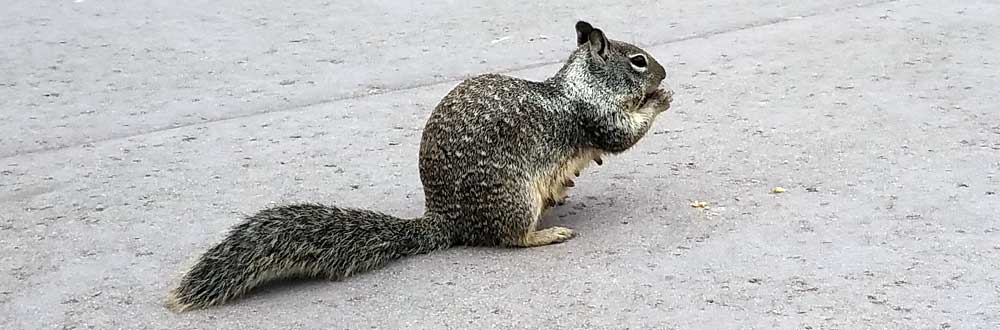
In the early 18th century, squirrels were popular pets in Britain and the American colonies. In fact, Benjamin Franklin once wrote a grand eulogy for a girl’s pet squirrel named “Mungo.” The adjective sciurine means “referring or pertaining to squirrels.”
This episode is hosted by Martha Barnette and Grant Barrett, and produced by Stefanie Levine.
Photo by Grant Barrett. Used under a Creative Commons license.
Books Mentioned in the Episode
Music Used in the Episode
| Title | Artist | Album | Label |
|---|---|---|---|
| Saturday Night Special | Lyman Woodard Organization | Saturday Night Special | Strata Records Inc |
| Cheeba | Lyman Woodard Organization | Saturday Night Special | Strata Records Inc |
| Sweet Revival | Ronnie Foster | Sweet Revival | Blue Note |
| Belle Isle Daze | Lyman Woodard Organization | Saturday Night Special | Strata Records Inc |
| Allen Barnes | Lyman Woodard Organization | Saturday Night Special | Strata Records Inc |
| Lisa’s Love | Ronnie Foster | Sweet Revival | Blue Note |
| Creative Musicians | Lyman Woodard Organization | Saturday Night Special | Strata Records Inc |
| Kimba | Lyman Woodard Organization | Saturday Night Special | Strata Records Inc |
| Volcano Vapes | Sure Fire Soul Ensemble | Out On The Coast | Colemine Records |

