

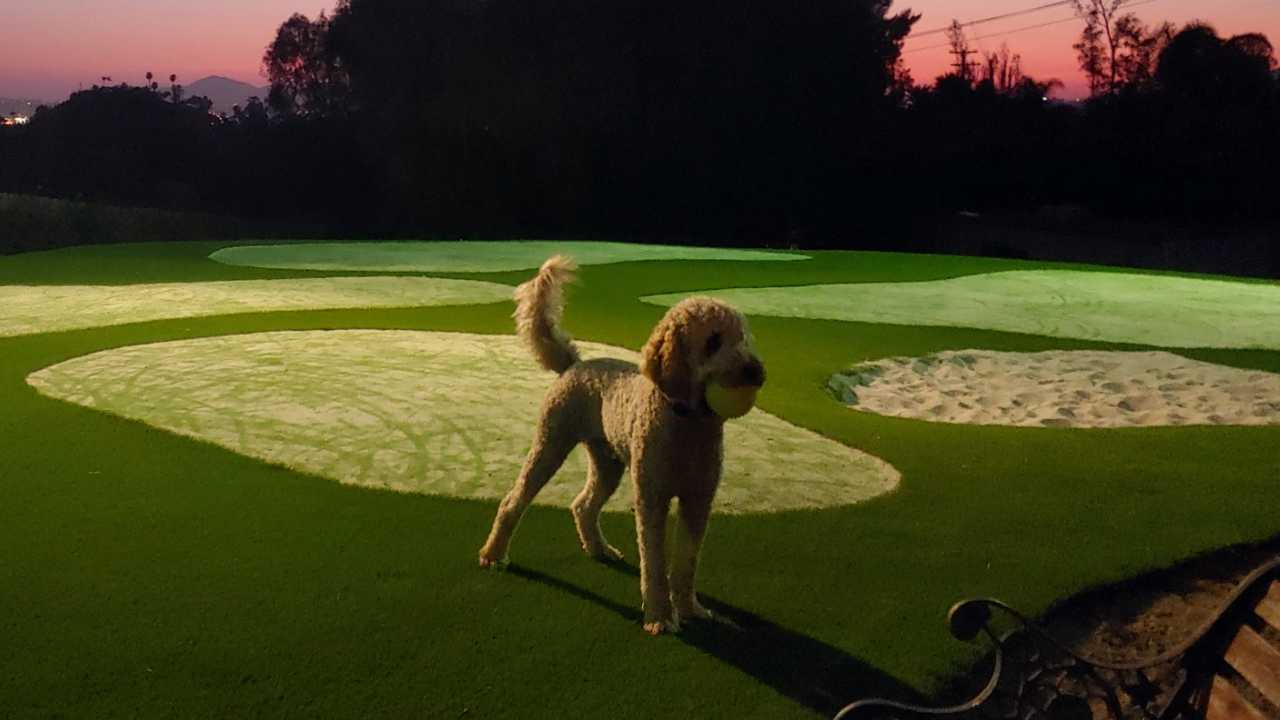
Critters, co-workers, and clothes: What do you call your favorite mixed-breed dog? There are Heinz 57 mutts and Texas brown dogs in the U.S., while in parts of the Caribbean they’re called potcakes and coconut retrievers. Plus, among firefighters, if you’re not pulling your weight, you’re called a bagger, a term with military origins. And: if your clothes are piled high on the floor and not in the closet, that’s what you call a floordrobe. Also, curbstone sitters, sky-blue pink, a poem about cornbread, the lurgy vs. the crud, turn on the lights vs. turn off the lights, absolute weapon, a word puzzle with pairs of words, autocorrect vs. autocorrupt, an axe to grind, and for crying out loud!
This episode first aired August 15, 2026.
Transcript of “Apple Turnover (episode #1686)”
You’re listening to A Way with Words, the show about language and how we use it.
I’m Grant Barrett.
And I’m Martha Barnette.
We had a question from Liz Basquin Krause, who lives in West Lafayette, Indiana.
And she writes, If you ask my father to state his favorite color, he would answer sky BluePink.
As a little girl, I thought that wasn’t fair because he did not pick a color.
As an adult, my siblings and I decided it was the color of the sunset, and it is a fond remembrance.
Is this a known expression?
Yeah, it sure is.
It’s got a deep history and often used exactly that same way as what’s known as a fobbing off phrase.
When a child or somebody asks you a question you don’t feel like answering, and you just give them some silly thing in response.
Right.
That color is sky blue pink.
There’s an entry for this in Reese’s books of quotations, and more than one of the books.
Books.
And he has a longer form, which is sky blue pink with a finny hatty border.
Fini hatty is kind of a smoked, a smoked haddock.
I think famous from Scotland.
Yeah, a town in Scotland.
So a border of smoked haddock?
I don’t I don’t really know.
And he also has another version.
He’s got some quotes from correspondence, one of them is Sky blue scarlet, the color of a mouse’s fart.
Okay?
Oh my goodness.
But it goes back at least a 130, that color.
Yeah, yeah.
It’s been around for a while.
Yeah, and it was also popularized by the Uncle Wiggly series of books in the early twentieth century.
But I think I like the simple version, sky blue pink.
We’re so excited to get your stories, thoughts, ideas, and questions about language.
Call or text toll free in The United States and Canada, (877-929-9673.
Email wordswaywardradio dot org, or go to our website, waywordradio.org, where you can find all our past episodes and a dozen ways to reach us.
Hello.
You have A Way with Words.
Hi.
This is Sid calling from Dallas, Texas.
Hi, Sid.
How are doing?
What’s up?
So I’m calling in because I wanted to share one of my favorite pieces of workplace jargon.
I work at an animal shelter in Texas, and so, being in The US South, we have a pretty significant issue with dog and cat overpopulation.
So between backyard breeding and accidental litters, we actually, end up with a lot of mixed breed dogs that are some combination of separate pit bull husky, and they all kind of end up looking very similar to each other.
They’re like these big dogs, tan, just kind of like your quintessential dog.
Mhmm.
And we like to lovingly refer to these in my shelter as Texas brown dogs.
So whenever we have somebody, like a client coming in for an adoption and they’re looking at a puppy and they ask, what breed is he?
We don’t really have any way of knowing exactly what mix of breed they mix of breeds they are.
So, really, we just say, oh, he’s a good old Texas brown dog.
Yeah.
Yeah.
I love it.
Do you call them TBDs for short?
We should.
Yeah.
Because I’ve seen that in some of the some of the places where these lists are collected of of terms for for mutts.
And and this is what we’re talking about, right?
Just your your good mix of dog.
Yeah, exactly.
I I actually wanted to ask you guys if there were any other fun regional words for mutts and mixed breeds that I can add to that lexicon.
Oh, there sure are, Sid.
And first of all, thank you for your work.
It’s very much appreciated.
I guess I have a Texas brown dog myself, a bear.
Oh, really?
Yeah.
Yeah.
I never would have guessed it, but we did his DNA, and he looks sort of like a lab.
But but he’s a mix.
He’s mostly pit bull and German shepherd and boxer.
Yeah.
Exactly.
Yeah.
Yeah.
So so I know exactly what you’re talking about there.
And I don’t know if there are other, terms around The US.
I really like Texas brown dog.
I’m gonna appropriate that myself.
But there are some wonderful terms for, mutts around the world.
I know in, in, South Africa, they’re often called pavement specials, you know, because they’re Yeah, that reminds me of an old fashioned, American one, curb stone setter, s e t e e r.
Or curb stone sitter, with an I.
It’s very much the same idea, just a dog you find on the street.
Right, right.
Or in Brazil, there’s a term vira latas, which literally means garbage can tippers, you know, because those street dogs will go, you know, from can to can.
Or in The Bahamas and Turks And Cake Coast, they call mixed breed dogs pot cakes, which is named after the crusty layer.
Oh, yeah.
Did you have an moment there?
Yes.
I have an old coworker who does a lot of work in Turks and Caicos with whales, and she’s talked about the pot cakes out there.
She gifted me, like, a little coaster with a picture of one of those dogs that says, like, we love cocktails.
Oh, yeah.
The The Caribbean hits some bunches, sometimes called pothounds.
The idea is you feed them whatever scraps are left in the pot.
Or rice dog.
Coconut retriever is my favorite one.
Coconut retriever.
Yeah, you’re in Caribbean area.
Oh, I need to use that one.
That’s really good.
Yeah, try that one.
But I tell you, one of the terms that I really like is from Brussels, Belgium, because there a mixed breed is called a zynica, which means mutt.
But there’s this wonderful turnaround for this word because Brussels is a real crossroads.
It’s a really mixed area of French and Walloon and Belgian folks and a lot of immigrants there too.
And Zinnika, the term for mutt, is now a nickname chosen to represent a person from Brussels who wasn’t born there.
And it’s a very proud term.
In fact, every couple of years, they have a Zineca parade, which celebrates the city’s diversity, you know, all the immigrants and all the the mix of cultures there.
So it it sort of moved from the dog world to the people world.
So that’s, that’s one of yeah.
The ones I really love.
Isn’t it lovely?
Sid, I, I wanted to ask you, this one’s a little old fashioned, but does anyone call the Texas brown dogs the, the mixed breeds Heinz 57 dogs or Heinz dogs?
I have never heard that.
Okay.
Because that’s, you know, Heinz 57 flavors.
That’s an old fashioned one for anything that’s There’s a one more.
I’ve seen this, a Texas amalgamated brown dog.
So the amalgamator will show up again and again in these terms kind of as a fancier word for mix or mutt.
Well, Sid, the cool thing is that, we have listeners all over the world and all over The United States, and I’m really excited to hear what other terms we have for these wonderful animals.
Me too.
All right.
You take care now.
Give those dogs some extra scratches from us, all right?
Yeah.
Yeah, absolutely.
Thanks so much for having me.
Tell them hi from Bear.
Bear says hi.
Take care, Sid.
Y’all have a good day.
Bye bye.
What do they call a mixed breed dog out your way?
You know, those dogs where you’re not quite sure of their origins and they don’t much matter because you love them anyway.
Call or text toll free in The Canada and United States, (877-929-9673 or email wordswaywardradio dot org.
Hello, you have A Way with Words.
Hi, this is Bebe.
I’m calling from Charlotte, North Carolina.
Hi, Bebe.
Welcome to the program.
What’s up?
Thank you.
So I am not, a first language English speaker, and I lived in England before I moved to The United States.
And when I lived in England, whenever someone was sick with something like a cold or something like that, that would say they have the lurgie.
And so when I moved to The United States, that’s what I would say.
I would say, oh god.
I’ve got the lurgie.
And people would be like, oh, that’s weird.
Is that contagious?
Is that something really bad?
Right.
And so after a few years, I learned that here, you say you have the crud and not the lurgie.
And so I’m wondering why there are different words and where those words even come from.
Martha, don’t you think BB is pointed out, like, this perfect match of how the British and American language differ?
It’s just a It’s perfect just exactly the right example.
Yeah, and they’re both great words because they both just sort of sound like what they are.
So lurgie is L U R G Y cred or Right, C R U right.
And, yeah, they’re very specific to those two different places.
Lurgie goes all the way back to at least the seventeen hundreds when the lurgie referred to laziness or idleness or sort of jokingly a medical condition.
You might, if you didn’t feel like working, you might say, have the lurge or the fever lurge or the fever lurden.
And by World War II, in British military slang, lurge could refer generally to an imaginary catch all disease.
And then I know Grant is gonna get excited about this because something very important happened in 1954 involving Involving a radio comedy on the BBC called The Goon Show.
This is an extremely silly episode called Lurgey Strikes Britain, and it featured this terrifying epidemic of the dreaded lurgey.
This terrible disease gave its victims this uncontrollable urge to yell, To yell what, Grant?
Yakabul!
What did they yell?
They would yell, Yakabul!
Oh, Yakabul!
Yeah.
The dreaded lookie.
Don’t forget, that’s what they call it in this episode.
The dreaded alert.
Always with the dreaded.
And this episode just gets sillier and sillier.
They figure out that the one thing that all these victims of the lurgie have in common is that none of them plays in a brass band.
So, perfect goon show episode because it is high speed, manic.
It is silly, silly, silly.
They’ve…
They all practice comedy from the lowest fun to the the highest illusion, like, to Greek classics.
You know what I’m saying?
Everything in between.
It is Yeah.
And it was so very British.
I think even at the time, a lot of the references probably just went over people’s heads because it’s so fast.
Yeah.
And so silly because in this episode, the government buys 50,000,000 brass band instruments and drops them over a town that has lots of lurgey victims because, you know, the one thing they have in common is that they don’t play in a brass band.
So in short, what you’re saying is that lurge kind of went from this semi obscure turn for skiving off of work or being indeterminately ill to being something that everyone knew and everyone used.
It’s real fun.
At BB, you can find goon show episodes out there on the internet, and that BBC actually still broadcasts them on streaming if you’re, if you have a way to get that on BBC Radio four extra.
That’s amazing.
I’ll have to look it up.
In any case, thank you, BB, for turning us on to this really good topic of just one of the kind of basic ways that the two dialects differ.
Well, don’t get Grant started on an all time radio comedy.
We’ll be here all day.
I’m not going to be, I’m not going to give you the creeping crud by talking about OTRs, they call it.
Thank you so much.
This was great.
Yeah.
Sure.
Take care.
Okay.
Bye Stay healthy.
Thank you.
I’ll try.
Bye.
Well, don’t be a sleazy vomitous crud.
Give us a call toll free (877-929-9673 in The US and Canada.
Or go to our website where you can not only find all of our past episodes at no cost, but you can find more than a dozen ways to reach us at waywordradio.org.
We got an email from Ronnie Arnold who lives in Texas and apparently listens to us very early in the morning.
He said, today you had a discussion proposing a new word, Mico, for an error when you’re dictating on your phone.
He said, I was literally shouting from my bed.
Doesn’t everyone know that those types of autocorrect errors should be called autocorrupt?
Oh, yeah.
I’ve heard that one before.
Autocorrupt errors.
That’s a good one.
Yeah.
Well, give us a shout, (877-929-9673.
You’re listening to A Way with Words, the show about language and how we use it.
I’m Martha Barnette.
I’m grandparent, and dressed in gold lame and wearing rocket boots and a helmet about to do a stunt.
It’s our quiz guy, John Chaneski.
Woof.
Watch out, guys.
Back up.
This is gonna be big.
I’m auditioning for Starlight Express.
It’s gonna be great.
Let’s get to this quiz.
Okay.
I’ll I’ll do the stunt after.
I promise.
This is a quiz adapted from a question category on a popular television game show.
You might be familiar with the category.
It’s called before and after.
Does that ring any bells?
Is this a Jeopardy!
Category traditionally?
I’m not familiar with that show, but, it’s probably something like that.
Yeah.
I’ll give you a clue to two answers.
Both are two word phrases, and the second half of the first answer is the same as the first half of the second answer.
Okay.
So they can overlap.
For example, if I clued, It’s a fruity pastry.
You might find just under a man’s chin, the answer would be, Adam’s apple turnover.
Gotcha.
Okay.
Adam’s apple, apple turnover.
I was thinking about beefcake whole, but that doesn’t work.
That’s something.
There’s something there.
I’ll work on that next time.
Something there.
Now to simplify things this week, every overlap word like apple in Adam’s apple turnover will begin with a.
Okay.
Just just for a thing to do.
Oh, okay.
Also, you’ll note that for for language reasons, the second part will typically be clued first, like I did with this.
You’ll see what I mean.
Here we go.
It’s a light, fluffy, baked dessert that watches over and protects you in a heavenly fashion.
Angel food.
Yeah.
Angel Guardian angel food.
Guardian angel food I will take, or guardian angel cake.
That’s perfectly well, perfectly fine.
Very well done.
Very well done.
Guardian angel cake.
Guardian angel, angel cake.
It’s the record of friends names and phone numbers kept by Abraham Lincoln in Pennsylvania.
Gettysburg address book.
Gettysburg address book.
Gettysburg address book.
Either one.
It’s a little weird there, but I was thinking about Rolodex midnight runners or something, but that’s just another clue all the time.
I miss Rolodexes.
The way they used to spin around and flip Flap.
Flap.
Flap.
Flap.
Yep.
It’s a famous highly classified US Air Force base that may or may not contain aliens, but does have a gas station and places to eat and just relax during a long trip.
Rest Area 51.
Rest Area 51.
That’s what the aliens call it.
It’s gotta be a thing.
We’re just a stopover on the way to better planets.
Sure.
It signals the beginning of Lent and involves the fine pulverized rock created during an eruption.
Volcanic Ash Wednesday?
That is it.
Exactly.
Volcanic Ash Wednesday.
Volcanic Ash, Ash Wednesday.
No.
Volcanic ash Wednesday.
He’s just your regular working class guy who happens to know a lot about baseball players’ stats at home plate.
So Joe blow by blow?
No.
Remember the middle word, the middle the overlap word will always begin with a.
Oh, I see.
Oh, right.
So average Joe average Joe something?
Batting average Joe.
Yes.
Batting average Joe.
There you go.
Batting average, average Joe.
Batting average Joe.
It’s a trippy music genre from the nineteen sixties that focuses on oranges, grapefruits, lemons, and limes.
Citric acid rock.
Knocked it out of the park.
Very good.
Citric acid.
Good.
Acid rock.
At our age, it’s citric acid reflux.
Okay.
Guys, that was fantastic.
You did very well at before and after.
Good good teamwork.
All right.
Give our best to the family, and we’ll talk to you next week, John.
You too, guys.
Talk to you then.
Take care, John.
One of the nice things about this show is John Chaneski shows up to make our lives difficult, and we love it.
You can also mark our lives wonderful by calling or texting toll free in United States and Canada.
Hi there.
You have A Way with Words.
Hi.
This is Mandy Flowers calling from San Antonio, Texas.
Welcome to the show, Mandy.
What can we do for you?
This is actually something that happened about twenty years ago.
It was a while ago, and I had a friend who was Canadian.
And at the time I was living in we were both living in South Korea, and, I met most of my Canadians outside of The US.
But she used to say something to me, and it always confused me.
And I I was never really sure how to answer when she would say it.
And so I I I just wondered about it.
I know what I know about her is that she was from Newfoundland, and she was from an island called Saint John’s Mhmm.
In Newfoundland.
And so I assume that that must have something to do with where it comes from.
But, anyway, so she would call me and she would say like, I would answer the phone, and I would answer the phone, and I would say, hello.
And she would say, hey.
What are you at?
This just confused me.
What are you at?
Yes.
Did she have a did she have a follow-up to that, like, a second phrase that she would say after?
Yeah.
She would say, I’ll come where you’re too.
Yeah.
There’s the fulfillment.
It’s kinda like a shaving haircut waiting for the the two bits.
And I never knew what she was asking me.
If she was asking me where I am or what I’m doing or how I’m doing, It was I didn’t know if it was, like, what’s up?
Which is, you know, a weird way to ask how people are.
So I would usually just give an answer that answered all of those things.
I’d be like, I am at my house doing laundry, and I’m going to go to the store later.
And I’m fine.
Thanks for asking.
I would give her this ridiculous long reply because I just tried to cover all my bases.
And she would always laugh at me, but she would never correct me.
So she always would giggle.
You know?
So it came up.
I I was going through my old journals, recently, and I came upon this where I was like, what is this?
What is she asking me?
So I I felt maybe you could shed some light on it.
Such a good insight the way you’ve told this story into the speech of Newfoundland.
And actually, this particular phrasing, What are you at?
I’ll come where you’re at.
I was also heard in Prince Edward Island.
But it’s so well known in Newfoundland that it’s what linguists call unregistered.
I usually call them chamber of commerce words where people are highly aware that they say it.
It has a strong association with local identity, and they don’t consider it like a socially risky at all.
It’s just it’s a marker of how they speak.
And particularly important here, and I think if we break this down, most people who don’t speak that dialect would stumble on the at and the to because they seem like not quite the right words in those slots, right?
Yeah.
I was never quite sure.
She was asking me, I’ll come where you’re to.
She was saying, She’ll come to where I’m at right now or to where I’m going.
Like, she’ll meet me somewhere.
It’s basically saying, Where are you?
I’ll come join you.
Or, and sometimes it is, What are you up to?
Or, Let maybe let’s do it together.
But it just can really depends on the context.
The the at and the to here are what are called locative or sometimes stative, which meaning they serve almost like a verb when they’re, they, they explain kind of activity in a particular location.
Here’s another example from a CBC interview that I plucked from a book of Newfoundland and Labrador English.
It goes, I’d like to live in Europe someday or here wherever the money’s to.
So it’s, it’s kind of like almost always a follow-up to the verb.
It almost serves as a verb itself.
In any case, there are a couple of really great books on this.
And one of them pointed out that there was a song in 1966.
There was apparently a hit in Newfoundland by Dick Nolan because it was kind of a comeback to Newfoundland year where they had like a campaign that if you had gone away from Newfoundland, they were encouraged you to come back.
But his song was called Come Where We’re At.
And it had many lyrics in it.
They were very similar to the expression that you that you gave us.
What are you at?
I’ll come where you’re at.
So how do you reply to that?
Like, what would a Newfoundland person say as answer?
Yeah.
Yeah.
They they would generally say something like they would just talk about what they’re doing, just like you did.
You actually answered pretty well for somebody who’s For from somebody from away, you did okay.
I covered all the bases with my very long answers.
Yeah.
Okay.
I just wondered if there was, an equally colloquial way to answer that.
And maybe she was laughing at me because I didn’t use it.
No.
She’s just laughing probably because she knew that it was a localism, and she was just delighted to to be able to have this strong sense of being who she is even in a strange place like Seoul, Korea.
I mean, strange if you’re from Newfoundland.
Right?
Yeah.
Yeah.
Strange if you’re from anywhere but Seoul, really.
It stuck with me all these years.
Well, maybe stay where you’re at, and maybe we’ll come where you’re too when we hit the road and do our live shows.
Looking forward to it.
Thank you so much.
All right.
Take care.
Bye bye.
Take care.
All right.
Bye bye.
Well, come where we’re too.
That’s toll free in The US and Canada.
Or you can email us wordswaywardradio dot org.
You know, we were talking earlier about names for mixed breed dogs, and we forgot one, which is Bitsa.
Bit…
Oh, a bit of this and a bit of that.
Yeah, yeah.
B I t s a, Bitsa.
Oh, that’s nice.
And, you know, I’ve known a few dogs named Bitsa, which is, I think, a form of Betsy.
I could see that working out for, you know, a sweet little brown mutt.
Right.
Betsy’s Ibiza.
Betsy Ibiza.
(877-929-9673 is a twenty four hour toll free number in The United States and Canada.
Hello.
You have A Way with Words.
Hello.
I’m Rod Wing calling from, Tucson, Arizona.
Hi, Rod.
We’re glad to have you.
What’s on your mind today?
Yeah.
I I had a phrase that, I was interested in, that my my wife and her siblings say.
The the phrase is close the lights, and that’s always kind of bug me.
Mhmm.
And she’s, you know, close the lights instead of turn off the lights.
And she’s Chinese American, and her family, her her parents, her father was born in in Guangzhou, China, and mother was born in Chinatown, San Francisco.
So I thought this could be possibly a direct translation from Cantonese into English.
So that that’s that’s what I’d like to know more about.
Close the light instead of turn off the light.
Yes.
The clues you’ve given us and your interpretation of them is right on.
It is most likely what’s known as a CALQ, c a l q u e, which is basically a literal loan translation from another language where it’s almost word for word.
And the really interesting thing here is even though you find it a little annoying, English is the odd language out.
Most of the languages of the world don’t use a verb that equals turn or turn on, turn off.
Most of the languages of the world use verbs that are mean close and open when they talk about lights.
So we’re kind of the exception.
And so, it’s not only people from Asia who do this, like you’ll get people from Singapore and Malaysia, but also people from Nigeria, India, Pakistan.
It just and even pockets of The United States, you’ll find it.
People who just…
Because for them, there’s a little bit of history why you might say close the light in, in our culture and other cultures.
The interesting thing here is why people say close the light instead of turn the light.
It’s because lights have been handled differently at different times in the modern era.
Some people grew up with turn knob electrical switches, which was common in The United States.
Some people grew up with knobs on lamps that raised or lowered a wick, And some people have little doors on lamps that you could move back and forth to change the amount of light or change the amount of air getting to the flame inside, again, controlling how much light is happening.
And so all of these verbs for these other devices kind of inconsistently showed up when electricity became more standard, and the standard modern flip switch became, kind of just par for the course in most electrical builds out in in North America.
So So this is why we have these different pockets of this, different cultures adapted in different speeds and in different ways to electricity, going from flame devices or gas devices to to electrical devices.
Wow.
That’s pretty, that’s really interesting.
You call that a a calc?
Calc, c a l q u e.
Yeah.
It’s a literal, like, word for word loan translation from another language.
I have a technician who works in my my my lab, and I asked him today about this.
And he’s from The Philippines.
Yep.
And he says he uses, you know, close the lights.
But he also said lit the literal translation in Tagalog is kill the light.
Oh, interesting.
Which was pretty interesting.
Interesting.
Yeah.
But even in English But he doesn’t use that.
He doesn’t use that.
Yeah.
In The Philippines, though, you do.
I do find in my books the Philippine English, I do find plenty of examples of people saying close or open the lights.
What really interesting is that we have fixed in our heads that somehow turn the light is the default verb, but it’s just a passing verb.
It’s just it’s only for this moment, kind of this short little blip of history, and I’m calling, you fifteen to a hundred years of blip because history is huge.
It really isn’t hasn’t been entrenched in the language all that long to refer to electricity, because electricity isn’t hasn’t been all that common for all that long.
So it’s not like it’s been, like, goes back to time and mortal that we’ve been saying turn off the light.
So I should say to my wife and her siblings that that they’re in the minor the majority.
You should.
That’s right.
But but also just enjoy the pictures.
Yeah.
If we all spoke alike, how boring would that be?
Okay.
Well, I I stand corrected then.
My I’ll have to tell my girls it’s okay to say, close the light.
Yeah.
Sounds like it’s you’re you’re night to make dinner too, Rod.
That’s what I’m thinking.
Empty the dishwasher.
Yeah.
Rod, thank you so much for calling.
Yeah.
It’s in trouble.
Appreciate it.
Alright.
Nice to talk to you.
Thanks so much.
I really enjoy your show.
Oh, thank you.
Care.
Bye bye.
Bye bye.
Call or text (877-929-9673.
Hello.
You have A Way with Words.
Hello.
Martha Berry France.
I’m calling from Grand Rapids, Ohio.
It’s just a small community South West of Toledo, Ohio.
Yeah.
Yeah.
Definitely.
So what’s on your mind, Martha?
Well, I was curious about the phrase, having an axe to grind.
And I wondered, you know, obviously, a long time ago, there was a guy that went around and sharpened blades Mhmm.
Scissors, daggers, axes, etcetera.
And then and now it seems as though if you have an axe to grind, it’s kind of a negative thing.
Like, you’ve got a chip on your shoulder, or, you know, you’re hepped up about something and you need some resolution.
So I was curious about how it changed or what, what caused the change.
That’s very perceptive, Martha.
And my Martha, my radio Martha, she’s kind of really zeroed in on these two different meanings, hasn’t she?
Yes, indeed.
The meaning of this term has changed over time.
And as you said, today to have an to grind means you have a grievance or a complaint, right?
Yes.
Well, Martha, the first known use of the expression to have an axe to grind appears in 1810.
That’s when a Pennsylvanian newspaper editor named Charles Minor wrote about being flattered into doing the hard work of turning one of those heavy grindstones for a stranger to sharpen his ax.
And then he applied that image to people like politicians and merchants and other people who seem eager to help, but they really have something to gain.
They have some sort of ulterior motive.
And in this article, he writes about how if he sees an overly friendly shopkeeper offering sips of brandy to his customers, he writes, thinks I, that man has an axe to grind.
So originally, didn’t have the meaning that it has today, but over time, its meaning broadened.
And now we think of it, as you suggested.
You know, you have a grievance, you have a complaint, you have something that you got to talk to somebody about.
You’re not happy about something.
So it’s really undergone a change in meaning.
Quite a bit, I’d say.
Yeah, yeah.
Yes.
Okay.
Well, thank you very much.
I really enjoy your program.
Martha, in Ohio, thank you so much for spending time with us.
We really appreciate it.
It’s been my pleasure.
Thank you both.
All right.
Bye bye.
Take care.
You can find all of our past episodes on our website at waywordradio.org, where you’ll also find all of our social media handles and lots of ways to talk to us.
Stay put.
We’ll be right back to Untangle the Web of English.
You’re listening to A Way with Words, the show about language and how we use it.
I’m Grant Barrett.
And I’m Martha Barnette.
Hi, you have A Way with Words.
Hi, my name is Ryan.
I’m calling from Asheville, North Carolina.
I am a wildland firefighter, and we have a word.
The word is bagger, and we use it to describe other firefighters in a, I guess, derogatory way, meaning, like, lazy or unprofessional or maybe amateur.
So I’m curious if you guys have any ideas about the origin of the word.
So I’ve heard a few different explanations.
One being that it describes a firefighter that shows up to a camp and gets a bagged lunch, and that’s all they really show up for.
And they don’t really do anything.
They kind of disappear, don’t put in any work.
I’ve also been told it’s kind of an older term that describes nonprofessional crews that just show up to fires just with the backpack on their back.
And then the third thing I’ve heard is it describes someone that shows up and attaches their bagged lunch to their belt.
So I’m curious if you guys have any ideas on that.
I hear your doubt as you recite the last one.
Yeah.
It’s it kinda sounds weird, but I think that’s a much older term or an idea, I guess, than before we had equipment to carry our bag launch, I guess.
All three of those supposed origins all really lack evidence, and they’re all not that great.
And they sound like they were just devised after the fact to try to explain the term.
For example, pretty much everybody who goes to a fire brings some kind of bag, don’t you?
When you’re out there, don’t you have your belongings in a container?
Oh, yeah, absolutely.
So the idea that this one particular group of people who brings a backpack, that they’re the ones get called bagger just doesn’t seem right.
And as far as the bagged lunch goes, yeah, there are definitely people who go, all they’re there for is whatever minimum amount of money they’re gonna make them, and they find a way not to do the work.
That happens pretty much everywhere.
But I have something for you that I think for me is convincing that it doesn’t come from any of those possible origins, and that is that forms of this term exist in the military.
And in the military, they seem to be older.
And in the military, a bagger, we’re talking about bagger, b a g g e r, is short for dirtbagger, or, let’s call it S-bagger, S being the first letter of the word that means fecal matter, Or, of course, dirtbag or S-bag for short.
Obviously, the term isn’t S-bag.
It’s the thing I can’t say on the radio bag.
And in the military, especially the Navy, it has exactly the same meaning.
It’s the kind of person who is constantly trying to get out of work or not do the things that they’re capable of and just don’t want to.
And all of these are also probably from the much older sandbagger.
And a sandbagger, again, is somebody who just doesn’t do the job, or they always have excuses about why it’s not getting done.
And it’s especially because they’re perfectly capable of doing it.
They’re just like, Meh, I don’t want to.
So the idea is that you’re got these sandbags that you’re doing, putting them in the way of actually getting real work done.
And this, of course, goes back to at least the 1940s.
And so, sandbagger becomes dirtbagger and sbagger, and then just is clipped to bagger in the military before it even leaves that.
And as confirmed from you or anything, it’s true.
A lot of people who fight fires are ex military.
Oh, yeah.
Absolutely.
So I think that’s a really strong path for that to show up among firefighters, to go from the military and leap over and be borrowed into the jargon and and language, the slang of firefighting.
Very interesting.
I appreciate it.
Ryan, we’re grateful for your work.
Yeah.
Absolutely.
Thank you It’s your for work there.
Doing the hard stuff out there in a world of serious climate issues, but, and stay safe.
And we know you’re not a bagger.
Thank you.
Pretty sure.
All right, you take care now.
We know.
Be safe out there.
Right.
Take Thank you.
Bye bye.
See you.
We’re always eager to talk about language in the work place, and Bagger is a great example of that.
If you have one, you can always call us, (877-929-9673, or email us wordswaywardradio dot org.
Hi, you have A Way with Words.
Hi, this is Jeff.
I’m in Knoxville, Tennessee.
Hey, Jeff.
Hi, Jeff.
Welcome to the show.
Well, thank you so much.
I’m glad to be here.
It’s kind of a phrase that really nobody else in my family remembers, but I remember it from as a kid playing cards with my grandmother.
And my mother does not remember it.
My sister does not remember it.
But my grandmother, whenever she would get a bad hand, whether we were playing crazy eights or king’s corners, it didn’t really matter.
And she had a bad hand, she would just say, oh, for crying in a bucket.
And it just struck me as funny.
It stuck with me this whole time.
I talked to my family about it, and they think I’m nuts because they never heard anybody say that before.
Really?
And you just have this great memory of this these fun times with your grandma.
I do.
I do.
I would spend the the night with her a lot of times and, you know, drink Pepsi out of the bottle and and play cards.
Sharp cheddar cheese was one of her favorite snacks on crackers.
So it’s good times.
It it just sounds like you guys are just painting the town red.
Shoes debauching you with the with the cheese and the Coke.
That’s right.
That’s right.
Exactly.
For crying in a bucket is an established expression.
What’s confusing about it maybe is that it itself is a different version of the much older for Christ’s sake.
It’s another one of those minstos, and we talk about a lot of them, where to avoid offending someone or avoid, you know, saying the Lord’s name in vain, you say something that’s roughly similar, but isn’t actually the offense.
So for crying in a bucket is one form of it.
For crying out loud is far more common version of it.
But, people will say for crying in the beer.
And they actually cry in, in this expression, a lot of things like, are you crying in a sink, a bathtub, the ocean, a cemetery, the creek, the soup, the dark, the alley, the rain.
There’s all these different things that you that you might cry into.
But it’s an expression of outrage or frustration or surprise.
Right?
Oh, well, that that tracks then.
That makes sense.
Jeff, would you describe her as somebody who would reach for that kind of minced oath rather than say something profane or even more angry?
Oh, for sure.
Yeah.
For sure.
I I don’t think I don’t think I ever heard her say anything, you know, any bad words whatsoever.
Oh, wow.
But so that kinda makes sense that, you know, that that would be a phrase that she would use.
She was an amazing woman.
She lost her husband, my grandfather, in World War two, and then raised three kids on her own, never remarried.
I was just one of the most resilient people I ever met in my entire life.
And but, you know, really fun to be with.
Love love to play cards and, you know, spend time with family.
So, yeah, it was good.
Well, I love that those memories of her are preserved in that little phrase.
Do you use it yourself?
I I do.
I I do much to my family, my my wife and my daughters.
You know, they’ve heard me say it for years, and they think it’s it’s cute and kinda funny, but didn’t you know, I think they thought the same thing.
I think they were thinking it was, you know, kind of a, oh, for goodness sake or something like along those lines.
Yeah.
Right.
But didn’t really have, you know, context No.
To what it might have been.
Well, now you know.
Now you can go back to people and say, see, I’m not just weird like my grandma.
Well, the jury is still out on that.
But Well, I think you’re fine, Jeff.
Yeah.
Jeff, thank you so much for calling.
Yeah.
We appreciate it.
Take care.
It’s helpful.
Sometime.
Absolutely.
Thanks so much.
Sure.
Bye bye.
Yep.
You bet.
You guys have a good day.
You too.
You too.
Well, for crying in a bucket, give us a call.
Kentucky poet and novelist Silas House writes often about growing up in Appalachia, and I wanted to read one of his poems.
It’s called Cornbread.
I like to scoop the meal up by hand, no spoon, so I can feel the grain on my fingers, wonder at the fields that gave it life.
I love the splash of egg, the gallop of buttermilk.
When I mix all of this, I see my mother cooking for me after a long day bent over stoves, spent serving all of the mean children at the Lilly Elementary School.
I see my aunt, cigarette planted firmly between her teeth as she holds the bowl against her belly, eyes on the young and the restless while the cast iron skillet of grease heats in the roaring gas oven.
I see my grandmother and every woman before her in my family, and yes, even the occasional man who lowered himself to cook, who secretly enjoyed fingering the meal.
And here I am too, time sick once again.
If I could go back, I would tell my mother to go, sit down, and rest.
I would memorize every word my aunt said as she taught me how to cook, how to live in this world, how to be myself.
I would kiss Mama on the forehead and spend time with her at her little wooden table, savoring every bite, listening.
I’d ask Granny to tell me that story one more time, please.
This is the curse of who we are as a people, always eating our own history, tasting the past.
That is such a perfect encapsulation of food and memory, And it evokes my own experience with my own family in Southeast Missouri, which has a lot in common with Appalachia, you know, the cornbread and the skillet.
Even the cigarette dangling while you cook.
Mhmm.
Yeah, this is a poem you can almost smell, right?
Oh, yeah.
I can smell the bacon fat you keep in the refrigerator that you pull out to grease the pan with before you pour the cornmeal batter Oh, yeah.
In The poem and the author again.
It’s Cornbread by Silas House, and it’s from his collection called All These Ghosts.
We’ll link to Silas House’s book on our website at waywordradio.org.
Martha and I love to hear what you’ve been reading, whether it’s poetry or literature or something else.
You can email us wordswaywardradio dot org or call and text toll free in The US and Canada.
Hi, you have A Way with Words.
Hi, my name is Brianna Green.
Hey, Brianna.
Where are you calling us from?
Hi, I live in Jacksonville, Florida.
All right.
We’re glad to have you.
What’s on your mind today?
Yes.
I was calling about a term that my family and friends use, but it’s something that only my family and friends seem to know about.
And it’s a term that if I were to use it with, new people who I’ve just met, they have no idea what I’m talking about.
So I thought that, it would be, a good, word to call in with, and that is that we call each other weapons.
And we, use the phrase weaponry or the word weaponry in a way that, does not seem to be as common as it is to those of us who, are in the know.
Now what does that mean to you?
Okay.
So we call each other weapons.
Like, usually, if that means that somebody’s causing a scene or they’re maybe acting a little bit crazy or they’re doing something weird, kinda like a weirdo.
Like, you’re being a weirdo.
You’re being a weapon.
Mhmm.
Oh, interesting.
Or if there was a scene of sorts of someone just doing something maybe in public, and afterwards we’re walking away, we might say something like, That was weaponry.
So an instance of being foolish or making a mistake?
Usually, yes.
Any idea how long you’ve been saying this or where you picked it up?
So I’ve been saying it ever since I can remember, and I believe so have my parents.
It comes from my dad and his family who are from Long Island, New York.
And it seems that anyone who has known my dad for a long time or has grown up around my dad Mhmm.
Will know what we mean when we say it.
They’ll know what we’re referring to.
But unless you’re tight with my family Mhmm.
Then the average person who we just met will if if I were to say, ugh, that that person was being a weapon or that was weaponry, wasn’t it?
They will be like, what?
Until I then explain that it comes from my dad in Long Island, New York.
So, Brianna, let me just ask you.
Do you does your dad have any connection to Ireland or Scotland?
Our family is Irish, partially.
Not fully.
Yes.
But what are we talking first generation Irish or just further much further back?
No, further back.
Okay.
The reason I ask, like, even a trip to Ireland or Scotland, because a very similar use of weapon exists in Scotland and Ireland, sometimes in Australia and The UK.
I’ve got examples of this where people talk about somebody being a weapon.
It’s often derogatory, kind of the same way that in The US, when you call somebody a tool, you know, you’re a real weapon.
They might say you’re an absolute weapon.
But sometimes it’s a especially in sports uses where you call somebody an absolute weapon, meaning that out on the pitch or the field, they’re amazing at whatever position they’re playing.
Other uses of this do exist outside of your family.
Great.
That’s what I was interested in hearing.
Maybe similar to, it has been used by Chuck Norris, as in I I don’t need a weapon.
I am one.
Love it.
Right.
Clearly a positive use, right?
Exactly.
Right before my stepson graduated from college, he kept describing himself as an academic weapon, and his friends were calling themselves apparently academic weapons.
There was a meme going around at the time where you can watch this little video on TikTok where this guy is is talking about how he’s an academic weapon because he’s on the front row of a big lecture class with 700 students in there.
He’s he talks about how he’s an academic weapon, and let’s let’s do this.
It’s very funny.
Okay.
I could see it.
See, and just another great example of how it can be quite a versatile term.
Mhmm.
Yeah.
The emphatic force or the kind of, like, the emotional impact of the concept of a weapon is kind of carried through, positive or negative.
Right, of course.
Thank you so much.
I had so much fun.
I really appreciate it.
All right.
Bye bye.
Take care.
Thank you.
Well, what’s the word or phrase that your family uses?
And when you use it, people look at you like, What?
Give us a call and let’s talk about it.
Or send us an email, wordswaywardradio dot org.
Grant, I was pleased to see that the editors at the Oxford English Dictionary just made a new entry for the word floordrobe.
Floordrobe.
This is instead of putting your clothes where they belong, in the closet, the wardrobe, or the drawers, you pile them on the floor.
That’s right.
The dictionary defines it as an untidy heap of discarded clothing left on the floor of a room instead of stored in a wardrobe.
Yeah, yeah.
I think their definition doesn’t really do the chaos justice, but okay, dictionary people.
A little straight laced.
I’m glad to have a word for it.
Apparently, it’s been around since at least, 1995.
How about that?
Not not that I have a floordrobe or anything.
-huh.
No.
No really.
No really.
Sure.
We know you’ve got all kinds of family language that describes the chaos and mess that it just happens when you live, and when you live together.
Call us (877-929-9673.
Email wordswaywardradio dot org.
A Way with Words senior producer is Stefanie Levine.
Tim Felten is our engineer and editor, and John Chaneski is our quiz master.
Go to waywordradio.org for all of our past episodes, podcast links, and ways to reach us.
If you have a language, thought, or question, the toll free line is always open in The US and Canada.
702-0673.
A Way with Words is an independent nonprofit production of Wayword Inc.
It’s supported by listeners and organizations who are changing the way the world talks about language.
Although we’re not a part of NPR, we thank NPR stations throughout The United States that carry the show.
And special thanks to our nonprofits volunteer board, Michael Bresslauer, Josh Eckels, Clare Grotting, Merrill Perlman, Bruce Rogow, Rick Sidemorm, and Betty Willis.
Thanks for listening.
I’m Grant Barrett.
And I’m Martha Barnette.
Until next time, goodbye.
So long.
“Sky-Blue Pink,” Maybe with a Finny Haddy Border
 The expression sky-blue pink is what’s known as a “fobbing off phrase,” a playful, nonsensical answer for when a child asks one too many questions. Variations include sky blue pink with a finny haddy border (the word haddy meaning “Scottish smoked haddock”) and sky-blue scarlet, the color of a mouse’s fart. The phrase sky-blue pink has been around for at least 130 years and was popularized in the early 20th century by the Uncle Wiggily series.
“Texas Brown Dogs,” “Pavement Specials,” “Potcakes,” and More Mutt Monikers
Sid from Dallas, Texas, works at an animal shelter where staffers lovingly refer to the many large, tan mixed-breed dogs there as Texas brown dogs, or TBDs. Are there other colorful regional terms for mutts? In the U.S., they’ve been known as curbstone setters or curbstone sitters, as well as Heinz 57 dogs or Heinz dogs. In South Africa, they’re called pavement specials, and in Brazil, they’re referred to with the Portuguese term vira-latas, or “garbage-can tippers.” Throughout the Caribbean, there are several more terms, including potcakes, pothounds, rice dogs, and coconut retrievers. In Brussels, Belgium, a mixed-breed dog is a Zinnike, a name that has also come to describe proud residents not born there, and in fact, that city’s multicultural nature is celebrated with a Zinnike parade.
How “The Lurgy” Went from 18th-Century Joke to Wartime Slang to “The Goon Show”
When Bebe, a non-native English speaker in Charlotte, North Carolina, moved from England to the United States, she learned that a minor illness isn’t called the lurgy but the crud. In the 1700s, lurgy was used jokingly to refer to “a vague medical ailment” or plain old “laziness.” By the Second World War, the lurgy took hold as military slang for an imaginary catch-all disease. The term got a boost from the long-running BBC radio comedy The Goon Show. In a 1954 episode called “Lurgi Strikes Britain,” victims of the dreaded lurgy had an uncontrollable urge to yell “Yakabool!” When it becomes clear that playing in a brass band immunizes people from the affliction, the government proceeds to drop planeloads of brass band instruments on a town.
What to Call a Phone Dictation Error: “Mico”? “Autocorrupt”? Something Else?
After a listener suggested that a phone dictation error might be called a mico, formed by analogy with typo, a Texas listener wrote to say that such autocorrect blunders are better referred to as autocorrupt.
A “Before and After” Word Puzzle
Quiz Guy John Chaneski presents his “Before and After” game, in which a pair of two-word phrases overlap on a shared word. For example, what do you get if you combine a fruity pastry with a part of a man’s throat? An Adam’s apple turnover, of course. In this particular puzzle, each in-between word in the answer begins with the letter A. So if John mentions a light, fluffy, baked dessert that watches over you and protects you, what exactly is he talking about?
Newfoundland English “What Are You At?” Means “What Are You Up To?”
When Mandy of San Antonio, Texas, was living in South Korea, her Newfoundland friend would call and ask, What are you at? and follow with I’ll come where you’re to. The phrasing is a well-known bit of Newfoundland English that means something like “What are you up to? I’ll join you.” The at and to in this case carry locative or stative meaning. Sandra Clarke’s Newfoundland and Labrador English (Bookshop|Amazon) gives a similar example from an interview: I’d like to live in Europe someday or here, wherever the money’s to. The lyrics to Dick Nolan’s 1966 hit “Come Where We’re At” employ the same construction.
A “Bitsa” Dog is Bits of This and Bits of That of That
A mixed-breed dog is sometimes called a bitsa, as in it’s made from “bits of this and bits of that.”
Why “Close the Lights” Instead of “Turn Off the Lights”?
Which is correct: close the lights or turn off the lights? They’re both fine. Rod from Tucson, Arizona, noticed that his Chinese-American wife and her siblings say close the light, which is a calque, or direct translation, from Cantonese. In fact, English is the odd language out; most languages use verbs meaning close and open for lights. The use of turn on and turn off is a relatively recent development.
“Axe to Grind” Now Means a Personal Grievance, but It Used to Mean an Ulterior Motive
Martha from Grand Rapids, Ohio, wonders about the phrase having an axe to grind. She notes it once meant literally sharpening blades, but today it suggests having a chip on your shoulder or a troubling issue to resolve. The first known use of the expression was in 1810, when Pennsylvania newspaper editor Charles Miner wrote about being tricked into turning a grindstone for a stranger. In his essay “Who’ll Turn Grindstone?” he extended the image to anyone with an ulterior motive, such as a seemingly friendly shopkeeper plying customers with brandy to sell more goods. Miner writes that when he sees such a person, he can’t help thinking “that man has an ax to grind.” Over time, the phrase’s meaning shifted from “having ulterior motives” to “having a personal grievance or complaint.”
“Bagger” Is Slang for a Lazy or Amateur Wildland Firefighter
Ryan, a wildland firefighter from Asheville, North Carolina, asked about bagger, a derogatory term for “a lazy or amateur firefighter.” The term likely comes from military slang, where bagger is short for dirtbagger or S-bagger, most likely deriving from sandbagger or shitbagger, an expression that shows up at least as early as the 1940s and refers to someone who makes excuses or puts obstacles in the way of real work. The word appears to have moved from military jargon into firefighting slang, which is not surprising, given how many wildland firefighters are ex-military.
“For Crying in a Bucket” and Other Playful Substitutes for “For Christ’s Sake”
Jeff in Knoxville, Tennessee, is the only one in his family who remembers his grandmother’s card-table exclamation: For crying in a bucket! Whenever she got a bad hand in a game of crazy eights or king’s corners, she’d shout that instead of swearing. She was using a minced oath, one of many playful substitutes for for Christ’s sake!, like for crying out loud! or for crying in the beer! Other variations include for crying in a sink, for crying in a bathtub, for crying in the ocean, for crying in a cemetery, for crying in the creek, for crying in the soup, for crying in the dark, for crying in the alley, and for crying in the rain.
“Cornbread,” a Poem About Appalachian Food, Memory, and Family
“Cornbread,” a poem by Kentucky writer Silas House, is thick with sensory memories of Appalachian cooking and family: scooping cornmeal by hand and “the splash of egg, the gallop of buttermilk.” The poet recalls his mother cooking after work, the lessons he learned from his aunt, and his grandmother’s stories. The poem conjures the ache of memory and how food itself becomes a way of “eating our own history, tasting the past.” “Cornbread” is from House’s poetry collection All These Ghosts (Bookshop|Amazon) and is used here with permission from the book’s publisher, Blair.
Calling Someone a “Weapon” is Insult, Compliment, or Both
Brianna from Jacksonville, Florida, says her family and friends call someone who’s causing a scene or acting foolish a weapon. A blunder or awkward moment is weaponry. The usage, which she picked up from her dad, who’s from Long Island, New York, turns out to have parallels far beyond her circle. In Scotland, Ireland, Australia, and the UK, the word weapon can be a derogatory term for “a foolish person,” similar to calling someone a tool. In sports, though, an absolute weapon is a term of praise for a dominant player, and the phrase academic weapon has become a popular meme for a student who’s crushing it in class.
“Floordrobe” is What You Call it When Clothes are Scattered on the Floor
Floordrobe is the new word for an old habit: piling your clothes on the floor instead of putting them away. The Oxford English Dictionary recently added an entry for it, defining floordrobe as “an untidy heap of discarded clothing left on the floor of a room instead of stored in a wardrobe.” It’s been around since at least 1995.
This episode is hosted by Martha Barnette and Grant Barrett, and produced by Stefanie Levine.
Books Mentioned in the Episode
| Newfoundland and Labrador English (Bookshop | Amazon) |
| All These Ghosts by Silas House (Bookshop | Amazon) |
| Oxford English Dictionary (OED) |
Music Used in the Episode
| Title | Artist | Album | Label |
|---|---|---|---|
| Nao Podes Fugir do Teu Destino | Hareton Salvanini | Magia Erotica | Aguamanda Records |
| Dirty Red | Funk Inc | Hangin’ Out | Prestige |
| Ocotillo | Ghost Funk Orchestra | Ocotillo Digital Single | Karma Chief Records |
| Un Soir de Blanco | Claude Thomas | Accordéon Électronique Vol. 1 | Epervier |
| I Can See Clearly Now | Funk Inc | Hangin’ Out | Prestige |
| Wheat Fields | Doctor Bionic | The Invisible Hand | Chiefdom Records |
| Expert Witness | Doctor Bionic | The Invisible Hand | Chiefdom Records |
| The Other Side | Sure Fire Soul Ensemble | Step Down | Colemine |

