

Have you ever eaten a Benedictine sandwich? Or savored a juicy pork steak? What’s a favorite dish you grew up with that may be mystifying to someone from another part of the country? Also, what does it mean to tell someone to “put a snap on the grouch bag”? This episode first aired May 3, 2008.
Transcript of “Put a Snap on the Grouch Bag”
You’re listening to A Way with Words.
I’m Grant Barrett.
And I’m Martha Barnette.
You know, anytime that we talk about food on this show, the emails and the phone calls come pouring in.
And it’s really amazing how names for different foods can vary from place to place and how the name of a local specialty in your part of the country may be totally mystifying.
Oh, yeah.
Yeah.
I mean, Grant, for example, would you know what Benedictine is?
No.
Is it a drink, like grenadine or something?
Well, yeah. Benedictine is the name of a green drink.
But I grew up in Louisville eating Benedictine sandwiches, which— What’s on those?
It’s like rutabaga and beets or something?
No, I don’t know.
No, it’s a mixture of cucumbers and cream cheese.
And it’s like one of those regional words that you grow up with.
And then you go someplace else in the country and you use it and people just look at you like you’re nuts.
I mentioned Benedictine to somebody, you know, once I was an adult and living someplace else, and they had no idea what I was talking about.
I’ve been there before.
You know, a lot of the conversations that I’ve had about food over the years have been about barbecue, vinegar versus tomato, right, pork versus beef, simmer versus basting, all of these things.
But you know what shuts down the argument?
When I bring up pork steaks.
Oh.
Nobody except my family from St. Louis knows what a pork steak is.
I don’t either.
Yeah, it’s a cut of meat made from the pork shoulder.
It’s not a big deal.
They look kind of like pork chops.
You put them on the grill, maybe they’re a half inch thick with a rim of fat.
Pork steaks, it’s an easy word, right?
Big mystery though.
Well, so how about you?
Is there a specialty where you live that baffles outsiders when they come to visit?
Tell us about it.
You can call us at 1-877-929-9673.
Good words, we expect a flood.
Just send them to words@waywordradio.org or give us a call.
That’s 1-877-W-A-Y-W-O-R-D.
Hello, you have A Way with Words.
Hi, this is Tim Kraft from Indianapolis.
What’s on your mind language-wise?
Well, I wanted to find out about the origin of the word “touchdown” in football.
You’re a football player yourself?
Actually, no, I’m a referee for the sport that I think the word “touchdown” came from.
Basketball?
Lawn bowling?
Lawn bowling, no, I’m not a lawn bowling referee.
Curling?
So, that’s another ball-based sport.
Maybe, what is it?
Rugby.
Really?
Yes.
You’re a rugby referee?
I’m the head referee for Indiana for rugby.
Hello.
Well, Tim, I would love for you to educate me for a minute.
At rugby, you can’t throw forward, right?
You have to throw back.
That’s right.
But the goal, like American football, still is to get the ball across that line at the far end of the field, right?
That’s right, but the trick is, in rugby, instead of just crossing the line, you must ground it or touch it down.
Right.
So, your question is, does the touchdown that we know from American football actually derive from rugby?
Exactly.
Well, yeah, we may be the language experts.
I don’t know about the…
Yeah, the closest I come to knowing anything about sports, I mean, I don’t know, is biscuit baking a sport?
I can make buttermilk biscuits until the sun comes up, but I don’t know anything about rugby or football.
You were in the chess club, weren’t you?
No, I was nerdier than that still.
I was doing anagrams, you know, in study hall.
Well, I tell you what, Tim, neither one of us is an expert about rugby, but our chitchat has given me enough time to at least look in the Oxford English Dictionary here, and the first reference I see to touchdown is a sentence in 1864, and it’s talking about the old rugbeans.
Let’s see, the old rugbeans soon touched the ball down in the school goal.
That sounds like rugby to me, and I think that 1864, that may even be before American football, Grant.
That would create American football.
It depends on how you define American football because there were numerous sports that went by that name.
The rules overlapped somewhat, but not completely, and it’s all about your starting point.
I see.
Well, Tim, I have a question for you.
How many people are on a rugby team?
Well, there are 15 players from each team on the field at the same time.
Wait, there are 30 people on the field at a time?
There are 30 people on the field and one referee.
Holy cow.
Okay, so you’ve anticipated my question, Tim.
How does it feel to have 15 big, sweaty guys and all their friends mad at you?
You just have to make sure that they’re not mad at you.
You make the right call, and they shouldn’t be mad at you, right?
Oh, sounds like a referee to me.
You always make the right call.
I see.
Okay, I get the picture.
Law 7 in rugby is that the referee is the sole judge of fact on the field on the day, so I’m done.
So you could walk out there and say, “You know, today, gentlemen, the sky is purple. It’s not blue.”
And you’re the law, right?
I’m the sole judge of fact, that’s all.
Black is white and white is black, and I’m your daddy, so listen to me.
And we’re going to shoot at hoops today.
That’s just what we’re doing.
Well, Tim, as far as I can tell, you’re right about touchdown as well.
Perfect.
All right.
Thank you, Tim, for giving us a call.
Good luck out there with the season.
All right, thanks, guys.
Yeah, be careful out there.
Bye-bye.
Bye.
Couldn’t do it, Martha.
Put that on my list of jobs that I’ll never have.
Rugby referee.
I wonder if the referee has his own bodyguard, you know, or his own locker room.
Can you imagine the towel snapping when the referee shows up?
Oh, my gosh, yeah.
Well, if you’ve got a question about language or language related to sports, if you want to make fun of us for being, you know, the puny weaklings who go rah-rah from the sidelines, give us a call, 1-877-929-9673, or send us an e-mail, words@waywordradio.org.
Hello, you have A Way with Words.
Hi, this is Kim, calling from Carlsbad.
Hiya, Kim.
How are things in Carlsbad?
Oh, things are good.
Yeah, are they?
Yeah, they’re great.
How good are they?
Well, there’s…
Carlsbad good.
Carlsbad good.
There you go.
It’s like Minnesota nice, right?
Absolutely.
Well, Carlsbad is great.
I’m getting my hair cut there tomorrow.
Oh, excellent.
The whole town’s going to be shut down for Martha’s haircut.
If there are roadblocks, I’ll know why.
Well, there’ll be a parade, so be sure to catch some of the candy.
That’s right.
Homer, if I’m late, now you know why.
Okay, there you go.
So, do they have language questions there in Carlsbad?
Well, I do.
Recently, my husband was slightly annoyed with me, and he said, “Don’t patronize me.”
And I said, “I think you mean don’t patronize me,” which I have to say didn’t improve his mood, but it did raise a question as to whether or not there are two ways to pronounce the word, and does the meaning change depending on the pronunciation?
Oh, good.
So there’s a happy ending.
You called us.
Absolutely.
So you said patronize.
Correct.
And that’s the way that you pronounce it for all meanings?
No.
Growing up, as I recall, when someone would say, “Don’t patronize me,” it had a negative connotation, as opposed to you patronize a restaurant, or you’re a patron of the arts, which would be a positive connotation.
Right.
Mm—
All right.
And then your husband’s name is what?
His name is Bob.
Can we talk to Bob?
Yeah, hold on.
I’ll put him on.
Hello.
Hi, Bob.
Hello, Bob.
Hi.
This is Grant.
Hi.
And Martha.
And Martha.
And so, Bob, you say patronize.
Yeah, I agree with Kim.
If you patronize something, if you patronize someone, it’s negative.
But if you patronize, it means you patronize a restaurant, that sort of thing.
-huh.
So based on the way you say it, it has a different meaning.
Well, how interesting.
You know, I’ve never heard that, actually.
Martha, have you?
No, but it sort of feels right.
Yeah?
Now that you mention it.
Wait, so you guys no longer have a dispute then, Bob?
No, no, it’s okay.
Oh.
Well, Martha, we worked miracles without knowing it.
Holy crap.
That’s right.
Go ahead and kiss and make up.
We’ll wait.
Okay, can we talk to Kim again then, Bob?
Okay, she’s right here.
All right, thanks, Bob.
Hello.
So wait, you guys worked it out, Kim.
No, I think he’s changed his story.
You are a persuasive woman.
You know, you have me doubting myself now, Kim, because as far as I know, there’s no difference in the meaning between those two pronunciations.
And in fact, some dictionaries only say that patronize is the correct pronunciation and don’t even allow that patronize might exist as a pronunciation.
You know, I had a feeling you were going to say that.
I don’t think that those pronunciations are tied to a specific meaning, negative or positive.
Yeah, I would agree with Grant there.
Okay, so I can continue to say patronize and he can continue to say patronize.
Yes, go and patronize freely.
Okay.
Or patronize freely.
And fraternize.
Thank you.
Fraternize.
Bye-bye.
Kim, thank you so much.
Tell Bob we said thanks.
Okay, I sure will.
All right.
Best of luck.
Bye-bye.
Well, you know, if all marital disputes ended that way, this would be a happy country.
And we’d be rich.
Well, you know, we’d love to take your calls about pronunciation of words.
Let her rip.
Words@waywordradio.org, 1-877-929-W-O-R-D.
Hello, you have A Way with Words.
Hello.
Hi, who’s this?
Amy Sarbanes here from Quincy, Massachusetts.
All right, well, what’s on your mind, Amy?
Well, being so close to New Hampshire, we hear a lot about the primaries and everything going on.
Oh, yeah.
Yeah, so we’ve been hearing an expression “dead heat” a lot lately.
And I was wondering, where exactly does that come from?
It sounds very odd that you’d be talking about something being dead, or dead heat.
Ooh, that’s a good one.
What a really good one.
You just picked one that you could break that apart into two really interesting word histories.
Great.
Congratulations, Amy.
Thank you.
Bonus, you win the prize.
Ding, ding, ding, ding.
Whatever it is.
Break it down into two parts, dead and heat.
Dead actually isn’t about lack of life in this case.
Right.
It’s just an intensifier.
It means absolute or exact or utter.
It’s the same dead that you see in deadlock, which has got a relationship, of course, dead heat.
So the heat, on the other hand, is even more strange than that.
In this case, it means something like a single continuous effort, or one great burst of energy.
These days, you’ll most often find it in horse races, which is very interesting since political campaign coverage has often been compared to horse races.
Does that make sense to you?
Yes, definitely.
The little research that I did is I found on horse racing.
Right.
Right.
So heat is a race, right?
When horses run against each other.
That particular use that’s specific to horse racing is the one that we’ve borrowed into other sports and borrowed into politics.
But the older form, which actually still exists in a few places, is a little more general.
It’s all about that one burst of activity.
It’s kind of like you count all the different activities and each one of them is a heat.
In any case, two really strange words that sound like words that we use every day, but they have very divergent meanings, don’t they, Amy?
Yes, they do.
It just sounds so grim to me when they use it in political races.
No, no.
You know, think about if you say that somebody is dead on, you know, they say something that’s the correct answer.
You’re not actually talking about death.
It’s not a bullet in the forehead or anything like that.
Or a dead ringer, you know.
Someone says a dead ringer for George Clooney or something.
Right.
Thank you, Martha.
I think I am.
So how do we do that, Amy?
Is that all right?
Very good.
Super duper.
Thank you so much for your call.
Take care of yourself.
Bye, Amy.
Bye-bye.
Here we go.
Bye-bye.
Hippy dippy, go to your phone and give us a call.
The number is 1-877-929-9673 or you can email us.
That address is words@waywordradio.org.
Stay tuned for a word puzzle and more of your calls.
That’s coming up next on A Way with Words.
You’re listening to A Way with Words.
I’m Martha Barnette.
And I’m Grant Barrett.
And here to try to stump us once again is our quiz guide, John Chaneski.
Hello, John.
Hello, Grant.
Hello, Martha.
Hello, John.
Hello.
Buenos dias.
What’s going on over there?
Hello, Topo Gigio.
I don’t know if either of you have ever played any bingo.
No.
Yes.
Yes, you have?
I have.
I’ve spent my time in church basements and I’ve also been on several cruises to Bermuda and the Bahamas and that’s where they do a lot of that stuff.
I played just enough to pick up some bingo slang.
Or you can call it, I guess you can call it bingo lingo.
See, while the end game is rather intense, sometimes bingo callers drop little jokes to entertain the crowd and themselves during the beginning and middle parts.
Here’s how it works.
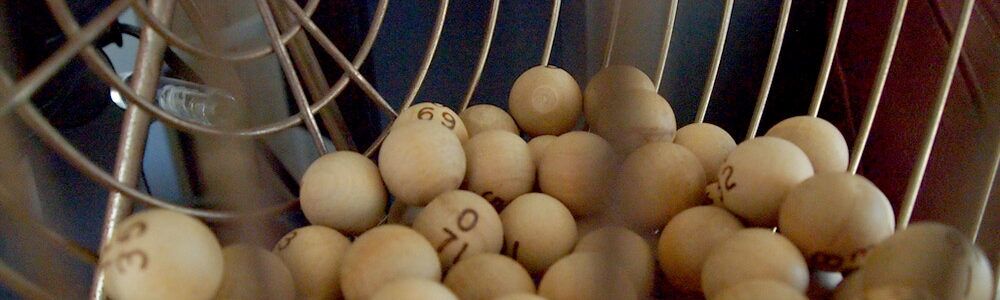
When the ball drops out of the cage, the caller either prefaces or follows the announcement of the number with a little joke that describes the number or letter number combination.
For example, the doctor says the results are good.
It’s… Many guesses?
B9.
B9.
Right.
That’s right.
B9.
That’s right.
It sounds like B9.
Okay.
We’re talking puns.
Or the shape of the number might be important.
For example, look, it’s a little snowman.
It’s B8.
B8.
That’s right.
B8.
Wait.
I don’t get that one.
It’s one or the other.
Like a snowman.
Yeah.
Oh.
Okay.
You don’t have to know anything about bingo to figure out most of these.
I’ll call a few numbers and let’s see how many you can get.
I’ll give you hints.
Remember, the numbers go from one to 75.
Okay?
All right.
Okay.
Here we go.
Let’s get the balls rolling and here comes the first number.
It’s the vitamin number.
It’s…
B12.
B12 is right.
Good.
How about B16?
Oh, it can’t be B16.
Okay.
I get it.
I get it now.
Okay.
Here comes the next number.
I wish I had the sound of rattling balls.
It just misses something.
Rattle, rattle, rattle, rattle, rattle, rattle, rattle, rattle.
And here’s the next number.
Heinz varieties.
It’s G…
57.
57.
57.
Right.
Mark your 57s, everyone.
Do they really say these?
They do.
Over and over.
Oh, really?
And more.
Yes.
Some they say over and over again.
If you’re a 92-year-old woman playing bingo, you get quite a kick out of these.
I’m just — it’s okay that they get a kick out of this.
Here comes the next number.
It’s a pair of little ducks.
It’s I…
Quack, quack.
They do say quack, quack.
They say quack, quack, a pair of little ducks.
It’s…
22?
I-22.
Right.
I know.
France is looking at me like, “Huh?”
Because it looks vaguely like ducks on a pond.
They look vaguely like ducks.
Did they say a duck in a pond?
Well, that’s on a pond.
Three players on a base, but never mind.
You fell for that old canard.
A duck in a pond is — that’s nice, Martha.
Very good.
Thank you.
A duck in a pond is 20.
The duck with the — A duck in a pond is 20?
Oh, is that right?
Yeah.
Oh, man.
I think it’s cute.
Here we go with the next ball.
Book ’em, Dano.
It’s Hawaii.
50.
50.
50.
50.
50.
50.
50.
50.
50.
50.
50.
50.
50.
50.
50.
50.
50.
50.
50.
50.
50.
50.
50.
50.
50.
50.
50.
50.
50.
50.
50.
50.
50.
50.
50.
50.
50.
50.
50.
50.
50.
50.
50.
50.
50.
50.
50.
50.
50.
50.
50.
50.
50.
50.
50.
50.
50.
50.
50.
50.
50.
50.
50.
50.
50.
50.
50 Hello, Maggie.
What’s going on?
Well, I just wanted to call in.
I had a phrase I was curious to see if you guys knew about.
I came across a colloquial phrase in New Orleans while I went to college there a couple years ago.
That was “making groceries.”
That was the phrase exchanged instead of shopping for groceries or going to a grocery store buying groceries.
New Orleanians would say they made groceries or they were making groceries.
-huh, and what happened the first time you heard that?
I wasn’t sure what they were really talking about.
I said, “So you’re going to make groceries.
What are you making?”
Maybe I was referencing a meal.
Are you going to make red beans for dinner or something down there?
No, it was actually just the shopping that was making groceries.
That’s fabulous.
Are you from Indiana originally?
I’m originally from Tampa, but I live in Indianapolis.
After college, I moved up here.
Okay, so you’ve been all over.
Well, you know, this is one of those things that people from Louisiana, and particularly New Orleans, are proud of.
It’s one of the things that they’re very conscious of being a part of their local dialect, their local language, and their color, to say that they make groceries.
And what it is, it’s a “calc.”
You ever heard that word, Maggie?
I haven’t.
It’s C-A-L-Q-U-E.
A “calc” is when you translate a phrase from one language to another, word for word, rather than for idea for idea.
And in this case, the French expression, and as you know, New Orleans and all down in there has all got the French heritage for hundreds of years.
The French expression is “faire de course,” which means “to run errands,” or they use it actually to mean “to go grocery shopping.”
And “faire” is the verb in that phrase, and in French it can either mean “to do” or “to make.”
And so what it is is a kind of repeated bad translation from French into English.
It’s like in Spanish, when you say, “I’m going to go shopping,” you say, “Hacer compras.”
Exactly.
That I’m going to make purchases, make groceries.
How interesting.
Well, thank you for sharing that.
Maggie, thank you so much for a diverting call.
This is very interesting.
Thank you.
All right.
Bye-bye.
Bye-bye.
Well, if you’d like to make conversation with us, give us a call.
The number’s 1-877-929-9673, or email us the address is words@waywordradio.org.
Hello, you have A Way with Words.
Hi there, this is Tom from Power Inn in San Diego.
Hi, Tom.
How you doing?
All right.
Well, what’s up?
Yeah, well, I was at a party with one of my friends’ party, and we were going to have this boggle tournament, and so the question arose, “How are we going to set up this boggle tournament so that the best people would have a shot of facing each other in the final?”
And so, of course, we decided to seed it, and we had this original round where everyone would compete to see who was good, and then we’d create the pool of seeds from there.
And so the question arose, “Where does this term seed come from?”
Well, yes, you’re right.
The word is seed, like the seed that you plant in the ground, and as far as we know, it comes from the world of tennis, and not just because tennis started out as lawn tennis.
It has nothing to do with lawns and seeds.
But yeah, it’s a method of sort of metaphorically planting the top players strategically.
You know, when you see those brackets of tennis players or the basketball teams in the NCAA tournament, and you have those brackets and all that, and you don’t want to have your top players playing against each other.
In women’s tennis right now, you wouldn’t want to have Hennen playing Ivanovich, or in men’s tennis, you wouldn’t want to match up Nadal versus Federer in the first round, because how boring would that be?
Somebody would have to be out, and then you’ve lost one of your best players.
So it’s really just a way of doing what you described, seeding them in different places by their ranking.
So it’s not S-E-A-T?
No, although in Boggle, that might be the case.
No, no, okay.
Does that work for you?
Does that make sense?
Yeah, that makes perfect sense.
All right.
Super.
All right, well, best of luck to you, Tom.
Thanks for giving us a call.
All right, thank you.
All right, bye-bye.
All right, bye.
Are you a Boggle player, Grant?
I played last with my mother-in-law, who beat the pants off of me.
She’s a librarian, and she’s got a few years on me, so it’s tough competition.
You know, you think as a dictionary editor that you might have an advantage?
No, sir.
There’s a whole world of people out there that will smoke you.
We’d love to hear your calls and questions about any kind of game that you’ve got going on. 1-877-929-9673, that’s 1-877-WAY-WORD.
Hi, you have A Way with Words.
Hi, Martha.
Hi, Grant.
This is Glenn from Princeton Junction, New Jersey.
What do you do there in Princeton Junction, New Jersey?
Well, I work in a large financial firm, and I am a project leader and a Six Sigma black belt.
Oh, hello, Six Sigma.
Whoa.
That’s a mess of jargon, if I’ve ever heard of a mess of jargon.
Well, Six Sigma is a statistical term, and Six Sigma in this case is a philosophy of continuous improvement, and there’s a set of tools and methodologies to carry that out.
Oh, really?
So I’ve been trained in these, and I’m a black belt.
You’re improving business, right?
Whoa.
Yes.
So we better — oh, it’s not really karate?
No, no, no.
I was going to talk about how all I got was yellow tips.
No, it’s a business management philosophy.
It’s usually suitable for big companies like GE, right?
Right, GE is well known for having a Six Sigma program, that’s correct.
Is that what you called us about today?
I work near and around technology, and every once in a while new words come up, and here’s one that even though I feel older than the rocks that eventually formed dirt, I still can pick up a new trick every once in a while.
So a group of us geezers at work have latched on to the use of the word Uber as an intensifier.
I was just curious about how it’s being used as an intensifier and what about other words that might be formed on Uber or Uber?
Yeah, well, so how are you guys using it around the office?
Well, real common examples, just like having an Uber meeting or somebody’s Uber confused, or even I’ve heard things like, “He is Uber in the middle of this situation.”
Oh, that’s nice, meaning very much so?
Very much so, so like Uber meeting would be like a summit meeting, but it’s got more oomph, I think, or Uber confused would be totally confused, but sort of more, again, more oomph.
The way you describe it is consistent with the way that I see it.
I see it used as an adjective.
An Uber meeting would be a super great meeting, right?
Or an Uber person would be a great person or a good person or a remarkable person, right?
I’ve seen it as an adverb, which is what you described.
If you would say that somebody is, “He is Uber good at that,” he’s basically saying, “He’s very good,” and that’s an adverbial use of Uber.
The noun form is a lot rarer, and I’m hesitant to say that it’s widespread yet, but I could see how it could occur.
It seemed like a natural thing for this word.
Well, Glenn, thank you for pointing out the ubiquity of Uber.
Well, thank you.
I am overjoyed to have this chat with you super-intelligent Uber scholars.
We are the Uber scholars.
The language Ubers.
I like it.
I like it, Glenn.
We may have to borrow that from you.
Well, thank you for your great shows.
I’ve enjoyed them for a very long time now.
Oh, thank you.
Oh, super.
Thank you so much.
Best of luck to you.
Super, Uber.
Super, Uber.
Bye-bye.
Bye-bye.
All right, bye-bye.
Bye-bye, Grant.
Bye-bye, Martha.
Bye.
Get to the phone schnell.
1-877-929-W-O-R-D.
Hello, you have A Way with Words.
Hi, this is Elizabeth Boulet from Indianapolis, Indiana.
Hello, Elizabeth.
Hello, Elizabeth.
Well, good afternoon.
What’s cooking over there?
Well, a couple years ago, my cousin and I were visiting our elderly Aunt Harriet, and she used a phrase, and the phrase was, “Put a snap on the grouch bag.”
What?
Put a snap on the grouch bag.
Put a snap on the grouch bag.
In what context would Aunt Harriet say something like that?
Well, you know, we weren’t sure, because Harriet told a lot of stories, and you didn’t always listen to every bit of it, but that sure caught our attention when she said that.
Wake up, everybody.
Well, we thought it meant quit your complaining.
Yeah, that’s what I would think.
Yep, yep, I would think so, too.
I like that.
And so we giggled, and I thought, “I’ll start using that phrase immediately.”
So I said, “Well, what does that mean, Harriet? Did that mean to stop complaining?”
She said, “No, it meant to keep track of your valuables.”
And I thought, “Isn’t that…”
So I just sort of, for the last few years, just walked around thinking that I have no idea where the phrase came from, really.
But more importantly, I’d like to be able to use it in common parlance, but I don’t really know what it means.
So I thought I’d better find that out first.
Oh, well, you know, we’re big advocates of bringing old phrases back, so all four of that.
We’ll tell you all about it, and you’ve got to promise to go use it, all right?
You bet.
All right.
Well, here’s an interesting fact about grouch, all right, because the word that you said is “grouch bag,” G-R-O-U-C-H, right?
Mm—
Grouch actually comes from a word, or is related to a word, “grutch,” G-R-U-T-C-H, which in turn is related to “grudge,” G-R-U-D-G.
They’re all kind of kith and kin.
Okay.
Okay.
Now, one of the meanings of “grudge,” the verb that we don’t really use anymore, is to murmur or complain or to be reluctant to give.
There’s several meanings we don’t use here, and they’re all kind of all wrapped up together, right, because you don’t really say, you know, “He was over in the back of the house grudging about how nobody else did any work around the house,” right?
We don’t really use “grudge” that way.
Right.
Begrudge, in the verb “to grudge,” like, I begrudge you the money that I’m giving you even though I owe it to you, right?
Sure.
I don’t really want to give it to you.
I want to withhold it from you.
It actually has the same meaning as an older form of “grudge” that we don’t use anymore.
So these are all kind of related.
There’s a transition there.
You can see how that might work where a verb that means to murmur or complain and also has something to do with someone who begrudges you their money and complains about it is grudging, right?
And also it’s a pretty easy transformation from grudge to grouch and grouchy.
But you’re right.
A grouch bag, interestingly enough, was used among carnies, that’s circus and carnival folk, in the same way that tourists today use money bags and they kind of wrap them around their waists or around their chests under their clothing.
And that’s a grouch bag.
Really?
There’s a lot of variables there.
I didn’t know that.
Yeah, when you’re out on the fairway and you’re running your stand, you don’t want something to go back to your trailer and pilfer all your dough.
So you’ve got to keep it on you, right?
No, but why would it be called a grouch bag, though, as opposed to a happy bag?
Well, again, remember here, grouching has something to do with complaining and begrudging people I think what they want from you, right?
People want your money.
That’s the best I can offer you.
So it doesn’t have anything to do with carrying a grudge, then?
No, I don’t believe that it does, no.
So Elizabeth, we have to put a snap on the talk bag here.
Well, I understand.
Well, thanks so much, very fun to chat with you both.
Great chatting with you.
Bye-bye.
Thanks, bye-bye.
Bye-bye. 1-877-929-9673 or email, we read everything, words@waywordradio.org.
So, Grant, earlier we were talking in the program about local food terms that vary from place to place.
I’m wondering if being in New York there you ever had Albany beef.
No, what is that?
Albany beef is an old term for sturgeon.
It turns out that sturgeon were really plentiful in the Hudson River at one point to the point where they used to use caviar in taverns.
They would just give it out for free.
And Albany beef was a joking term for sturgeon because it was so plentiful.
I had no idea.
So here’s my question for you, how many different names can you give for a fried pastry that has a vegetable or fruit filling?
Pretty much every culture has one, doesn’t it?
Hamantaschen?
Well, I’m thinking more like empanadas in Latin America, right?
Okay, yeah, envelopes.
Empatas in Portugal and Brazil.
Okay.
And samosas in India.
Patties from the Caribbean.
In Iran, in Iranian food, they have sambusas.
They’re all exactly alike but they’re fried dough that’s been filled with a vegetable or meat filling, right?
Yeah.
It’s just interesting.
Every culture or many cultures seem to have the same exact, very similar kind of concept.
Right.
It’s just interesting to me.
I’m trying to complete my list.
Well, if you’ve got anything for my list, I’d love to hear it.
If you’ve got some food terms that are special to your hometown, we’d like to hear about those too.
Give us a call, 1-877-929-9673 or email us, words@waywordradio.org.
Coming up, it’s our game about weird words from the edges of English.
Stay tuned.
Support for A Way with Words comes from Word Smart, the vocabulary building software.
Improving your vocabulary, reading comprehension and critical thinking skills will increase your chances for success.
Learn more online at wordsmart.tv.
And from iUniverse, supported self-publishing.
Is there a book in you?
Find out how to publish it at 1-800-AuthORS or learn more online at iUniverse.com.
You’re listening to A Way with Words.
I’m Grant Barrett.
And I’m Martha Barnette.
And it’s time for Slang This, the puzzle where you guess the meaning of some strange slang terms.
Today’s contestant is Craig Molyneux from Lawrence, Kansas.
Craig, welcome.
Hey, everybody.
How are you, Craig?
What’s going on in Lawrence, Kansas?
Well, I know most of the town is getting ready to watch the games tonight.
Right now, I’m just relaxing at work talking to A Way with Words.
Are you ready to play a quiz, Craig?
I am very ready.
Okay, Craig, here’s how we play.
Grant’s going to give you a slang term and then he’ll give you three sentences that suggest what that term could mean.
Only one of those will be real and the other two are fake.
So, Craig, your task will be to guess which sentence illustrates the slang term as it is really used.
And chances are you won’t have heard the word before, so the trick is going to be to puzzle out its meaning.
And I’ll be standing right here to help if you get stuck, okay?
Excellent.
From my experience, it’s been that almost no one knows these words, so I’m ready.
You’re right.
They’re all real.
You’re right.
I did not make these up.
But, you know, smarty pants, what’s your slang word?
You’re supposed to come to this with your own favorite slang word.
Do you have one for us?
My own favorite slang word is something that I think only high school students in southern Kansas might know it, and it’s chewy.
Chewy?
Chewy.
It’s very similar to a wedgie, but whereas a wedgie is done by someone else to you, a chewy just happens on its own.
A chewy is when your underpants get kind of uncomfortably pulled up between your buttocks, right?
So if someone has a strange look on their face, you can always ask, “Do you have a chewy?”
Okay, so it’s like an auto-wedgie.
It is like an auto-wedgie, and it’s common to see someone picking a chewy, and you just don’t acknowledge that.
No.
Maybe we better move on to our game, huh?
All right.
So we’ve got two words for you today, Craig.
The first of our two words today is op-tempo, O-P-T-E-M-P-O, op-tempo.
The first possible clue is, “The op-tempo of the war has increased the need for manpower so much that reenlistment bonuses can reach more than $100,000 for the right person.”
And the second clue, “Doctors at Johns Hopkins call doing surgery with music in the operating theater op-tempo.
They know when they hit the third chorus, it’s time to put in the new kidney.”
And the third clue, “Op-tempo dieters never sit down.
They sleep only a half hour at a time, seven times a day, and they bathe just once a week.
They claim they not only lose two pounds a day, but get more done in a week than most people get done in a month.”
So, Craig, is op-tempo A, the pace of a war or military operation?
Is it B, a method of using music during surgery?
Or is it C, a high-speed, highly efficient diet?
Wow.
Well, the first two, I would say, would be operation tempo or occupation tempo, I guess.
I would have to go with the third one, maybe optimum tempo, optimum tempo.
So, you think op-tempo refers to a type of dieting in which you manage your time wisely?
That sounds great.
Do you know any op-tempo dieters?
I don’t, but I work for a nutritional analysis team, and I’m sure that we could come up something similar to that, that’s all about go, go, go.
Exactly.
Unfortunately, the answer is A.
Op-tempo is military jargon for the operation tempo of a war or a military operation.
Sounds like military jargon, yeah.
Yeah, yeah.
They’re all about strange language.
My friends from McConnell Air Force Base near my hometown are going to be very disappointed that I didn’t know that.
Oh, but your friends in the nutrition business will be really excited.
Exactly.
A new thing that we can sell.
Listen, we’re going to make a lot of money with this.
You are going to include us on this, aren’t you?
I’ll have my name and then Grant’s name, Martha’s name, and we’ll kind of mix it together.
What kind of order is that?
All right, one more for you, Craig.
Try this one.
This word is “squish,” S-Q-U-I-S-H, but it’s not going to be the squish that you know, all right?
Or a chewy.
Or a chewy.
The first clue.
In an effort to reduce the money and time spent schooling, some Arizona schools now have squish years.
Nine months of school are compressed into six.
Squish students can complete high school in two years and enter college at age 16.
Second clue.
To those on the political right, she looks like a squish.
She once voted for the war and now says she’s against it because of all the pressure for more liberal members of her party.
And then the third clue.
If there’s a bully in school, then there’s always a squish.
The bully’s long-suffering target.
So, is a squish A, a new time scheme for high school?
Is it B, a politician who constantly caves into criticism?
Or is it C, the name for a bully’s victim?
Craig, what do you think?
What’s a squish?
Wow, so the first one has to do with shortening the amount of time or extending the amount of time that you’re in high school.
Taking nine months of school and doing it in six months.
I actually did a program similar to that in high school, so I’m going to have to go with that.
What did they call it when you were in high school?
We just called it graduating at semester.
Okay, so Craig, your answer then is A.
The squish is nine months of school compressed into six.
Unfortunately, the answer is B.
A squish is a politician who’s kind of squishy on the issues.
You squeeze them in there.
One answer pops out between one set of fingers and another answer pops out between another set of fingers.
They never really stick to what they say.
So we go from flip-flop to squish.
Yep, we do indeed.
Craig, thank you for playing.
I just wanted to ask you, what do you do there in Lawrence?
Right now, I’m a research assistant for the long-term exercise study through the Energy Balance Laboratory.
That is fantastic.
So no wonder you went straight for that clue.
Sure.
Well, thank you for playing today, Craig.
That was great fun.
I wish you the best of luck.
Well, thank you so much.
You guys have a wonderful day.
Hey, Craig.
Yeah?
You’re going to have a wonderful day in a couple of weeks because we’re going to send you a whole book of interesting words.
I am looking forward to it.
Craig, we’re going to send you a copy of Aaron McKean’s book called Weird and Wonderful Words.
Excellent.
I look forward to it.
All right, thanks for playing.
Thank you, Craig.
Bye-bye.
If you would like to play our slang quiz, we’d be happy to hear from you.
The address is words@waywordradio.org, or call us, 1-877-929-9673.
Those are the same ways that you can reach us to ask us questions about language.
Hi, you have A Way with Words.
Hello, this is Pete from Elgin.
Elgin, Illinois.
How are you doing, Pete?
Doing good.
I’m calling about something that’s become a cliché, and it really bothers me for a couple of reasons, and it’s drinking the Kool-Aid.
Oh, yeah.
And I assume that this is based on the event at Jonestown 30 years ago.
Yeah, Pete, how would you hear people use it in a sentence, for example?
Well, I hear it more often spoken than I see it read, but here’s a specimen for you.
This was from the Huffington Post.
A blogger wrote this.
“I get a little touchy when callers and blog respondents assume that because I’m not yet ready to drink the Obama Kool-Aid that I must be in the tank for Hillary.”
So that’s an example of a way that it’s used, and it bothers me.
What’s the difficulty with it?
Well, first of all, this is not the main reason, but I think it was a tragic, horrible event.
It conjures up bad pictures in my mind.
People use it kind of whimsically.
Yeah, I think you’re exactly right.
You’re referring to the grisly mass suicide in Jonestown back in, what, 1978?
That’s right.
It’s been 30 years, and it was horrifying where Reverend Jim Jones had everybody drink poison out of big vats of flavored Kool-Aid or some kind of flavored drink, right?
Right.
Some people didn’t even do it voluntarily.
They did it at the point of a gun.
Children were forced to drink it.
It was really a terrible thing.
Right, horrifying.
So I hate to hear it used that way, but that isn’t even my main objection.
When people use it, it relates very poorly to the actual event.
In this way, people mean that when a person drinks the Kool-Aid that they’ve more or less been hypnotized by a charismatic character or they’ve been inducted into a corrupt corporate culture or something like that.
But it seems more accurately that drinking the Kool-Aid actually occurs long after you’ve been converted into a particular religion.
It actually happens when you do something destructive or self-destructive perhaps many years later.
Drinking the Kool-Aid is not like being hypnotized by a potion.
You’re actually doing something self-destructive.
You see the difference?
Right.
It actually occurs many— If you follow somebody blindly for years and then do everything they say and then he tells you to do something and you do something crazy, that’s drinking the Kool-Aid.
You brought a lot of issues up here, Pete, but the difficulty is this.
Words change and the meaning change and the use changes and they don’t stick to their roots.
There’s a worse example than drink the Kool-Aid where we use it in trivial fashion now.
Nazi.
We use the word Nazi to describe somebody who cuts us off in traffic or a teacher who gives too much homework.
Or a grammar Nazi.
A grammar Nazi.
As English speakers, we trivialize words all the time.
We take them from very harsh circumstances.
We kind of downgrade them to something that’s a little simpler.
We did that with Watergate, the suffix gate.
We no longer use it to describe this big scandal that unseats a president.
We now use it to describe the fact that we can’t get the sandwich we want in the cafeteria any longer because they’re now using a different vendor.
It’s sandwich gate.
We trivialize stuff.
Just because you, say, go along with a candidate, you decide to vote for him, that doesn’t mean that you’ve drunk any Kool-Aid yet.
But if you were persuaded to do something really crazy, like a suicide bomber, for example, that would be drinking the Kool-Aid.
Well, it could be drinking the Kool-Aid, but that’s not how people use it, so it isn’t drinking the Kool-Aid.
That’s what bugs me when I hear it.
Yeah, I see what you’re saying.
I think the Kool-Aid is already being diluted, so to speak.
Seriously, I’ve got the Oxford English Dictionary up on my computer screen, and it lists as a definition “to support wholeheartedly.”
That’s really pretty diluted, and I’m sorry for the pun, but I think it’s very useful that you’ve sort of caught us up short and called attention to this because now that I think about it, it is a pretty creepy expression.
Yeah, well, I hope I’ve raised some people’s consciousness about it.
Well, we’re definitely glad to have given you an airing, Pete.
Thank you.
All right, thank you so much for your thoughtful call.
Okay.
All right, bye-bye.
Bye-bye.
Whether you agree or disagree, Martha and I often talk about the email and the phone calls and say, “Hey, you know what, they raised a great point,” and we may talk about your point on a future show.
Right, so call us at 1-877-9299673, or send those emails to words@waywordradio.org.
Hello, you have A Way with Words.
Yes, this is Bob Engle in Saratoga, California.
Well, hiya, Bob, how are you?
Hello, Bob, what’s going on?
When I was growing up in Iowa, there was an expression that was very common. It’s used two different ways, to who laid the rail is like a large but indefinite quantity, like John had corn to who laid the rail, or a long but indefinite amount of time, like John was away until who laid the rail. And I just wondered what the origin of it was.
I love this expression. If you don’t mind me being nosy, when in Iowa are we talking?
We’re talking about in the ’50s.
And where in Iowa?
In Des Moines and around Des Moines.
Okay, great. You know, I have to say, I grew up in Kentucky, and I never heard the word, and then somebody from Kentucky asked me about it, and I had no idea where it came from. I mean, it’s a funny sounding expression.
Yeah, the expression is who laid the rail, right?
Who laid the rail, yep. W-H-O-L-A-I-D-T-H-E-R-A-I-L.
Bob, it’s your lucky day, you know?
Oh, good. I got a lottery ticket, and here’s why. Because I’ve already done all the research on this term, and I have an entry for this on my website, and I can tell you a few things about it that other people don’t know, except that they’ve seen my website.
What’s really interesting about this to me is that this whole expression, who laid the rail, behaves like an adverb. The whole phrase is kind of like a superlative, right? Because there are other ways to say it. You can say, I’ve known her since who laid the rail, or he was eating those corn dodgers to who laid the rail. So you can say to who laid the rail, or from who laid the rail, or since who laid the rail, and the who laid the rail is consistent.
The earliest uses that I can find, and I’m going to give you a footnote on that in just a second, are from the early 1880s. And the first four that I can find, and these are in newspapers, are all from Georgia. So my suspicion is that this phrase comes from Georgia.
Really? There are a couple stories in the newspaper, some guys telling some colorful anecdotes that don’t bear repeating here, but his name is Tom Arter, A-A-R-T-E-R. I don’t know if that’s his real name or it’s a pseudonym, but he uses it, and he makes it sound in those stories as if he goes around on speaking tours. So it’s possible this fellow Tom Arter spread it, just by doing speeches, say, at the courthouse or the church or wherever.
So in what time period?
1880s.
1880s?
Yeah, I don’t find it any earlier than 1880s.
That’s pretty old. Well, and here are a couple other things. Do you know where most Americans heard this expression?
No.
They heard it in The Music Man. Do you remember that play? And I think there was a movie as well.
Yeah.
Mary and Madame Libra. Is that the one?
Yeah, it’s the one with…
One of my favorites.
Trouble starts with…
Trouble right here in River City. Rhymes with P-E-E, yeah, and stands for pool.
That’s the movie. Well, the mayor in that play uses Houlaid the rail.
Oh, he does?
He does. So most people might have heard it there, because it’s not that common, really.
You’ll find it in a few old newspapers and occasionally in the books, and people who are trying to write fiction with a little bit of historical color will sometimes yank it out of some old dictionary and use it.
Right.
Anyway, so that’s a mouthful and an earful and a brainful, but that’s the best I’ve got for you.
That’s great.
That’s a lot more than I had before.
He gave you information to Houlaid the rail, didn’t he?
Yeah, that’s right, that’s right.
If you do want more information, we’ll put a link to my full entry and the citations from the historical sources.
We’ll put a link on our discussion forum so you can look for yourself.
Okay, great.
Okay, Bob, take care.
Thank you so much.
All right.
Thank you so much.
Bye-bye.
Bye-bye.
As you know, we love colorful expressions from the past and from the country, and we’d love to hear about yours.
Send us an e-mail to words@waywordradio.org or call us on the telephone, 1-877-929-9673.
♪♪ You know, a while back, we had a call from a listener about the food dish known as Turkey Manhattan or Beef Manhattan.
Remember that one?
Oh, how could I forget?
We got pictures of that in our e-mail box.
Oh, my gosh.
We did beautiful pictures.
I went and made dinner right after.
I saw those e-mails a little too early in the morning.
Yeah, right.
It was the headlong shot, and what it is, it’s a piece of meat, like a really scrumptious piece of turkey or beef covered in, like, buttery mashed potatoes and then covered with a rich brown gravy, right?
Yes.
Gorgeous, gorgeous food, and I’m sure it tastes like it looks.
And so we put the call out.
You know, you and I said it seems to come from Indiana or thereabouts, and, you know, we knew a few things about it, but we put the call out, and then we said, “Hey, listeners, do you have something to add?”
And, boy, did they ever have something to add.
People remembered Turkey Manhattans and Beef Manhattans as far back as the 1940s and the 1950s, and not only at school, which is where, I think, we kind of thought it was from, but also at restaurants, and there are still restaurants across Indiana, apparently, serving this.
You can just ask for it if it’s not on the menu, and they’ll know what you’re talking about.
And some callers remember it from outside in Indiana, so it’s not strictly an Indiana dish.
Mona said she remembers Manhattans from St.
Louis in the 1940s and 1950s.
Jerry from Minnesota says he remembers them from the ’50s and ’60s, and Anna said she not only knew them growing up in north-central Indiana, but she remembers them from Iowa in the 1960s and 1970s.
So how about that?
Mmm, well…
Will you welcome your calls?
1-877-9299-673, and we welcome your e-mails.
♪ That’s our show, but you can leave us a message anytime.
It reaches at 1-877-9299673.
That’s 1-877-W-A-Y-W-O-R-D, or send an e-mail to words@waywordradio.org.
Or stop by our discussion forum.
You’ll find it at waywordradio.org.
Stefanie Levine is our senior producer.
Our technical director and editor is Tim Felten.
We’ve had production help this week from Dana Polakovsky and Michael Bagdasian.
“A Way with Words” is produced at Studio West in San Diego.
I’m Grant Barrett.
And I’m Martha Barnette, inviting you to join us next time.
That’s right here on “A Way with Words.”
♪ Oh, if we call the whole thing off, then we must part ♪ ♪ And oh, if we ever part, that would break my heart ♪ ♪ So I say, “Oyster” ♪ ♪ You say, “Oyster” ♪ ♪ I’m not gonna stop eating oysters ♪ ♪ Just ’cause you say oysters ♪ ♪ Let’s call the whole thing off ♪ (upbeat music) [BLANK_AUDIO]
Regional Foods
 Have you ever eaten a Benedictine sandwich? Or savored a juicy pork steak? What’s a favorite dish you grew up with that may be mystifying to someone from another part of the country?
Origin of Touchdown
A rugby referee from Indiana calls to ask if his sport is the origin of the word touchdown as it is used in American football.
Emphasis on Patronize
How do you pronounce the word patronize? Is one pronunciation used if you say “Don’t patronize me!” and another one if you say “We patronize local businesses”?
Dead Heat
Why do we say political campaigns that are in a dead heat? Why dead and why heat?
Bingo Lingo Word Quiz
We play bingo on the air with Quiz Guy John Chaneski. His motives are not B9!
Making Groceries
A woman who went to school in New Orleans reports she was startled the first time she heard residents of the Crescent City talk about making groceries rather than buying them. Grant explains the French origins of that expression.
Seeding a Competition
A listener who recently played in a Boggle tournament wants to know why we speak of seeding such a competition.
Über
The German word über has found a place in American English. A New Jersey man says he and his colleagues find it to be more versatile than a Swiss Army knife, as in, “He is uber in the middle of that situation,” “That was an uber meeting,” and “You guys are the language ubers.”
Expression “Snap on the Grouch Bag”
An Indianapolis caller wants to know about curious expression she heard from her Aunt Harriet: “put a snap on the grouch bag.” You would think it means “Stop complaining!” but she says it refers to making sure your valuables are secure. What’s the grudge?
Albany Beef
Martha and Grant discuss more regional food terms. If you order Albany beef in upstate New York, for example, don’t be surprised if you’re served fish.
Squish and Optempo
This week’s Slang This! contestant grapples with the slang terms squish and optempo.
Drink the Kool-Aid
What’s the trouble with using the expression “drink the Kool-Aid” to connote blind, unquestioning obedience to a politician? A caller is bothered by the grisly origin of the phrase—a reference to the 1978 mass suicide in Jonestown, Guyana—and thinks it’s being used inaccurately, in any case.
To Who Laid the Rail
A caller is curious about the odd expression “to who laid the rail,” which is used to mean, among other things, “thoroughly, completely, excessively.” You can see Grant’s work on the term at the Double-Tongued Dictionary.
This episode is hosted by Martha Barnette and Grant Barrett, and produced by Stefanie Levine.
Photo by Marlon E. Used under a Creative Commons license.

