

A new online archive of Civil War letters offers a vivid portrait of the everyday lives of enlisted men. These soldiers lacked formal education so they wrote and spelled by ear. The letters show us how ordinary people spoke then. • Is there a single word that means the opposite of prejudice? Unhate? Or maybe allophilia? • There’s an old joke that if you buy clothes at a flea market, they throw in the fleas for free. But the story behind the term flea market is a lot more complicated. • Also: go to grass, go up the spout, take the devil out of it, bobbery, and diabetes of the blow-hole.
This episode first aired November 18, 2017. It was rebroadcast the weekend of October 28, 2019.
Transcript of “Hidden Treasures (episode #1485)”
You’re listening to A Way with Words, the show about language and how we use it. I’m Grant Barrett.
And I’m Martha Barnette.
What if I told you that you could go back in time and actually read the correspondence of Civil War soldiers?
Not the officers, but the everyday soldiers?
What might that tell us about our nation at another really divided time?
There’s an incredibly cool new collection of thousands of letters from everyday Civil War soldiers.
It’s online and it’s free.
Linguist Michael Ellis and Michael Montgomery and historian Stephen Berry have put together a new archive online, and it’s called Private Voices.
And what’s really special about all these letters from Civil War soldiers is that it’s from guys who wrote by ear.
That is, they were untrained in spelling or punctuation or capitalization.
So sometimes it’s hard to read them, but you can sound them out.
So I’m going to read a letter from a Civil War soldier later in the show.
But for right now, I just wanted to mention one expression that jumped out at me.
And that’s one that occurs time and again in these letters.
And that’s the phrase to go up the spout.
Oh, interesting.
Do you know this expression?
I don’t know that.
To go up the spout?
It means to die or be ruined or be lost.
There’s a letter from 1863 in Alabama.
A guy writes, our noble old army is becoming very tired of the war and deserting like hell.
100 left General Daniels Brigade last night. I fear they will so many leave that we will have to go up the spout.
So I did a little bit more digging on the term to go up the spout, and I found it in the transcript of the trial of John Wilkes Booth, because one of the witnesses said in the trial that he heard John Wilkes Booth say, old Abe Lincoln must go up the spout, and the witness understood by the expression must go up the spout that it meant he must be killed.
So the spout refers to what, a tornado or a water spout?
I think it must be the spout on a house because there’s a similar expression to go up the flue.
And I think it just means, you know, go up into the atmosphere.
Oh, I see. So your spirit has left your body and it’s disappearing into the ether.
Yeah. And it seems very common in a lot of these Civil War letters in this database online, but we don’t hear it today.
The other thing about this collection of papers is that it kind of tells the lie on the belief that we have that everyone wrote incredibly formally back then.
Oh, absolutely.
That somehow their English was perfect and that they all had the perfect school grammar and great vocabulary, but they didn’t.
Right, elegant, elegant.
It’s not elegant at all.
It’s very much like our social media posts today.
You know, that’s a great analogy.
Absolutely.
Well, it’s just a delicious collection to dig into, and you can just Google Civil War Private Voices and find it.
Or you can go to our website.
We’ll put up a link there.
We’d love to hear from you if you’ve got questions or comments or stories about language having to do with slang and new words and old words or something you found in a letter from a relative from a long time ago.
877-929-9673 or email words@waywordradio.org.
Hello.
You have A Way with Words.
Hi, Martha.
Hi, Grant.
My name is Megan, and I’m calling from Orange County.
Hey, Megan.
Hi, welcome to the show.
So my husband and I are avid vintage and antique shoppers.
And it got us thinking about flea markets, yard sales, estate sales, and all that we often frequent.
And we were talking about how yard sales or estate sales, it’s reasonable why they would be called that.
But we were curious as to why a flea market would be called a flea market.
We couldn’t quite figure out what it was that gave it its name.
So we thought we’d give you a call.
Oh, interesting question.
I wonder if you had any theories on this.
So we thought that perhaps it was because things that are at a flea market, things that you can purchase at a flea market are normally kind of old goods, antique things.
And we thought perhaps it was because they’re kind of flea-ridden or, you know, that’s maybe how it got started, something, you know, that makes things maybe a little dirtier or used or something like that.
It was just kind of a name that stuck, even though that’s not necessarily the case anymore.
That was kind of our only guess that we can come up with.
Or like a lazy boy or a couch that actually does have fleas in it or something.
Exactly.
There is something to that, and I’m going to get back to it.
But there’s an older part of American history that plugs in here.
It has to do with the Dutch in New York.
In Manhattan, there used to be a market on Maiden Lane.
We’re talking several hundred years ago.
And there’s a Dutch word that means a marsh or valley that when it’s said fast and kind of like kind of slurred, it sounds like vli or vla, which in the mouths of English speakers after the British took over New Amsterdam and renamed it New York, it came out like flea.
And so this market was referred to as the flea market or the market of fleas.
And so this is hundreds of years ago.
How interesting.
Right.
OK, but fast forward a little bit.
In Paris, markets were well known to be selling old clothes.
In any case, the joke was that you not only paid for the clothes, but they would give you the fleas for free.
I love it.
So that plus just the kind of understanding that you’re buying used goods of dubious quality, just like you said, and there may be vermin of a variety of types, not just fleas.
They became the marché opus, which means the flea markets.
And even now, there was one in particular to start with, even now that term is still used in Paris and throughout parts of France, just the same way that we use flea market here.
So by the 1920s, these two different uses of flea market kind of merged in the American idiom.
And now all small markets where you buy used goods tend to be referred to as flea markets.
I’m so happy that I called.
That’s a really interesting history.
Right?
I cannot wait to share it with my husband.
He’ll be thrilled.
Thank you for your call.
We really appreciate it.
Thank you so much.
I appreciate it.
Thank you.
Okay, hi to your husband.
Bye-bye.
All right, thanks.
Bye now.
Bye-bye.
Email words@waywordradio.org.
One term that keeps surfacing in the Civil War letters I’m reading online is the term pills.
And by pills, the soldiers didn’t mean the things that you take as medicine.
They talked about Lincoln’s pills or Abe’s pills.
And by that, they meant bullets.
Bullets.
They were talking about lead pills.
Wow, lead pills.
That has pill referring to ammunition of a kind.
It goes back a long ways.
It goes back to at least the 1600s referred to cannon, cannonballs.
Oh, is it right?
Yeah, and various times in history it has referred to naval mines, you know, water mines or depth charge, bombs from the air.
Referring just to bullets goes back to the 1700s easily.
And then kind of fast forward to the 1930s where you’ve got like the detective and fiction, like the Dashiell Hammett sort of thing.
And actually in The Thin Man, he uses pills to mean bullets.
So at that point, it kind of sounds more like tough guy slang, but it’s got hundreds of years history before it reaches dazzling.
Yeah.
Very cool.
So that’s the nice thing about these letters.
They’re a snapshot in time that plug into the larger history of language and our culture.
Indeed.
Hello, you have A Way with Words.
Hi, this is Kelly from Pittsburgh, Pennsylvania.
Hi, Kelly. Welcome to the show.
Thanks.
What’s going on?
I have a question about a phrase I’ve long considered a family heirloom.
I am not a native of Pittsburgh.
This phrase is used by my family in central Pennsylvania to refer to an undiagnosed and not serious illness.
It is the nun puckeroo.
The nun puckeroo.
That sounds ominous.
I know, but it isn’t.
You’re not feeling well and somebody says, what’s up with you?
And you’re like, I don’t know.
I’ve got the nun puckeroo.
Yeah.
My mom would always use it with another kind of crazy phrase.
So I might say, you know, how is so-and-so doing?
And she’d say, well, she’s sick in bed with her feet hanging out the window.
And I would say, oh, what seems to be the problem?
And she’d say, she’s got the non-puckaroo, but she’ll be okay in a few days.
So it’s sympathetic and yet, you know, acknowledging that you don’t feel good.
And so, yeah.
So wait, was she really lying in bed with her feet hanging out the window?
Or is that figurative?
That’s figurative.
And I don’t know where that comes from, honestly.
But those two phrases are often used together.
But now in my generation, we use it all the time.
And it sounds like you have a certain pride in this family heirloom.
Yeah, it’s kind of funny.
I’ve never heard anybody else use it.
But my siblings love it.
And in fact, in a text message last week, one of my brothers, who is a medical doctor, said, I’m at home today with Declan.
He has a numpuckaroo.
Last night he threw up at his brother’s birthday party.
So it covers a lot of ground, but it isn’t serious.
You know, we wouldn’t use it for anything like, you know, a clearly diagnosed illness.
-huh.
How interesting.
You know, I’ve never heard nun puckeroo, per se.
But the Dictionary of American Regional English has, they did a survey of all these different features of different dialects.
And one of the questions that they asked people was about joking names that people make up for imaginary diseases, like what you’re talking about.
And there are a couple of similar terms.
One is rum puckaroo.
They found one instance of rum puckaroo.
That was in Rhode Island, right?
Yeah, in Rhode Island.
And then there was another one, just non puck, N-O-N-E hyphen puck in Delaware.
But not very common and not exactly what you’re talking about.
So with you and those two results, that’s just three attestations to similar terms that we know about.
And none of them are identical to each other.
That’s great.
This has been around for probably five generations for my family.
Five generations.
That’s great.
Yeah.
So we’re keeping it alive, hoping other people will embrace it.
Maybe it’ll go viral.
No pun intended.
Right.
I like it, having the nun puckaroo.
It’s better than some of these other examples in the Dictionary of American Regional English, like he’s got the sky-beatees of the blowhole.
Wow.
I don’t know.
I kind of like that one.
Yeah, there are a whole lot of them, but I like that nun puckeroo.
It’s like you don’t feel so good, but you can’t really put your finger on it, it sounds like.
Right, and it’s very sympathetic.
It’s like, oh, poor you.
Oh, okay.
It’s got a sympathetic aspect to it.
Kelly, if we hear from other listeners about their use of similar terms, we’ll let you know, all right?
Terrific.
Thanks a lot.
Thank you.
I appreciate the show.
It’s wonderful.
Thank you, Kelly.
Bye-bye.
We do know that in your house there’s family words that you think only you say,
But we’re pretty sure if you share with us, we can find other people who say them too.
Grant, do you know the term bobbery, as in to kick up a bobbery?
Mm-mm.
No, it sounds British for some reason.
It is.
Is it?
It is.
It’s an argument or disturbance to kick up a bobbery.
What’s the root of that?
I’m glad you asked that.
It’s been attributed to Hindi, actually.
Bopre, which means alas or oh father, literally.
But it’s broader than that.
I think it’s older than that as well.
Bobbery.
B-O-B-B-E-R-Y.
Correct.
Bobbery.
Right.
Don’t make such a bobbery.
It wouldn’t be a bobbery if you gave us a call.
You’re listening to A Way with Words, the show about language and how we use it.
I’m Martha Barnette.
And I’m Grant Barrett.
And we’re joined by our quiz guy in New York City, John Chaneski.
Hi, John.
Hi, Grant.
Hi, Martha.
Hey, John.
What’s up?
I’ve got some bad news and I’ve got some good news.
Oh, boy.
Today.
Yeah.
I’m sorry to say that your eccentric old uncle has passed on.
Poor thing.
Oh, Uncle Albert?
Yeah, that uncle you share.
Yeah, sure, why not?
Now, fortunately, he’s left you some things through his will.
The instructions in his will are quite clear, though.
You and your family can have anything you can gather from his huge house in the space of an hour.
Now, within each of the sentences I’m about to read to you is hidden treasure.
Now, you must find it in the sounds between two or more words.
Oh, my.
For example, if I said, if you don’t reach your goal, don’t get discouraged,
You can see that in that sentence is hidden the word…
Gold.
Gold, yes.
Gold, don’t get discouraged.
Yeah.
So let’s see how much booty you can find.
Bear in mind that these will be some generic items and some specific ones, too.
Okay?
Okay.
All right.
Good.
Let’s try.
Good luck.
If you can’t decide between the windowsill versus the door jamb, search both.
Silver.
Silver versus.
Oh, nice.
Yeah, silver versus.
Very good.
Nice catch.
Cha-ching.
If you don’t share the wealth, I guarantee you will rue being so greedy.
Ruby.
Oh, nice.
Okay.
If you don’t find what you seek, you may need to compel friends and family to help.
Pelf?
Pelf.
Yes.
Nice catch, Martha.
You get the pelf.
Give me a hand.
I’m under a lot of strain here.
Dime.
That’s a little cheap.
Yeah, I know that is a little cheap, but it’s relative, right?
Maybe it’s a rare dime.
I’m under…
Diamond.
Diamond, yes.
Oh, wow, yeah, that’s a catch.
Tired of your job race literally from room to room, and you may never work again.
Tired of your job race.
Job race.
Tired of your job race literally from room to room.
Brace?
Brace-a-lit.
Yes, brace literally from room to room.
He’s been emphasizing the syllables.
Yeah, he’s helping us.
Well, I’m on your side.
Finally, let’s keep Earl, your cousin, out of the loop.
No reason to share.
Earl.
Keep Pearl.
Pearl, yes.
Very good.
Okay.
Oh, man, John, what a work out.
And then next we go into the glass booth with the money billowing around.
We have to grab it as we can in 30 seconds.
Grab it fast.
Put it in your pockets.
Put it down your shirt.
Oh, that was rich.
John, thank you, and we will talk to you next week.
Talk to you then, guys.
Take care.
Well, as you can hear, we do a lot of goofing around on this show, but we talk about all aspects of language.
So give us a call, 877-929-9673, or send your emails to words@waywordradio.org.
Hello, you have A Way with Words.
Hi, this is Todd Patinsky from Port Jefferson, New York.
Hi, Todd.
Welcome.
Hi, Todd.
Welcome to the show.
What’s up?
I’m curious if you can help me sleuth out an antonym or opposite of prejudice.
All right.
How did you come up with this question?
It’s actually an area where I do social science research.
About 10 years ago that I was writing a paper, and I wanted to just make the point that transformative
People in terms of community relations typically aren’t merely tolerant or accepting, but
Have stronger attitudes.
And I was reminded and inspired to call you more recently when
The marches around Charlottesville and many of the people who came out to support different
Communities were described as un-hate.
The un-hate movement would seem like a very clunky way
And a very somewhat inaccurate way to describe people who are really feeling deeper emotions
Of kinship, comfort, engagement, support.
So un-hate is a negative and you’re looking
For something that’s inherently a positive.
And more than just simply not hating, actually have
Some kind of kinship or affection.
It seems it’s a phenomenon in the world.
The young people,
Go to visit another culture, someone who’s drawn to go deeper or learn more or experience a new
Cuisine or simply ask someone they meet a little bit about their background.
Tolerance is the one
That most people come back at me with.
But it was funny when I went to Teaching Tolerance,
Which is a big website for tolerance curriculum, on the front page it says,
Tolerance is surely an imperfect term.
The English language offers no single word that
Embraces the broad range of skills we need.
So that sort of led me to check, is that accurate?
There’s an interesting notion about the term un-hate.
I think it does do one thing very well.
I agree that it’s clunky and it doesn’t lend itself to any kind of poetry of thought, if I can coin a phrase there. But it does successfully reflect the idea that not having prejudice is what they’re talking about. They’re talking about completely removing prejudice and being at this baseline state of neither positive nor negative. Right? So they’re not then, they’re not removing prejudice and then also adding a positive attribute. There’s just something we’re not prejudiced or this movement isn’t about prejudice.
So it does do that very well because the opposite of prejudice might not be a positive term. It might simply be the absence of prejudice. Yeah, I’m thinking opposite. Would that be post-judish, but… Also clunky, right? It is clunky, and then I’m thinking, well, what if you take out the pre in prejudice and then you just have judicious, which is, you know, showing good judgment or sense, but still that’s not…
The other thing is, it’s interesting that the website, what is it for tolerance? Teaching tolerance? Teaching tolerance. It’s interesting that they do accurately point out that there’s no single word for the lack of prejudice or the opposite of prejudice, but there’s no requirements in English that all of our ideas are best encapsulated in a single word. We don’t require that kind of efficiency of the lexus where one word isn’t the perfect form of language.
And so we should be comfortable with expressing our ideas in phrases or sentences or paragraphs or even chapters in order to get our point across. On the other hand, if you have a term for something or you come across a term for something. Like, for example, sexual harassment. What did we talk about before we had those words? I mean, I can remember there was a moment for women where you thought sexual harassment. That’s what I’ve been experiencing. Right. It really clicked for you. It’s comprehensible on both sides. It doesn’t require a great deal of interpretation or reinterpretation.
Yeah. And you think, oh, somebody else has had this experience that I’ve had and haven’t had words for. I’m very swayed by that point. And could I throw a word out there for you and your listeners to consider? Absolutely. Allophilia. Allophilia, meaning loving the other? Like or love of the other. And we go back to some of the language around the civil rights movement. It really wasn’t about sort of a mere acceptance, but it was something more virtuous. And it was really about looking to others with a curiosity, an interest, and an affection.
You know the other thing? I like that term. I mean, the problem with coining a word is that now you are responsible for spreading it and getting it out there. Maybe in your work you can do that. Maybe you have the audience or the connections to the part of the world that will immediately understand the importance of that word and adopt it. I don’t know.
I’m thinking about everything that you’re saying here, Todd, and what Martha’s been saying, and looking at what real prejudice is and going, we really need to array all of our weapons against it. So we need more than one opposition to it. We do need the word tolerance and maybe alophilia and perhaps the word respect and perhaps the word open-mindedness and maybe a whole bunch of other language all needs to be in our arsenal to equip us.
There was one word that was used for quite a while, colorblind. In a sense. And it’s interesting, that has really fallen off, I think, partly as attitudes change and as people realize that groups can really make a difference to how people live and how people interact. And so that term seems more and more to be abandoned. I don’t see any more references where as recent as maybe 10, 15 years ago was a term that had a lot of currency. Colorblind. Certainly in the research community, and I feel like in broader communities. I don’t know. We need a more ambitious vocabulary.
Yeah, I like that word ambitious because you’re talking about something proactive. And for that reason, I like the word you’re proposing, allophilic, love of the other, liking the other. Do you think that that’s too opaque, though? I mean, you got it because you understand the etymological roots. The Greek, yeah. I think it could be adopted just like, you know, if, I mean, if a word functions well and is a word for something that needs a word for it, you know, maybe it’ll catch on. Maybe it’ll get popularized. You never know.
Todd, I got to tell you, we could probably do two or three more hours on your question of looking for the opposite of prejudice. But I think it’s time to throw it out to our listeners who will surely have ideas. All right. Thanks to you and to your listeners. Take good care. Take care. Bye. Thanks, Todd. Bye-bye.
So if you have a word or want to coin a word or find a word that you think really encompasses the opposite of prejudice, where you can say, I am this or I have this characteristic, let us know, 877-929-9673 or email words@waywordradio.org or talk to us on Twitter, W-A-Y-W-O-R-D.
Hi, you have A Way with Words. Well, good afternoon. I’m Lee Weber, and I live in Greenville, Pennsylvania on a sunny and breezy day. Just a beautiful day to be alive. Well, it sounds fantastic. Thanks for taking a little bit of it to call us. What’s on your mind?
I had a spelling teacher in junior high who was very, very clever with words. So I decided to challenge her one time, and I said, I have a sentence that I can say in the English language, but I don’t know how to spell it in English. And the sentence is, there are three words pronounced two in the English language. How do you spell two? Believe it or not, I actually puzzled her. She wasn’t sure. And I’ve never found anyone who’s been able to provide an answer. So that’s my question to you.
It sounds like you were a burr under the saddle of your teacher. Did she give you an A? Passing grade at least? Well, she did give me extra credit for my question. There we go. So Lee, linguists, long ago encountered this exact same problem. And they asked themselves the question, how can I write out the words in other languages that use different alphabets in my own alphabet? And so what they came up with more than 100 years ago, late 19th century, French and British linguist came up with the International Phonetic Alphabet, which allows you to more or less write almost any of the sounds spoken in almost any of the languages spoken by humans.
So phonetics is the key, huh? Yeah. So if we wanted to write three twos, there are three twos in the English language. The twos, we would put a forward slash, a T, a lowercase u, and a Z, and then another forward slash. And that is the phonetic representation of all three of those twos, the plural form of twos. But if I were reading that sentence, let’s say I was someone not overly familiar with the English language, I would say, what’s a twos?
Well, the context of your situation, if it’s simply a stumper, then you win. And there’s no easy way to do it without using a special alphabet like the IPA, as it’s known. But if we’re just looking at a general purpose document where you might be encountering the need to write something phonetically, then the IPA is a very standard way to do it. But yeah, there’s always the, with puzzles and word games and trickery like that, there’s always the on the spot feeling about it, right? I’m not a prepared academic sitting here trying to scribble this out in a way that my fellow linguists can understand.
All of the IPA characters have names. So even though it looks like T-U-Z when you say twos, the U, for example, is called the closed back rounded vowel. Because the vowels are all described about how the mouth is formed and where the tongue is inside the mouth, which is really interesting. So the IPA is sort of its own language in and of itself? No, it’s a phonetic rendering of any language. It’s not a language itself. But you have to learn what those symbols mean in order to interpret it.
And what’s strange in this country, Lee, most of the dictionaries in this country don’t use the IPA to show spelling next to words, which means Americans are less familiar with the international phonetic alphabet than, say, British people or Australians.
Well, that’s helpful, you know, after many, many years of puzzling.
And I figured you could do it phonetically.
It’s good that we have phonetics.
Yeah. Lee, thank you so much for your question.
I think this is a really solid stumper, and you should continue to stump the younger generation with it.
I think it will continue to have many years on it, much success with it, okay?
All right.
It’s been great being with you guys.
Thank you, Lee.
Take care now.
Good time with you, Lee.
Bye-bye.
Bye.
Call us with your language question, 877-929-9673, or send it an email to words@waywordradio.org.
Hello, you have A Way with Words.
Hi, this is Wendy McCarville.
I’m calling from San Antonio, Texas.
Welcome.
What’s going on, Wendy?
Well, I am calling about an expression that I’ve often used growing up and just seemed very common to me.
It is, take the devil out of it.
And generally used when you get, you know, an adult beverage and you pass it to your friend and ask them to take the first sip to take the devil out of it.
Recently, I used this expression when I was visiting friends in Nashville, and they thought it was very peculiar.
They’d never heard it before.
So I was just curious.
Take the devil out of it.
And so it’s just handing a drink to somebody for them to take the very first sip.
Is that right?
Yes.
Yes.
That’s really interesting.
So this is kind of a custom or maybe even a ritual?
Is it kind of a superstition?
I think it’s, yeah, kind of a custom ritual rolled together.
It was just so common for us.
Have you all ever heard this?
No, I haven’t.
I have not. No, no.
I didn’t even know, and I wonder if I’m missing something in my reading.
I didn’t even know there was like a culture surrounding like the first sip or drink of something.
No.
Maybe there’s like this whole category of folklore that I’ve just been missing my whole life.
I know.
We’re getting really excited in here.
Wendy, you know what?
I’m glad that we got you on the air because if this is a San Antonio or Texas thing or there are other parts of the American states or anywhere else in the world where people listen to this show, they’re going to email us and let us know that there’s something that they say when they or a friend takes the first sip of an alcoholic drink.
Yeah, or we’ll hear from people who say, I can’t believe you never heard that expression.
That’s what I’m kind of hoping for.
All right.
Well, all right.
So hang on.
What we’re going to do is we’ll put the call out, and then this will all come in, and then probably on a future show,
If we get any response at all, we’ll share it out, and we’ll let you and the world know, all right?
Fabulous.
Yeah.
All right.
So if you, listener, can help Wendy, do you say something like to take the devil out of a drink,
Meaning to take the first sip of a beer or a cocktail?
If you do, give us a call, 877-929-9673, or explain an email to words@waywordradio.org,
Or tell us on Twitter @wayword.
Okay.
We’ll see how it goes.
All right.
Okay.
Take care now.
Y’all have a great day.
You too.
Thanks, Wendy.
Thank you.
Bye-bye.
Bye-bye.
We talked on an earlier show about regions of the country known as belts, like the Rust Belt and Borscht Belt.
Corn Belt.
Yes.
And it turns out that there are smaller belts, too, like just in Chicago.
There’s a particular belt called the Bungalow Belt.
Interesting.
We learned about this from Susan Hyatt.
She’s a professor of anthropology at Indiana University School of Liberal Arts at Indianapolis.
And she wrote us to say that bungalow belt in the 1980s was used in Chicago to refer to neighborhoods on the south side
That at the time were made up of small brick bungalows occupied mostly by Catholic European immigrant families
Who originated mostly from Eastern Europe, Ireland, Lithuania, and Italy.
They were considered to be somewhat conservative, so the term was used rather disparagingly to signal a kind of narrow-mindedness.
I haven’t lived in Chicago since 1989.
And now those neighborhoods are much more diverse and much more expensive.
But the bungalow belt.
Bungalow belt.
Yeah, I’m wondering if there are other belts just in cities like that.
There must be.
Besides green belts.
Some places have green belts.
Yeah.
This green path that they’ve made through their city.
Right.
We’d love to hear about it.
If you have one in your city, 877-929-9673 or send us an email to words@waywordradio.org.
You’re listening to A Way with Words, the show about language and how we use it.
I’m Grant Barrett.
And I’m Martha Barnette.
Earlier I was talking about the new collection online of Civil War letters called Private Voices,
And I’ve had such a great time digging through there, looking at all these letters from uneducated Civil War soldiers.
One of the themes that comes up again and again and again in all these letters is the theme of wistfulness.
Just, I can’t wait to see you. I can’t wait to get back home.
It’s just such a longing. It’s really moving to read these.
And I wanted to read part of a letter from a soldier from North Carolina.
It’s not from that collection, but it’s from the Civil War.
And it was written at a camp in Virginia.
Dear wife and children, by the kind and tender mercies of Almighty God,
I am once more permitted to drop you a few more lines to let you all know that I’m not well yet,
But I’m a heap better than I have been.
I’m tolerable hearty, not forgetting to hope that these few may reach you safely and find you all enjoying good health.
I have no news, important news, to write to you.
Only I want to see you all very bad, so bad.
I cannot tell by pen and ink how I do want to see you all.
Though I hope that the time will come that we will all meet once more.
I want you to write me and let me know all the best news you can find out in the good old state of N.C.
Tell me whether there is any prospect of peace there or not.
So I don’t know as I have anything more to write that is worth your attention,
So I’ll close by saying that I hope you will excuse bad writing and spelling and everything therein that you might find amidst my hurried letter.
So I remain your affectionate husband until death.
And that was written by Francis Webster to his wife, Sarah.
And Francis Webster was my great-great-grandfather.
How about that?
How about that?
That’s amazing.
I was waiting for the punchline, and there it was.
There’s the punchline.
Great-great-grandfather.
That’s astonishing.
Yeah, it really is.
I can remember that framed letter on our mantle for years and years.
But you hear the longing there.
It’s like, I don’t have any news, but I’m reaching out anyway.
And, of course, the linguistic features are interesting.
Heap is an intensifier and tolerable.
Yeah, and hardy.
You see the term hardy again and again in all these letters in the Private Voices database.
Yeah, we wouldn’t use those three words that way today.
No, no.
But isn’t that beautiful?
It is beautiful.
Share your stories with us, 877-929-9673.
Email words@waywordradio.org.
Hello, you have A Way with Words.
I’m Arlo.
Hi, Grant. This is Jeremy from Vortsmouth, Arkansas.
Hey, Jeremy.
Welcome to the show.
How can we help you?
What’s up?
I have a question about a word. It’s cement or cement.
My wife’s from Canada. You can imagine the pronunciation debates we get into.
And this was one that she brought up with me pretty early on.
And I admit that cement, I don’t see how it’s pronounced that way.
So I changed it. But I was kind of curious on how or where that pronunciation even came from.
So, Jeremy, you grew up in Arkansas?
Yes, my whole life.
All right.
Okay. Can I ask you a couple other questions?
I want to see if you’ve got a pattern of pronunciation that matches the pronunciation of cement, okay?
Sure.
What’s the name of the American holiday where we eat turkey in November?
Thanksgiving.
And what do State Farm and GEICO sell?
Car insurance.
And what do rock musicians use that has six strings and a wooden body and they plug it into an amp?
A guitar.
And the guys who drive the black and white cars with the lights flashing on top?
Police.
Police.
Okay.
What I was looking for here is there is this whole category of words that people in the American South, more often than people in the American North, pronounce with the stress on the initial syllable.
And so they are more likely to say words like police, guitar, Thanksgiving.
Somebody didn’t ask you about like umbrella, July, TV.
Detroit in a really well-known one, insurance, instead of insurance.
Hell yeah.
Yeah, you have that one too.
You say insurance.
Yeah.
What you find in the American South, particularly among older speakers, these pronunciations are really common, but over the years they’ve become stigmatized, and those pronunciations are slowly disappearing.
And the younger generations don’t tend to say things like police or insurance or Thanksgiving.
They’re more likely to say police or insurance or Thanksgiving.
Interesting. And see, my best friend doesn’t say it, but my whole family does.
Yeah, my father was born in southeast Missouri, which isn’t all that far from Fort Smith, Arkansas.
So he has a lot of those pronunciations, too.
And he was a police officer.
So for him, there’s a double emphasis there.
But that cement pronunciation goes right in the category.
It fits perfectly with the other list of words.
And it’s really well known.
Sociolinguists have studied it and tracked it.
And it’s the kind of thing that comes up again and again in surveys that they do when they’re doing field work.
And they’re keeping an eye on it.
More common in the American South than it is the American North.
Certainly isn’t heard in Canada or the UK.
I don’t think there should be any shame in pronouncing it that way, but I can certainly understand how your Canadian spouse might have difficulties with going, why do you say cement instead of cement?
Yeah.
So it’s nice to know that you’re just part of a larger pattern of speech.
It’s a dialect feature.
It’s about who you are and where you’re from.
Yeah, so it’s not necessarily incorrect.
It’s just a way of saying it.
Oh, absolutely.
Yeah, I keep picturing the Beverly Hillbillies.
Did you watch that as a kid?
Yeah, yeah, I did watch that.
You remember Ellie Mae Clampett?
Every time she would go out by their pool in Beverly Hills, she would say, I’m going out to the cement pond.
The cement pond, and they would have that music.
But I have a, because through my father, because I spent some of my youth in southeast Missouri, which has got a very southern sound to some of its speech, I do say things like TV.
You say vehicle.
I say vehicle.
Yeah, that’s another one.
And I do say Thanksgiving.
I don’t say Thanksgiving.
Oh, do you really?
Yeah, I do.
Obviously, as we often talk about on the show, Martha and I aren’t really good examples of where we’re from.
No, we’re terrible examples.
Because we’ve spent so much time trying things out as we study.
Much many influences.
Yeah, exactly, studying language.
But some of those come out.
And some of them I know, like umbrella is one that I know that I say.
So I kind of like overdo it every time I say umbrella because I know that it’s a goofy thing that a lot of people don’t say.
Yeah.
How about that?
That was so neat.
I’ll have to let her know that it’s just part of the South.
Jeremy, thanks for calling.
Appreciate it.
All right.
Take care.
Bye-bye.
Bye, Jeremy.
Well, we’d love to hear your stories of disputes at home with somebody who speaks maybe a little bit differently from you.
You can send those stories to words@waywordradio.org or call us 877-929-9673.
Hello, you have A Way with Words.
Hi, this is Tamiko from Suffolk, Virginia.
Suffolk, Virginia. That’s where in Virginia?
Southeast.
The Southeast. Well, welcome to the program. How can we help?
My question is about the word onus.
I’ve heard that all my life from people and even in a movie, Boomerang with Eddie Murphy, saying onus.
And I’ve always wondered what does that word mean.
-huh.
And how do you hear it in a sentence?
What’s an example of it?
Well, I think I have a sense of it, but I guess I’m looking for origin, too.
It’s like the onus is not on me or the onus is on you to do this or something like that.
So it’s the responsibility or the burden or something like that.
O-N-U-S, onus, yeah.
Yeah, yeah.
And I’m so glad you asked about it because it gives us an opportunity to talk about Latin.
Because the word onus, O-N-U-S, comes directly from Latin, where onus in Latin means a burden.
It’s like literally the burden is on you.
And it’s actually related to a couple of other words that we hear in English a lot, one of which is onerous.
You know, if you have a job that’s onerous, it’s sort of a heavy load to carry.
It’s a burden to you.
And one more word that it’s related to in English is the word exonerate.
Isn’t that cool?
That’s interesting.
So exonerate, the X means to take off an owner, and they’re sort of taking off the burden or removing the burden.
Exactly.
So a lot of times in law, there’s a legal expression.
What is it?
Onus probandi.
Probandi, which means the burden of proof is on whichever party.
So it’s just a very old word from Latin that we borrowed directly into English to mean burden.
Oh, wow. Excellent. Thank you for explaining that.
I didn’t even know there was a spelling. I didn’t even know how to spell it until you said it.
Yeah, yeah. O-N-U-S. And it’s a weird word, isn’t it?
I mean, it almost seems like it might be an acronym for something.
Or it made up, or like it’s a children’s playword or something.
Yeah.
But no, it’s got…
Yeah, or somebody’s name, you know.
Yeah.
Tamika, thank you so much.
Thank you.
All right, take care now.
Yeah, thanks for calling.
Bye-bye.
Bye, Tamika.
Maybe there’s a word or phrase that you heard in a movie and you’re wondering about it.
Give us a call, 877-929-9673, or send us an email.
The address is words@waywordradio.org.
One bit of Civil War trivia that I came across when I was writing a book about food names is Salisbury Steak.
Do you know the origin of Salisbury steak?
No, I’m sure you can tell me, though.
I’m going to tell you that originally Dr. James Henry Salisbury was trying to come up with a meat cure, as he called it, for intestinal disturbances that Civil War soldiers were having.
And he called it muscle pulp of beef because he thought that a lot of chewing and just focusing on eating meat and nothing else would cure what they called camp diarrhea.
So they would mince up the steak and he tested it on Civil War soldiers.
I don’t think it worked very well, but the name stuck, Salisbury Steak.
Yeah, when we had that in school, it always struck me that it was the leftovers, like the gristly trim and not the best cuts.
Right, with all that crosshatching.
Yeah, exactly. It was hard to chew.
Yeah, I bet it didn’t go over well in the Civil War either.
Hit us up on email, words@waywordradio.org.
Hello, you have A Way with Words.
Hi, this is Ruth from Council Bluffs, Iowa.
Hi, Ruth. Welcome to the show.
Welcome. What’s up?
Growing up, my mom used to always say it’s six and one half dozen of another.
And I always try to figure out what that meant.
Like if you did the math, that’s like, what, 12?
And I just never could get it, but I knew what it meant.
When she would say it, it would mean whatever you decide, it doesn’t matter because it’s all the same.
There’s no difference.
And she would say six and one half dozen?
Yeah.
Yeah.
Yet I think I’ve heard it other ways, like six or one half dozen of another, and that kind of makes more sense to me.
And it’s interesting that it got a little twisted in your mom’s rendering of it because that’s how folklore works.
It kind of becomes its own thing after a while and we repeat what we think it is rather than thinking, going back to the original.
So six of one and half a dozen of the other or six of one and a half dozen of another, those are two common ways to render it.
And I would say six of one or half a dozen of the other.
Six of one or not even have the or in there.
Just say six of one, half a dozen of the other.
So it’s a comma separating the two clauses, right?
Right.
And it’s meant that six is the same as half a dozen.
Right.
That’s right.
And there’s no real origin story for this.
There are, in some of the etymological books, there’s a story that they’ve basically, authors have basically stolen from each other that it dates to a particular work from 1836.
But that’s not true because it’s older than that.
I was going to say, it sounds older.
Yeah, it’s much older than that.
So it has nothing to do with pirates in the original.
It has nothing to do with seafaring.
It’s just an expression that kind of pops up.
The first use I found was in a political column in a newspaper.
It’s literally exactly what it sounds like, just a way of saying the same thing in two different sets of words.
That’s it.
There’s no folklore.
There’s no tale.
There’s no story.
Yeah, bottom line, they’re equal.
They’re equal.
Huh.
Yeah.
Well, it’s interesting.
Okay.
Well, thank you.
Yeah, thank you.
We appreciate it, Ruth.
I appreciate it.
Take care.
Yeah.
Okay.
Bye-bye.
Bye-bye.
It’s the same as a phrase that we’ve talked about on the show before, a horse at peace.
Oh, yeah.
And we get lots of emails and calls about that.
From Wisconsin.
From Wisconsin, yeah.
So a horse at peace means one choice is as good as the other, or six of one, half a dozen of the other.
And I’m thinking there must be very similar expressions or similarly colorful expressions in other languages for this.
Probably. I don’t know them.
Nothing coming to mind.
I bet our listeners do.
Yeah, I bet they do.
877-929-9673 or tell us on Twitter @wayword.
Some words of wisdom attributed to the poet Rumi.
Raise your words, not voice.
It is rain that grows flowers, not thunder.
Hi, you have A Way with Words.
Hi, this is Nikki calling from Dallas, Texas.
How are you guys?
Doing well.
How are you, Nikki?
I wanted to ask you guys about a phrase that I’ve always heard my grandmother say since I was young.
She would say the phrase, go to grass.
We always used to chuckle as kids.
I don’t think we really understood what it meant.
We just thought it was funny.
And the more I listened to your show, I think, huh, I wonder where that phrase comes from and what exactly it means.
Wait a second.
So what are the circumstances that she uses this?
So what’s happening when she says something about going to grass?
So it would typically be like if my grandfather was kind of, you know, nagging at her for doing something.
Or if she’s, you know, cooking and something spilled on the stove.
It was just kind of like an exclamation of, oh, go to grass.
Oh, is this kind of a polite way of saying go to hell or bug off?
I think so.
Go jump in a lake?
Okay.
Something like that.
There’s two kind of separate histories for go to grass, and I think they’re both connected here.
Back to the 1600s, go to grass meant to be knocked down, say if you were a fighter or a boxer.
So you would be knocked down onto the grass.
But the more important one here is more recently, as far back as the early to mid-1800s, go to grass meant to go to hell, literally, meaning die, be buried, and have grass grow on your grave.
Oh, my goodness.
Yeah.
So it’s basically, you know, go dig a dirt farm and live in it, basically.
Right.
Well, that makes a lot of sense.
My grandma grew up in Brooklyn.
Her parents are from Italy, and her father was a preacher.
So I don’t think there was much probably cursing going on in the house.
So maybe it was a more polite way.
Yeah, euphemism.
There’s a couple other things to say to this.
If you have animals, if a horse goes to grass, for example, say it’s a racing horse, it means that you’re kind of withdrawing it from regular competition or withdrawing it from stud duties or that sort of thing.
So it kind of means go to grass could mean, in a farm context, get out of my hair, go keep yourself busy.
I don’t need you here anymore.
You’re not relevant to what’s going on.
That’s a more polite interpretation.
Yeah, that’s like another version of it, go to grass and eat hay.
Yeah.
Go to grass and eat hay.
Gotcha.
Okay.
All right.
Well, thank you guys so much.
I’ll be happy to report that back to her.
All right, Nikki.
Thanks for doing so.
Thank you.
All right.
Thank you.
Have a good one.
All right.
Bye-bye.
In the Dictionary of American Regional English, by the way, which has a nice entry on go to grass, they have a note to see the entry for Halifax.
Did you see this?
No.
Halifax used to be used as a euphemistic way to saying go to hell.
Oh, go to Halifax.
Halifax.
Yeah.
Both the Halifax in the New World and in the Old.
Isn’t that interesting?
I love that.
But there are so many ways that we take impolite language and we clean it up a little bit, put some lipstick on it, and take most of the sting out of it, but just a little bit left.
Go to Halifax.
I like that one a lot.
Yeah, go to Halifax and back.
That’s going in my word bucket.
Want more A Way with Words?
Listen to years of past episodes at waywordradio.org or find the show on any podcast app or on iTunes.
Our toll-free line is always open, so leave us a message at 877-929-9673 and we’ll take a listen.
We’d love to get your messages at words@waywordradio.org or hit us up on Twitter @wayword and look for us on Facebook.
This program would not be possible without you.
Grant and I are out to change the way we listen and think about language, and you’re making it happen.
Thanks also to senior producer Stefanie Levine, director and editor Tim Felten, director Colin Tedeschi, and production assistant Emma Kelman in San Diego.
In New York, we thank quiz guy John Chaneski, and that master of keeping it real, Paul Ruist at Argo Studios.
A Way with Words is an independent production of Wayword, Inc.
From the Recording Arts Center at Studio West in San Diego, I’m Martha Barnette.
And I’m Grant Barrett.
So long.
Bye-bye.
Music playing.
Civil War Letters
 Private Voices, also known as the Corpus of American Civil War Letters, is an online archive of thousands of letters written by soldiers during the U.S. Civil War. Because the soldiers lacked formal education and wrote “by ear,” the collection is a treasure trove of pronunciation and dialect from that time and place. One phrase frequently appearing in these letters is go up the spout, meaning to die, be lost, or ruined. In fact, the transcript from the trial of John Wilkes Booth quotes a witness who testified that Booth told him Old Abe Lincoln must go up the spout. A similar idea is expressed by the phrase go up the flue.
Origin of “Flea Market”
A flea market is a type of bazaar, usually outdoors, where vendors of secondhand and discount goods sell their wares. But why flea market? The term probably reflects the influence of two linguistic strains: In 18th-century New York City, the Fly Market took its name from a similar-sounding Dutch word. Later, English speakers adopted the French phrase for a similar type of market, marche aux puces, literally meaning market of the fleas.
Pill Meant Bullet
In the Private Voices corpus of American Civil War letters, the term pill is often used to mean bullet, although this slang term is at least a century older.
Puckeroo
A Pittsburgh, Pennsylvania, woman says her family has long used the term nun puckeroo to designate a kind of vague, non-serious malaise. Neither Martha nor Grant knows that exact one, but the Dictionary of American Regional English gives similar jocular terms for such illness, including none-puck in Delaware and rum puckeroo in Rhode Island. Any of these sound preferable to diabetes of the blow-hole.
Bobbery
The term bobbery means a noisy disturbance or hubub. The word’s origin is disputed, although one explanation is that it comes from the Hindi exclamation “Bap re!” or literally, “Oh father!”
Hidden Treasure Word Game
Quiz Guy John Chaneski has us looking for Hidden Treasures, specifically terms for valuable items you might find in adjacent sounds in a sentence. For example, the name of a precious metal is hidden in the following sentence: “If you don’t reach your goal, don’t get discouraged.”
The Opposite of Prejudice
A researcher in Port Jefferson, New York, wonders if there’s a single word that means the opposite of prejudice. Unhate? He suggests the word allophilia, a combination of Greek words that mean love or like of the other.
How to Write Out Words that Sound Alike
There are three words in the English language that sound like too. So how do you indicate in writing how word should be pronounced? IPA (International Phonetic Alphabet) to the rescue!
Take the Devil Out of It
A San Antonio, Texas, woman wonders about a tradition she grew up with. Before drinking an alcoholic beverage, you hand the drink to someone else to have a sip in order to take the devil out of it.
Bungalow Belt
An Indianapolis, Indiana, woman offers a followup to our discussions about various geographic belts around the country. The Bungalow Belt in Chicago refers to a strip of small brick bungalows just inside the city limits originally occupied by Catholic European immigrants.
A Particular Civil War Letter
Martha reads a special letter from the U.S. Civil War soldier who wrote this letter.
The Southern Stress on the First Syllable in Words like Cement and Police
A man from Fort Smith, Arkansas, says his Canadian wife is baffled by his pronouncing the word cement as CEE-ment. Stressing the first syllable of such words as police, insurance, umbrella, and vehicle is an occasional feature of Southerners’ speech.
Onus
A woman in Suffolk, Virginia, is curious about the origin of the word onus, as in responsibility. The word onus is borrowed directly from Latin where it means burden. This Latin word is also the root of the words onerous, which describes something burdensome, and exonerate, meaning to free from a burden.
Salisbury Steak
Salisbury steak is named for Dr. James H. Salisbury, who prescribed what he referred to as “muscle pulp of beef” for Civil War soldiers suffering from so-called camp diarrhea.
Six of One, Half Dozen of the Other
A woman in Council Bluffs, Iowa, says that when her mother was indicating that two things were roughly equal, she’s say they were six and one half dozen of the other. The more common version is six of one and half a dozen of the other or six of one, half a dozen of the other. Another phrase for saying two things are equivalent is a horse apiece.
Raise Your Words
A saying attributed to the 13th-century poet Rumi goes, “Raise your words, not voice. It is rain that grows flowers, not thunder.”
Go to Grass
Go to grass is In the 1600s, go to grass meant to be knocked down. In the 1800s, the phrase was the equivalent of telling someone to die and go to hell. Go to grass has also been used to refer to a racehorse or working horse that’s been retired from service. A variant is go to grass and eat hay.
This episode is hosted by Martha Barnette and Grant Barrett, and produced by Stefanie Levine.
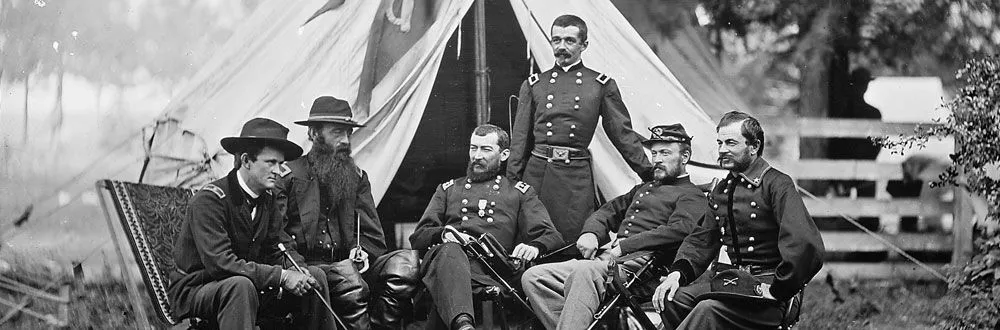
Photo by Matthew Brady courtesy of the National Archives. Shown are Maj. Gen. Philip Sheridan and his generals in front of Sheridan’s tent, 1864. Left to right: Wesley Merritt, David McM.Gregg, Sheridan, Henry E. Davies (standing), James H. Wilson, and Alfred Torbert.
Book Mentioned in the Episode
Music Used in the Episode
| Title | Artist | Album | Label |
|---|---|---|---|
| West Coastin’ | Alan Moorhouse | The Big Beat Vm 2 | KPM |
| Expo In Tokyo | Alan Moorhouse | The Big Beat Vm 2 | KPM |
| Funky Drummer | James Brown | Funky Drummer 7″ | King Records |
| Step Forward | Keith Mansfield | Progressive Pop | KPM |
| Nose Job | James Brown | Ain’t It Funky | King Records |
| Fast Back | Keith Mansfield | Speed and Excitement | KPM |
| Soul Thing | Keith Mansfield | The Keith Mansfield Orchestra | Pronit |
| Volcano Vapes | Sure Fire Soul Ensemble | Out On The Coast | Colemine Records |

