

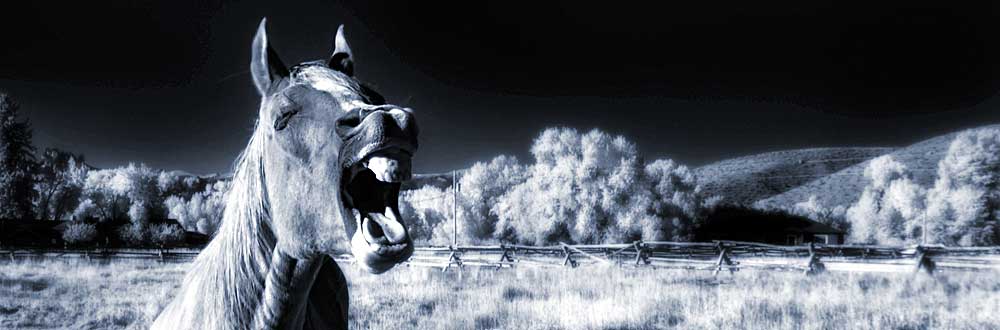
The edge of the Grand Canyon. A remote mountaintop. A medieval cathedral. Some places are so mystical you feel like you’re close to another dimension of space and time. There’s a term for such locales: thin places. And: did you ever go tick-tacking a few nights before Halloween? It’s pranks like tapping ominously on windows without being caught or tossing corn kernels all over a front porch. Also, horses run throughout our language, a relic of when these animals were much more commonplace in everyday life. For example, the best place to get information about a horse you might buy isn’t from the owner — it’s straight from the horse’s mouth. Plus, shoofly pie, bring you down a buttonhole lower, didaskaleinophobia, pangrams by middle schoolers, Albany beef, using say as an interjection or attention-getter, a brainteaser inspired by a New Jersey grandma, and a whole lot more.
This episode first aired June 28, 2019. This episode was rebroadcast the weekend of February 3, 2024.
Transcript of “Gift Horse (episode #1528)”
You’re listening to A Way with Words, the show about language and how we use it. I’m Grant Barrett.
And I’m Martha Barnette.
Danielle Kuhl teaches 7th grade English language art at Home Street Middle School in Bishop, California.
And she does something special in the middle of each week.
She has A Way with Words Wednesdays.
Wow.
Kids can come to her classroom and they eat lunch there and they listen to our podcast and they talk about language.
And they try to beat us at the quizzes and that kind of thing.
And we had an episode a while back on pangrams.
Right.
These are sentences that include all the letters of the alphabet and as brief a wording as possible.
Yes.
Yes.
At least once.
And she sent us some of the pangrams that her students came up with.
And a lot of them are better, I think, than the ones that adults sent to us.
Oh, really?
Yeah.
Here’s one from Morgan that goes,
The quick mama bunny had very good instincts to help six of her babies from getting jumped on by a white zebra.
It’s really picturesque.
I was waiting for the Z.
I was like, how is she going to work the Z into that story?
Yeah.
Well, funny you should mention the Z because that’s one of the ways that they figured out how to do pangrams was to write out words that have those rare letters like Z and Q.
Yeah.
So zebras were a big thing.
Jameson wrote, excited mystic zebras quickly galloped from the very crowded watering hole just before noon.
Wow.
That’s like the volume, first line of a 10-volume epic about Mars or something.
Exactly. And here’s one I learned something from. This is from Anwen.
She wrote, she was flying over the sea, bumping into clouds, wishing that they didn’t look like jumping zonkeys, killer axes, and reckless queens.
Okay. So she, yeah, she did kind of the pile on of the hard letters there at the end.
Yeah. And I was thinking zonkeys.
Zebra donkeys.
I know.
Zonkeys painted like zebras. Have you never been to Tijuana?
I have, but there are zonkeys in real life, too.
Oh, yeah.
You know, the product of a zebra and a donkey.
Gotcha.
Yeah.
So I thought those were really cool.
I’ll share a couple more later in the show.
Pangrams.
There’s no end to the pangrams.
No end.
Our inbox will be flooded with more pangrams.
Bring them.
Email words@waywordradio.org or talk to us on Twitter @wayword.
Hello.
You have A Way with Words.
Hi, my name is Jim Gemberling from Abilene, Texas.
Jim from Abilene, welcome to the show.
Hey, Jim.
What’s up?
Oh, hello, thank you guys.
Well, I believe I was responding to a question you would ask about pies or unusual dessert names.
Yeah, we’re always talking about food and language, so it sounds like us.
Oh, yeah, well, I’m all about food and language, too, because I talk while I eat, and I try not to let people see my food.
But when I was growing up, my mom was from Pennsylvania, and there was a pie called a shoe fly pie.
And I was a child and really remembered I liked it very well, although I’ve never seen it since.
We’ve been in Texas.
And there was also a mincemeat pie, but it never had meat with it.
So I didn’t really understand where those came from.
Okay, shoe fly pie and mincemeat pie.
Well, your description of shoofly pie sounds right on the money because it’s pretty much localized to the Pennsylvania area.
It’s a really sweet pie, right?
A lot of molasses.
Oh, sure.
Yeah.
Down here, pecan pie is a good substitute.
Oh, yeah.
But the shoofly pie, you know, as a child, I was thinking very tangential or very, you know, on task thinking.
I’m going, shoo, I don’t get that.
And I don’t see any flies around.
I think that’s the kind of pie you put in a window.
The flies will come pretty soon.
Yeah, I think that’s exactly it.
So it’s S-H-O-O, shoo.
Like shoo fly.
Get out of here, fly.
Get out of here, fly.
Right.
And it’s more like a cake, really, right?
Or a tart.
Yeah, maybe a tart.
Sometimes it has a top.
It was really kind of, I remember it being sticky and very tasty as I grew up.
Also, that mincemeat pie, as I recall, that was a very spicy kind of, not hot spicy,
But it had a lot of clove in it or whatever.
And I don’t know.
I’ve looked it up since we talked about it.
Some of them even have meat in it, I guess.
But I don’t remember meat being in it.
Well, they used to.
These days, mincemeat, at most, it’ll have a little fat in it, like beef fat or something like that.
But usually these days, there’s no meat in mincemeat.
Okay.
Yeah, just little things all cut up, like raisins.
Well, minced to cut into fine pieces.
Oh, yeah.
I bet the raisin thing I remember.
I think that was a big part.
I thought clove was a big part, too, as I recall.
But, again, those were long days ago, and it just made me think of these neat things when I heard you guys on the radio.
Yeah.
Well, Jim, there you go.
Shoofly pie comes from Pennsylvania.
A lot of people think of it as being something to do with the Pennsylvania Dutch.
There’s a variant called Montgomery pie.
Did you hear about this ever?
No, I haven’t heard about this.
It’s from Montgomery County, Pennsylvania.
It’s similar to shoe fly pie, except sometimes they add lemon juice.
Oh, okay.
And maybe buttermilk is a topping.
Oh, that sounds interesting.
I’ll have to look into that somewhere.
Yeah, sometimes it’s called Granger Pie or Pebble Dash.
Mm—
I haven’t heard of those either.
But, oh, gosh, those are neat, interesting terms to be looking into.
I’m going to surprise some bakers here in my town.
Jim, thank you so much for the call.
We really appreciate it.
Sure, it’s no problem.
I just enjoy listening to you.
So thanks a lot.
I appreciate it.
It’s our pleasure.
Thanks for being with us, Jim.
Bye.
Love those food questions.
I do.
I was reading one of the recipes from 1908.
Yeah.
Because recipes, they kind of don’t really grow stale, right?
Right.
But one thing that changes is the measurements.
Oh, yeah?
Yeah.
So this one says, instead of saying a quarter cup of butter or a part of a stick of butter or a tablespoon of butter, it says butter the size of one egg.
Oh, I love that.
I do.
But eggs can vary a lot.
So it’s kind of emphasizing the make it up as you go along aspect of a lot of recipes.
It’s not necessarily chemistry.
Some of it is just practice and art.
Right.
I love that.
You might be pulling it from the churn, right?
Yeah, yeah.
About the size of an egg.
Yeah, because if you handle eggs all day, you know what an egg feels like and looks like in your hand, right?
That’s right.
Is there a regional dish from your area that you’d like to talk about?
Call us, 877-929-9673, or email us.
The address is words@waywordradio.org.
Here’s another pangram from Home Street Middle School in Bishop, California.
Laurel wrote, in bed, sneezing, queasy and coughing, watching Netflix with pajamas on, but don’t worry, I’m very good at faking.
Oh, wow.
Isn’t that good?
Wait, where was the Z in that?
Sneezing.
Oh, that was really good.
I know.
Because a lot of times when people do pangrams, they have to work in some awkward word with a Z in it.
And these are so visual.
I just love that.
Very good at faking.
And Netflix, using the proper noun to get that X in there.
That was smart.
Very clever.
Hello, you have A Way with Words.
Hi, this is Sloan from Omaha, Nebraska.
Hi, Sloan.
Welcome to the show.
What can we do for you, Sloan?
Well, I’m going into middle school next year.
And one day while I was wondering how in the world I’m going to survive, I was thinking and wondering if there’s a word for the fear of middle school.
One single word for the fear of middle school.
You have a fear of middle school?
Kind of.
I’m mostly excited but I’m a little nervous.
And what are you nervous about?
Mostly not knowing very many people.
And also like just most of it, I guess.
Yeah.
Yeah.
Yeah.
Well, those are perfectly legitimate fears, and we can tell you, Sloan, you’re not alone.
I mean, that’s a really big step going from elementary to middle school.
Yeah.
Yeah.
What years is your middle school there? How many years does it cover?
Two years.
We start in seventh grade.
Oh, seventh grade.
So it’s what I called junior high growing up.
Yeah, yeah.
That’s what I called junior high as well.
So you’re probably 12?
Yes.
Okay.
I’m turning 12 today.
12?
Oh, happy birthday.
Oh, nice.
Thank you.
Happy birthday, Sloan.
There are a couple of fancy words for fear of school in general. I don’t know about middle school specifically, but they’re so long and fancy and it doesn’t really sound like what you’re describing.
I mean, if you want to know these words, one of them is scolionophobia. It looks like scolionophobia, but it’s just one O there before the L.
Scolionophobia. And that one comes from Latin words. And then there’s another one, didascalinophobia.
I don’t think I can say that.
It’s hard for me to say, Sloan. But those are pretty fancy terms that refer to, you know, a really extreme version of being afraid to go to school.
I’m thinking that, you know, maybe if it’s just a matter of not knowing folks there for the most part, I mean, it’s sort of like what we adults have when we go to a party. And, you know, maybe we don’t know people there.
I mean, there’s neophobia, which is the fear of new things. And there’s agnosticophobia, which is the fear of things that you don’t know.
Okay.
Yeah.
So there are lots of different things. But as far as one single word for fear of middle school, we don’t have one.
But, Sloan, I want to ask you a question. Are you going to a completely different school system? Or is there a chance that some of the kids from your elementary school will also be in the seventh grade with you?
I’m going to my district’s middle school. So there is a chance that I’ll see some kids. But my school is very small. And there’s a lot of bigger schools in my district. So I’ll probably be pretty split up.
Yeah, you’ll be overwhelmed by kids from other schools.
You know, I have a 12 year old and he likes middle school partly because he feels like this is the first step towards becoming more independent and getting a little more of that freedom. And maybe that’s something I could recommend to you where you have a little more control over your schedule, a little more control of your life. They trust you to do things more. You don’t, they’re not, they don’t treat you like as much like a baby or a really small child anymore. So maybe that will help take some of the sting out of it if you can think about middle school as you growing up and you becoming the great adult that you’re going to be.
Sure, thank you.
Yeah, you’re welcome. You know, Sloan, I would also just say that it’s not every seventh grader-to-be who can call a national radio show and it sounds so good on the air. Yeah, you have poise and composure, so congratulations. Yeah, I bet you’re going to do really well. Will you be in touch with us later and let us know how it’s going?
Sure, I’ll try.
Okay, great. Take care. We appreciate your call, Sloane. Bye. Bye-bye.
Bye-bye. I remember we moved around a lot when I was growing up, and I remember at first, like the first time we went to a new school, I was like, you know, second grade, these new people. And it turned out all the things I liked were still there. They still had a library. There’s still lunch in the middle of the day. I still had time to read on the bus. And so many of the things that I enjoyed about my old school were always found. And there was always somebody with my sense of humor, and somebody else who would like to read the things I like to read.
And it just took a couple weeks, and then it all worked out.
Yeah, yeah.
And it’s perfectly natural to be afraid of a transition, whatever it is, right?
We welcome your calls. And no matter your age, no matter your background, no matter what the issue is, as long as it’s about language somehow, 877-929-9673.
Email words@waywordradio.org.
Another pan-gram from Home Street Middle School in Bishop, California, Ashley wrote, Voldemort’s zealous followers quickly came, bravely protecting the horcruxes in jeopardy.
Wow, yeah, that’s a good one.
Those are some good words.
She did really well, yeah.
Kind of need to know the Harry Potter stories to get that that could be a line in the books.
Yeah, yeah, but it uses every single letter of the alphabet.
Well, we love getting email and phone calls from you, so call us, 877-929-9673, or send your stories about language to words@waywordradio.org.
You’re listening to A Way with Words, the show about language and how we use it.
I’m Martha Barnette.
And I’m Grant Burt, and we’re joined from New York City by our quiz guy, John Chaneski.
Hi, John.
Oh, hi, Grant.
Hi, Martha.
How are you?
Doing well.
Thanks, you?
Good, good.
You know, I went to NYU, and I studied theater, so a lot of times people can’t really tell where I’m from by my voice. But I was born in Hoboken, and when I go back there, I easily code switch into a Jersey dialect.
But I never say Joy-Z. I’ve never known anyone in Jersey who did, except maybe Joe Piscopo. However, I did know some people who would substitute for oy. For example, my grandmother would call oysters erstes.
Oh, sure, yeah.
Yeah.
Now, you can imagine my surprise when she was cooking pasta. The first step was to bring the water to a knotty, rounded tree growth.
What’s that?
Burl.
Burl.
A burl, yes, a rounded, knotty tree growth that results in beautifully grained wood.
I could not understand, but that’s right. She would burl the water instead of boil.
So this is sort of dedicated to my gram, a quiz about woids, words and woids.
Now, the second thing gram usually did was ask me to fetch from the pantry a British nobleman above a Viscount and below a Marquess.
Now, I didn’t even know we had one of those, but what was it that she wanted?
Earl.
Earl.
So go get me some Earl.
Go get me some Earl.
Usually it was olive Earl. If there were leftovers, she would need to wrap them up.
So grandma would use something that was rolled up like a flag. What was this metallic object?
Some tin furl, yeah, tin furl.
So many of my memories of Grandma have to do with food. I remember a kind of roast she would make that was pork from the dorsal side of the rib cage.
She called it pork to gain or acquire knowledge.
What was that?
Learn.
Pork learn.
Loin, yeah.
Now, Grandma and Grandpa and I and my brothers and my cousins often like to play cards. They had a book of rules they consulted to make sure we played properly.
Now, what did this book have to do with throwing an object with great force?
Hoyle.
Hoyle.
It was according to Hoyle.
Hurl.
According to Hurl.
When my family went on vacations, my grandparents often came with us. Why did they want a hotel room that was taking a break with the intent of resuming later, as if their hotel room was a meeting or a court trial?
That’s a join.
A join.
A join.
Let’s adjoin. They wanted adjourning rooms with my parents.
I started writing puzzles freelance while I was still living at home with my grandmother and my grandfather. After sending in my first work for publication, why did my grandmother think I needed to send the magazine something that is the opposite in order to get paid?
Something that is the opposite in order to get paid. Inverse.
Inverse. I had to send them an inverse.
Even back then, I was known for finding concepts that needed new words, or as Grandma would put it, I was adjusting the space between letters in a piece of text.
That’s close enough, I guess.
Kerning.
I was kerning words. Yeah, kerning voids.
She was always concerned for my safety. If she knew I was going out, she would tell me about certain neighborhoods that I should have stated or asserted to be true.
Averd.
Averd. Or avoid, right.
Avoid.
Now, I never had the chance to find out what grandma’s feelings were about turquoise, but I’m sure her head or my head would have exploded.
So that’s all I’m going to say for now.
So that was from my grandma.
Thank you.
Wow, that’s fantastic.
You know that accent with the replacing the oil has been recorded as far back as the 1920s.
But it is pretty much on the way out.
The last generation is passing on that uses it.
Yeah, if I go back to Joy-Z, I can still come across some people who still talk the way a little bit.
They’re usually older, right?
Much older people, yes.
Yeah, it’s about gone.
John, we really endured that.
It hurt.
Thanks, John.
We’ll talk to you next week.
Talk to you then.
Bye-bye.
Bye.
Your question’s about language, 877-929-9673.
Email words@waywordradio.org or talk to us on Twitter @wayword.
Hi there.
You have A Way with Words.
Hi, this is Kate calling from Indianapolis, Indiana.
Hi, Kate.
What’s up, Kate?
So I had a kind of interesting thought about titles, military and civilian titles.
I just received my doctorate in physical therapy.
Ooh, congratulations.
Thank you.
And my fiancé is a lieutenant in the National Guard and the Army.
Excellent.
So I found lots of information about how to address a couple if one has a title and the other doesn’t, or if a military member has a civilian title.
But I can’t find anything about how the two of us would be introduced, say, at our reception, if we want to be introduced as something other than Mr. and Mrs.
Let me ask you a couple of questions.
Did you use any particular wording on your invitation, like titles and order and that kind of thing?
We just used our first and last name.
I believe my name is first on the invitation.
But for no reason other than I was the one typing them, so my name went on first.
Of course. Good reason.
Okay. And so you’re asking about being introduced at the reception.
So somebody says your name aloud, right, as you enter the room?
Right. You know, introducing for the first time as a married couple, typically it’s Mr. and Mrs.
But we were thinking, since we both have titles that we’ve worked hard to earn, we could have some fun with them.
Right.
But we’re not sure if it goes doctor and lieutenant or lieutenant and doctor.
And will he be in uniform?
No.
Okay.
And will you be taking his last name?
Are you keeping your own?
I will eventually take his last name.
Okay.
Okay.
It’s a lengthy process to go through.
Yeah.
These are all important questions if you’re going to hew to the most conservative point of view on these names.
We are far past the point in American life where all of the old naming conventions are respected all that much in pretty much any place except the most formal of circumstances.
So you can kind of do whatever you want, really, to be honest, Kate.
Sure.
But if you’re going to do the formal thing, strictly formal, if your husband is not in uniform, he’s still probably first in the list.
So let’s just say that his, I don’t know what his name is.
Let’s just say it’s Jack.
So Lieutenant Jack Smith and Dr. Kate Smith, something like that.
That’s how you would do it.
So the man isn’t automatically first.
He’s first because he has the military title.
If you had the military title, you would be first and he would be second because his doctorate, his civilian title comes after the military title.
Right.
Okay.
Yeah, that’s it.
Yeah, traditionally speaking.
Traditionally speaking.
But, you know, there are lots of different conventions for this around the world and even around this country.
And in parts of Africa, for example, in the English-speaking world, they will pile on titles.
So he could be Lieutenant Mr. Jack or Mr. Lieutenant Jack, right?
And you could be Dr. Mrs. Whatever.
Are you leaning in one direction or another?
I like the way that Dr. and Lieutenant sounds just because we both have monosyllabic first names and it’ll be a very long last name.
So I like the way that Doctor and Lieutenant goes with all of it, but he likes the way Lieutenant and Doctor go.
I like the formality of both of them together in either order.
It’s romantic.
It’s like a lovely novel about two very competent, busy people who are brilliant, brought together to make a new thing together.
I love it.
But are you saying that he wants to do it one way and you want to do it the other way?
We don’t have a strong opinion about it.
It’s just when we kind of play around with it and go, well, which way would it go?
He likes the way that lieutenant and doctor sounds better than doctor and lieutenant.
Oh, could you arm wrestle or flip a coin or leg wrestle?
I’m not sure I’d win that one.
Do let us know what you decide.
Maybe on the night of you’ll have inspiration and something will come to you and you’ll be like, oh, that makes perfect sense.
Why didn’t I think of that before?
And that’s what we want to hear about. All right.
Who has to do the introducing?
Yeah. Is it is it the father of the bride or somebody of that stature?
It’ll likely just be the DJ that we’ve hired for the event.
Oh, well, you can blame the DJ.
Slip the DJ a 20 and have him do it your way.
Fair enough. All right. Well, thanks so much for for your time and for that information.
And I might keep that bit to myself that really should be Lieutenant.
Congratulations on your new life.
It sounds wonderful.
Thank you.
Thank you.
And I’ll update you when we decide what we’re doing.
Cool.
Thanks.
Good luck to you both.
Bye-bye, Kate.
Thank you.
Goodbye.
Email words@waywordradio.org.
Or talk to us on Twitter @wayword.
We got a voicemail from Julie Andreas in Hammondsport, New York.
And she said, when we were kids, and my dad was obviously doing a project of some sort, and we were silly enough to walk up to him and say, hi, Dad, what you doing?
His response would invariably be, I’m sandpapering a bowl of soup.
Go away, kids, scram.
Add that to our long list of the things that parents say to make the kids go away.
Yeah, we’ve collected a lot of those, but I’ve never heard that one anywhere.
What’s the buttons for kittens, britches or something like that?
Sewing buttons on ice cream, that kind of thing.
It reminds me of the expression soup sandwich, you know, as silly as a soup sandwich, which makes no sense at all.
Right, yeah.
And that reminds me of a milk sandwich, which is the joke that people always make anytime there’s a severe weather event and you go to the grocery store and all the bread and milk are gone.
Oh.
What are people doing, making milk sandwiches?
I didn’t know that.
That’s cool.
Hello, you have A Way with Words.
Hello, this is Noam from the Bronx, New York.
Hi, Noam. Welcome to the show.
Thank you so much. Glad to be here.
Glad to have you, Noam. What’s up?
Why, within sayings such as, look a gift horse in the mouth, or straight from the horse’s mouth, how would the origin, what the origin of having the animal, a horse, within those sayings, is instead of, say, a zebra or a monkey, instead of any other animal.
So you’re asking about expressions like don’t look a gift horse in the mouth or straight from the horse’s mouth, things like that.
Right, right, precisely.
Sayings that encompass the word the animal horse.
Martha, why don’t we say straight from the monkey’s mouth?
That would sound interesting.
Yeah, well, both of these reflect a time when horses were much more commonplace in everyday life.
There are a lot of associations when it comes to straight from the horse’s mouth to horse racing itself.
Right, right, right.
Because in the late 19th century, for example, people talked about, you know, they would go to the track and they wouldn’t want to tip from the bettors hanging around there or the stable hands or the jockeys.
They wanted to tip on who would win the race straight from the horse’s mouth.
And there are other stories involving horse’s mouths and truth in the past.
When you talk about don’t look a gift horse in the mouth, you’re talking about a horse being given to you.
And when horses get older, their gums recede and so their teeth look longer.
And so that’s also why we talk about looking long in the tooth.
So there are all these terms that have to do with horses and they just reflect their place in our society a generation or so ago.
I see. I see. And do we know when those things were coined approximately or created?
Well, the straight from the horse’s mouth is, what, mid-19th century, Grant?
Yeah, roughly.
And it shows up early in not only just in horse racing, but it shows up in stories about horse trades gone bad, where somebody lied about the age of a horse.
And there was a funny anecdote running around in the 1860s or so that the newspapers were publishing about somebody saying, how did you know how old it was? And he goes, I got it straight from the horse.
But the other one, Martha, has got a lot more legs to it, right?
Yeah, four.
Don’t look a gift horse in the mouth goes back to the writings of St. Jerome.
Yeah, centuries.
Centuries.
Oh, wow.
Hundreds of years.
And it also appears in pretty much every European language.
And you can find it in Latin, even.
Yeah, and the metaphor, of course, is don’t look too closely. Don’t inspect a gift too closely.
Right, right, yeah.
So I see there’s a whole equine history to those things.
Yeah, I don’t know that new horse idioms are being coined now.
I suspect with the horses being relegated to specialty areas in modern life, they’re not being coined for everyday use.
Yeah, we certainly have a lot of horse racing terms.
My favorite is hands down. You know, somebody wins something hands down. It’s a reference to a jockey who’s so far ahead that he or she can lower his or her hands at the end of the race.
So I see that those sayings were largely coined at a time where events such as horse racing and other horse-based events were more popular than they might be now.
Yeah.
Yeah.
Horses in everyday life.
Yeah.
Right, right.
Horses have always been valuable animals.
Right.
So horses were property of some prestige. Sales and trades and that kind of thing.
Noam, thank you so much for your call. We really appreciate it.
Absolutely.
My pleasure.
All right.
Take care.
Bye-bye.
Bye-bye.
We could also talk about the term to vet something.
Sure, yeah.
A veterinarian going down to check out a horse before the race, right?
Yeah, yeah, thoroughly.
Thoroughly, which surprises people that it’s something so prosaic, but yet that’s it.
When you vet somebody for a job, you are carrying on a tradition of examining a candidate.
Right, right.
Hello, you have A Way with Words.
Yes, this is Danielle from Oklahoma City.
Hi, Danielle in Oklahoma City. What’s up?
There’s a podcast in the New England area that covers sports and entertainment.
And Jason, one of the co-hosts, has a theory that, like, every five years, let’s say on the celebration of 30, 35, 20, 25, like, it’s a bigger celebration if it ends in fives and zeros.
And so he believes, and his two co-hosts, Liam and Bill, do not agree with him, that there is a word that ends in fives and zeros of celebration.
I have like three guesses on it because I think he’s like, right, but there may not be a word.
And so we’ve been trying to find what the word is.
Let’s clarify for a second, Danielle.
So you’re saying that he believes, although he can’t name it, that there’s a word to use to describe the years that end in five and zeros.
Yes.
You mean like a round birthday, like when you turn 40 and you call that a round birthday?
Exactly.
Yeah.
For those particular words.
Decades are easy, but you’re looking for something that’s decades and the five-year marks, right?
The only thing I can think of in terms of that period of time is the word lustrum, L-U-S-T-R-U-M.
I doubt that’s the word that he was thinking of, but it refers to a period of five years, and it goes back to an old Roman practice of doing a ritual sacrifice every time they did the census, which was every five years.
So it actually goes back to an old word that means to wash.
I think it’s like, you know, laboratory or something like that.
Lustrum, which is kind of a sexy word, but probably not what you’re looking for.
Right.
And what’s funny is like, you know, I’m in Oklahoma City and podcast radio shows in New England.
And everyone from around the world, this has been a debate for like two years.
Does this term exist or not?
And every time he refers to it, it’s like fives and zeros. It’s something that ends in fives and zeros.
And there’s like, I’d say 90% of people, it sounds like they don’t believe him.
And I’m like, I think he’s like got an idea. He might have a concept, but, like, the word is what nobody knows.
Does it exist?
So that one, correct, that’s great.
I don’t know.
That’s funny.
Daniel, are you saying that this podcast guy actually knows the word and is withholding it?
No.
No, I don’t think he, it’s like, because he went to, him and his friends, I think they all went to, like, school for, like, film.
Yeah.
Like, journalism, I guess, would be the category.
He remembers hearing the word or understanding the concept, but I think he’s, like, blanked on the word.
Now, if he’s holding it from us, then I’d be like, hey, Jason.
Yeah.
I got to tell you, if people have been working on this problem for two years and you’ve come to me and Martha and we don’t have an answer.
I’m not saying that we know everything, but I’m saying all those other people, plus the two of us, there’s a good chance that he is just having a lot of wishful thinking.
I mean, you can just call it a big anniversary and be done with it, right?
We don’t have to have a special term for that.
And frankly, any new term that you would coin or an old one like lustrum that you would bring back is just going to sow confusion because people don’t know it.
And so then you have a whole new job of confusing them with a word that you didn’t used to have.
So really just call it a big anniversary and be done with it and continue to talk about the patriots and the, you know, the ball gate and all that stuff.
Yeah, I mean, Grant and I can tell you all kinds of words that are put together with Latin words like quindecennial is a 15-year anniversary and things like that.
I could see corning something like infennial.
You know, we take inf, which just means some unknown number of counts, and then ennial, which means annual.
Oh, yeah.
The infennial.
But you would probably use something like that when you didn’t know how many years it truly was.
It’s fun to have these things to argue about.
They certainly stop us from fighting in the parking lot over sports teams.
But really, I would just email them and say, dear gentlemen, wrap it up.
But I appreciate it.
Because, again, we could all coin something, but making it catch, that’s an impossible task.
Well, thank you, guys.
You all have a good day.
Take care.
Bye-bye.
Thanks.
Bye-bye.
Maybe you know the word. If you do, call us or call us about any language question.
You’re listening to A Way with Words, the show about language and how we use it.
I’m Grant Barrett.
And I’m Martha Barnette.
Sometimes when I’m hiking and I stop near the top of a mountain, the beauty and the stillness there feels otherworldly.
It almost doesn’t seem real.
It’s as if the sky is like this scrim that I could just punch my fist through and look through to the other side.
It’s this profound feeling in a place like that, like you’re on the edge or on the threshold of something.
Maybe you’ve had that kind of experience out in the desert, in that vastness, or overlooking the Grand Canyon, or maybe just an almost empty cathedral looking up.
And it turns out that there’s a poetic term for these locales.
They’re called thin places.
And thin places have been described as places in the world where the walls are weak, and another dimension seems clearer than usual.
And author Eric Weiner has called them those rare locales where the distance between heaven and earth collapses.
And we’re able to catch glimpses of the divine or the transcendent or, as I like to think of it, the infinite whatever.
But, you know, the power of thin places doesn’t necessarily have to be religious.
I like what the essayist Oliver Berkman said about them.
He said, we’re in the territory here of the ineffable, the stuff we can’t express because it’s beyond the power of language to do so. Explanations aren’t merely useless, they threaten to get in the way. The experience of a thin place feels special because words fail, leaving stunned silence.
And I should point out that if you Google the term thin places, you’re sure to see this popular story going around about the idea that thin places is a translation of an Irish Gaelic expression from hundreds of years ago, which is a very appealing notion. But I haven’t come across hard evidence that the expression in English has been around for more than a century or so. But in any case, I’m thrilled to have a name for these places. And I’m wondering, does that resonate with you?
Yeah, absolutely. I just a hundred different things came to mind. Some of them are very practical, but I also think about my time in Paris, which is in some ways overrun with tourists, in some ways can barely handle the people who want to come and see it. And yet, despite all that, if you have ever been in Paris in the snow, say Christmas morning when most shops are closed and most people are at home or even still in bed, and like I did, walked along the Seine with a friend and in the falling snow, trudging your feet through the snow that has already fallen, it could have been a thousand years ago. It was astonishing.
And I still, the hair on the back of my neck kind of stands up when I think about that moment with that person in that place at that time. Wow. And so Paris is one of those strange towns where surely it’s finished. They say year after year, surely it’s done. And yet, and yet Paris is loaded with thin places. That’s super cool. Layer after layer after layer, right? Just all that history underneath.
Well, we’d love to hear from you. What kind of thin places have you experienced and what was it about them that left you without words? Give us a call, 877-929-9673 or email us. That address is words@waywordradio.org.
Hello, you have A Way with Words. Hi, this is, my name is Ken and I’m calling from Swarthmore, Pennsylvania. Hi, Ken. How are you guys? We’re doing great. What can we help you with?
It’s interesting to discover that words have lifespans. You know, sometimes we discover that a word that we thought was recent is actually very old, but sometimes words die. The word that I’m thinking of is the word say, as in, oh, say, can you see? I don’t even know what part of speech that is. It was used in that fashion at least through the 40s, because I remember in the old Humphrey Bogart movies, he would always say stuff like, say, what’s the big idea? It disappeared, you know, and I wonder if it just disappeared or if it morphed into hay. Now, that’s an interesting word in itself.
When I was, I’m 67. When I was a kid, that was a word that you’re not supposed to use. At least kids weren’t supposed to use that to adults. It wasn’t obscene, but it was impolite somehow. I don’t quite know why, but if I came into the house and said, hey, ma, she would say, hay is for horses. Something that kids aren’t supposed to do, which brings up another whole question about language etiquette. But anyway, I’m just interested in hay. Is it still for horses? Say didn’t become hay, let’s just put the kibosh on that. Say is its own thing, hay is its own thing, and they’re unrelated.
But I do want to say the longer form of your mom’s response. It’s hay is for horses, grass is cheaper, straw is free, marry a farmer, and you have all three. So say as an expression, kind of an interjection to something you throw into a conversation to catch someone’s attention did kind of fall out of fashion. It was colloquial, maybe slangy. And that’s what happens to stuff that isn’t core English, like words about relationships and parts of the body and the fundamentals of the earth and animals. Those are the ones that tend to be consistent and not change very much. So say definitely went the way of much slang and disappeared.
The say in Oh Say Can You See is not quite the same say as say, kid, what are you doing? What are you trying to do to me? It’s not quite the same thing at all. But they’re both attention getters. And the one in the national anthem is literally, I believe, if I can parse this approximately, asking you to tell the speaker, can you actually see the flag? Can you see the ramparts? Can you see what’s happening? So it’s a question. Can you see it?
Lang Ward, also tell me what’s the scoop here. Yeah, exactly. When Bobar says that, he’s asking to have the thing explained to him. But this will be a little moment for most of our listeners. In the American mind, there’s an old stereotype about the British saying, I say, old chap. And that I say is directly related to the, say, what are you trying to pull here, kid? It’s exactly, they’re very similar. They’re both attention getters. They’re both interjected into the sentence to cause you to focus on what is being said.
I associate say at the beginning of a sentence with Jimmy Stewart or World War II movies. Say, you know, it’s sort of this whole other era. By the way, it dates back probably to the 1830s, that say, that particular kind of weird say that we associate with old black and white films. Is hay still considered impolite anywhere? I think it wasn’t so much the impolite, at least according to the books that I’ve read and the grammars and etiquette guides and so forth. It’s about the informality of speaking to your elders.
Right. It’s about the informality of the relationship. She is not one of your peers. She is your mother, and she deserves a little more respect than, hey, ma. We were talking about, you can say hey to another kid, or an adult can say hey to a kid, but not the other way around. But in the United States, we’ve lost a certain amount of that formality. Actually, it’s all across the world, that old formality of speaking to your elders a particular way. Everything’s kind of flattened. There are still some rules, like a kid isn’t supposed to address an adult by their first name.
Well, I will tell you, all of my teachers in school were Mr. and Mrs. or Ms. This and that. And none of my sons are. He’s in middle school. He may have Miss Mindy and Ms. This and that, but it’s their first names, not their last names. And so it’s far more informal than when I went to school. Thanks for taking the call. Ken, our pleasure. Thanks. Call again sometime. I will. Take care. Bye. Bye, Ken.
Give us a call, 877-929-9673, or send your stories about any aspect of language to words@waywordradio.org. Hi there. You have A Way with Words. Hi. This is Evelyn. I’m calling from Wilmington, North Carolina. Hey, Evelyn. Welcome to the show. What’s up?
Well, there was an expression my parents used to use, and I’ve always been curious as to where it came from. I’ve talked with my older sister, and she said, well, let me know what you find out. So when we were growing up, if we were sassy to them at all or would talk back, she would say one of two things. Either you’re getting too big for your britches, which I understood, but she would also say, I’m going to bring you down a buttonhole lower. And we knew it was a threat, but as an adult, I’ve often wondered, well, what does that mean? Where did it come from? Where did the expression originate? So that was my question.
Buttonhole lower. So you may be surprised to find that the expression to bring someone down a buttonhole or a buttonhole lower is about 400 years old. Wow. Maybe more. Actually, more like 500 now that I’m looking at it. So the word buttonhole itself appears about 1530 or so before that garments were fastened in other ways. But then by the middle of the 1500s we have this expression popping up and it pops up in Shakespeare too and it means basically to take someone down a peg, which is a good synonym for it.
Both of these are ways that you might fasten a coat or a cloak or an outer garment and as a matter of fact we still have coats that fasten with pegs. They look like horizontal wooden buttons and they kind of slide through the hole and you turn them sideways so that the button is one way and the slit is the other, right? The buttonhole slit is the other. We don’t know 100% for sure why people coined this, but we think it means to expose someone’s body in public, to embarrass them, because it was a time when propriety was a little different, when having a décolletage or, you know, or having one skin exposed wasn’t the done thing. And so if you undo their clothes by a button, imagine like jerking their clothes, the button pops, you’re embarrassing them.
You’re embarrassing them by exposing them or addressing them in public.
Oh, okay.
Yeah.
That’s very fascinating.
I thought it was this, I don’t know, something they made up or whatever.
So that’s amazing.
A long history, yeah.
But the embarrassment part is kind of speculation.
And I always hate to do speculation on this show, but it’s the best that I have to offer.
That’s what some of the people who have researched this believe, Eric Partridge and others.
Okay.
Well, all right then.
Well, thank you very much.
I appreciate it.
I’ll let my sister know where it came from.
Evelyn, thank you for your call.
We really appreciate you.
Thanks, Evelyn.
Thank you.
Bye-bye.
Thank you.
Bye-bye.
Well, if there’s a word or phrase kicking around your family and you’re not sure if it’s your phrase or if other people use it, call us, 877-929-9673.
Here’s a cool food term, Albany beef.
Another one of those things that’s not beef.
Right.
Is it another seafood, another fish?
It’s another kind of fish.
Albany is right there on the Hudson.
Hudson, sure.
Shad.
Close.
Sturgeon.
Sturgeon.
Yeah, there was a time when sturgeon was really, really plentiful in Albany.
So plentiful that bar owners would serve sturgeon caviar just for free, along with drinks.
Here, have some caviar.
We’re at a different time now.
Right?
Albany beef.
Albany beef.
877-929-9673 or talk to us on Twitter @wayword.
Hello.
Welcome to A Way with Words.
Hi.
This is Monica Barber.
Monica, where are you calling from?
I’m calling from Lexington, Kentucky.
Lexington, Kentucky.
Well, welcome to the show.
What can we do for you?
Well, I listen to your show every week.
Yay.
And I came up with a term that we used as kids all the time in my little hometown in northern Kentucky.
And since I’ve moved away, I have not found another person who knows what I’m talking about when I talk about tic-tacking.
Tic-tacking.
And, Monica, what northern Kentucky town is that?
Augusta, Kentucky, population 1,500.
Okay.
All right.
Well, tell us about tic-tacking.
Okay.
So about maybe two to three weeks before Halloween, all the young kids, maybe pre-teen and teens, maybe around 13 years old and older, go out and just cause mischief around the town.
And so you might do things like the most popular soaping car windows or, if you’re really brave, house windows.
And so for a few weeks before, we would go get corn out of the farmer’s field that was all hard for the cattle, and we would shell the corn into bags and save it up.
And so you might run down the street and throw corn on somebody’s front porch, you know, and then watch the lights come on.
And the funny thing is our parents did it, our grandparents did it, and they encourage it.
And they like to tell stories about when they were kids.
My dad’s favorite story is taking manure and putting it in a paper bag and setting it on fire on someone’s porch.
And then when they’d come out, they’d stomp it.
And yes, he encouraged us to do those things.
They thought it was hilarious.
Did they have a name for the manure in the bag trick?
No, it’s just generally called tic-tac-ing.
Okay, okay.
And you might say, hey, do you want to go tic-tac-ing tonight, or do you want to tic-tac the barber’s house tonight, things like that.
And so when I moved away, I’ve asked people, have you ever heard of tic-tac-ing?
And I have not found another person outside of my little hometown that knows about tic-tac-ing.
Well, we can tell you, Monica, that there is a long tradition of tic-tac-ing both in this country and in the U.K.
And it has to do with exactly what you’re talking about, specifically wrapping on windows, finding different ways to wrap on windows.
It’s sometimes called window tacking.
And you can do that, of course, by throwing hard corn kernels at somebody’s window.
But, you know, kids are really ingenious when it comes to coming up with devices to execute these kinds of pranks.
And window tacking can involve all kinds of different things.
Like there’s one method where you take a wooden spool and you take all the thread off the spool and you cut notches in the circumference of either side of the spool.
And then you wind it with twine and you put it up near a window and put a pencil through the hole of the spool and yank on that string that’s around the spool.
And it makes a rapping noise.
Don’t give me ideas.
I might go back and check back.
And it’s supposed to be really annoying.
And the nice thing about these little devices that kids come up with to do tic-tac-ing in one way or another is that you can run away really quickly.
You know, they’re lightweight, and you can just do that tic-tac-ing on the window and then run away.
Probably before we got our driver’s license.
So it was in that age period where you had to run quickly to get away.
And the townspeople just turned a blind eye.
You know, they just laugh and say, oh, it’s those kids just tic-tac-ing and harmless.
Good clean fun, huh?
And what was your method for tic-tac-ing?
I like the bar of soap and the corn on the porch.
Oh, I see.
Because some people would use paraffin, and then you can’t wash that off the window.
So we stuck with more harmless things that could be cleaned up.
Would you write things?
You would write things, but mostly, depending on who it was, just try to soap it up really good on the front windshield and then just make circles on all the rest of the windows.
I wouldn’t mind having that done to my car.
It’s kind of a mess.
Monica, thank you for this stroll down memory lane.
I’m sure a lot of people are going to be remembering those nights.
I hope other people have heard of it from other parts of the country.
Well, we will hear about it.
Okay, good.
Thanks, Monica.
Thank you. Bye.
One of my favorite books of all time, seriously, I mean, at least as far as reference works go, is The Lore and Language of Schoolchildren by Iona and Peter Opie from 1959.
And they have a page or two on tic-tac-ing.
And they have a ton of names for this, which I don’t need to get into here.
But they describe it as using a pushpin and a string to push the string into the pane of a window.
And you have a button knotted onto that string.
And you’re on the other end of the string, like hiding in the bushes or something.
And you’re slowly letting that button tap against the window.
Tap, tap, tap.
Because it’s hard to see when you’re looking out at night what’s causing the tapping.
And it can be pretty freaky, maybe even scary, right?
Right.
Well, you know, they’ve got tic-tac-ing where you are.
I know they do.
Maybe they have Devil’s Night and they’ve got something else.
Cabbage Night.
Cabbage Night.
Pranks that you get up to, oh, around Halloween or so.
Call us.
We want to hear about those pranks, what you called them, where you learned them, who’s doing them now.
Email words@waywordradio.org.
Thanks to senior producer Stefanie Levine, director Colin Tedeschi, editor Tim Felten, and production assistant Tamar Wittenberg.
You can send us a message, subscribe to the podcast, get the newsletter, or catch up on hundreds of past episodes at waywordradio.org.
Our toll-free line is always open in the U.S. and Canada, 877-929-9673.
Or send us your thoughts to words@waywordradio.org.
A Way with Words is an independent production of Wayword, Inc., a nonprofit supported by listeners and organizations who are changing the way the world talks about language.
We’re coming to you from the Recording Arts Center.
At Studio West in San Diego, California.
Thanks for listening. I’m Grant Barrett.
And I’m Martha Barnette.
Until next time, goodbye.
Bye.
Thank you.
Student Pangrams
 After hearing our discussion about pangrams, those sentences that contain every letter of the alphabet at least once, a middle-school teacher in Bishop, California, assigned her students to write some. They’re great!
Shoofly Pie
Jim from Abilene, Texas, says his Pennsylvania-born mother, used to bake a molasses-based tart called shoofly pie. The name most likely derives from the action of shooing away flies attracted to the sweet, sticky dessert. Found primarily in her home state, this dish sometimes goes by the name granger pie or pebble dash. A similar version, Montgomery pie, with a dash of lemon or buttermilk, is found in Montgomery County, Pennsylvania. Long ago, mincemeat pie usually contained meat or suet, but now usually consists of sweet ingredients cut up, or minced, into tiny pieces.
Netflix Pangram
A middle-schooler from Bishop, California, pens a clever pangram about watching Netflix while under the weather.
A Word for the Fear of School
Sloane, a 12-year-old from Omaha, Nebraska, is a bit anxious about starting middle school in the fall and wonders if there’s a single word that means “fear of middle school.” There are some long, rare words for the extreme fear of school in general, such as didaskaleinophobia and scholionophobia, or also spelled scolionophobia. More generally, there’s neophobia, meaning “fear of the new” or agnostophobia, “fear of the unknown.”
Harry Potter Pangram
A young Harry Potter fan in Bishop, California, crafts a dramatic pangram about horcruxes in jeopardy.
Noo Joisey Word Game
Quiz Guy John Chaneski’s puzzle is an homage to his grandmother from New Jersey, or as she would pronounce it, Noo Joisey. When his grandmother cooked pasta, she’d bring the water to a rounded, knotty tree growth, also known as a what?
Who Comes First, the Doctor or the Lieutenant?
Kate from Indianapolis, Indiana, just earned her doctorate in physical therapy. She’s marrying an Army lieutenant. How should the couple be introduced at the reception? Dr. and Lt.? Lt. and Dr.? Or some other way? Although there’s plenty of leeway on this nowadays, traditionally the military title comes first, regardless of the new spouse’s gender.
Sandpapering Soup
Adding to our long list of silly responses from harried parents to children who ask what they’re doing, Julie from Hammondsport, New York, says her father’s standard reply was: I’m sandpapering a bowl of soup.
Horses Run Rampant Through English
Several phrases have stuck around long after a time when horses were much more common in daily life. They include don’t look a gift horse in the mouth, which is a warning not to expect a gift too closely, and straight from the horse’s mouth, which refers to information directly from the source involved. Also, to vet, as in to vet a presidential candidate, means to examine with the necessary thoroughness of a veterinarian.
Word for Anniversary Ending in Five or Zero?
Danielle in Oklahoma City, Oklahoma, is looking for a word for a year or anniversary that ends in a 5 or a 0. The word lustrum is an old term for a period of five years that derives from an ancient Roman practice. A quindecennial is a 15-year anniversary.
Thin Places, Where We Glimpse Other Realities
There are places in the world where the walls of reality seem weak and another dimension seems nearer and clearer than usual, leaving you without words. Perhaps you’ve had that experience on top of a mountain, or at the edge of the Grand Canyon, or looking up in a medieval cathedral. There’s a poetic term for such locales: thin places. Writer Eric Weiner describes them as places where “the distance between heaven and earth collapses and we’re able to catch glimpses of the divine, or the transcendent, or as I like to think of it, the Infinite Whatever.”
Say, Kid. Hey, Man
Ken in Swarthmore, Pennsylvania, wonders about the use of a couple of interjections. Why don’t people begin sentences with the word Say any more? And is it impolite to start a sentence with Hey?
A Buttonhole Lower
Evelyn in Wilmington, North Carolina, says that when she and her older sister were sassy to their parents, her mother would say either You’re getting too big for your britches or I’m going to bring you down a buttonhole lower. The former makes sense, but what about the latter? The expression bring you down a buttonhole lower goes back some 500 years, and even Shakespeare used the version take you a button-hole lower.
Albany Beef
Albany beef is a slang term for sturgeon. There was a time when this fish was so plentiful in the Hudson River along the New York town of Albany that bartenders served sturgeon caviar free with drinks.
Tick-Tacking and Other Pranks
Monica says that generations of children in her Augusta, Kentucky, neighborhood would go tick-tacking, or playing pranks during the nights leading up to Halloween — soaping car windows, tossing corn kernels onto front porches, leaving flaming paper bags of manure on people’s doorsteps, and finding ingenious ways to tap ominously on a window without detection. The last of these, tick tack, or window tacking, is described at length in Iona and Peter Opie’s classic 1959 work The Lore and Language of Schoolchildren.
This episode is hosted by Martha Barnette and Grant Barrett, and produced by Stefanie Levine.
Photo by Greg Westfall. Used under a Creative Commons license.
Book Mentioned in the Episode
| The Lore and Language of Schoolchildren by Iona and Peter Opie |
Music Used in the Episode
| Title | Artist | Album | Label |
|---|---|---|---|
| Up Above The Rock | Ray Bryant | Up Above The Rock | Cadet |
| Dag Nab It | Ray Bryant | Up Above The Rock | Cadet |
| Upshot | Grant Green | Carryin’ On | Blue Note |
| If I Were A Carpenter | Ray Bryant | Up Above The Rock | Cadet |
| Jan Jan | Grant Green | Live at the Lighthouse | Blue Note |
| Quizas, Quizas, Quizas | Ray Bryant | Up Above The Rock | Cadet |
| Volcano Vapes | Sure Fire Soul Ensemble | Out On The Coast | Colemine Records |

