

If you’re not using a dictionary to look up puzzling words as you read them, you’re missing out on a whole other level of enjoyment. • When you’re cleaning house, why not clean like there’s literally no tomorrow? The term death cleaning refers to downsizing and decluttering specifically with the next generation in mind. The good news is that older folks find that death cleaning enhances their own lives. • You know when anticipating something has you extremely nervous but also really excited? Is there a single word for that fluttery feeling? • Marrow, a set of twins, skid lid, reckon, vicenarian, miniscule vs. minuscule, and how to pronounce potable. This episode first aired November 11, 2017.
Transcript of “Butterflies in Your Stomach”
You’re listening to A Way with Words, the show about language and how we use it.
I’m Grant Barrett.
And I’m Martha Barnette.
If a person is in their 80s, we call them an octogenarian. What do we call them if they’re in their 90s? Your Honor? I don’t know. We call that person a nonagenarian. Nonagenarian, right. If they’re in their 70s, they’re a septagenarian. You know what they call people in their 60s? A sexigenarian. Yeah, with an A, sexagenarian, right. What about a person in their 50s? There is a term for this. It’s not used very often, sometimes in medical texts. I don’t know, actually. Cinquantinarian, I don’t know. That’s close. It’s quinquagenarian. Quinquagenarian. Quinquagenarian. And someone in their 40s? The new 20s. Exactly, right? I’m in my 40s. Exactly. Whoever I am is the right age to be. That’s how we feel, right? Right. Well, someone in their 40s is a quadrigenarian. Quadrigenarian. These are great. Of course there had to be terms for all these, right? Right, right. We only think about the teen ones and the toddler years, but after that, if you work in demographics, you probably know these. Right. Or marketing. It’s a shorthand way to say that. 100 is centenarian. Right. We don’t need terms much more than that. No, not much more, although there are super centenarians. Super centenarians. What does that mean? It means over 110. Over 110. 110 or older. Wow, super centenarians. Yeah, how about that? But you mentioned people in their teens, and I will share the word for that later in the show. Ooh, something to look forward to. There is actually a lot to look forward to. We take calls from all around the country, including you, about language and things having to do with how we talk and slang and new words and writing well and literature and poetry and word puzzles. Try it, 877-929-9673. Email us words@waywordradio.org or talk to us on Twitter @wayword.
Hello, you have A Way with Words. Hi, this is Kitty from Norfolk, Virginia. Hi, Kitty. Welcome to the show. Hello, Kitty. What’s up? Hi. I have a question about the word potable. I’m active duty Navy, and I have noticed over a few years that it consistently gets mispronounced in the fleet. And while I try to correct people, I find that I get quite a bit of a backlash, and they actually do think that it is pronounced potable. And so, Kitty, where did you learn it as potable? Well, I took Latin for a few years in high school, so I know that it comes from the word, and I’m probably going to mispronounce this, but it comes from the word potare. Potare, maybe? That means to imbibe, or that’s what I was taught that it meant. So, you know, it makes sense. Potable water, you’re drinking water. Yeah, it comes from the Latin potare, which means to drink. And it’s a linguistic relative of words like potion and also symposium, which literally is a drinking together. Oh, interesting. Oh, I didn’t know that one. Yeah, yeah. And so you have a long O in all of those words. And even the Merriam-Webster Dictionary, which I think of as pretty permissive when it comes to pronunciations, lists only one pronunciation, and it’s the one you’re using, Kitty. Potable. Okay. Potable. Potable, meaning you can drink it. Right, right. You can drink it. Yeah. The problem, of course, is I’m wondering, number one, are the people you’re correcting below you in rank or above you in rank? No, it’s sort of just a co-worker situation and it’s not really according to rank. I mean, if someone’s mispronouncing something, we would want to, you know, correct that. I see. Personally, I had a little bit of an issue with my CO coming over the 1NC saying, you know, oh, we need to secure the potable water, and then it just becomes rampant. So that was a little frustrating. Yeah. The problem is that you’re in a situation where a whole lot of people say potable. Yeah. Right. Yep. Yeah. Those pronunciations are sort of existing side by side. And I think perhaps the fact that you’re in the military may have something to do with it as well. I’ve seen tons of people commenting that potable is far more common in the military than elsewhere. And there’s a culture of not correcting anybody who’s above you in rank if it’s something simple like a mispronunciation, right? Right, right. You just would let that go usually. Yeah. So it’s sort of a win in Rome thing. But outside the military, and I’d say in general in English, potable is far more common. Far more. Like vastly more common. But potable. Oh, that’s heartening. Potable is on the rise. And again, mostly from a misunderstanding of the origins of the word. And a lot of people actually don’t even know how to spell it. You can find people spelling it with two T’s because they think that’s. Oh, really? Oh, I didn’t know that. Yeah. So they don’t quite get. The word is a little strange. Potable sounds like something you can put in a pot, right? Okay. So they’re misanalyzing it. Misanalyzing it. Interesting. Yeah. Well, your Latin is serving you well, but I guess it’s causing problems, huh? But again, the better pronunciation is potable, but many people do say potable. And unless they ask you to be corrected, I would just let it go. Yeah. I’ve pretty much started to just try to mind my own business with that now. Yeah. Yeah. Just make a mental note to think of Martha and Grant every time that happens. Katie, thank you so much for your call. I really appreciate it. Oh, absolutely. It was a pleasure. Thank you. Great talking with you. Bye-bye. Thank you. Bye.
877-929-9673. Email words@waywordradio.org or talk to us on Twitter, W-A-Y-W-O-R-D. We heard from Lucy Zeldin-Roost, who listens to us in Two Rivers, Wisconsin. And she was talking about the fact that words often have more than one meaning, like the term mango, which can mean either a bell pepper or a fruit. She had the same experience with the word marrow. Oh, yeah. Yeah. Right. So the marrow of a bone, but the vegetable marrow as well. Exactly. She said to us in the U.S., marrow is that center fatty goop in a bone, but to the British, it’s a zucchini. And she said, visiting friends there, I was surprised to hear we would have marrow with a dip as an appetizer. I’m a vegetarian. I can’t have that. The language is interesting and diverse.
877-929-9673. Hello, you have A Way with Words. Hello, is this Martha? This is Martha. Who’s this? Hi, Martha. It’s Mary Lou, and we’re calling from the quiet corner of Connecticut. Hi, Mary Lou. What’s the quiet corner of Connecticut? Yeah, which corner is it? The quiet corner of Connecticut is the northeast corner of Connecticut. And what makes it so quiet? Away from the city. It’s away from the city. We have beautiful fields and pastures and lots of cows. Okay. Well, they’re not very quiet, are they? And so you and the cows had some questions for us? Well, me, the cows, my daughter, and actually we’re here with her whole fifth grade class. Oh, nice. Oh, wow. So I’m going to ask Nina to ask you what her question is, if that’s okay. Yeah, sure. I’m looking for a word for how I feel right now, which is nervous and excited. You’re looking for a word about how you feel right now, which is nervous and excited. So it’s a combination of the two things. You’re eager to talk with us, but you’re also nervous? Yes. Okay. Well, that’s a great question. And have you thought of some other words and then rejected them? Some like anxious and stage fright. Yeah, anxious. The peach frites are a good one, but it doesn’t feel right. What about butterflies in your stomach? That’s good. But we’re wondering if there’s one word that would bring that feeling together, a word like bittersweet that has two emotions in one word. Two different elements. So what you’re talking about is the feeling that you get when you really want to do something, but you sort of don’t want to do something. Is that the idea? Yes. And so worked up isn’t quite right because you’re more than just worked up. You’re worked up but also cautious. And anxious really is more negative. It doesn’t capture the positive part of it, which is that you really want to do it, but part of you is rebelling. Exactly. And so you wouldn’t be happy with the phrase like butterflies in your stomach. You just want something briefer? Something briefer.
So when something happens and we have that feeling, we can just say, I’m blank.
We always come up with a blank.
Oh, man, this is a tough one.
It is.
You know what? This is kind of a silly thing, and it’s not one word, but my Aunt Mazo in the hills of North Carolina, when she was talking about somebody who was both excited and anxious, would say, he was like a worm in hot ashes. And I thought that was just her phrase, but I looked it up, and it’s actually in the Dictionary of American Regional English. Hot ashes means excited and anxious.
That’s interesting.
So maybe I’m hot-ashed?
You reminded me for some reason of words like Twitter-pated.
I was thinking of that too, actually.
Twitter-pated is more about frantic and excited.
Yeah, being silly.
Silly, yeah.
Isn’t Twitter-pated being in love?
Isn’t that from Bambi?
It is in Bambi, yeah. It’s not only for being in love, but in Bambi it was used that way.
Yeah.
I think what we’re figuring out here is that there’s a hole in our language that you all have pinpointed. So maybe we need some help coming up with a word.
So what’s the word that you would use, listener, for being excited to do something but also nervous about it?
And Mary Lou and Nina, we will let you know.
Thank you so much.
And hi to the class.
Yeah, hi, class.
Hi.
I have a fifth grader at home. They sound exactly like him.
Mary Lou, thank you very much. And Nina, thank you too.
Thank you.
You know, I was going to say it sort of reminds me of the word that we’ve talked about before, which is when you’re really excited about something and then it turns out to be a disappointment. Maybe you could say anticipation. Sometimes movie sequels are anticipating, but anticipation, it’s tough, right? It’s hard to come up with a word for this.
Aren’t there some forms of flustered that kind of work?
Oh, flustered.
Yeah, I’m all fluttery.
Fluttergated or something like that?
Flutterpated.
Flutterpated.
Flutterpated.
Well, we don’t know, but perhaps you do. 877-929-9673. What’s the word for being excited about something, but also a little nervous about it? Send an email to words@waywordradio.org.
I promised earlier to share with you the term for someone who’s ages 10 through 19.
Yeah.
Yeah.
Okay.
Well, it’s not just teenager.
Right.
Not just teenager. Since there’s more than teens in there.
Yeah.
There’s an official term for it. You don’t see very much, but there is a term.
Oh, it’s pain in the neck.
Exactly.
I don’t know. What is it?
No, it’s denarian.
Oh, that’s cool. That sounds like something out of the Game of Thrones, doesn’t it?
I know. I was going to say, right? The denarians are invading.
Right.
Their refrigerator is completely empty.
Right.
But it’s D-E-N-A-R-I-A-N, denarian.
So these are 10 to 19?
Yes.
10 to 20?
Yeah.
10 to 19.
10 to 19.
Very good.
Official word for that, right?
We were about to have a sleepover. My son and all of his denarian friends are coming over.
That’s right. They are going to be mobbing my house.
That’s true.
You have a denarian for what?
I have a denarian, yeah.
The next nine years.
You just have to keep pushing food in their direction. That’s how you take care of a denarian. I learned that from Star Trek.
877-929-9673. This show’s about family history and culture examined through language. Stick around.
Support for A Way with Words comes from HelloTalk, a language exchange community where you chat with native speakers to practice any language. With the HelloTalk app, you can explore new cultures at hellotalk.com slash words.
You’re listening to A Way with Words, the show about language and how we use it. I’m Martha Barnette.
And I’m Grant Barrett, and here he is, a handsome fellow from the East Coast, John Janeski, our quiz guy.
Hi, John.
Hi, Grant.
Hi, Martha.
Hi, John.
Hi, hi.
Everybody’s always shouting these days about this and that and the other thing. Now, why can’t we all just calm down and use our inside voices, okay? Like, for example, if I said, excuse me, Mr. Horse, could you possibly just stop? Thanks. I’d be most perturbed if someone shouted, whoa! See, now, that’s just too, too loud, okay? You get it?
No? Can you give us another one?
Sure. Well, we’ll get started and I think you’ll get it. Here are some more. Some are straightforward. Some of them require a little more thinking. Now, just like I said, try to keep it quiet.
Excuse me, but I believe I have managed to tick off five squares in a row on this card of numbers. Thanks.
Bingo.
Oh, okay. Yeah, okay. Not so loud. Not so loud. Thank you.
Excuse me, but I’m becoming increasingly irritated that you have not yet sewn up the holes in my socks. Thank you.
Darn.
Say again, Grant.
Darn.
Oh, yes, that’s it.
Oh, my ears, yes.
Darn is correct.
Excuse me, but it seems I’ve been unsuccessful in eliminating my large rodent infestation.
Rats.
Oh, yes, that’s right, rats.
I’ve been trying to find the state motto of California, and I’d like to announce that my search has come to a successful conclusion.
Eureka!
Oh, geez, yeah, okay. Yeah, Eureka.
Excuse me, but we seem to have misplaced our bows, so we’ve rendered our violin recital impossible.
Sorry.
Fiddlesticks.
Yes, so fiddlesticks indeed.
Excuse me, but you don’t seem to be aware that there’s a foul ball coming down toward you. Maybe you should direct your attention toward it. Thanks.
Foul?
Crying foul?
Head’s up!
Yes!
Oh, there you go.
Heads up.
Easy.
Easy there.
Excuse me, but if I’m correctly interpreting the effluvia emanating from the chimney of the Sistine Chapel, it seems that they have elected a new pope.
Holy smokes!
Oh, jeez. Yes. Oh, my.
Excuse me, but I am a disembodied soul with unresolved issues who wishes to frighten you and or express displeasure at your performance. Thank you.
Boo! Boo!
Caesar’s Coast.
Oh, Martha’s is good. That’s a good one, too.
Great Caesar’s Coast.
That’s awesome.
That’s right on target.
Nice.
Finally, excuse me, but I’d like to mark the finish of this quiz by taking you both out to Nathan’s, Fat Johnny’s, Pink’s, or Daddy’s for some Frankfurters.
Thanks.
Hot dog.
Oh, yes. That’s right.
We could go to Pinchot Factory in Miami, if you like, but any of those places we’ll do.
Yes.
All right.
All right.
For hot dogs.
Nice.
John, bravo and bravo Zulu.
Bravo, bravo Zulu to you too as well.
You did great.
Thank you.
Thanks, dude.
Take care.
Bye.
On this show, we goof around with all sorts of language, so give us a call, 877-929-9673, or send us an email. The address is words@waywordradio.org.
Hi, you have A Way with Words. This is Bill Lundgren from Denton, Texas.
Hey, Bill. Welcome. What’s up? What can we help you with?
So I guess my question is, is I used to work with a guy and he had twins. Well, he had four children that were twins. And he used to say that I have a set of twins. And some people just kind of instinctively knew that he had two pairs. To me, when he said I have a set, I thought he meant he just had one set, you know, one pair of twins. But some people, I don’t know, some people understood and some people didn’t.
That’s interesting. So he wouldn’t say I have a matching set of twins?
No, he would just say I have a set of twins.
And were they identical or fraternal?
Each one was. Each pair were, I guess it was a male and a female. I guess it was paternal.
Oh, that might explain it. Because if he had one boy and one girl in each one, then he’s got a matching set. So he’s got pairs of boys and pairs of girls, but not in the same twin set.
But how did people know that?
I don’t know.
I wouldn’t know that.
I would assume he meant two kids.
Yeah, I would too.
If he set of twins.
Set of twins, yeah.
We used to go round and round about that. It would be in, I’m in aviation, so I work around engineers. So we would get, and everybody would have a different take on what a set of twins were.
Oh, boy.
I don’t understand it, frankly. I really don’t, Bill. I’m very confused here. I don’t know why anyone would understand to say, I have a set of twins is to mean four people.
So what we’re talking about here is the definition of set.
And isn’t that one of the longest entries in any dictionary?
And I know there’s some mathematical definitions that are very specific, but I don’t think they encompass the notion of four or two matching pairs or two sets.
Did this ever cause him problems when he said, I’m coming over with my set of twins? You know, for dinner or something? And they had to set two more plates?
No, not that I know of. I think by the time I met him, they were already up in age anyway.
Okay.
Bill, I am one of a pair of twins. I don’t know if you knew that.
No. Nobody in my whole life, there’s no circumstance under which anyone talking about the set of Barrett twins, nobody would ever think that was four people as far as I’m concerned. I just don’t see that possible.
Somehow, I guess, by when he would say it, it just came across and that you would have, there would be another pair of Barrett twins for him to say a set. A set.
That’s true. And so what if he had two sets of triplets? That’s what we used to go around and around about. Two groups of triplets because I can’t use the word set that way.
That would be a lot of kids. That would be a lot of kids. You know, we used to bring in like a set of tires as four.
Yeah. A set of shoes. We talk about a pair, but like a set of tires is four. Well, on our truck, a set of tires could be 10 for an 18-wheel truck.
Sure. But a set of bookends is only two. It’s not four somehow. So he would say a pair of twins, but a set of twins. A pair of twins is two, and a set is four.
Bill, you know what we have to do? We have to. We have got to ask the world. If somebody said to you, at home I have, it’s my wife, the dogs, and a set of twins, would you understand that to mean two or four kids?
Right. If they said, I’m bringing my wife and a set of twins over for dinner, how many plates would you set out?
Oh, my gosh. Yeah, that would make a great survey question. Well, we’ll find out if people have strong opinions about it. And let me tell you, public radio listeners do have strong opinions.
They do. We will know. 877-929-9673. Let us know.
Bill, and thank you for your call, bud. Thanks, sir. Have a good day. Thanks, Bill. Bye-bye.
Yes, ma’am. Bye-bye.
Hello. Welcome to A Way with Words.
Hi. This is Betsy.
Hey, Betsy. I’m from Cape Cod, Massachusetts. From Cape Cod, Massachusetts. Cape Cod. Welcome to the show. What’s up?
We, meaning Cape Codders, are in the midst of what we refer to as our tourist shoulder season. And the question is, where does that originate?
And by shoulder season, you mean what? It’s on either side of our high tourist season. So we’re still getting visitors, but then it sort of ramps up to our high season. And then it sort of ramps down to the other side of our tourist season, shoulder season, less busy.
So you have two shoulder seasons then?
Yep. And what are the periods for Cape Cod? Generally, it is late spring, early summer, or after Labor Day in the fall.
Right. And so those are the periods where it can be a really good deal to go there, right?
Yeah. Yeah, absolutely. But the weather might not be quite as nice and not as many things are open or as open as long.
Right. Correct. And, for example, right now the weather is beautiful, but the water might be a little cold. So if you want to go and spend all day splashing around in the water, getting chased around by sharks, it’s not going to happen this time of the year.
And the shoulder seasons, as I understand it, tend not to be the traditional vacation times.
Correct. The traditional vacation time is when school is out. You actually gave a great explanation for it because you were talking about how there’s sort of this curve where there’s this level of tourism there, and then it kind of goes up, and then it goes back down.
It’s sort of almost like a silhouette of shoulders and a head. So a plateau of a shoulder curving up to the roundness of a head or spiking up to a pointy head and then coming back down to another plateau of a shoulder.
That’s cool. Yeah, it’s kind of like a silhouette. But that is the origin of it, right? It’s the shape of the graph when you put it on paper.
Right, or just the notion of it. You know, just less and then more and then less again. And it appears to go back to the mid-20th century. And the earliest citations I’ve seen involving shoulder season have to do with aviation.
Interesting. And, you know, when planes fly certain places.
Right. They may have seasonal roots. But also it’s related to the idea of a shoulder as something on the side. So it’s the side of the main season.
Exactly. Like the shoulder of the road.
Exactly. I was wondering if it had something to do with the shoulder of a road, especially when you’re talking about tourists that are driving out here to vacation.
With the non-literal language, we often find many contributing factors kind of throw in their notions to combine and give us the overall understanding of a term like shoulder season.
Well, that’s wonderful. I appreciate it. My volunteers, the not-for-profit where I work, will be fascinated. They’re the ones that sort of prompted this conversation.
That’s cool. And what business are you in? Are you part of the tourist business there?
Actually, I work for Mass Audubon. I work at the Wellfleet Bay Wildlife Sanctuary.
Oh, nice. That’s very cool. Well, we certainly would love to see you. We’d love to have you visit us.
Okay. Maybe in the shoulder season. It’s certainly a lot less busy.
Betsy, thank you for your call. We really appreciate it.
Thank you. Take care. Take care. Bye-bye.
Well, it sounds like Cape Cod is a wonderful place that we need to go.
Let’s go. And you can go right here and call us with the questions about where you’re from and the things that are happening in your life and your work.
877-929-9673. Email words@waywordradio.org.
I was looking on a discussion board involving a particular hobby, and I saw a number of slang terms, and you probably can guess what they are.
The slang terms were skid lid, cage, and backyard. Those ring a bell?
Is this more baseball?
Nope, not baseball. Skid lid is probably the clue there.
Skid lid?
Yeah. Skid lid is a motorcycle helmet.
Oh, skid lid, sure, yeah. Yeah, and a cage is an automobile as opposed to flying free on your motorcycle. Motorcycle, and the backyard is the place that you like to bike, just your favorite route or something like that.
I collected a few motorcycle terms a while back, and one of those that I really like just because it’s hard to know that it’s slang until you start to look at the lingo of the people who ride motorcycles, it’s to lay it down.
Lay it down. Yeah, when you lay down your motorcycle, it’s when you actually have an accident or you drive in such a way that it actually ends up on its side.
Oh. So you don’t say crash, you don’t say wreck necessarily, but you might just say I laid it down and I had to get back up and do the thing.
Oh, no kidding. So it describes as a more gentle act than you might expect.
A lot more.
Hi, you have A Way with Words.
Hi, how are you all doing? This is Landon. I’m calling from Dallas, Texas.
Landon?
Hi, Landon. Welcome to the show. What’s up?
Hi, thank you. Well, I had a question about the word reckon, as in, you know, people say I reckon or reckon when. I’m from a pretty rural area, and I grew up saying that.
But in the U.S., it has kind of a stigma as kind of, I guess, tailbilly or redneck term, somebody who’s uneducated. But I watch a lot of British television and stuff like that, and they tend to say it kind of all the time, just regardless of class or education level, and there’s really no stigma attached to it.
I was wondering how that kind of happened in the U.S., where it became kind of just like, you know, when somebody says it, all of a sudden they’re looked at as kind of like country or rural.
Yeah, yeah.
I reckon definitely it’s marked, is what sociolinguists say, that it means it’s marked as having an extra value beyond its meaning.
And in this case, rural or rustic or uneducated.
What’s really interesting, if you look at a map of the United States, it’s very southern and very, very strong in the southeast.
In Texas, there’s little bits of it.
Are you from rural Texas?
Yeah, yeah.
I’m from rural East Texas.
Rural East Texas.
Yeah, it’d be perfectly appropriate for you to use this word.
And that kind of unfortunately exposes this bias we have in the United States against the Southern American dialects.
They are often portrayed as being uneducated or being unacceptable in a variety of different ways.
Or films and TV definitely do it.
I see it happen all the time.
When you look back at the history of English, reckon is just one of many words that when we kind of forked off from the UK,
When we took a different path, when we became our own nation and our two languages started to diverge,
Reckon is one of the words that they kept more than we kept.
And they kept it more universally than we kept it.
But even there, it’s still considered a little old-fashioned and a little folksy, maybe, is a better word for it.
It’s not the kind of thing that probably is going to be used in Parliament during question time.
And it’s hundreds and hundreds of years old.
Yeah, that’s right.
It’s really old.
It predates English. It’s older than English in the various forms that it comes from.
Okay, wow.
Do you think the reason it’s stayed in the southern United States is because there’s a lot more people of English descent there,
Is kind of they’re more isolated, so we kind of kept some of those words that a lot of people in
Other parts of the country kind of abandoned? Not quite that way. There’s two things that you
Need to know when you think about why some places talk differently than others. One is,
We don’t move around nearly as much as we think we do. And two, we talk a lot more like our
Neighbors than we think we do. And so that first one means that when our ancestors came and settled
Into a part of the country, they all kind of came from some of the same places, like people from
Scotland or Ireland or different parts of the UK would tend to move together to different parts of
This country. And some of those language patterns and traits still exist here. So they persist.
There’s a myth that we’re all going to talk one English and our Englishes are all merging and the
Dialects are disappearing. As a matter of fact, our dialects are still transforming and we still
Have these really strong regional and geographic ways of speaking. And reckon is a really classic
Example of that. Okay, cool. Well, yeah, that definitely answered my question.
Thanks, Landon. Appreciate the call. We’re glad to help. Thank you. Take care. Bye. Bye.
877-929-9673 is the number to call to talk with us about language.
You can also email us. That address is words@waywordradio.org.
If you haven’t heard the Swedish term,
Dürste ning.
Dürste ning.
I probably mangled that.
Ja, fasta rinta.
I don’t know what you said.
Well, if you haven’t heard that or its translation,
You will soon.
It translates as death cleaning.
And this is a new fad that’s coming out
In relation to a book called
The Gentle Art of Swedish Death Cleaning,
How to Free Yourself and Family
From a lifetime of clutter.
Once you get up into your 60s and 70s,
You start cleaning so that you don’t leave burdens to your children.
Right, because cleaning a house out is not only sad,
But it is a lot of work.
I’ve been there, yes.
If you’re in your 70s, ask yourself,
Do I really need to save this copy of Catcher in the Rye
For when I was in high school?
Right, or this book you’re going to read someday.
Unless it’s signed by the author, the answer is probably no.
Right.
What’s the word again?
You’re going to make me say it, right?
The Swedish word.
It’s something like dusting.
Dusting.
Yeah, but death cleaning.
It’s sort of the successor to Marie Kondo, I think.
I’m just imagining the music you must have listened to.
It has to be death metal, right, while you’re doing it.
Do-do-do-do-do.
Oh, I was thinking of.
I have been me booked out of the show.
I was thinking more of, you know, the Bach B minor mass or something.
Oh.
Death cleaning.
It requires appropriate music.
Yeah, and supposedly, according to this book, it’s a really joyous thing because it sorts out your life before you die.
Yeah, it’s a considerate act.
Right.
You look upon the people who are going to be responsible for your belongings and your estate.
And it’s never too early to start, right?
It’s true.
So I’m already tired of the phrase, I have to say.
More of what we say, why we say it, and how we say it.
Stay tuned.
Support for A Way with Words comes from a gift honoring students of the San Diego Community College District.
City College, Mesa College, Miramar College, and Continuing Education prepare them for jobs, personal goals, and transfer to universities.
SDCCD.edu.
You’re listening to A Way with Words, the show about language and how we use it. I’m Grant Barrett.
And I’m Martha Barnette.
We heard from Tim Wilson, who grew up in Minneapolis and now lives in Delray Beach, Florida.
And he wrote us to say that when he was growing up, he was surrounded by books and his family
Made lots of trips to libraries and bookstores. And his family actually kept a dictionary in the
Kitchen and his dad would use all these big words. And it was expected that if his dad used a big
Word that he didn’t know, then Tim had to go look up that word so he could understand the conversation.
And he said his initial thought was that this is kind of ridiculous.
But then he said, paradigms are made to shift.
And so mine did one Saturday when I was 16.
I was preparing eggs for breakfast and was made to realize that I must keep my fork parallel to the pan’s bottom,
Using the word tyne, heretofore unknown by me, as in the tines of a fork.
I dutifully found the word, pronunciation, and demonstrative sentence in the foreboding OED.
After breakfast, I drove to the high school to take my SAT test,
And lo and behold, what was the first word in the vocabulary section but time.
I knew it! I owned the test from that point forward.
Also, I never begrudged my father compelling me to search a definition.
That is the most concrete example of why looking words up as you’re reading is a good idea.
Or having a word-a-day calendar or a word-a-day email or whatever it takes.
It accumulates.
Yeah, it does.
I cannot imagine reading a text and not looking up words I don’t know.
I know some people do that, but I cannot imagine it.
Yeah, I love the digital dictionaries because they track all the words I looked up.
And I’d like to go back and browse.
I’m like, wow, I looked up a ton of words.
Like on your Kindle or wherever, right?
Yeah, yeah.
I will tell you, I had a similar experience to Tim where we were at the zoo and we were looking at the okapis, which are these beautiful animals.
They’re kind of as tall as a small horse and they have striped legs that look like they’re wearing stockings.
And then the very next day I was able to use this in my word feud game, which is kind of a Scrabble type game that you play on your phone.
And I remember the person I was playing challenged me and said, like, you must be cheating.
How could you know that?
And I was like, I was at the zoo yesterday.
I know what a no copy is.
It was a nice moment.
We know that you’ve had moments like that, too,
Where your word study or paying attention to vocabulary
Or just looking things up has made a difference
And you were able to stick it in someone’s face
Or at least beat the SAT.
Put it on a tine.
Email words@waywordradio.org.
We have denarians for people aged 10 to 19,
And we have centenarians are people who are in their hundreds,
And nonagenarians are people in their 90s, but 20s and 30s?
There are terms for each of those.
Someone in his or her 20s is a vicenarian.
Vicenarian. That sounds official and important.
Yeah, doesn’t it?
But it’s related to, of course, the French word for 20, vicenarian.
And the word for someone in their 30s is a tricinarian.
Tricinarian.
That’s like a dinosaur epic, right?
It’s some era when the tricinarians roamed the earth.
That’s right.
All these 30-year-olds roaming the earth.
Hit us up on Twitter, Wayword.
Hi, you have A Way with Words.
Well, hello.
This is Steve from Dallas.
How are you guys?
Well, hello, Steve.
Hi, Steve.
What’s up?
Recently, one of the most aggravating things I think I’ve ever come across.
The text message, email, billboard, literally everywhere is the usage of the money symbol, you know, the dollar sign, in the wrong place.
It’s in the wrong place.
It’s on the back end.
Normally, at least when I was being educated early on in life, they taught me if you’re going to use the dollar sign, it should go before the number, i.e., to the left of the number.
Right.
But for some weird reason, I don’t know why, I don’t know who changed this rule or when it happened, but for some weird reason, lately, I always see it on the right side of the number.
Always?
Almost always, unless, of course, it’s some professional something or another, you know, if it’s like really, really something that somebody really thought through, then okay, yeah, it’d be in the right place.
But otherwise, it’s like everybody in the world is stupid, and they no longer understand that it’s supposed to go on the left side of the number.
I don’t know what I missed.
Well, A, everybody in the world is not stupid, at least not a…
Thank God.
Or we’re all stupid in our own small ways, but not all in the same way, and that’s why the world is complex.
Let me ask you, do you spend a lot of time on parts of the Internet where there are lots of people from around the world chiming in and having conversations?
Around the world? I don’t think so, not specifically.
Of course, I mean, yeah, technically Twitter and Instagram, there are people from other parts of Facebook.
There are people from other parts of the world, but my circle of friends doesn’t generally include them.
Okay.
Okay, so you just see these in passing.
It’s not like you’re shopping anyplace in particular online.
Right.
Yeah, you’re not at the grocery store, the Bigly Wiggly or whatever, and seeing prices that way in the store.
No, no, not at all.
Okay, that’s good.
That’s good to know.
Do you ever read stuff from France or Quebec?
No, not knowingly, no.
Okay.
The reason I’m asking is because there are parts of the world where their currency symbol does go at the end of the word, and France and Quebec are two of those places.
Wait, are you telling me that you haven’t noticed this trend?
I have noticed it, but I’ve got some other things to say on that.
But I just wanted to say, just in case, some of those cases that you’re seeing, out of the vast number, apparently, that you’re noticing, may be accounted for by people who started out in another language and haven’t fully mastered the intricacies of putting symbols with numbers in English.
So we’ll give them the benefit of the doubt, right?
And then there’s another whole category, and these are the ones I think that are less palatable to me.
These are the people who expect English to be logical and insist because we say $10 that the dollar sign should go after the 10.
And, of course—
Oh, really?
Yeah, there’s tons of them.
You can Google the internet.
You can find it.
They’re very insistent.
And English, of course, isn’t logical and expects to be logical as expecting pigs to sing.
It just doesn’t work.
Anyway, so there are a lot of different ways to do this around the world.
The way we do it is by no means universal.
And what’s really interesting, supposedly the reason that we put the dollar sign first is because in the days of written checks,
And I know there are many places where we still do written checks,
It would prevent somebody from adding numbers in front of your amount.
So if I wrote a 10 and put the dollar sign after, you could easily add another 10 in front of my 10,
And suddenly the check would be worth $1,010 instead of just $10.
And so it kind of stops that.
Or a bound.
Yeah, a bound.
So you do dollar sign 10 period zero zero.
You can have as many numbers as you want after the zero zero.
And it’s not going to really matter very much, right?
But that’s not necessarily true.
I heard that in part of Russia, the former Soviet Union, what they do is they do the currency symbol after the number.
So let’s say euros or rubles or whatever.
So let’s say 29.
But they’ll do what looks like an equal sign or two hyphens in front of the number to prevent you from squeezing in your own extra digit to change the value.
The more I think about it, I’m seeing it more on social media than anything else.
And I think it may, because now that I think back on the way I write, I may say $10, if I’m trying to say $10, I’ll write, I need to get the $10 from you guys, period.
But I may say, I may write 10 and then, oh, shoot, I forgot the dollar sign.
Then I have to backspace, backspace, or left, left.
But insert the dollar sign and then continue.
But instead, I think maybe the people are just being lazy and they, oh, shoot, I forgot to put the dollar sign.
And just stuck it at the back end of it instead of doing backspace.
All right.
Well, Steve, I know that a lot of our other listeners have encountered this on the Internet.
But maybe somebody who does this, who puts the dollar sign after the number, can give us a really good reason why.
All right?
That’d be great.
Okay, cool.
Thank you very much for your call.
Appreciate it.
Thank you.
Have a good night, guys.
Take care.
Thanks, Steve.
Bye-bye.
Bye.
Email words@waywordradio.org.
Martha, we want to hear from people who do put the dollar sign after.
We want to know why.
Yes.
Like, is it part of your culture?
Were you taught that way?
Does it seem more logical?
Are you just lazy?
Are you lazy?
Are you just doing it because you’re stubborn or you don’t think it matters?
Or let us know.
I get Anugard’s word of the day in my email,
And the other day I saw the word stenophagus.
S-T-E-N-O-P-H-A-G-O-U-S.
Stenophagus?
Snuffleupagus’s invisible brother.
No.
No.
And I’m not even going to say good guess because that wasn’t a good guess.
So steno, maybe it’s the same as in stenography,
And phagus is something to do with eating.
Yes.
So is this a bookworm?
No, no, that was a good guess.
But stenos in Greek means narrow.
So like stenosis of the spine is narrowing of the spine.
Stenography is narrow writing.
Very good.
And so if you’re stenophagus, then you have a very limited range of what you’ll eat.
Oh, I see.
And it’s usually in terms of biology, but, you know, sometimes it’s hard to plan a dinner party if everybody is stenophagus.
That’s right.
You have the vegan table over there.
Right, right, the chem-free table.
Or you have toddlers who only eat cold fish.
Right, or Jell-O.
Jell-O, cold fish crackers.
Send us your stories about language, words@waywordradio.org.
Hello, you have A Way with Words.
Hi, this is Susan from Reno, Nevada.
Hey, Susan, welcome.
Hi, Susan, what’s up?
Thank you.
I am the director of a nonprofit.
We’re a school for adults,
And every year our annual fundraiser is a spelling bee we call Spellbinder.
And every year we choose a different theme.
This year was the Harry Potter book series and the writings of J.K. Rowling.
Last year was Alice in Wonderland.
And the words that are chosen for the spelling bee are, and this is spelling bee for adults, not children,
The words are chosen from the writings of the author or from those specific books.
And somebody asked me the question, are these real words if they’re not in the dictionary?
And do you have an opinion on that?
I believe that they are because they are what the author wrote, what the writer had in mind when they wrote the book.
And they have to spell it the same way that the writer did in that book.
So they get materials to prepare for it.
They’re just told the words will come from, for instance, this year, any of the books in the Harry Potter series or any word associated with J.K. Rowling.
Oh, I see.
So you could have pulled words from the Cormoran Strike novels?
This year we just stayed with the Harry Potter books.
Okay, so any book in that series, then any word in any of those books, wow.
Because I know a lot of times when people are preparing for spelling bees, you get a list.
Or they make their own list.
A lot of times you don’t get the list because that’s cheating, isn’t it, to get the list?
No, like a huge long list, and then you just memorize all those words.
But gosh, to learn the entire books.
Harry Potter books have the Latin spell names.
They have the strange creature names.
How many of the people have unusual names?
Wow.
Did you include proper nouns in there, too?
Absolutely.
So if she capitalized it in the middle of a sentence, then that’s the way.
And we give the speller the word and then the word in that very sentence.
And then we repeat the word again.
Okay.
And have you had the spelling bee already or you’re going to?
We had it a couple of weeks ago.
Oh, okay.
And how’d it go?
It went great.
Everybody wore costumes, and they had a great time.
And the word that took out quite a few people that surprised me was minuscule.
Really?
Because she spelled it M-I-N-U-S-C-U-L-E.
Oh, she did.
Yeah, in the Prisoner of Azkaban.
And how is that used in a sentence?
I’m sorry, I don’t have that right in front of me right now.
I mean, was that one of her puns, like minus-skew?
No, it was just a descriptive word, but everybody spelled it M-I-N-I.
Well, yeah, it would have taken me out.
M-I-N-U-S-C-U-L-E, that’s how she spelled it?
Yes.
All right, that’s one of the spellings of it.
Yeah, it can be spelled either way, according to the dictionary I’m looking at.
Yeah.
Yep.
Your question, Susan, is do these words count?
Are they real words?
And you said yes, and I agree with you.
So do I.
And so does Martha.
And anybody who studies language will tell you, anybody, whether a linguist or a lexicographer or something else, computational linguist, that a word does not need to be in a dictionary in order to be a legitimate, real word that anyone can use anytime that they like.
It need only be able to be said, to be written, and to have a meaning.
That’s it.
Wow.
Sometimes it doesn’t even have to be written.
So it has to have a meaning and be able to be uttered.
And therefore it is automatically a word.
Wow, that’s interesting.
Now the thing is people always say, well, what if I just say brr?
Well, does it have meaning in your house?
Maybe it doesn’t.
Sometimes we do have these exclamations and interjections and utterances that don’t really sound like words, but like, huh, that’s got some meaning to it.
Is that a word?
But it turns out some dictionaries do include a form of it.
And then if it were in a spelling bee, what would be the correct spelling of it?
Right, exactly.
So one of the really strange things about people’s misunderstanding of dictionaries is that they often talk about the dictionary, like there’s one grand universal monolithic work.
And I have on my phone and on my computer, just for my daily work, like nine or 10 dictionaries, and I can search them all at once.
And not every dictionary has every word.
So if Collins has it and Chambers doesn’t, is it a word?
You would run into that problem.
But the larger question is here is, how many words can you fit into a dictionary?
There’s no dictionary that has all the words for one thing.
Even the Oxford English Dictionary is far short of all the words.
So did she write it?
Did it get printed?
Does it have meaning?
Did it change the understanding of the sentence?
It is automatically a word.
That’s great.
So what’s next year?
You know what?
We haven’t chosen a theme yet.
Do you have any ideas?
Poetry of Walt Whitman.
He has such crazy use of language.
It’s wonderful.
Oh, that’s good.
But a lot of people can’t really sink their teeth into poetry, so I don’t know about that.
Or maybe the short stories of Mark Twain.
Oh, that’s a good one.
That would be perfect because he spent a lot of time in Virginia City, Nevada, as you know.
That’s right. Yeah, he did.
There you go.
I love that idea.
Yeah, maybe just throw all of Twain in there and see what you can get.
He’s got some wonderful dialect stuff, particularly the stuff he wrote about the Mississippi.
A lot of apostrophes.
A lot of apostrophes.
That could be tricky, too.
Susan, thank you for your call.
We really appreciate it.
Well, thank you so much.
Take care now.
Bye-bye.
Bye-bye.
Bye-bye.
Call us, 877-929-9673.
Remember our conversation a few weeks ago about the term clean in terms of clean food and clean sandwiches?
Those are trendy words that you hear more and more in advertising about food.
That prompted an email from Helen Hutchison, who lives in Northern California.
She said, your discussion of clean food reminded me of a sign in the Oakland airport and probably in others also.
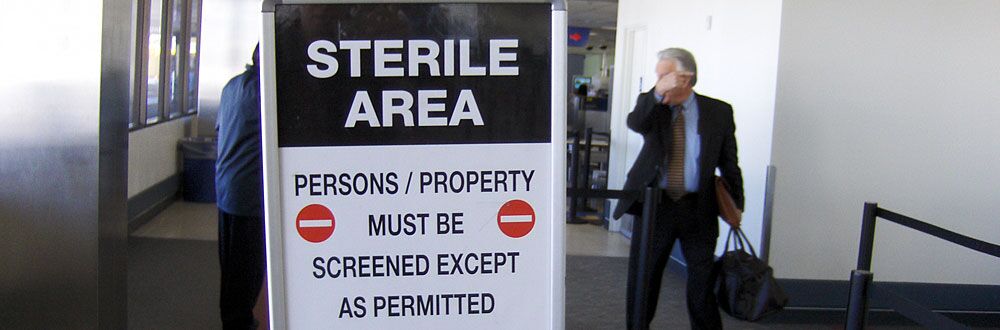
As you’re exiting the security area, going into baggage claim or other open areas in the airport, there’s a sign that says you are leaving a sterile area.
Since I consider airports to be one of the least sterile areas that I frequent, I always get a giggle from this sign.
Clearly sterile has a new meaning within the realm of airport security.
And it does.
Security in general, yeah.
Well, I don’t know about it in general, does it?
Yeah, sterile is an area that’s completely controlled.
It’s security in one end to the other.
I didn’t know that.
A sterile environment is not about disease in this case.
It’s about security measures are fully enforced.
Oh, no kidding.
I didn’t realize that.
Like maybe you’re leaving an area that has got a lot of surveillance, has guards at all the exits and entrances, and so forth.
Okay.
You know, when you hear the phrase, you’re leaving a sterile area, it’s almost like I’m so hot that the area is now sterile.
It reminds me of in the Milwaukee airport, there’s a sign that says Recombobulation Area, which is the place where you put yourself together after you’ve gone through security.
Put your shoes back on, your belt back on.
Everything in your pockets.
Yeah, back in your pockets.
Recombobulation Area.
Airport language.
Love discussing that kind of thing.
Want more Way With Words?
Listen to years of past episodes at waywordradio.org or find the show in any podcast app or on iTunes.
Our toll-free line is always open, so leave us a message at 877-929-9673 and we’ll take a listen.
We’d love to get your messages at words@waywordradio.org or hit us up on Twitter @wayword and look for us on Facebook.
This program would not be possible without you.
Grant and I are out to change the way we listen and think about language, and you’re making it happen.
Thanks also to senior producer Stefanie Levine, director and editor Tim Felten, director Colin Tedeschi, and production assistant Emma Kelman in San Diego.
In New York, we thank quiz guide John Chaneski and that master of keeping it real, Paul Ruist at Argo Studios.
A Way with Words is an independent production of Wayword, Inc.
From the Recording Arts Center at Studio West in San Diego, I’m Martha Barnette.
And I’m Grant Barrett.
So long.
Bye-bye.
Names of Age Decades for Old People
 Someone in their 70s is septuagenarian, someone in their 80s is an octogenarian, and someone in their 90s is a nonagenarian. Someone in their 50s is a quinquagenarian, and if they’re in their 40s, they’re a quadragenarian. If they’re between 100 and 110, they’re a centenarian, and older than that, well, congratulations! In that case they’re a supercentenarian.
Potable Pronunciation
How do you pronounce the word potable, which means drinkable? A woman in the Navy stationed in Norfolk, Virginia, says most of her fellow sailors pronounce it with a short o, but she pronounces it with a long o. The word derives from Latin potare, meaning to drink, and traditionally the long o sound in the Latin has been preserved in the pronunciation of potable so it sounds something like /POE-tuh-bull/. Increasingly, though, many people pronounce it with a short o, something like /PAH-tuh-bull/, as if assuming that the adjective describes something that might be put in a pot and boiled. This pronunciation is especially common in the military. Potable is a linguistic relative of the word potion, a type of drink, and symposium, from Greek words that literally mean drinking together.
Marrow Vegetable
A listener in Two Rivers, Wisconsin, was surprised to learn that in England the word marrow refers to zucchini.
Word for Being Excited but Anxious
A woman and her 10-year-old daughter are looking for a word that describes being excited but anxious. It’s not exactly twitterpated, and the Southernismlike a worm in hot ashes is vivid, but a phrase and not a single word. If a single word for this feeling exists, maybe it involves butterflies?
Denarian
If you’re between the ages of 10 and 19, you’re a denarian.
Exclamation Word Puzzle
Quiz Guy John Chaneski has a quiet quiz involving words that are usually shouted. Suppose, for example, someone said, “Excuse me, Mr. Horse, I’d appreciate it if you stopped. What’s the exclamation suggested by this request?
Set of Twins
If you tell someone you have a set of twins, does that mean you have two kids or four kids? It depends on the meaning of the word set.
Shoulder Season
A woman in Cape Cod, Massachusetts, wonders: Why is the less busy period in a tourist area known as the shoulder season?
Motorcycling Slang
Skid lid, cage, and backyard are all slang terms from the world of motorcycle enthusiasts. A skid lid is a helmet, a cage is an automobile, and a backyard is a favorite place to ride. The phrase lay it down means to have a motorcyle accident.
I Reckon in the US vs. UK
The phrase I reckon meaning I suppose is marked in the United States as rural, rustic or uneducated. The term is centuries old, however, and used widely in the United Kingdom.
Death Cleaning
Death cleaning is the translation of a Swedish term, döstädning, describing a kind of de-cluttering later in life, when you downsize to make things easier for the next generation. It’s being popularized by The Gentle Art of Death Cleaning by Margareta Mangusson.
Looking Up Unfamiliar Words
Martha shares an email from a listener from Delray Beach, Florida, about the rewards of looking up unfamiliar words in the dictionary.
Vicenarian and Tricenarian
If you’re in your 20s, you’re a vicenarian. The word for someone in their 30s is tricenarian.
What Do Some People Put the Dollar Sign After the Amount?
A Dallas, Texas, listener is annoyed when he sees a price listed with the dollar sign after the amount, rather than before, as in 500$ rather than $500. In some parts of the world, however, the currency symbol routinely follows the number.
The Greek Root “Stenos”
The word stenophagous means eating a limited variety of food. It derives from Greek stenos, meaning narrow, also found in stenography (literally, narrow writing) and stenosis, a medical term for abnormal narrowing.
Are Words Not in a Dictionary Really Words?
A nonprofit that promotes literacy in Reno, Nevada, held a spelling bee in which adult competitors were asked to spell words from books in J.K. Rowling’s Harry Potter series. The author made up some of those words herself. But are they really words if they’re not in the dictionary? Yes, if it’s said or written and has a meaning, it’s a word. The word that took out a lot of the competitors was minuscule, which Rowling used in The Prisoner of Azkaban. In the United States, the word is usually spelled differently: miniscule.
What is “Sterile” in “Sterile Area”?
A Bay Area listener says she always giggles when she sees a sign in the Oakland airport that reads, “You are leaving a sterile area.” Among security experts, the term sterile specifically means an area that is officially under control and clear of threats.
This episode is hosted by Martha Barnette and Grant Barrett, and produced by Stefanie Levine.
Photo by Peter Dutton. Used under a Creative Commons license.
Books Mentioned in the Episode
Music Used in the Episode
| Title | Artist | Album | Label |
|---|---|---|---|
| Kulun Mankwalesh | Mahmoud Ahmed | Ethiopiques 3 | Buda Music |
| Lomiwen Teqebeletch | Mahmoud Ahmed | Ethiopiques 3 | Buda Music |
| Metche Dershe | Mulatu Astatke | Ethiopiques 4 | Buda Music |
| The Old Spot | Clutchy Hopkins Meets Lord Kenjamin | Music Is My Medicine | Ubiquity |
| Temeles | Alemayehu Eshete | Ethiopiques 3 | Buda Music |
| Essu New Messelgn | Hirut Beqele | Ethiopiques 3 | Buda Music |
| Brother John | Clutchy Hopkins Meets Lord Kenjamin | Music Is My Medicine | Ubiquity |
| Wubit | Mulatu Astatke | New York Addis London | Strut Records |
| Aynamaye | Teferi Felleqe | Ethiopiques 3 | Buda Music |
| Sabye | Mulatu Astatke | New York Addis London | Strut Records |
| Volcano Vapes | Sure Fire Soul Ensemble | Out On The Coast | Colemine Records |


Re: Sets of Twins. You may recall the “Bobbsey Twin” books. They had already passed from school bookshelves when I was young but my mother made reference to them. It was she who noted that the Bobbsey family had two sets of fraternal twins: Nan and Bert, who were 12 years old, and Flossie and Freddie, who were six.