


Get out your skinny jeans and pass the PBR! Martha and Grant discuss the definition of the word hipster. Also, what happens when you pull a brodie? And why do we describe something cheap or poorly made as cheesy? Also, sawbucks, shoestring budgets, the origins of bootlegging, and cabbie lingo, including the slang word bingo. This episode first aired June 23, 2012.
Transcript of “What’s a Hipster?”
Hi, podcast listener. It’s Martha, inviting you to make our lustrum lustrous.
We’ve talked about this before. The word lustrum goes back to ancient Rome, where it meant a time span of five years. And we borrowed the word into English, although, of course, it’s not often that you hear anybody use that term.
But I’m using it today because at A Way with Words, we are celebrating our very first lustrum. That’s right, we’ve been producing this show independently now for five years. Independently means that we don’t get funding from NPR, not from any network, not from any radio station. We are supported by listeners, by kindred spirits who believe as we do in lifelong learning and smart conversation.
Go online right now to waywordradio.org/donate. Do your part. Help us make our lustrum lustrous. That’s waywordradio.org/donate. Thanks, and on with the show.
You’re listening to A Way with Words. I’m Grant Barrett.
And I’m Martha Barnette.
I didn’t know until recently that I’ve been a bingo.
Ooh, yeah?
Or at least I would have been a bingo had I been trying to hail a cab in Seattle 30 years ago. The reason I know this is because you and I, Grant, asked listeners to share slang from their workplace. And over on our Facebook page, Randy Raymond shared some of his memories of being a taxi driver in Seattle 30 years ago.
Yes.
Okay, yeah.
Yes.
And Randy reports that in his experience, a bingo was someone who was hailing a cab that the driver wasn’t able to pick up because he already had a customer. So the driver might tell the dispatcher, bingo at 3rd and Pike, so another cab would come along and get the passenger.
Very good.
I’ve been a bingo many times, especially in the rain.
I’m sure that happened a lot in Seattle.
They never seem to come for me.
You’re not a bingo.
I end up trudging in the rain.
Well, what else did he have on his list?
Another one that he had that I really liked was green pea. And I’ve seen this used in the automotive industry for a brand new dealer at the car dealership, a green pea. But you also refer to a new cab driver that way.
Oh, so this is related to the more general use of somebody being green means they’re new or wet behind the ears.
Yes.
Very good.
Green pea.
Yeah.
And so, all right, I’m looking at this. Randy’s got some great stuff. And I see nut on here. And this is the amount of money that the cab driver has to pay to the shop that he’s renting the car from, right?
Right.
Right.
And that reminds me of the poker term because in order to make your nut, you’ve got to reach that bare minimum of value, right? In poker, it’s the best possible hand. And so, like, if you make your nut, that means that you just got the card you needed to get the flush, right?
And in the car, if you make your nut, it means that you just got enough fares so you can pay your rent. And everything that you earn for the rest of the night is yours.
That’s right.
Very good.
I love this. He just really dished it out, didn’t he?
He did, and we love it when people share their workplace jargon. And we’d love to hear about jargon in your workplace. You can put it on our Facebook page or Facebook group or email us, words@waywordradio.org.
And you can call us to talk about any aspect of language. That number is 877-929-9673.
Hello, you have A Way with Words.
Hi, this is Susie from Dallas.
Susie, welcome.
Hi, Susie. How are you doing?
I am fine, thank you.
How can we help?
Well, I had the question about the word, the slang term cheesy. My friends have used that to describe music or maybe an album cover or something, and I always wondered what it means. And I’ve tried to look it up, and I couldn’t find it in any slang dictionaries.
What’s your impression when they say cheesy?
Oh, well, I think of something that’s corny or kitschy, but I’ve tried to figure out what the distinction, like why would you say cheesy instead of corny? Where did this word come from? What does it have to do with cheese?
It’s a really good question because it’s one of those variable terms that’s automatically negative, but you’re never 100% sure in what way they meant it to be negative. Because kitschy and corny to me are very different things.
Cheesy as in poorly made exists or cheesy as in beneath me is another one of those things or cheesy as in lowbrow. These are all variations on a kind of derogatory take on something that somebody else has done or said or performed.
Yeah, and sometimes it’s cheesy, but you still have a certain affection for it in spite of it not being quite up to stuff.
Yeah, I definitely have that use of cheesy. You’ll say things like, I know it’s cheesy, but you know what we did? We just went to see the third Pirates of the Caribbean movie because whatever. It was a lot of fun, right?
Right.
Something like that. Maybe you wouldn’t think that was cheesy. I don’t know.
And so your group of people, they all use cheesy in that way.
Right.
They mean it in a derogatory way, for sure.
So maybe it refers to the negative characteristics of cheese, you know, that it can be a wonderful thing. I mean, I don’t want to get angry emails from Wisconsin. But, you know.
But I think even the people in cheese country would agree that poorly made cheese has these particular characteristics that you’re like, you could have done better, right? It’s like it doesn’t have the right texture or the taste or the feel, right?
Yeah, or cheese just, I mean, think of the essence of cheese, you know. It’s smelly and oozy and sometimes it just sits there, you know, dumb as a wheel of cheese.
All right, let’s see if we can break down a little bit of the history of cheesy. It’s really interesting. It first pops up about 100 years ago, maybe a little bit more, 120 years ago. And it shows up at first to mean inferior or cheap or even nasty.
And so the first guess for most lexicographers, people like me who make dictionaries, is that it probably referred to low-quality cheese that stank, like stinky cheese. Not like a good Stilton that’s supposed to stink, but the kind of cheese that means like they didn’t do the job well.
Okay.
So that’s the first guess there. And also there’s another guess that has to do with cheese that doesn’t have the right consistency. Like it crumbles when it’s not supposed to crumble or it oozes when it’s not supposed to ooze. And in this way, it’s not a well-made cheese.
Okay.
That’s the theory there. But it kind of transfers itself, particularly when it shows up in the United States. Cheesy starts to refer to pop culture that is hackneyed or cliched or melodramatic or like falsely sentimental, these sort of things.
But at the same time, you might still like it or it might still be really popular. And so we see cheesy slowly move just to mean second rate or bad to meaning, all right, not the best of its kind, but still in some way kind of pleasant.
And I guess a good stilton might actually be that, right?
I don’t know if you know a good Stilton.
Yeah, I’m vegan, so I don’t eat cheese.
Yeah, soy cheese is just not the same.
Yeah, so as a vegan, you use the word cheesy?
Well, no, I don’t use the word because I haven’t really identified with that word. I couldn’t figure out why they would use that.
I think what you’re saying to me is that when you hear your friends say cheesy, you’ve got a question automatically that you need to ask them. It’s like, how did you mean that? Right? You’re probably already doing that, just seeking clarity because it’s such a variable term.
But don’t we all kind of know what it means?
Well, it means I don’t approve in general, but I don’t approve how.
Especially if you’re a vegan.
Yeah.
I’ve got one interesting little fact for you. What’s really interesting is that cheesy used to be positive.
Really?
Yes. You’ll find it in the much older slang dictionaries than the 1800s where it meant smart or excellent. And interestingly enough, it was sometimes compared to cheesy as a rare Stilton.
And as I mentioned, the Stilton is considered a very good cheese if you can stomach it.
Okay.
Cheesy is really variable.
Like a lot of slang, it’s got these nuances depending upon the crowd and its context.
You’re going to have to seek clarity from people when you hear or read them using the word cheesy.
Okay.
Or talk them out of eating it.
I’ll try.
Susie, thank you so much for your call.
Okay, thank you.
Take care now.
All right, bye-bye.
Bye-bye.
Bye.
Call us with your language questions, 877-929-9673.
We got a tweet from Hannah Baker in Indianapolis who asked,
Any idea where shoestring budget comes from?
I’m on one right now.
Ooh, nice.
I love that.
What does that mean?
Enough money to buy shoestrings?
It means a budget that’s, well, as thin and spindly as a shoestring.
And we first saw this in the early 1900s, but you know when it really took off?
In the Depression.
When everybody was trying to stretch their budget.
Yeah, yeah, yeah.
Maybe whole things together that were falling apart.
More like a thread budget.
Yeah.
Yeah, so good luck with that, Hannah.
877-929-9673 is the number to call, or you can always tweet us, as Hannah did.
Hello, you have A Way with Words.
Hi, my name is Grace, and I’m calling from Fort Worth, Texas.
Hi, Grace, how you doing?
Hi, I’m good, how are you?
All right, you sound very lively.
Cool.
What can we help you with?
In my English class last year, we read The Moor of Venice after we finished Othello,
And there was this line that Desdemona says to the Moor, and it just, I just, here’s the line anyway.
She says, and in truth, I think you love me little were you to leave me here in Venice, denying me to bear you company,
Or could believe that I would leave for abide in safety here, then share the safeties that await you.
So when I read Liefer, I’m also taking German, so I immediately made this connection between the German word Lieber,
And in the context of the passage, it sounds as if she’s saying that Lieber means that she would rather or that she would prefer doing that.
And that’s kind of how you’d use Lieber in German as well.
So I was wondering if I’m right in making that connection and also why we don’t use that word anymore.
This is brilliant.
Not only have you provided the question, you’ve provided the answer.
Talk to you later.
Thanks for calling, Grace.
You’re exactly right.
The leaf or leafer means rather.
I’d rather not tell her.
I’d leaf tell her, right?
I would leaf her bide in safety.
L-I-E-F-E-R, right?
That’s right, yeah.
And it’s related to the English words for love and to leave.
And we have this rare meaning of leave in English that you’ll find in books,
But we don’t use really in spoken speech much anymore.
I give you leave to ask her hand in marriage.
That kind of leave.
Oh, wow.
By your leave, my lord.
By your leave, yes, exactly.
That sort of thing.
So these are all kind of,
If you did a Venn diagram
And made circles for each of these words
In the German and the English,
There would be a little bit of overlap
In the middle
Where they’re all kind of related to each other,
But they’ve gone their own path
In the history of their languages.
Same with believe, too.
Exactly.
Oh, yeah.
Having an affinity.
So you’re exactly right.
So you’re studying German,
Reading Shakespeare.
What kind of wizard are you?
I’m just your average 17-year-old, I guess.
Yeah!
Yeah, right.
You know what?
I hope that you are exactly average because that means there are a lot of brilliant people coming up in the world.
Cool.
Thanks for calling, Grace.
Really appreciate it.
Oh, thank you.
Take care.
Good luck with your studies.
Thanks.
Bye-bye.
Later.
Grant, there’s hope for our future.
Call us, 877-929-9673.
At the top of the show, we talked about Randy, who posted a great list of taxicab slang on our Facebook page.
Well, he got me so excited about slang.
You know, that’s my thing.
Redundant.
Yeah.
I googled around for some more, and I found this great blog called SoCal Cabbie from right here in San Diego.
And a few years ago, this person posted a list of cabbie slang.
And the one that I really loved is called stretching your hood.
And short for stretching your neighborhood, it’s when you lie to your dispatcher about where you are.
Because you’re only supposed to service a particular area, right?
Pick up calls in that area.
And yet sometimes you’re like, well, I know there’s a really hot nightclub over there.
I’m going to go over there and see if I can get a fair.
And so your dispatcher goes like, car 54, where are you?
And you’re like, oh, yeah, I’m not where you think I am.
I’m stretching the hood.
I’m stretching the hood.
Coming up, more language chat for the obsessively curious.
Stay tuned.
Support for A Way with Words comes from the University of San Diego,
Whose mission since 1949 has been to prepare students for the world as well as to change it.
More about the college and five schools of this independent Catholic university at sandiego.edu.
You are listening to A Way with Words.
I’m Martha Barnette.
And I’m Grant Barrett.
And we’re joined now by our quiz guy, Greg Pliska.
Hello, Greg.
Hello.
Hello, Grant.
Hi, Martha.
How are you doing, Greg?
This week, we’re going to look at something we call a container clue.
In a container clue, the answer word is divided into two words, one of which is inserted or contained inside the other.
For example, the word knowing, K-N-O-W-I-N-G, consists of the word now inside the word king.
Okay.
Very good.
Oh, whoa.
Right?
Or the word masonry is the word son, S-O-N, inside the word Mary.
That’s cool.
Container clues always include some indication of which word is the container and which word is the contents.
Usually a word like holding or swallowing or tucked into.
Also to help limit the parameters of today’s puzzle, every answer is a Greek or Roman god or goddess.
Oh, we like this part.
I thought you’d like that.
You’ve got your pencils ready?
Let’s start.
Yeah.
All right.
Here’s your first one.
Not now in a 12-step program.
So it’s probably AA.
I was going to say Atalanta, but at a later date?
No.
But you’ve got AA is right.
That’s the 12-step program.
So A is probably the first letter, and A is probably the last letter.
Yep.
And something, a synonym for not now is inside of that.
Athena.
Athena.
Very good.
Then.
Athena, not now in a 12-step program.
Oh, that’s good.
Okay, here’s another one for you.
Encountered among white-tailed ruminants.
So that’s a deer or a mule deer?
Yeah, deer is right.
And you’re looking for something among that.
So is it Demeter?
Demeter is correct.
Encountered as in met, M-E-T, inside of among deer.
Nice.
White-tailed urminants.
Yeah.
New Age Training Seminar is held in Virginia.
New Age Training Seminar.
So in Virginia, you got V-A, right?
That’s right.
That’s the outside part.
The New Age Training Seminar.
And you know what else I should tell you?
The answer is five letters long,
Which you would know if you were doing a crossword puzzle.
So that helps, too.
Vesta.
Vesta with Est, the Earhart Seminar training.
Very good.
In the middle of Virginia, VA.
Here’s one that you’ll find easier, I bet.
That woman’s embracing me.
That woman.
So the woman is on the outside.
Right.
Yep.
And me is on the inside.
Hermes?
Hermes, yes.
That woman’s hers, as in belonging to, embracing me.
Yep.
Okay.
Your answer is four letters long, and your clue is little woman seen around the United Nations.
Juno.
Ooh, good.
Quick.
Wow.
You in and little woman from Little Women.
Yeah, Jo is the main character.
Jo is one of the little women, and she’s around UN, the United Nations.
Nice.
For Juno.
Oh, you guys are good.
Here’s another five-letter one.
Bovine regurgitation includes letter from Athens.
Because no show is complete without mentioning bovine regurgitation.
Right.
Bovine regurgitation.
Cupid.
Cupid.
Oh, I see.
Cud around a letter from Athens, pi.
Here’s one more for you.
Sound of hesitation amid laughter.
Four letters.
So the sound of hesitation is or
Or something else.
There’s another sound of hesitation.
Hera.
Hera.
The sound of hesitation, inside laughter.
Ha.
Very nice.
I appreciate all the work that went into it, Greg.
Thank you so much.
You’re very welcome.
It’s my pleasure.
If you’ve got a question about words or slang or language or grammar or punctuation or something that stumped you or befuddled you, give us a call, 877-929-9673, or send an email to words@waywordradio.org.
I’ve had a lot of fun lately exploring a book called Word Book of Virginia Folk Speech. It’s from 1912. Have you seen this one, Grant?
Oh, I haven’t. Sounds interesting.
You’re going to love it. It’s got all these great phrases used in Virginia, some of which are familiar, like cool as a cucumber. And one of my favorites is, bachelors’ wives and old maids’ children are the best people in the world. Think about it.
Right, which means none. Nobody. Nobody. You by yourself on the porch with a glass of tea. Call us with your folk phrases, 877-929-9673, or send them an email to words@waywordradio.org.
Hello, you have A Way with Words.
Hello, Grant and Martha. This is Justin in San Francisco. How are you doing?
Hi, Justin. What’s up?
Hi, Justin.
Hi. I’m going to ask what your thoughts were on the word hipster.
Hipster.
Yeah, it’s a bit of a toxic word here, and I’m not quite sure what it is, if it’s a word that’s used to describe a subculture or if it’s just an insult. It kind of depends on who’s saying it and who’s taking the description.
And I’ve done a little reading up on it, and I’m still more confused, and I’m just wondering what your thoughts were about the word itself, the past, and the future of it. Because as far as I can see, hipster’s a word maybe sort of the way hippie or beatnik was, in that at the time when these words were created, people who were actually considered hippies would never use the term, but as time went on, they accepted it, and maybe in the past would say, yeah, I was a hippie back in the 60s.
And maybe the same thing’s going on now, and I’m wondering what you think about this.
Yeah, I’m not sure I know of any hipsters who actually call themselves hipsters. In fact, I’m reminded of that great headline in The Onion, you know, the satirical newspaper, two hipsters angrily call each other hipster.
Exactly. Exactly right.
So you’re in San Francisco, and you said there in San Francisco that hipster is a word that is probably derogatory. Is there a particular neighborhood where this is more important?
Yeah, absolutely. The mission would be the epicenter of hipsters. And I guess the exact opposite would be the marina.
So if a hipster is walking down the street toward you, how do you recognize that person as a hipster?
Well, it depends on who you are. But I guess the stereotype would be skinny jeans, thick-brimmed glasses, maybe vintage clothing, scruffy hair, maybe riding a fixie bicycle, and maybe a little bit of shovel-looking, carrying a pass-blue ribbon beer. And it’s kind of regional too, but that’s the general going stereotype.
Well, yeah, that’s the stereotype as I know it. I lived in Brooklyn, New York for a long time, and I actually was just back to Williamsburg, Brooklyn, which is hipster central. It’s like the ground zero of hipsterdom, like a hipster bomb went off there. It’s crazy.
Of course. So you’ve nailed it. Let’s just do a quick assessment of the history of this word, but you’ve nailed the recent history of hipster, which is most of the time people don’t call themselves a hipster. But they might call other people a hipster. And it has something to do with your appearance. You are putting on an appearance.
So it almost seems like a uniform, and maybe it’s authentic, maybe it’s not, but it’s like a lot of other people’s uniform that they’re putting on. But it’s playing down your self-importance by underdressing or underhygiening, if I can coin a verb here, right? But at the same time, you probably spent a lot of money on your accoutrements, right?
Right. So you’re carrying the expensive phone. They’re carrying the expensive phone, the expensive laptop, riding the expensive bike, have the expensive jeans. Went to Urban Outfitters. Yeah, maybe have the expensive haircut, right?
So we have that modern version of hipster.
And it looks to me as if the meaning of the word is growing more negative over time.
If you go back to the 1960s when hipster was also a term, it really kind of just meant people who were hip. That is somebody who wasn’t square, somebody who was in touch with counterculture, somebody who was in touch with what was happening in the arts, something who was in touch with what was happening in music and so forth, and looking forward to the future rather than dreading the future.
And it slowly changed.
And in the 1990s, I began to see, and you can verify this by looking in old newspapers, I began to see that hipster started switching. And the calling somebody hipster became a pejorative. It became a negative, and that suggested that you were inauthentic and that you were modeling yourself on people that you wanted to be like, but you weren’t actually that kind of person yourself.
And now I think the pejorative meaning is in full flower, and it’s almost exclusively pejorative.
There was a brilliant video shot by a French journalism student at Columbia University. You can find this on Jason Kotke’s site. Just go to kotke.org and look for the word hipster or hipster video. And she goes to Williamsburg, Brooklyn and interviews people. Are you a hipster? What do you think hipster means? I mean, we’re talking this is the place where if you looked at almost anybody walking down the street, you’d go, that’s a hipster, except for the few Polish people from Greenpoint who are passing through to the subway, you know. It’s really kind of incredible.
And she encounters this guy, if I’m remembering correctly, who has gauged ears and like a pierced nose and the bedhead and the kind of vintage but expensive clothes. And she asks him, are you a hipster? And he’s offended by it. He’s offended that she would even ask the question. And I’m thinking, dude, you’re a hipster. You’re clearly a hipster.
So that’s all I got to say on that, Justin. I mean, it’s really worth exploring, though, is how you can have a term that exists as a pejorative for people who are clearly identifiable as a group, and yet they all reject the term. I guess you think someday people will say yes. Back in the 2000s, I was a hipster.
I’m not old enough to have been around in the 60s,
so I’m not quite sure if people identified themselves as hippies in the early days
or if this is something looking back.
They said, yeah, I guess I was a hippie.
And if the same thing will happen, I’m not sure how these words develop.
Well, gosh, we could put the call out to hipsters to have them call and tell us what they think,
but nobody’s going to call, right?
Who’s going to self-identify?
Well, you know, I do think that some people might self-identify as a hipster,
but I’m betting that they’ll have a different definition than the negative one that’s usually portrayed in the criticism in the press and on the street, that sort of thing.
Right. It would be ironic.
Well, you know, we’d be delighted to hear more from you, Justin.
If you have some more thoughts on this, pop us an email and we’ll share it with everybody. All right?
Okay. Thanks a lot.
Take care. Bye-bye.
Thanks. Bye-bye, Justin.
Get in on this discussion. Are you a hipster? Do you know hipsters?
What do you think about hipsters? Call us, 877-929-9673.
Great new word from the UK, grant omni shambles. Does that mean all messed up? Yes, yes, particularly.
In the realm of politics, it was first uttered in the House of Commons during the Prime Minister’s questions recently, talking about the coalition government and its series of policy and public relations blunders. and Apparently, that was lifted from a television show there.
But Omnishambles, like worse than a shambles. It’s kind of an elegant variation that I’d never heard before.
Yeah, and I think it lends itself to variation, you know, like Omnishambolic or Omnishambalism. So, I don’t know. You think it’s got legs? We’ll see. All right. Omnishambles.
Call us with your new words, 877-929-9673.
Hello, you have A Way with Words.
Yeah, hi.
Hi, who’s this?
How are you?
Doing well?
This is Thomas, calling from Lafayette, California, where we’re doing a photo shoot today.
And you’re doing a photo shoot. What are you shooting?
We’re doing furniture.
So, yeah, on our photo shoots, we use a lot of different tools, and some of the tools have funny names.
And one of the tools that we use is called a kookalorus.
And this thing, it’s a piece of, sometimes it’s a piece of wood with some holes cut out in it,
And we put it in front of a light so that it creates interesting shadows.
And on set, we use it a lot, and we always just call it a cookie.
So, you know, can you bring a cookie over here?
You know, I need a cookie.
So we say that a lot, and sometimes people ask, well, why is it called a cookie?
And we say, well, it’s actually a cocoloris.
And they say, well, what’s a cocoloris?
As if that helps, yeah.
Does it have feathers or what?
Yeah, exactly. And we never could figure out what it is. I did a search on the internet for stories, what it could be, and the different stories, there’s different stories, but I don’t think any of them sounds right or makes much sense. So I thought maybe you guys had an answer.
All right, I can help you with this because I have done an entry for the word cookie on my Double Tongue Dictionary website.
I did this a few years ago, and I found eight different spellings of kookalorus.
And also some people call it, besides calling it a cookie, they call it a kook or a kuk or a cuckoo.
And you maybe have heard it called a gobo as well, right?
Yeah, a gobo, yeah.
Or an ulcer or a dapple sheet because it puts dapples of light on whatever you’re filming or shooting, right?
There you go.
So this is the device where you have the light on one side, you have the kookalorus, and then it casts a shadow that looks like light passing through the trees.
Correct.
Right.
I was not able to find the origin of this word.
Hollywood, which is mainly where this term comes from and where it’s mainly used, is filled with people who like to invent myth, as you might imagine.
And they have invented—
And get paid for it, too.
I counted seven different supposed origin stories for this term, and they’re fun, but they’re throwaway.
That’s the thing, is they’re like light and fun.
And there’s just no meat to them.
I just can’t believe any of them.
The best one that I heard about this term is from 1954 from the Journal of Western Folklore.
So I pass it on to you because it has the slight approval of some academic back in the day.
And in a footnote, he writes,
Cucoloris, and he has a weird spelling,
As I understand it is a coined word of no special philological significance or implication.
And he said, yes, exactly.
That’s the best.
But he suggested it might be related to the famous director and producer, George Cukor.
C-U-K-O-R.
And he was involved with the Gone with the Wind, although I think he was fired a couple weeks before they started shooting.
And he was also, he did the remake of A Star is Born.
And so there’s a suggestion in the 1920s or 1930s that he was somehow involved with the creation of this device in Hollywood when they were shooting films.
That’s the best theory I have.
But it doesn’t explain where the Loris part comes from.
It looks like Greek, but it’s not a Greek word as far as I know.
Not as far as I know.
I’ve asked Greeks.
I’ve looked in Greek dictionaries, and it’s not Latin,
And it’s just an invented, goofy word as far as we know.
Oh, that’s kind of unsatisfying in a way.
It’s kind of unsatisfying.
Hello, welcome to my world.
I’ll spend eight, I mean, I probably spend days on this dictionary entry.
Days!
And I could not find an answer to it because it’s really interesting.
It’s so strange looking.
It’s tantalizing, isn’t it?
It’s kookaloris.
It sounds like a Seussian character, right?
I really…
Courtney hears a kookaloris.
Somebody, one person claimed, for example, that it has, it comes from a Greek word for breaking of light.
But I couldn’t prove that either.
I can’t think of any word like that.
So, sorry, it’s a big orig-unk, as I like to say.
Origin unknown.
But it does go back to the 1950s.
It’s probably used since the 1930s in Hollywood for sure.
It’s got a long history.
It’s funny how consistent the language of Hollywood can be.
And you’re not even really in Hollywood.
You’re like in this sideline, right?
Are you shooting stills, right?
Not film?
We’re shooting stills, yeah.
If we hear from somebody out there who’s got an answer for this,
Or at least a really great story, even if it can’t be proven,
We’ll pass it along, all right?
Oh, that would be wonderful.
Thanks for calling.
Really appreciate it.
Good luck with the shoot.
Yeah, good luck.
Thank you.
Take care.
Bye-bye.
Bye-bye.
All right, bye-bye.
If you want to talk about language, call the kookalorei right here, 877-929-9673.
From time to time on the show, we talk about paraprosdokians.
You know, those are those sentences that are going along one way and then they take a sudden right turn.
We got a great one from Andrea Young in Richardson, Texas.
Two guys walked into a bar.
The third one ducked.
Perfect.
Exactly right.
I guess that’s two sentences, but I like it.
Coming up, watching a word’s meaning change through time.
Stay with us.
Support for A Way with Words comes from National University,
Where flexible online classes let you earn your degree or credential on your schedule.
More at nu.edu.
You’re listening to A Way with Words.
I’m Martha Barnette.
And I’m Grant Barrett.
I’ve been thinking about bootlegs, Martha.
You have, because I just came back from Franklin County, Virginia,
The moonshine capital of the world?
You know what?
That might be the reason I was thinking of it.
Bootleg is a really interesting term
That has more than 100 years of history,
And it’s changed,
And I think it may be the perfect example
Of how a word is modified through history
To fit the circumstances of the period.
Okay, let’s hear it.
Let me lay this out for you.
Bootleg first appears to refer to this way
That people were literally bringing liquor
Into the reservations of the Native Americans.
White folks, Europeans, would put bottles of liquor in their pants, which is in violation of the rules, and bring it for sale into these reservations.
So they were literally bootlegging.
Through the next decades, the term continued to be used to mean, you know, illegally distributing alcohol or illegally selling alcohol.
And it also came to refer to illegally selling books or music.
We think of bootlegging of music as being a modern thing or a product of the Internet age.
But really it was already happening back then.
People would illegally press records and sell them.
And then this term comes up in the 1960s,
Which shows the continuing life of bootlegging.
And this is buttlegging, where people would bring in cigarettes
From places with no taxes or lower cigarette taxes,
And the buttleggers would then sell them illegally in shops and stores.
And you can still find this term being used by police today.
Buttlegging is selling cigarettes without the proper license or stamp.
No kidding.
Because different states have different kind of regulation on cigarettes, right?
Or different countries, for that matter.
And the term continued to be used to refer to knockoffs.
You might make knockoff jeans, so call them bootleg jeans, or knockoff purses, or this and that.
Then we get to the 80s and 90s, and bootleg kind of finds its home as a way to refer to the digital borrowing of music.
I hesitate to say theft of music because you’re copying something, so the original is still there.
But it’s the unlicensed use, the unlicensed distribution of movies, of music, of books, of e-books, and this sort of thing.
And we also see bootleg come up in slang to mean less than legitimate.
It’s directly related to that use, but you can apply it to people.
I could say that she is kind of bootleg, meaning she’s not really worthy of my respect.
She’s a little janky, not quite like all buttoned up.
It’s kind of the opposite of legit.
If you are legit, it means you’re respectable.
I mean, at least in the slangy kind of way.
You deserve my…
Okay, but if I’m bootleg, I don’t.
Yeah, bootleg, you don’t.
So we have this term over 100 years kind of continue to be modified.
And you can see each step of the way, it makes perfect sense.
But if you look at the two ends of its life, they’re very different.
Really different.
And there’s also the football term, of course.
Bootleg?
A bootleg play in football is when I believe the quarterback pretends to throw the ball but doesn’t.
Actually tucks it under his arm and runs.
Oh, that’s called a bootleg as well.
I did not know.
But it’s related to the idea of this unorthodox or illegitimate kind of maneuver.
Stuffing it where it shouldn’t be.
I love this term, and there are many terms like this in English,
Where you can see the full panorama of possibility of how we take a word,
Adopt it into a particular sphere of influence,
And use it in a way that makes perfect sense, but isn’t exactly like its parentage.
Yeah, but it’s very cool when you lay out the footprints of bootleg that way.
Very interesting.
I’d love to do some more of these with slang.
If there’s a slang word that you think has a great life in English, let me know.
words@waywordradio.org, 877-929-9673.
Hello, you have A Way with Words.
Hi there.
This is Bill.
I live near Saranac Lake, New York, in the Adirondack Mountains.
How nice.
Beautiful country.
Welcome to the show.
Well, up here, we burn quite a bit of wood,
Either as for heat in the wintertime or as a supplement to our heat.
And I burn wood, and I have a sawbuck.
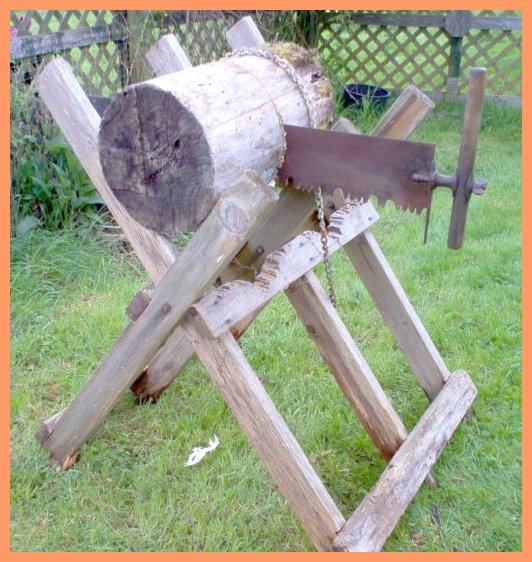
And I use that to hold the logs when I’m cutting the logs to stove length.
And I’ve also heard the term applied to money, usually paper money.
And I was just wondering how the two terms got to be the way they are.
So tell us what your sawbuck looks like.
Well, it’s got four legs.
It’s kind of an X frame.
Actually, mine has six, so I can make several cuts at a time.
But it usually has four legs, and it holds the log in place.
Okay.
So this is a wooden structure, and it’s supported by X-shaped things, correct?
Right.
Okay.
Beautiful.
Well, if you go back to ancient Rome and ancient Roman numerals, you know what the 10 looks like?
Right.
Okay.
It’s an X, yes.
Yeah.
It’s an X.
Yeah.
All right.
And that got applied to the $10 bill.
So that’s why we call a $10 bill a sawbuck.
It has to do with the shape of the legs on a sawbuck.
Oh, so the shape of the leg matches the Roman numeral.
Yep.
And the Roman numeral represents the 10.
Therefore, 10 is a sawbuck.
Right.
So your kid is going to be asking you to lend him a sawbuck for the weekend, or probably several sawbucks.
Right.
Yes.
Well, I had no idea that that’s where it came from, from the shape of the sawbuck.
Okay.
Yeah, but it makes sense, right?
It sure does.
Well, Bill, thank you a lot for calling.
Thanks, Bill.
Thank you very much.
All right. Bye-bye.
Bye-bye.
Bye-bye.
You know, you also hear sawbuck used in terms of prison sentences, like, oh, he got a sawbuck.
Ten years.
A couple of sawbucks. Yeah, 20 years.
Okay, very good.
Yeah, sawbuck.
877-929-9673, words@waywordradio.org.
Hello, you have A Way with Words.
Hi, this is Phil from Indianapolis, Indiana.
Hello, Phil. Welcome.
Hi, Phil. What’s up?
Well, my topic is about typos.
I had a question about, it seems like with everyone on devices like computers and phones and stuff like that,
We’re seeing printed text all over the place generated by random people all the time.
And it used to be a typo was, you know, you accidentally pushed an S instead of an A,
So you misspelled a word because of that, and that’s a typo.
But now it seems like it’s kind of transformed into, you know,
If you put in Y-O-U-R instead of Y-O-U apostrophe R-E, you can still call that a typo.
Like the definition of typo is expanding to be pretty much any grammatical or linguistic problem with your sentence.
It seems like to be a catch-all for any mistake you might make when writing.
And I was wondering if this is what you find an appropriate expanse of this word,
Or maybe you not even experienced this, or is this a phenomenon that you’re aware of?
Phil, it sounds like you have an opinion about this.
That’s what I was going to say.
You know, I don’t want to make it sound like I’m one of these, you know, grammar sticklers,
Because I probably make just as many mistakes as everyone else.
But I’m willing to say that all my mistakes are just because I’m careless,
Not because of, you know, it seems like you’re saying typo,
You’re almost blaming it on the device you’re using.
Right.
Exactly.
The poor craftsman blames his tools, right?
Exactly, exactly.
I know enough that it’s my own ineptness that is causing the problem,
That’s not a technological glitch.
So if you call your confusion error a typo, you’re deferring the responsibility, right?
Exactly.
You’re saying, well, it’s not me.
I’m perfect.
It’s the machine.
No, the machine is making all these mistakes.
Yeah, yeah.
I don’t know why.
I almost feel like sometimes if you write a sentence and maybe it ends up having a little bit more of a strict tone than you meant,
Sometimes people are like, oh, that was just a typo.
I mistyped that.
I mean, that’s really taking away any kind of responsibility from the writer at that point.
You know, I’ve got to say, Phil, I’m kind of with you on this.
I think somebody who strives to be a better writer and often comes up short,
I feel like the only way I get better is if I do take that responsibility on myself
And don’t blame my tools and don’t blame the mechanics of the situation.
I mean, if it’s actually my fault.
There’s a difference between confusing the different yours, right, and an adjacent key error where you hit the E instead of the letter next to it, right?
Yeah.
There’s something, they talk about this, of course, of course they do in linguistics all the time.
And they have jargon for it, which perfectly applies here.
You have performance errors.
This is where you know how to do a thing, but for some reason you didn’t.
The machine got in the way.
The cat walked on the keyboard.
You were typing on your phone and one of the letters was stuck, something like that.
That’s a performance error.
And then there’s the competence errors, which is you never knew the difference between all the different yours in the first place.
Or that you are a terrible speller.
Or you’re just really not that bright.
And so what you’re talking about here is people claiming something is a performance error when it’s actually a competence error.
You know, there’s an inverse to this, Phil, as well.
And I’ve had this happen when I was a working journalist.
Where people say, well, you misspelled that.
I’m like, no, that’s not a misspelling.
That’s just a literal keyboard mistake
Where it actually wasn’t a misspelling.
The word was misspelled,
But it didn’t reflect upon the fact
That I didn’t know how to spell it.
It’s just like a keyboard mistake,
Like a book fell on the keyboard
And inserted a VD or somewhere.
I don’t know, you know?
Phil, I’m with you.
I’m interested in what the rest of our listeners think
About this expansion of the term typo
To refer to any kind of text-based mistake.
Do you think that there’s a difference there?
Do you find that it’s just an excuse to blame your tools when it’s actually your fault as somebody who didn’t learn enough?
Well, you know, I kind of like the word so that I can blame all my mistakes on it.
It’s kind of convenient.
It is handy, isn’t it?
I’m not sure I wanted to change.
I just kind of wanted to bring people’s attention to it.
Well, consider attention brought.
Thanks so much for calling.
Thanks, buddy.
Thank you very much, guys.
Bye-bye.
Bye-bye.
Bye.
Did I tell you I had a cat named Typo because he walked across my keyboard?
It’s really true. I had him for 17 years.
Oh, sweet kitty.
Yeah, first day I got him and he stepped on the 6 key, so he typed 6666.
And I didn’t name him Diablo, I named him Typo.
They love the computers because they’re warm, right?
And also because that’s the direction you’re facing.
That’s right.
And your hands are right there and you might actually scratch under a chin.
Right, so what do you get a view of?
Hello, you have A Way with Words.
Hi, this is Peter calling from Eagle River, Alaska.
Welcome to the show. What can we help you with?
It’s actually sort of an Alaska-specific term we have up here.
So in the winter, a lot of the parking lots up here get packed down with snow.
And so, especially when you’re a teenage kid, you like going into the parking lots and spinning around with your car,
Especially if you had a rear-wheel drive car.
And so up here, we would call it spinning brodies or pulling brodies.
And my friends down in California, when I went to college down there, I mentioned that term in passing.
They thought I was absolutely nuts.
And so since then, I’ve sort of been informally pulling people.
And almost all Alaskans that I’ve spoke with either use that term or at least have heard of it.
And hardly anyone else from anywhere else in the country that I’ve asked has heard that term used.
And so most people call, like, you know, spinning donuts or something like that.
Yeah, doing donuts.
That’s what I’ve heard.
That’s really interesting that your friends from California didn’t know the term.
Where were you?
I went to college down in the L.A. Area.
Okay.
I think if you surveyed Californians, and we’ll hear from them, trust me,
You will find that Brody is used to refer to donuts that are done with a car.
In California as well. As a matter of fact, it’s a little more common around the country now too,
And also in the Northwest and in Washington and Oregon and places like that. But you want to know
What’s even doubly more interesting about this is the history of the term Brody. It’s completely
The other side of the continent. 1886, New York City, a fellow by the name of Steve Brody
Claims to everyone that he has leapt from the Brooklyn Bridge. Unfortunately, there don’t seem
To be any witnesses, one or two people who vouch for him, but nobody with a lot of credibility.
He was a sensation in the newspapers.
It was much discussed.
Did he or didn’t he?
Could you do it?
Wouldn’t you die if you jumped from that height?
Blah, blah, blah.
I mean, this was the big event of the age.
And so to do a Brody came to mean to jump or to fall and eventually came to mean to do any kind of stunt, including something simple like a donut became a Brody.
In an alternate path, Brody continued to have the fall sense and it showed up in Hollywood to refer to a flop.
Because you would imagine Steve Brody jumping into the East River from the Brooklyn Bridge did some kind of belly flop.
So if a movie tanked in Hollywood, it was called a Brody or it did a Brody, meaning it flopped or fell.
And so we have these weird paths that all go back to this guy and his claim in 1886 that he jumped from the Brooklyn Bridge.
And that’s how it ended up in Alaska, too.
Peter, what’s the secret of doing a great Brody in Alaska?
The real secret is to have a rear-wheel drive car with pretty bald tires
Or tires without any studs in them.
But when I was talking to my dad this morning,
I was saying how probably kids nowadays don’t do them as much
Because most cars nowadays are all-wheel drive or front-wheel drive.
A front-wheel drive will work if you’re going backwards,
But, you know, you need to get that end to swing out.
Whoa, a backwards Brody?
Can you do one of those, really?
That’s what it’s done.
They work as long as they have a front-wheel drive car.
Oh, that’s impressive.
And do you do the version where you throw on the emergency brake?
Yeah, you can do that, too.
That works best, especially when the lakes get frozen up here, you can drive on them.
And especially if they freeze pretty solid before we get much snow.
All right.
And especially if you have a date in the front seat with you, right?
Yeah.
Are the ladies impressed by the Brodies?
Oh, yeah, most definitely.
The right sort of ladies.
Yeah, there we go.
That’s right.
You slam on the brakes and things happen.
Right, yeah.
Thanks so much, buddy.
Really appreciate it.
Well, thanks for having me.
Take care.
Bye-bye.
Bye, Peter.
Bye.
Here’s something cool.
A poetry lover in Chicago named Felix Jung started a website called apoemfromus.com.
And the idea is simple.
He invites people to submit video of themselves reading someone else’s poem,
Which is then shared on the website.
So these aren’t people reading their own poetry.
It usually has to be by somebody else who’s an established author.
And there’s something oddly compelling about this
Because there’s something about ordinary people choosing a poem that’s touched them in some way
And then taking the time and trouble to record themselves reading it
And then putting it out there for everyone to see.
You watch a few of these and you’re reminded that poetry really is deeply personal
Because you really make yourself vulnerable if you pick a poem that you really like
And then share it with the world.
And Grant, it’s how I was introduced to a poem that I wanted to share with you
That I think you’ll really like if you don’t know it already.
It’s called A Cradle Song by William Butler Yeats.
And it’s a very simple poem that might be recited by a parent over a crib.
And I should mention that the poem includes a reference to the sailing seven,
Which is probably the group of stars in the night sky known as the Pleiades.
So this is A Cradle Song by William Butler Yeats.
The angels are stooping above your bed.
They weary of trooping with the whimpering dead.
God’s laughing in heaven to see you so good.
The sailing seven are gay with his mood.
I sigh that kiss you, for I must own that I shall miss you when you have grown.
Oh, it’s true.
I knew you would love that.
You know, I have a gigantic five-year-old who I put in my lap,
Even though he’s entirely too big for it now because he’s big for his age.
Yeah.
And I already miss, like, the four-year-old, you know?
It’s crazy.
I’m sure.
I’m sure. I think it’s so great the way that that poem ends with the word groan.
You know, it just hits you right at the end.
Oh, my gosh. It’s coming whether I like it or not.
Well, that poem was read on the site, a poem for us dot com by David Robert Jones.
And we’ll link to that on our website.
You can go there to watch other videos of people reading poems they love or submit one of your own.
877-929-9673. words@waywordradio.org.
Things have come to a pretty path.
That’s all for today’s radio show, but join us online on Facebook and Twitter,
Or sign up for our weekly newsletter for the latest in language news.
You can also leave us a message anytime at 877-929-9673,
Or find us on the web at waywordradio.org.
You can email us to, the address is words@waywordradio.org.
If you happen to miss our broadcast, you can hear us by podcast anytime at all.
If you listen on iTunes, don’t forget to rate and review the podcast.
Our senior producer is Stefanie Levine.
Tim Felten edits and directs the show.
Our production assistants are James Ramsey and Josette Herdell.
A Way with Words is independently produced and distributed by Wayword, Inc.,
A nonprofit supported by listeners and organizations who believe in lifelong learning,
Better human communication, and the value of a thing well said or well written.
The show is recorded at Studio West in San Diego, California.
Thanks for listening. I’m Martha Barnette.
And I’m Grant Barrett. Take care.
Sayonara.
You like tomato and I like tomato.
Potato, potato, tomato, tomato.
Let’s call the whole thing up.
But oh, if we call the whole thing up.
Support for A Way with Words comes from National University,
Where flexible online classes let you earn your degree or credential on your schedule.
More at nu.edu.
Cabbie Slang
 A former cabbie shares his favorite jargon, like green pea and making your nut. Someone waving down an occupied cab is known as a bingo, and the cabbie will usually tell the dispatcher to send another car. A San Diego cabdriver has gathered much more taxi slang.
Cheesy
Is there any etymological connection between the dairy product and the adjective cheesy, meaning inferior, cheap, or otherwise sub-par? This descriptive term for something lowbrow or poorly made at one point had positive connotations in the 1800s, when something great could be said to be cheesy as a rare Stilton. Over time, though, cheesy took on the connotation of something unappealing, an apparent reference to a low quality, stinky cheese.
Shoestring Budget
A shoestring budget is a spending plan that’s as thin and spindly as a shoestring. Not surprisingly, the term gained popularity during the Great Depression.
I Would Liefer
A line from The Moor of Venice, “that I would liefer bide,” features an old word for rather that shares a root with the words love and leave, as in by your leave.
Stretch the Hood
Cabbies are sometimes known to stretch their hood, which means to fib to the dispatcher about their location. Sometimes they have to drive out of bounds to pick up a fare.
Container Clue Word Game
Quiz Guy Greg Pliska has a word puzzle based on so-called container clues, where the answer is divided into two words, one which is found inside the other. For this game, the answers are all Greek gods.
Best People in the World
A Word-Book of Virginia Folk Speak from 1912 includes this gem: “Bachelors’ wives and old maid’s children are the best people in the world.”
Identifying Hipsters
What is a hipster? Is it an insult to call someone a hipster, even if they’re, well, a hipster? Do hipsters identify themselves as hipsters? Grant traces the label from 1960s counterculture to today’s skinny-jeaned Brooklyn paradox.
Omnishambles
The handy term omnishambles means all in shambles, and has found its way from the British TV comedy The Thick of It to the floor of the House of Commons.
Cucoloris
What is a cucoloris? This lighting grate, which also goes by such names as cookie, gobo, and dapple sheet, is used in photography to cast a dramatic shadow. There are lots of spellings of this word, including cuculoris, kookaloris, cookaloris, and cucalorus. The name may have to do with George Cukor, an early pioneer of the tool in old Hollywood.
A Paraprosdokian
Add this to your list of paraprosdokians: Two guys walked into a bar. The third one ducked.
Bootleg History
Where does the term bootleg come from? Originally, smugglers tucked bottles of alcohol into their pants to sneak them onto Indian reservations to sell illegally. The term knockoff also refers to pants, and buttleg is a variant that can refer to contraband cigarettes.
Give Me A Sawbuck
Why do we call a ten-dollar bill a sawbuck? The support for woodworking known as a sawbuck folds out into the shape of an X, the same shape as the Roman numeral for ten. Hence, the slang term for the currency worth ten bucks.
Typos: Performance vs. Competence
Can you get away with calling a misspelled word a typo if you didn’t know how to spell it in the first place? One variety of mistake is called a performance error, where the goof is somehow related to the machine or keyboard. A competence error occurs when someone doesn’t know the difference between your and you’re in the first place.
Pull a Brodie
To spin a brodie or pull a brodie is to spin a doughnut in a car. The term derives from the name of Steve Brodie, who allegedly jumped off the Brooklyn Bridge in 1886. To do a brodie, originally meaning to jump or fall, came to mean any kind of stunt.
A Poem From Us
On the website A Poem From Us, people upload videos of themselves reading poetry from other writers. Here, David Jones reads “A Cradle Song” by William Butler Yeats.
Photo by Shaun Sullivan. Used under a Creative Commons license.
Book Mentioned in the Episode
Music Used in the Episode
| Title | Artist | Album | Label |
|---|---|---|---|
| You Got Me Hummin’ | Placebo | Ball Of Eyes | CBS |
| Showbiz Suite | Placebo | Ball Of Eyes | CBS |
| Balek | Placebo | 1973 | CBS |
| The Cylinder | Milt Jackson | The Ballad Artistry of Milt Jackson | Atlantic |
| Locked Down | Dr. John | Locked Down | Nonesuch Records |
| Funky, Funky | Harry Deal and The Galaxies | Absolute Funk 5 | Body and Soul |
| Funk Pump | The Counts | Funk Pump | Aware |
| My Children, My Angels | Dr. John | Locked Down | Nonesuch Records |
| Makin’ Whoopee | Milt Jackson | The Ballad Artistry of Milt Jackson | Atlantic |
| Let’s Call The Whole Thing Off | Ella Fitzgerald | Ella Fitzgerald Sings The George and Ira Gershwin Song Book | Verve |


Wait a minute… Is this a double joke:
—-
telemath on July 10, 2012 at 1:29 pm said: I recently heard this one:
… “I just had hip surgery. You’ve probably never heard of it.”
—-
Sounds like what a Hipster (or Hippie) has when he has his appendix out, no?
Scott Adams is a mater at Paraprosdokians, or is it Paraprosdokia, and even talked about his technique in his book.
Anyway, my favorite such thing is from Dilbert (2/28/2001) on Management Training:
” The two essential rules of management. ONE: The customer is always right. TWO: They must be punished for their arrogance.”
Regards, Steve
Forgot to mention… I think you have the name of your show all wrong. It is quite the opposite: “Away with Words”…Hardly…
Regards