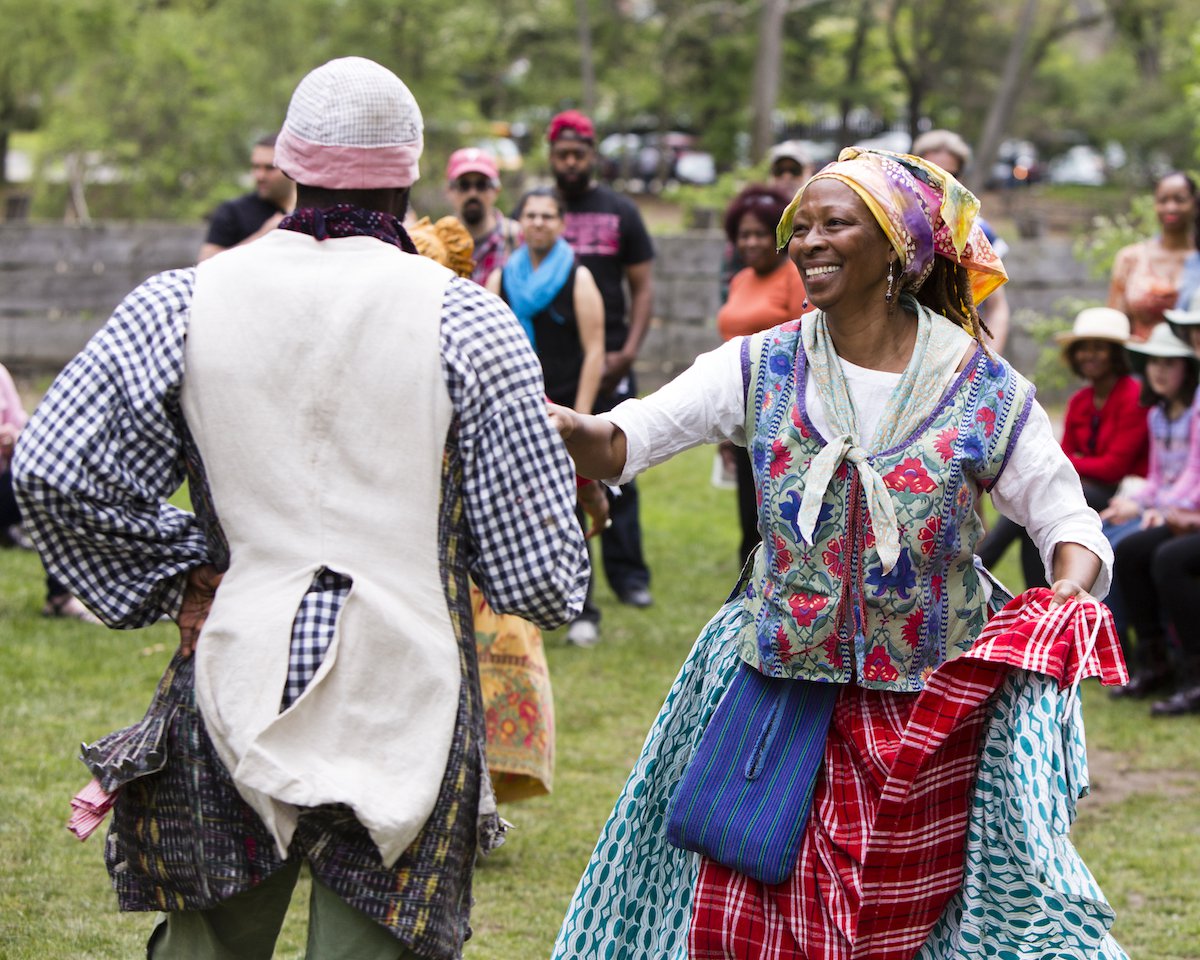
The organization Historic Hudson Valley describes the African-American celebration of Pinkster in an exemplary way. It avoids the use of the word slave and instead uses terms such as enslaved people, enslaved Africans, and captives. It’s a subtle yet powerful means of affirming that slavery is not an inherent condition, but rather one imposed from outside. This is part of a complete episode.
Transcript of “Slave vs. Enslaved”
You’re listening to A Way with Words, the show about language and how we use it.
I’m Grant Barrett.
And I’m Martha Barnette.
A few weeks ago on this show, we were talking about Sojourner Truth and the fact that the first 10 years or so of her life, she spoke only Dutch. She learned English later. And that led me to do a lot of reading about Pinkster, the spring festival.
You know what this is, Grant.
Yeah, it’s an African-American holiday, or was. And the name derives from the Dutch word for Pentecost, and it happens in the late spring. I was reading about the festival in the early 18th and 19th century on a website called HudsonValley.org. Now, this is the website of an educational nonprofit that discusses the historic Hudson Valley. And I wanted to share with you a paragraph from that website and see if anything strikes you the way it struck me.
Okay, let’s see.
Pinkster was brought to the New World by Dutch settlers in the 1620s and flourished in the areas of heaviest Dutch settlement, the Hudson Valley, northern New Jersey, and western Long Island. These same areas also had significant populations of enslaved Africans from the 1600s until emancipation in New York in 1827. For enslaved people, the year offered few holidays or breaks from tedious and often grueling work. For rural captives in particular, who were often isolated from larger African communities, Pinkster became the most important break in the year.
Anything strike you about that?
No. What am I missing?
Well, they never once used the word slave. They said enslaved.
That’s right. But they never used slave as a noun. They used enslaved Africans, enslaved people, and rural captives. And the reason I was thinking about this was that I gave a talk in Fort Worth at Tarrant County College, and a history professor called my attention to the fact that there’s something that happens in your mind if you don’t use the word slave and instead substitute the words enslaved person, enslaved men, enslaved children. It’s just different.
And I think that there’s a risk of carrying political correctness too far, but I think that this is a really profound way to write and talk about slavery.
I see. I was trying to figure out what, if you thought it was bad writing to leave the word slave out, or if the way that they’ve used enslaved as an adjective was more effective in humanizing the subjects. And that’s what you’re saying, right?
That’s exactly what I’m saying.
So if we say a slave, what are we thinking about? We’re thinking about people in a horrific situation, of course, people who didn’t want to be doing what they were doing. But we’re also falling deeply into all these stereotypes of us and them and white and black.
Well, and the presumption that it’s a condition rather than something imposed upon you. It’s sort of like when you read history books that say slave families were broken up on the auction block. No, white people broke up families of enslaved people. There was an actor there. That passive language is taking away the fact that there was an agent of destruction who did the deep. That’s what I’m talking about. I think it’s a very powerful tweak.
So clearly whoever wrote that put some thought into how they wanted to talk about slavery in the right way.
Exactly. It’s really changed the way that I think about and write about that now. You know, I work in the museum business in my other life. And I read a museum blog, which is really interesting. It’s a person who works in a museum on a plantation in the south. I’ll find it for the website. I’m not recalling the name of it right now. But what she does is relates the questions and comments that she gets from visitors. And so many of her visitors want to deny that slavery was real.
Oh, yes, yes. I’ve seen that blog. They basically said, but they were treated well, weren’t they?
Right, right. But they were fed and taken care of and given clothing and shelter, right?
Right. They were singing. Hello.
Yeah, it’s just hard for some people to get to that extra understanding. Like, yes, and if they tried to escape, they would be killed or their family would be killed or they would be branded or they would be mutilated or injury would happen.
I know we’re far afield on the language topic.
Right. But it is really at the heart of this, what you’ve brought up, is this way that we can either do justice through words or we can do injustice through words.
Very, very well said.
And it behooves us to do justice.
Very well said, Grant.
We know you’ve got comments about this. 877-929-9673. Email words@waywordradio.org.