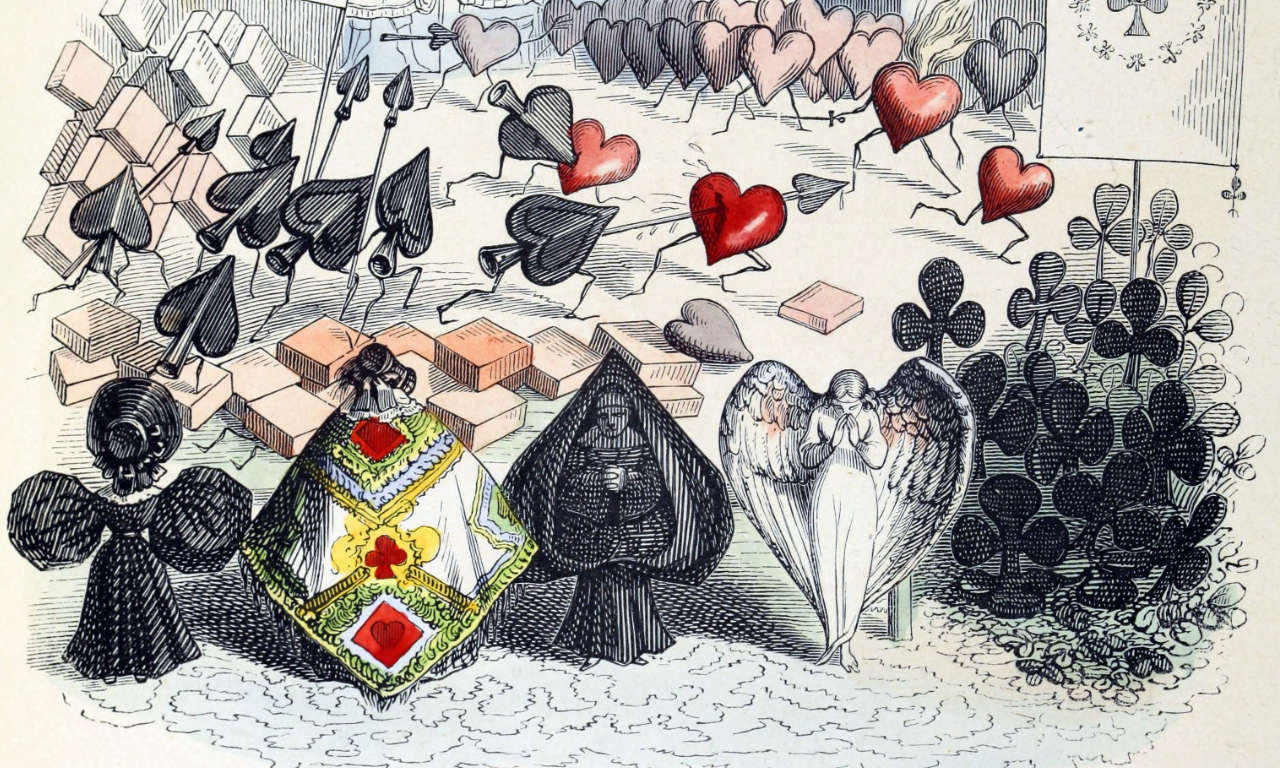
Get out your umbrellas — it’s raining pitchforks and … bullfrogs? This week, it’s odd expressions that mean “a heavy downpour.” Also, holistic vs. wholistic, recurrence vs. reoccurrence, flash drive vs. thumb drive, whether it’s good or bad to be jacked up, stomach Steinways and bunheads, and the origin of listless. And not to mince words, but what does the expression “not to mince words” really mean? This episode first aired May 26, 2012.
Transcript of “Raining Cats and Dogs”
You’re listening to A Way with Words. I’m Grant Barrett.
And I’m Martha Barnette. Here’s a question for you.
In what profession would you hear your colleagues talking about the following things?
Clams, footballs, hairpins, and axes.
Web design. I don’t know.
Well, maybe. I don’t know.
What? What is that?
Well, actually, I should have said it’s a musical question because this is all slang used by classical musicians.
Oh, really?
A clam?
Yeah, a clam is a missed note, you know, when you’re doing a run and you miss the note.
A football is a whole note, you know, because it looks like a whole note on the page.
Very good.
That makes sense.
Hair pins?
I don’t know.
Those are crescendo and decrescendo marks.
They’re a little wavy, right?
Well, they’re like little arrows.
All of V’s, long V’s.
Yeah, yeah, yeah.
Turned sideways.
They look sort of like hair pins.
And an axe, as you know.
Is your guitar.
Is your guitar.
Or your instrument in general.
Exactly.
Exactly. Classical musicians use acts for any kind of instrument.
Isn’t that great?
These are great. These are stupendous.
Yeah, we got these from people on our Facebook page who added a lot of them.
And one that I like from Kyle Hayes, who actually started the discussion on Facebook,
Is a rather sexy musical term.
Oh, hello.
You know what a bisectional is?
I don’t know. What is it?
Somebody who plays more than one instrument.
So they’re either in the horn section or the wind section.
How do they move that fast between sections?
I think it’s for different performances.
Oh, I see.
I was thinking of a quick change artist.
Anyway, we love slang from your workplace.
We’d love to hear more of it or any other questions you have about language,
Observations about grammar, disputes you might have with your sweetie about how to pronounce a word.
We love it all.
Call us, 877-929-9673, or send it an email to words@waywordradio.org.
Hello, you have A Way with Words.
Hello, this is Alison in San Diego.
Hi, Alison. Welcome.
Hey there, what’s up?
Well, I thought I’d call you guys because last weekend I was on the phone with my mother.
She’s 87 and she lives in Edinburgh, Scotland.
And she’s just recovering from a minor illness and she told me she was feeling listless.
Now, she’s a former English teacher and she loves words and she sort of said to me,
You know, I feel so listless, but I don’t even know what the word means.
Where does it come from, you know?
It’s nothing to do with lists.
You know, it’s not like I’ve lost my list.
And she told me that she had talked to my brother that morning,
And they talked about it.
And he was near the ocean.
He often was around boats.
And he speculated that perhaps it was something to do with, you know,
Boats list to one side or the other.
And perhaps she wasn’t listing in either direction,
And that she was somehow neutral, you know, becalmed.
So anyway, we had a great discussion, but I thought, well, why don’t I call the Way With Words guys and see what they have to say?
That’s a great question.
So is it a bucket list, a short list, a grocery list, a laundry list?
Something to do with a ship at sea?
Yeah.
That’s right.
We know that it can’t be that, but what is it?
Where does this word come from?
Well, let me ask you a private question about your mother.
Is your mother somebody with a lust for life?
Does she live vigorously?
Is she one of these kind of people who just loves to just live and be alive?
Yes.
When she was younger, she was a mountain climber.
She was full of energy and passion.
That’s true.
So I think it’s kind of distressing for her to find herself in this listless state at this point.
I asked you, Alison, that’s a leading question,
Because the list in listless has nothing to do with lists of names or groceries,
Has nothing to do with whether or not a ship is upright.
It’s related etymologically to the word lust.
They come from the same old English root,
And they mean desire or longing or wanting.
And so if your mother is listless, she is literally without lust.
She does not have the lust to carry on her life
And to do the ordinary things that keep us alive
And keep us interested in the world.
Well, maybe she does.
She sounds like she probably has had a very long, good run, right?
She’s had a great life, yes.
And she’s going to be so interested in this because she loves finding out the roots of words.
And I think you’re right.
You know, she was feeling a little bit like she’d lost her lust for life and she was missing it.
But she’d merely lost her list.
Well, I said at the end of the call, I hope you find your list.
But now I can tell her, I hope you found your lust for life.
She needs a lover.
She needs to take a paramour.
Oh, I’ll talk that along.
Yes, that’s a good piece of advice for her.
It’s a little TMI.
No, TMA, too much advice.
There we go.
Who knows?
All right, well, I hope she feels better, and do tell her that we wish her the best.
All right, Allison?
She’s on the mend, and thank you so much for that.
Our pleasure.
Take care.
Take care.
Bye-bye.
Bye-bye.
Grant, I’m looking at the Oxford English Dictionary, and indeed, another definition for this particular list is pleasure, joy, or delight, as well as appetite or craving.
So it makes perfect sense.
You can find it in Beowulf.
And a lot of the Old English stuff that you might learn in school,
If you’re studying linguistics or if you’re learning about the history of poetry and English and so on and so forth.
So it’s there.
L-Y-S-T-A-N is the word that you want to look for in Old English.
But another great example of how words can be spelled exactly the same but come from completely different roots, right?
English is a mongrel tongue.
As long as you remember that, then this stuff won’t be very surprising.
It is indeed.
Call us with your questions about language, 877-929-9673, or send them an email to words@waywordradio.org.
Hi, you have A Way with Words.
Hi, Martha.
Hi, who’s this?
My name is Savannah. I’m calling from Washington, D.C.
Hi, Savannah.
Welcome to the show.
Hi, Grant. Thank you.
Well, I’ve been listening to your show for a long time, and I’ve always wanted to call in, but I didn’t have a very good reason to until recently.
My husband and I often listen to the podcast while cooking.
And one day we were listening to a podcast right after we’d had an interesting language conversation,
Which happens all the time.
He recently immigrated from South Africa.
We often talk about the differences in our languages.
But this is a situation where I think his interpretation makes more sense.
So we are calling to ask about the meaning of the phrase jacked up.
So in the U.S., or commonly, I use it to mean something is messed up.
It’s not working as intended.
So the conversation we were having was John said, you know, the metro in D.C. is really jacked up.
I said, I know it hardly ever is running on time.
It seems like they’re constantly doing track work.
You know, it has a lot of problems for major public transportation.
And he said, no.
I meant, like, it’s great.
It’s a cut above the rest.
You know, like when you jack up a car, it’s better a cut above.
And so we both could agree that the Metro was jacked up, but we had totally different interpretations of what that phrase meant.
So jacked up. So your take is it sucks. His take is it’s great. You both think it’s jacked up.
Yeah. Well, and then, of course, there’s the use.
We had this conversation with some friends who pointed out that it can also be in reference to a person.
So you could say somebody is jacked up to mean that, you know, they’re also like a bodybuilder and their body is really jacked up,
Or that they’re jacked up on something, like they’re jacked up on drugs or on caffeine.
And I don’t know if there’s any relation between that use of the term and the way that we were using it.
And is your husband around?
He is.
Can we get his take on it?
Of course.
Hi, Martha and Grant. It’s John here. How are you?
John?
Hi.
Hi, welcome.
Hey, how are you doing?
Thank you very much. Very well yourself. Can’t complain.
Welcome to the show and welcome to this country.
Yes, thank you very much for having a fantastic time so far.
Excellent. So your take on Jacked Up is different from hers.
Absolutely. I mean, Savannah was telling you the story behind it, and we could both agree that the metro was jacked up.
In my experience coming from South Africa, we definitely use it very colloquially and sort of in the context that you’ve raised your game or you’ve really stepped up to the plate to really sort of outperform yourself.
Interesting.
And so when I came through to the U.S., I was very impressed with the public transport system and thought that everything was very jacked up, and she agreed with me.
Well, what we’ve got here is something known as polysemy, P-O-L-Y-S-E-M-Y. That means that words in English often have more than one meaning, and jack is a very, how should we put this, a very successful polysemy word.
And particularly when it’s paired with prepositions, where one preposition can completely change the meaning. You can have opposites, you can have antonyms, you can have synonyms, what have you.
So in this particular case, you’re both right, because both of these meanings exist in a wide variety of dialects of English.
To jack up literally means to raise it up, just as you would jack up a car. But even more likely, before the automobile, you had jacks where you would jack up, say, buildings on a lot.
Or you would jack up farm equipment in order to work on it. You would jack up, it was a wide variety of things that you would jack up, but you were literally raising this stuff up because that’s where it needed to be or because you needed to work on it or get underneath it.
But the jacked up that we have that is a negative is probably related to words like hijack and blackjack. These are where you accost somebody or you confront them, where you are jacking them over.
You’re literally doing something negative to them by taking from them or cheating them or beating them. Like you can actually jack somebody up against the wall. That means you push them against the wall and you start pummeling them.
You’re jacking them up. And so these two meanings of jack exist side by side and they’re only apparent through context. And English is a mongrel language and we’re able to figure this out because of context.
So you’re both good. I love these cross-cultural confrontations. Do you often have these, John? Do you and your wife often?
Constantly. Especially about pronunciation.
Yeah. Absolutely.
I assume that coming to the U.S., one of the easiest sort of transitions would be the English language. But it has, you know, proven absolute mystery.
And daily we’re coming across examples where, you know, like Jacked Up, we have entirely different answers to the questions.
What else have you encountered?
In South Africa, we would talk about just now and now now being terms of time. Drives me crazy when he says, I’ll be there now, and then he shows up 45 minutes later.
And what’s the difference between just now and now now?
Well, just now may mean anything from half an hour to entirely blowing you off. You know, I’m not going to do it for you at all.
Whereas now now would be within the next 10, 15 minutes. Oh, really? And now would be in the exact present time.
I love that. Never a dull moment at your house. I love now now.
That’s a case of emphatic reduplication where you say something twice to mean that you mean the ultimate or utmost meaning of that word. Like now actually means this very second.
Yeah. Oh, this is all really interesting.
I heard you say blow it off. Did you get that from your American wife?
Yep. Because that’s not very widespread in South African English.
No, it’s not. Interesting.
And you two have to keep us updated. We want to know how this marriage is going.
Yeah, count us with more.
Well, we love that we are both right.
Yes, so you both have to buy each other dinner. And you’re both word nerds. That’s fantastic.
This is going to work out really well.
Well, it was wonderful to talk to you both. Savannah, John, thank you so much for telling us about your life.
And do please send us some more of this stuff in email. This is really interesting.
We will. Thank you so much.
Take care, Dan.
Absolutely. And thank you very much for having us on the show. I really appreciate it.
Bye-bye.
Thank you.
Bye-bye.
Thank you.
Take care.
Bye.
Email words@waywordradio.org.
Get down and nerdy. More language chat coming up. Stay with us.
Support for A Way with Words comes from the Ken Blanchard Companies, whose purpose is to make a leadership difference among executives, managers, and individuals in organizations everywhere.
More about Ken Blanchard’s leadership training programs at kenblanchard.com slash leadership.
You’re listening to A Way with Words. I’m Martha Barnette.
And I’m Grant Barrett, and with us is John Chaneski, our quiz master. Hello, John.
Yo!
Hi, Grant. Hi, Martha.
How’s it going?
What’s cooking, dude?
You know, it’s time for another episode of The Musical Question. Do-do-do-do-do-do-do-do-do-do-do-do-do-do-do-do-do-do.
I’ll give you clues beginning with the artist and the year of release for a song, and then sort of a cheeky answer to the song title, because the title is a question.
For example, Johnny Mathis covered this 1967 hit by The Young Rascal, the answer is, you can’t be. Nothing in life is certain.
Are you sure?
Close.
Sure.
I have no idea.
How can I be sure you love me?
That’s it. Except for the you love me part, which is wrong.
How can I be sure? It’s how can I be sure.
How can I be sure?
Oh, yeah, yeah, yeah, yeah. I do remember that.
Let’s try this first one. Now, some of these may sound obscure, but I think I’ll give you enough clues so you can get it.
Augie Rios and the Mark Jeffrey Orchestra had a seasonal hit with this song in 1958. Now, the answer is, El hombre gordo está en el polo norte con los duendes.
So, there’s something about where’s Santa Claus and the elves?
Well, it was… ¿Dónde está?
Yeah, go.
Oh, is that it?
That’s it. ¿Dónde está Santa Claus?
That’s it. ¿Dónde está Santa Claus?
¿Qué sé yo?
Oh, mamacita, ¿dónde está Santa Claus?
They still play it every year around somewhere near the end of the year or somewhere.
Do they?
I’ve never heard that song.
I can’t place it, no. It’s one of my favorites.
It’s 1956, and Frankie Lyman and the teenagers are asking a question. Listen carefully to the answer, which is, because they are too dumb to stay out of it.
Why do fools fall in love?
That’s right. Why do fools fall in love?
Let’s try this. This was a hit for The Who in 1978. The answer?
Puzzle Guy John Chaneski.
Who are you?
Who are you?
Who am I?
Who are you?
Who are you?
Right. All you CSI fans out there.
Now, this next song was never a hit, but when Florence Reese wrote it in 1931, it became popular among people in a certain industry.
The answer? I’m a union man, through and through.
Which side are you on?
Which Side Are You On?
Yes.
Okay. That’s the answer, huh? Dispute between miners and mine owners.
And she wrote the song, Which Side Are You On? Which became a perennial, well, perennial, but a folk classic.
Okay. Very good.
This Bee Gees hit from 1971 might make you think the answer is bypass surgery. But I think the answer most people might offer is time and lots of Ben & Jerry’s ice cream.
Oh, perfect. I know this one.
Yes.
How do you mend a broken heart?
Yes. How do you mind a broken heart?
This song was a hit for Whitney Houston in 1987. The answer is, yes, that’s right, not quite everything.
Or is it her big one?
Yeah. The one that Dolly Parton did originally?
Didn’t we almost have it all?
Oh, there we go. Yes, didn’t we almost have it all?
That was not the one that Dolly Parton did.
No.
No, that was I Always Love You.
Yes. I will always love you.
Right. Okay, here’s the last one.
Okay. In 1960, you could have given Elvis Presley an answer. Just a little. Why don’t you come on over? We’ll hang out and have some Ben and Jerry’s.
That’s the second time you’ve mentioned Ben and Jerry’s in a clue.
That’s true.
I’m looking for sponsorship.
What can I say?
What’s the hint?
Hint, hint.
How about Are You Lonesome Tonight?
That’s it.
Are You Lonesome Tonight?
Are You Lonesome Tonight?
Come on over.
PB&J and banana.
He liked banana and peanut butter, right?
Is the torture over?
The torture is over.
But you guys were fantastic.
You guys were really good.
We’re free of our chains.
It was fun.
It was fun.
It was fun.
It was fun.
It was fun.
I’ll give you that.
Yes, it was.
I tease.
John, thanks so much.
Thank you, Martha.
Thank you, Grant.
Thanks, buddy.
Bye-bye.
If you want to talk language with us, give us a call, 877-929-9673.
Or if you’re lonesome tonight, send us an email, words@waywordradio.org.
Hello, you have A Way with Words.
Hi, it’s Clark Griffith from Fort Worth, Texas.
Hi, Clark. Welcome to the program.
Thank you.
What’s going on?
Well, I was reading an article in the New York Times the other day,
And Paul Krugman used the phrase, not to mince words.
And I’ve seen the phrase a million times, and I’ve used it,
And I just wondered what its origins might be,
Because we mince onions and we chop onions and we dice onions and we grate onions, but we don’t chop, grate, or dice words.
Good point.
Except if you’re the kind of editor that I always get.
So what did Paul Krugman mean?
Could you tell what he meant?
Feet around the bush, basically.
Okay.
So he was saying, he says, I’m not going to lie to you.
I’m going to tell you the truth.
I’m not going to be vague.
I’m going to be frank and explicit, right?
Straightforward.
Straightforward.
Okay, very good.
Yeah.
So mincing words, yeah.
Mincing words and mincing onions, is there a relationship there?
Yes, absolutely.
Absolutely.
Mince, in both of those senses, goes back to the Latin word minutia, which means smallness.
And you see it in other English words, such as diminish, miniature, let’s see, what else?
Minutia.
Minutia, yeah.
Minute, like 60 minutes in an hour, right?
Yep, yep.
They all come from the same family that has to do with the idea of smallness.
And so if you’re mincing words, you’re chopping them very, very finely and being very careful and almost dainty with them.
I see. That makes a lot of sense.
Sort of not to put too fine a point on it.
Clark, does that fit your understanding of what Paul Krugman was talking about?
I still don’t quite get the sense of how chopping them into fine pieces equates into speaking them plainly.
Well, that’s a really good point.
It’s usually said in the negative, I’m not going to mince words.
Right, right.
Not to mince words.
Although you might talk about a minced oath,
And this is where you have literally pared it down so that the meat of it isn’t there.
All that’s left is some kind of like inspecificness, some vagueness,
Like an amorphous cloud of poor meaning and poor clarity, right?
Or pink slime, as it were.
Or pink slime, as it were.
Verbal pink slime.
Love it.
There are no chicken nuggets on this show.
But there are other minces as well, right?
So you can mince words and you can mince your steps, right?
Yes.
Like if you’re wearing heels and a skirt, you’ll take tiny mincing steps so that you don’t fall over, right?
Right, right.
If your knees are glued together or look like they are, yeah, mincing steps.
Because, I mean, you’re not going to walk like a lumberjack if you’re wearing a skirt, right?
That’s the opposite of mincing.
You’re going to like…
It depends on how tight the skirt is, I think.
I don’t know anything about that.
Clark, thank you so much for your call.
Really appreciate it.
Thank you.
Take care, Clark.
Take care. Bye-bye.
Bye now.
Well, if a language question occurs to you while you’re in the kitchen or elsewhere,
Give us a call, 877-929-9673, or send it an email to words@waywordradio.org.
Remember our conversation about the term stove up?
Yeah, it has to do with bashing something in.
Right.
We heard from Jill Herr in Lancaster, Pennsylvania.
She said, I’m a physician, and I’ve had a number of people come to see me for stoved fingers.
The complaint is usually, I think I stoved it, meaning they jammed their finger.
I never could figure out why they use that expression, and it makes sense to me now.
And actually, we heard from softball players and volleyball players who talked about their fingers being stoved up.
I see. I did that once playing volleyball when I was a kid.
For years, one of my pinkies was shorter than the other one.
Really?
Yeah, they’re fine now.
And then it changed? What happened?
It got jammed.
Did you hang from your fingers?
No, it jammed in. The volleyball hit it directly.
Yeah?
Yeah, and it jammed, and it took months to even stop hurting,
And then it took years to turn back to its regular length.
The things you learn on public radio.
877-929-9673 or email words@waywordradio.org.
Hello, you have A Way with Words.
Hello, this is Catherine Penavaria calling from Barron County, Kentucky.
How can we help today, Catherine?
Well, I’m calling to see if you can give me any help with understanding the various names for a tiny little computer that you can attach to your keychain.
I call it a flash drive, but I have three acquaintances who call it different things.
One calls it a thumb drive, another calls it a jump drive, and the third one calls it a stick.
And I don’t know what to call it and why there are so many names.
Oh, very good.
This is a great question.
Yeah.
And this is a merging of my tech geekery and my language geekery all in one place.
Oh, my gosh.
Catherine, this is wonderful.
They’re going to have a baby.
How long do you have?
The short version is this.
It’s complicated because there have been so many different players in this market.
Some of them have had brand names that almost became generic, like thumb drive.
And some of them have been names that didn’t ever have a chance, but that’s the one product you know, so that’s the name that you use.
You use, Catherine, the most common one, flash drive.
And the flash refers to the kind of memory that’s in these.
These are the things, they’re about the size of a matchbox, maybe a little longer, and they plug into a USB port, right?
And you put data on them, and it allows you to replace floppies, basically.
It allows you to carry data a variety of places.
So flash drive is the most common.
The second most common is USB stick because you plug it into the universal serial bus on your computer.
And there’s, of course, jump drive, thumb drive, memory stick, fob, USB fob, F-O-B.
Like, you know, you have a key fob because sometimes these are designed to just screw right onto your keychain, right?
Mm—
Well, now, I call mine my monkey.
What?
Because it’s shaped like a monkey.
You know, you can get these cute little things.
That’s my little monkey that I take with me everywhere.
So there’s more names than I actually even knew, and there could be more coming in the future.
Yeah.
When I worked in IT, and this was from the early 90s to, oh, heck, for a long time, 15 years or so.
I worked in IT, and these things just came online.
We had this exact problem in all the different IT departments where I worked,
Where somebody would call up and say, I want a thumb drive.
And be like, oh, you mean a USB drive.
I’m like, no, I don’t need the whole big thing.
I need the small thing.
Because you have this kind of confusion as well,
Where a USB drive can either mean the little thing
That’s about the size of a matchbox,
Or it can mean the big hard drive in the enclosure
With the power cord and the long cables and stuff.
So I’m okay to keep calling it a flash drive.
Well, you’re all okay.
It’s just going to be a lot of,
There’s always going to be this re-explanation
Every time somebody uses a term
That you’re not quite sure what they mean.
Each of these times I heard these,
I didn’t know what the person meant,
And there was a couple of seconds of misunderstanding.
Thumb drive, though, is one that I love.
I just like the color because it’s about the size of your thumb, right?
Why don’t they make some that look like thumbs?
They do.
They do?
They do.
These are a novelty product that you can buy by the thousands from companies in China that will put your brand in.
They make them shaped like sushi, like animals. They make them look like knives and like thumbs.
Yeah, they make them look like Lego characters and characters out of fantasy fiction. And monkeys, yeah.
Yeah, all different sorts of things. Anything that’s plastic that you can shove a USB stick into, that’s what they’ve done.
My follow-up on that is, are these regional in any way? Do people in certain parts of the country tend to use one or the other?
I don’t think so. Within my experience and what I know about this, they’re sprinkled throughout the United States.
But flash drive, just to kind of reiterate here, flash drive is more common by a factor of like 100 or 200. It is the winning term.
And in the last seven years or so, it’s actually pushed the other terms out of the market. It’s like it will probably be the winning term in another 10 years if we’re still using these devices at all.
All right. Well, I’m going to be part of the move to push the other terms out. I’m sticking with Flash Drive.
Well, see, I always like the underdog, so I’m still rooting for Thumb Drive. Thanks for your call, Catherine.
Okay. Thank you very much. Take care now. Take care. Bye-bye.
Maybe you could have a little underdog, you know, the cartoon character, underdog, Thumb Drive.
Yeah, sure. Why not? I like Thumb Drive, too. I do.
Everyday difficulties that we have where we really find this common thread that we all have, which is like, I didn’t understand this person. I need some help figuring this out.
Yeah. If you need some help figuring out a little language question, doesn’t have to be the best one ever. 877-929-9673. Or send it to us an email to words@waywordradio.org.
Grant, we were talking earlier about slang used by classical musicians, and that’s such a rich topic. There’s so many great ones. Do you know what a stomach Steinway is?
Is this like a handheld keyboard, like one of the little Casios?
Well, it’s a little bit more antiquated than that. Accordion. Polka. Yeah, yeah, yeah.
Oh, very good. Yeah, stomach Steinway is an accordion. We got that from listener Mary Feinzinger in New York City, who’s a classical musician, composer.
Stomach Steinway. I love it.
Yeah, yeah. Isn’t that great? And another one that she mentioned that I love is bunheads. You probably know this one.
Oh, dancers. Ballet dancers.
Yes, ballet dancers with the buns back there. Well, buns up there, I guess. That’s a little derogatory, right?
Not those buns. No, you know, the way they wear their hair. In those tights, you could be talking about either buns.
That’s true. But, you know, if you have a gig where you’re playing the ballet, you talk about the bunheads on the stage. Love it. Very good.
If you’ve got something we should know about the slang of your profession, 877-929-9673 or email words@waywordradio.org.
Hello, you have A Way with Words.
Hi, this is Steve Jolka, a colleague from San Diego.
Hi, Steve. Welcome to the program.
Hey, thanks. Here at work, I’m working in a supportive environment, and we’re dealing with problems all the time, problems that happen frequently or repeatedly.
And my peers have taken to using the term reoccurrences to refer to these problems that happen repeatedly. And to me, that sounds wrong, and it’s been bothering me for a number of years.
I like to use the term recurrence instead. And my ear says I’m right, but I’m looking for some more substantive basis for that.
You said you work in support, computer support, something like that?
Okay. Very good. Okay, that’s helpful. And you like recurrence, and they like reoccurrence.
That’s correct. Because your native ear is telling you that recurrence just sounds better.
Yes, exactly.
Yeah, well, your native ear is right. I mean, if you look at the corpus of American English, these are like these massive texts all collected together and analyzed.
Yeah, recurrence outnumbers reoccurrence just exponentially. Like 30,001 or something like that.
Yeah, yeah, yeah. It’s an extraordinary percentage. Recur and recurrence are almost always your safe choice.
Yes. Now, that’s not to say that reoccur and reoccurrence aren’t words. They are, but they tend to be highly specialized.
You’ll encounter them in medicine where somebody is very specifically trying to say, well, the cancer came back, but we don’t know how many times, or it recurred, or the cancer came back, and we know it came back just once. It reoccurred, right?
But outside of medicine and some very specific professional uses, most people should just use recurrence.
Yeah, I mean, even dictionaries. There’s some dictionaries where you can’t even find reoccurrence.
Right. Oh, great.
Yeah. So they both come from the same root. It’s the idea of running. It comes from a Latin root that means running. Get the word current from that, and course, those kinds of things.
Let me ask you. Recur is the simpler and the better.
Steve, how are you going to tell them that you’re right?
I may use this broadcast. Put it on the PA. I’m writing a document to support some of our processes, and which word I choose will help. So I’ll try to institute it that way if I can.
Leading by demonstration rather than by memo is often the better way to do it.
Yeah, exactly. By demo rather than memo, I think they put it.
Yeah, I think you should send them a recurring email, you know? Like once a day, send them this email saying, I’m right and you’re wrong.
I don’t recommend that.
No, probably not. It’d be satisfying, but maybe not so helpful.
Steve, thank you so much for your call.
Well, thank you very much. That was a big help. Super.
Okay. Bye-bye now. Bye-bye. Bye-bye.
Computer support. Who knew?
Oh, we should have called him. I’ve got some questions.
I can help you with those.
That’s true. You’re a geek.
Oh, big one, and I love it. I love it too.
All geeks should call 877-929-9673 with your language geekery. And you can also send all your language nerdism to words@waywordradio.org.
Grant, you got such a kick last time out of some negative terms that I used from an old book of Virginia folk sayings. I have a couple more for you.
Okay. If you’re talking about somebody or something that’s old, it’s as old as my tongue and a little older than my teeth.
As old as my tongue and a little older than my teeth.
That’s true because the teeth come in later.
I know. Isn’t that great? You kind of have to stop and think about it. But I love that. I love that.
And another one is he can’t spell A-B-L-E. Great stuff, Virginia folk sayings. Gotta love it.
Call us with your favorite folk sayings, 877-929-9673. Send them an email to words@waywordradio.org.
Or if you just can’t wait, find us on Facebook and Twitter. More of your language questions coming up. Stay tuned.
Support for A Way with Words comes from National University, where flexible online classes let you earn your degree or credential on your schedule. More at nu.edu.
You’re listening to A Way with Words. I’m Martha Barnette.
And I’m Grant Barrett.
And Martha, I’ve got a stack of cards here that you won’t believe.
Yeah? You have people sending you valentines or birthday cards?
Well, yeah, of course. I get a lot of I love you valentines.
No, no. These are word cards. These are kind of a fieldwork thing that I do when I give public speeches, right?
Oh, these are souvenirs from your trip to Potsdam, New York.
I went to Potsdam, New York. You had a blast.
I did a bunch of classroom lectures. I did a public talk. I talked to the listeners in North Country Public Radio. Hi, guys. It was great.
And when I was in public with these people, I gave out all these index cards and said, tell me the words that you don’t think I know, either because they’re slang and you’re young and I’m old or because they’re a regional expression or because they’re something that you use in your own family, right?
So this is when you were at State University of New York at Potsdam.
That’s right. SUNY Potsdam.
SUNY Potsdam.
And so one of the words I wanted to talk about was crick.
Crick, like in your neck?
No, crick as in creek, C-R-E-E-K, and it’s a regional pronunciation.
What’s really interesting about it is a lot of people who don’t really know it or use it.
Think that crick is southern, but it’s actually mostly northern.
It’s used in the northeast and New England and around the Great Lakes and along the Canadian border.
Kind of south of there, but in the deep south and in the very southern parts of the United States, they don’t say crick.
Huh.
Interesting.
Another one that I really liked is a slang term, bogue.
Bogue?
B-O-G-E.
Can you guess what it means?
B-O-G-E.
Or B-O-A-G.
I had two different spellings of it submitted.
Boag sounds biblical, and Bogue is like Bogart?
Yes.
It is?
It’s a cigarette.
Oh, oh, oh.
Sometimes it’s a tobacco cigarette.
Sometimes it’s something else.
Okay.
So you know about don’t Bogart that, right?
Sure.
It means don’t smoke at all, let me have some, right?
Yeah, I’ve never been told that, but yes.
And it supposedly comes from Humphrey Bogart and his fondness for cigars, right?
Right.
And that sort of thing.
But this is a further shortening of Bogart or Bogie to Bogue.
Huh, give me a Bogue.
Yeah, give me a Bogue.
Yeah, give me a cigarette or give me a smoke of that, right?
Interesting.
Right?
We’ll talk about a few more of these cards.
I’ll put the whole list on the website.
Oh, wow, really?
Yeah.
There’s 160 different terms I collected, a wide variety of things.
If you’ve got some language that you think we should know and probably don’t,
877-929-9673, or put the whole messy thing in email to words@waywordradio.org.
You’ll make Grant a very happy man.
Hello, you have A Way with Words.
Hello, this is Isabel in Stevens Point.
Hi, Isabel.
Hello, Isabel, welcome.
Thank you.
I’m calling about an expression that I heard my mother use that I never heard from anyone else used to describe a fierce rainfall.
She would say, it’s raining pitchforks and hoe handles.
And I wondered about that.
I don’t know the source, but she taught in one-room schools for 10 years before she was married.
I wonder if possibly it appeared in a children’s book.
Where was she when she was teaching?
In Portage County in several different schools.
And just recently I discussed this with a friend who had grown up in Racine,
And the Racine version is pitchforks and hammer handles.
So I guess that’s the contrast between an agricultural area
Area and an urban area or a business area.
Well, Isabel, it’s really interesting that you mentioned this expression.
I’ve seen lots of different variations that start with the pitchforks.
Aha!
Raining pitchforks and bullfrogs.
Oh!
Pitchforks and bull yearlings.
Bull yearlings, really?
I hadn’t seen that one.
Pitchforks and barn shovels.
Oh, yeah.
Pitchforks and grindstones.
Pitchforks and angleworms.
Angleworms.
Angle worms, yeah, like to go angling with.
Oh, that you put on a hook, huh?
I guess.
And it’s interesting, too, because the whole idea of something falling very noisily from the sky
Seems to be at the root of things like raining cats and dogs.
Right.
Exactly. That’s the expression that I did hear a lot as a child.
You put it very well, Isabel. These always refer to fierce rains.
We’re not just talking a light little spring thing.
We’re talking about the kind of torrent rain where you think the house is going to come down, right?
Or if you’re out in it, it actually stings because it’s coming so heavily.
Yes, and it’s described in terms that the utterer would have at hand.
It’s vivid, right?
Yeah, it’s your daily life turned into a metaphor.
Yeah.
Right, right.
But there’s a whole bunch of language that we use in the United States.
Some of it’s a little outdated now or not much used, but for heavy rainstorms,
Gully washer is one that a lot of people, toad strangler.
Yes, I heard frog strangler in Florida.
Stump washer, ditch worker, because it actually clears out the ditches.
Oh, yeah, yeah, right.
And Grant mentioned expressions in the United States, but there’s some great expressions all around the world.
Oh, really?
Yeah, in Greece, I know they say it’s raining chair legs.
That’s great.
I guess they have pitchforks over there, but raining chair legs.
In Norway, it’s raining female trolls.
And my favorite is down in Colombia.
The expression is, están lloviendo hasta maridos, which means, it’s raining even husbands.
It’s raining men, hallelujah.
That’s marvelous.
So if you’re looking for a husband, move to Colombia, I guess.
Falling from the skies.
Wait for a good gully washer.
The one that you use, the pitchfork version, does go back at least 100, probably 150 years in American English.
These colorful expressions, once people hear them, they can’t leave them be.
They pick them up, they use them, they pass them along, put them in their stories and their writing.
It’s interesting.
I’ll bet you’re going to get a lot of phone calls subsequent to this, giving you other versions.
I bet we do.
And I hope we do.
Isabel, thank you so much for your call.
We really appreciate it.
Thank you.
Take care now.
Bye-bye.
Bye-bye.
Bye-bye.
If you’ve got a term that you use for a heavy rain, 877-929-9673,
Or put the list in email, words@waywordradio.org.
Hello, you have A Way with Words.
Hello, this is Lester in Dallas.
Hiya, Lester. Welcome.
Thank you.
I’m calling because you all are the only people I can think of that might be able to help me.
What’s your problem?
There’s a lot of things that I hear every day that irk me,
And then some of those things are typically in the office.
And one of them that sticks out a lot is holistic.
Now, I think of it the way it should be with an H.
But what I’ve noticed a lot of people doing as of late is putting a W in front of it.
And pronouncing it the same way, they would say, okay, let’s look at this project holistically.
So they’re meaning let’s look at the entirety of the project, all the things involved with it.
As opposed to, which I would likely bring up in meetings, the natural or what are the elements,
The natural elements that we’re trying to apply to this, because that’s what holistic means to me.
And I’ve looked it up.
I don’t know if I’m using something out of date, but I don’t see that as being an actual word.
With the W or with the H?
With the W.
Huh, huh.
And you’re talking about not necessarily in terms of health care.
Right, exactly.
They would only look at it in the sense of looking at the entirety of something.
And so I don’t know if that’s an actual word that’s now come into existence,
But I guess my big question is, what is it called when that occurs?
When a word that, like, say, holistic with the H exists, means something,
But then yet someone who wants to coin it a different way and then spell it a different way, like say with the W,
And then make it a new word with an implied definition.
Because it’s weird because then people in meetings and stuff like that will hear someone else or higher up say it,
And then they adopt it.
They’re like, oh, well, Mary just said it, so Mary must know what she’s talking about, and let’s use this word.
And then it just grows.
So I see it in emails, I see it in notes, I see people talk about it.
You see it with the W spelling, right?
Yes.
So you’ve got two problems here, it sounds like.
One is the word holistic, H-O-L-I-S-T-I-C, is now being spelled by some people in your office with a W at the beginning, as if it came from the word W-H-O-L-E, right?
Correct.
And they’re also now using holistic to mean all of something or all of somebody or the entirety of the situation instead of the way you use it, which is a very specific meaning related to the, was it the psychological or metaphysical treatment of a person?
Am I understanding that correctly?
Right.
Right.
And you’ve got a bunch of questions here, and I’m going to try to knock them off one by one.
The first thing is, what’s really interesting is the only spelling of holistic that you should be using is without the W.
It should not be spelled with a W.
And I realize that’s a really obvious pun.
And some people might use that spelling just because they think it’s goofy or funny or it kind of gets their point across about the meaning that they want, which is all of something or all of somebody.
Or their higher ups used it.
Or their higher ups used it.
But really, it’s the H spelling without the W.
Okay?
The second thing is, and this is going to blow people’s minds, is that holistic does not come from the same etymological root as the word whole or W-H-O-L-E.
It does not.
Holistic actually comes ultimately from a Greek prefix meaning all of something.
And whole, W-H-O-L-E, comes from deep Germanic roots a zillion years ago.
That actually has something to do with being hail or hearty.
And has to do about the actual substance of our behavior,
I mean, sorry, the health of a person.
And it’s going to blow people’s minds because the meanings are so similar.
And the spellings are so alike that people are convinced that they must be related.
And there is a term for that, which is to answer another one of your questions.
It’s called a folk etymology.
This is when people look at the evidence in front of them without understanding the true depth of the history of a word.
And they just draw a conclusion based on superficial appearance like spelling or meaning.
And what we’ve got here is another of these great things that makes the English language so bizarre.
And one of the reasons why you can actually have a national show about language to explain this stuff.
They’re not related.
To get to your third question, I think the final question, if I’m remembering, the meaning of holistic.
So you might talk about holistic therapy in which you were going to address all the issues that a person might have.
Their physical being, their mental being, their stress level, their family life, their work environment.
We might talk about that as holistic, right?
That’s one of the meanings you’re hearing.
That is a later meaning of holistic, but it is a legitimate one.
It does exist.
It’s very widespread.
It’s used throughout the United States in the English-speaking world, but it is the slightly newer meaning than the original holistic.
Yeah, and that was my thing.
That’s what I know of it to be, this whole new, not to apply a pun there, but the whole new application of it is what’s confusing me because people so readily accept it.
And so that’s what I was trying to figure out.
What is that called?
It’s a folk etymology.
Sometimes it’s just simply called a misinterpretation, and that’s actually what they use in the linguistic text.
This is a classic example of a misinterpretation.
Don’t spell holistic with a W.
The meaning of holistic to mean all of something is fine.
And holistic and whole, W-H-O-L-E, are not etymologically related.
Yeah, the H-O-L, there is.
Yeah, it’s the same H-O-L in hologram and holocaust as well.
Right.
Yeah, the whole thing.
Well, Lester, I’m glad that we were able to help you.
Thank you so much.
I hope it works out for you in the office, okay?
Oh, yeah.
Thank you very much for taking my call.
Take care.
Rock on.
All righty.
Bye-bye.
Bye-bye.
Bye-bye.
We can help you speak the same language in your office, 877-929-9673,
Or put the dispute privately in email to words@waywordradio.org.
I’m still going through these cards I collected in Potsdam, New York.
I bet you are.
Here’s a family word that I didn’t know.
Suvy, S-U-V-V-Y, and it means soft and fuzzy.
Oh, I love that.
Doesn’t it sound like it?
Yeah, that’s a suvy sweater you have on, right?
Yeah, it sounds like your security blanket.
Where’s my suvy?
It’s a good term.
Like my woobie is very suvy, right?
My woobie is very suvy.
877-929-9673 or email words@waywordradio.org.
Hello, you have A Way with Words.
Hi, how are you?
This is Mike Flint and calling from New York.
I have a question.
Something that started decades ago when my kids were small and we would take long city rides and
Get bored. We would play, what are these people called? And what that was, was I would challenge
The kids, they were in middle school, and I would challenge them to figure out what residents of a
Given city were called. For instance, Bostonians were from Boston and people from New York were
New Yorkers. But when you get into other cities, there didn’t seem to be a rule and there didn’t
Seemed to be a logic, and sometimes you simply couldn’t guess what somebody would be called.
For instance, people from San Francisco called San Franciscans.
What are people called from, I don’t know, Phoenix, Arizona, Miami, Florida,
Magadoches, Texas, or Cave City, Kentucky?
Any of those.
It got pretty complex, and I never found a rule of thumb, philosophy,
Or anything in any kind of language rule that would guide to answer my kids.
Now I find that I’m a grandfather, and I’m playing the same game with my grandson,
And I still don’t have any rules for it.
Yeah, I think my first suggestion would be find a different game.
Very likely.
You know, play Padiddle or auto-licensed bingo or something.
But I’ve always stressed to them, each of my children and my grandchildren, that the words are toys.
And as long as you’ve got words and you understand words, you always have toys to play with.
You can’t lose them. You can’t harm them.
I love that. That’s amazing. We’re stealing that as our slogan.
Well, to answer your question, what we’re talking about is what we call demonyms from the Greek word for people.
We also get the word democracy from the same root.
D-E-M-O-N-Y-M.
Yes, demonyms. But the problem, as you’ve already suspected, is that although there are some rules for this, there are at least seven.
And they’re very complicated beyond that. And there are a lot of exceptions.
There was a historian named George Stewart who came up with seven of these rules.
And there are too many to go into here right now.
But I tell you what, if you Google municipal onomastics, if you have.
Okay.
That’s okay.
That’s municipal, O-N-O-M-A-S-T-I-C-S, municipal onomastics.
You’ll find these rules, and they include things like if the place name ends in A or I-A, then you add an N, like Californian.
And if it ends in an O-N, then you add I-A-N, like Oregonian.
I see.
It gets long and complicated.
I mean, you mentioned Phoenix, and the people in Phoenix are called Phoenicians, like the ancient people.
In Troy, if you live in Troy, you’re a Trojan.
I mean, it just gets pretty crazy.
There is a book that you can find that has some of these gathered together.
The book is called Labels for Locals.
It’s by Paul Dixon.
It’s easy to find on Amazon for new or used, and I highly recommend that.
It’s got some fun stuff in it.
That sounds outstanding.
I’ll have to get that, and I’ll have to study up,
So the next time my grandson challenges me, I’ll have all the answers.
Okay.
Mike, thanks for calling.
Thank you.
Bye-bye.
Bye-bye.
What do they call people where you’re from?
The name of your town, your county, your state, whatever, 877-929-9673,
Or tell us about the weird names of places and people that you know in email,
You know, one of the things about this show, Grant, is that it’s a celebration of curiosity.
And I was reminded of this recently when I came across a great translation of a Chinese proverb.
It goes, he who asks a question is a fool for a minute.
He who does not remains a fool forever.
Very good.
Beautiful, isn’t it?
Very true.
Things have come to a pretty path.
That’s all for today’s radio show, but you can always join the Language Salon online.
Find us and fellow listeners on Facebook and Twitter,
Or sign up for our weekly newsletter for the latest in language news.
You can also leave us a message anytime at 877-929-9673.
Let us be your linguistic detectives and share your family’s stories,
Or you can ask us to resolve language disputes at work, home, or in school.
You can also email us. The address is words@waywordradio.org.
If you happen to miss our broadcast, you can hear us by podcast anytime.
Check us out on iTunes.
Our production staff includes senior producers Stefanie Levine,
Editor Tim Felten, and production assistants James Ramsey and Josette Herdell.
A Way with Words is independently produced and distributed by Wayword, Inc.,
A nonprofit supported by listeners and organizations who believe in lifelong learning,
Better human communication, and the value of a thing well said or well written.
The show is recorded at Studio West in San Diego, California.
Thanks for listening. I’m Martha Barnette.
And I’m Grant Barrett. Take care.
Dasvidaniya.
Support for A Way with Words comes from the Ken Blanchard Companies,
Whose purpose is to make a leadership difference among executives, managers, and individuals in organizations everywhere.
More about Ken Blanchard’s leadership training programs at kenblanchard.com slash leadership.
And from National University, where flexible online classes let you earn your degree or credential on your schedule.
More at nu.edu.
Hey there, podcast listeners.
Just want to let you know that although we give you the show free and we give it free to stations, it does cost something to send these episodes out to hundreds of thousands of listeners across the planet.
Help support our educational mission by going to the website and clicking the donate link.
Ten bucks? A little more?
How about as much as you think it’s worth?
Thanks in any case for helping us keep shop.
Classical Musician Slang
 In what profession would you deal with clams, footballs, hairpins, and axes? They’re all slang terms used by classical musicians.
Origin of Listless
What’s the origin of the term listless? Does it mean you can’t find the piece of paper with the groceries you need? No. Listless shares a root with the English word lust. In its most literal sense, listless means “without lust,” or “lacking want or desire.”
Jacked-Up
Is being jacked up a good thing or a bad thing? It depends. To jack up means “to raise up,” as with a car on a lift. But jack up also has a negative meaning, perhaps deriving from hijack or blackjack, suggesting that something’s been hurt or cheated.
Song Title Word Game
Our Quiz Master John Chaneski has some answers to classic songs in this week’s puzzle about song titles in question form. For example, the answer “Because they’re too dumb to stay out of it” answers the musical question from Frankie Lymon and the Teenagers, “Why Do Fools Fall in Love?”
Etymology of Mince
What do we mean by the expression “not to mince words”? The New York Times’ Paul Krugman often uses this idiom meaning “to be straightforward and blunt.” The verb mince means “to make small,” and is a linguistic relative of such words as diminish, miniature, and minute. Mincing is what you do when you’re cutting onions into small pieces or diminishing the force of your speech by using euphemisms.
Stoved Fingers
In an earlier episode, we discussed various meanings for the term stove up. One meaning of stove up is “to be in pain from work or exercise to the point where it’s hard to move.” Similarly, lots of athletes will get stoved fingers from getting them jammed with volleyballs or baseballs.
Flash Memory Device
Do you store files on a flash drive, a thumb drive, a USB stick — or perhaps on a monkey? What do you call the little device that holds flash memory and goes into the USB drive of a computer? Some come in wild forms, like sushi or animals.
Stomach Steinway
Did you ever take lessons to play the stomach Steinway? You know, the accordion? That’s another bit of musicians’ slang sent in by a listener, along with the term bunhead, which means “a ballet dancer.”
Recurrence vs. Reoccurrence
Which is the better term, recurrence or reoccurrence? A look at the corpus of American literature confirms that recurrence is far and away the more commonly used word denoting “something that occurs more than once.”
Virginia Folk Sayings
An old book of Virginia folk sayings contains such gems as “It’s as old as my tongue and a little older than my teeth,” and “He can’t spell A-B-L-E.”
Raining Pitchforks
What do you call a fierce rainfall? There are lots of vivid terms in this country besides “it’s raining cats and dogs.” Some Americans say “It’s raining pitchforks and hoe handles,” or “raining pitchforks and bullfrogs.” Or they might call a heavy rain a toadstrangler, a ditchworker, or stumpwasher. In other countries, this kind of cacophonous rain is denoted by lots of picturesque phrases involving imaginary falling things, including chair legs, female trolls, ropes, jugs, and even husbands.
Holistic vs. Wholistic
If something pertains to a whole system or body, is it holistic or wholistic? Despite that tempting “w,” holistic is the correct term. It’s an example of folk etymology, the result of looking at the word whole and assuming that wholistic is the proper correlative.
New Slang from Potsdam
If something’s soft and fuzzy, why not call it suvvy? Grant collected that bit of slang and more during a recent appearance in Potsdam, NY.
Demonyms
Everyone knows New Yorkers and Angelenos, but what do you call someone from Sheboygan, Wisconsin? Demonyms, or the names for people from a given place, can get pretty complicated, but there are seven rules as drawn by George Stewart, and Paul Dickson’s book Labels for Locals has lots of other answers.
Chinese Proverb Fool
A Chinese proverb says, “He who asks a question is a fool for a minute. He who does not remains a fool forever.”
This episode is hosted by Martha Barnette and Grant Barrett, and produced by Stefanie Levine.
Photo by Matt Brown. Used under a Creative Commons license.
Book Mentioned in the Episode
| Labels for Locals by Paul Dickson |
Music Used in the Episode
| Title | Artist | Album | Label |
|---|---|---|---|
| Tapioca | Jimmy McGriff | Outside Looking In | Lester Radio Corp. |
| 911 Beat | Timmy Timeless | 35th and Adams | Timeless Takeover |
| Sabotage | Beastie Boys | Ill Communication | Capitol Records |
| Let The Sunshine | Dennis Coffey Trio | Hair and Thangs | Maverick |
| Got Myself a Good Man | Pucho and His Latin Soul Brothers | Jungle Fire! | Prestige |
| Sure Shot | Beastie Boys | Ill Communication | Capitol Records |
| Tom vs. Galt | Timmy Timeless | 35th and Adams | Timeless Takeover |
| Our Day Will Come | The Slackers | Better Late Than Never | Moon Ska |
| Namaste | Beastie Boys | Ill Communication | Capitol Records |
| Let’s Call The Whole Thing Off | Ella Fitzgerald | Ella Fitzgerald Sings The George and Ira Gershwin Song Book | Verve |