


What colorful language do you use to when you’re angry and tempted to use a four-letter word? There’s a difference between cursing and cussing: It takes a slow mind to curse, but an active, vibrant mind to cuss. Also, what it means to be stove up, the phrases the horse you rode in on and it’s all chicken but the gravy, plus a couple of handy synonyms for armpit. And when can you trust Wikipedia? This episode first aired April 28, 2012.
Transcript of “The Horse You Rode In On”
You’re listening to A Way with Words. I’m Grant Barrett.
And I’m Martha Barnette. Grant, I know how much you love quizzes, so I have one for you.
Oh, please.
What do these words have in common? Tantalizing, erotic, echo, and mercurial.
They all are related to gods.
Yes, yes, they all come from mythology. Tantalus was the god who was deprived of food and water, Herodic from Eros, the god of love.
Echo, the nymph, who had her voice taken away.
And Mercurial from Mercury.
Now, the reason that I’m thinking about words from Greek mythology is that I came across another in a news report recently that I’d never seen before.
Oh, very good. What is it?
Hadal, H-A-D-A-L.
What is that?
Hadal is a word that I came across in a news report about James Cameron’s deep sea dive.
Remember that? In March.
Into the Mariana Trench.
Yes, and into the Hadal Zone in the Pacific.
So that means like hell or like Hades?
The deepest part, yes.
The ocean’s deepest level below 20,000 feet.
I had no idea that there was this word knocking around since the 1950s that refers to Hades and refers to that particular part of the ocean.
Well, who knew? That’s fantastic.
Call us with something about language that caught you by surprise or share your questions and stories.
Or put anything at all in email to words@waywordradio.org.
Hi, you have A Way with Words.
Hi there, this is Susan DiGiacomo in San Marcos.
Hi, Susan, welcome.
San Marcos, California, huh?
Yes, ma’am.
All right, what would you like to talk with us about?
Well, as a child, I grew up with my grandparents. I was my grandpa’s sidekick.
And I suppose one day I might have said something, a bad word, and he stopped me and took me aside and said,
And sweetheart, there is a difference between cursing and cussing.
And he says it takes a slow mind to curse.
And he says it takes an active, vibrant mind to cuss.
And he says, I’m going to tell you some words that you can use to cuss, and this is what I want you to do.
And he taught me three words that I’ve used most of my life.
I’ve never heard another living soul use these words.
And I’m really curious if anyone knows anything more about them.
I taught my children how to say them and told them how proud I was, and this is part of their heritage.
And as soon as they mastered them, about a week later, every kid on the block knew it.
Oh, really?
Yeah.
You went viral.
Yeah, exactly.
Congratulations.
Yeah, well, at any rate, these three words are really interesting, and hopefully you guys would know something about them.
My husband’s been begging me to call because we really enjoy your show.
Well, great.
We’d love to hear them.
Okay.
Try us out.
All right.
The first one is Alapalup, Palip, Palam, Basam, Sam, Malikazowski, Cosnoozalism.
And all the kids on the block were saying that?
Oh, yeah.
They could repeat them at one time, all three of them.
You just made my rabbit disappear.
So these are the things he would say if he hammered his thumb or stubbed his toe or the electric bill was higher than it should be.
And when my son was little, he had quite a temper, and I told him, listen, you can say these words anywhere.
No one’s going to know what the heck you’re saying, and they’re not going to get angry at you.
Very good.
So that’s just the first one.
You have two more of these gems.
That’s one word?
Yeah.
I have three of them.
All right, let’s hear them.
That’s the first one.
The second one, transnance, ninai, fi, ninai, namuality.
And what is that?
Is that a noun?
I have no clue.
I have no clue.
It sounds like what you get when a lot of financial companies merge.
There you go.
I have no clue.
I don’t know where Grandpa got them.
That’s the name of your bank.
He enjoyed playing with words.
That’s great.
What’s number three?
Elegantly scrumptious, stunningly rambunctious, Oscomoblicating, hippocanocious, super gobsloptious.
Wow.
My goodness.
That sounds like a compliment.
Thank you very much.
You’re welcome.
Wow.
I’m feeling sufficiently suffonsified.
I also like this shirt.
Have you guys ever heard anything like this?
No.
Never.
You’re the first.
You’re weird.
Okay.
Not a problem.
Unique.
Unique.
That’s the word.
But I love the idea of all these little kids running around the neighborhood with these $20 words coming out of their mouths.
Exactly.
Exactly.
Susan, what does this do to the mood, though? I’m wondering if, I mean, if your grandfather did this, then did people think he was cussing or did it make everybody laugh?
Well, like I say, he liked to play with words. He was really a mentor of mine. I’m always saying, well, Grandpa said or whatever.
And, in fact, another one is kind of funny. When I was little, we lived on a farm in northeast corner of California up in Surprise Valley. And it was a farm between two towns. One was Cedarville and the other was Lake City. And the name of the ranch was called the Ackerman Ranch, and I used to think that was such a magical word. You know, was it an Indian word? Was it this or that? And one day I asked him, and he said, “Grandpa, how did you pick Ackerman for the ranch? It’s such a beautiful word.” And he goes, “Oh, honey, I just got tired waiting for your grandmother, and I said, oh, come on, let’s go.”
Oh, that’s great. I thought you were going to tell me it was some indigenous word.
Oh, I thought it was. I mean, I was willing. I’d go for it. It’s a sweet thought. You as just the sidekick to your grandpa, who does sound like a little bit of a hero to you.
Oh, absolutely. Absolutely. He’s your green hornet, and you’re his Kato.
There you go. That’s nice. Oh, that’s great.
Well, I think these might be unique to your family. But I bet you, if we put the word out, everyone else, more than a few people will have these not quite cuss words, right? They’re euphemistic, and they diffuse your temper in the same way that a cuss word does.
Yeah, absolutely. I mean, there’s been times they’re not quite as satisfying as saying some of the short, curt words, but…
Like hat and sit?
Yeah, like hat or car.
Oh, cat.
Exactly. But I was just curious. You folks come up with some explanations on different things like this. He grew up in Wisconsin, Illinois area. And I was just curious if you’ve heard any of these things.
It would be wonderful if other people could call in and let us in on some of their cookwork.
That would be wonderful. If they have different ones.
Yeah, we’d love to hear from anyone else who knows something like this. If you’ve heard similar words or if you’ve got your own, by all means, share them. 877-929-9673 or send them an email to words@waywordradio.org.
Susan, thanks so much.
You’re Jim.
You’re welcome.
Thank you.
No problem.
Okay, take care.
All right, thank you, dear.
Bye-bye.
Bye-bye.
Bye-bye.
Mini quiz, Martha.
Mini quiz.
Mini quiz.
All right, bring it.
Do you know what oxter means?
O-X-T-E-R?
Yes, I do.
Very good.
It’s right under my shoulder, right?
My oxters.
Yeah, it’s your underarm area, right?
Right, right.
Doesn’t it sound a little nicer?
Oxter.
It makes me feel like I have a degree from my British.
Yeah, it’s very much a British word, not much used in the United States,
Probably in the north of the United Kingdom overall.
But there’s also a verb, oxter.
This is when people take you by the armpits
And kind of drag you to wherever you need to go.
I did not know the verb.
We oxtered him out of the club or the pub.
Oh, really?
Yeah.
Have you been oxtered today?
O-X-T-E-R.
Nice.
Oxter is either the armpit
Or the verb is to carry somebody by their armpits.
That’s interesting.
The only other word I know for that is axilla.
Ooh, nice.
For the armpit.
877-929-9673 or email words@waywordradio.org.
Hello, you have A Way with Words.
Hi, this is Anne Louise.
I’m calling from San Diego.
Hi, Anne Louise.
Welcome to the program.
Hi, Anne Louise.
Thanks.
My friend and I, we work together and we keep long hours and sometimes we joke about ever
Seeing the sunlight and my friends will always say that it’s a pipe dream.
And we started wondering where that expression could have come from.
What’s your pipe dream?
What are you dreaming of?
Our pipe dream is seeing the sunlight.
Seeing the sunlight?
Have you been kidnapped and locked in a dungeon?
We work for an opera company, so we rehearse all day, and then we’re in the theater all night.
Oh, yay!
Getting outside when there’s daylight is sort of an impossible task.
Just have the gaffers put some amber gels on, and you’re all set.
Yeah.
I believe it or not, sunlight isn’t quite the same.
Oh, okay.
And do you have your own speculation about what kind of pipe we’re talking about?
Well, I would think possibly like down the drain, you know, like, oh, it’s never going to happen, pour it down the sink sort of thing.
That could be one.
Yeah.
Or maybe the ethereal feel of music produced by organ pipes.
Oh, I didn’t think of that.
Well, that’s not the answer.
Well, you know the answer.
You’re just leading her down the garden path, Martha.
You know the answer.
I am.
I know the answer.
I’m just trying to think of all the different possible pipes it could be.
Well, tobacco pipe, right?
Maybe light it on fire and smoke it?
Yeah.
You’re getting warmer.
You’re getting warmer.
Yes.
But what are you smoking?
That’s the question.
Yes.
What are you smoking?
And the answer is opium.
Oh, like an opium pipe?
Yes.
Exactly.
That is the answer.
These fevered, strange dreams that you get in the dark dens.
It’s kind of an opium madness.
Right, right. Those castles in the air you see, those are from the opium pipe.
I see a reference to the famous poem, right?
Yeah, yeah, yeah. And it’s been around since at least the 1890s, pipe dream, but we don’t usually think of it that way.
No, but it’s been figurative for quite a while.
Now that smoking opium in that way is less common, there’s a disconnect there.
But there was a while when there were crusades against smoking opium.
It was the scourge of the inner cities and the scourge of the slums and the ghettos and the tenements and so forth.
So it was more common in the discourse, you know, the front page of the newspaper, so-and-so, found dead in an opium den.
And people knew about the effects.
Yeah, like in the old Sherlock Holmes stories.
Exactly, yeah.
He would go hang out there to try to get the latest news from the criminals to find out what was happening in Moriarty’s web, right?
Yeah.
So, Ann-Luigi, have your answer there.
Thank you so much.
Thank you for calling.
Go tell her.
Best of luck at the opera.
Okay.
Bye-bye.
Bye-bye.
Ask us your questions about language, 877-929-9673, or put it all in email, words@waywordradio.org.
Well, the emails keep rolling in about skeuomorphs, Grant.
You remember we talked about those.
Yes, these are the design features that stick around even though we don’t need them anymore.
Like the floppy disk icon on the save button in your word processor.
Right. Who has floppy disks anymore?
Nobody I know.
Well, we got a great email from Diana Denny from Indianapolis.
She has a job at the Saturday Evening Post there, and she’s got the coolest task right now.
She’s updating a database of cartoons.
Oh.
So she’s going through all those, and she keeps running across skeuomorphs.
In one of them, a mother is reading bedtime stories to a child.
There’s a digital clock on the nightstand.
And the little boy asks, Mommy, what does TikTok mean?
Oh, very good.
That’s right.
How about that?
And then the other one is great.
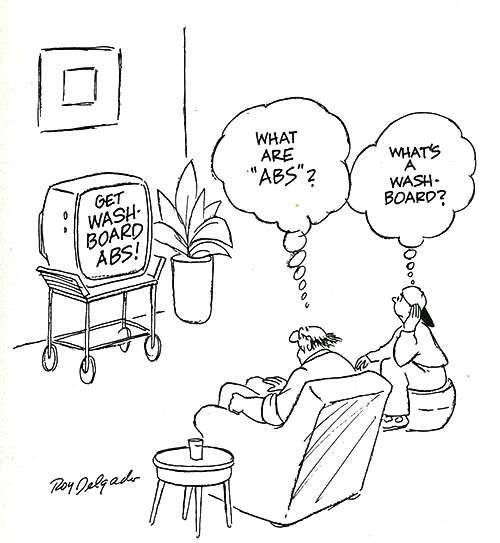
The grandpa and grandson are watching an ad on TV announcing, get washboard abs.
And there’s a thought bubble above the boy’s head that says, what’s a washboard?
And there’s one above Gramps’ head going, what are abs?
Those are both perfect.
What have you come across lately in your work that has to do with language?
Call us 877-929-9673 or send it an email to words@waywordradio.org.
Coming up, fantastic wordnastics for your brain.
Stay with us.
Support for Way With Words comes from the Ken Blanchard Companies, whose purpose is to make a leadership difference among executives, managers, and individuals in organizations everywhere.
More about Ken Blanchard’s leadership training programs at KenBlanchard.com slash leadership.
You’re listening to A Way with Words. I’m Grant Barrett.
And I’m Martha Barnette. And, whoa, who’s that over there? Why, it’s John Chynisky. Welcome, John.
Hey, Grant. Hey, Martha. It’s me.
What are you doing here?
I have a quiz for you guys. I call this quiz, Aye, Aye, Captain.
Okay.
These are phrases that contain only the long I vowel sound.
For example, this is a two-word phrase describing something that exists at a great altitude.
Something that exists at a great…
Sky high?
Sky high is right, yes.
Sky high.
Let’s do these. Let’s see how they go.
All right.
This is a colorless synonym for a fib.
A lie.
White lie.
A white lie, right.
It completes the phrase, once bitten.
Twice shy.
Twice shy.
Good.
This is another name for a mafioso.
Wise guy.
Oh, wise guy.
Wise guy.
Its chemical formula is CO2.
Carbon dioxide.
No, there are other vowels in there.
Did I mention that it’s really, really cold?
Dry ice.
Oh, dry ice.
Yes, dry ice.
I was being tricky there.
But dioxide.
What’s that?
Dioxide is fine.
Don’t get the ahs in there, though.
Sorry.
Only eyes.
Only eyes.
Only eyes.
Here’s the next one.
One of these crazy cinematic scenes occurs at the end of Mel Brooks’ movie Blazing Saddles.
Oh, it’s been such a long time.
And also in several Three Stooges shorts.
Pie fight.
Pie fight is right.
It’s funny but messy.
Pie fight.
The crew of the Enterprise often uses its tricorders to scan planets for these.
Something life?
Life.
Yeah.
Yeah.
Life.
Signs.
Life signs is right.
Life signs.
Very good.
In the song Total Eclipse of the Heart, Bonnie Tyler uses this term of endearment and encourages the listener to turn around.
Bright eyes.
Bright eyes is right.
How was my singing on that?
It was great.
It was great.
All right.
This is a great 1985 horror film that was remade as a 2011 horror film.
I’ll give you a hint.
Fright Night?
Yes, Fright Night.
You don’t need the hint about Chris Sarandon and Roddy McDowell being replaced by Colin Farrell and David Tennant.
Yes, Fright Night.
It helped retroactively.
Retroactively it helped.
Good.
If you’re a parent of a small child, you should know that teachers will ask kids to create one of these, featuring pictures of themselves as babies, then toddlers, etc.
Timeline?
Timeline, yes.
Spent the last weekend making two timelines, one for Max and one for Jesse.
Is that right?
Right.
Get ready for a couple of triples.
Three I’s, okay?
Just like the fish on The Simpsons.
Do you know his name?
Blinky.
Blinky is correct.
Very good.
A little extra credit for you, Martha.
Thank you.
This is a classic Doors song that begins, you know that it would be untrue.
Light my fire.
Light my fire is right.
Good for cooking.
They are low in sugar and include Riesling and Chardonnay.
White wines.
What’s the third one?
Dry?
Dry white wines.
Dry white wine.
Did I miss that rule too?
There had to be three now?
We should really send you the rules ahead of time.
I know, Grant.
Well, something.
Or I clean the wax out of my ears.
Finally, this describes a company that is not worthy of your trust or money.
They may be gone by tomorrow.
Fly by night.
Fly by night is right.
Very good.
And finally, I will end with an NSYNC song, Bye, Bye, Bye.
Bye, bye, baby.
Goodbye.
Bye, guys.
You guys are fantastic.
Thanks, John.
You’re our hero.
Bye, bye, John.
Well, if you’d like to talk about grammar, slang, punctuation, or words and how we use them and what they say about us, call us 877-929-9673 or send them an email to words@waywordradio.org.
Hello.
You have A Way with Words.
Hi.
This is Teresa calling from Dallas, Texas.
Hi, Teresa. Welcome to the program.
Hi.
Hi.
Okay, so I recently had some family visiting, and a saying came up that I had never heard of, and I immediately thought to call you guys.
So we were driving in the car for a while, and after we stopped to get out, when my mom was climbing out of the car, she said she was stiff since she had been sitting so long, and then she added that my grandmother would say that she would stove up.
So I looked at her like she had two heads.
I was like, stove up? What is that?
And what did she say?
Well, that, I guess, that you’re sore or you’re stiff.
Yeah, I’ve never heard it before.
I was wondering where it came from or what it means, really.
-huh, -huh.
Stove up.
So she got out of the car.
She was all stiff.
Didn’t feel quite right.
Had to walk it off.
Yeah.
Right.
Yeah, she said, I’m all stove up.
Maybe sore and got to get the circulation going, right?
Yeah.
Right.
I know that one.
Yeah.
Did your family use it growing up?
Yeah, but it’s definitely connected to the more rural and countryside of my family, the older folks even on that side.
So the older, more rural, more countryside of my father’s family would use it.
Yeah.
Well, you do hear it more in the South, in the South Midlands, where your family came from.
But I can tell you that, Teresa, it has nothing to do with the kind of stove you cook on.
Yeah?
Yeah, that’s probably what’s confusing you, right?
Well, I thought maybe like a stovepipe or something.
Yeah, yeah.
I don’t know.
Yeah, yeah, that’s what I thought when I first encountered this term.
But it turns out that stove is the past tense of stave.
And stave goes all the way back to an old word for stick.
And those bent, flat pieces of wood in a barrel are called barrel staves.
Have you heard that term?
Barrel staves.
And so if you stave in a barrel, it means that you break into it or you stave in a boat.
You crash into the hull and open it up.
And then stove up eventually came to mean just sort of incapacitated, damaged, that kind of thing.
And you do see it mostly in the South.
The doctor told me after this operation I’d be all stove up for a while.
That kind of thing.
So banged up and sore, not quite yourself.
Yeah.
Okay.
That’s great. And this has got some years on it too, right?
Oh, lots. Yeah, yeah, yeah. And the stave goes way, way back. It’s a relative of staph.
And like if you’re staving off hunger, you’ve heard that expression, Teresa?
Yeah.
Eat this to stave off your hunger. The idea there is beating it off with a stick, literally.
Does that make sense now?
Yeah. Yay!
But my question is, why did it go from being stove in to being stiff?
Wouldn’t it have something to do with the staves themselves being stiff?
Well, I don’t know that it’s stiffness so much as just general…
Malaise.
Yeah, incapacitation due to overwork or injury, that kind of thing.
She just wasn’t right, right?
Your mother just wasn’t right.
I love the expression.
I’m all stove up.
Yeah, that’s great.
Yeah.
All right, Teresa.
Thanks for calling.
All right, thank you.
Take care of yourself.
Bye-bye.
All right, bye.
877-929-9673, words@waywordradio.org.
Your questions about language and grammar and old sayings and pronunciation and spelling and slang, you name it.
Hello, you have A Way with Words.
Hi, this is Jeff from Paris, France.
Well, hi, Jeff.
How are you doing? Welcome to the show.
Hi, how are you?
Okay. What can we do for you?
Well, I’ve always been fascinated with languages and especially the learning process of language.
And I was wondering if you guys think that it’s possible to ever reach the same level of proficiency in a foreign language as a native speaker when you start learning the language from scratch.
That’s a really great question.
Yeah, at what age?
Yeah, that’s always the answer. What age do you start?
Well, as far as I’m concerned, I started learning English when I was 11 years old.
Okay.
I’ve been told that unless you start really listening to the language when you’re a baby, you’ll never really sound authentic.
That’s a really good question.
Most people say that if you learn the language before the age of 10, you have a chance of speaking it so that a native can’t tell that it’s not your first language.
If you want to be perfectly bilingual, I mean perfectly, you really need to start learning it before about the age of 4.
Of course, these are ballpark numbers that just depends on the individual.
But in general, in the aggregate, those are pretty good age markers.
So you’re saying that you started learning at about 11?
That’s right.
Yeah, and so you are a native French speaker.
That’s right.
Because I know that in French, I mean, you can tell straight away if a person is a native speaker or not.
But I was thinking because in English you have so many different accents that maybe it was not as easy for a native speaker to tell whether you’re a native or not.
Well, French has a tremendous number of accents as well.
There is a few accents, but I was thinking in English, you know, Canada, the U.S., the U.K., Australia, maybe you have even more accents.
Jeff, did you learn English in school then, or did you have somebody in your family who was an English speaker?
No, I don’t have any native parents in my family.
Both my parents are French, and I started learning when I was 11,
And then I majored in English in university,
And I’m an English teacher, literature teacher, actually.
Oh, very good. Yeah, you sound great.
Yeah, I was going to say, you don’t sound like most French people I know.
All right. Would you be able to tell?
I think I would. I’ve heard a couple things.
I think you gave yourself away on your nasals.
Oh, that’s right.
This is something that the French do very well, and the Americans at least,
Usually the British do very poorly. Americans tend to get their French nasals badly, but it’s a
Strong difference. Yeah, but I’m hearing a lot of things that are right.
What we’re talking about is something really subtle, but it tends to be more idioms anyway,
Doesn’t it, Grant?
Yeah, that’s definitely where you’re going to get caught up. It’s when
What we take as normal everyday expressions kind of stump the onlooker, you know?
Or even a lot of times, we’ve talked about this on the show before,
Prepositions tend to be a giveaway when somebody’s trying to learn English
Or when an English speaker is trying to learn another language.
But just in this short conversation, you sound pretty good,
And you’re probably a great teacher because of it,
Because you’re giving your students an accent that they can emulate,
And that’s probably good for them.
Well, thank you, because I was thinking about idioms,
And idioms and expressions you can probably learn in a book.
But in accent, I mean, it’s a lot harder to pick up.
You know, I’ve traveled a lot,
And I’ve probably picked up a lot of different accents along the way,
So, you know, I learned English watching televisions, watching movies.
But, you know, I’ve never really stayed in one place for a long period of time.
You’ve traveled in the United States then?
A little bit, yeah.
And what about in the UK?
Because it’s funny, you mainly sound American to me.
There’s something happening with your R in words like harder that kind of gives you away as a non-American speaker.
But I wouldn’t automatically notice whether or not you were a—I wouldn’t think of you as a French speaker automatically.
Or as you suggested, the ends of words like accent, the nasal.
Yeah, the nasal, yeah. It’s really interesting.
So it’s funny. Do your students come to you and want you to teach them British English or American English, or do they care?
Well, actually, I teach in an international high school.
So the kids are from a lot of different places, the U.K., Australia, and America.
Well, you know, they all have a lot of different accents.
And I don’t think they have a clue where I’m from, really.
I know I sound American, but they don’t have a clue where exactly I’m from in the U.S.
I’m sorry, I misunderstood. You’re teaching French to English speakers.
You’re not teaching English to French speakers.
Well, actually, I’m teaching both English as a language to French speakers
And also English literature to, well, bilingual kids, basically.
Oh, wonderful. Very good. Sounds like a great pastime. How do you like the work?
Oh, well, I love English. I mean, my job is my passion.
Wonderful.
Well, Jeff, I think you need to come over this way and travel around the country and pick up some more accents.
All right.
Thank you, sir, for calling.
Good luck in Paris.
Thank you for having me.
All right, sure.
Bye-bye.
Thanks a lot.
Bye-bye.
Bye-bye.
We’d like to hear about your encounters with foreign languages, 877-929-9673, or email us.
The address is words@waywordradio.org.
We’ve talked about pitch-ins on this show.
Yep.
These are the potluck suppers that they hold in Indiana, right?
Right.
It’s a term only in Indiana.
And we’ve talked about potlucks.
Yeah.
Right?
This is where everyone brings a dish.
There are other terms for this, covered dish supper and covered dish meal.
And this is one that I didn’t know, but dish to pass supper.
Dish to pass?
Mm—
It’s a hyphenated dish hyphen T-O hyphen pass.
Where’s that?
Various places all around the country.
It doesn’t seem to be regional.
I’ve never heard of that.
But, you know, I went to Wikipedia just to see what they had on this, and Wikipedia let me down.
And I just wanted to say once again, well, Wikipedia is better than it used to be.
And sometimes it’s reliable and sometimes you get lucky and they nail it.
But somebody had put in there a term supposedly for this kind of meal where everyone brings a dish and shares.
Nosh you want.
N-O-S-H hyphen, the letter U hyphen want.
And I’m like, oh, I didn’t know that.
And so I Googled it.
-oh.
Not in Google Books anywhere.
I looked in Google News Archive, which has trillions of words across more than 150 years.
Not anywhere in there.
I looked on the bare internet.
And all of the uses I found of nosh you want were all either taken from the Wikipedia article or referring to the Wikipedia article.
I found that kind of surreptitious vandalism in Wikipedia where they don’t put a dirty word, but they put patently fake information that could be real.
Oh, my gosh.
Issuing this kind of like warning to you, always double check Wikipedia or any source,
No matter if it’s a book or a friend’s letter or an expert, always double check your data.
That’s a great example.
I’m so glad that I did. So I made the edit to the Wikipedia page.
It’s no longer in there and hopefully nobody will add it back in.
So it’s kind of like a mount weasel.
A little bit. Yeah. These are the surreptitious terms that people throw in there to catch up
Copyright themes.
Dictionaries. Yeah.
If you found some data that needed to be double-checked, we’d like to hear about it, 877-929-9673,
Or send us email to words@waywordradio.org.
Hello, you have A Way with Words.
Yes, I’m James Wynons.
I was raised at Alvord, Texas.
That’s a little town about 50 miles north of Fort Worth, Texas.
Raised on a farm, didn’t have any electricity, didn’t have any running water,
And just made the best of it.
It was all happy.
You said a lot like my dad, James.
Yeah.
I have a question that I wanted to ask.
If maybe someone knew where some of the old sayings come from.
Okay.
Some of the old riddle songs that our folks used to sing to us.
My daddy used to sing to us when he was little.
It went, old Dan Tucker was a fine old man.
He washed his face in a frying pan.
He combed his hair with a wagon wheel, and he died with a toothache in his heel.
That’s great.
I always wondered where that come from.
Well, did he sing it to you, or did he just recite it like a poem or a little ditty?
He had his foot on the floor and slapped his hands on his knees and sang it to us.
Oh, he did? He sang it to you?
Yeah.
-huh.
And did he sing any other verses?
No, that was about it.
Okay.
Well, we can tell you, James, that there’s a long tradition for this song.
It goes back to the 1840s or so, and there are lots and lots and lots and lots of versions and lots and lots and lots of verses.
Yeah.
That was in the 40s when he was saying that to us.
How far back does the songs go, you think?
It goes back to the 1840s.
You weren’t around in those 40s, were you, James?
No, I liked a little being there.
They sure enough didn’t have runny water.
They drank out of the creek, I guess.
Did y’all ever talk about the song or the meaning of it or anything?
No, no, we just laugh and go on.
Yeah, old Dan Tucker is a little bit of a character.
He almost always does these fantastical things that a real person can’t quite do,
Or he gets into trouble that a real person couldn’t quite get out of.
Yeah.
All kinds of crazy things happening.
That’s right.
Well, there are lots of versions of that song now.
If you go on the Internet, you can hear a lot of different people singing it.
If you think of any more verses of the song that your daddy sang to you, we’d love to hear about them at another time.
You want to give us another call or send us an email, we’d be happy to hear it, all right?
All righty.
Take care now.
Y’all have a good time.
You too. Bye-bye.
Okay, bye-bye.
What we didn’t get into, Grant, was the fact that the song goes back to the minstrel tradition and white performers performing in blackface.
And I can’t help but mention and highly, highly, highly recommend the documentary Ethnic Notions.
Have you seen that?
No, I haven’t.
It’s an Emmy Award-winning documentary about depictions of African Americans in history.
And it’s a 1987 documentary, but it’s not easy to watch, but it sort of puts this song into perspective.
All right.
If you’ve got a question about something your daddy used to sing to you or something that your mama used to say, give us a call.
877-929-9673 or send us email to words@waywordradio.org.
Old Dan Tucker was a fine old man when he washed his face in the frying pan.
He combed his head with a wagging wheel while he died with a toothpick in his heel.
Get out of the way, here comes Tucker. You come too and eat your sucker.
Language stories, questions, and a whole lot more as A Way with Words continues.
Support for A Way with Words comes from National University,
Where flexible online classes let you earn your degree or credential on your schedule.
More at nu.edu.
You’re listening to A Way with Words. I’m Martha Barnette.
And I’m Grant Barrett.
Martha, you remember when we talked about voracious readers?
Oh, yeah, yeah, yeah.
We had a call from a young woman who wanted to know if there was something negative about that.
Right, and we didn’t see anything negative about being a voracious reader.
Because we’re both voracious readers.
Yeah, yeah. Indiscriminate reader, maybe there’s something wrong with that.
But we consume a lot of printed matter.
It goes into our eyes, into our brain, and we’re better for it.
A lot of fiber, yes.
We got a lot of calls and emails about that.
One of the calls that we got, there was a great voicemail left by a fellow named D.B. In Texas.
And D.B. reminded us that there’s a quote in Shakespeare that applies here.
And it’s from Act 4, Scene 2, and Love’s Labor Lost.
And I wanted to share this with you.
Great.
Okay.
He hath never fed of the dainties that are bred in a book.
He hath not eat paper, as it were.
He hath not drunk ink.
His intellect is not replenished.
He is only an animal, only sensible in the duller parts.
And that really, for me, encapsulates what the reading experience is like.
It is an ingestion.
I am eating this book, more or less.
It is going to my brain.
It is fodder for everything that I think and do.
Right, right.
And that’s the root of voracious, too.
Yeah, perfect.
Devouring.
We also got an email from Michael J. Sheehan.
He was reminded of a quote from Francis Bacon on this topic.
Some books are to be tasted, others to be swallowed, and some few to be chewed and digested.
That is, some books are to be read only in parts, others to be read but not curiously,
And some few to be read wholly and with diligence and attention.
Perfect. I love it.
Yeah. So here’s to voracious readers.
Here’s to voracious readers.
We know we have a huge audience of readers.
If you’ve got something to share about books or language, give us a call, 877-929-9673.
And if there’s a particular quote or passage that you love, we’d like to see it.
Send it an email to words@waywordradio.org.
Hi, you have A Way with Words.
Yes, hi. John Hance here, calling from Seattle, actually the airport in Seattle.
Hi, John.
Hi, John. Welcome to the program.
Well, there is a phrase, and it’s one that I’ve heard usually as a slightly comedic twist,
Not quite the same as in the Scandinavian rites,
But it tends to be a postscript or a suffix.
And it’s, and the horse you came in on.
Now, that usually follows a request for a certain anatomical impossibility that starts with a four-letter word.
And in the normal expression,
It’s almost as if somebody wanted to stab the dagger
And then kind of smile as they twisted it.
But I’ve never really been able to figure out
How far back that goes.
Wow, that’s a really good one.
And the horse you rode in on.
And you’re absolutely right.
It usually follows something very crude that we can’t say on the air.
There are a few variations on this.
It’s really interesting that it’s almost always the horse you whatever came or rode in on.
So it suggests that you arrived as if you were some kind of savior and they just needed you to butt out.
So part of it is often that you’re saying or doing something where or when you’re not wanted.
Yeah, you’re some kind of outsider.
They need you to go away.
And instead of just insulting you, they want to insert your whole circumstance, your offer of help, all of your expertise, everything that you think you know, right?
That would sound right. That’s right.
The earliest that we know about this term is the 1950s.
As is the problem with a lot of coarse language, it doesn’t show up in the printed record until long after it was probably said.
I would not be surprised if this predates World War II easily.
But you do find it really pops up in some interesting places.
It’s popped up in literature again and again.
And my favorite place that And the Horse You Rode In On appears is in a painting,
The official painting of Donald Reagan, who was the Secretary of the Treasury under Ronald Reagan.
And it’s on the spine of a book in this photograph.
And you can find this story in one of William Sapphire’s books.
In short, the whole story is that Regan, not Reagan,
Regan loved this expression,
And the official portrait painter put it on the spine of the book
Just because he wanted to, and Regan loved it, so they left it.
And so you can still see that there.
But Regan used the full, unabridged version of the phrase.
Do you use it yourself, John?
You know, I have probably not ever used that in anger.
I’ve used it as a joke a couple of times
When I had a willing recipient, so to speak,
In terms of not being
Getting insulted,
But no, never.
Very good, John.
Well, thank you for
Sharing this question with us.
I wish we had a lot more
To offer you.
I’m sure we’ll get some
Theories and speculation
From our other listeners,
And when we do,
We’ll be sure to share it,
All right?
I just appreciate your show.
I think it’s just a delight
To listen to.
You guys take care.
Thank you so much.
Take care of yourself.
Bye-bye.
Thank you.
Bye-bye.
If you’ve got a question
About language,
Give us a call,
Or send it an email
To words at
Grant, a mini quiz for you.
Oh, please.
Have you ever had sphenopalatine ganglioneralgia?
I bet you have.
Spheno, I’m trying to break the word down.
The neuralgia has something to do with my nerves.
Yeah, algaes, pain.
Pain, yeah.
Can you read the whole thing?
Sphenopalatine ganglioneralgia.
You probably would have had this at Dairy Queen.
Brain freeze.
Yes.
Oh, nice.
Yes.
How about that?
That’s a great word.
Why do I need the long one when I have the short one?
Yeah, I love this term, sphenopalatine ganglioneuralgia.
And it has to do with this little area on the roof of your mouth that has nerves that go to your head.
And it seems that some migraine sufferers have found relief by using that little wedge-shaped area in your soft palate by using its sensitivity to cold.
They eat an ice cream bar, and they feel better.
Oh, nice.
Isn’t that weird?
Say it one more time for us.
Sphinopalatine ganglioneralgia.
What she said.
Email words@waywordradio.org.
Hello.
You have A Way with Words.
Hi.
This is Amy from Texas.
Hi, Amy.
Hi, Amy.
Where in Texas are you?
Well, right now I’m at work in Fort Worth, but I’m actually from Springtown.
Okay.
Well, welcome to the show.
How can we help?
Well, I realized recently that I’ve given my husband a complex about the way he pronounces a word.
And we decided that if you guys could maybe tell us why he pronounces the word this way, he might get over it.
Get over the complex or get over saying the word that way?
Hopefully both.
He actually told me it’s gotten to the point when he realizes he’s about to have to pronounce the word.
He thinks it’s almost like the words are coming at him out of a tunnel,
The way he’s used to pronouncing it, the way I say it needs to be pronounced,
And he can’t pick and he panics.
Oh, okay. Very familiar.
He’s tongue-tied.
He’s trying to be helpful, but his inner nature is getting in the way.
Exactly.
What’s the word?
It’s won, W-O-N, as in I won an award.
What does he do to it?
Won.
Won?
Juan, which, you know, the little translator in my head makes either a Spanish gentleman or somebody who’s very pale in Juan.
Yeah.
I’ve never heard anybody pronounce it like this before.
So he’ll say one, two, three, four, or he’ll say I won the race.
No, he says one, two, three, four, but I won the race.
Okay.
Wow.
Have you ever heard of that?
That’s really interesting.
Is there anything else he says that’s strange?
The only other thing that’s kind of odd is it’s actually a proper name.
There’s a restaurant that we occasionally go to, and I’ll give you the actual name, but not the whole name of the restaurant.
We’ll just call it Rosa’s Tacos.
He says roses, and he cannot pronounce the A on it for some reason.
So he makes it sound like plural rose and not like possessive Rosa.
Right.
So he says roses instead of rosas.
Right.
Which makes me go, we don’t need roses.
We have roses.
And so you’re like Hermione Granger trying to teach everyone to pronounce spells.
You’re like, Wingardium Leviosa.
That’s exactly what he said to me.
He did?
He called you Hermione?
He did, but that’s okay because she had her strong points.
She did.
She did.
I get called Hermione all the time.
Don’t worry.
She’s a mascot of ours.
We like her.
Brainy and nerdy and, you know, hangs out with the cool kids.
Wow.
This is interesting.
I have a few theories about this.
Let me ask you one more question, though.
Just another diagnostic question.
Does he say,
Does he aspirate words like when and where?
He does do that a little bit.
Well, the wan thing
Might just be a function of his idiolect,
But there are some,
Is he from Texas?
That’s another question.
Is he from that part of Texas?
We both grew up a city from each other.
Okay.
And basically we’re talking North Texas, right?
Right.
North Central.
North Central.
Okay.
There is a Southern vowel
That is similar to what he’s doing there.
And I don’t want to get into the whole phonetics of it here for fear of boring everybody’s tears,
But we’ll put a little information online about this,
Where sometimes that the schwa sound is, I might call it a hypercorrection to another vowel sound.
So instead of son, you might say son.
So one and wan, you know?
And the thing is, I’m expecting, Amy, that if you pay a little more attention to this
In the speech of people around you in your community,
At the grocery store, the post office, that sort of thing,
That you will hear some more of this.
I mean, stand by the lottery counter at the grocery store
And see what people say when they did or didn’t win.
How do they say, I won?
I won?
I won, right?
But it sounds like that’s what he’s doing here.
It doesn’t sound like a big deal.
But we all have little things in our speech.
This is what the idiolect is.
These are the little peculiarities that we have,
A little bit from our mother, a little bit from our father,
Some from our friends, some things that we just accidentally do,
Some things that we never learned to do well.
And this is what makes our idiolect, our own personal speech pattern.
But he’s got a problem because now that you’ve corrected him,
He’s self-conscious about it and he can’t avoid that word.
It’s the pink elephant for him.
I’ve ruined him. Oh, no.
I wonder if you can offer him another word to use instead.
It’s kind of one of the techniques that people try to do when they’re stuttering.
They try to come up with words that they don’t stutter on that they can replace the troublesome word with.
So instead of one, maybe you can say, I am victorious.
I was not victorious.
Rejoice, I can’t.
That’s so much more impressive.
Yeah.
Winnie, weedy, weaky or something.
Yeah, yeah.
All right.
Well, I don’t have anything more to offer you than I just suspect that he’s got something interesting happening that’s part of the regional vowel pronunciation there.
And I suspect it’s not common, but I think you’ll hear it in other speakers if you just listen for it.
I will do that.
Okay.
Cool.
All right.
Thank you so much.
Thank you for calling.
Amy, thanks for calling.
It was a real pleasure to talk to you.
All right, thanks.
Bye-bye.
Bye-bye.
Bye-bye.
What are your acute observations?
Let us know, 877-929-9673, or send your language inquiries to us an email, words@waywordradio.org.
I’m on the slang hunt again.
Yay.
I came across a new bit of derogatory language.
New-ish. And this is a word, buster. Do you know this one?
Buster? I think of Buster Brown and his dog.
You’re not in a gang with a lot of young men.
No. No. That’s not how I roll.
So imagine this. A group of young men, usually, maybe there’s some women in the group, but a gang.
And not like the formal mafia sense of gang, but a bunch of kids who are all together like on a block and they’ve got a neighborhood and they’re doing stuff together, good and bad, right?
And the buster is the guy on the fringe of the group who always is putting on airs or fronting, right?
He’s always acting like he’s all big stuff and he’s not really and nobody really respects him.
That’s a buster. The guy who’s just kind of a weasel.
So they say it behind his back?
No, probably too.
Oh, yo, buster.
Well, you’re a buster. You can find it in hip—
Oh, you’re a buster.
Yeah, you can find it in lots of hip-hop lyrics, actually, where somebody is ripping on somebody else.
Oh, interesting. Buster.
Buster.
Okay.
And it may come from gangbuster, which was the old-fashioned word for these squads of police that would break up the more formal gangs, like the mob.
That’s the source of gangbuster.
Yes.
Very good.
If you’ve got some slang that you’d like to share, maybe it’s something you use or something you heard, 877-929-9673, or email us, words@waywordradio.org.
Hello, you have A Way with Words.
Hello, this is Ryan. I’m calling from Charlottesville, Virginia.
Hi, Ryan. Welcome.
Hey there, Ryan.
Hey, so I went to boot camp in Virginia Beach, and I had a drill instructor who would tell me, it’s all chicken but the gravy.
And I’m familiar with, it’s all gravy.
And he never seemed angry when he told it to us, but it seemed a strange thing to say.
I’ve said it before, and nobody’s really responded as well as I thought they would.
What were the circumstances? What was happening when he said this?
There would be some minor slight, or there would be somebody who’s not falling in formation and us getting angry with him.
He would just remind us that, you know, don’t be upset.
It’s all chicken but the gravy.
Do you know anything about where he was from?
I don’t.
It was young, and I’m assuming he’s a southerner himself, because I can’t imagine anybody else saying something like that.
What are you saying about people from the north?
Oh, that they don’t often refer to gravy in normal conversation.
Unless it’s pasta with that red sauce on it in Jersey.
Nice.
That’s true.
He’s probably from the South, right?
The data show that the term Southern, it’s not that common, but it has existed for, I think I’ve got a use here from 1948.
But I’m trying to understand the meaning of it.
Would you say it like, oh, things aren’t as bad as you think they are?
Or, hey, close but no cigar.
I’m not quite sure I understand the meaning of it, how he would use it.
It’s all good.
Is that what he’s saying, basically?
My impression is if it’s all chicken but the gravy, the chicken’s good and the gravy’s even better.
Yes.
I think that sounds right.
That sounds exactly right.
And it jibes with what I see here.
If you do some digging around on this, and it doesn’t come up very often, so you might spend some time.
In 1969, there was an exchange, I believe it was in the congressional record, between Admiral Connolly and somebody, the chairman of this panel that’s interviewing him says, is kind of upset or chagrinny.
He’s like, you told me everything was chicken but the gravy.
And then Admiral Connolly replies, well, I guess I got the rose-colored glasses on, but I really think we are going to get around these things.
So in other words, the person interviewing the admiral said, you said everything was great.
And the admiral says, well, maybe it wasn’t as great as I thought.
So that gives me the idea that this expression is used in a situation where you’re trying to say that something is positive, something is good.
The admiral? Was this like you’re in Vietnam? Are we talking about chicken and gravy?
Well, the term goes back quite a ways.
And I was wondering, it was interesting that it should come from some branch of the military.
I was wondering if this was a kind of thing that some of our Marines who are listening to the show, we have tons of Marines on both coasts listening to the show, if they know something more about this.
Because maybe it’s the kind of thing that’s in the parlance of soldiers.
Or in the mess hall.
Yeah, something like that.
It’s all chicken but the gravy.
It pops up in literature now and again.
It’s one of those colorful expressions that once a fiction writer finds it, they can’t leave it alone.
They throw it into all of their books.
We’re going to see it popping up a lot more now that you’ve popularized it again.
I should hope so.
But it’s really rare, and I’m glad that you made the connection to it’s all gravy because that’s the far more common thing that most people will know.
It’s all gravy, meaning it’s all good, everything’s fine, or it’s even better than you thought.
It’s all icing.
It has a cherry on top.
Oh, no, wait, that would be kind of gross with chicken and gravy.
Yeah, gravy, no.
It’s all chicken but the gravy.
I’m so glad you brought this one up, Ryan.
Well, I’m so glad you have brought it up.
It’s been on my mind, and when I heard your show, it seemed like you guys would be the ones to ask.
Yeah, sure.
Thanks for calling, dude.
Maybe we’ll hear more about it from our listeners.
Take care.
Thanks for calling.
Bye-bye.
Has a word or phrase been rattling around in your mind since you heard it?
Call us about it, 877-929-9673, or send it an email to words@waywordradio.org.
This email just came in from Jeff in Philadelphia.
Ready?
The past, the present, and the future walked into a bar.
It was tense.
Call us with your jokes about language, 877-929-9673, or send them an email to words@waywordradio.org.
Things have come to a pretty pass.
That’s all for today’s radio show, but let’s continue the conversation online.
Join us and other listeners each week on Facebook and Twitter, or sign up for our weekly newsletter for the latest in language news.
You can also leave us a message anytime at 877-929-9673.
We listen to all of your calls, so share your stories and questions about language, or email us.
The address is words@waywordradio.org.
If you don’t catch the broadcast, you can listen to the podcast on iTunes or get the apps for iPhone, BlackBerry, and Android.
Our senior producer is Stefanie Levine.
Tim Felten directs and edits the show, and we have production help from James Ramsey and Josette Herdell.
A Way with Words is independently produced and distributed by Wayword, Inc., a nonprofit supported by listeners and organizations who believe in lifelong learning, better communication, and the value of a thing well said or well written.
The show is recorded at Studio West in San Diego, California.
Thanks for listening.
I’m Martha Barnette.
And I’m Grant Barrett.
Love you.
So long.
Potato, potato, tomato, tomato.
Let’s call the whole thing.
Support for A Way with Words comes from the Ken Blanchard Companies, whose purpose is to make a leadership difference among executives, managers, and individuals in organizations everywhere.
More about Ken Blanchard’s leadership training programs at KenBlanchard.com slash leadership.
And from National University, where flexible online classes let you earn your degree or credential on your schedule.
More at nu.edu.
Hey there, podcast listeners.
Just want to let you know that although we give you the show free and we give it free to stations, it does cost something to send these episodes out to hundreds of thousands of listeners across the planet.
Help support our educational mission by going to the website and clicking the donate link.
Ten bucks? A little more?
How about as much as you think it’s worth?
Thanks in any case for helping us keep shop.
Hadal Zone
 The hadal zone, named for the Greek god Hades, refers to the deepest depths of the ocean floor. James Cameron’s deep sea dive drive recently made it down there.
Cussing vs. Cursing
There’s a difference between cursing and cussing: It takes a slow mind to curse, but an active and vibrant mind to cuss — especially when the cusswords sound like alapaloop palip palam or trance nance nenimimuality. What colorful language do you use to diffuse anger?
Oxter
What’s an oxter? It’s another term for the underarm, primarily used in Northern England, Scotland, and Ireland. A bit nicer than armpit, isn’t it? Oxter can also serve as a verb, as in, “We oxtered him out of the club.” Need another synonym for that body part, one that also happens to rhyme with gorilla? Try axilla.
Pipe Dream
A pipe dream is “an unobtainable hope” or “an unrealistic fantasy.” The term originates from the idea of opium pipes and the strange dreams one might incur while high on opium. Back in the 1890s when the term first showed up, opium pipes were a bit more common.
Even More Skeuomorphs
Here are a few good skeuomorphs, or outdated aesthetic elements: We still refer to the ticking of a clock, even though we’re surrounded by digital timekeeping devices, and the kids are working hard for those washboard abs when they don’t even know what a washboard is!
Long I Word Game
Our Quiz Guy John Chaneski has a game called Aye Aye, Captain about phrases with that long “I” vowel sound. For example, a colorless synonym for a fib would be a white lie, and another name for a mafioso might be a wise guy.
Stove Up
What does it mean to be stove up? This phrase for sore or stiff has nothing to do with a stovetop; stove is actually the past tense of stave. To stave in a wooden boat is to smash a hole in its side, and thus, to be stove up is to be incapacitated or damaged. These words are related to the noun stave, the term for one of those flat pieces of wood in a barrel. Similarly, to stave off hunger is to metaphorically beat it back, as if with a stick.
Second Language Idioms
If you master a second language by the age of ten, native speakers won’t recognize that it’s not your first. Even so, things like idioms or prepositions can often trip up even the most skilled second-language speakers, if their second language is English.
Dish-to-Pass Supper
A dish-to-pass supper, common in Indiana, is the same as a pot-luck supper or a covered-dish supper, but the term nosh-you-want drew a red flag when Grant went to visit the Wikipedia page for potluck. It hadn’t appeared in any other form of print — meaning it probably is not real — so Grant personally edited out the specious term.
Old Dan Tucker
The song Old Dan Tucker has a long history in the United States, going back to the minstrel shows of the 1840s. Martha highly recommends the documentary Ethnic Notions about our country’s complicated history with racially-charged imagery in theater and song, and the evolution of racial consciousness in America.
Voracious Reader
Is it a good thing to be a voracious reader? We think so. Just take Shakespeare’s notion of the replenished intellect in Love’s Labour’s Lost.
Horse You Rode in On Idiom
The idiom and the horse you rode in on, usually preceded by a far more unfriendly phrase, tends to be directed at someone who’s full of himself and unwelcome to boot. It first pops up in the 1950s, and it’s written on the spine of a book in Donald Regan’s official portrait.
Brain Freeze
Sphenopalatine ganglioneuralgia, also known as brain freeze, is a variety of nerve pain that results from something cold touching the roof of the mouth. But some people who suffer from migraines actually find ice cream confuses the nerve in a way that eases the pain. How convenient!
Pronouncing “Won”
How do you pronounce the word won? Does it rhyme with sun or Juan? Some people, depending on their regional dialect, may hypercorrect their vowels and pronounce certain words in an unusual way.
Buster
What is a buster? As TLC sang, “A scrub is a guy who thinks he’s fly, also known as a buster.” That is, a buster is that guy on the fringe who’s always putting on airs. The word may come from the old term gangbusters, which originally applied to police officers or others who took part in breaking up criminal gangs.
All Chicken But the Gravy
If something’s all chicken but the gravy, then it’s all good. This colloquialism pops up in an exchange from a 1969 Congressional record.
Grammar Joke
The past, the present, and the future walked into a bar. It was tense.
Photo by Paul Loberg. Used under a Creative Commons license.
Music Used in the Episode
| Title | Artist | Album | Label |
|---|---|---|---|
| Chicken Strut | The Meters | Struttin’ | Josie Records |
| Point Of View | Hal Galper | The Guerilla Band | Mainstream Records |
| Mtume | Harold Land | A New Shade Of Blue | Mainstream Records |
| Midnight At The Oasis | Freddie Hubbard | The Roots of Acid Jazz | Sony |
| Chili Beans | Mongo Santamaria | Soul Bag | Columbia |
| Old Dan Tucker | Gid Tanner & The Skillet Lickers | The Very Best Of (1926-1934) | Vintage Masters |
| Nunya | Tom Scott and The L.A. Express | The Roots of Acid Jazz | Sony |
| Here Comes The Meterman | The Meters | Here Comes The Metermen | Charly R&B |
| Dry Spell | The Meters | Look-Ka Py Py | Josie Records |
| Little Old Money Maker | The Meters | Look-Ka Py Py | Josie Records |
| Let’s Call The Whole Thing Off | Ella Fitzgerald | Ella Fitzgerald Sings The George and Ira Gershwin Song Book | Verve |


And the horse you rode in on. reminds me of the Wizard of OZ – “and your little dog too!”