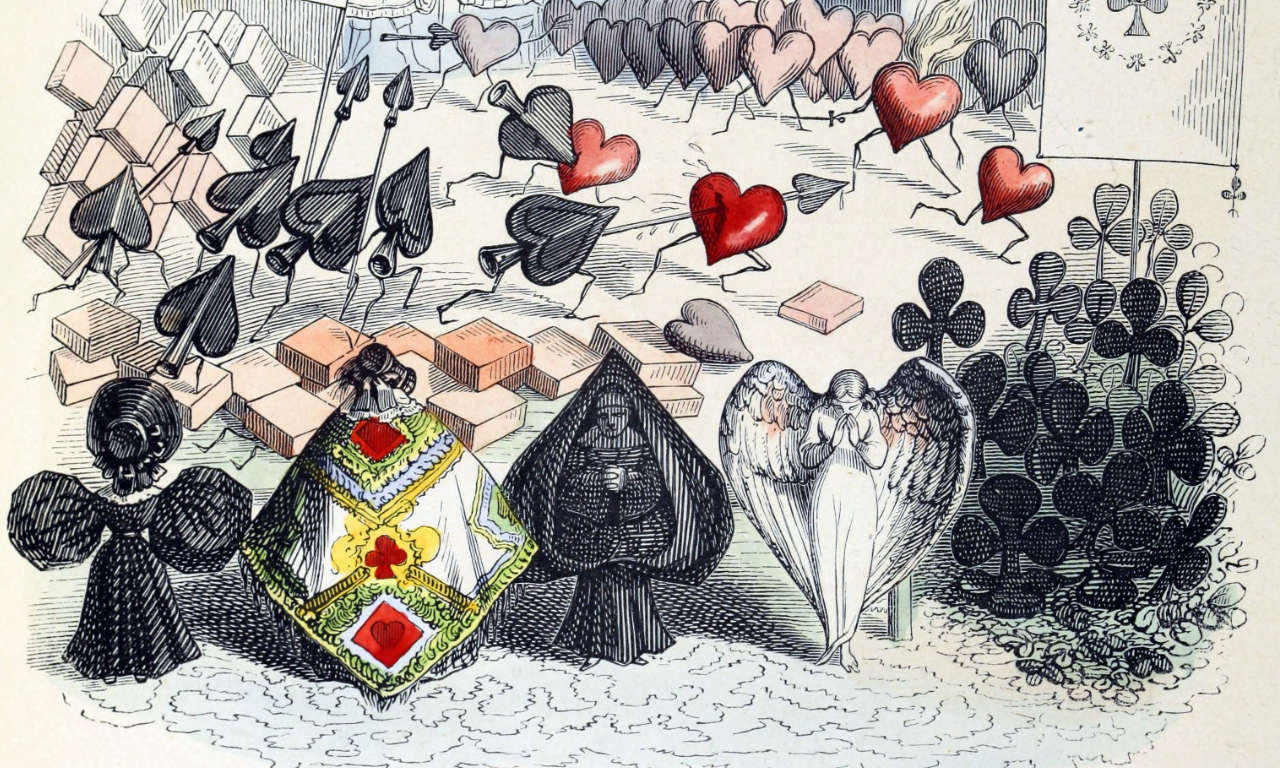
You know that grammatical “rule” about not ending a sentence with a preposition? Well, who ever decided finishing off a sentence like that is a bad thing? (Personally, we think it’s one of the silliest things anyone ever came up with.) Released January 22, 2010.
Transcript of “Jack Lynch, author of “The Lexicographer’s Dilemma””
Welcome to another minicast from A Way with Words. I’m Martha Barnette.
The English language has existed in one form or another for about 1,500 years. And it’s only been in the last 300 years or so that anyone believed that people ought to be schooled in a language they already use every day.
So just who were those 18th century grammarians who made up all those rules, and how did they decide what’s good and bad English? In his new book, Jack Lynch answers some of those questions.
His book is called The Lexicographer’s Dilemma, The Evolution of Proper English from Shakespeare to South Park. Jack Lynch is a professor of English at Rutgers University and an authority on the lexicographer Samuel Johnson.
Jack, welcome to A Way with Words. Well, thanks very much for having me.
Jack, you’re right that in the early 18th century, some people were wringing their hands over the idea that language was, God forbid, changing, and that they were fretting that something had to be done. What were they so worried about?
Well, people have realized that language changes for a long, long time. Chaucer, in the 14th century, was talking about language change, but it didn’t really seem to bother anyone all that much. But in the 17th and 18th century, people began to think it’s a bad thing, that there’s not going to be any permanence in their language and their culture.
And they became convinced that the ancient languages, Latin and Greek, didn’t change. Now, that’s just completely wrong. Latin and Greek changed as much as any other language. But they began to have serious Latin envy, that we have this impermanent language that’s fluctuating and waxing and waning, whereas the more serious languages didn’t change.
So it’s important that we try to fix it and stop it from changing. There were attempts to write dictionaries and grammars and even to establish institutes, academies, that would fix the language. A word they often used was ascertain it and prevent it from changing anymore so that they could be as serious and as permanent and as lasting as the ancient classics.
Never really worked, but it was a real cultural anxiety that grew really acute then, and it continues with many people even today. And Jack, around the same time, people started turning to grammar books almost as if they were sort of, I don’t know, self-help manuals for the upwardly mobile. Why is that?
Yes, well, the grammar book as we know it, which is to say an English grammar written for people who already speak English, is a fairly recent development. Now, there were English grammars, say, for French speakers or German speakers, people who wanted to learn English. But the whole idea that there would be a grammar book to teach you the language that you already speak was fairly new.
And it really gets started in that same era I was talking about earlier, the 17th and 18th century. Now, a lot of people assume that correct English is something that was imposed from above, that it was the powerful and well-educated who told their social inferiors, this is how you must speak. In fact, it was just the other way around. It was the middle classes. It was the up-and-coming, the aspirants, the nouveau riche, who decided that they wanted to sound like their social betters because they wanted to travel in the same circles.
So, curiously, some of the earliest guides to grammar in English we see are not published by linguists. They’re not in reference sections, but they’re in books for how to get by as a middle-class person. How should you write letters that look good to possible employers and people you might have to hire to work in your household? It was very much part of social climbing, that people wanted to sound like their betters. And that’s, I’d argue, that’s really where we get our idea of correct English. It’s the English of the social class above us.
That’s so interesting. So it was aspirational rather than somebody from on high wrapping your knuckles and beating you over the head. Well, in a way, it makes a lot of sense, because the people who are born and grow up in the aristocratic classes don’t need to be told these sorts of things. It’s the people who are entering it for the first time. And everyone who’s ever had his or her first formal dinner in serious company knows that terrible feeling of anxiety. Am I reaching for the right glass for the right plate? Am I using the right fork? The aristocrats don’t need to know that. The etiquette books on these things are not written for them because they’ve been doing it since they were in their cribs. It’s for the aspiring middle classes who need to be told these things and who want to fit in.
That’s really where proper grammar comes from, our whole idea of what is proper, and the notion that most people don’t speak their own language correctly. And before 1775, the English language lacked one great unifying authoritative dictionary. And then enters Samuel Johnson, who sounds like a real oddball to say the least. Can you describe him for us?
Johnson was a bizarre character. First, he belongs to a very small club of writers whose most famous books are by someone else. Most people know him because he’s the subject of James Boswell’s great biography, and not so much for his own writing. But he was a bizarre physical specimen. He was big and gangly. He stuttered. He sweated when he ate. He spat. Best guess today among physicians who’ve examined his case, he probably had Tourette’s syndrome, obsessive-compulsive disorder, bipolar disorder. He had tuberculosis of the lymph nodes. He was just a walking bundle of disease and disorder.
And he came to London in 1737, hoping to make it big by selling his verse tragedy based on a source of the early 17th century, set in Renaissance Turkey. And I can tell you now that a verse drama on that subject would be about as successful on the stage then as it would be today. Johnson had ridiculous notions of how he was going to make it big. That and his Latin scholarship was going to make him prominent.
So he settled into the hack writing scene for a few years and was making a meager living when for some reason, and it’s still a mystery, we don’t know why they approached him. A group of publishers, they would have been called booksellers, approached Johnson and asked if he would write a dictionary. And he said that he would do it single-handedly in three years. So he finally gets his dictionary written. How did it change the way that people looked at English?
It’s a question that’s still hotly debated. Johnson’s dictionary came out in 1755, which is right around the time that publishers started getting a sense that there should be a standard spelling, that there’s only one way to spell words. It used to be that publishers had a lot of flexibility. And, you know, we look at justification of margins now. We do that now with just clicking a button on our word processor. But at the time, this had to be done with slugs of lead, and justification was tricky.
Printers in the 17th century and into the 18th, if a line was a little short, add a silent E, double some consonants, and always do that. Well, even Shakespeare didn’t spell his name consistently, right? Shakespeare, yes, even in his own handwriting, he spelled his name differently. And most writers, and a lot of people think this, that’s some clue, Shakespeare wasn’t really Shakespeare. Virtually no one in the 17th and 16th century spelt words the same way from time to time.
But around the 18th century, middle of the 18th century, we start getting publishers’ spellings. There’s one correct way to spell. Johnson’s Dictionary came out right around that time, but it’s still hotly debated, did he help to fix spellings, or did he just arrive at the right time? We don’t know. He did provide one place for people to look. On the other hand, he had some eccentric ideas about spelling. For some reason, he thought that no English word ends in the letter C.
Oh, really? So he’d always end words that we’d say end in C with CK, music, CK, physic, magic, and all these sorts of things. And that was a minority view even in his own day. Some people say if he really did set the standard for spelling, then we’d all be using these Ks, but we mostly just ignored them. Well, you know, Jack, when people find out what I do for a living, they suddenly get very self-conscious. You probably have the same.
Oh, I’ve seen that.
Yeah, yeah.
And especially if they happen to end a sentence with a preposition. They fall all over themselves apologizing.
Jack, who is responsible for that prohibition anyway? That came about in the 1760s. People have been ending sentences with prepositions in English for as long as there’s been in English.
But in the 1760s, one of the major grammarians, and this is what people are talking about when they refer to the 18th century grammarians, this was a guy named Robert Loth, who said that in the more formal writing in English, it’s best not to end a sentence with a preposition.
But he then went on to say that this is an idiom that English is inclined to. And a lot of people have pointed at that saying, ha, look how stupid he was. He even breaks his own rule when he says it.
Well, if you think about it, he wasn’t saying you can never do this. He was saying it’s actually natural in English to end with a preposition. But then he said, in more formal situations, it’s usually best to avoid it.
And that was probably where we got this rule. And now we have this notion, if you end your sentence with a preposition, you’re going to go blind and grow hair on your palms or something horrible like this. No doubt, spend an extra few millennia in purgatory.
There are times when it sounds better not to end with a preposition because you can get a more forceful word at the end of your sentence if you don’t. But it’s silly to suggest that it’s illegal, that you’re somehow doing something that’s naughty or offensive.
Well, how about split infinitives? Who laid down the law about that?
Now, split infinitives, a lot of people like to blame those same 18th century grammarians for the rule against split infinitives, which is supposed to be the stupidest and most arbitrary rule in English. Now, an infinitive, I’m sure many of your listeners know this, but the infinitive is the form of the verb that comes after to, to run, to go.
And splitting an infinitive is putting something between those two words, to boldly go, for instance. Now, it’s impossible to do that in Latin or Greek because the infinitive is a single word. You couldn’t possibly split it.
And in the earliest forms of English, it’s a single word. But around the 12th century, the English infinitive often becomes two words, two and then the base form of the verb. Early on, it was not split.
Then, in Chaucer’s day, it was split pretty often.
Shakespeare did it only once in his canon, and then it disappeared altogether.
No one split infinitives that we’ve been able to find.
Not because there was any rule against it.
It just didn’t sound right to people, so they stopped doing it.
In the 18th century, actually, the split infinitive came back.
Samuel Johnson famously splits in infinitive in one of his writings.
And there was no sense that this is wrong.
It hadn’t been done for a while, but it was just a natural development of the language.
It was only in the 19th century that people began saying that you shouldn’t do this.
Latin and Greek don’t allow it.
We shouldn’t allow it.
In this case, those nasty 18th century grammarians had a bum rap, because not only did they not prohibit it, they never discussed it.
And in fact, they revived the split infinitive.
Well, speaking of lexicographers and grammarians getting a bad rap, let’s fast forward to 1961.
Who was Philip Babcock Gove, and why was he absolutely vilified in the media?
Well, Philip Gove, if you read some accounts, you’d think that he betrayed the nation.
He gave away the nuclear launch codes to Khrushchev.
He’s up there with Benedict Arnold and completely undermined everything that’s decent about American life.
And his prime was writing a dictionary.
1961, he was the editor-in-chief of Webster’s Third New International Dictionary.
And this was the last complete unabridged dictionary to come out from Merriam-Webster.
To this day, that’s still their flagship dictionary, though it hasn’t been on sale in quite a while.
But he came up with a policy early in his days that was really just picking up on what linguists, professional students of the language, had been doing for a long time.
He said that a dictionary should be descriptive and not prescriptive.
That is, it should describe the way people really do use the language instead of telling them how they must use the language.
And he went through the language, and he included many words that people considered non-words.
He put the word ain’t in there and didn’t say it was a naughty word.
He put in all sorts of things.
I don’t think this made it in, but things like irregardless, or he did put in infer, meaning imply, or vice versa, and all of these sorts of bugbears that people get upset about.
He simply included them saying, many people speak this way.
And the reviews were blistering.
Many of the reviewers, usually the more culturally conservative reviewers, looked on this dictionary as the worst sort of dereliction of duty.
And it really got co-opted into the early battles of the culture wars.
This is the 60s, the very beginning of the 60s.
But it got turned into a kind of free-love, do-as-you-please, dope-smokers dictionary instead of the kind of discipline that a real lexicographer should provide.
Wow. Yeah, he really did get a bad rap, didn’t he?
Oh, he seems to have been such a mild-mannered person in life.
I imagine he must have been utterly shocked by the reaction that he got in many of the papers.
Jack, I want to thank you for talking with us today.
It’s been a great pleasure.
I’ve been speaking with Jack Lynch of Rutgers University, and his new book is called The Lexicographer’s Dilemma, The Evolution of Proper English from Shakespeare to South Park.
You’ll find a link to it and to Jack’s helpful webpages about grammar at our website.
That’s waywordradio.org.
For A Way with Words, I’m Martha Barnette.
In his new book, The Lexicographer’s Dilemma: The Evolution of ‘Proper’ English, from Shakespeare to South Park, literary historian Jack Lynch offers a lively narrative about the evolution of such rules, starting in the 17th century, when grammar books were more like self-help guides for the upwardly mobile. He introduces us to the flesh-and-blood (and almost always quirky) grammarians and dictionary editors who created and popularized traditional rules that people still argue about today. Recently Lynch talked with Martha about why and how some of those rules came to be.
Incidentally, Lynch, an associate professor of English at Rutgers University, has published his own helpful guide to grammar and usage online.
Photo by Liz West. Used under a Creative Commons license.