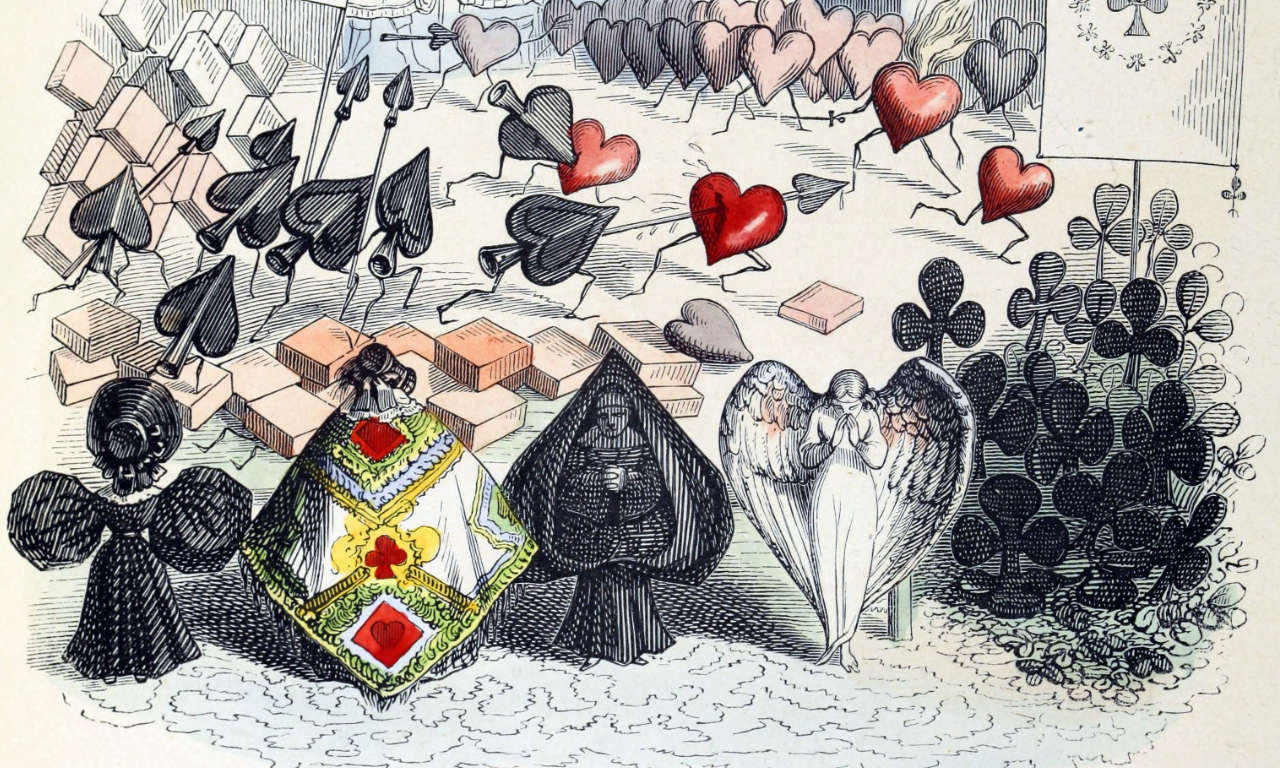
Online recaps of Mad Men or Breaking Bad can be as much fun as the shows themselves. So why not recap classic literature — like, say, Dante’s Inferno? A literary website is doing just that. And, you’ve heard about the First World and the Third World — so where in the world is the Second World? Plus, animal stories, including how the aardvark got three “A’s” in its name, and why the catbird seat is the place to be. Also, the origins of crackerjack, mall, mad money, and the admonition “you might want horns, but you’re gonna die butt-headed!”
This episode first aired November 16, 2013. It was rebroadcast the weekend of April 27, 2015.
Transcript of “Catbird Seat (episode #1382)”
You’re listening to A Way with Words, the show about language and how we use it. I’m Grant Barrett.
And I’m Martha Barnette. A listener named Danielle tweeted us a question the other day.
She wanted to know if it’s true that they call it the mall because you don’t go to one store. You go to the mall. Funny joke. Yeah, funny joke, and not an entirely unreasonable question, because there are some words in English that come to us by misdivision. In the strangest of ways.
Yeah, yeah, by misdivision, like apron used to be napron, and napron became apron. But the mall did not come from them all.
No, there’s a park in London, right?
Yeah, yeah, an alley.
An alley, right.
So this is St. James Park, where they used to play a game called Paul Mall that involves a mallet. So mall here is related to the word mallet. And the Paul part referred to…
To the ball.
To the ball.
Yeah, it’s from Italian, pa la maglio. So there was this place in this park that was a long lane or a row of trees, I guess, or an open space where you would play this game, Paul Mall.
Yeah, it was a long alley, actually. And so the name of the game was transferred to the park. It was abbreviated to the mall. And when people started building these places intentionally where people might promenade or walk to be seen, they started calling them malls. And thus, when we built these giant shopping centers in the United States, there we have it.
Yeah, yeah. That’s great. I love that. The strange ways of history. And who knew that the cigarette name had a backstory?
Yeah, and a weird pronunciation. All I know about that is that it’s called the vulgar pronunciation.
Oh.
Pell-mel.
Pell-mel.
And is it related to Pell-mel, running Pell-mel?
No, that’s a different route.
There we go.
Yeah.
Well, thank you for your tweet, Danielle. We really appreciate it. We are W-A-Y-W-O-R-D on Twitter. You can also find us on Facebook. Send us an email. Find us at waywordradio.org. And you can call us 24 hours a day, 877-929-9673.
Hi, you have A Way with Words.
Hi, this is Joanne. I’m calling from Port St. Lucie, Florida. I have a question about the word Zax, Z-A-X.
Z-A-X?
Yes. It’s been my nemesis in the Scrabble game, and I just want to know where it came from, why it goes in and out of the dictionary. Has been just one of those words that is not a good word for me.
Joanne, what do you mean it’s been your nemesis? Are you trying to play it, or other people are trying to play it in Scrabble, or what?
Yeah, when I was a kid and learning how to play Scrabble, my mom had just taught me, you know, how you can challenge somebody. So she played Zax, and she was getting all these points, and I just knew that wasn’t a real word, so I challenged her. And we looked it up in the dictionary, and it was there. So I lost the challenge.
Oh, you were traumatized, right? She got all these double points. So she got all these points, and it was a challenge. So I lost big time.
Oh, man. And then years later, in college, we’re playing Scrabble, and I had the opportunity to play Zex. And I was like, yes, here it is, awesome. So I played it. It was on the double word. And, of course, my college friends are like, you know, we’re music majors. They’re like, you mean sax? That’s not a word. What are you talking about? And they look it up, and I’ll be, daggone it, stupid word wasn’t in the dictionary anymore.
Well, what dictionary did they look in?
It was Webster’s. And do you know what it means?
Yeah, it’s like a tool that you use for, like, in cement work and that kind of stuff.
Yeah.
And roofing, yeah. I’ve even taken it further now. I mean, I’ve looked it up since then. And I’m a middle school bander. So it looked in like the dictionaries in school. It’s not in a hardcover dictionary anymore.
It’s still not. But if you go online, you can look it up and find it online. You’ve got to find the right dictionary. The thing is, if you’re going to play Scrabble, then use the Scrabble dictionary because it’s in there. Any old dictionary isn’t the same as any other old dictionary. They’re not identical. You can’t just treat each dictionary as interchangeable.
It’s a real word, though, and your friends were wrong. You were allowed to play it. It just, you weren’t checking the right reference work. You totally should have gotten away with that.
Totally.
Yeah, so Z-A-X is worth 19 points, and then you add in a double and a few other things going on and whatever other words you’re extending out. Yeah, that could be a killer on a good Scrabble game.
Joanne, your friends owe you. I think you have to track them down.
For real, yeah, because they made me take it off. And then I had like, I think I got like four points.
Yeah, I mean, that’s just so not fair. But it’s a perfectly legitimate word. And Grant, you’re saying it’s actually in the Scrabble dictionary.
It is, yeah. That’s a great Scrabble word. It’s a really good Scrabble word. Z-A-X. It’s a variant of S-A-X, sax. And they come from an old Saxon word or old English word that means knife. Because it’s got that one side is a really sharp edge, and the other side is like a tiny pick or kind of a sharp chisel-like protuberance.
Yeah, I can’t say I’ve ever seen a Zax.
Yeah, they’re still used. They’re probably called something else. People probably just call them a hatchet. But yeah, a Zax or a Sax. So, Joanne, did we make your day?
Yeah, thank you. So it’s a real word. I wasn’t crazy.
Well, it’s a real word. I should have got my points back then.
All right. Well, we’re glad we could help you. Thank you very much, you guys. That was awesome. I hope you get to use it soon.
All right. Bye-bye.
Thank you. Bye-bye.
Bye, Joanne.
Bye-bye.
There’s some speculation that that exact word sax may be the root of the word Saxon because they fought with long knives.
Yeah.
But we don’t know for certain whether or not that’s true.
Okay. Yeah. For some reason, I was thinking…
The myths of ancient word origins are sometimes they fail to clear. That one’s really old. I’d like to hear from somebody who uses a sax, though.
Yeah.
I’ve never heard of anybody carrying one in their tool belt.
So all the dictionaries that I’ve checked show that it’s used in roofing.
Okay.
And they might call it a sax instead. I’d be interested. Do they still use the old word or do they just call it a hatchet or hammer or something else?
Yeah.
What do you call it? Call us, 877-929-9673, or send your answers and questions about language in email to words@waywordradio.org.
Grant, do you know what a grab it and growl is?
A grab it and growl?
Mm—
A sandwich and beer to go.
It’s pretty close. It’s a diner that’s sort of scruffy, maybe not that good. But you just sit at the lunch counter and you grab it and then go, where’s my check? Give me another burger.
I like that.
877-929-9673 or send your language questions to words@waywordradio.org.
Hello, you have A Way with Words.
Hi, this is Curt. I’m calling from San Diego, California. Welcome to the show. How can we help?
Well, I actually, I work at the San Diego County Regional Airport Authority, and we were having an off-site meeting with one of our divisions, and we were talking about feedback, and one of the points of feedback that one of our customers gave the group was that they were Cracker Jack. And one of the participants at the event turned to me and said, what is Cracker Jack?
Oh, really?
Yeah. I had not heard it before, and I said, I don’t know, but I grew up in Wisconsin. I used to get Cracker Jack. And I said, so in my mind, I think it means like hit or miss because you get those prizes. And sometimes they’re good and sometimes they’re bad.
Right.
Sometimes you get the cheap little plastic figure and sometimes you get the magnifying glass, right?
Oh, but sometimes you get the whistle. Remember the whistle with two little notes?
But the magnifying glass was the one that I loved.
Oh, that was really cool.
But sometimes you get like this little like crumbly.
A booklet or something.
Or the tattoos that didn’t work.
You’d lick them and stick them and then nothing happened.
It was just a piece of wet paper on your arm.
Completely.
And so in my mind, that’s what I thought it meant.
-huh.
The irony is that I went home and I asked my partner, Nick, who trains horses and dressage.
-huh.
And he’s like, well, that doesn’t make sense because there’s an event production company called Cracker Jack Events.
And I’m like, okay.
Mm—
Getting to the bottom of it now.
Yes.
So we did actually end up looking up the definition and obviously discovered that it meant someone who was brilliant or smart.
Yeah.
So I was curious.
Where it came into the language and how about it’s used
And how I’ve never heard it before.
That’s interesting.
And it makes me wonder if other people have the same definition that you do in your head.
Right, where they thought that it meant to hit or miss instead of great or good.
It seems to me it comes from cracking, like something’s cracking good, right?
Yeah, we have that in a few words.
We have crack shot, right?
Oh, yeah, right.
We have a crack team.
Imagine like a heist movie with a crack team that breaks into the safe.
Yeah.
We have it in a few places.
And we first see it show up in the late 1800s in horse racing, I believe, where they talk about crackerjack horses.
So these, I believe, were horses who were fast off the mark.
As soon as the race started, they were right out of the gate.
And there they were.
But it soon quickly generalized.
And you can find it almost sticks to sports for a really long time before it starts to be used for many other professions and just regular people who are just kind of awesome at just being alive.
Right.
And associated with baseball for a long time because of the sugary treat, right?
Right, exactly.
Buy me some peanuts and Cracker Jack, right?
And the Cracker, that came along, what, that’s more than 120 years now, right?
Yeah, it’s really old.
Wow.
Yeah, so…
Interesting.
It’s so fascinating in the beginning of it in horses, too, which my partner is a huge animal activist and cares very much for the animals, so he won’t go to horse racing.
So the Jack, though, in our vocabulary.
We should explain the Jack, though.
Interesting.
So the crack part means excellent, good, first class, first rate.
But the jack part refers to the generic term for a man.
So a jack or a jill.
A jack is a man and a jill is a woman.
So crack jack, it has been used instead of cracker jack.
So a crack jack is a great man, a good man, very good at his job.
So your partner will like that too, right?
Yeah.
And so it is a good name for a business.
Good to know.
The next time I get some feedback, I’ll call them a cracker jack, I guess.
There you go.
Well, Kurt, thanks for calling.
Absolutely.
Thanks for helping.
Take care now.
Bye-bye.
Bye.
Good question.
Out of the workplace.
It’s funny because this is where we spend eight to ten hours a day, right?
Yeah.
In the workplace.
In the workplace.
And this is where we pick up a lot of language.
Yes.
And a lot of disputes.
Call us with your stories from the workplace, 877-929-9673,
Or send them an email to words@waywordradio.org.
I was looking at a collection of slang from Nicaragua, and I like this one.
You know how in English we say, rob Peter to pay Paul?
And what’s your sense of that?
You’re taking money out of your left pocket and putting it in your right.
Exactly.
In Nicaragua, you say,
De vicio a Juan para vestir a Pedro.
It is, he undressed Juan to dress Pedro.
Oh, so you take Juan’s clothes and give them to Pedro.
Yeah.
That’s funny.
So you still have a naked dude, but…
Yeah.
That’s a good one.
Everybody wins.
So this is from a collection of Nicaraguan slang.
Yeah, I just found it online.
Pretty cool, huh?
Awesome.
Yeah, it’s very great.
Call us with your slang, 877-929-9673, or send in an email to words@waywordradio.org.
Hop on the language bus right here on A Way with Words.
You’re listening to A Way with Words.
I’m Martha Barnette.
And I’m Grant Barrett.
And we’re joined by John Chaneski, our quiz guy.
Hello, John.
Hi, Grant and Martha.
How are you?
What’s up, buddy?
Hi, John.
I’m doing well.
Good.
What’s up?
I’m doing great.
Now, as usual, I’m out to embarrass the two of you as much as possible.
Thank you.
So I’ve come up with a quiz.
Yes, you’re welcome.
That will leave you both going…
More than usable?
More than usable.
I’ll give you clues to phrases or titles that contain three words, all of which begin with the letter B.
Okay.
Okay.
All right.
For example, this reality TV show was hugely popular but only ran one season because the title character’s wife, Whitney Houston, refused to continue on with the show.
Bobby Brown’s boondoggle.
Baby, baby.
Close enough.
It was being Bobby Brown.
Oh, being Bobby Brown.
Okay.
And it was on Bravo.
So there’s that.
Let’s see how many of these you can get.
Oh, boy.
He is Yogi’s ursine sidekick.
Boo-boo bear.
Boo-boo bear is correct.
Yes, very good.
You call these people when a store or a company or a radio show does not meet your expectations.
Better Business Bureau.
Yes, the Better Business Bureau.
Very good.
This group was fronted by siblings Jake and Elwood.
The Blues Brothers Band.
Yes, they’re on a mission from God.
This phrase describes a detailed description of an event, like a price fight, for example.
Blow by blow.
Blow by blow is right.
This one is just a lyric.
Here you go.
We love you, Conrad.
Oh, yes, we do.
We love you, Conrad.
Bye-bye, Bertie.
It will be true.
Bye-bye, Bertie is right.
This feature of the central nervous system protects your cerebellum and cerebrum from invasion by bacteria
While allowing oxygen and CO2 and hormones in.
Body, brain, membrane.
I don’t know. Body-brain barrier.
Close.
Brain-blood barrier.
Blood-brain barrier.
That’s good.
Yes, blood-brain barrier is correct.
Blood-brain barrier.
Very good.
You can find this signature Korean dish all over New York.
It means mixed rice and is rice with sautéed vegetables, usually an egg or some beef.
Bee-beam-bop.
Bee-beam-bop is right.
This song, written by Eric Clapton and performed by Derek and the Dominoes, is about unrequited love.
Or maybe it’s an immense sadness about having to wear old-timey sailor pants.
Bell-bottom blues.
Bell-bottom blues.
Clang-a-clang, clang-a-clang.
This novelty song from a 1950 film is also known as The Magic Song.
Its title follows the lyric,
Salagadula, michigabula.
Bibbidi-bobbidi-boo.
Bibbidi-bobbidi-boo.
That’s right.
Now, this wacky 1965 musical film stars Paul Lynde, Don Rickles, and Buster Keaton,
Oh, man.
As well as its two iconic stars, Frankie and Annette.
Beach Blanket Bingo?
Yeah.
Beach Blanket Bingo is right.
Finally, in a famous sentence illustrating the plasticity of language, these words follow
Buffalo, buffalo, buffalo, buffalo, buffalo.
Buffalo, buffalo, buffalo.
Yes, buffalo, buffalo, buffalo.
Well done, you guys. You did pretty good on the…
That’s all, folks. Thanks, John. Really appreciate it. That’s a good one.
You’re welcome.
Thanks a bunch, John.
If you’ve got a quiz or a question for us, you want to know something about language,
You’ve got something to share, a story to tell, 877-929-9673,
Email words@waywordradio.org, or let us know on Facebook and Twitter.
Hello, you have A Way with Words.
Hi, this is Paige from Milton, Kansas.
Hi, Paige. How are you doing?
I’m doing fine. How are you all?
All right. What can we help you with?
I have a question about a word or a little phrase my grandmother used to use.
I used it in front of my children, to my daughter, actually, and they thought it was hilarious.
She was getting ready to go out on a date, and I asked her if she had any mad money to take with her.
And, of course, she thought that was funny and had no idea what I was talking about.
It’s real common to me, though.
I’ve heard my grandmother and my mother use this term.
I was going to say.
I grew up.
Yeah.
So once you explained it to her, did she get the concept?
Yeah, yeah.
We live in rural Kansas, so the idea of having bus fare in your shoe kind of doesn’t make sense.
No buses in Kansas.
So that’s how you think about mad money.
It’s the emergency cash that a woman would put in her shoe when she goes on a date in case the fellow gets fresh and she takes an umbrage and has to leave on her own.
Correct, yes.
Because there is another mad money.
The other mad money is money that you kind of save so you can splurge later.
You might buy a nice pair of shoes or you might have just a crazy meal out that you ordinarily wouldn’t provide for yourself.
Just madcap spending.
Yeah, and the two mads are different.
So the mad money for a woman that she takes on a date is in case she gets mad and she has to go out on it.
And the mad money that you spend frivolously, that’s because you’re a little crazy.
I’ve heard of the former, but not the latter.
Yeah, mad as in loony.
And both of these words are about 100 years old.
Both of these meanings of this are 100 years old.
And I find that mad money is still used, although it’s interesting.
The cell phone has kind of become that default security device or device for a woman when she goes out.
Yeah.
Yeah, because she can call a friend, call a family member, call a cab.
Or just a credit card.
Or just a credit card, yeah.
Yeah.
Interesting.
All right.
Thanks, Paige.
Thanks for calling.
Good luck.
Bye-bye.
Thank you.
Have a nice day.
Take care now.
Bye-bye.
Bye-bye.
Mad money.
Mad money, yeah.
Eric Partridge, the famous slang lexicographer, suggests that it came about during the First World War.
But I can’t really prove that, and sometimes his etymologies lack supporting information.
Yeah, I would think he would have a chaperone then, but who knows?
Hello, you have A Way with Words.
Hi, this is Ellen Johnson. I’m calling from Coos Bay, North Bend, Oregon.
Well, welcome to the show, Ellen. How are you doing?
I’m doing great, thank you. How are you?
Just fab, thanks.
What’s going on?
We travel a bit, and it occurred to me that we talk about the third world,
And I think I’ve read that the developed countries can be considered the first world.
So I asked a few people recently on a trip, where’s the second world?
And so that’s my question to you. Nobody knows.
Well, we have had the term second world for a while, but you’re right.
Few people use it anymore.
First world and second world were actually around longer than the term third world.
Oh.
The first world and second world terms came up right after World War II.
It was first used by the UN, and the first world denoted what you’re suggesting,
The industrialized capitalistic societies in North America and Western Europe and Australia and Japan.
And the second world was the communist bloc, the Soviet Union and Eastern Europe.
And then in 1952, I believe it was, a French demographer proposed that there should be a term for the rest of the world because that didn’t encompass everybody.
And so he proposed a term that translates as third world.
And all those distinctions are blurring anyway.
They’re not all that useful.
The word that I would use is deprecated.
All three of these terms are now deprecated,
Which means they are no longer used in the sciences where they once appeared.
So you won’t find them in social sciences or demography
Because third world has become a pejorative.
The second world, it doesn’t exist because the Soviet bloc countries
Aren’t really a thing anymore.
And the first world to describe it as a unit these days
Is probably a mistake because it’s very fractured.
Yeah. I mean, originally Brazil was third world,
And it’s booming these days.
Yeah, the brick nations.
Yeah, exactly.
Interesting.
Okay.
So there you go.
Second World, the former Soviet bloc.
Yeah.
Nobody knew that, that’s for sure.
Oh, you guys are so helpful.
Oh, we try.
Yeah.
Thanks for calling, Ellen.
Yeah, sure.
Thanks for calling.
Thanks for listening.
Glad to hear from you.
Oh, spread the word.
Thanks.
Take care now.
Take care.
Happy travels.
You too.
Bye-bye.
Bye.
Oh, I’d love to travel.
Where are you going to go next, Martha?
You know, I’d love to go to London.
You know what I’m going to do?
What?
I think I’m going to go to Washington, D.C.
And go to all the museums.
Oh.
If they’re open.
Take the kid?
Yeah.
No, go by myself.
Yes, I’ll take the kid.
What do you want to hear from us?
What do you want to know?
Email words@waywordradio.org.
Find us on Facebook and Twitter and our website where we have a very active discussion forum at waywordradio.org.
A few weeks ago, our quiz guy, John Chaneski, gave a quiz called Just One More.
And he was talking about the fact that he has a friend who likes to say five ever,
Which is even longer than four ever.
Well, we got a whole lot of responses to that.
And quite a few of you said that if we liked that quiz,
We’d love the video of the late comedian Victor Borga on that same topic.
He calls it inflationary language,
Noticing that there are parts of numbers in words like wonderful.
You know, something really good is tutiful.
And I watched the video and it is really funny.
And I just want to share one little passage from it.
He says, tenderly should be elevenderly.
A lieutenant would be a lute elevenant.
A sentence like, I ate a tenderloin with my fork would be, I nine an elevenderloin with my fife.
And so on and so fifth.
I loved his stuff when I was a kid.
He had this whole routine at the piano where he did the punctuation,
Where he would make the sound effects for the punctuation as he read it.
Right. Question mark.
Victor Borga, check out his videos online.
And call us with your language questions, 877-929-9673,
Or send them an email to words@waywordradio.org,
And come find us on Facebook and Twitter.
Hello, you have A Way with Words.
Hello, this is Mike from Locha Polka.
Alabama.
Well, my question is about this term that would come up.
Years ago, I played poker with friends, and it was nickel-dime quarter.
You know, we just have a little fun.
We have this banter.
When the cards came around, like a two would come up.
We’d say, Lucy, Lucy, or a five, there’s a fever.
And we get to the last person in the betting order.
We have this advantage because he got to see everybody play their cards.
Somebody maybe bet strong, and then somebody bowls.
Somebody maybe matches bets.
Somebody raised a bet.
And when he got to the last guy, he was said to be in the catbird seat
Because he had this advantage.
I understand what it means.
I just wondered how in the world did that ever get to be.
I mean, that’s really a puzzle, and I’m glad your show’s there
Because I can never figure this out.
Well, it’s interesting that you mentioned poker.
Let me ask you, Mike, did you ever listen to Morning Edition on NPR back when Bob Edwards was the host?
Oh, absolutely, yeah.
Okay.
Do you remember on Fridays he used to have this colorful sportscaster named Red Barber?
I do.
I sure do.
Yeah, and he was from sort of down your way.
He was a colorful guy from Mississippi, and he’s the guy who’s been credited with popularizing this expression,
And he actually claims that he heard it in a poker game sitting in the catbird seat.
Yeah, yeah.
In fact, he lost a lot of money in that round,
And he said he lost so much money that he figured he might as well get a phrase out of it
Since he paid for it.
Well, that’s quite a coincidence, yeah.
Yeah.
And then it was popularized even more by a short story by the writer James Thurber.
It’s a really funny story called The Catbird Seat,
And it’s about a really annoying office worker.
And this woman in this story runs around using phrases that she heard Red Barber use when he was calling the Dodgers games.
And so she’s the kind of person who he describes her as somebody who who would romp into somebody’s office like a circus horse and say things like, are you lifting the ox cart out of the ditch?
Are you tearing up the pee patch? Are you hollering down the rain barrel? Are you sitting in the catbird seat?
Just, you know, that kind of person around the office who says annoying things like that.
I don’t know.
Have you ever run into cat birds down there?
Oh, we have a few cat birds.
They’re supposed to be kind of a bad bird because they, in a sense, they take over other birds’ nests and lay their eggs in there. And then the other birds sit on their eggs for them.
Huh.
So they’re in somebody else’s seat. But they have a call like a cat, right? And they like to be up high. They’re like mockingbirds. They like to be up high and do their call to beckon a mate.
Oh, okay.
Or to establish their territorial range.
Yeah.
So if they’re up high in a tree, then they’re in a position of advantage.
Yeah, where they can see everything happening around them.
Oh, okay.
There you go. I’m glad you have this show because I could have never figured that out.
Yeah.
I think it’s really interesting that Red heard about it in a poker game, just like you.
I know.
And the earliest use that we know of the term in print is from 1916, also from a poker game in Georgia.
Wow, okay.
It’s a very southern thing. I’m down here in Alabama.
There we go. Well, Mike, thank you for calling. We really appreciate it.
Thank you.
All right, take care now.
Take care.
877-929-9673 is the number to call with your stories about language. Or you can send them to words@waywordradio.org and find us on Facebook and Twitter.
Grant, suppose your company is an overnight delivery service, and you need to figure out language for letting people know that something has happened to a package that they were sending. What kind of language would you put on the tracking notice?
If something happened to their package and you can’t find it?
I don’t know. Accident in transit? Something like that?
Accident in transit? Lost in transit?
Nancy Friedman, who has the blog FridaNancy, wrote that she got one that said, your package has experienced an exception.
Oh, it must be a software error, actually.
Oh, you think?
Yeah, because an exception is a software error where one process doesn’t go as planned and returns an error message rather than a result.
Okay.
Well, maybe that explains it. It looks pretty funny just all by itself. Your package has experienced an exception.
Yeah, that’s strange.
Yeah, I wonder if it was like a template where your package was supposed to be followed by your package is now available or your package is in Tennessee, but instead the software just substituted the error message.
If possible. 877-929-9673. Hello, you have A Way with Words.
Hi, this is Heather calling from Tallahassee. And I have a question about a phrase that befuddled my son.
Befuddled. Okay, let’s hear it. How old is your son?
My son is seven years old. And we were at the playground swinging and we got to the point where our swings were going in tandem. And I looked over to him and I said, hey, get out of my bathtub. And he looked at me with an expression of just complete confusion. And I realized that I grew up with it being completely normal to say, get out of my bathtub whenever we were swinging and our swings were going at the same speed. But apparently that’s just not the case anymore. And it made me wonder if there was any type of history to this particular phrase or whether I just heard it somewhere or made it up or where it came from.
Wow.
Do you know that one, Martha?
No, I never used that.
We never used that either.
No. We can dig around on this, but this is, I don’t know. I would just say, hey, we’re swinging together.
Yeah, we kind of liked it. Get out of my bed.
And you grew up in Florida?
No, I grew up in Louisiana.
Okay. Were you, as a kid, worried that if you were in sync, the swing set would tilt or fall over?
No, it never occurred to us, and we probably would have been, it probably would have added some excitement to swinging, but no, I don’t think it had anything to do with that.
Huh. Was it like jinx? Like the first person who noticed it was a little bit better than the other one?
Well, you definitely, you know, the person who said get out of my bathtub would, I guess by saying that, you were saying that you were swinging at that speed first and the other person jumped in. And so you were, I guess you were establishing some type of hierarchy there.
Heather, we got basically nothing to add to this. We don’t know where it came from. We don’t know how far it goes. We don’t know if there’s a geographic component. It’s a beautiful stumper. I love it. But I have two really dumb theories that I thought of that I want to share with you. Do you want to hear them?
Okay.
Do you know when you go to the playground and the swings are heavily used beneath the playground is kind of this pit of sand and it roughly has the shape or pit of dirt roughly has the shape of a bathtub? That’s one of my theories. But the other theory is that if you’re swinging full out and you’re going almost horizontal, your body is horizontal and you’re kind of in the pose that you would be in where you’re taking a bath with your feet on one end and your head on the other. And if you’re on one of the soft swings, like a rubber swing, then the actual shape of the swing itself is kind of like the shape of a rounded bathtub.
Two dumb, useless theories that you should probably ignore. But I just want to say, there they are for what they’re worth. So anything goes, apparently, in terms of the theory.
Well, I’m not going to stop saying it. I love to swing at the playground. And whenever anybody is swinging at the same cadence as me, then I’m just going to tell them to get out of my bathtub.
I got to tell you, Heather, when adults just drop all of their pose and all their pretension and swing full out like they were still a kid, it’s the best thing ever. I remember those days just going flying.
Oh, yeah, and not carrying at all. The elastic joints just kind of solving everything for you. No broken bones.
Well, Heather, thanks for calling. I’m betting, I’m betting that we’re going to get lots of calls about other people who use this, and they might have their own dumb theories about where it comes from and why people say it. But thank you for calling.
Bring it on. I’m excited. And keep using it.
Well, thank you so much for having me.
All right. Take care now. Bye-bye.
Take care, Heather. Bye-bye.
Call us 877-929-9673 and share your language stories on Facebook and Twitter. You’re listening to A Way with Words, the show about language and how we use it.
I’m Grant Barrett.
And I’m Martha Barnette.
Grant, people often ask us what language-related or book-related websites we frequent, and so I thought maybe we could talk about a couple of them.
Oh, yeah.
One that I’ve been looking at a lot lately is the Paris Review. It’s that venerable literary magazine.
Yeah, yeah.
It’s been around about 60 years, but you’ll be interested in the way I consume it. I started consuming it on a regular basis because of its Facebook feed. It’s very attractive. It’s very visual. It’s got lots of photos of writers, and sometimes it’s got photos of manuscripts that have been all marked up, great manuscripts, or Emily Dickinson’s scribblings on envelopes. And one of the things I really like that they’re doing lately is they’re recapping Dante’s Inferno. We’re recapping it, just like it’s an episode of a TV show.
Exactly, exactly.
Because you know how we sort of come together, millions of us, every Sunday night to watch this or that, you know, Mad Men or Breaking Bad or something like that. And then part of the pleasure, at least for me, is reading the recaps the next day. It kind of extends the pleasure a little bit. It solidifies the community aspect of it.
Yeah.
You’re like, oh, I was there. I saw that and I felt that same thing.
Exactly.
Or they point out themes in Mad Men or something that you hadn’t noticed. And it’s just a little treat on Monday mornings. And so what they’re doing is they figured, well, why couldn’t we just do the same thing with Dante? The real, you know, the Inferno.
I love it.
The great, great poem. And so they said, just think of it as every Sunday night you have your appointment viewing with a TV show.
But why not have appointment reading with Dante?
And then the next day we’ll recap it.
And it’s actually a lot of fun.
I love that idea.
And the other site that I’ve been going to more and more lately is Book Riot.
You know, bookriot.com.
It’s got some serious stuff about books, but also some lighthearted stuff.
If I hadn’t looked at Book Riot, then I would not know that I can buy online custom-made Edgar Allan Poe shoes for one thing.
Not toe shoes, Poe shoes.
Poe shoes.
Got a little Raven, got a little Edgar Allan Poe.
It’s a lot of fun, bookriot.com.
Good choices, Bears Review, bookriot.com.
My one choice is Stan Carey’s blog.
Stan Carey is an editor and writer.
He calls himself a swivel chair linguist, which I love.
And he’s an Irishman who writes pretty practically about language as we know it today.
He is a modern linguist, which means that he looks at the language with a new light and a new lens and tries to make sense of what we say today rather than what we used to say.
He gets a lot of respect from people in the language business because he’s really easy to read and he’s a solid writer, and that’s an important part of it.
If I’m going to learn about language from other people, I need it to be something other than academic jargon and I don’t need this dense thicket of words.
He also contributes to the Macmillan Dictionary blog,
And you can find his website at Stan Carey, that’s C-A-R-E-Y dot WordPress dot com,
Or just search for Sentence First, which is the name of his blog.
Do you know where that comes from?
Sentence First?
I should, but I don’t.
Lewis Carroll from Alice’s Adventures in Wonderland.
Oh, okay.
Of course, yeah.
The queen says, Sentence First, verdict afterwards.
Because remember, they do it backward, right?
Right, yeah, yeah.
She’s guilty, and then here’s what you did.
Yeah, I really enjoy his blog because he covers a lot of topics, sometimes just very, very briefly with a lot of links.
And so it’s a great way to get a roundup of what’s going on in language.
Yeah, and lots of conversation going there, too.
So it’s not just one guy spouting into the void.
It’s other people around the world who speak English and who are interested in language, putting in their two cents or five dollars, as the case may be.
Well, let us know what you’re reading online about language.
You can send us an email to words@waywordradio.org or find us on Facebook and Twitter.
Or you can always call us with your questions and stories about language.
That number is 877-929-9673.
Hello, you have A Way with Words.
Hi, Grant.
This is Rob Daniel calling from Charleston, South Carolina.
Hey, Rob.
What’s up?
Hi, Rob.
So one of my dear friends, we kind of have this thing going back for a long time, kind of an inside joke about aardvarks.
And now in this age of texting, I was just sort of texting the joke, and she wrote back,
Is that really how you spell aardvark?
Because I guess she just, you know, for years hadn’t looked at it in print.
And I was like, yeah, it is kind of weird that there’s this superfluous A at the beginning of aardvark.
And I sort of wondered to myself, is this A there?
Because the person who named the aardvark wanted to be the first word in the dictionary.
And how likely do you think that is?
You know, people, I feel like at least nowadays people name things, you know, for, you know, some sort of personal reason or for some sort of, you know,
There’s like Einsteinium and stuff.
And I thought, you know, that’s a good a reason as any.
Like if you wanted your word to somehow stand apart from the other words, why not make it first in the dictionary?
I don’t know that it is first in the dictionary.
I haven’t checked.
It’s right up there.
I don’t know about first, but I think it’s pretty safe to say, Rob, that we don’t know who named the aardvark.
It’s a word that’s been around for a long time.
And the reason that it has that funny spelling is that it comes from the language in South Africa, Afrikaans, which is very closely related to Dutch.
And if you’ve seen any Dutch, then you know that often there’s that double A.
And aardvark actually comes from a couple of words from that language that mean earth pig because it’s a burrowing animal.
And if you actually look at the two components of that word, art, well, in Afrikaans, it’s artfark.
And if you look at those two components, the art is related to earth and the fark is related to pork in English.
So it’s an earth pig.
Do people eat the aardvark like we eat pork?
I don’t think so.
I think what’s going on here is something that happens quite a bit in language,
Where you see an animal or a food or something like that that you’ve never seen before,
And so you give it a name that’s related to something that you already know.
For example, the word porpoise in English comes from Latin words that actually mean pigfish.
Porcus meaning pig and piscis meaning fish, like Pisces.
And so it’s another example of that.
The aardvark is a burrowing animal, and so they named it the earth pig.
That’s a very cool answer.
I liked your answer, too.
I secretly still wish that it was a plot to reach the top of the dictionary, but I’m glad to know the real reason.
A, A, A, AAA Aardvark Auto Repair.
First in the phone book.
If I ever have the opportunity to name a specific species of aardvark, which is unlikely because I’m a graphic designer, but if I do, I’m going to go with AAA Aardvark.
Just a beat out history.
I like that.
Hey, Rob, thanks for calling.
Thanks, buddy.
Thanks so much for having me.
Okay.
Have a great afternoon.
You too.
Bye-bye.
Bye-bye.
Email words@waywordradio.org.
Hello, you have A Way with Words.
Hi, I’m Bob from Billings, Montana.
Hi, Bob.
Welcome to the show.
Welcome.
What’s going on?
I had a question about a new word, new to me anyway.
The word is meetup.
Basically, I heard this.
I’m on the board of a local club that’s been around for a long time, but has a gradually declining membership.
The board recently elected a new president who’s quite enthusiastic and wants to turn that around.
He started by totally revamping the club website, did a very nice job.
But there was one thing on the website that I find very distracting.
He calls the monthly meetings meetups and capitalizes it regardless of where it is in the sentence.
I find that distracting.
It takes my attention away from the meaning of whatever sentence it’s in and seems sort of affected.
He maintains that everybody in their 20s and younger is quite familiar with the word and very comfortable with it.
And he hates the word meetings.
For me, the word meeting is neutral.
I’ve been to meetings I hated, and I have been to others that I enjoyed a lot.
Right.
And I think if you call a meeting a meetup, it sounds as if I think they’re boring, and I want to call it something else.
Oh, really?
So you won’t think it’s boring also.
We can get to the bottom of this, and I think we can help make you a little better with this.
All right?
I’m not saying that you’re wrong, but I think there’s an attitude that we can take here, which might just change your point of view on this.
There are two things at play here.
One is the website meetup.com.
This is a site which launched around 2002 and became really big by about 2004 during the political campaigns of that year.
And they have meetups.
And these are informal gatherings based upon shared interests.
So you might have a pug meetup group or you might meet because you’re a supporter of a certain politician or because you’re a fan of knitting.
I don’t even know what it is, but you meet up.
But the thing about these meetups is that they’re not obligatory.
You come because you enjoy sharing your experiences with other like-minded people.
And they tend to have really loose agendas if they have any agenda at all.
Sometimes you simply show up at the same place and just start talking.
You have a conversation.
You have a coffee.
You have a beer.
What have you.
And that’s the whole event.
There’s no agenda.
There’s not a podium or a lectern.
There’s no PowerPoint presentation.
There’s no handouts.
There’s no obligatory clapping for people who’ve won awards.
None of that kind of stuff that you might find at a typical organization’s monthly meeting.
And so you are 100% correct when you say that they sound different from each other.
And he’s right in choosing that to make it sound a little more, you know, a little less kind of like, oh, a meeting and more like, oh, a meetup.
Right. It’s just a tiny bit difference.
The way that I would put it generally is a meeting is a formal gathering and a meetup is informal.
Now, the meetup noun, the noun meetup definitely predates the use for the website meetup.com.
I can find uses that are more than 100 years old of the noun meetup.
But generally, and this may be one of the things that’s kind of tweaking you,
Generally meetup has been a verb until the 2000s.
Almost always when meetup was used, it was a verb meaning to simply show up at the same place
In the same time with other people.
And it was two words, not one.
Yes.
The verb you meet up with.
Yeah.
Yeah.
So the capitalization.
There are lots of verbs that have been turned into nouns.
Sure.
Sure, yeah, no problem with that, right?
Sure.
So anyway, at the very least, then, he’s got a style issue where he needs to take the capital letter off of Meetup,
Unless it’s at the beginning of a sentence or other places where it deserves to be capitalized.
Yeah, I have a feeling that’s going to be more and more common.
And I think that the other question here is that basic question of writing.
Who is your audience?
What group do you want to reach?
And I think it’s probably actually pretty smart to use meetup if you’re going after younger members.
There is another distinction that I think that you could make here, Bob, to talk to your new director.
And this is that a meetup is kind of a meeting that typically is for recruiting new people, for getting them interested in organization.
This is the social aspect.
We introduce the organization to newcomers.
And then the meeting is the kind of thing that you have once they’re committed, once they’re paying dues or once they’ve signed on to be an officer or to volunteer or what have you.
And you could easily make that distinction and agree with your director.
How about we do both here?
How about we make our older long-term members comfortable with meetings and we also welcome the newcomers with meetups?
I like that.
Bob, why don’t you give that a try?
All right.
And, you know, frankly, it’s not that big a deal anyway.
No, but it’s these small things that niggle us until we, right?
The burr gets under your saddle and you just have to get to the bottom of it, right?
Well, yeah, that burr under the saddle can be dangerous, but, you know, this is just an annoyance.
Yeah, the burr under the saddle will turn into a big sore before you know it.
You’ll lose your mount.
Hey, Bob, thanks so much for calling.
Great. Thanks very much.
All right, take care now. Good luck.
Take care. Good luck.
Bye-bye.
Bye-bye.
Bye-bye.
The workplace is just filled with these kinds of things, small and large,
That annoy us about language,
And sometimes they please us immensely.
Email words@waywordradio.org.
And find us on Facebook, Twitter, SoundCloud, iTunes, Stitcher,
And I don’t even know where.
We were talking earlier about John Chaneski’s quiz,
Just One More, and the Victor Borga video grant.
On our Facebook page, Jen Lynch has offered a couple more of these.
Maybe you can guess what these are.
Hers was the biggest brass instrument in the whole marching band.
It wasn’t just a…
Tuba, it was a threeba.
Exactly.
Here’s another one.
He knew every detail about Henry VIII and his wives.
His obsession wasn’t just about the…
But the…
Blank.
The tutors, but the threetors.
Exactly.
Thank you, Jen, for posting that on our Facebook page.
Come visit us on Facebook or call us with your language questions, 877-929-9673.
Hello, you have A Way with Words.
Hi, my name is Jody Perez and I’m calling from Tallahassee, Florida.
Hey Jody, welcome to the show. What can we help you with?
I am from a small town in southwest Georgia.
And when we were young, my sisters and I used to occasionally get to ride into town with my grandfather in his pickup truck.
And we were sort of three silly, boisterous little girls, and I don’t think he ever really knew exactly what to do with us.
And when we would go into the stores and stuff with him, we would see, you know, candy or shiny things or whatever, and we would be like, I want, I want, I want.
And my grandfather’s response to us generally would be, well, you might want candy, but you’re going to die buttheaded.
And then the real way that the saying went was you might want horns, but you’re going to die butt-headed.
But he would substitute horns for just about anything that we wanted to ask for.
That’s great.
That’s great.
You might want horns, but you’re going to die butt-headed.
Exactly.
What did you take that to mean?
I’ve never heard this from anybody else before, and I’ve asked friends and other people, and no one’s ever heard it either.
Nobody else, huh?
What did you take it to mean?
That we might want it, but we’re probably not going to get it.
Right.
If wishes were horses, then everyone would ride, that sort of thing.
Exactly.
Yeah.
This is a great classic expression.
It’s still not that common, but we’ve got it recorded in some of the writing of some of the best American authors.
Zora Neale Hurston has it in her writing.
In at least two of the pieces, a novel that she wrote and a short story, she uses this exact expression.
And what we figure out when you get to the bottom of it is that butt-headed here just doesn’t mean stubborn or dumb like we would use it today.
Right.
What it means is without horns.
It means muley.
That’s like an agricultural word for not having horns.
If you depole a cow or a goat, they are muley or butt-headed.
And he lived on a farm, and they had goats and cows and all kinds of stuff.
So I can definitely see where that came from.
There we go.
So the whole expression, you might want horns, meaning you want horns because you think they’re an accessory or they’re beautiful or very useful.
But you’re not going to get them, and therefore you’re going to die buttheaded.
That means without horns.
Exactly.
But, yeah, so it pops up here and there, never that common, but it is such a vivid and colorful expression.
To me, I would call this a Velcro expression, which when you hear it and understand it, you can’t help but use it.
That’s how I feel about it.
I feel that way about Velcro expression.
I’ve never heard that.
Well, there you go.
I’m Edja McCate in the world.
Jodi, that’s fantastic.
Well, thank you very much.
He was an interesting old fella, so I like to understand where some of these things came from.
Yeah, I love the image of the three goofy girls and the old gentleman.
Yeah, it reminds me of Duck Dynasty.
Yeah.
Did you ever watch that with Uncle Si and the girls in the car?
Absolutely.
Oh, you do?
Absolutely.
Nice.
Well, may you not die butt-headed.
Thank you, and you too.
Thanks, Jodi. Bye-bye.
Bye-bye.
Thanks. Have a good day.
So the Zora Neale Hurston, I mentioned she used these, a great African-American author.
She used it in her 1937 novel, Their Eyes Were Watching God, and in her short story, Conscience of the Court in 1950.
You can actually find that latter one in full from the Saturday Evening Post online.
Oh, cool.
Yeah.
We love those language stories that involve your family.
Call us with yours, 877-929-9673.
Send them an email to words@waywordradio.org.
And find us on Facebook and Twitter.
That’s all for today’s broadcast, but don’t wait till next week.
You can join us on Facebook, Twitter, iTunes, or SoundCloud.
And check out our website, waywordradio.org.
You’ll find a dictionary, a newsletter, mobile apps, and a discussion forum.
You can also listen to hundreds of past episodes free of charge.
Leave us a message anytime at 877-929-9673.
Share your family’s stories about language,
Or ask us to resolve language disputes at work, home, or school.
You can email us. The address is words@waywordradio.org.
Our senior producer is Stefanie Levine.
The show is directed this week by Mark Kirchner and edited by Tim Felten.
We have production help from James Ramsey.
A Way with Words is independently produced and distributed by Wayword, Inc., a nonprofit supported by listeners and organizations who believe in lifelong learning and better human communication.
We’re coming to you this week from the Recording Arts Center at Studio West in San Diego, California.
Thanks for listening. I’m Martha Barnette.
And I’m Grant Barrett. Take care.
Sayonara.
Fashionable Street
 Shopping malls take their name from the fashionable street now known as Pall Mall in London’s St. James area. The game of pall-mall, which involves hitting a ball with a wooden mallet, was once played there.
Zax
Listen up, Scrabble players! Zax is a real word that refers to a kind of roofing tool.
Grab-it-and-Growls
A small eating place where the food is not particularly good is sometimes called a grab-it-and-growl.
Crackerjack Fellow
A crackerjack fellow is someone who’s excellent or first-rate. It’s most likely the same positive sense of crack found in terms like cracking good, crack team, and crack shot.
Giving Juan’s Clothes to Pedro
The idiom “rob Peter to pay Paul,” means “to borrow someone from someone in order to repay someone else.” In Nicaragua, the same idea is expressed by a phrase that translates as “take Juan’s clothes to give them to Pedro.”
Quiz with the Letter “B”
Quiz Guy John Chaneski has a game of phrases involving the letter B.
Mad Money
Mad money is the emergency cash a woman tucked away to get home safely if an evening out went badly. These days, it’s largely been replaced by cell phones.
Second World
There’s a First World and a Third World, but what about a Second World? The Soviet Bloc countries once made up the Second World, but these terms are becoming increasingly irrelevant.
Inflationary Language
In an earlier episode, we played a game in which we raised the ante on words with hidden “numbers” inside them. For example, forever became five-ever. Many listeners wrote to share Victor Borge’s hilarious Inflationary Language video along the same lines.
Origin of Catbird Seat
The legendary baseball announcer Red Barber is credited with popularizing the term the catbird seat, the enviable position in poker where you’re last to bet. James Thurber’s amusing story “The Catbird Seat” published in The New Yorker helped popularize it even further.
Tracking Notice Tweet
Name developer and language observer Nancy Friedman tweeted this curious tracking notice from UPS: “Your package has experienced an exception.”
Swinging in Sync
What do you say to the person next to you on the swings who’s in sync with you? How about, “Get out of my bathtub!”
Literary-Minded Blogs
There’s some great stuff out there on the web. Among our current favorites are Stan Carey’s blog Sentence First, and The Paris Review, where they’re recapping Dante’s Inferno.
Aardvarks
The animal called an aardvark takes its name from an Afrikaans term meaning “earth pig.” The word is cognate with the English words earth and pork.
Meetups
Meetup is an increasingly common substitute for meeting, especially when the gathering’s meant to be less formal and attendance is optional.
Threebas
About that inflationary language: Writing on our Facebook page, Jen Lynch inflated the word tuba, calling it a threeba.
Butt-Headed
“You might want horns, but you’re gonna die butt-headed!” This expression derives from butt-headed, meaning “without horns,” and shows up in the writing of Zora Neale Hurston.
This episode is hosted by Martha Barnette and Grant Barrett, and produced by Stefanie Levine.
Photo by dupo-x-y. Used under a Creative Commons license.
Book Mentioned in the Episode
| Dante’s Inferno by Dante Alighieri |
Music Used in the Episode
| Title | Artist | Album | Label |
|---|---|---|---|
| Hard Times | Piero Umiliani | Il Corpo | Sound Work Shop |
| Good Morning Sun | Piero Umiliani | To-Day’s Sound | Liuto Records |
| Risaie | Zalla | Paesaggi | Ciak Record |
| Oxygene (Part III) | Jean-Michel Jarre | Oxygene | Polydor |
| Soul Hi | The Jive Turkeys | Bread & Butter | Colemine Records |
| Funky Brewster | The Jive Turkeys | Bread & Butter | Colemine Records |
| Oxygene (Part IV) | Jean-Michel Jarre | Oxygene | Polydor |
| Straight Fire | The Jive Turkeys | Bread & Butter | Colemine Records |
| Let’s Call The Whole Thing Off | Ella Fitzgerald | Ella Fitzgerald Ella Fitzgerald Sings The George and Ira Gershwin Song Book | Verve |