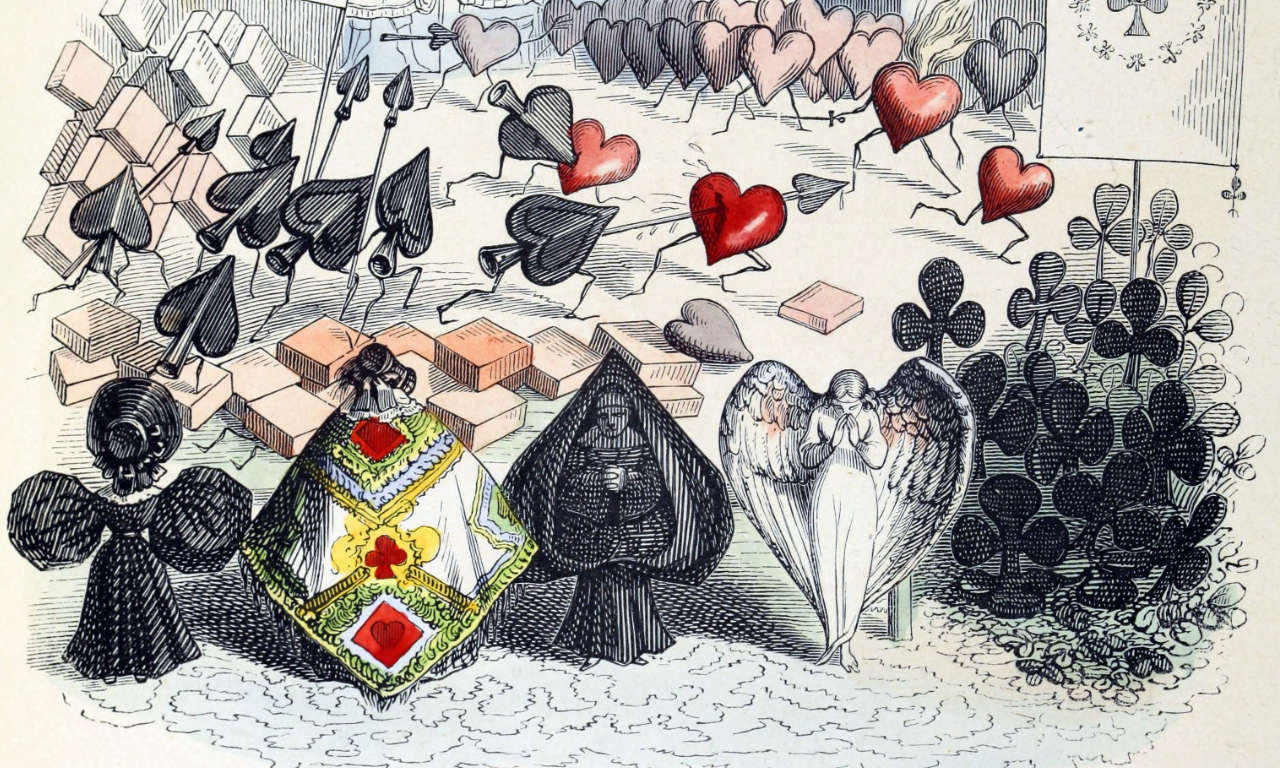
Is the term “Oriental” offensive? Where do we get the phrase “not one iota”? Why do we tell someone to “take a gander”? And who coined the word supercalifragilisticexpialidocious? This episode first aired December 18, 2010.
Transcript of “Too Much Sugar for a Dime”
Hey podcast listener, even though you’re hearing this recorded show, you can still call us whenever you want.
1-877-929-9673. Our voicemail will take your call. Later we’ll listen to it just as we listen to all of them.
And then there’s always a chance that we’ll decide to have you on the show to ask your question or share your story.
On with the show.
Support for A Way with Words comes from National University, where flexible online classes let you earn your degree or credential on your schedule.
Learn more at nu.edu.
You’re listening to A Way with Words. I’m Grant Barrett.
And I’m Martha Barnette.
Groucho Marx had A Way with Words.
He was an expert at turning a particular kind of phrase, like this one.
I’ve had a perfectly wonderful evening, but this wasn’t it.
Now, what makes these sentences funny, of course,
is that the speaker takes you down one mental path
and then suddenly makes a sharp turn and takes you someplace you never expected to go.
Love those.
Well, it turns out there’s a word for this.
It’s a term of rhetoric, and it’s paraprosdokian.
Paraprosdokian.
Yes, let me spell that.
P-A-R-A-P-R-O-S-D-O-K-I-A-N.
This isn’t one of the more common terms of rhetoric, I guess.
No, no, but it’s really handy to have this word if you want to find a whole lot of paraprosdokians on the Internet.
It’s from two Greek words that mean beyond or beside expectation and has been a staple of comedy ever since antiquity.
And now people like Stephen Colbert use it all the time.
Does it have to be funny, though?
I mean, it often is, and the best examples are, but it could just be unexpected turn of phrase, right?
Yeah, yeah.
That’s just straightforward, right?
Yeah.
Do you have any favorites yourself?
You know, I do have one now that you mention it, and it’s incredibly short, and I think it is a paraprostokian.
Decades ago, when Ronald Reagan was president, Rich Little was famous for imitating Ronald Reagan, right?
And Reagan had this particular speech habit that he would imitate.
And so one of his gags was he’d do this fake interview thing and somebody would say, Mr. President, how are you feeling today?
And he would go, well.
And then he would just stop because Reagan always said, well, I want to tell you about the Russians and the missiles.
Right?
Because you’d expect him to go on.
But actually, instead of saying well as a sentence marker, he was saying well as an adverb, meaning I’m well.
I like it.
And it was just perfect, perfect right turn.
You’re like, wait a second.
Oh, oh, it just takes you a second to realize he’s not going to follow that up.
That is the answer, and it’s perfectly coherent.
That’s it.
I suppose that works.
Yeah.
But you’ve got more.
I see a big stack of papers there.
I do, and I’ll share some more of them later in the show.
But let me just leave you with this one.
Change is inevitable, except from a vending machine.
Boy, don’t I know that one.
Well, this is the place to talk about language, about paraphrosdokians, or prose, or poetry, or words and where they come from.
Call us 1-877-929-9673, or you can email us words@waywordradio.org.
Hello, you have A Way with Words.
Hi, my name is Barb, and I’m from Indiana.
Hi, Barb, where in Indiana are you?
Evansville, Indiana.
Oh, whoa, we’re on the air there, wonderful.
Well, what’s up?
Well, I have a crazy family word that I would love to know a little more about.
It goes all the way back to my grandparents who are not living anymore,
And it goes all the way down through my generation, and my children use it,
But I’ve never heard any other family use the word before,
So I thought it would be fun to throw at you guys.
If you’re wrestling around with someone or horsing around with someone
And you want to be released from that situation, you yell calf rope, C-A-L-F-R-O-P-E.
My husband teases me about it.
He’s never heard of it.
And all the people I’ve told the story to never have heard of the word before.
So I was just curious to know where it came from and how it got started
And why our crazy family uses it this way.
So the kids are goofing around.
One of them’s got the other one pinned, or the one on the ground, in order to get out of it.
Instead of saying uncle like the rest of the country, they’re going to shout,
Calfro, Calfro.
Correct.
You got it.
And one more question, Barb.
Is your husband from the same area?
He is. I say he’s a Midwestern fella, but he’s actually lived in Indiana, excuse me, Illinois and Missouri and Iowa growing up with his family.
So I claim him as a Midwest boy, but he’s really not from this part of the country, no.
But your grandparents, are they from that part of the country?
They are.
They are from southern Illinois, and then after they were married, we’re in southern Indiana.
How about that?
Okay.
Well, that makes a lot of sense because that expression is spread around that area, smack dab in the middle of the country.
Okay.
And in Texas, Oklahoma, right in that area.
How about that?
So there’s more than just Barb’s family.
Barb’s crazy family, I think, was how you put it.
So your family may be crazy, but it’s not because of this particular expression.
Okay.
Yeah, there are a couple dictionaries that have entries for this if you want to find out a little bit more.
The Dictionary of American Regional English, which we always talk about.
And even if you just go to Google Books and look up Holler Calf Rope, you’re going to find a ton of places going back more than 100 years where it’s used in fiction and nonfiction.
Yeah.
Okay.
So the image, of course, is of roping a calf, right?
Right.
Yeah.
Exactly.
Yeah.
So you didn’t calf rope us.
We had an answer for you.
I knew you would.
I knew you were way too smart.
Cool.
Great.
Thank you.
Thanks, Barb.
Hey, Barb, thanks for calling.
Have a great day.
All right. Bye-bye.
Bye-bye.
I know there are a lot of crazy families out there that have a lot of crazy language because you call us and you tell us so, and we do so love to hear from you.
And we really enjoy the stories that you send us an email to words@waywordradio.org.
Tell us about your family’s crazy talk.
Hi, you have A Way with Words.
Hi, this is Gary Whitlock in Fallbrook, California.
Hi, Gary.
Well, I was thinking the other day about the phrase to take a gander, and I’m not sure I’ve ever actually even heard it, but I have read it, and wondered how that came to mean to take a look at something.
Okay. That’s a great question.
Do you have geese or animals of any kind? Ever lived on a farm?
I have lived on a farm, never had geese, but I’ve met up with some, and they’re not very friendly birds.
No, they’re not.
No, if you find a dark alley and there’s honking in it, just walk on by.
Yeah, run away, right.
But, you know, it’s really straightforward.
Geese have these necks, and they do this strange craning because of the way their eyes are positioned on their head.
And so they have a very characteristic movement of the head.
And so when people are straining their own necks to kind of look over or beyond or they’re in a crowd, right?
Martha’s doing it now.
She looks more like a chicken than a goose, though.
Yeah, I think of geese as they look at something, but I’m not seeing it as something that they’re, at least as when you’re saying, I’m going to take a gander, or let’s take a gander.
You’re not looking intently at something.
You’re kind of, you’re looking at it as something that’s just something I’m going to take a look at, but I don’t have to study it too hard.
I don’t know if I’ve got that right or not, but that’s what it seems like to me.
Well, maybe, but in general, it’s universally agreed among lexicographers and etymologists that the gander comes from the geese.
So maybe it’s not exactly what geese do, but it’s similar to what they do.
You know, they crane their necks, and so do we.
And we look kind of silly when we stand on tippy-toe and strain our heads up to look above a crowd just to see what’s happening, right?
Right.
Yeah, but, Gary, I think you’re describing the motion very well.
I mean, I’ve spent a little time around geese, too, and even when I think about it now, I sort of unconsciously cover my backside.
They’re going to nip you, right?
Yeah.
They’re going to goose you, you know?
I don’t want to take a goose at anything.
No, and I don’t want them taking a gander back there.
But, yeah, that’s the idea.
Yeah, it’s straightforward, straight from the male geese.
Okay.
Thanks for calling, Gary.
Okay, well, thank you for your answer.
Thanks a lot, Gary. Bye-bye.
Bye.
Ask us about an idiom, 1-877-929-9673, or email us, words, at waywordradio.org.
We’re going to have more paraprosdokians, those statements that take a sharp turn.
Okay.
Of course, there’s the famous one by Will Rogers, I belong to no organized party.
I’m a Democrat.
I like that one.
Still true.
And I like this one from Mitch Hedberg.
I used to do drugs.
I still do, but I used to, too.
That one cracks me up.
Send us your funny turns of phrase,
The stuff that just kind of takes the crook in the road and doesn’t go back.
877-929-9673 or words@waywordradio.org.
Hello, you have A Way with Words.
Hello, this is Patricia Blackshear.
I’m calling from Frankston, Texas.
Well, hi, Patricia.
Welcome to the program.
Hey there.
Well, I have a question.
I have a saying that I’ve only ever heard my mother use.
I now use it regularly, as does my husband.
And it is too much sugar for a dime.
And what are the circumstances?
Where would you use this?
Are you in the grocery store?
Is this something at home?
It applies to any number of circumstances.
The best I can figure is it basically means something that is too much effort for the result.
Mm—
Too much hassle.
So if I say, let’s make a suggestion or something, my mother will say, well, that’s too much sugar for a dime and nix the suggestion, whatever it may be.
So it would be not worth the hassle, that kind of thing?
Yes, exactly.
That’s very interesting because I have heard this several times and it either means that, too much of a hassle, or just a little too unbelievable.
Have you heard it that way, too?
She uses them.
My mother uses them interchangeably.
Something that’s sort of too good to be true.
I don’t quite believe it.
So it’s very interchangeable.
It took me a while to figure out the nuance between those two things.
Right, right.
Too good to be true or more trouble than it’s worth, right?
Too much sugar for a dime.
Yeah.
Yeah, there is an old Merle Travis song from the 50s by that name.
Really?
Yeah.
Yeah, we should link to that on our website.
If we can find the original.
Do you know the song?
Can you sing it?
No, but I can show you the YouTube clip with Merle Travis singing it.
Very nice.
And in that case, it’s more of the skeptical one, more of the, oh, you’ve got to be kidding.
That’s too much sugar for a dime.
That’s the one that I found.
And I found one person compared it to cotton candy where they take a penny’s worth of sugar and they spin it up so that it’s all fluffed up and mostly air and then they sell it for a dime.
So you have the impression that you’re getting this big wad of candy.
But really, when you compress it down, it’s a tiny little cube of sugar.
And I thought that was a great, I don’t know if that’s the source of it,
But I thought it was a great way to try to explain it.
Yeah.
Wow, very interesting.
I have never heard anyone else use it.
Oh, really?
Yeah, it’s out there.
It definitely has a southern inflection,
Not the kind of thing you’re going to hear in the New England, probably.
And it’s got a little bit of history behind it, so it’s not new,
Nothing that came up in the television generation, that’s for sure.
Very interesting.
Well, maybe I will start using it outside of my own home then.
Oh, yeah.
I know it’s legitimate and not something my mother made up.
I think that’s safe enough.
Yeah, you don’t have to be closeted about it.
I was going to say, I hear language that’s not appropriate outside the home, outside the home all the time.
Don’t we all?
Hey, Patricia, thank you so much for calling.
I love this expression.
Thank you all.
Thank you.
I appreciate it.
I love your show.
Keep up the good work.
Oh, of course.
Thank you.
Bye-bye.
That’s too much sugar for a dime.
You’re always handing me a line.
That happens in the best convertible.
Always brag about all you got, a swimming pool and a fancy yacht.
I’ll bet you don’t know nothing about a boat.
They float.
Call us with your language questions, 877-929-9673,
And drop by our Facebook page.
You’ll find us there under Wayword Radio,
And you can email us, words@waywordradio.org.
Stay tuned for a mental tune-up of Puzzles Next on Way With Words.
You’re listening to A Way with Words. I’m Martha Barnette.
And I’m Grant Barrett. And we’re joined once again live on the line from New York City by John Chaneski.
Hello, John.
Hi, Martha. Hi, Grant. How are you guys?
Hi, what’s happening over there?
Doing well.
What I have for you is another radio puzzle hunt.
Yay!
Remember, I know.
I love these.
I don’t remember.
Not as at least.
Was this more recently than 10 minutes ago?
Because I don’t remember it.
Martha asked for this recently.
Oh, yay.
It’s another radio puzzle hunt.
Like a regular puzzle hunt, I’ll give you a clue leading to a location.
Not a real place.
It’s a real place in the world somewhere.
And if you manage to solve it or get to the new location, there’ll be a new clue waiting for you there.
What do you mean if?
I remember now.
This puzzle is an around-the-world one.
It can lead you to any place in the world.
Okay.
Here we go.
Here we go.
All right.
This first one is easy, I’m sure.
Oh, yeah.
You always say that.
Yeah.
Your puzzle hunt begins at the Capitol building in the only U.S. State capital that consists of three words.
Salt Lake City.
There you go.
Oh, very good.
All right.
So you begin in Salt Lake City.
Once you get there, you find a shining golden plaque that reads –
Go back to Illinois.
Go back home.
Go to the Central American country that is the only country named after Jesus Christ.
El Salvador.
El Salvador, right.
The Holy Savior.
Very good.
When your plane lands, you spot a cheering mob spelling out this clue.
Go to a Caribbean island nation whose flag features a trident head.
Now, this is no coincidence.
The first four letters of the country name describe a feature of a trident’s tip.
Trinidad?
No.
No?
Dern.
What feature do you find on the tip of a trident?
A hook or a barb?
Barbados.
Barbados.
Very good.
This flag was intentionally designed with that in mind.
Isn’t that right?
Now, when you get there, you check into your hotel,
And all of a sudden a note has slipped under your door.
It reads, find a city whose name answers this question.
Name two letters that can be used to make the sound K.
KC, Kansas City?
No.
That’s a good alternate, though.
How about this?
Find an Irish city.
County Cork?
No.
Darn, that doesn’t work.
Cork is correct.
Cork?
Cork, C or K.
Oh, nice.
He’s got a little chicken there.
Oh, C or K.
Yeah, baby.
All right.
That’s good.
I’ll accept the feat on that one.
It was clever.
That’s all right.
Thank you.
So you go to Cork, and while wandering around, you spot a plane doing some skywriting.
It reads, head to a country whose name can be anagrammed to Big Mule.
Love it.
Big Belgium.
Belgium.
There you are.
Head to Brussels or anywhere near there is fine.
When you get there, a strange man runs up to you and whispers the following clue.
Travel to an African country whose name becomes a woman’s name when you remove the first letter.
An African country whose name becomes a woman’s name when you remove the first letter.
You’re spelling Hannah wrong.
Rwanda.
Rwanda is correct.
Very nice.
Also the name of a popular movie fish.
After a day and a night there, your PDA vibrates delightfully and you receive a text that says,
Jaunt on over to an Asian city that has a homophone describing a real go-getter.
Wow.
Generally, people are classified in two different categories.
Taipei.
Taipei.
That’s correct.
Very good.
Oh, Chaneski.
As an unusual consequence of all this traveling, you’ve got some mild hallucinations, one of which involves a talking cat who mumbles the following clue.
You need to reach the mouth of a river.
If you change the first letter of this river’s name, it becomes a word of celebration.
It is the longest river on its continent, and its continent is Australia.
Oh.
I don’t know any rivers in Australia.
I’m running through waltzing Matilda.
Not even the longest?
Well, maybe.
Well, give me a word of celebration.
What do you say when you do something right?
Hooray?
That’s it.
Hooray?
And if you change the first letter, you find a man’s name.
Murray?
Murray.
Oh, Murray.
That’s right.
It’s the Murray River.
Oh, sorry, all you cobbers.
River in Australia.
That’s the second time recently you’ve stumped us with an Australian clue.
I got a phone number.
I’m sorry about that.
You are my mates, and I’m sorry.
Murray becomes hooray, and as in hooray, you’ve solved all the clues, the last clue at least, on the international puzzle hunt.
You guys did very, very well.
You’re being very generous, John.
But thank you.
Thank you.
Thanks, John.
That was fun.
If you’d like to send us your puzzle questions or if you’d like to just ask a question about language and words and grammar and so forth, give us a call, 877-929-9673, or put it all in email to words@waywordradio.org.
Hello, you have A Way with Words.
Hello, this is Lo calling from Oak Park, Illinois.
Welcome to the show.
Thank you.
How can we help you?
Well, recently I have a friend who is Caucasian asked me whether I would be offended if someone refers me as an Oriental woman.
And I said, no, should I be offended?
And my friend then explained to me that she used to have a colleague from the Philippine Islands who believed that using the word Oriental to describe Asian people is condescending.
And now I am Chinese American, and I have learned English as second language.
And I sometimes do use the word Oriental to describe people from East Asia, including myself.
So could you explain to me why this word can be offensive and in what context?
So you don’t take offense at the word Oriental, even though you’re Chinese-American?
Right. I don’t.
Have you met others? Are there others in your family who do find it to be offensive?
No, that’s interesting because after my friend asked me that question, and I asked around my family members and also some of my friends.
Now, most of my friends are from Hong Kong, and I myself, I grew up in Vietnam, and nobody took that word as offensive at all.
So that’s why, you know, am I missing something?
What a great question.
It’s a fantastic question.
Now, let’s just keep in mind here that Martha and I are Caucasian, and you are Chinese-American, so it’s a little weird for us to be discussing this matter.
But we can go to some other experts and kind of report what they’ve said.
And I guess the best thing to say about this is that it’s kind of an undecided question.
But like a lot of the questions that we get when it comes to referring to groups of people, it’s up to the people who are being talked about to decide whether or not it is offensive.
It is up to each individual.
And there’s not a universal that applies here.
Okay.
And I know that makes it difficult.
And I know that outsiders sometimes resent that they don’t get to choose what to call another group of people.
And that’s just tough cookies to them because that’s not how it works.
It’s low. It’s up to you.
If you decide not to be offended, it’s completely your prerogative.
But I think that the reason that some people might think that it’s offensive is because Oriental has to do with Orient and the East.
And so you’re sort of getting oriented, if you will, by what’s in what’s west of the east, if that makes sense.
Does that make sense?
Like it’s a European perspective.
Yeah, it’s a Europeanism.
It’s definitely one of those words that presumes that European and therefore Caucasian culture.
And let’s just throw the let’s call it the west in general, as we know it, is somehow the norm.
And those people over there to the east, they’re other.
Right.
White Europeans are the center.
Yeah, they’re nonstandard. They’re different.
And in that way, it’s a diminishing of this other group of people.
And so it’s definitely an intellectual argument.
It’s an academic argument.
It sometimes filters down into day-to-day conversation.
I have met other people who believe Oriental should not be applied to them just because they’re from that part of the world.
I’ve heard some people say Oriental should be used only in the context of rugs.
Oh, yes.
And nothing else.
I also heard that.
Oh, really?
It’s referring to things, but not people.
Not people.
-huh.
Yeah, I’ve heard that argument as well.
This first comes up as a possible area of dispute in the 1970s or 1980s.
People began to write about this and to think about this.
There’s plenty of evidence that has been collected that shows that some people are offended by Oriental.
And the word Asian really started to come into play in the 60s and 70s and 80s.
And in North America, Canada, and the United States, when we speak English, we use Asian typically to refer to people from East Asia and not to people from Pakistan, Bangladesh, and India.
Whereas in the UK, they use Asian often to refer to people from anywhere in Asia, including Pakistan and India and Bangladesh.
Yeah, that could be confusing.
It’s very confusing.
But we tend to specify their nationality or we’ll say South Asian, even though Pakistan isn’t very far in South Asia.
It’s mostly West Asia.
So I think I still can use that word, but I really should be sensitive about it, right, when I use that word referring to another group of people.
Yeah, I think so. I think so.
I’ll just say that you’re a great caller and be done with it.
Okay. All right. Great. Thank you so much.
You’re welcome. I hope we added clarity.
Yeah, it’s a great question.
Yes, you sure did. Great. Thank you very much.
Thank you.
Okay, thank you, Lo.
Bye-bye.
What are the strange predicaments that you encounter in language?
Martha, we get them all the time, and we love to talk about them, don’t we?
We do, whether we know anything about it or not.
877-929-9673, or send it all in email to words@waywordradio.org.
Hello, you have A Way with Words.
Hi, how are you?
Hi, great. Who’s this?
This is Jeff, calling from Columbus, Indiana.
Hello, Jeff. Welcome to the program.
Well, my dad used to use the phrase, well, he would say he would use the term one iota.
In other words, he would say something like, I went to the store and there was no bread.
I mean none, not one iota.
And he used that a lot.
And, of course, I grew up hearing that since I was a little boy, so I always knew what he meant.
But as years go by, I question a little what that meant or if there was any connection to any true meaning to that other than just something he used.
All right.
Well, we can definitely help you with this one, Jeff.
Iota is the smallest letter in the Greek alphabet.
It looks kind of like a letter I, right?
Yeah, only it’s tiny.
It almost looks like an apostrophe or a comma or something.
Sometimes in some forms of certain Greek words, it looks so tiny, it just looks like a speck that you want to flick off the page.
And so even the ancient Greeks use the word iota or iota in ancient Greek to mean something that’s really, really tiny.
So not one iota is not one little tiny thing.
Even in the Gospel of Matthew, the fifth chapter, all that business about the Sermon on the Mount, Jesus uses the word to mean something tiny, tiny, tiny.
I see.
And this also reminds me of a jot, right?
Not a jot of tobacco left in the bag, right?
Right. Not one jot or tittle.
I mean, that’s from the fifth book of Matthew.
Right. Very good.
And jot and iota have the same etymological root, right?
Yeah, they kind of look like each other, huh?
You know, there’s an interesting connection to what you just shared with me, which was that my dad was a minister.
There you go.
And was he classically trained? Did he have a little bit of Greek or any other classical languages? He was not classically trained. I mean, he did attend a seminary, and how much of this was brought out in that, I have no idea. But it is interesting that you connected that as you did, and in fact, he was a minister, so that’s interesting to me.
Yeah, well, as a preacher’s kid, I can tell you that a lot of the language there gets picked up and is passed on around the family and to the congregation, like this one.
Yeah, that’s really very good to know. I had no idea, and this has been part of our life, like I said, since I was a little boy, and it’s really great to hear what the meaning of this word is.
Well, that just gives us a great deal of pleasure. Thank you so much, Jeff. That’s very cool. All right, take care of yourself.
Okay. Bye-bye. Take care. Bye-bye.
Yeah. The religious connection, the Bible connection, reminds me of that new book by David Crystal called Baguette, and he talks in this book specifically about all of the different expressions and phrases and even just kind of unusual words or characteristic words that we have in English that we got from the different versions of the Bible.
Okay. And this is one of those. I’m putting that on my wish list right now.
Yeah, that’s David Crystal’s Bagat. We’ll make a link to the Amazon page for that. Tell us about what your parents used to say, 877-929-9673, or send it an email to words@waywordradio.org.
Grant, we were talking earlier in the show about paraprostokians, those statements that start out one way and then take a sharp turn someplace else. I have a few more for you.
How about always borrow money from a pessimist? He won’t expect it back. I like that. And speaking of money, save a little money each month, and at the end of the year, you’ll be surprised at how little you have.
I can relate to that. Call us with your paraprosdokians, 1-877-929-9673, or send an email to words@waywordradio.org.
Hello, you’ve got A Way with Words.
Hi, this is Evan Childress. I’m calling in from Madison, Wisconsin.
Hi, Evan. Welcome to the program.
Thanks. I’ve long had a problem with the word perused. My mother ingrained in me that it meant to read carefully or, you know, examine a document. But it seems like everybody uses it sort of in the opposite way, sort of to skim over something or, you know, do a cursory job.
So I was wondering if you knew how this shift came about or, you know, whether I’m just wrong about what it means.
No, Evan, you’re not wrong at all. I was going to ask, was your mother a real stickler for grammar in other ways?
Oh, yes. She’s a word person and a writer herself.
-huh.
Yeah, and I actually, interestingly, when I was first, I actually learned the word while I was studying for SATs with her.
-huh.
And I would continuously get it wrong and actually think that it meant to kind of read over briefly.
Mm—
Mm—
Yeah. And whenever I use it, people interpret it in the opposite way.
Yeah, exactly. I just try to avoid it entirely because of that confusion.
Right. That’s what I would do, too. I would just stop using the word altogether.
I mean, it’s a shame that you have to do that, but maybe if we give it a time out, we can go back to it in a few years.
Yeah. But the short version is that your mother was exactly right. In fact, the oldest sense of the word peruse means to use thoroughly, to use up, to exhaust.
I mean, it was a really intense word. And somewhere along the line, people started using the other version of it.
Yeah, it’s really interesting the way that those shifts just seem to happen.
Yeah, and it’s curious because for a long time it had that sense of reading something very closely, very thoroughly.
But it’s sort of like oversight, you know?
I mean, think about the word oversight, which can mean…
A couple of different things.
Yeah.
I suspect what happened here, Evan, is that people were reaching for a word that they didn’t quite understand in order to sound more sophisticated.
And in that way, that almost always leads to mistakes where people speak with an unnatural vocabulary.
And I suspect that peruse was if you were looking in your thesaurus for synonyms for the word to read, you might choose that word without understanding its nuances.
I hadn’t thought about that.
It’s often the mistake that people make when they want to sound more educated than they are.
And that’s not a judgment. I’m just saying we all do that. We want to sound sophisticated and formal and might push our vocabulary in directions it ought not go.
So you’re right. Technically, it means to look at something very, very carefully and thoroughly, to pore over something, P-O-R-E, over something.
Yeah, peruse does not mean just to browse casually and just to skim. It does not mean that at all.
Well, it’s of limited comfort since I can’t really use it anymore.
Well, sorry about that.
Yeah, it’s what they call a skunked word. It’s kind of, in its misuse, it is kind of ruined for legitimate uses.
Right. But I bet you did well in the SAT, right?
Thanks a lot.
Yeah, sure, no problem. Thanks for calling, Evan.
Bye-bye.
Bye-bye.
Language and words, words and language, 877-929-9673.
And hey, we’ll even answer questions about punctuation. Send them to words@waywordradio.org.
More of your calls coming up on A Way with Words. Stay tuned.
A Way with Words is sponsored in part by iUniverse, supported self-publishing.
Is there a book in you? Information available at 1-800-AUTHORS or online at iUniverse.com.
You’re listening to A Way with Words. I’m Grant Barrett.
And I’m Martha Barnette.
It’s not every day that I read about a museum exhibit that makes me think that I need to book a flight immediately to another country to go see it.
This is the one at the British Library in London called Evolving English One Language Many Voices.
It just opened, and I swear it has me looking at the flight schedule because it just sounds fantastic.
Well, book me a window seat because I want to go too.
All right. We’ll go together then.
One of the reasons I’m so excited about it is it’s curated by the linguist David Crystal.
Sure. Fan of his.
Second, it’s a look at English through the ages, and some of the greatest icons of the entire language are right there.
Actual icons and metaphorical icons.
Things right there under one roof.
We’re talking about original editions of Beowulf and Wycliffe’s translation of the Bible and the original massive King James Bible.
Fantastic.
No matter what your religion, if you speak English, you owe a debt to that book.
You speak some things from that Bible, which, by the way, turns 400 next year, you know, 1611.
And there are all kinds of other things like Johnson’s Dictionary.
It goes all the way up to text messaging.
There are old slang dictionaries, which I know you’d be crazy about.
But, you know, I think the most moving object in that whole exhibit is a gold medallion that’s about the size of a penny.
And it’s inscribed with the words, Gagoga Magomedu.
What does that mean?
Well, we’re not completely sure, but supposedly it’s the earliest example of very, very, very early English from the 5th century.
And this is just so thrilling to think that, you know, you could be there and see that thing.
They think that maybe it means this she-wolf is a reward to my kinsmen because there’s an engraving of a she-wolf there with little Romulus and Remus underneath her.
But, I mean, this thing just sounds like the English Hall of Fame.
It sounds like, you know, I don’t know, the equivalent of a baseball fan going to Cooperstown or something.
I don’t know. It just sounds so exciting.
So this is in London. It’s at the British Museum.
Library. A British library. And it’s when?
It’s going on now. It just opened. It’s going through April 3rd.
Fantastic.
So start racking up the frequent flyer miles on your credit card and go.
Do you think they have replicas of that medallion? I’d love to have one.
Oh, wow. What does the gift shop look like?
Oh, my gosh. I hadn’t even thought about that. Grant, we gotta go.
We have to go. Well, while we’re doing.
That, give us a call at 877-929-9673 or send your emails to words@waywordradio.org. Questions about words and language, this is the place.
Hello, you have A Way with Words.
Hi there, this is Matthew. I’m calling from Somerville, Massachusetts.
Hi, Matthew.
Hi, Matthew. Welcome to the program.
Thanks a lot. It’s good to be on.
So I had a question about the phrase learning curve. It’s something, obviously, you hear people say a lot, you know, talking about a new skill or some kind of sport, and they’ll say, oh, this has a steep learning curve. And they typically mean that it’s difficult to learn. But in my view, I think, well, if the curve is steep, then with very little forward motion, you get very high. So it must be interpreted to have exactly the opposite meaning of what’s intended. And maybe it’s some of my mathematical training. I’m actually a physicist, but I think of a curve. I want to see axes. I want to know, what are you plotting it against? If the axis is time, you have a steep curve, then very quickly you rise very high. So anyway, it’s one of those phrases that I always kind of wondered maybe what was the original meaning. Where does that actually come from?
Nice question. So the question is, what am I going to plot here on the x and the y axis on this graph, right?
Yeah, right. I know. It does refer back to an actual curve. You start to see this show up in literature related to education more than 100 years ago.
Really? The answer is important because you’ve got to get these exactly right. On the bottom of the axis, you would plot performance. That is, how well you do with this particular skill. So across the horizontal axis. And on the vertical, you plot practice. How much effort or how much repeated exposure you need to learning this skill in order to improve. And then you could see a steep learning curve would actually be accurate because your performance, you would only move a little bit to the right, and yet your graph line would be very steep for all the practice that you put in.
Interesting.
Okay. So you can write this out as I’m talking about it, right? Just put the performance horizontal and the practice vertical and then draw a steep line in it. It makes perfect sense.
Okay, practice versus performance. Very interesting. In my head, I always had it reversed, right, where the horizontal axis would be practice or time or something indicating your effort, and the vertical would be, you know, your skill level rising. So that’s, yeah, reversing it then makes perfect sense.
Well, I guess my question for you, in physics, do you tend to put the time on one axis over another?
Well, time is always horizontal.
Okay.
Or I shouldn’t say always, but very often.
Okay, very good. And I guess the other kind of metaphor that I have in my head when I hear the phrase is thinking of curve as literally like a mountain that I’m climbing.
-huh. Right? The goal is to get high. That would be the performance, if you will.
I see. And so, again, then that would be the reverse of the way you’ve described it.
Yeah, many ways to interpret a graph, and on such subjects, theses are built. Matthew, I hope we helped. I assume that your learning curve is rather steep, right? But lots of practice, and you’ll get that solved, right?
We’re definitely hoping for performance, yeah. But a lot of practice involved. Matthew, good luck.
All right. Thank you very much.
All right. Bye-bye. Take care.
Bye. Have a good day.
Bye-bye. You have a question from your line of work? Call us, 877-929-9673, or send those emails to words@waywordradio.org.
Hello. You have A Way with Words.
Hi. This is Gillian. I’m calling from Fort Worth, Texas. How are you?
Great. Welcome to the program, Gillian. What can we do for you?
Oh, thank you. Well, I had this question about this super long word that children, my daughter uses, and her and her friends try to say it as fast as they can. I’ve actually looked up the word, and it says it’s a nonsense word. So I always wanted to know where the word came from, how it came into existence, and why is it so fascinating to children. And the word is supercalifragilisticexpialidocious.
-huh. Now, would you spell that for us?
Can I spell it? S-U-P-E-R-C-A-L-I-F-R-A-G-I-L-I-S-T-I-C-E-X-P-I-A-L-I-D-O-C-I-O-U-F.
Oh, my goodness. Bravo, bravo. Oh, man. We have our script spelling bee, champ. One more time. No, just kidding. That is great. Have you been practicing?
We’ve been practicing for about five years with that word.
Oh, wow. Oh. And so it says spell it. And a couple of times I’ve gotten it wrong. And I said, I’m going to beat this 10-year-old one day, and I’m going to spell that word. And so you’re calling about supercalifragilisticexpialidocious. And what do you know about the word? What do you know about its provenance or its history?
I don’t know much about it, except it says it’s a nonsense word in English language, meaning fantastic. And so how does fantastic translate into such a long, ridiculous word that kids love?
Yeah, well, that’s a fair question. Have you seen the movie Mary Poppins?
I have not, but I’ve heard of it.
All right. Do you know that there’s a song in the movie and the stage play by this name? Supercalifragilisticexpialidocious.
Yeah, I’ve heard that song. Supercalifragilisticexpialidocious, even though the sound of it is something quite atrocious. I can’t do the rest of it. Can I do the -do-do-lum-do-lum-do-lice?
Well, that’s the place that most—actually, was it in the stage play? I know it was in the movie, but that’s the place that most people heard this word for the first time.
Yeah, I know it wasn’t in the books. The P.L. Travers books? It wasn’t in those books. And the movie was huge at the time. It was enormous. And it is still a constant favorite, even though Dick Van Dyke has the worst Cockney accent I’ve ever seen on a human being. He was so great in that movie. His acting was good, but his voice was atrocious and somebody should have helped him out. And his dancing?
Yeah, his dancing. But in any case, so that’s where most people came across supercalifragilisticexpialidocious.
Right. It’s actually a little older than that. There’s some evidence, right, Marth, that it goes back maybe to the 1930s and it was kind of floating around as a nonsense made-up word. Because that’s the thing. It’s just a goofy word, a show-off word, just to kind of, it’s a performance word. You say it just to show off and be a little smart-alecky and just kind of like, you know, we play with it.
Yeah, yeah. But it’s been around since the 1930s or so. There was actually a lawsuit about that use of the word in the movie because some other people had written a song that was somewhat similar, supercalifagilistic, expialidocious, something like that. I mean, but it was spelled differently. But similar.
Yeah, but the upshot of the lawsuit was that they didn’t have any claim because the word had already been floating around, for one thing, and their song didn’t sound like the song in the movie. So it’s been around. We don’t know who invented it, but it’s just one of those playful, crazy English words. It doesn’t have a word origin in other words.
No, as far as we know, it doesn’t. We can’t pin it down. So much of the language is like that. But I would say that Mary Poppins, the movie, is the popularizer, and sometimes the popularizer is more important than the coiner.
Definitely. It was great talking to you about these extremely long words. Gillian, thank you for entertaining us so much.
Yeah, it was fun. Thanks a lot. Thank you so much. Have a good day.
Bye-bye.
Bye-bye. Well, if you want to talk about words, call us 877-929-9673 or send your emails to words@waywordradio.org.
More parapros tokens for you, Grant. And this one is, you know, this one’s funny, but it also is profound. War does not determine who is right, only who is left.
-huh. Right on. If you want to talk about language, call us 877-929-9673 or send those emails to words@waywordradio.org.
Hello, you have A Way with Words.
Hi, this is J.D. Calling from Green Bay, Wisconsin, home of the Packers.
Hello, J.D., go Packers.
Yeah, go Packers. Welcome to the program, J.D. I have a challenge, especially with the politics just winding down.
Oh, goody, are they?
Well, I don’t have to worry about my calls and hearing political ads, and especially the negative ones that were all over the airwaves.
But there’s a phrase that I’ve been hearing, a word that I’ve been hearing by announcers talking about the Democratic candidate. And they’re referring to the candidate that’s running as a Democrat, and they call him the Democratic candidate. And the Republican is called the Republican candidate.
Now, I’m confused because I’ve always thought that a person is a Democrat or Republican, and if they’re a Democrat candidate, that’s what they are. They’re not a Democratic candidate, because I always go, if they’re a Democratic candidate, which party are they with? Because they’re in a democracy, right? And so it’s a little bit confusing. To me, Democratic is a process and not necessarily an adverb or an adjective to describe, you know, a noun. But I’m just wondering, has it morphed? Has Democrat morphed into Democratic? And is that really acceptable?
It’s always been acceptable. It’s been the standard form for as far back as the Democratic Party has existed. And note that the name of the party is the Democratic Party. It is not the Democrat Party. And that right there has set the adjective in place for a long time, for ages and ages.
Now, there have been various places throughout history where people have used Democrat to refer to a candidate as an adjective. Democrat, you know, the Democrat candidate for treasurer or the Democrat candidate for president. And usually it was done innocently. But in more recent decades, maybe back as far as the 1940s, it depends on your source and how well you do your research. It began to be used by Republicans. Democrat, that is not Democratic. Democrat began to be used as an adjective by Republicans for the very reasons that you explain, which is it’s not quite right for the Democrats to solely claim to be Democrats small d. And that’s usually how they write it, too. They’ll say Democrat small d to mean anybody who participates in our democratic system, right? And Democrat big D to refer to somebody who is a member of the Democratic Party.
So in any case, Democratic is the standard adjective you use. It is still the one preferred by every media organization that I have a style guide for. It is the one that I would recommend. If you use Democrats as an adjective to refer to a candidate to say, you know, the Democrat candidate for treasurer, then you are setting yourself immediately to be recognized as a partisan who is against that candidate. Does that make sense?
People are going to know that you’re probably a Republican or a conservative or that you have some kind of bias against that particular party or that particular candidate. And if that’s fine, go for it. But if it’s not, then just be careful.
Okay. So if somebody asks me what party I belong to, I can tell them that I’m a member of the democratic process. There we go. That totally works. And that I’m covered.
All right. Well, thank you very much for your insight on that one. Oh, sure. Thanks, J.D. All right. Take care. All right. Bye-bye.
Jeff Nunberg, who does essays for Fresh Air once in a while, did an essay on this a few years ago. He talked about democratic versus democrat. We’ll link to that on our website. And also there’s a great piece in The New Yorker by Hendrik Hertzberg. There’s also from 2006, I believe. He talks about the same phenomenon. What is the deal with people using Democrat where ordinary Democratic would be used? It makes a big difference. That little ending makes a real difference.
Yeah, the headline in The New Yorker article is really funny. It’s the ick factor, and they spell it I-C. Oh, that’s nice. Give us a call, 877-929-9673. Talk to us about words and language in email to words@waywordradio.org.
Hello, you have A Way with Words. Hi, this is Ellen Johnson in Greenbelt, Maryland. Hi, Ellen. Welcome to the program. Hello, Ellen. Thank you. Hello. What would you like to talk with us about?
I would like to know about an old-fashioned dessert, which I’ve never had. It’s called the blueberry buckle. My sister-in-law found a recipe for it. I think she might have made it, but I haven’t had it yet. And every summer she usually brings me a bag of wild blueberries that she’s picked up in Michigan. And I don’t want to try this recipe until I know it’s really good. But I just got to thinking about the word buckle and thought, well, that doesn’t even really make sense because buckles are on your shoes and on your belts. And why is it a blueberry buckle?
What a great question. Yeah, yeah. Do you have any guesses? I have an answer. You do? Yes. Okay, good. Yes. So maybe you’ll want to make it if you know the meaning of the word. Okay. Think of buckle here not as a noun, but a verb.
Oh, okay. I never would have. Yeah. Yeah. It’s odd. But if you think about it, I’ve never made it either, but I gather that it’s got cake batter on the bottom and then it’s got the berries and then it’s got this streusel top, this kind of crumbly top. And what happens is as the batter rises, it’s not really strong enough to raise the berries and the streusel evenly. And so it rises here and there, and it gives the cake this sort of buckled appearance.
Like pie tectonics. Yes, exactly. Or like, you know, bad asphalt in the road. It buckles. Or like an earthquake. Like an earthquake, exactly. Okay. So now you’re going to try it? Well, I’m going to wait until next summer when she brings me more wild blueberries. Okay. Probably. And I’ll have to ask her for the recipe, which I haven’t done either. And would you like our mailing address? I’ll send you a sample. I’ll let you know.
Okay, great. So, Ellen, thank you so much for calling us. You’re welcome. Thanks for answering my question. Our pleasure. And if you do make some of that, we insist on having some. All right. Bye. Bye-bye.
Pie. 877-929-9673. Nothing more need be said. Send your pictures of the best pie you ever made to words@waywordradio.org. That’s our show for this week. If you didn’t get a chance to talk with us today, you can leave us a message even when we’re not on the air. Call us at 877-929-9673, or you can always email us. That address is words@waywordradio.org.
You can also stay in touch with us on our discussion forums or look for us on Facebook under the username Wayword Radio. Stefanie Levine is our senior producer. Our technical director and editor is Tim Felten. We’ve had production help this week from Josette Herdell and Jennifer Powell. A Way with Words is independently produced and distributed by Wayword Inc., a nonprofit organization. The show is recorded at Studio West in San Diego, California.
Thanks for tuning in. I’m Martha Barnette. And I’m Grant Barrett. Ta-ta. So long. We must part. And oh, if we ever part, that would break my heart. So I say, you say oyster. I’m not going to stop eating oysters just because you say oysters. Let’s call the whole thing off.
Support for A Way with Words comes from National University, where flexible online classes let you earn your degree or credential on your schedule. Learn more at nu.edu.
Hi, it’s Martha. Did you know that A Way with Words is independently produced by a small nonprofit? To keep bringing you the show, we need your help. We welcome your contributions of any size. Go to waywordradio.org, click on membership. Your donations do add up, and they make this program possible. Thanks.
Man’s Best Friend Paraprosdokian
 “Outside of a dog, a book is a man’s best friend. Inside of a dog, it’s too dark to read.” This kind of sudden, surprising turn in a sentence is called a paraprosdokian. Martha and Grant trade some examples.
Calf-Rope!
Instead of crying “uncle,” an Indiana woman’s family cries calf-rope! She wonders if this expression of submission is unique to her family.
Take a Gander
Why do we say “take a gander” for “have a look”?
Paraprosdokian Quotes
Will Rogers was a master of paraprosdokians. Martha shares a favorite, as well as one from comedian Mitch Hedberg.
Too Much Sugar
“Too much sugar for a dime” can mean either “too good to be true,” or “more trouble than it’s worth.” Merle Travis and Judy Hayden sing about it.
Radio Puzzle Hunt Game
Quiz Guy John Chaneski reprises his popular “Puzzle Hunt” game.
Political Correctness of “Oriental”
A Chinese-American says she’s not offended by the term “Oriental,” but she’s been told she should be. Who’s right?
Not One Iota
The expression “not one iota” means not one bit. Martha explains that it goes back to ancient Greek, and explains its connection to the Sermon on the Mount.
Different Uses of Peruse
A caller was taught that peruse means to examine closely and carefully, but increasingly hears people use it to mean skim quickly.
One Language, Many Voices Exhibit
“Evolving English: One Language, Many Voices” is a new exhibit at the British Library in London featuring the earliest printed versions of Beowulf, the Wycliffe and King James Bible, and the oldest known example of written English.
Etymology of Learning Curve
A physicist is curious about the term learning curve. He pictures it as a pair of axes. But if that’s the case, what’s X and what’s Y?
Supercalifragilisticexpialidocious
Who coined supercalifragilisticexpialidocious?
Money Paraprosdokians
Martha shares two more paraprosdokians about money.
Democrat vs. Democratic
What’s the correct adjective to describe something associated with the Democrats? Is it Democrat or Democratic?
Buckle Desserts
Blueberry buckle is a dessert with cake batter, fruit, and a streussel topping. What does that have to do with buckles?
This episode is hosted by Martha Barnette and Grant Barrett, and produced by Stefanie Levine.
Photo by Kristen Taylor. Used under a Creative Commons license.
Book Mentioned in the Episode
| Beowulf: A New Verse Translation by Seamus Heaney |