

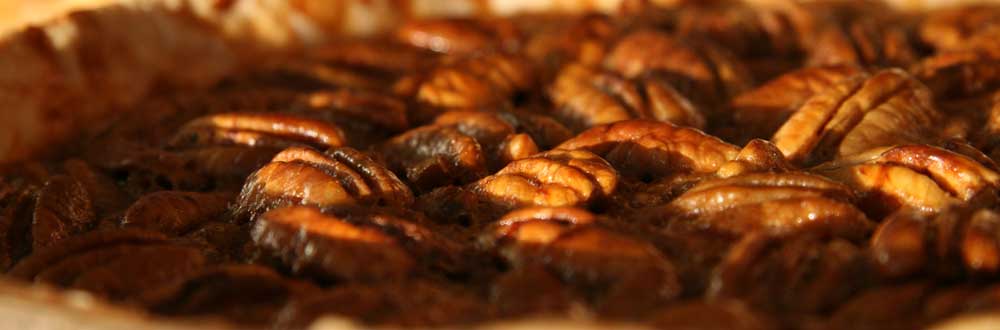
What do pigs have to do with piggyback rides? We get a lesson from a listener in the fine art of speaking gibberish. What’s the correct way to pronounce pecan? The French have the Academie Française, but what authority do we have for the English language? Also, what you should do when someone yells, “Hold ’er Newt! She’s headed for the barn!” This episode first aired January 27, 2012.
Transcript of “Secret Gibberish”
You’re listening to A Way with Words. I’m Grant Barrett.
And I’m Martha Barnette. Grant, please don’t tell anybody, but recently I’ve been engaging in a lot of omphiloskepsis.
Oh.
Don’t tell anybody.
You’ve been doubting your own umbilical cord?
You know the term, omphiloskepsis. Yes, it comes from the Greek omphilos, which means belly button.
It’s related to umbilical and skepsis, inquiry, looking.
Omphalo skepsis, O-M-P-H-A-L-O-S-K-E-P-S-I-S.
Omphalo skepsis.
And it means what exactly?
It means navel gazing.
Oh, perfect.
Yeah, navel gazing.
Well, you know what?
I keep losing my keys for the mumble teeth time.
For the mumble teeth?
Mumble teeth.
That’s my new favorite word.
Yeah, mumble teeth.
Mumble teeth is when you don’t really want to tell people exactly how many times something has actually happened.
Oh, that’s nice. Mumble-teenth.
So you’re like, mumble-teenth.
It’s just a kind of vague number.
I like that. It’s like pasta bazillion.
Yeah, pasta bazillion, exactly.
Love that.
You know, we can find a lot of new words in our reading and our listening to radio.
What do you find? Let us know, 877-929-9673, or send us an email to words@waywordradio.org.
Hello, you have A Way with Words.
Hello, my name’s Eddie Renner. I’m calling from Petoskey, Michigan.
Well, welcome to the program, Eddie. How can we help?
Well, I was going to call about a language that my mom taught me when I was very young called Double Talk.
Double Talk.
Okay.
And it’s where you insert the letters I and B before every syllable.
How does that sound?
Well, for example, Grant Barrett would be Grybant by Barabit.
Grybant by Barabit.
I want more.
Nice. What about Martha?
Martha Barnette.
My Barthabob by Barnabet.
So if you’re saying A Way with Words is hosted by Grant Barrett and Martha Barnette.
You’d say,
Now wait a minute.
Now wait a minute.
Are you playing the tape backwards?
That’s what it sounds like.
There’s a few simple rules to it.
You put an IB before every syllable.
Let’s use a simple word like cat.
Cat starts with a C, which is a consonant, so you’d put the I-B after the C.
If it’s like Ash, you’d put the I-B before the A, before a vowel.
So cat would become Kaibat, Ash would be I-Bash.
Wow. And Eddie, you learned this from your mother?
My mother, who grew up in the 50s, early 60s.
She was born in 51.
And she taught it to my sister at a very young age,
So we can both speak it as if it was just second nature.
Really?
And my sister since has taught it to her kids who are now in their early teens, and they can also speak it fluently.
My goodness, that must come in handy.
It actually does.
If you’re ever in a situation in public where you have to say something that you don’t want anybody eavesdropping on,
We’ve done this all the time where we can just say something back and forth to each other.
Oh, my gosh.
That’s pretty cool.
And from whom did your mother learn it?
From her girlfriends.
Okay.
So it was a thing being passed among teenagers in the 50s?
Right, right.
Okay.
I don’t know how you do it.
But the understanding of it might be the hardest part, right?
Right, right.
However, I know I’ve had friends in the past who, for some reason, however, perhaps how their brains are wired,
They can’t speak it right away, but right from the very beginning they can just hear the words inside.
And they’re able to understand it pretty easily.
But speaking it’s much more difficult.
So this is a double talk.
I guess it’s a kind of pig Latin.
It’s not the pig Latin, which most people in the United States know.
Do you know any others of these?
Well, I did do some initial research from Google,
And apparently there’s an entry called Ubi Dabi,
And it shows that there’s a lot of variations of different, you know,
They don’t just put the IB, they put IZ or some of them.
I can’t remember what they were exactly.
There’s a whole slew of them, and they’re not just in English.
They’re in languages all around the world.
Oh, yeah, I’ve heard it in Spanish, yeah.
But there wasn’t a lot of information on exactly where it comes from or how old it is.
Oh, that’s a good question.
Well, we do know it’s at least a couple hundred years old because a lot of times it appears in the language of criminals.
So it’s recorded in some of the early reports of, say, marketplace criminals in the U.K., or what is now the U.K.
And so there’s just a few records of that.
As far as the other countries go, a lot of times it appears in the language of children because it’s a part of creating identity.
Like our close social cohesion.
You know, people use it to say, well, if you know my little, my double talk, then you must
Be a friend of mine somehow.
We must be part of the same circle.
Yeah.
And I’m thinking we’ve had children and criminals with us since time immemorial.
I’m betting it goes back to antiquity, although I don’t know of any of you.
Yeah, I wouldn’t be surprised.
Yeah.
But it’s not necessarily the kind of thing that you would find written records of.
No, it isn’t.
It’s hard to find.
It starts to appear when people really start to pay attention to language.
So by the time the brother is grim and Germany start paying attention, like real academic attention to language,
Then you start to get people making these word lists and really listening to the speech of other people.
So, yeah, it probably goes back to the first language ever.
Because, hey, frankly, humans love to toy with language.
I know I say this on the show all the time, but a lot of the stuff that we do did not start with a purpose.
It was done first as a goof, and then people developed a purpose for it.
Right.
So it sounds cool.
So I can just imagine you guys in the supermarket in the Piggly Wiggly or wherever.
How do you say Piggly Wiggly?
Pye Big Lebby, Wye Big Lebby.
Eddie, you are fabulous.
That’s awesome.
Thanks for sharing with everybody.
You’re welcome.
Thank you.
Really appreciate it.
Bye-bye.
Take care.
Bye-bye.
I know Eddie can’t be the only one with this kind of double talker pig Latin in his family.
You’ve got something that’s a little different that the rest of us haven’t heard?
Give us a call.
Drop three minutes of that in our voicemail.
And then tell us what you said.
Yeah, definitely.
Or tell us about it in an email to words@waywordradio.org.
Hello, you have A Way with Words.
Hi.
Hi, who’s this?
Hello.
Yes, Aaron Cundell calling from Helena, Montana.
Hi, Aaron.
Welcome to the program.
Thank you.
What’s happening in Montana?
Well, I’m staring at two pies over here.
One’s a pecan pie, and the other one is a pecan pie.
We’ll be right over.
Yes, freshly made, and I’ve always wondered why the difference between pecan and pecan.
Which do you say?
Well, I’ve always said pecan, and I’m an old Texas kid.
-huh.
Okay.
And wood, you know, when you go, many of the old schoolhouses had pecan floors.
But if you go down the deep south, say, you got one of them pecan pies over there?
Give me a slice of that pecan pie.
So my question is, which is correct, or is it just a colloquialism, you know, based on area?
It’s one of those things that will cause much debate and consternation.
It’s like arguing about barbecue in the Carolinas.
I’m sure that’s true.
Both of the pronunciations that you gave, Aaron, are just fine.
Pecan is by far the most common, and as early as 100 years ago, it was considered standard by the authorities.
But pecan has always been around as far back as I know.
Pecan’s always been an option for a certain part of the population, definitely in the South.
Definitely in the South, yeah.
I grew up in Kentucky saying pecan, for sure.
I was shocked when I went to Georgia and somebody said pecan.
I thought they were making a joke.
And part of the reason there’s a variation is because it was originally a Native American word, Algonquian.
Right.
And none of these pronunciations are anywhere near the original.
Right.
But it was recorded in a wide variety of spellings and a wide variety of text.
So you’ve got all these different tributaries where this word just kind of went about its business, you know, in the food and in the lumber and so forth.
And the spellings influenced the pronunciation, and they kind of became independent of each other.
So, Aaron, a nut pie by any other name would taste as sweet, right?
Yeah.
Well, I tell you what, you can’t beat a piece of pecan pie.
You can’t.
No, you can’t.
And my advice for you is when they have the sugar part of the recipe, double it, and you’re good.
Oh, yeah.
Oh, yeah.
Always add a little bit more.
Yeah, it should almost crystallize.
It should be like hard candy almost.
It is.
It’s delicious.
Oh, you guys.
You guys.
And put chocolate in the bottom, and it’s derby pie.
It’s derby pie in Louisville.
Now it’s really chocolate.
Yeah.
I don’t know a thing about that, but I’ve got to have some.
I’ll be over tonight, Martha.
You make some of that for me.
All right.
Well, we’ll have some ready for you.
Take care.
Bye-bye.
Bye-bye.
Tell us about the words in your regional dialect, 877-929-9673, or send an email to words@waywordradio.org, or you can find us on Twitter and Facebook.
Hello, you have A Way with Words.
Hello, this is Sarah from San Diego.
Hi, Sarah. Welcome to the program.
Hi, Sarah.
Thanks. Hi.
Oh, and hello to the baby.
Oh, sweet little baby voice.
Sorry, she’s making a lot of noise in the background.
Oh, that’s all right. It’s a sweet little sound.
How can we help you today, Sarah?
Well, my husband and I recently toured the Queen Mary.
At one point on the tour, we stopped in front of a glass case in the second-class lounge, and the guide said that rather than browse through the shops like in first class, the second class passengers would look at the items in the case and tell the steward what they wanted to buy.
And then the steward would go and get the object and the customer would pay.
Well, the guide said this was where the term window shopping originated.
But my husband and I have taken this term to mean look without the intent of buying.
So this story kind of confused us.
Is there a different origin for the term window shopping?
Why did it actually originate on cruise ships?
You were good to be suspicious.
This sounds like there should be a whole category of words, false etymologies that tour directors.
If you’re getting your etymologies from tour guides, you’re doing it wrong.
Yeah, you’re spot on, Sarah.
Don’t listen to the tour guides when they say, and that’s how it came to be, because their other facts are likely to be wrong, too.
It comes from literally what you’d think, right?
Walking down the street, seeing things in the window with no intention to buy or not being able to buy because it was after hours.
Very, very simple.
Yeah, exactly what you said.
You can find this kind of activity mentioned again and again over the last hundred years, particularly in New York, where the shops on Fifth Avenue would close at 5 p.m., and yet people would go out for the after-dinner stroll and spend a lot of time looking in the windows, which is how New York got this culture of these really expansive window displays, these really elaborate kind of showpieces in the windows that were designed to attract and allure people, you know, when they did have money or when the shops were open.
Oh, okay.
So, Sarah, you’re right.
Does that make sense?
Yeah, that does.
Thank you.
Okay, sure.
All right.
Thanks for calling.
Thank you very much.
All right.
Bye-bye.
Bye-bye.
Bye-bye.
And Grant, in French, the term is window licking.
L’écher les vitrines.
Lick the windows.
And you can, you know, if there’s something particularly delightful inside, your pans are on the window, and your nose is pressed against the glass.
Some of that cheese, yeah.
By the 1930s, the term window shopping and window shopper was so common there was a very successful play on Broadway called Window Shopping that ran for a few performances.
Oh, really?
And it’s about a proprietor of a department store who tried to get people into a store by putting an actress live in the store windows for two weeks.
She would do a strip tease at night, and then she’d do a dress tease in the morning to attract the crowd.
She would dress up.
Huh.
I think somebody got a government grant to do that.
Yeah, maybe.
1938?
Does that ring any bells?
No.
I wish I could remember the movie that was being discussed, but this movie review was talking about the music as being plangent.
Do you know plangent?
Oh, sure, yeah, from the Latin for to strike.
P-L-A-N-G-E-N-T, but it also can mean to lament, right?
Yes, it has both those meanings.
And so music that is plangent is music that is loud and melancholy and reverberates throughout a room.
I think of some of the tubular bells stuff that Mike Oldfield might have done, that sort of thing.
Yeah, I was going to say, I think of plangent bells.
Oh, very interesting.
Kind of striking.
Tell us about the words and things you found.
Or send it all on email to words@waywordradio.org.
Support for A Way with Words comes from the University of San Diego, whose mission since 1949 has been to prepare students for the world as well as to change it.
More about the college and five schools of this independent Catholic university at sandiego.edu.
You’re listening to A Way with Words. I’m Grant Barrett.
And I’m Martha Barnette. And joining us now is our quiz guy, John Chaneski. Hi, John.
Hi, Martha. Hi, Grant.
Hey, buddy. What’s up?
Oh, things are good here. It’s raining, but it’s a really nice, cool day. It’s not too cold.
And it’s just New York’s looking great.
So, John, what do you have in that canvas shopping bag there?
I have, it’s funny you shouldn’t mention the canvas shopping bag.
I have a little quiz called Get Back.
Now, I’m always trying to come up with something different, but I thought it might be okay just to bring out my canvas bag that has a bunch of old stuff in it.
Just have a quiz about one of the most simple forms of wordplay, the reversal.
I’ll give you a clue to a two-word phrase.
The second word is the first word spelled backwards.
All right?
Simple enough?
Oh, my goodness.
Okay, sure.
For example, if I said, sketch Beaver Cleaver’s dad, you would say.
Draw Ward.
Draw Ward.
Good.
Here we go with the first one.
Give the cold shoulder to baked goods.
I was going to say shun news, but that’s not going to do it.
Give the cold shoulder to baked goods.
Baked goods, yes.
Wow.
Snub buns.
Snub buns is right.
Yeah, I try not to snub buns.
I enjoy them.
So here we go with the next one.
Become acquainted with someone who studies hard.
No wonk.
Yes, no wonk.
Nice.
How about celebrity vermin?
Star rats.
Star rats, like Ben and those guys who were in that movie.
Trim the bowling equipment.
Trim the bowling.
Snip pins.
Snip pins, yes.
Well done, Grant.
How about abscond with a hammer?
Abscond with a hammer.
Loot tool.
Loot tool, yes.
Don’t loot tool.
Just a little PSA for you there.
I like this one.
Let’s try this.
Okay.
The buckle, the leather, the holes, and that’s about it.
I’m going to belt, but what does that have to…
Yeah, I’m not doing anything.
Yeah, I’m not trying to get there.
Another term for a belt.
Think of…
Cinch?
Think of straight jackets.
Strap…
Strap parts?
Strap parts.
The buckle, the leather holes.
That’s pretty much what you got.
Okay, okay.
Let’s try this one.
Send back a stopwatch.
Remit timer.
Yes, remit timer.
Good.
And finally, highlighted the pastries.
Something your waiter might do.
He highlights the pastries.
He’s trying to push them.
Lists, sites, tells.
What part of the meal are the pastries?
Dessert.
Stressed.
Stressed desserts.
Oh, stressed desserts.
Stressed desserts.
Yes.
So they stress them back.
Okay, very good.
Thanks, guys.
You’re a lot of fun.
Thanks, John.
Thanks for having me.
Bye-bye.
If you’d like to talk with us on the air about words and how we use them, call us 877-929-9673 or send an email to words@waywordradio.org.
Hello, you have A Way with Words.
Hi, this is Rick from Waynesboro, Virginia, and I have a silly question for you.
All right, let’s hear it.
Well, I had a friend who recently told me something that sounds a little silly about the origins of the word silly.
He told me that originally it meant blessed or innocent, so that you could say without any offense or impiety.
That you wanted to talk to the silly Virgin Mary.
The silly Virgin Mary.
Now, if I’m not going to get excommunicated at this point.
No, probably not.
I think the story is something quite like that, isn’t it?
Yes, yes.
Your friend actually isn’t silly at all in the modern sense of the word.
Yeah, silly is an interesting word that’s gone through lots of different changes.
It goes all the way back to an old English word that means happy or blessed.
And indeed, as your friend says, by the 1400s, you see things like, silly art thou, holy virgin Mary, and worthiest all men are praising.
Which means blessed.
Yeah, blessed are you, Holy Virgin Mary.
I haven’t seen Silly Virgin Mary written out that way, but I’ll bet that it was used that way.
And if I remember correctly, the transformation from the early meanings to the modern meanings, it’s a slow gradation, right?
There’s no sudden moment where it goes from A to B.
Right.
There were meanings existing next to each other, like silly could mean worthy of compassion or worthy of pity.
You read in the 1600s about silly nuns, and that doesn’t mean that they’re foolish.
And don’t the sheep figure into this somewhere, that somewhere it became an adjective that was typically describing the lambs in the field?
Yeah, yeah, silly lambs, yeah.
And in Edmund Spencer’s The Fairy Queen, which was a late 16th century, it meant defenseless or weak, you know?
So again, you would see the silly virgin defending herself against somebody.
Right, but we’re still not quite to the modern silly, which means that you’re behaving in an unexpected way, right?
Yeah.
Kind of counter to the norm.
Yeah.
Well, or as the result of being weak or not so strong in the head.
I mean, you can kind of see the progression going along.
Okay.
Very good.
I see.
So you’re weak and in need of protection, which means you might be a little simple-minded, which means you might act silly.
Yes.
Very interesting.
I love that.
And girl is a similar word.
Do you know that, Rick?
Do you know about girl?
No, I don’t.
Yeah, girl was another one of those words that didn’t used to mean girl.
It used to mean boy.
Whoa.
Is that silly or what?
That’s definitely silly in the modern.
But, you know, English has such a rich, long history that anything could happen.
I mean, it’s like a journey in space, you know, when you’re in the cryogenic chamber and you’re frozen.
You know, aliens would come and play cards on your dinner table and you wouldn’t know until you got out.
I don’t know, just strange stuff going on.
So, Rick, does it strike you as silly?
Well, just a little bit, but I really expected a Monty Picon reference in there somewhere.
Like the Minister of Silly Nuns. I don’t know.
Minister of Silly Nuns. Very good.
Yeah, I guess Silly Walks is sort of…
Is there a patron saint of silly? There should be.
Your friend is right. How about that?
That’s pretty cool.
Thanks for calling, Rick. Much appreciated.
Thank you so much. Have a silly day.
You too. Bye-bye.
Thank you. I guess Rick meant a blessed day there.
Yeah, sure. I’ll take silly as well. I have a four-year-old. I know.
Nice is another word like that that started out meaning not knowing things, being ignorant.
Very interesting.
And eventually it became nice as we think of it today.
I find it significant that these words that we’ve mentioned, silly, nice, and girl, are all very simple words, right?
It’s easier to transform the meaning of a simple word than it is a complicated word.
Yeah. Well, if you have a silly question for us, or even if it’s not silly, call us.
877-929-9673 or send an email to words@waywordradio.org.
Hi, you have A Way with Words.
Hi, my name is Sarah, and I’m calling from Zion, Illinois.
Hi, Sarah, welcome.
Hey, Sarah, welcome to the program.
How can we help?
Well, I majored in French in college, and now I’m learning Spanish.
And they’re always saying in class that the Académie Française or the Académie Real said so-and-so about the rules of language.
And I got to thinking, well, you know, English doesn’t have something like that.
No, we don’t.
I’ve always wondered who makes the rules then in English that we learn in grammar books.
And also, why don’t we have an academy?
And I kind of wish we did because I get a little irritated when I read, like, columns about grammar usage when people write in questions, and the answer is always, well, technically it’s supposed to be a certain way, but, you know, whatever people say is okay because the language always changes.
-huh.
Or when you listen to a show like ours and hear kind of the same message.
Yeah.
Is that where you’re going?
Oh, Sarah, this is such a gigantic question.
But let’s just recap a little bit.
So you’re talking about the Académie Française and the Académie Royale.
And these are two august bodies filled with intellectuals who make the official dictionaries for French, French, and for Spanish, Spanish, or Castellano, right?
And so they are these, they make, the Spanish dictionaries now have been going for, well, they’ve been going for centuries.
Each of them is going for several hundred years.
And these are considered the official kind of touchstones of the language.
These are the dictionaries of ultimate resort, the ultimate arbiters on how those languages should be spoken, right?
Right.
Okay.
And you’re learning English.
In English, we don’t have that.
And so the problem that you’ve got is who is your authority, right?
In English, we have dictionaries we kind of turn to as an authority.
We turn to a couple of goofy radio hosts as authorities.
William Sapphire before he died, maybe.
You know, there’s all these different people that we turn to.
And so if you want this big body of highly educated people to make these pronouncements, it just doesn’t exist.
So it’s a little bit of a free-for-all.
Yeah, and I can understand being wistful about that.
You know, it’d be nice if things were cut and dried in black and white.
And I think we’ve missed our chance.
There was a strong movement for this in the 1500s and 1600s, particularly in the 1600s.
Jonathan Swift was one of the people who made a movement.
Dryden made a movement.
A lot of people came out and said, look, we need this body, like the French and the Spanish have done, to really kind of fix this once and for all.
Spelling is all over the place.
Pronunciation is all over the place, and so on and so forth.
But ultimately, they failed to do it because there was too much infighting.
They couldn’t decide who should prevail.
A lot of it was just the internal politics of the great thinkers of the age.
I don’t like so-and-so.
I don’t want him on the academy.
And nobody could even agree who should appoint the academy.
Does that make sense?
Yeah, it’s weird, though, because Spanish speakers are fractious.
French speakers are fractious.
Right.
But they have these institutions.
Yeah, but the institutions, like for in France, it’s basically ignored, except in the utmost, like when they do the dictée in the newspaper or by the governmental bodies.
But for most of the French people, they learn it in school, but it doesn’t really dictate how they write and speak.
Well, sure. And in South America as well.
Yeah, yeah.
So the academies exist and they are a resource, but that doesn’t mean that the people necessarily pay attention to them.
Exactly.
Students do, though, Sarah.
You would want to pay attention because you were probably reading some of the finest literature in French and Spanish, right?
Right.
And so for you, you want to learn the best Spanish that you can possibly learn so that you start out at a good place and you’re not learning just like street slang from some Cuban kids, right?
Right.
And also because if I go and speak with an educated, you know, like if I go to school in that country, I’d have to know how to use it properly because that’s how they’re going to be talking.
Right. Well, because you’re going to learn academic.
You’re going to learn the academic language.
I had this when I lived in France.
I learned French as well.
And what I read in school, I read the highest of literature, the best works of our age and of previous eras.
And then I would go on the street, and it didn’t sound anything like the French that I was speaking in class.
And that right there is the problem in a nutshell, is that the academy can do all of the work that it wants, but it doesn’t mean that people are going to pay attention to it.
Well, sure. And in Latin America, there’s so many different Spanishes, and they’re all different from the one in Spain.
So, Sarah.
Yes.
I don’t hear you being satisfied.
I’m not.
I mean, I can see what you’re saying. And it’s true that the French people just talk however they want and they ignore.
I mean, the Academy will say, no, you can’t use the word parking lot. And they, you know, they do. Everyone does.
Right, right, right.
But at the same time, I just, something just would feel better if, I get the feeling that if there was at least an attempt to do it, then maybe it would slow down the disintegration of…
Well, that’s a complicated statement because English is not disintegrating. It’s a kind of a natural…
Think of it as a river. It continues to flow. And we can attempt to dam it, but it will frequently overflow its banks.
Here’s the thing that I think will make you feel better. Choose a very good dictionary. There are several dictionaries out there that have what are called usage panels, where they’ve basically created little mini academies of great writers and thinkers and intellectuals of all different backgrounds and races and genders and put them together in a room several times a year and say, here are the language questions that we’re all wrestling with. What do you think? And they take a vote and then they enshrine that vote into the work of their dictionaries.
And that is a great way to know that you are following the advice of the best thinkers and writers of our age. And that’s about as good as anyone can hope for.
I think it’s the closest we’ll get, I think.
Right.
Yeah.
Right.
How about that?
Well, all right.
Well, thank you very much.
All right.
Thanks for calling, Sarah. We really appreciate it.
All right.
Bye-bye.
Bye.
Bring us your language questions, 877-929-9673, or send them an email. The address is words@waywordradio.org.
A term that I came across in my reading lately is burgeroid.
Is that like a malady of the derriere?
No, no, no, no, no, Grant. I don’t know. Although that could be a possibility. Maybe there’s a secondary definition. But no, burgeroid is a term that is being promoted by scientists here at the University of California, San Diego. They were studying how it is that double rainbows are formed. You know, single rainbows are formed by light being refracted through droplets. But what they figured out, as far as I can tell, is that when droplets get sort of fat and sort of burger-shaped, that’s when they end up forming these double rainbows. And they call them burgeroids.
So because burger from hamburger, so they kind of have a hamburger shape, and then oid, which is a suffix meaning having the shape of or the appearance of.
Exactly. And I just love the term burgeroid. I think we could apply it to lots of different things. We could rhyme it with murgatroyd in limericks. I mean, it’s great. I love it.
So, burgoroids. What have you found in your reading?
877-929-9673, toll-free in the U.S. and Canada, or send in an email to words@waywordradio.org.
Hello, you have A Way with Words.
Hi, this is Vincent from Juneau, Alaska.
Hi, Vincent. Welcome.
Hey, welcome to the program.
Yes, I remember a few years back while I was working for a supervisor here in Alaska. Apparently she made a mistake in setting up calendars for me to work with. And she would say, oh, my, this is a bummer. And I’m like, what is a bummer?
A bummer? B-U-M-M-E-R?
Yeah.
So you were working? I’ve been curious about where the world came from and, you know, is it the slang or proper English?
So the circumstances where you were working alongside somebody, she made a mistake on a, it sounds like a shared calendar, and then she’s like, oh, bummer, right?
Yeah. It’s kind of a tone of disappointment when she said it probably, right?
Yeah.
And Vincent, I have to ask, are you originally from Alaska?
Originally, I’m from Africa. I’ve been here since 1982.
Kenya, Nigeria, something like that?
Yes, yes. I’m from the southern part of Nigeria, yes.
Okay.
Lafayette.
So we’re talking about the word bummer, which you heard is a mode of disappointment, or kind of an interjection, something you’d say if something doesn’t go quite right.
Okay.
You wouldn’t say bummer if someone dies. You don’t go, oh, yeah, bummer.
Good point.
But you might say bummer if your ice cream cone falls on the ground. You might say, oh, bummer, right? Because it’s a small disappointment, not a big one.
There’s a lot of great history about bummer.
There really is. And it takes a lot of different paths. But the short version is that when it first appears in English, it comes to us from German, where there’s a word bummer, B-U-M-M-L-E-R, and the English doesn’t have that L. And it means a loafer or drifter. It is a person who moves from place to place, a vagrant and doesn’t do a lot of work and probably is kind of shiftless and doesn’t have like a career or a life much.
And then after that, it’s shortened at some point pretty quickly to a bum, as we know it today, right? And from there, the negative connotation of that, I mean, clearly nobody wants to be said not to be a worker or to be kind of lazy, right? The negative connotations stick with bum, and it starts appearing by the late 1960s. This is more than 100 years after bumler first shows up in English. And by the 1960s, bum starts being attached to other words in things like bum deal or bum rap or bum trip. And then by the late 1960s, bum is re-enlarged back out to bummer. And this is the best speculation of language researchers. And it used to mean, as you heard it, something disheartening or disappointing or something that something kind of small but bad that just happened.
How does that sound?
Very, very, very good.
So, Vincent, that’s the way your friend used it, right?
Yeah.
Yeah.
Oh, I’m so glad. You guys are awesome. I listened to the program quite often.
Vincent, thanks so much for giving us a call, and thanks for being such a dedicated listener. We really appreciate it.
Thank you.
Thank you so much.
You guys are awesome.
All right, bye-bye.
Thank you.
Take care.
Bye-bye.
Okay, bye-bye.
Tell us your story about language. What do you know? When did you learn it? And what should the rest of us know?
Or explain the whole thing in email to words@waywordradio.org.
Coming up, we revisit the question of me versus I. Stay tuned.
Support for A Way with Words comes from National University, where flexible online classes let you earn your degree or credential on your schedule. More at nu.edu.
You’re listening to A Way with Words. I’m Grant Barrett.
And I’m Martha Barnette.
Recently, we were talking about the word palette, P-A-L-L-E-T. Remember this, Grant? Angela had called us to say that when she was growing up in Texas, she used this term all the time to describe the kind of bed that you make on the floor for a sleepover, maybe with blankets, a pillow. But after Angela moved to Wisconsin, she found that nobody in her adopted home knew what she was talking about.
And we had discussed how it was a term that is more commonly heard in the South and the South Midlands and about how the word pallet also appears in the Bible, in the book of John. And after that call, we heard from Terry Schmidt in Dallas, who wrote us to say, lots of memories of sleeping on a pallet as a child from Oklahoma City. And Terry also reminded us that there’s a great blues folk song called Make Me a Palette on Your Floor. I can’t believe we didn’t mention that. It’s been recorded by a lot of the greats like Mississippi John Hurt and Doc Watson. I love his version. Lucinda Williams and Jillian Welch all have versions of this. And part of it goes, honey, make me a palette down on your floor. Make me down a palette on your floor. Honey, make it down. Make it soft and low. Then maybe my good gal, she won’t know.
So it’s like the guy’s got a gal on the side.
Yeah, a little spare change over there.
Yeah, a little spare change.
Yeah, so keep it on the palate.
We also received a lot of email and phone messages about the conversation that you and I had with Art from Phoenixville, Pennsylvania.
He’s the guy who was sitting at a family meal when his daughter said, “Me and my friends are going to the movies.”
You remember that one?
And his mother-in-law corrected her by saying, “My friends and I are going to the movies.”
And, of course, this was accompanied by the classic rolling of the eyes, as only an adolescent can do, at the dinner table.
And poor Art called us because he was trapped in the middle.
He was wondering, who is the keeper of those grammatical rules?
Are they changing?
And when is it okay?
So the problem was me and I versus, right?
Yeah, me and my friends are going to the movies.
And we gave a kind of wonky answer about the levels of formality and informality in language.
And we heard from a whole lot of listeners who said to us, you know what, there’s really no excuse for saying that incorrectly, for using the words me and I, because the grammatical rule isn’t that hard.
They were saying, you know, it’s not, as I like to say, it’s not rocket surgery.
Listener Jerry Welner explained it like this.
He wrote, an easy way to figure out which is correct is to leave the other person out of the sentence.
Someone might say he gave it to Joe and I, but he wouldn’t say he gave it to I.
Also, he might say me and Joe are going to a movie, but wouldn’t say me am going to a movie.
And he’s right. I mean, it’s not that hard.
And if someone explains it to you well, it should be fairly easy to get it.
And Andy Anderson argued even more forcefully.
He said, this is not an issue of formal versus informal use of the language.
This is a matter of correct and incorrect grammar.
This is and has been a standard rule of grammar for a long time.
The problem seems to be that we no longer teach grammar in school, not to mention you would never say me went to the movies.
I may be old-fashioned, but I’m tired of hearing supposedly educated people say things like her and Mike went with Larry and I.
Suffice it to say that no one ever lost a job because they spoke grammatically correct English.
Interesting. So there’s lots of layers here, lots of great responses.
If you’ve got an opinion on this, by all means, send us an email, words@waywordradio.org,
Or let us know on the telephone, 877-929-9673.
Hello, you have A Way with Words.
Hello.
Hi, who’s this?
This is Malcolm Todd.
Hello, Malcolm. Welcome.
Hi, Malcolm. Where are you calling from?
Oh, I’m from Atlanta.
Atlanta? Oh, welcome to the show. We’re glad to have you here.
What can we help you with?
Well, I was listening to the radio the other day, and they had a story on about rats being empathic.
And I thought that they were misspeaking it and calling it empathic instead of empathetic because they were exhibiting empathy.
Right.
And then I saw the written story and certain off it was spelled empathic.
And so I’m like a science fiction guy and, you know, Counselor Troy was an empath and she had empathy and was empathetic.
Her talent was being an empath,
But I never knew that there was empathic and empathetic,
Two words that are the same except for one syllable in the middle,
And then I looked them up and they mean the same thing.
So I thought I’d find out why.
But you made a really good point.
Even though they can be perfect synonyms,
Because of this whole science fiction culture,
Where an empath is a person who can sense the emotions of another person
To a higher level than an ordinary human,
So empathetic probably would have been a better choice.
Well, I like empathetic.
That’s what I always grew up with.
But I didn’t even know that empathic was a word that meant the same as that.
I thought it was just the science fiction talent.
You know, Malcolm, I remember when that article came out recently, and I thought the same thing.
I thought empathic.
It’s like preventive versus preventative.
It seemed weird to me.
And then, like you, I looked it up, and I found out that empathic is actually an older word,
Meaning having empathy for people.
But now we hear empathetic all the time.
Empathic, yeah, I think of empaths, the noun.
Counselor Troy is a great example of that.
In English, when we have two very similar words,
Both in spelling and pronunciation and meaning,
Then what we do is we tend to come up with variations
And we kind of force them apart so they become more different as time passes.
And I think that’s what we see here with empathic and empathetic.
Okay.
So, Malcolm, we’re sympathetic with your point of view.
I mean, really.
Yeah, yeah, really.
I am definitely sympathetic.
Sympathic, okay.
Malcolm, thanks for calling.
Really appreciate it.
Thank you.
Take care.
Take care.
Bye-bye.
Bye.
So what word in the news has caught your ear?
Call us and tell us about it, 877-929-9673, or send it along an email.
That address is words@waywordradio.org.
Grant, I have a new-to-me word.
You probably already know it.
Oh, okay.
Sure.
Let’s hear it.
FOMO.
FOMO, yeah.
Fear of missing out.
Yes.
I think that’s a great acronym.
That was on my words of the year list.
Oh, was it?
Yeah.
Katerina Fake, who was one of the founders of the photo site Flickr, had a great blog
Post about fear of missing out and how a lot of the complaints that people make about things like
Facebook and Twitter when they come up with a new user interface, it’s just because somebody
Didn’t tell them. They didn’t know. And when people sign up for all these new services,
They sign up because like, I better get my name in there because in case this turns out to be hot,
I’ll already have a login. FOMO, fear of missing out.
Yeah. Well, I think it also applies just to
Using Facebook and Twitter because you don’t want to miss something.
I’m embarrassed at how many
Times I check it a day.
Yeah, why didn’t you invite me?
Well, it was on Facebook and you’re not.
You missed out, right?
You’re missing out.
You M.O.ed, yeah.
You M.O.ed.
Call us with your language questions, 877-929-9673, or send them an email.
The address is words@waywordradio.org.
Hello, you have A Way with Words.
Good afternoon. This is John from Dallas, Texas, calling in.
Hi, John. Welcome.
Well, listen, I was listening to your program the other day, and I teach English
And writing at a community college here in Dallas.
Great.
I’m always playing with words and phrases with my students.
And as I was listening to your program, for some reason,
The phrase piggyback came into my mind.
And I was trying to think, where does that come from, piggyback?
It doesn’t really make much sense.
And I did a little bit of research on it and really didn’t have much luck.
So I was wondering if you guys have an answer for that.
Mm—
So you did some research, and did you find anything out about pigs?
Yeah, there’s a lot of strange terms related to pigs.
I do have, I did find an old dictionary
It’s about 50 years old, Webster’s, and I looked at piggyback and the first definition
Says pick a back, b-i-c-k a-b-a-c-k, and then in the same dictionary pick a back says
On the shoulders or back as to carry pick-a-back.
So how it transitioned into piggyback, I don’t know.
That still puzzles me.
Well, you’re right.
Yeah, the old expression back in the 16th century was pick-a-back,
And pick in this sense is an old word that means to pitch or throw.
So you throw somebody on your back, pitch them on your back.
Right, and it became corrupted over time as people said it aloud,
And in American English in particular,
It’s almost exclusively piggyback these days.
Right, right.
Well, I know as a kid going to grade school, we used to have piggyback races.
And we used to also have piggyback fights where, you know, some guy would get up on your shoulders or on your back
And you would fight two other guys until you could remove one of them to the ground.
And also I know it has an industrial relationship, meaning, you know, in the transportation system,
A loaded truck trailer that are carried on a railroad flat cars.
That’s also piggyback.
Right.
But it still doesn’t quite make any sense to me.
Where do they get the piggy?
Well, it’s because pick-is corrupted to pick-ga-pig-gee. It’s just a natural progression of sounds as over time it’s misunderstood, misheard, and then mispronounced on top of that. It’s a really great example of a natural, slow, I hesitate to use the word corruption, but corruption of English. So just little by little, the sound changes, and it doesn’t matter much because it means the same thing that it did.
Yeah, okay. All right.
Well, and especially when you’re a little kid, the term piggy is going to appeal to you.
Yeah, that’s true. And I love the fact that this word is from the 1500s at least. And so it’s been with us in English for a very long time, and I’m surprised that it even still exists. Most words from that period are either so changed that they’re unrecognizable or they’re gone altogether. We don’t use them.
So this word has endured because we have a use for it. However, it’s endured in a variety of different forms. The number of different spellings that it’s taken over the centuries, dozens.
Wow.
Yeah, lots.
Wow.
So nothing really to do with pigs, except that that captured the imagination later on?
That’s right.
Well, yeah, I was trying to imagine what the heck does this have to do with pigs, you know, but I understand your explanation.
Yeah.
I do the evolution of it anyway. Thank goodness it’s not a pig, right? That would be pretty heavy. Although I have seen people ride pigs in races. That was something to see.
Hey, John, thank you for calling.
Well, I appreciate it very much. Thank you. Bye-bye. Take care. All right. Bye-bye.
877-929-9673, words@waywordradio.org, and find us on Facebook and Twitter.
There’s something called the frequency illusion. Remember this?
Oh, yeah. This is when you encounter a word, and then you become kind of obsessed with it and feel like you see it everywhere.
Well, that word for me these days is cray, C-R-A-Y.
Cray.
Cray.
It means crazy.
Oh, really? And it’s been around for quite a while as a slang word. And a lot of times people say cray cray. You so cray cray.
Oh, really? And a lot of times it’s done in hip hop and black films and shows featuring black actors. It’s got an African-American component to it. But the word has become so kind of various that it now has morphed into crayness.
Crayness.
Yeah, his crayness was just outstanding. So if you did all this wacky stuff on set, you might say it about an actor, right? Meaning craziness.
I love it. So cray means crazy. Cray cray is very crazy, and your crayness is your craziness.
Now I’m going to see it everywhere still, right? Now I have a word for it. Thank you.
You’re so cray, Martha.
877-929-9673, words@waywordradio.org.
Hi, you have A Way with Words.
Hello, this is Kate from Indianapolis.
Hi, Kate.
Hi, Kate. Welcome to the program. Welcome.
Thanks. Well, a friend of mine and I and her kids were all sitting around one evening talking about my friend’s mother. And funny things she used to say having to do with cars. They were swapping stories about how it was to learn how to drive out in the country. And one of the things that their grandmother used to say was, holder newt, we’re going round the corner. And so we got to wondering where that came from. And none of the kids, nor my friend, knew.
Now, I do know that the woman who would say this, she was born in Cincinnati, Ohio in 1922. But she’d also lived in eastern New York State for a while. So we were wondering if maybe it had come from out there. So if the car was going around the corner, say, fast, she wanted to tell the driver to be careful, she’d say, hold on, Newt?
No, she was more of a really adventuresome, and it was more of one of those, you know, giddy up.
Oh, really?
Yeah, she said it gleefully.
Oh, oh, sort of like, floor it!
Oh, she sounds like a lot of fun.
She’s just a hoot. 1922, she was born in 1922, huh?
Mm—
Interesting. A little work has been done by some of our predecessors in the world of language. Eric Partridge, who was a famous slang lexicographer, put a little entry for it in one of his books called The Dictionary of Catchphrases. And he traces it back as far as 1922, which is interesting. It’s very interesting, coincidence in those dates.
Yeah. And suggests the newt isn’t a person’s name exactly, but perhaps it’s related to an old-fashioned slang word for adult or an idiot.
Oh, okay. So it’s basically, hang on, doofus. Or giddy up, doofus. And now I can take it back a little bit further than Eric Partridge did. There’s a book of World War I stories written by a guy who was in the army. It’s published in 1919 where he mentions that in 1917 that was one of the phrases that he learned. Hold on, hold or newt. I don’t know that that’s the origin of it, but certainly the World War I was an incredible period for language expansion because you’ve got people from all across the country meeting each other in the boot camps and on the battlefield and all the different centers of the population, the military centers.
And not only that, but the civilian population was moving to the cities as well. They were congregating in the places, you know, wives and kids would move in with the grandparents or people would go, the kids were sent to the country to live with the aunts and uncles, that sort of thing. So a lot of language swapped hands at that time.
So I would not be surprised if 1917 or World War I in general was the popularization period for this. And what’s really interesting is it appears in songs in the 1930s and 40s. It appears in songs in the 1950s. It shows up in movies and newspapers. But yeah, it had a long life. And I guess it was about the time that horses stopped being a common thing and cars started taking over that people stopped using. Because it was always about reining in a horse.
Definitely, Kate. There are lots of different examples of it, too. Like, hold her newt, don’t let her rear. Or hold her newt, she’s heading for the rhubarb. Or she’s heading for the barn. Or heading for the pea patch.
Yeah, heading for the pea patch. She’s heading for the timber. So it’s like hold those reins as tight as you can.
Kate, I’m loving how she transferred that from horses to cars. You know, there’s that moment that Grant was describing in history. Well, Kate, she sounds like a lot of fun. We appreciate you sharing those stories.
Well, you’re welcome. Thank you, Kate. Thank you. Bye-bye. Take care. Bye-bye.
Well, if you remember a phrase from Grandma or Grandpa and want to share it with us, call us 877-929-9673 or send it an email to words@waywordradio.org. We love these linguistic heirlooms.
Grant, I recently came across this wonderful quotation from Anton Chekhov, the great playwright. It’s, don’t tell me the moon is shining, show me the glint of light on broken glass.
Nice. I love that. Good writing advice. And yeah, think about that a second. That is probably the best writing advice that a new writer could get, right?
Right. Show, don’t tell. Show, don’t tell.
Exactly. Well, call our show, 877-929-9673, or send an email to words@waywordradio.org.
Things have come to a pretty pass. Our show’s over for now, but you can get your word fix online anytime. Find us on Facebook and Twitter, and you can stay up to date on Language in the News by signing up for our weekly newsletter at waywordradio.org.
Try us anywhere in the world on Skype using the Skype name Wayword Radio. Or email us. That address is words@waywordradio.org.
A big thanks to this week’s callers. If you’d like to share your stories about language, call us any old time you want, even if you’re listening on podcast, 877-929-9673. We listen to and read all your questions about language. We could pick yours to read on air, so keep them coming.
Stefanie Levine is our senior producer. Tim Felten directs and edits the program. He also chooses the music interludes you hear between segments. And we have production help from James Ramsey and Josette Hurdell.
A Way with Words is independently produced and distributed by Wayword, Inc., a nonprofit supported by listeners and organizations who believe in lifelong learning.
Better human communication, and the value of a thing well said or well written.
The show is recorded at Studio West in San Diego, California.
Thanks for listening. I’m Martha Barnette.
And I’m Grant Barrett.
See you on the big drum.
Bye-bye.
Support for A Way with Words comes from National University, where flexible online classes let you earn your degree or credential on your schedule.
More at nu.edu.
Hey there, podcast listeners.
Just want to let you know that although we give you the show free, and we give it free to stations, it does cost something to send these episodes out to hundreds of thousands of listeners across the planet.
Help support our educational mission by going to the website and clicking the donate link.
Ten bucks? A little more? How about as much as you think it’s worth?
Thanks in any case for helping us keep shop.
Unusual Words
 Martha and Grant share some favorite unusual words. Omphaloskepsis is a fancy term for “navel-gazing,” from the Greek omphalos, meaning “navel.” Mumbleteenth is a handy substitute when a number is too embarrassing to mention, as in, “Socrates the omphaloskeptic questioned himself for the mumbleteenth time.”
Double Talk
Double-talk, or doublespeak, is a form of gibberish that involves adding ib or other syllables to existing words. This sort of wordplay has been used among criminals using double-talk to communicate on the sly.
Pecan Pronunciation
You say puh-KAHN, I say PEE-can. Just how do you pronounce the name of the nut called a pecan? Turns out, there are several correct pronunciations.
Window Shopping
Window-shopping became popular pastime along New York’s 5th Avenue back in the days when stores closed at 5 p.m. Passersby would stroll past, gazing at the window displays without intending to purchase anything. The French term for “window shopping,” lecher les vitrines, literally translates as “window-licking.”
Plangent
The word plangent, which means “loud” and sometimes has a melancholy ring to it, is an apt descriptor for movie soundtracks.
Word Reversals Game
Our Quiz Guy John Chaneski revives a classic game of word reversals called Get Back. What palindromic advice would you give to someone who ought to stay away from baked goods? How about snub buns? If, on the other hand, you’ve highlighted the pastries, then you’ve stressed desserts.
Silly Changed Meaning
The word silly didn’t always have its modern meaning. In the 1400s, silly meant happy or blessed. Eventually, “silly” came to mean weak or in need of protection. Other seemingly simple words have shifted meanings as the English language developed: the term girl used to denote either a boy or a girl, and the word nice at one time meant ignorant.
Who Decides What’s Good English?
Is there an English language authority like the Real Academia Española or the Academie Française? Dictionaries often have usage panels made up of expert linguists, but English is widely agreed to be a constantly shifting language. Even in France and Spain, the common vernacular often doesn’t follow that of the authorities.
Burgeroids
How do double rainbows form? Scientists at University of California San Diego have explained that extra-large droplets, known as burgeroids because of their burger-like shape, have the effect of creating a double rainbow. Burgeroids, all the way!
Bummer Origins
The word bummer originates from the German bummler, meaning “loafer,” as in a lazy person. In English, the word bum had a similar meaning, and by the late 1960s, phrases like bum deal or bum rap lent themselves to the elongated bummer, referring to something that’s disheartening or disappointing.
Sleeping Pallet; Me vs. I Rule
Many in the South know a pallet to be a stack of blankets or a makeshift bed. The classic blues song “Make Me a Pallet on Your Floor” gives a perfect illustration.
The “I vs. me” grammatical rule isn’t hard to remember. Just leave the other person out of the sentence. You wouldn’t say “me am going to a movie” or “Dad took I to a movie.”
Empathic vs. Empathetic
What’s the difference between empathic and empathetic? Empathic is the older word, meaning that one has empathy for another, but the two are near-perfect synonyms, and thus interchangeable.
FOMO
Do you suffer from FOMO? That’s an acronym fueled by Facebook and Twitter and other social networking sites. It stands for “fear of missing out.”
Piggyback
What does a piggyback ride have to do with pigs? Not much. In the 16th century, the word was pickaback, meaning to pitch or throw on one’s back. It’s had dozens of spellings over the past few centuries, but perhaps the word piggy has contributed to its popularity among children.
Cray
You know how it is when you encounter a word and then suddenly you start noticing it everywhere? One that’s seemed to pop up is cray, or cray-cray, a slang variant of crazy.
Hold ’Er Newt
Hold ’er, Newt! This primarily Southern idiom means either “Hold on tight!” or “Giddy-up!” It apparently derives from the idea of a high-spirited horse. Variants of this expression sometimes add “she’s headed for the rhubarb” or “she’s headed for the barn!”
Chekhov Quote
Some classic advice for writers from Anton Chekhov: “Don’t tell me the moon is shining, show me the glint of light on broken glass.”
Photo by Chad Miller. Used under a Creative Commons license.
Music Used in the Episode
| Title | Artist | Album | Label |
|---|---|---|---|
| Gee-Gee | Calvin Keys | Shawn Neeq | Black Jazz |
| Also Sprach Zarathustra | Deodato | Prelude | CTI |
| Faut Ramasser Les Bananes | Le Grand Orchestre d’Alain Goraguer | Faut Ramasser Les Bananes 45rpm | Disques Temey |
| Strange Games & Things | Love Unlimited Orchestra | The Funk Essentials 12″ Collection and More | Island Records |
| September 13 | Deodato | Prelude | CTI |
| Mellow Music | 9th Creation | Mellow Music 45rpm | Track Records |
| I Hate I Walked Away | Syl Johnson | Back For A Taste Of Your Love | Hi Records |
| Ringo Rock | The Soul Vendors | Studio One Scorcher | Soul Jazz Records |
| Let’s Call The Whole Thing Off | Ella Fitzgerald | Ella Fitzgerald Sings The George and Ira Gershwin Song Book | Verve |


I’ll need to re-listen to the episode to see how “pecan” is handled, but this brings to mind a story we recently listened to while on vacation. (I believe it was The Search for Belle Prater but am not certain.) One of the characters states that a PEE-can is what you keep under the bed. Made me laugh, because I’ve always been in the puh-KAHN camp myself!
Ron Draney: There is no term for a young great anteater (which prefers termites), but another ant eating endentate, the armadillo, has pups, so maybe that will work.
P’kahn is the state tree of Texas, but the state nut is the governor. A pea can is a cylindrical metal container for monocote legumes.
Bullnettle seeds can substitute for the pecans. Use kitchen tongs to pick the pods as soon as the part between the lobes turns white. Put them in nesting cans in the sun until they pop (without the enclosure, they will pop several feet and never be found). Shell with a pocket knife and use a pecan recipe for the pie. They taste between a peanut and sunflower seed. The disadvantage is they take a long time shelling to get enough for a pie.
The guide’s false etymology sounded disgustingly like the treatment of “second class” citizens under Jim Crow and I would have pointed it out had I been there.
There is a single open quotation mark instead of an apostrophe in ” ‘Hold ‘er Newt! She’s headed for the barn!’ ”
Word curls up the apostrophes the wrong way when they come at the beginnings of words, but Word is assuming they are meant as single quotation marks. So this is an error.
polyorchid, it’s a function of the open-source editor that WordPress uses and quite an annoyance. I’ll manually put the curvy quote in there but I know there are lots of other places like this on the site. I change them when I see them.