

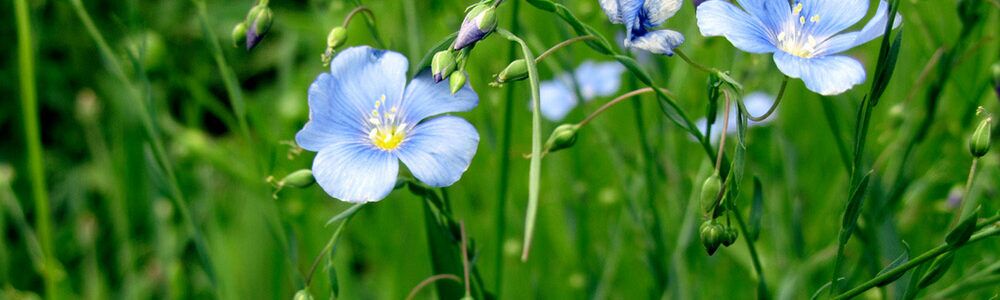
We have collective nouns for animals, like “a gaggle of geese,” “a pride of lions,” and “an exaltation of larks.” So why not collective nouns for plants? How about a “greasing of palms,” or a “pursing of tulips”? Also, the difference between further and farther, the proper use of crescendo, how Shakespeare sounded, and why a child’s runny nose is sometimes referred to as lamb’s legs. This episode first aired November 20, 2010.
Transcript of “A Roberta of Flax”
Hey podcast listener, even though you’re hearing this recorded show, you can still call us whenever you want.
1-877-929-9673. Our voicemail will take your call. Later we’ll listen to it just as we listen to all of them.
And then there’s always a chance that we’ll decide to have you on the show to ask your question or share your story.
On with the show.
Support for A Way with Words comes from National University, where flexible online classes let you earn your degree or credential on your schedule.
Learn more at nu.edu.
You’re listening to A Way with Words.
I’m Grant Barrett.
And I’m Martha Barnette.
I’ve always gotten a kick out of those collective nouns for animals.
You know, they’re the simple ones like a gaggle of geese or pride of lions.
And then they’re the more unusual ones like a smack of jellyfish and a clowder of cats.
Clowder.
Clowder.
C-L-O-W-D-E-R.
Clowder of cats.
And you can find a lot of those in the book An Exaltation of Larks, which is another…
Oh, very well-known book.
Yeah, I love that book.
James Lipton.
Yes, James Lipton.
But I was thinking the other day, why should animals get all the good names?
Why aren’t there great collective nouns for plants?
And granted, it turns out that there are.
Oh, really?
Yes, yes.
I found a lot of those on the internet.
I mean, they’re made up, but they’re really cute.
Try these on.
Yay, internet.
For almonds, how about a joy of almonds?
Oh, nice.
Isn’t that nice?
Are these real?
Are these ones that people invented just to have fun?
These are invented, collected plant names.
Who cares?
They’re still fun.
Go ahead.
Yeah, let me give you some more.
For grapes, a wrath of grapes.
Okay, yeah.
For blue bonnets, how about an oleo of blue bonnets?
Okay.
Like that.
A Roberta of flax.
I knew you’d like that one.
Nice.
A cliche of chestnuts.
Oh, clever, clever.
Nice.
And one more for you.
For hosta, a luego of hosta.
What is hosta?
The plant with the really big leaves.
Never heard of it.
So I’ve got two for you, Martha.
All right.
How about this one?
A flecks of spinach.
Oh, nice.
You know, like Popeye?
Sure, sure.
Okay.
And then, this is my favorite, an ember of chili peppers.
An ember of chili peppers.
Right.
They’re fiery hot, right?
They’re glowing red and they’re going to burn your lips off.
Yeah, nice.
But we do have some kind of collective nouns, but they’re just not really specific, like a bouquet of flowers, right?
Oh, yeah.
Or a sprig of mint.
What’s that?
A sprig is like multiple leaves, right?
Yeah, that works.
Or a mess of greens, one of my favorites.
A mess of greens, yep.
But I’m going to share some more that I found later in the show.
Oh, super duper.
Send your collective nouns for plants to words@waywordradio.org
Or give us a call at 877-929-9673.
Hi, you have A Way with Words.
Hi, my name’s Kat and I’m from Escondido, California.
Hi, Kat, welcome.
Hi, Kat.
Hi, I wanted to talk about spoonerisms today.
Like, you don’t really hear that many spoonerisms nowadays.
Like, I can only think of a couple of them in our modern idiom, you know,
Like maybe punk and drublich or T-mini martoonies, that kind of thing.
T-mini martoonies.
And they only usually refer to being inebriated or something like that.
Those are the only ones I can think of.
You know, why don’t we use spoonerisms more?
Doggone it, why don’t we?
I don’t know, it’s a really good question,
Because they’re just a natural part of the humor of language, right?
Mm—
I read a book that was just nothing but spoonerisms when I was in middle school,
And it got me really into them.
Okay.
So they’ve stuck with you ever since.
Do you use a lot of them yourself?
No, I don’t, but I can always pick them out in other people’s conversations,
And I get really excited when they do.
Sure, because we say them and we don’t notice them, right?
Mm—
What are some of your favorites?
Well, I remember some of the ones from the said spoonerism book
Where lovers killing and booing instead of billing and cooing.
Oh, that’s nice.
You know, a few like that.
Oh, that’s very good.
I like to go back to some of the classics.
What was his name?
Was it William Spooner, the Reverend Spooner at Oxford?
Who was?
It was Dr. Spooner, I think.
Right, Dr. William Archibald Spooner.
Oh, very nice.
Oh, there we go.
He was known for doing this, and this is where we get the word Spoonerism, right?
Right.
Because his last name is Spooner.
And the long phrase that he supposedly uttered,
You have hissed all my mystery lectures.
In fact, you have tasted two whole worms,
You must leave Oxford this afternoon by the town drain.
And what he meant was you missed all my history lectures and you’ve wasted the whole term and you must leave this afternoon by the down train.
Yeah.
Yeah.
He also raised a toast to our queer old dean rather than our dear old queen.
Although, you know, what I’ve read suggests that Reverend Spooner actually got kind of a bad rap.
Oh, really?
Yeah, he was known for doing all these transpositions, but it turns out that it sounds like most of them were done by Oxford college students with too much time on their hands.
By definition, an Oxford student.
Yeah.
And the other thing about spoonerisms that I’ve noticed is that so many of them give you a little snickering chance to sort of do a double entendre.
Yeah.
I mean, people talk about the story of Rinder Seller instead of Cinderella.
You know, she slopped her dripper.
Or I’d rather have a bottle in front of me than a frontal lobotomy.
Me too.
Oh, I’d love that.
Yes.
Yes.
So, yeah.
So you’re a big fan of spoonerisms.
It’s kind of an old-fashioned pursuit, making up new spoonerisms.
Do you make your own?
You know, sometimes I do.
I’m just, I’m generally kind of an old-fashioned person.
I’m really interested in Victoriana and that kind of thing.
Kat, I’ll do credit, but you sound like you’re 22.
I’m 26.
Okay.
So old-fashioned at 26.
Very good.
Well, Kat, this is interesting.
I’m sure we’ll get lots of Spoonerisms favorites from our other listeners, and we’ll share those in the show.
Hopefully.
I look forward to hearing all of them.
Put that in your poke and smipe it.
Thank you so much, Kat, for calling today.
Bye-bye.
Bye.
Oh, I just remembered, we forgot to mention that book by Shel Silverstein that was published after his death, Runny Babbitt, a Billy Sook.
Well, Kat has a great idea.
What are your spoonerisms?
Send your favorites to words@waywordradio.org or give us a call 877-929-9673.
These are sure to be a lot of fun.
Hello, you have A Way with Words.
Oh, hi.
I’m Martin Grant.
This is Ramona Tenorio from Milwaukee, Wisconsin.
Hi, Ramona.
Welcome to the program.
Hello.
I have a question for you.
So I grew up in Milwaukee and my grandfather would make this meal for us.
It usually happens sporadically and was mainly done once a year.
And he called it punnets.
It was kind of how, the way I can describe it is like a meat type of bread, a meat bread.
We call it a meatloaf.
But he grew up on a farm.
He’s of German and Dutch ancestry.
And he grew up on a farm near Newton, Wisconsin.
And so I was wondering if you could help me kind of figure out where punnets have come from,
Its origins, and if there’s other people, if it’s a common food in Wisconsin or other areas throughout the United States.
So you’re going to have to say that word for us again.
It sounded like you said pumice, but that can’t be right.
Clean your teeth, but no.
Can you spell it?
Yeah, I think the family spells it P-A-N-N-A-S.
Oh, very good.
Interesting stuff.
So your grandfather made it and fed it to his family.
Yes, he fed it to his family.
I never actually saw him prepare it, but I’ve heard stories about his preparation.
Apparently it smells a lot when you prepared it.
Smells in a bad way or a good way?
In a bad way.
And people still eat it?
Yes, well, I loved it.
And once it was done and was finally prepared, it tasted delicious.
Its preparation was very arduous.
For example, it was made from pork neck bones.
You would boil the pork neck bones in a big, heavy kettle or a pressure cooker for several hours.
Did you have to say spells over the cauldron?
Yeah, practically.
And you’d make a broth from it.
And once the meat was tender, you would take the meat from the bones, discard the bones, and put the meat back into the pot.
And then after a while, you’d add a couple cups of buckwheat flour or buckwheat pancake flour and or a couple cups of white flour.
I think my grandfather added the white flour just to make it a little softer.
Okay.
And then you would add a pound of liver sausage, and you would stir this up over the stove.
And can you imagine with all of that flour in there, it got very hard to stir.
My grandfather would have these big, heavy wooden spoons that sometimes would break.
Oh, my gosh.
So much.
After that, you would put it in a bread pan as a mold.
Oh, good Lord.
Or you could make a loaf type of form out of aluminum foil and put it in there.
Okay.
And mind you, this is a huge batch.
And you would freeze a bunch of these molds, and then some you’d keep in the refrigerator to chill.
And once they were chilled, you could thinly slice them up, fry them in a frying pan with butter, and then you’d eat it.
All right, now we’re talking.
One more question, Ramona.
Would you put anything on this fried meat bread?
Well, I asked my great-aunt June, who grew up eating this from her mother, which was my grandfather’s sister, and they grew up eating this on the farm.
She often recalled it being eaten on bread.
Or some people would even eat it kind of like a meat pancake and put syrup on it.
So this is a language show, though clearly if we had our way to be about language and fruit every time that we do it.
But you want to know a little bit more about where this comes from, why it’s called that, if you’ve got the name right, if other people use it right?
Right, exactly.
We can help you.
We can help.
Yes.
Wonderful.
Yes.
It’s Pennsylvania Dutch, and, well, it’s spelled a lot of different ways.
P-A-N-H-A-S or P-A-N-H-O-S-S.
Some people call it pawn horse or pony horse.
And it’s kind of spread in that area, Illinois and Pennsylvania, West Virginia.
And it’s the same thing as Pennsylvania Dutch scrapple or very similar to that.
Scrapple.
Scrapple.
S-C-R-A-P-P-L-E.
Yes.
So it’s another kind of dish of mixed meat parts in a little kind of gelatin made into a loaf.
Right, right.
Just using all that extra stuff that you have left over.
I imagine it was a Depression era kind of.
Well, no, it’s been used for a long time that way.
You make the most of what you have there.
Is this strictly American?
Well, it derives apparently from Germans.
So this has a history of hundreds of years.
I’m looking here.
A great resource for this kind of thing is the Oxford Encyclopedia of Food and Drink in America.
And they’ve got a really great entry on Scrapple.
And they mention this dish in the Scrapple entry.
And they talk about similar recipes going back to the 1300s.
The recipe’s got a long history.
Right.
Who’s going to make me some?
Not me.
Not you?
Sorry.
You should see Grant’s biceps.
I think he could help you.
Yeah, you should see my midsection.
I don’t think I need any more Scrapple.
Thanks.
Wow, wonderful.
Hey, thanks a lot for calling, Ramona.
Thank you.
It was tremendous, Ramona.
Bon appetit.
Thank you so much for the food question.
We love it.
Okay, great.
Take care of yourself.
Bye-bye.
Bye-bye.
Questions about food and language together are something that we just can’t resist.
Or send them an email to words@waywordradio.org.
Digging through the email bag here, Grant, we got something from Mark J. Drozdowski in Templeton, Massachusetts.
He writes,
Martha and Grant,
Just curious,
Does Snap, Crackle, and Pop require a serial comma?
No!
A serial comma?
Get it, get it, punch it.
Huh, huh, huh?
Where’s the hi-hat?
Ba-dum-bum.
That’s actually so funny.
I liked it, Mark.
Thank you for sending it.
The place to send your thoughts about language, words@waywordradio.org.
Or call us, 877-929-9673.
A puzzle’s on the way.
Stick around for more of A Way with Words.
You’re listening to A Way with Words. I’m Grant Barrett.
And I’m Martha Barnette. And we’re joined now by our quiz guy, John Chaneski. Yo, John.
Hey, Martha. Hey, Grant. Hi, guys.
Hi, buddy.
Today, I hope you guys are ready for some anagramming.
Oh, yeah.
Yeah, because I’m going to give you a few groups of letters, and you have to anagram them into a word, okay?
Okay, great.
Also, the answer will be part of a common two-word phrase.
For example, if I give you the letters G-S-G-E, you can make what word?
Eggs.
Eggs, right.
And what two-word phrase could describe G-S-G-E?
Scrambled.
Scrambled, right.
Scrambled eggs.
Good.
They’re sort of like wacky wordies, those little graphic representations of words you see in the magazines.
I’ll give you a clue to the phrase, and let’s try a few more.
Okay.
Here’s the first one.
Something found in a bowl at a party.
T-S-U-N.
T-S-U-N.
Nuts.
Some mixed nuts.
Mixed nuts.
Very nice.
Great.
How about this?
Part of a hackneyed phrase, L-I-K-M.
M as in Michael?
Yes, M as in Michael.
Or milk, scrambled milk.
Spoiled milk.
Clothes.
Spilled milk.
Spilled milk.
Very good.
L-I-K-M is spilled milk.
How about this one?
A medical problem, S-K-I-D.
Kids?
Kids are not a medical problem.
S-K-I-D.
Disc?
Slip disc?
Yeah, slip disc.
Slip disc is good.
I’d say ruptured disc is also good.
Very good.
Here’s the next one.
This is a famous hair metal band.
E-S-S-T-R-I.
E-S-S-T-R-I.
Okay, Grant, this is your department.
E-S-S-T-R-I.
Yeah.
Sister.
Twisted Sister.
Twisted Sister.
Oh, good one.
Yes.
Here’s a shout out to D. Snyder, wherever he is.
This is a classic practical joke.
G-C-R-I-A.
G-C-R-I-A.
It’s not a particularly nice practical joke either.
G-C-R-I-A?
That’s right.
It’s not a Murphy.
It starts with a C.
Cigar?
Right.
Exploded cigar.
Exploding cigar.
Or exploded cigar.
Very good.
Oh, man.
Okay.
These are tough.
Now, this next one is three words, okay?
This describes something bad that turns out to be good.
So it’s pretty long.
S-G-L-I-N-E-B-S.
Okay.
Mixed blessing.
Mixed blessing is good.
Good.
I was also going for blessing in disguise.
Oh.
How about scramble blessing?
Scramble blessing, a faulty blessing, anything like that is good.
Here’s something kids learn about in English class.
R-V-S-B-E.
R-V-S-B-E.
Verbs.
Compound verbs.
Not helping, auxiliary, what kind of?
Irregular verbs.
Irregular verbs.
Very good.
And here’s the last one.
This is a common sitcom plot device.
It’s kind of long.
Deus Ex Machina?
No.
Okay.
D-Y-N-T-I-E-N-T.
D-Y-N-T-I-E-N-T.
E-N-T.
It begins with an I.
Identity, but hidden, what do you call it?
Something identity.
Mistaken identity.
That’s it.
Mistaken identity.
Very, very good.
John, that was fun.
Thank you.
If you’d like to talk about grammar, slang, punctuation, or words and how we use them, the number to call is 1-877-929-9673.
That’s 1-877-WAYWORD, W-A-Y-W-O-R-D, or send us an email to words@waywordradio.org.
Hello.
You have A Way with Words.
Hey, guys.
This is Mike calling from Dallas, Texas.
Hello, Mike.
Hi, Mike.
How are you doing?
Hey, doing great. How are you guys?
Super.
Really good.
Well, let me give you a little bit of background as far as what I do.
I am a theater arts teacher.
I teach at a couple of colleges here in the Dallas area.
And oftentimes I’m called upon to teach voice classes, which will every now and then require me to teach certain dialects.
And I’ve always had a fascination with dialects, and I’ve always had this really weird, uncanny ability to pinpoint where someone is from in the United States just by being able to hear a few of their vowel sounds.
And I’m kind of a nerd when it comes to wanting to learn about accents and dialects, and I’ve always had this really, really bizarre fascination and curiosity as to what people may have sounded like in the early part of the 18th and 19th century here in the United States.
I’ve always wondered what people during Shakespeare’s time, how they sounded.
I had this teacher in graduate school.
She was from London, and she worked for the Royal Shakespeare Company for many years.
And she was a big proponent for American actors never, ever, ever using a British accent to do Shakespeare.
Because she said the way that British people speak now is nothing like Shakespeare spoke back then.
And she actually read a monologue from The Merchant of Venice using the accent that she thought Shakespeare probably used.
And it sounded very Appalachian, like the R’s were very hard.
It sounded a lot like an East Texas or maybe even an Arkansas, Tennessee type of accent.
And believe it or not, Shakespeare’s meter flowed so much more nicely than it ever would with hearing John Gilgood or Ralph Richardson do it.
It was really kind of eye-opening.
Yeah, I can see that.
David Crystal is a British linguist, and he’s written a book called Pronouncing Shakespeare.
And in that book, he talks exactly about the things that you’ve described.
When we think about the difference in American and British pronunciations, Americans and British people both make the mistake of thinking somehow that we’re the deviants.
And that the British somehow have persevered through the centuries in speaking correct English.
And it’s simply not the case.
Both branches of English have changed with similar degrees of variety.
And the roticity of English, that is, whether or not they pronounce the R’s, has fluctuated.
It’s turned on and off throughout the centuries as different accents have become prestigious and other accents have fallen away.
And, Mike, I really think you’d enjoy this book, Pronouncing Shakespeare by David Crystal, if you haven’t seen it already.
Because he makes some really interesting points in there.
Like, you know, we have a sense of Shakespearean actors getting up there and speaking in sort of a slow, distinct way.
But he’s figured out from texts that actually they probably spoke a lot faster.
And when the company that performs there at the Globe was performing Shakespeare plays in the original pronunciation or what they’ve extrapolated is the original pronunciation.
The plays were always 10 minutes shorter because they spoke faster and they dropped vowels in the middle of sentences, you know, middle of words.
So it would be like natural.
And at the bottom of it, Shakespeare is he’s writing comedies.
A lot of his stuff is comedies.
And just like modern sitcoms, they can’t be ponderous.
They’ve got to fly.
They have to zoom through and across the audience so that the jokes come fast and furious.
Right. So they would have, for example, dance sequences that they had all figured out that would fit perfectly with the timing of the show.
And they kept going, and they had to redo the dances because the plays were shorter.
Well, this has been a great call.
It sounds like you’ve got some interesting work.
Yeah, and I’m really looking forward to checking out this book.
Yeah.
Thank you.
Yeah, in fact, there are recordings online.
There are, as a matter of fact.
Yeah.
We’ll link to them on the website.
David Crystal has advised a few theater productions on how to do Shakespeare in the original.
And some of these videos are really kind of astonishing.
You’re like, well, that’s not a very good British accent, but they’re not doing the modern British accent.
They’re doing the old one.
And so it’s pretty great.
Thanks a lot, Mike.
Yeah, thanks, guys.
Have a good one.
Our pleasure.
Take care.
Bye-bye.
877-929-9673 or send an email to words@waywordradio.org.
Hi, you have A Way with Words.
Hi, this is Caitlin from Philadelphia, Pennsylvania.
Hello, Caitlin.
Welcome.
Hi, Caitlin.
Hi, thank you.
What can we help you with?
Well, there’s this game that I had always grown up calling a certain thing.
And when I was an undergrad at Temple in Philadelphia, I talked to a few people that were from a different area than I was.
And they always called this game something different.
Spin the bottle?
Not exactly.
Okay.
So this game is when, you know, you kind of sit in a line, and the first person thinks of something that they want to whisper to the next person.
And, you know, on and on down the line until it gets to the last person, and the last person is the one that says it out loud.
And so I always grew up calling this game Whisper Down the Lane.
And some friends that I had at school, this one girl who was from Allentown, a little bit further north than Philadelphia, she called it Whisper Down the Alley.
And then some other people I knew that were from the New England area would call it Telephone.
And I’ve also heard Broken Telephone.
So I was just wondering, you know, are there any kind of geographical boundaries for that?
And are there any other names for this game?
Now, Caitlin, were you playing it in college?
No.
You were just talking about it.
Yeah, I think it just got brought up.
You know, I don’t know why, but I can’t even remember.
But I know we were talking about it, and I had never, you know, I was so surprised because I had never heard these other names for it.
Right.
Right.
Okay.
And the object of the game is to pass a message down the line, and by the end of the line, it’s really different from when it started.
And you’re supposed to whisper it in such a way that other people can’t hear you, only the person that you’re talking to.
Increasing the chances that it’ll be corrupted, right?
Right.
Right.
This is the kind of game that parents pull out when they meant to have a party outside, but it’s raining.
And they’re desperately looking for something to entertain a house of four-year-olds.
Yeah, exactly.
I just thought that telephone was strange because, you know, on a telephone you wouldn’t really whisper.
So I was like, that’s kind of, you know, a little out there.
I mean, whisper down the lake, you know, made much more sense to me.
Telephone.
Yeah, we called it telephone too.
It was a telephone game.
And, you know, we lived in the country for a large part of my childhood.
And so when you got news from one family member, you hung up the phone and immediately dialed somebody else.
And then they did the same thing.
And so before you know it, grandmas in the hospital became grandmas on her deathbed.
You know, it’s just like a slight twist to the content of the message, not necessarily even the words.
So by the time that, you know, people have shortened the story or elongated it, as the case may be.
Grandma bought her horse a pistol.
Yeah, it is interesting that it goes by different names.
I’m not sure that there are any specific regional components, though, unless you’re in Britain.
Yeah, unless you’re in Britain, they tend to call it Chinese whispers there.
Right. I think I actually was looking up, you know, doing a little bit of research online, and I think I read that.
But generally, I feel like whatever article I was reading said, they didn’t typically use it in the United States too much.
Well, I don’t know of any regional variation on this term, but I wouldn’t be surprised if we got a lot of calls about it with other names that people might use.
Telephone game, Chinese whispers, whisper down the lane, those are the most common as far as I know.
Yeah, yeah.
You don’t hear Chinese whispers here because it’s a little politically incorrect.
That’s right, yeah, yeah.
Right, right.
Well, I might recommend to you the book How We Talk by Alan Metcalf.
It’s a very accessible look at regional dialects around the country.
And you might find some more in there that would…
Yeah, I would love that.
Thanks so much for calling today.
All right. Thanks, guys.
All right. Best of luck with your studies.
Bye-bye.
Thank you. Bye-bye.
877-929-9673 or email words@waywordradio.org.
Earlier in the show, we were talking about made-up collective nouns for plants.
I have some more for you, Grant.
Oh, please.
Okay.
How about a gilding of lilies?
A greasing of palms.
I love that.
A tin-tinabulation of bellflowers.
Oh, that’s nice, yeah.
A rash of poison ivy, of course.
A haste of impatience.
And I love this one.
A stan of laurels.
Oh, nice. A stand of laurels. Very good.
Send us your collective plant names to words@waywordradio.org.
Hello. You have A Way with Words.
Well, hello. How are you?
Great. How are you doing?
I’m doing well. This is David calling from Bentonville, Arkansas.
Well, David, welcome to the program. Glad to talk to you. What can we help you with?
Thank you so much. Well, I have an interesting question about the term further or farther.
And which one is which for the purposes of whatever you’re doing.
I was in the process of writing a report,
And I was going to start a sentence that said, to the extent,
Before so-and-so went any further, the meeting was canceled, as an example.
And somebody read it and said, no, that should be before he went any farther.
I said, well, no, it should be when any further.
So we really could not find an authoritative source to answer our question as to which word is more appropriate in that situation.
And so I said the only authoritative source I know is your show.
Yes.
Well, before we go any further, that’s how I would say it.
Is that how you would say it?
Further?
That’s how you did say it.
I think that’s how I did say it.
I was challenged.
And, of course, I didn’t have anything to back myself up with.
So further with the U is what you would use.
That’s what I would.
Yeah, David, unless you were having this meeting on a train.
Oh.
Before we go any farther down the road.
The Ozark Express.
Yeah, yeah.
I mean, generally, further is going to refer to more abstract kinds of things.
And farther, more and more in this country is becoming specifically for distance.
It’s definitely that way in Britain now.
But yeah, I think further was correct in that case.
Yeah, I think you had the right decision.
And there are a couple of reference books that will back you up.
Two of the biggies that we talk about, Brian Garner’s Modern American Usage and the Merriam-Webster’s Dictionary of English Usage.
These basically represent two ends of the style spectrum.
And so conservative or liberal, not in a political sense, but either one of those will support your case.
They’re good to have on your desk anyway.
That’s great. Thank you.
So maybe can I say that for the purposes of remembering this rule,
Can I simply notice that farther starts with the word far,
And that would be anything where you’re talking about a physical distance,
And further is fur, which has nothing to do with anything, but it’s abstract.
Yeah, fur, it’s a little bit more fuzzy, isn’t it?
I never thought of that until you said that, but that’s a great way to remember it.
Thank you, David.
Well, thank you both, and I appreciate the authoritative decision.
Right. I don’t think we need any further discussion, right?
Thank you so much.
Thanks, David.
Thank you.
Bye-bye.
Bye-bye.
Without further ado, that number is 877-929-9673, or you can send an email to words@waywordradio.org.
We were talking earlier about collective nouns for plants.
Oh, you’ve got more?
I have plucked a few more from the internet.
You have sheafs of them, do you?
I do, bringing in the sheafs of collective nouns for plants.
How about this one?
For roses, a war of roses.
For passion flowers, a crime of passion flowers.
A shepherd of flocks.
These are really good.
These are great, aren’t they?
Yeah, yeah, yeah.
A murmur of rhubarbs.
How about the collective noun for tulips?
That would be a pursing of tulips.
Oh, very good.
And last but not least, my favorite.
Yes.
A mommy of poppies.
Isn’t that great?
Yeah, that’s really sweet, actually.
A mommy of poppies.
You can find lots more of those on the web.
We’ll link to some sites on our site.
That’s waywordradio.org.
And in the meantime, call us with your collective nouns for plants.
We’re kicking it Bookman Old Style.
Fonts coming up on A Way with Words.
A Way with Words is sponsored in part by iUniverse, supported self-publishing.
Is there a book in you?
Information available at 1-800-AUTHORS or online at iUniverse.com.
And by National Geographic Books, Publishers of the Last Speakers,
The Quest to Save the World’s Most Endangered Languages by K. David Harrison
From the Emmy-nominated documentary The Linguist.
In bookstores and on the web at shopng.com slash books.
You’re listening to A Way with Words. I’m Grant Barrett.
And I’m Martha Barnette.
Sometimes watching a movie or TV drama about your own profession can get really frustrating.
You know, Grant, you and I both worked in newsrooms,
And sometimes when I watch a film about journalism, I find myself saying,
Wait, that would never happen in a newsroom.
It’s not done that way. You know what I mean?
I always make the radio people beautiful or dashing.
And the problem is?
Well, and I’m sure that this is true whether you work in a hospital or a courtroom, you’re in the military.
You spot things on TV and in films, and you just think that is not right.
That’s not the way it’s done.
Because you have special expertise.
Right?
And you know.
You do.
You do.
Well, pity the poor folks who design fonts and typefaces.
Oh, terrible.
I mean, imagine how painful it must be to watch the movie Ed Wood, which is set in the 1950s,
And then see a sign that’s printed in a font that wasn’t even invented until the 1980s.
I mean, that must hurt if you know what you’re looking at.
Or what if you’re watching a movie that’s set during World War II,
And you see a document printed in Snell Roundhand Bold.
No! Not Snell Roundhand Bold!
Not the snail round and bold, which wasn’t invented until 1972.
I mean, oh, the pain.
Oh, the indignity.
Well, how many people are we talking about that notice this?
Well, maybe not that many, but there are typeface font freaks out there.
And they all know how to write very well, don’t they?
Did you see this stuff on Mark Simonson’s blog?
He’s got a couple posts about typecasting.
For example, he’s taking Mad Men to task.
Beautiful show, well-scripted, just lovely set decoration.
But they keep using fonts that were definitely not from the 1960s, not even variations.
Sometimes a font goes from year to year and it’s changed and modified.
And, you know, it’s got a long like the typeface Century goes back to the 1800s and was used by the Century Printing Company in New York City and has been modified and changed.
New Century School Book and Century School Book.
And we have it and we know that.
But some of these fonts, they simply were brand new.
And, you know, some of this stuff is less than 10 years old.
It’s crazy.
Poor guy’s tearing his hair out.
His name is Mark Simonson, right?
There’s also more about this in a new book that’s out called Just My Type.
Now, this is already a bestseller in the U.K., which often has bestsellers about nerdy language topics, you know.
But you can read excerpts about it online.
It talks about one of the rock stars of the font world who is Matthew Carter.
The New Yorker once described him as the most widely read man in the world because he invented that Verdana typeface that you see all the time.
Sure, yeah.
And Microsoft products.
And if you want to get really hardcore about this.
Oh, please.
Bring it on.
Okay.
You can watch the movie Helvetica.
Aha.
Which is an entire documentary about the Helvetica font.
A single typeface in a film.
I love this stuff.
Oh, good, good.
I’m glad this is a safe space to discuss this.
If you can talk to me about X heights and descenders and ascenders, then we’re all good.
You’re going to be my best friend.
And serifs.
Please, can we talk about serifs?
Your fonts, talk, and crazy language questions to words@waywordradio.org or 877-929-9673.
We’ll link to Mark Simonson’s blog on our website, waywordradio.org.
Hi, you have A Way with Words.
Well, thank you for saying so.
This is Matt Bracey calling from Dallas, and I have a question.
Well, I’m perplexed by a certain choice of words I’ve heard lately,
And I don’t know if it’s just because I’ve just noticed it recently
Or if it’s some kind of a new usage in our culture that I’m just not aware of.
Okay.
Or maybe it’s regional.
I’m originally from Southern California, where I know you are, and now live in Texas,
But I’ve been in Texas for a number of years, so it may just be a new awareness I have.
But here’s the story.
It’s the choice of words between when or whenever.
And I’ll give you an example.
I’ve heard this recently by lots of folks, and they say it so naturally that it must be something that’s ingrained in them.
But, for instance, let’s talk about a surprise birthday party.
He went to his house on his birthday, and whenever he opened the door, his friends yelled, surprise.
I think that should be when and not whenever.
But I am perplexed and I know that you are the people that can help me.
So they use whenever when you feel like they should use when.
Yeah, yeah, exactly.
I think that whenever sort of describes sort of a general rule, like, you know, whenever I walk in my door at night, my dog jumps up on me.
Right.
But if I talk about last night, it would be when I walked in my door, my dog jumped on me.
Right, right.
Whenever my dog died, yeah.
So do you have this, Martha?
Let’s just ask the southern woman in the room.
Do you have this speech feature?
No, I do not.
But you know people that do, I bet.
I do.
All right.
And family members, he’ll say whenever, where you or I or Matt would say when.
When.
Correct.
Correct.
For a single event.
Okay.
Very good.
We have some data on this.
And this is thanks to the research that’s in the dictionary of Smoky Mountain English.
And that’s not to say, Matt, that this is solely from the Smoky Mountains or Appalachia or any place like that.
It’s definitely a Southernism.
And one of the editors, Michael Montgomery, has said in the American Dialect Society’s email list, he said that he believes this particular speech feature comes into American English from the Scotch-Irish immigrants.
And so you will find this in American English where the Scotch-Irish immigrants tend to have settled.
And so that includes large parts of the South.
It includes Appalachia.
It includes folks as far north as the Ohio River Valley and so forth.
I mean, the Ohio River Valley, you’ll hear me mention it all the time, is often a dividing line between different kinds of speech in the United States.
And he’s got a great entry.
He has citations as far back as the 1930s on this of people using exactly like you’re talking about.
Here’s an old one. What did they do with you whenever you killed that man two or three years ago?
Yeah. How many times did that happen?
Right. So clearly it’s a case where he only killed the man once, right?
But yet they use the word whenever.
Yeah. So it’s the influence of history there on the language.
That’s right.
Yeah. They came over on the boats, so to speak, with the immigrants who settled here.
And like a lot of the things that we use and a lot of the ways that we talk in American English, that has just happened to stick with us or some of us.
So it’s a regional, it’s a dialect feature.
I wouldn’t call it wrong because it is perfectly comprehensible among the people who use it.
It’s just that when two dialects encounter each other, we have this negotiation and this renegotiation where we’re trying to say, oh, when you say whenever, I would say when, now I got you.
Oh, wait, we have all those mini Eureka moments.
Yeah.
The book that I mentioned, I highly recommend anyway for this and other things.
It’s the Dictionary of Smoky Mountain English.
It’s bedside reading for me.
I mean, there’s all kinds of great stuff, like what they call moonshine in the mountains, panther sweat, splow juice because it makes your head splode.
There’s great, great poetic stuff in this dictionary, Matt.
I really recommend it.
Oh, fantastic.
I think I know what I want on my Christmas list.
All right.
And, you know, even better, unlike almost every other dictionary in the country, because Michael Montgomery has thick glasses, he made sure they printed it in large type, which I think is great.
I love it.
No pictures, though.
Matt, thank you so much for calling.
Well, thank you so much for your help.
I really appreciate it.
All right.
Bye-bye.
Bye.
Take care.
Heard something interesting you’d like to talk about?
877-929-9673 or email us.
The address is words@waywordradio.org or drop by our Facebook page.
It’s slash waywordradio.
Hello, you have A Way with Words.
Hello, this is Linda from Fort Worth, Texas.
Hi, Linda. Welcome to the program.
Thank you.
What have you got for us?
Well, I have a pet peeve.
My pet peeve is the misuse and abuse of the word crescendo.
-huh.
Crescendo.
-huh.
I’m a professional musician, so I come to this with a working practical knowledge of that word, but I’m seeing more and more it’s being used in a way that’s really incorrect.
So you’re a professional musician.
May we ask what music you play or what kind of instrument are you singing?
I’m a retired symphony orchestra musician.
I’m a bassoonist.
Excellent.
So as a professional musician, tell us about the term crescendo.
What does it mean to you?
The term crescendo means an increase in the volume or the intensity.
And it’s either written out, the word crescendo or an abbreviation, or it’s indicated in the music with what we call hairpins, like a V on its side.
I never heard it called hairpins.
It’s like one of those less than signs, only it’s really big, right?
Really big and long?
Yeah, right, right.
I never heard it called a hairpin.
That’s great.
Thank you for that bit of…
That’s what we call them, hairpins.
And sometimes you’ll see, often actually, you’ll see a crescendo and then a diminuendo, which is the decrease in the sound or intensity.
And so when you see those two indications together, it looks like two hairpins facing each other on their sides.
So that’s where it comes from.
I love hearing professionals talk about their work when I know nothing about it.
We sure do.
We’re fanning ourselves.
This is really cool.
Grant’s making a note.
I’m fanning myself.
So we have the problem here where what’s used in a professional environment has become a little misshapen when it’s used by people outside that environment, right?
Yes, because the way it’s used outside the environment, it’s often used as, oh, it is the peak or the climax.
What would actually be the end of the crescendo, rather?
Because the crescendo is a process of getting to that peak or climax, and instead it’s often misused to say, for instance, the noise in the room rose to a crescendo when actually it’s the crescendo that got the noise to that point.
Exactly.
That rose to, yeah.
Right.
I think, Linda, what’s happening is that people have lost sight or never saw the Latin roots of this word.
If you pull it apart, you see that it’s related to words.
It has to do with growing, and it’s related to words like increase.
Exactly.
And another word that crescendo is related to is crescent moon.
You know, it gets really little, and then it’s crescent.
It’s getting bigger and bigger.
So I see completely what you’re saying, and I like what grammarian Brian Garner has to say about the use that you dislike.
He refers to that as woolly-minded, and I like that, you know.
That’s good.
You with me on that?
I am with you, yeah.
To me, it seems like if you just hear the word, it’s a very appealing, it’s an attractive word.
Musical word.
And so I can understand how, yes, a musical word indeed.
And I can understand how a writer would say, ooh, that sounds great, I’m going to use that.
And then wind up not only misusing it a bit, but missing the opportunity to get the most out of the word.
To get the crescendo out of the word crescendo, right?
Bingo, bingo. That’s right. It’s a seductive word.
I think so.
And the truth is that writers as fine as F. Scott Fitzgerald and William Faulkner have been seduced by that word and used it in the way that you and I would say is incorrect.
So, Linda, I think you’re right. There is a crescendo of people using crescendo in this way.
But if you want to be really precise about it, use crescendo to describe the process rather than the end result.
We appreciate your musician’s perspective on this and thanks for calling.
Sure. It was a pleasure. It was really fun.
Okay, thanks a lot.
Thanks, Edna. Bye-bye.
Bye-bye.
Thank you. Bye.
877-929-9673, or you can send an email to words@waywordradio.org.
In our talk about the word whenever being used for a one-time event instead of indicating an ongoing event or series of events, I came across a couple other forms of the word, which are kind of strange.
These are both conjunctions.
They’re both from the Dictionary of Smoky Mountain English.
Whenevern, with an N at the end.
Whenevern.
So whenevern, it was snowing.
You couldn’t get half the logs out of that brush.
I like that.
And then whensomever.
So it looks like when with some ever at the end.
Grand, often in Appalachia, I’ve heard people say ever when.
Oh.
Ever when and ever who.
Ever who’s coming.
Come on.
Very interesting. That’s new to me.
Share your quirks of English with us, words@waywordradio.org or 877-929-9673.
Hello, you have A Way with Words.
Yes, hello. This is Ben Grenette from Quincy, Florida.
What can we do you for today?
Well, I had a question about, I’m from Indiana, and growing up there, I never remember it from my childhood, but I now have two children.
And my parents, whenever the kids have a runny nose where it’s just dripping down their lip, you know, they call that, they say it has a lamb’s legs.
Lamb’s legs?
Lamb’s legs.
For a runny nose, like the glazed lip, right?
The donut face?
Right, right.
Exactly.
Oh, what a nice question.
I thought it was a fitting question for the show.
Yeah.
So you’ve got a couple of kids yourself.
This is a, I have one, so it’s a common feature of childhood, right, is the glazed face.
Right, right.
So what do you know about this?
Is this something that they learned from their parents?
They don’t know where it came from.
They both grew up in West Lafayette, Indiana.
So what would they say about it exactly?
How would you use it in a sentence?
We need to wipe the lamb’s legs off his nose.
Oh, that’s so cute.
Yeah, so I don’t know if you guys have come across that.
That is fantastic.
Well, it is a term that we see in dictionaries back to, what, the 19th century?
Probably, yeah.
In Britain, either lamb’s leg or lamb’s tail as well.
Although I like the idea of the legs, you know.
The two coming down.
The two little legs hanging down there, I guess.
That’s all I know to suggest is that it’s a resemblance.
So we got it from the naughty Brits, is what you’re saying?
Yeah.
And is this widespread in this country?
No, it’s not in the south or the west so much.
It’s more in the Indiana, Wisconsin.
So north of the Ohio River.
Yes, yes, north of the Mason-Dixon line.
So that would fit perfectly with your experience.
Very good.
I’ve never heard that.
I’ve never heard that at all.
That’s great.
I love it.
It’s terrific, isn’t it?
Yeah.
There’s only one other weird expression like that that I know in English, and that is candle.
Who uses that?
So like a dripping of wax then.
Exactly.
Exactly.
And there’s a similar expression in Spanish.
That’s what made me think about it.
And I looked into it and sure enough, George Eliot wrote about a little seven-year-old vainly contending against candles at his nose by feeble sniffing.
Candles at his nose.
It’s like candle dripping.
Same thing in Spanish.
But I do like lamb’s leg.
That’s nice.
It’s a constant predicament.
The boogery boy in my house is a common feature several times a year.
Right.
How old are your children?
Four and one and a half.
Oh, yeah.
Prying years from Uca’s face.
You have a whole flock of lamb legs there, don’t you?
Yeah, usually at the same time.
Yeah, so we know a little bit about lamb’s leg.
We know that it comes into American English from British English.
It’s got some widespread use.
Still not that common in the Ohio River Valley, especially to the north of that, south of the Great Lakes.
And so your parents are speaking a dialect term that’s part of a larger pattern rather than just something they made up.
Yeah, a longer tradition.
Ben, I bet a lot of people pick this up now.
It’s just too picturesque to pass up, I think.
Right.
Thanks for calling, Ben.
All right.
Thank you.
Take care.
Bye-bye.
Bye-bye.
Have a good day.
Bye.
The Way With Words, brought to you by Kleenex.
Well, give a couple of snots a call, 877-929-9673, or send in an email to words@waywordradio.org.
That’s our show for this week.
If you didn’t get a chance to talk with us today, you can leave us a message even when we’re not on the air.
Call 1-877-929-9673, or email us.
The address is words@waywordradio.org.
You can stay in touch with us all week on our discussion forums or at facebook.com slash waywordradio.
Stefanie Levine is our senior producer.
Our technical director and editor is Tim Felten.
We’ve had production help this week from Josette Herdell and Jennifer Powell.
A Way with Words is independently produced and distributed by Wayword, Inc., a nonprofit organization.
The show is recorded at Studio West in San Diego, California.
Thanks for tuning in.
I’m Martha Barnette.
And I’m Grant Barrett.
Adios.
Bye.
So if you like pajamas and I like pajamas, I’ll wear pajamas and give up pajamas.
For we know we need each other, so we better call the calling off off.
Let’s call the whole thing off.
Support for A Way with Words comes from National University, where flexible online classes let you earn your degree or credential on your schedule.
Learn more at nu.edu.
Hi, it’s Martha.
Did you know that A Way with Words is independently produced by a small nonprofit?
To keep bringing you the show, we need your help.
We welcome your contributions of any size.
Go to waywordradio.org, click on membership.
Your donations do add up, and they make this program possible.
Thanks.
Collective Names for Plants
 Why not have collective nouns for plants, like a “greasing of palms,” or a “pursing of tulips”? Martha shares some others collected on the site of food writer Gary Allen.
Favorite Spoonerisms
Reverend William Archibald Spooner was known for transposing sounds, like raising a glass “to our queer old dean” instead of “to our dear old queen.” A caller shares some favorite spoonerisms.
Pannas
Boil up some pig neck bones, add some liver sausage and buckwheat, mold it in a loaf, then slice, fry, and serve with syrup. Some folks call that scrapple, but a Milwaukee woman’s family calls it pannas.
Snap, Crackle, Pop
A listener asks: “Does the phrase ‘snap, crackle, and pop’ need a cereal comma?”
Anagram Word Quiz
Quiz Guy John Chaneski has a puzzle about anagrams.
How Shakespeare Sounded
What did Shakespeare’s plays sound like in his day? An acting teacher with an interest in dialects wants to know how researchers reconstruct Elizabethan speech.
Whisper Down the Lane
A Pennsylvania college student remembers playing a game called “Whisper Down the Lane.” She’s surprised to learn that her fellow students call the same game “Telephone.”
Further vs. Farther
What’s the difference between further and farther?
Mommy of Poppies
Martha shares more clever collective plant names, including a “mommy of poppies.”
Typefaces in History
Pity the poor typeface designer, always seeing anachronisms in movies and television. Imagine how painful it must be watching a World War II movie only to see a document printed in Snell Roundhand Bold, a font invented in 1972. Here’s typeface expert Mark Simonson’s analysis of the lettering on “Mad Men.” More about the life of font designers in the new book Just My Type by Simon Garfield.
Scots-Irish “Whenever”
Some speakers of American English use the word whenever to refer to a single event, as in “whenever Abraham Lincoln died.” This locution is a vestige of Scots-Irish speech.
Proper Use of Crescendo
A professional musician maintains that many people use the word crescendo incorrectly.
Lamb’s Legs
A father of two small children says his Indiana family referred to a child’s runny nose as a “lamb’s legs,” as in “We need to wipe the lamb’s legs off.”
This episode is hosted by Martha Barnette and Grant Barrett, and produced by Stefanie Levine.
Photo by Rachel Kramer. Used under a Creative Commons license.
Book Mentioned in the Episode
| Just My Type by Simon Garfield |
Music Used in the Episode
| Title | Artist | Album | Label |
|---|---|---|---|
| I Can Dig It | Booker T and The MG’s | Doin’ Our Thing | Stax |
| Spanish Hustle | Fatback Band | Raising Hell | Event |
| Agbara | The Soul Jazz Orchestra | Rising Sun | Strut |
| The Bamboos Theme | The Bamboos | Rawville | Tru Thoughts |
| Expressway (To Your Heart) | Booker T and The MG’s | Doin’ Our Thing | Stax |
| Oakland Blackouts (Instrumental) | Hieroglyphics | Third Eye Vision | Hieroglyphics |
| On The Sly | The Bamboos | 4 | Tru Thoughts |
| Let’s Call the Whole Thing Off | Billie Holiday | All Or Nothing At All | The Island Def Jam Music Group |

