An artist asks strangers to write haiku about the pandemic and gets back poetic, poignant glimpses of life under lockdown. Plus, the new book Queenspotting features the colorful language of beekeeping! Bees tell each other about a good source of nectar by doing a waggle dance, and when a queen bee is ready to mate, she flies around followed by a drone comet. Also, do you refer to that savory red stuff dripped over your pasta as sauce? Or gravy? And: a brain teaser about homographs, dog a door, granny beads, skinnymalink, embrangle, euphemisms for urination and defecation, dry up and bust, I’m gonna cloud up and rain all over you, and more.
This episode first aired July 11, 2020.
Transcript of “Queen Bee (episode #1550)”
You’re listening to A Way with Words, the show about language and how we use it. I’m Grant Barrett.
And I’m Martha Barnette.
Not long ago, the Orange County Museum of Art commissioned the Los Angeles artist Alan Nakagawa to do a project about social distancing.
So he invited people to write and record their own haikus about their experiences during lockdown.
The result was an online audio collage that he called Social Distancing Haiku and You.
And it’s online at his website, ellennakagawa.com.
And Grant, these are really good.
You know, the 5-7-5-syllable format of haiku really lends itself to this moment somehow.
I wanted to share some of these with you.
Yes, please.
Some of them are just beautiful, like this one from Mark Romanek.
No traffic, no planes, distant laughter drifts over the canyon.
Only birdsong now.
That’s really evocative, right?
Yeah, and that’s what it was.
I live next to freeways, and it was astonishing how little traffic there was at the start of the lockdown and quarantine.
It was eerie.
Here’s another one.
Sunshine warms the ground.
Trees dance outside my window.
I dance by myself.
Oh, that’s a little sad.
I know.
I know.
It’s sort of beautiful and poignant all at the same time.
That’s by Ann Tracy.
And then this one, I’m sure lots of people will appreciate.
This one’s by Leslie Rose.
The space between us in the grocery aisles, every face masked.
You know, it reminds me of petals on a wet black bow.
Yeah.
Yeah.
Because the socialness of shopping where you’re talking about produce or running to somebody that you know is hindered or muted by the masks and the distance.
Yeah. Some of these really pack a punch. Here’s one by Veronica Hosking.
Festive ambiance. She does not reveal her wish. Quarantine birthday.
I just feel like these are little Zoom windows on people’s lives, you know?
Yeah. We’ve all had this experience now. What else have we all shared in recent decades so much as this?
Yes. Yes.
In a society where media is fractured and lives are increasingly complex, this is one thing that we’re all undergoing.
We haven’t done this as a society in a very long time where we’ve all had one experience.
That’s really interesting.
Yeah, it’s something that everybody can instantly relate to, I think.
Here’s one more I’ll share with you that I think you’ll appreciate.
Yellow bananas grow black spots like cheetah fur.
Time to bake some bread.
It’s true in my house, absolutely.
How much banana bread have I eaten?
And regular bread and muffins and cakes and cookies.
Yeah, that one was by Sandra Payne.
But I just love the quality of the haikus that came in.
Oh, people are fantastic, aren’t they?
Yeah, I’ll share some more of those later in the show.
And you’ll share the link to the website, right?
Right, alannakagawa.com.
If you’d like to share a haiku with us about anything that you’ve been experiencing,
Please do, and we’ll perhaps share it on the air, 877-929-9673.
Email words@waywordradio.org or share it on Twitter @wayword.
Hello, you have A Way with Words.
Hi, this is Melissa Barkell from Grand Prairie, Texas, which is in Dallas County.
Yeah, hey, Melissa, what’s going on?
I’m calling because I come from a New Jersey Neapolitan family.
And recently in a forum I was in on Facebook, the question came up of the use of gravy to refer to pasta sauce.
So a Neapolitan family from Napoli in Italy.
Specifically, Caserta is where my family is from, but that’s part of Napoli, yes.
Okay. And gravy for red sauce?
For red sauce. My understanding growing up was that it was only red sauce that had meat in it.
So like marinara would be marinara, but tomato gravy has meat in it, usually meatballs or sometimes pancetta or prosciutto.
That’s what we call it in New Jersey thing also.
We leave off the final syllable of a bunch of words.
Neapolitan Italian is nothing like proper Italian.
And then when you add Italian-American to it, it becomes a whole nother thing.
And Melissa, was this discussion about gravy, was it by any chance heated?
It was pretty civil, considering it was a Facebook forum, and you know how people are on the net.
And it was all women, which I think made a difference.
But yes, the actual Italians and the Italian-Americans were getting into it.
Well, that’s not surprising, is it, Grant?
No, it’s not surprising at all.
This has come up before.
We last talked about this on the show, what, more than 10 years ago, I think, Martha.
And I’ve seen this pop up again and again, even on television and, of course, on the Internet.
And you’re so right.
People get heated about this. It’s not a surprise that it’s a Neapolitan family. And I wouldn’t have been surprised if you said you were Sicilian either, because the Sicilian Americans also do the same thing. They tend to call the red sauce gravy. And the why, and the why is important. I think you zeroed in on it. It’s because the dialect that you speak has this particular feature where the word for sauce in the local language can be translated as either sauce or gravy into English.
And so when they came over, that’s what they chose. Sometimes they chose to translate it as sauce and sometimes they chose to translate it as gravy. And it isn’t only the Italian Americans around the New York City metropolitan area, because it’s New Jersey and Connecticut and New York where they do this, but also in New Orleans. And it’s one of the local pride things there as well. They often call red sauce gravy. And again, you got something else really important there. Many people say without meat, it’s tomato sauce, and with meat, it’s gravy. So there is a distinction there.
There’s a really interesting line in Craig Claiborne’s New York Times Food Encyclopedia. He says, or the book says, basically a sauce and a gravy are the same thing. A sauce is, to my ears, simply a more sophisticated and better sounding word than gravy. Although he does go on to talk about using thickeners in gravies and that gravies would not be as refined as sauces. But I think that’s a really important point. Sometimes it is really just a different choice in words rather than a different choice in ingredients or a different choice in what constitutes the food that we’re eating.
Oh, interesting. I had no idea about New Orleans. That’s interesting.
Yeah, right. Well, it’s also because, well, New Orleans had a long tradition of Italian immigration. There was one point where the French Quarter in New Orleans was 80% Sicilian.
And as a matter of fact, they called it Little Palermo.
Oh, that’s fantastic.
Gravy is used to mean red sauce in the 1990 movie Goodfellas.
And you’ll find it used that way in, believe it or not, the Sopranos family cookbook.
Like, who knew that that existed?
But also in The Sopranos, the television show about an Italian-American mobster family from New Jersey.
And there’s a moment where a bunch of the guys go to Italy and Pauly, one of the mobsters, orders gravy with macaroni in this real nice Italian restaurant,
And he explains that he means red sauce.
And one of the Italian guys that they’re with in this nice restaurant turns to another one and says in Italian,
And you thought the Germans were classless,
And making fun of the Americans, the Italian-Americans, for asking for red sauce because it’s considered a low class because these were poor country people who came to the United States and did well for themselves and then came back thinking, I’m Italian, only to find out they’re a different kind of Italian.
My cousins had that happen when they went back to visit old relatives.
They were like, oh, these are our American cousins.
Yeah.
And it was very jarring for them.
I bet it is.
Anyway, yeah, so red sauce called gravy is a real interesting thing.
I love how it plugs into these immigrant roots and these paths that people took where, I mean, we’re talking about a time in American history where Italy was undergoing these upheavals of conflict and strife and poverty and even starvation.
And people were leaving by shiploads to come to the new world and strike out for themselves.
And they brought some of home with them.
And some of that was recipes and the ways of making food and the language that came with it.
And here it is in your mouth.
Here these words are.
Here you’re speaking it because I love it.
History right there in your mouth, Melissa.
That’s a great expression.
I love it.
Well, thank you for talking with me about it.
Oh, yeah.
We were delighted to talk to you, Melissa.
Call us again sometime, all right?
I would love to.
Thank you.
Bye-bye.
Bye.
Little did she know that our favorite calls are food and language together.
How are we going to pass that up?
That’s right.
This is, you know, radio that’s wafting up your nostrils, right?
And in your ears.
Well, give us a call about language, 877-929-9673.
Hello, you have A Way with Words.
Hi, my name is Emily.
I’m calling from San Diego, so I’m not too far away from you guys.
No, not at all.
Not at all.
Well, welcome to the show, Emily.
What’s on your mind?
Thank you.
Well, I had been recently going to a facility where I had to close the doors when I left.
And I noticed that there was this phrase on the door that said, to dog the door, you’ll do this.
And to undog the door, you’ll do this.
And I had never heard the phrase to dog a door before.
And I was speaking to one of the owners of the facility, and I told him when I left, because nobody else was there, that I had dogged the door.
And he laughed at me, and he said, oh, that’s an old military term.
And I was just wondering the origins of to dog a door or to undog a door.
Undog a door.
Dog as in D-O-G?
Mm—
Like a pet dog.
Mm—
Yeah.
So you said it was there was a connection with a military, a Navy, perhaps?
Yes.
Yeah.
Well, at least that’s what the owner told me.
That was a term that had originated maybe from the military, but I wasn’t sure.
Yeah.
On a seafaring vessel, if you dog the hatches, it means you’re tightening down the handles on the doors that have a gasket around them so that it makes them watertight.
The hatch is in the floor.
And you can dog the hatches, which means to secure them.
The term dog has been applied to a lot of different things, including a bolt or a handle that’s used to seal a hatch.
It sort of fits into something else, like a notch, and it secures something.
And I think that the origin is probably that it’s as tenacious as a dog that clamps its jaws around something.
Yeah, that’s what I would say, too.
My mom suggested that maybe it was that you leave the door open because it had to do with dogging and undogging the door, leaving the door open or leaving the door closed.
And my mom suggested, well, we leave.
There’s dog doors that we have to let the dogs go in and out.
Yeah, or maybe you’re waiting for the dog to.
I think they’re much older than dog doors.
I mean, we’re talking about at least the 1800s for the nautical sense and 1300s for other kinds of clamps that have to do with fastening in construction that are called dogs.
Yeah.
Yeah.
The dog that I’m most familiar with is that kind of latch that’s in an extension ladder that secures it.
You know, you stretch it up and then you secure the rungs with what’s called a dog.
So if you dog the doors or dog the hatches, then you’re sealing them shut with a little latch.
Okay, that makes sense.
I have a bone to pick with one of my dictionaries.
It calls this verb chiefly historical.
And I think it’s, here’s Emily telling us it’s still in current use.
Yeah.
Yeah, it’s actually, it’s a sticker on the door.
It’s just to undog the door and to dog the door.
Yeah, it’s definitely something that I guess is still used.
Thanks so much for calling, Emily.
That’s a great one.
Right.
All righty. Bye-bye.
We’d love to talk to you about this word you ran across and you couldn’t believe it.
Email words@waywordradio.org or chitchat on Twitter @wayword.
This show’s about language examined through family, history, and culture.
Stick around for more.
You’re listening to A Way with Words, the show about language and how we use it.
I’m Grant Barrett.
And I’m Martha Barnette.
And joining us now is our quiz guy, John Chaneski.
Hey, John.
Hey, Martha.
Hey, Grant.
How are you guys?
Hey, bud.
You know, we’ve done quizzes before about homophones, and of course, and homonyms, I’m sure.
I’ve lost count.
But I think this is the first time I’ve attempted a quiz about homographs.
Now, as you know, homographs are two words that are spelled the same, but have different meanings and sometimes often different pronunciations.
All the pairs we’re talking about today have different pronunciations.
For example, suppose I commissioned a painting of the planets, but the artist included the imaginary lines about which each planet rotated.
I might ask him to get rid of those.
Then I’d have to wait while he axes axes.
Got it?
Yeah.
Now, that’s not a good example, I know, but I’ve saved the best for the quiz.
So here we go.
Okay.
I was watching a movie about a medieval siege of a castle.
They had these tall, multi-tiered constructions on wheels, which were yanked up to the castle walls.
Now, what would you call a serf whose job it was to pull along one of these portable, mass-like structures?
A serf who pulled one of these structures.
They would be…
Is this a military term?
No, no, no. This is just a common word.
A common word.
What do you call a tall, multi-tiered structure?
Oh, it’s not the name of the serf, it’s the name of the structure?
Well, we’re going to say what it is this guy is doing.
I know what it is.
Oh, I see.
What do you got, Mark?
It’s a tower tower.
He’s a tower tower.
Yes, nicely done.
Oh, I see.
All right.
Hey, remember those novelty fish trophies that used to sing songs?
Suppose you purchased one and you found you had a very, very low vocal range.
What is that?
It’s a bass bass.
Bass bass, yeah.
If you’re a ship’s captain with a certain flair,
You might eschew a figure of a woman for the prow of your ship
And instead opt for a colorful ribbon tied in a fancy knot.
What’s that?
A bow bow.
A bow bow, yeah, or bow for your bow, a bow bow.
I’m writing a book about the periodic table,
Including short articles for each of the elements.
What I need is a strong opener for the article about the heavy metal
Whose atomic number is 82.
What would that be?
Lead lead?
Lead lead?
My lead lead, yes, exactly.
Not that I know all the elements.
I was just thinking about that word.
I happen to know that one.
Very good.
Now we all know what number 82 is.
There we go.
You know how they say time flies when you’re having fun?
Well, I’ve only been with you guys for about 60 seconds,
But it seems like a very, very, very tiny amount of time.
What’s that?
A minute minute.
A minute minute, yes.
Now, of course, we live in the future.
When I was in grade school, I had to create dioramas and show them on my desk.
Now, my kids can make them online and use a computer to display images of them on the wall.
What does it do?
Project projects?
Yes, it projects projects.
Nicely done.
And those are my homographs for today.
I hope you like them.
You were great, John.
Thanks.
This show’s about language and everything related to it.
Give us a call.
We’ll talk about it.
Slang, new words, grammar, something weird you heard, something the grandkids said,
Something you said, 877-929-9673, or email us, words@waywordradio.org.
Hello, you have A Way with Words.
Hi, this is Angela from Dallas. How are you?
Welcome to the show.
Thank you, guys. I’m excited to be here.
My question is, when I was growing up, my mom used to say, we’d come in from outdoors from playing and she would say, make sure to wash your granny beads. And at the time, I don’t know, like looking back if I don’t remember, but I didn’t even question it. And I knew that it had to do with washing my neck. But as I got older, just the other day, I came in from a long run and I thought, God, I’m really dirty. And I thought, oh, I need to wash my granny beads. And I thought, oh, I wonder where that saying came from because it sounds so, well, it sounds kind of ugly, you know, like against like saying like maybe older people are dirty or something.
And I was like, I wonder where that came from.
So I asked her and she said, well, I don’t know where it came from, but my mom used to say that to me.
So what do you guys think?
So what would your mom say to you?
Can you say that again, please?
Make sure you wash your granny beads.
Granny beads.
B-E-A-D-S.
Granny, like grandma?
Grandma.
And actually, I call my grandma Granny.
So Granny Beads, B-E-A-D-S, like a necklace.
Okay.
Gotcha.
Well, you’re exactly right when you describe it as being like a necklace.
You know, a little kid gets out there in the dirt and is playing around and getting sweaty.
And they have those creases in their neck and they get clogged with sweat and dirt.
And they do look like a necklace, kind of, right?
Oh, well, I’ve never had kids, so I don’t know.
We called them dirt necklaces when I was a kid.
Oh, did you really?
Yeah.
Oh, no kidding.
Oh, how funny.
So do you think that’s something they use all across the United States or just down here in the South?
Definitely in the South.
There’s a country singer named Randy Hauser who about 10 years ago, he had a hit song called Boots On that’s sort of about going out on the town after you’ve been working hard all day.
And he has a little part in there where he talks about sporting his dirty old hat and crooked little grin and granny beaded neck.
And apparently he had to explain.
Yeah, you’ll have to look up this song, Boots On, because it’s a great song.
But he apparently was asked about this.
And he said that granny beads are what they’re called when a grandma works in the garden all day.
And they have a handkerchief around their neck with a lot of dust on them.
And then the sweat will go down and make these black beads of dirt and sweat around their neck.
So I can just see like little kids, you know, thinking, well, I’m wearing a necklace like granny.
Of course, you get them other places besides your neck, right?
Like behind your knees and in your elbows.
Right. Right. Yeah.
Yeah, I’ve seen those.
Well, thank you guys so much. That’s very interesting.
And I hope everyone is watching their granny beads.
Take care, Angela.
Be well.
Thanks, Angela.
Bye-bye.
All right.
Bye-bye.
But you know, there’s another path we might consider, Martha.
In the 1920s and 30s, there was a trend for young women to wear something called granny beads.
These were plastic or glass beads strung around your neck.
Lots of them, like big loops of them, almost like Mardi Gras beads you wear with a dress or an outfit.
And they weren’t expensive or anything, but they were stylish and colorful, and you’d just throw them on.
And maybe that’s what the saying refers to.
Yeah, it could be.
There’s a long history of wearing granny beads one way or another.
But they weren’t necessarily for grandmas, but for some reason referred to grandmas.
Yeah, I could see that.
Well, you know, it’s funny how often our calls start with a memory
And turn out to be something that the young generation still says and still remembers, right?
Yeah.
There’s a bridge here from 100 years ago or 150 years ago,
And the past is still present.
And you can tell us that present.
Email words@waywordradio.org or start a conversation on Twitter @wayword.
Here’s another haiku from the online art project called Social Distancing Haiku and You.
It’s by Stephen DeLauro.
At 7 o’clock, sound of many hands clapping.
Not alone.
Hooray.
Right.
So this is the people applauding the health care workers and the people on the front lines of the pandemic.
Yes.
Everyone’s going out there to express just this minimum amount of public appreciation.
I mean, it’s the least you can do, but it’s a start.
Yes, this is what’s so wonderful about haiku, right?
You have a whole image, whole picture.
So few syllables, and to explain it takes pages.
Exactly.
Send us your haikus, 877-929-9673, or put them in an email.
The address is words@waywordradio.org.
Hello, you have A Way with Words.
Hey, Martha, how are you doing today?
Well, I’m doing well.
Who is this, and where are you calling from?
This is Sean calling from Reno, Nevada.
Sean, welcome to the show.
How can we help?
About a year and a half ago,
You had a lady call from the Midwest to the East Coast,
And she called about a word about skinny malink.
We grew up, you know, 50 years ago,
We grew up in the north of Ireland,
Actually playing a game called hopscotch,
And we always played it to that word skinny malink.
And I couldn’t remember it,
I had to go back to my sister in Ireland last year and ask her,
What the one?
And I went, skinny, malink, malogian legs, big banana feet.
Went to the pictures and couldn’t find a seat.
When he found a seat, he fell fast asleep.
Skinny, malink, malogian legs, big banana feet.
And I thought, I guess, that’s the way it went, you know, right?
I was going, Christ.
I took my, obviously, my older sister,
Who’s a vice principal in a primary school,
She taught that all to all the kids in her school as well.
But the real question that I was calling up about was,
We had a sense, you know,
I know I would drive over the Sierras to the Bay Area,
You know, every couple of times a year,
And we’d go to watch a game of football called Gaelic football,
Which is actually very different than, you know,
American football or anything else.
But anyway, afterwards we would go to a den of iniquity,
Or a pub in the Bay Area, as you do, if you’re an Irishman.
But always, we would be chatting about people, and they would go,
Oh, he’s a narrowback.
And I always wondered, was that saying narrowback,
Was that like a Bay Area saying, or was it just truly an Irish saying,
Or was it said in other different communities, if you know what I mean?
You know what I mean?
Was it said to – so it really meant – I mean, it wasn’t derogatory.
In any terms at all.
It was actually very friendly,
But it really meant that there was a second
Or third generation Irish-American
That actually didn’t have the broad back
That maybe his grandfather would have had, you know?
And he probably had a professional job
Rather than, you know, working on the roads
Or working on whatever they did.
I was wondering, did you know the terminology
Of where it came from?
Is it truly just an air saying, or is it actually used in other communities?
Yeah, you’re right. It’s not a great insult at all.
I think people have tried to turn it into one, but it never really stuck,
And the Irish-Americans have long used it amongst themselves,
Although I think it’s kind of fallen out of fashion.
And you will occasionally find it in old newspapers referring to someone
Who’s never done hard labor, whether they’re Irish-American or not.
And sometimes you’ll find it referring to commissioned officers during World War I
Who went from being office clerks to officers
And didn’t have the stamina to keep up with the enlisted men.
And it’s kind of the same idea.
These are people who have never really done,
Never had to dig ditches, you know, never had to do hard labor.
It was occasionally used to refer to people
Who were in favor of alcohol prohibition in the 1920s,
But not often.
But the earliest I can find it is in the early 1920s
To refer to Irish Americans.
And it’s exactly as you refer to it.
It’s exactly as you mention it.
It’s just the idea that these are people who really have never had to carry a hod loaded with bricks up scaffolding in order to help build buildings.
They’ve never had to build the back muscles to do the heavy lifting and the hard labor that their fathers and their grandfathers did.
So it is an Irish-American thing?
Mostly. It’s mostly used among Irish and Irish-Americans.
But it’s American. It’s an American term.
You won’t often find it used in Ireland except by people who are talking about Irish Americans.
All the records show that it is widespread and has been used across the country since the 1920s and probably earlier than that.
So it’s not specific to California or the Bay Area.
And like I said, it has fallen out of fashion.
It’s less frequently used now because the Irish don’t come to this country in the numbers that they once did.
And when they come now, they usually come for professional purposes and not to do the hard labor jobs like they did in the last century.
I love your show.
I like listening to it a lot.
When you mentioned the word skinny malinka a couple of years ago, I had to stop the car.
I was driving the car.
I go, I built this for you.
Thank you so much, Sean, for your call.
It came from that poem.
All right, guys.
Have a good one.
Take care now.
Thanks, Sean.
Sure. Bye-bye.
Bye-bye.
Bye-bye.
There are versions of that rhyme that Sean shared with us all over,
And one of them is in one of my favorite books,
The Lore and Language of School Children by Iona and Peter Opie.
Yes.
Skinny, malinky, long legs, big banana feet,
Went to the pictures and fell through the seat.
Grant, remember our conversation about all the terms that mean the same thing as go sit on a tack?
Right, the things telling people to buzz off or go away.
Yes, yes.
We got a tweet from Ben England who says that in high school, those of us who were math-minded would quip with a go divide 22 by 7.
Which gives you an infinite answer, right?
It’s suspiciously close to pi.
Just you keep putting those numbers at the decimal and there’s just not enough room on the page.
Go divide 22 by 7.
And go to your phone and call us 877-929-9673 or send your questions and stories about language to words@waywordradio.org.
Hello, you have A Way with Words.
Hi, my name is Amy and I’m calling from North Carolina.
Hi, Amy. Welcome to the show.
So I had a question.
My husband and I were driving home from the beach where we frequently listened to your show.
And he said, you know, you should call them and find out where that thing your mother always used to say.
And what that thing was, was when she would, first of all, I have eight siblings.
So things used to get a little hectic in my house sometimes.
I guess so.
And my mother would tell us when we were just really annoying her and complaining about how unfair life was and somebody was being mean to us, she would say, oh, please, just go dry up and bust.
And we wondered where that came from and what exactly it meant.
Well, I knew what it meant, but where it came from, I guess, is the question.
We all knew what it meant.
Oh, my.
So your mom had eight kids running around.
She had nine.
She had nine.
Nine kids.
Yeah.
Oh, my goodness.
Yeah, yeah.
And so it would be when you all were making a lot of noise or complaining or?
So when we couldn’t have something we wanted and we, you know, can’t we do this? Can’t we do that?
And she’d say no.
And then we’d keep at it.
She’d say, listen, you guys just need to go try out and bust because it’s not happening.
Try up and bust.
I say it to my kids when they were little, and they just used to look at me and say,
And how do we do that?
Right.
Oh, that’s wonderful.
Well, you know, Amy, since the mid-19th century, dry up is meant to stop talking.
It’s meant to be quiet, to stop the flow of words from coming out of your mouth.
Just the term dry up.
And I’m thinking that dry up and bust, maybe if you stop that flow of words, they’re going to build up and you might bust.
Although another version of this is dry up and blow away.
And I think both of those phrases just suggest stop talking and disappear.
Well, that’s sort of the gist we got was to just disappear.
But she said it good-naturedly, it sounds like.
Yeah, yeah, pretty much.
Pretty much?
Well, yeah, that’s pretty much what it means.
Dry up means to be quiet.
And in fact, in the theater world, people use the term dry up to mean to forget your words, forget your lines.
Somebody dry it up.
Oh, huh, huh.
So there you go.
One more thing before you go, Amy.
There’s a fancy version of this, which is desiccate can also mean to stop talking.
You tell somebody to desiccate themselves.
Oh, that’s wonderful.
I didn’t know that, but that literally means to dry up.
That’s right, yeah.
Interesting.
Thank you so much for your call.
We really appreciate it.
All right, great.
Thanks for calling.
Bye-bye.
All righty, bye.
Dry up and bust.
I never hear that.
Do you, Grant?
No, no, that’s kind of old-fashioned.
It looks like it might be kind of a Western American countryfied term, right?
Kind of a cowboys and, I don’t know, ranches and gold rush kind of word, right?
Yeah, just like dry up and blow away across the prairie.
Yeah, yeah.
It feels like tumbleweeds.
Don’t dry up.
Let it flow.
More about what we say and why we say it.
Stick around for more of A Way with Words.
You’re listening to A Way with Words, the show about language and how we use it.
I’m Grant Barrett.
And I’m Martha Barnette.
And Grant, I’ve been reading up on a topic that has so much interesting language,
I know you’re going to dig it.
Oh, yes, please.
Here’s some of the terms that I’ve encountered.
Cuddle death, piping, tooting, quacking, drone comet, and waggle dance.
This sounds like flatulence.
You’re reading about flatulence in humans.
No.
Hippopotamuses.
No.
Dinosaur sex.
The sex part you’re getting closer.
Oh, penguins.
Penguin sex.
Why penguins?
I don’t know.
Cuddling.
I was just thinking about penguins cuddle in the cold.
That’s all.
Oh, oh, oh, oh, oh.
Okay, what was it?
What were you reading about this time, Martha?
These are all terms involved with beekeeping.
Oh, of course.
I should have known the dance was the giveaway.
Yeah.
I should have remembered that from my Sherlock Holmes.
Sherlock Holmes? Really?
Yeah, he was known as a beekeeper.
Oh, really?
Okay.
I’m going to have to go back and read Sherlock Holmes then.
Well, it’s usually in the extended canon, the stuff written by other authors.
Not by Conan Doyle.
Okay.
I didn’t know that.
But I will have to check that out because I’ve been
Having the best time learning about beekeeping from a wonderful book called Queen Spotting.
It’s by Hilary Kearney, and she’s a beekeeper herself.
And the book is this great introduction
To the amazing lives of bees, including this kind of language that I’m talking about.
For example, every hive has to have a queen bee, and she’s responsible for laying both fertilized and unfertilized eggs to perpetuate the colony.
And if a hive has a queen, then the hive is said to be queenrite, queen, R-I-G-H-T, which is a super cool word.
But if the queen becomes sick or injured or otherwise unable to function, it’s time for her to be replaced.
And this means it’s time for her to experience cuddle death.
And cuddle death occurs when worker bees cluster around her in a tight ball and use their collective body temperature to heat her until she dies.
Ooh!
Yeah, I mean, you can pick up a hot ball of bees, like about the size of a tennis ball, and you will feel the heat.
And that’s called cuddle death, or also called bawling the queen.
Queen bees also make these distinctive sounds called piping.
And there are two types of piping.
One is called quacking and the other is called tooting.
Again, you can go to YouTube and watch videos, as I’ve been doing, of queen bees tooting.
And when they toot, you see all the worker bees stop.
They’re like, what? What’s going on?
It’s just the hive comes to a stop.
It’s so cool.
They’re listening to find out what the queen wants.
Yes.
What does the queen decree?
And I got some more here because I’m so excited about this.
The worker bees are all female, and the less numerous ones are the males called drones.
And a queen mates only when she’s flying through the air, and she’s followed by what they call a drone comet,
Which is a whole bunch of male bees, up to 100 male bees, chasing after her.
And then they mate in midair.
And then we were talking before about the waggle dance.
That’s when a foraging bee finds an especially good source of nectar and comes back to the hive
And directs everybody to this source by doing this dance in a figure-eight pattern.
And she’s waggling her butt during part of that pattern.
And the waggle tells them the direction of the nectar and also how far away it is.
It’s just, it’s wild.
That sounds fantastic.
Oh, bees are, I think they should take over for the humans.
It sounds like they have their act together.
Yeah, the way they communicate is just extraordinary.
I mean, I originally looked into this because I was really curious about harvesting honey, but honey is the least of it.
It’s so cool.
So I want to recommend this book called Queen Spotting by Hilary Kearney.
And you can find out more at her website, which is called girlnextdoorhoney.com.
And I should add to Grant that the website and the book are gorgeous because she has a background in art, as it turns out.
And the book is full of photographs, including all these fold-out photographs of bees in beehives, like close-ups.
So you can practice spotting the queen in each hive because she’s a little bit different.
So it’s like, where’s Waldo but for bees?
Do you think I’m excited about this? Have I got you excited about this?
Oh, yes, absolutely. Your excitement is contagious.
Thank you very much for sharing the language and the book and the excitement.
We’d love to hear about what you’re reading.
We’re always interested, 877-929-9673, or tell us about your reading habits in email to words@waywordradio.org.
We heard from Keith Johnston in Rosemead, California, and he writes,
A phrase my father used to use with us kids when we were acting up, usually said in a lighthearted way,
But certainly got the message across, was, I’m going to cloud up and rain all over you.
Do you know this one, Grant?
No, I’ve never heard it, but I get the message.
Yeah, it doesn’t take much, right?
I’m going to straighten up.
Right.
Keith said he did some research and found that there was a song by that name,
And he was wondering if the psalm came first because his father wasn’t a particular fan of country music.
And I did a little digging.
I’m going to cloud up and rain all over you goes back at least to 1911.
And it was popularized by a rockabilly singer named Danny Denver in the 1960s.
And there are different variations of this, like I’m going to cloud up and rain all over you and you’ll be walking home in the mud.
That’s good.
Similar maybe to rain on your parade.
Yeah, but just you specifically.
Right, just you.
Thanks, Keith.
Hello, you have A Way with Words.
Hi there, my name is Julia. I’m calling from Norfolk, Virginia.
Hey, Julia, welcome to the show.
What can we do for you?
Thanks. So I was talking with a coworker the other day, and we got stumped on trying to find a word.
We were working on a project and a coworker of ours had worked on it.
When he received it, it was a pretty simple project.
And then by the time we got to it, it had kind of gotten all messed up.
And so we’re trying to figure out if there’s a word to describe a person who takes something pretty simple and really overcomplicates it and makes it a lot more difficult and more time consuming than it needs to be.
Or if there’s a word to describe the action of doing that.
Oh, I know those people.
Can you go into more detail about what kind of project it was?
It was just like a review of some work that he had to go through.
We do these all the time.
And so he just, it’s a pretty straightforward process we do all the time.
And in just going through that process, he just kind of ended up like just going down a bunch of rabbit holes
And kind of just elongating the process in a lot of ways that just made it take a lot longer for him
And then for us to go back and to fix it.
Oh, yes.
I think Grant and I both know that experience.
This reminds me of the people who at the end of a long meeting
When the speaker says, does anyone have questions?
They have questions.
And you’re like, no, no, you don’t.
You don’t have questions.
Put that hand down.
That was rhetorical.
We’ve been here four hours.
Especially today with all the video meetings now.
Right?
Yeah.
That’s not a question.
That’s a statement anyway.
Shush.
Mute yourself.
I like your word elongated.
I’ve never heard anybody describe it that way, but that’s a good one.
It just stretches out, right?
How do you describe these people, Martha?
Do we want a verb or an adjective or just mean looks?
I tell you, I’m thinking of that acronym KISS.
Do you use that in your workplace, Julia?
KISS for keep it simple, stupid?
I think I have heard that before, but I’ve never used it.
Yeah, well, you know, the opposite of KISS, keep it simple, stupid, the opposite of KISS is kick me, which is keep it complicated, keep me employed.
I mean, that’s usually for somebody who’s doing make work for themselves so they look more productive than, you know, they’re worth their pay.
But I don’t know if that was the same kind of situation, though.
I mean, was this person trying to justify his paycheck or was it a matter of it just got out of control?
I think more the latter, that it got out of control or just a lack of understanding of what actually needed to happen.
And just instead of kind of stopping and thinking or asking questions, just taking it in the wrong direction.
Right. Down the rabbit hole.
I’ve got some verbs for that. You might say that somebody like this befouled the situation or he bemuddled it.
Maybe bemuddle is a better one.
He’s a bemuddler.
A rarer word is embrangle, sometimes spelled with an E at the beginning or an I at the beginning.
Embrangle.
That sounds like something you’d see on The Simpsons.
Yeah, you create conflict disorder and confusion.
You might also use, particularly if you’re involved with vehicles, you know, to mire or bog down.
It’s kind of to sink into mud or to trap a vehicle.
You mire it.
Or embog to put something in a bog.
But I like embrangle just because it’s kind of fun to say.
He’s an embrangler.
Yeah.
I was going to suggest complexify because that’s a legitimate word that you find in the dictionary, as are these others that you’re mentioning.
But I do like the element that Grant is bringing in with a word like embrangle.
It’s just there’s an element of fun there, too, or fun making fun of the other person that complexify doesn’t really carry.
Yeah, I like how it sounds kind of like entangled, too, which sort of reminds me of what happened because everything got all sort of messed up or jumbled up in the process.
Well, Julia, good luck with work.
Let us know how it turns out.
And if you get those embrangler brass plaques made for his door, let us know how he reacts to it.
Yeah, maybe you could change the job title.
Thank you guys so much.
Take care now.
Be safe.
I like that.
All right, thank you.
Bye-bye.
Yeah, maybe I’ll change my email signature line to Chief Imbrangler.
Chief Imbrangler.
Co-Imbrangler.
Co-Imbrangler.
I think it’s Co-Imbrangler.
What are you saying about—yes, it’s true.
Oh, come Imbrangle with us, 877-929-9673, or complexifyyourlifewords at waywordradio.org,
Or bemuddletheworld @wayword on Twitter.
Here’s another pandemic-related haiku collected by Alan Nakagawa.
This one is by Jessica Rath.
A stroke of my hand requires no social distance against her green veins.
Is that about someone who has houseplants and treats them with care and tenderness like a pet?
That’s what I’m thinking.
Right, because some people are so in love with their plants, like their children almost.
I follow some Facebook groups and subreddits that are about plants and house plants and stuff.
And people have such a passion for the green things in the world.
Yeah, I find when I go out in the backyard and I’m watching those tomato plants grow a little bit more every day,
It’s nourishing. It’s refreshing. It’s a balm for my heart.
We have a little watermelon that’s about the size of a marble, and we’re all very excited.
Have you named it?
Have you named it?
No, we should, though.
That’s cool.
Well, share your haikus.
We’d love to read them.
877-929-9673 or put them on Twitter @wayword.
Hello.
You have A Way with Words.
Hi, this is Dallas from Eugene, Oregon.
Hey, Dallas.
Welcome to the show.
What’s up, Dallas?
I was calling because I’ve been staying with my girlfriend and her family, and they were recently fostering some kittens.
And part of that process, of course, was litter box trainings.
We got them when they were just two weeks old.
And during the course of that, these phrases of number one and number two, to, of course, mean pee and poop, came up.
And that started the conversation about why do we call it that?
I mean, I get the need for a polite euphemism, but why specifically number one and number two?
And why, you know, why in that order?
Couldn’t figure out why that was.
Couldn’t really find much online about it.
So I figured you guys were the ones to talk to.
Well, yeah, I think we are.
And first of all, Dallas, props to you for fostering kittens.
Two weeks is really early.
I’ve really got to give my girlfriend and her mom the credit.
I’m interested that you would use a euphemism like number one and number two with cats instead of with, say, children.
Oh, yeah, I guess I didn’t think about that.
So number one is urination and number two is defecation, right?
Right.
There are a lot of theories floating around, a lot of amateur theories, I should say, about why we say number one and number two.
But the truth is, this has been looked at by word historians and etymologists and amateurs of all stripes.
And no matter how many theories people come up with, and there have been a lot of theories, nobody knows.
There is nobody who has an answer that can be verified in any way, shape, or form about why we say number one and number two.
They are, however, the most sterile euphemisms for those two bodily functions.
I think, that I’ve ever come across, number one and number two.
I think they’re perhaps even more neutral than a lot of the medical terms.
Right, yeah, even the least graphic ones still kind of give you, you know, sort of a mental image.
Yeah, micturation instead of number one still seems a little meh.
Right.
I suspect some super amazing teacher, perhaps, this is my made-up theory,
But it just seems to me that somebody figured out, some magical person figured out,
These two numbers were not going to make the children giggle.
Even something like to go wee or to make water would make children giggle in a classroom.
Interesting. Well, that makes as much sense as anything else.
Both are at least 100 years old. They pop up in a book of slang from 1902, and that’s the first that we know.
Yeah.
And I recall reading that sometimes you could use number one to refer to a chamber pot itself rather than the contents.
But yeah, I think Grant has a good point. I mean, those are the first two numbers that you learn.
Why we did that instead of A and B, I don’t know, but I think that makes sense that maybe a teacher just came up with that.
Maybe. But again, made up dairy like all the others.
You know, interestingly, there’s been a lot of proposals for what should be number three.
Some say vomit, some say other bodily fluids, but nobody has settled on one firm answer for what number three should be.
I think we’re probably good with just number one and number two.
Yeah, number one and number two. Yeah, I think we’re good.
Don’t want to get to four. Yeah.
Hopefully whatever number three is, we’re not doing it frequently enough to need it.
To need a word for it.
Right.
Exactly.
Yeah.
Right.
Sweat, maybe.
Sweat would be a good number of three.
There we go.
Well, Dallas, thank you so much for calling, and thank you for your work with the kittens.
Yeah.
Yeah, no problem, and thanks for having me.
Meow.
Bye.
Bye-bye.
Bye-bye.
Well, I love that Dallas would come to us with a question that’s that basic, but really interesting, actually.
I guess it’s made easier to take because it’s about kittens and about something gross that happened in the bathroom.
Yeah.
Email words@waywordradio.org.
And, you know, we love to talk to you on Twitter as well, @wayword.
I was sharing some haikus earlier collected by Alan Nakagawa.
This one’s by Beverly Haritz.
The telephone rings.
I put on my mask to answer.
I’m losing my mind.
You know, we’re all still figuring out how to use masks.
That’s right, yeah.
Hello?
I can’t believe how often I forget my mask.
I step out of the house and I’m like, oh, how am I not remembering this?
It’s like you’ve got this mantra, phone, wallet, keys, and why isn’t mask automatically tacked on the end of that list?
Yeah, I started hanging mine from the rearview mirror.
Yeah, I need to shove a couple in every glove box, you know, and backpack and everything.
We absolutely want to hear from you.
What are your haikus?
They can be about anything.
Please share them, and we’ll pick some perhaps and share them on the air.
877-929-9673 or email words@waywordradio.org.
Thanks to senior producer Stefanie Levine, editor Tim Felten, and production assistant Rachel Elizabeth Weisler.
You can send us messages, subscribe to the podcast and newsletter, and catch up on hundreds of past episodes at waywordradio.org.
Our toll-free line is always open in the U.S. and Canada, 877-929-9673, or email us words@waywordradio.org.
A Way with Words is an independent production of Wayword, Inc., a nonprofit supported by listeners and organizations who are changing the way the world talks about language.
Many thanks to Wayword board member and our friend Bruce Rogow for his help and expertise.
Thanks for listening. I’m Grant Barrett.
And I’m Martha Barnette. Until next time, goodbye.
Bye-bye.
Lockdown Haikus
 The Orange County Museum of Art commissioned Los Angeles artist Alan Nakagawa to do a project he called “Social Distancing, Haiku, and You,” in which he invited the public to write haikus about the experience of living through the COVID-19 pandemic.
Red Pasta Sauce is Sometimes Called “Gravy”
Melissa in Grand Prairie, Texas, hails from a family in New Jersey that refers to red pasta sauce with meat in it as gravy. Her family has Italian roots, and in their local dialect, the word for “sauce” can also be translated as “gravy.” Sicilian-Americans do this as well. In his book The New York Times Food Encyclopedia, Craig Claiborne says that sauce and gravy mean the same thing. The Sopranos Family Cookbook uses the word gravy in the same way, a usage also immortalized in a famous scene from the hit TV show.
Dogging a Door
Emily in San Diego, California, wonders about the phrase to dog, meaning “to close and secure” as in to dog a door. In a nautical context, the phrase dog the hatches means to secure them with a bolt or handle designed for that purpose. This phrase probably derives from the idea of securing the hatch as tightly as a tenacious dog locking something in its jaws. To undog a door or hatch is to open it.
Homograph Quiz
Quiz Guy John Chaneski is puzzling over homographs, words that are spelled the same but have different meanings and sometimes different pronunciations. For example, what two words that are spelled the same are suggested by the following clue? An artist is commissioned to paint a picture of the planets, but the patron wants him to get rid of the imaginary lines about which the planet rotates. At that point, the patron would have to wait while the artist does what?
Granny Beads
Angela in Dallas, Texas, remembers her mom’s admonition to wash your granny beads, meaning clean the dirt off your neck. Country music star Randy Houser sings about his own granny-beaded neck in his song “Boots On.”
Pandemic Haikus
The art project called “Social Distancing, Haiku, and You,” includes a poem that articulates gratitude to health-care workers on the front lines of the global pandemic.
Narrowback Irish
Sean, who is originally from Ireland, wonders if the term narrowback, which usually refers to second- or third-generation Irish-Americans, is considered a slur against the Irish. He also references an earlier conversation of ours about the term skinnymalink and shares a rhyme he remembers from childhood that includes that word. There are many other versions of that rhyme, including one in the book The Lore and Language of Schoolchildren by Iona and Peter Opie.
A Math Way to Say Go Away
Our discussion about the phrase Go sit on a tack! prompted a listener to send us a math-minded version, Go divide 22 by 7!.
Dry Up and Bust
A North Carolina listener wonders about her mother’s comment in response to complaining or pestering: Go dry up and bust! Since the mid-1800s, the slang phrase Dry up! has meant Stop talking! In the theater world, the term dry up can mean to forget one’s lines.
Parlance of Beekeepers
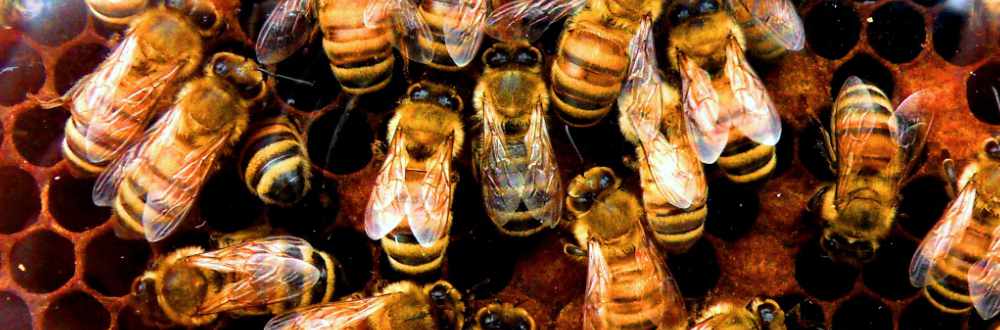
The terms cuddle death, piping, tooting, quacking, drone comet, and waggle dance are all part of the parlance of beekeepers. The book Queenspotting by Hilary Kearney details these and other bee-related terms. Kearney’s website, Girl Next Door Honey, has much more about all things apiary.
Ima Cloud Up and Rain
The threat I’m going to cloud up and rain all over you goes back to at least 1911.
Making the Easy Hard
Julia in Norfolk, Virginia, wants a verb that denotes the act of making something simple unnecessarily complicated, particularly in a work setting. Some possibilities: complexify, befoul, bemuddle, and embrangle.
Plant Haiku
A haiku from artist Alan Nakagawa’s collection of poems about social distance celebrates the kind of companionship that plants provide.
Number One and Number Two for Pee and Poo
Dallas, who lives in Eugene, Oregon, wonders why we use number one and number two as euphemisms for “pee” and “poo.”
Another Lockdown Haiku
Artist Alan Nakagawa’s project involving haikus about social distancing includes a funny take on just how blurred boundaries can become while under lockdown.
This episode is hosted by Martha Barnette and Grant Barrett, and produced by Stefanie Levine.
Photo by Jennifer C.. Used under a Creative Commons license.
Books Mentioned in the Episode
| The New York Times Food Encyclopedia by Craig Claiborne |
| The Sopranos Family Cookbook by Artie Bucco, Michele Scicolone, and Allen Rucker |
| The Lore and Language of Schoolchildren by Iona and Peter Opie |
| Queenspotting by Hilary Kearney |
Music Used in the Episode
| Title | Artist | Album | Label |
|---|---|---|---|
| Over Easy | Booker T and The MGs | Over Easy 45 | Stax |
| Groove Holmes | Beastie Boys | Check Your Head | Capital |
| Rise Up | The Freedom Affair | Rise Up 45 | Colemine Records |
| Musings To Myself | El Michels Affair | Musings To Myself 45 | Truth & Soul |
| Spread Your Soul | El Michels Affair | Musings To Myself 45 | Truth & Soul |
| POW! | Beastie Boys | Check Your Head | Capital |
| Hang ‘Em High | Booker T and The MGs | Over Easy 45 | Stax |
| Cool Aid | Paul Humphrey and His Cool Aid Chemists | Cool Aid 45 | Lizard |
| Detriot | Paul Humphrey and His Cool Aid Chemists | Cool Aid 45 | Lizard |
| Volcano Vapes | Sure Fire Soul Ensemble | Out On The Coast | Colemine Records |