

New research shows that you may be less influenced by superstitious behavior like walking under ladders or the magic of four-leaf clovers if you’re reading about it in another language. • Sometimes not cursing will catch someone’s ear even more than a real curse word. • In what sport do you enjoy a glass-off and speck out before getting flushed? Martha brings back a firsthand report from the language of paragliding. This episode first aired January 20, 2018.
Transcript of “Happy as Larry”
You’re listening to A Way with Words, the show about language and how we use it. I’m Grant Barrett.
And I’m Martha Barnette, and I’ve been delving into some wonderful slang in a field that’s new to me.
And I wonder if you can guess what I’m talking about.
Guess the field? Or the meanings of the slang? Or everything?
Guess the field, first of all.
Oh, wait, let’s hear it.
Here are three examples of slang from this field.
Glass off, speck out, and get flushed.
Is it water testing?
Water testing?
Is it telescopes? Is it astronomy?
Astronomy is in the general direction.
Is it people who make eyeglasses, optometrists?
No, no.
I heard spec and I heard glass. That’s what I’m thinking of those things.
This is something I did recently that you know about.
Can we talk about that on the air?
Not that thing.
I don’t know. What is it?
The terms glass off, speck out, and get flushed are used when you go paragliding, which I did.
Oh, that’s awesome.
It was so much fun.
You jumped off a cliff.
I literally jumped off a cliff.
That’s what they tell you to do is go running off a cliff.
And these are 300-foot cliffs right there at the ocean’s edge.
Into the Pacific Ocean.
Yes, Torrey Pines Glider Port.
I wanted that sensation of running off a cliff.
And it’s a tandem situation.
So I had an instructor with me.
And you have this, it looks like a parachute, but they call it a glider.
And you go running off into the wild blue yonder.
And then you float around.
Not motorized, just using the currents of the wind.
Just using those thermals, floating on the thermals.
So the term glass off describes a lovely, glassy, smooth lift, which is exactly what we had.
Oh, so a takeoff that’s glassy.
Yeah, yeah.
According to the United States Hang Gliding and Paragliding Association, in the dinner menu of flying conditions, glass off is creme brulee.
So you had that?
I had that.
Wow.
And it was wonderful, just this gentle lift up into the sky and over the sea.
It’s also called magic air.
And to spec out, as you can imagine, is to climb to a great altitude.
You know, oh, he really spec’d out.
Oh, so you have a good spectacle?
Is that kind of what it’s connected to?
No, no, the person looks like a speck.
Oh, the speck, S-P-E-C-K.
You know, when they go really far away.
This whole time I’m thinking S-P-E-C, short for spectacle.
No.
And the third one, flushed, we talked about that a lot in the air.
In fact, I got completely distracted when we were floating around.
And I forgot to be scared because we started talking about slang.
My instructor, Max, and I started talking about paragliding slang.
And we got flushed, which means that you lose wind and you have to make a landing.
And so instead of landing back at the top of the cliff, which you’re supposed to do.
At the glider port.
Right, at the glider port.
We had to go down to the nude beach below, which was fun.
You know, there were all these nude people on Black’s Beach, and we just fell out of the air very gently.
And it made somebody very happy.
They weren’t expecting to have a glider land in their lap that day.
They didn’t seem to care.
They were just sitting there nude.
They’re on a nude beach.
What do they care?
But go back to this.
So you did this willingly.
Nobody forced you to jump off the cliff with a little bit of fabric.
I wanted to know what that felt like.
That’s great.
Yeah, it was great.
I highly recommend it.
We will post a link to a lot more of this language on the website.
And Martha, do you have pictures or video to share with the world?
I have, yes.
Yes, we’ll do that as well.
You can watch Martha put her life at risk.
We’ll put that on the website at waywordradio.org.
You know, the world is filled with interesting hobbies and things you do on the side and the stuff that you do for fun.
And I know there’s lingo to it.
Call us and share it.
We love it.
Or heck, talk to us about language in any form or fashion.
Send an email to words@waywordradio.org.
Hi, you have A Way with Words.
How you doing?
Doing well.
Who’s this?
This is Donnie Dinwiddie from Virginia Beach, Virginia.
Hi, Donnie.
Welcome to the show.
What’s up?
I’ve got a question for you.
I’m a career roofer, and I’ve got a boss that pronounces it every time we have a meeting, a get-together.
He pronounces it roof.
I would like to know, because the big joke is that we’re roofers, not roofers like dogs.
We don’t bark like dogs.
So what my question is, is where did that terminology roof instead of roof come from?
Is that regional?
He’s from the mountains of Virginia.
And he went to Auburn School.
I think that’s in the south, deep south, right?
Auburn, Alabama?
Yeah.
And where are you from, Donnie?
I’m from Virginia Beach.
Okay.
Donnie, you say roof.
We are roofers, but he references us as roofers.
Roofers.
Oh, nice.
Is there anyone in the company that says it more like rough?
No, he’s the only one that I’ve ever heard pronounce it roof.
Donnie, what about your customers?
What do they say?
Because everybody calls us roofers.
He’s the office manager.
He’s the CEO of our division, and he kind of got mad the other day when I told him I was going to make Baker Roofing famous.
He said, oh, we’re already famous.
I said, no, I’m talking about Nationwide because I’m getting ready to go on this NPR show.
Oh, and I told him why.
And he says, oh, you looking for a job, Mr. Dinwiddie?
I said, no.
That’s why I called Prentice, which is our owner down in Carolina.
Oh, you got some insurance, huh?
I said, yeah.
It’s been a lot of fun, but he hasn’t liked it at all.
Donnie, Donnie, Donnie.
All right, let’s break this down.
Let’s talk some linguistics.
First of all, most people do say roof in the United States.
All right, roof.
However, maybe 10% to 20% say roof.
Wow.
Yeah, it’s kind of like the same vowel in foot.
Yeah.
It’s a roof.
But also some of these people also say root instead of root.
Right, right.
You know, my father is one of those people who says roof and root.
He says roof just like your boss.
And so where is he from?
He’s from southeast Missouri.
And there are a large number of people in this country who are nodding their heads and agreeing with your boss’s pronunciation right now.
Yes, sir.
There are a lot more of them.
Every one of them, tell them I’m not a dog.
Roof, roof?
But there is another third group.
So there’s roof.
I’m exaggerating the vowels.
There’s roof.
Right, right.
And there’s roof.
And there’s another third group that says roof.
It’s more of an
It’s even more of an sound, a schwa sound.
The jargon here is the common pronunciation of roof is a tensed vowel.
And the roof pronunciation is a lax vowel.
And that’s not a judgment on anybody’s speech patterns or their ability to articulate well.
It’s just the jargon that we use to describe those vowels.
Yeah, yeah.
Props to you.
You’ve got stones to challenge your boss on national radio.
That’s what I’m known for at this company.
Like I say, I’ve been here for 35 years, so I’ve done something right.
Being a smart aleck, you know.
Yeah, it’s working.
Keeping the company on their toes, you know, getting a little bit.
Because like I tell them all the time, I’m not here to make a million dollars, but if I can get a laugh out of y’all.
It worked.
It worked.
I got to tell you, Donnie, you’ve just gone from a local treasure to a national treasure.
We are so happy to talk to you on this show.
We really appreciate it.
You got to call us again sometime.
Thank you very, very much.
Appreciate it.
All right.
Bye-bye.
What’s going on in your workplace when it comes to language?
Let us know, 877-929-9673, or send us an email.
That address is words@waywordradio.org.
Hello, you have A Way with Words.
Hi, my name is Chess.
I’m calling from Williamsburg, Virginia.
Hi, Chess.
Welcome.
Yes.
Chess, like the game?
Like the game.
It’s actually short for Francesca.
Got it.
Makes a lot of sense.
What can we do for you, Chess?
So I grew up in a little bit of a rural area, but my mom wanted us to, like, really enunciate our words.
So that’s why I don’t really have the typical southern Virginia accent, but my fiancé does.
And we always have an argument about how to pronounce.
It’s a brown sauce.
It starts with a W.
I say it’s pronounced Worcestershire, and he always says that it’s pronounced Worcestershire.
And I just didn’t know which one was correct or if we’re saying it correctly at all.
What? Who says it’s pronounced Worchester-shire?
That would be my fiancé.
Do not marry this man.
Don’t do it.
Don’t do it. It’s a symptom of other problems.
He says a lot of things incorrectly, though.
Chess, it’s called a hypercorrection when people decide that the spelling is what most needs to guide the pronunciation of a word.
But the problem is the spelling follows, usually is supposed to follow the way we say it aloud.
In some cases, it doesn’t apply at all.
That word is so old, Worcestershire is how you say it, more or less.
That word is so old that you cannot use the pronunciation.
The spelling is a guided pronunciation.
You just can’t do it.
Okay.
Everybody knows that English doesn’t really obey its spelling when it comes to pronunciation.
Why would you think this word is an exception?
I have to say this word has always intimidated me because of the spelling and the difficulty.
So let’s just spell it.
Just get clear on it.
So it’s W-O-R-C-E-S-T-E-R-S-H-I-R-E, right?
Correct.
Okay.
So anybody from Massachusetts, they’re all screaming Wooster into the phone because there is a town in Massachusetts,
Which is the first part of that without the Shire.
W-R-C-E-S-T-E-R, that they pronounce Worcester.
Worcester.
Worcester.
And there’s a similar town in the United Kingdom pronounced basically the same way.
But we’ve got a couple linguistic things happening here, including haplology, which is a word that I love,
Which is where two syllables that sound alike that are back to back kind of just become one syllable that sounds like that.
And so that’s happening here.
And then we’ve got some lenition or weakening of vowels.
And we’ve got just basic history kind of chipping away at the form and structure and sound of the word.
The Worcester part of it is really old.
It goes back to like the Roman era, I believe.
Oh, really?
I didn’t know that.
That’s really cool.
Yeah, it’s been around for a long time.
But maybe the solution is just if you actually marry this dude just to avoid that particular sauce.
We typically do.
He doesn’t really like vinegar-based sauces.
Another reason not to marry the man.
And I say this as an advocate of vinegar and pickled things.
I agree.
I’ll tell you, dictionaries aren’t the perfect pronunciation guides, but they’re really pretty good for most things.
And he will not find his pronunciation in any dictionary in the English-speaking world.
Wonderful.
So I get to be right in an argument for once.
Hold it in reserve until you really need it and then drop the bomb at an important time.
I will.
I will.
Thank you guys so much.
Yeah, Chess, you know we’re kidding, right?
No, yeah, of course I do.
Of course I do.
Yeah.
All right, take care.
It was good to talk to you.
Call us and let us know other dumb things that he says, all right?
I will.
Yeah, once you’re married.
Take care.
All right, thanks, guys.
Bye-bye.
Bye, Chess.
Bye-bye.
So what language dispute have you had with somebody special to you?
Give us a call about it, 877-929-9673, or send it to us in email.
That address is words@waywordradio.org.
More of what we say, why we say it, and how we say it, as A Way with Words continues.
Support for A Way with Words comes from HelloTalk, a language exchange community where you chat with native speakers to practice any language.
With the HelloTalk app, you can explore new cultures at hellotalk.com slash words.
You’re listening to A Way with Words, the show about language and how we use it.
I’m Martha Barnette.
And I’m Grant Barrett, and we’re joined by our quiz guy, John Chaneski.
Hi, John.
Hi, Grant.
Hi, Martha.
Hi, John.
What’s going on?
It’s that time of year.
You know what I mean.
It’s the time for limericks.
Oh, yes.
Limericks.
Based on news stories from 2017, okay?
The past and the recent past.
So I’ll read you a limerick about something that happened in 2017.
You finish it.
You might need to supply one word, a phrase, a name, or something else.
So here we go.
My dependable British authorities say the royals have excellent qualities,
Like handsome Prince Harry, who announced he will marry,
Meghan Markle, who hails from the…
Colonies.
Colonies, yes. Very good. Very nice.
There once was a team that was cursed.
Chicago Cubs were the worst, but in 16 they won,
And the Astros, my son, in 17 took the series their…
First.
Yes, their first. Way to go.
What a great series that was.
Yeah, fun.
In France, from Marseille to the Seine,
They held an election and then, though might may make right, it was Macron that night who was mightier than Marine Le Pen.
Le Pen, yes.
From a Taiwanese factory comes a gift for your fidgeting chums, a spinning hand toy.
But when I was a boy, we just sat there and twiddled our thumbs for free.
This one was a request.
Film executives laboring under an archaic idea that to fund a box office hit,
You need a Brad Pitt, were knocked out by a woman, a…
Wonder.
Yes.
Very nice.
Oh, excellent.
Alabama just could not endorse Roy Moore, and they voted in force.
Doug Jones took the seat, and to Roy, they said,
Beat it, go ahead and get back on…
Your horse.
Your horse, yes.
If you’re one of those constant deniers of climate change, here’s some repliers.
Most scientists say we’re in a bad way, drought hurricanes, and increased…
California fires.
Yeah, wildfires.
Very good.
John, thank you for the quiz.
We’ll talk to you next week.
Thank you, guys.
Talk to you next week.
Bye.
Words and language and goofing around.
And you know what?
We know that you’re a huge trivia fan.
Maybe you got one you think you can stump us with.
We promise not to Google it.
Send in an email to words@waywordradio.org.
Hello, welcome to A Way with Words.
Hey, how’s it going?
My name is Dave.
I’m calling from Traverse City, Michigan.
Hi, Dave.
Welcome to the show.
Hello, Dave.
What’s up?
I got into a funny situation here in the office a few weeks ago.
I was telling a story about my upbringing in southeastern Pennsylvania when I used the term that stopped the conversation dead in its tracks amongst my colleagues.
I was talking about my time as a youth enjoying the sliding board.
Something that seemed very natural and very normal to me was obviously very strange to this group of Midwestern,
Northern Midwesterners that I worked with.
How interesting. What did they call it?
After talking it over, everyone agreed roundly that their preferred term was the slide.
And that is also familiar to me, but I always assumed slide was just a shortening or an abbreviation of sliding board, which in my mind was always the more formal word for this playground implement.
Right.
The group decided that sliding board was something that maybe was wooden or something that would result in a lot of splinters.
So after much laughter and discussion, we hashed out what we were all kind of talking about.
But the question remained, where the heck did sliding board come from?
That’s so interesting because that sounds perfectly normal to me.
I grew up with a sliding board, but I believe, and I grew up in Kentucky,
I believe Grant, who grew up in Missouri, called it a slide.
Just a slide, yeah.
Yeah, it’s very curious.
But you see that term sliding boards scattered around the country, Pennsylvania, Wisconsin, Maryland, places like that.
Sometimes in the south it’s called a sliding plank.
But I’m a little surprised that your friends didn’t understand it.
It was unanimous, not a single person.
And we’re in here, northern Michigan, not a single person had a clue what that word meant.
Not even in the ballpark.
They were all thinking it was something not even playground related.
I want to go back to their thought that it would mean splinters, because have they never seen polished wood?
Have they never slid down a wooden banister?
Are their childhood self-deprived?
I guess not.
I must work with a bunch of adventureless people.
I think, and one other guess was that it was some kind of backboard or emergency equipment.
Okay.
Slide onto in case of an emergency of some kind.
No, it’s like Martha said, it’s just a slide.
It’s a long, hard, flat thing like a board.
But I wouldn’t be surprised if there were people who had wooden slides.
So sliding board made a lot of sense because metal hasn’t always been an inexpensive commodity.
Right.
And when I was a kid, we didn’t even have this board.
I literally slid down the cellar roof just like in the song.
You know, there’s one other term for this piece of playground equipment that you hear in mainly New Jersey and New York, and that’s sliding pond.
Yeah.
And we’re not sure why.
Some people think it may derive from slide a pond.
But probably not.
There’s an idea that it might come from an old Dutch word, right?
Yeah.
That, again, has to do with sliding across a pond.
Right.
Sliding across a pond.
Yeah.
But it goes by lots of different names, but it’s still fun, right?
Right.
Well, that is really interesting, and that definitely helps clear it up.
I know everybody learned something, I think, in the office that day.
Yeah.
Please tell your colleagues that you’re not a weirdo.
They just need to read more.
They need to see the world more.
Everyone needs to get out to Philadelphia.
That’s right.
And slide down a band.
It’s a Pennsylvania language that I grew up with.
Dave, thank you so much for your call.
We really appreciate it.
Thank you so much.
All right, take care.
Bye-bye.
Take care.
All right, bye-bye.
Hello, you have A Way with Words.
This is Dana Lachance from Fort Worth, Texas.
Hi, Dana. Welcome to the show.
Hi, Grant. Thank you. It’s good to be on.
Great to have you. What’s up, Dana?
I wanted to talk about my granddaddy. He was really just an amazing man, kind of a renaissance guy, born in 1896.
So that when I was growing up, he was already an older gent, very dapper and just full of life, twinkle in his eye all the time.
And he was just, he was the king of things.
You know, don’t take any wooden nickels or, you know, the old gray mare just ain’t what she used to be.
I mean, he always had something.
But as he got older, there was one saying that he used to say that just baffled me, and it was, you live and learn, then you die and forget it all.
And I remember that most specifically because it was so profound.
Even at my young age, I was 12, 13, and it was unlike anything he had ever said before, and I hadn’t heard it since.
And I was wondering if it were a granddaddy original or where it had come from.
You live and learn and then you die and forget it all.
That’s it.
And when would he say this?
When it was something that happened that had taught somebody through hard experience?
You know, Grant, that is a very interesting question that since I have called y’all, I have pondered on.
And indeed, it was as he got older and the twinkle was a little less.
And I think it started maybe when my mom started getting sick.
And he didn’t.
Things had changed.
Yes.
So for him.
Does that make sense?
Yes, it does.
So it was about an acceptance of it’s kind of almost it is what it is.
It’s kind of an acceptance that things will just happen.
And all you can do is experience it and try to draw some lessons from it and move forward.
Well, you know what?
Actually, I never really got it until 20 years later.
I mean, you had been gone for 20 years, y’all, and suddenly it hit me.
You live and learn, and you die and forget it all.
I think it means just how trivial this life really is.
Yeah.
That would make a lot of sense.
Does that make sense?
It does, and it plugs in nicely to what I found when I was researching this phrase.
There are places where people had theological disputes about it.
The argument that you would forget it all isn’t necessarily in agreement with a lot of theological traditions.
Because that assumes that there is no afterlife, that you would not carry your worldly knowledge into this other afterworld.
Right.
So there is something kind of almost saying that there is no second chance.
There is no afterlife if you’re saying that you’re going to forget it all.
Or it’s just not that important.
Right, right.
That said, this saying isn’t only your grandfather’s.
It goes back at least to the 1840s.
You can find it pop up here and there.
A lot of times it’s quoted as if it’s a well-known saying, but nobody gives the source.
And we find many different versions of it.
Live and learn is a lot older.
Live and learn goes back to, I believe, the 1600s.
But to live and learn and then die and forget it all is much newer than that.
It reminds me of so many articles I’ve read about people who are either on their deathbed or toward the end of their life.
And when they’re talking about their main regrets, one of the biggest ones is they say,
I just wish I hadn’t worried so much.
Oh, yeah.
You know, why just don’t worry so much?
And it sounds like that’s what you’re saying, too, Dana.
Yes, there’s so many things you can just let go of, you know.
And I just, I’ve never heard it since, since my grandfather said it, though.
And I just found it comforting, profound, something to ponder on.
Yeah, and as Grant says, it has quite a history to it.
That’s great.
I knew, I mean, like I said, I mean, Granddaddy had been so many things, a soldier in the First World War, a barber, a schoolteacher, a banker.
I mean, just he had been everything and done so much.
And to hear him say something like that, you had to really think about it when it came out of his mouth.
Well, it’s clear that you idolized him, Dana, and I’m so happy you shared the memories with us.
You bet. Thank you all so much.
And you all have a good one.
I appreciate you.
Bye-bye.
Okay, you too.
Bye-bye.
All right.
Bye.
What are the words and phrases that have been handed down in your family?
We’d love to hear about them.
You can call us at 877-929-9673 or send them an email to words@waywordradio.org.
You remember our discussion about being both anxious and nervous at the same time?
Yeah, we had an adorable little girl on the show who was asking for a word for that.
And we heard from Chris Ball in Melbourne, Australia, who reminded us that in Australia they use the term toe-y.
And Chris says, when I think of the word, I can feel my toes moving in my shoes and that butterfly sensation coming up through my knees and beyond all the way to the tummy.
The sort of feeling that comes with your wedding day or starting a new job or your first time down a water slide.
Any leap in the dark.
Well, Australia’s got a word for it.
They do.
TOWEY.
TOWEY.
So it’s being anxious and excited altogether.
Anxious and excited altogether.
And it may have to do with a horse who’s impatient.
Right, right.
The hooves are like digging in the dirt.
Yeah.
Hit us up on Twitter @wayword.
Hello, you have A Way with Words.
Hello.
Hi, who’s this?
My name is Liz Worthy. I’m calling in from Huntsville, Alabama.
Oh, welcome to the show. How can we help you, Liz?
Thank you. I had a question, so I was listening to your show.
And it made me think of something that I thought was a little odd in terms of language when I moved to the U.S.
I’m originally from Scotland, and one of the things that happens when you’re living in Scotland is sometimes your grandmother will send you off to the store to buy some messages.
And I didn’t really realize there was anything unusual about that until I moved to the U.S.
And then I would say that and people would be completely confused about what I was talking about.
Oh, you would go to the store to buy some messages.
Your grandma would send you for messages.
Okay.
Yes.
And when you were sent for messages, what did you come back with?
So normally when you were sent for messages, you would get a piece of paper with a grocery list.
And you would hopefully come back with all the things that were on it and some sweeties for yourself.
Some sweeties for yourself.
Of course.
Yeah, and so you didn’t hear that when you moved to Alabama.
No, or Seattle or Wisconsin or any of the other places in the U.S. that I’ve lived.
I’m not surprised that you didn’t encounter it in any of those places.
It does exist.
It shows up in several different dictionaries as being a very Scots thing,
But it also, through the number of Scots who have traveled around the world
And moved to different places, it now shows up as well
And New Zealand and in some of the Caribbean dialects of English.
And the Irish do it to a smaller degree.
And the path that it took for messages to mean things that you pick up
When you’re running errands or groceries that you bring back
Is actually pretty straightforward.
If you go back to the early days of messengers
Who would actually literally take a message, you know,
Some kind of communication, sometimes verbally, but sometimes on paper.
And so the idea that they were delivering a piece of paper soon kind of got rounded up into the notion that they were just running general errands.
So they might not only deliver a piece of paper, they might deliver a trinket or a token of respect or a literal package.
And so before long, you can find this in the printed record. It’s really interesting.
You start to see I sent so-and-so out for messages.
And it might be that they went to take some things to somebody else, some things that weren’t even notes.
Are words or it might be that they went to get some things and to bring them back so in Scotland
It’s quite specific to groceries so were you able to tell in the Caribbean is it also groceries or
Is it you know DIY supplies well it’s interesting it’s interesting in Scotland and Ireland for sure
It’s always plural you wouldn’t go out for a message you go out for messages and it does
Usually tend to be the groceries, although I see some evidence in fiction, although fiction
Writers could have been taking some liberties, where messages sometimes are, they went to get a
Variety of dry goods, or maybe went to pick up a takeout order from a restaurant, that sort of
Thing. But there was always the idea that it wasn’t just the one thing, there were a bunch of things
That you were doing, and you were going to come back after they were all done. But in the Caribbean,
It’s usually singular where it’s used at all.
I’ve seen evidence in Jamaica and Trinidad.
So you might say, I’m going to collect the message from the shop
Or the message was too heavy to lift.
And in both cases, the message is some kind of thing
That you might buy at the corner store or the grocery store
Or the pharmacy, the drugstore.
That’s cool.
And we used to also say, you know, when you came back with those candies,
You would often say that you had a little skin off the top of the messages,
Which was a little bit for yourself.
It’s funny, now that I live in the U.S.,
All of these Scottish things that were just taken for granted,
I think about them more often.
I really appreciate it. That’s great.
Yeah, so that was a little skin off, S-K-I-N, or a skim, S-K-I-M?
A skin with an N.
Oh, like the skin off the top of a cream or something, or a pudding.
Yeah, hot milk or something.
Well, thank you very much for answering my driving along the road question.
Liz, thank you so much for calling.
Well, thank you very much.
Take care now. Bye-bye.
Take care. Bye-bye.
Maybe everybody knows this term, but I just learned it, al-desco.
Do you know this term?
Yes. If you eat al-desco, it’s when you eat your lunch at your desk.
That’s right.
Don’t do that.
Get up.
At least go to the conference room.
It’s not healthy.
But sometimes you can’t help it.
But what I didn’t realize was that that term has been around since the 1980s.
And I’ve had plenty of times when I’ve dined al-desco.
That is A-L, separate word, D-E-S-K-O, al-desco.
And it’s play off of al-fresco, which is outdoors.
Yeah.
But I’m dining al-desco.
Yeah.
You know, it’s funny.
I should look that term up and find the history of it because it has the sound of this funny
Little term that’ll never last, but here we are talking about it 30 or 40 years later.
More about language seen through the lens of family, culture, and history as A Way With
Words continues.
Support for A Way with Words comes from a gift honoring students of the San Diego Community College District.
City College, Mesa College, Miramar College, and continuing education prepare them for jobs, personal goals, and transfer to universities.
Sdccd.edu.
You’re listening to A Way with Words, the show about language and how we use it.
I’m Grant Barrett.
And I’m Martha Barnette.
A new study suggests that reading information in a foreign language can suppress common superstitious beliefs about that information.
Researchers from three European universities had people read imaginary scenarios either in their native language or in a foreign one,
And they were asked to imagine doing a particular action, like submitting a job application or taking an exam,
Under circumstances that might lend themselves to being superstitious.
For example, they were asked questions involving bad luck, like this one.
Imagine that you have an important exam and you feel nervous.
Before you enter the university building, you accidentally walked under a ladder.
How would you feel about taking the exam?
Or, for example, you might go to an airport and you’re about to take off,
And then you realize it’s Friday the 13th.
How does that make you feel?
Or in the case of a good luck scenario, one of their questions was, imagine that you have an important job interview and you feel really nervous,
But before the interview, you try to relax at a park and you find a four-leaf clover in the grass.
How do you feel going into the job interview?
And what was really interesting, Grant, was that overall the researchers found that when people read about those scenarios in a foreign language,
They felt less negative about the bad luck scenarios, and they felt less positive about the good luck scenarios.
So in other words, it appears that reading about either potential good luck or bad luck situations in a foreign language actually suppressed those superstitious feelings.
So their subjects were at least bilingual, and so they asked them first in their native tongue and then in their acquired language.
Yes, and this was a written questionnaire, and it was also people who learned the language in a classroom, the foreign language in a classroom.
So do they have any theories on why it’s like this?
Yeah, they think that superstitions tend to be acquired early in life, just like your native language tends to be acquired early in life.
And you pick up those beliefs when you’re young.
And so reading in your native language evokes those beliefs in a way that reading in a foreign language that you learn later on doesn’t.
And I don’t really know what to make of this study, although it’s part of a body of research now where people are more willing to talk about something embarrassing for a longer period of time if they’re talking in a foreign language.
And people are more willing to swear in a foreign language than their native language.
That’s interesting. So there’s something here about the trappings of a word that go beyond just basic meaning.
So the word as a sound structure in the mind and the mouth has attachments to it.
Right, right. Associative memory, in other words.
That’s right.
I remember that the one time that I had couples therapy in Spanish, I was so much more expressive.
It was a really great session because I was speaking in Spanish with more primary colors and less nuance.
And I highly recommend trying therapy in a foreign language.
And if you’re not fluent in that foreign language, you might not have the subtlety where you can kind of get these,
Have these second and third kind of currents of meaning underneath what you’re saying.
Exactly.
You’re kind of stuck with one meaning.
Exactly.
It was a great exercise for me.
So where was this?
It’s called Breaking Magic, Foreign Language Suppresses Superstition, and it’s in the Quarterly Journal of Experimental Psychology.
So we’ll post a link to more information about that on the website.
If you’ve got questions about language, this is the place.
It can be slang, new words, old expressions, an argument about usage, argument about spelling, something your kid said that was funny, a book you like, a book you recommend.
Email words@waywordradio.org or tell us on Twitter @wayword.
Hello, you have A Way with Words.
Hi, this is Susan. I’m calling from San Antonio, Texas.
Hi, Susan. Welcome to the show.
I’m calling about a question I had that came up at work the other day.
I work for a restaurant and gift shop chain, and part of our duty is if we have a return, we have to sign a piece of paper saying that we help the customer.
And I said to a coworker, there was a paper laying there, and I said, I need your John Henry on this paper.
And we were in a group, and she just said to the other person, Susan’s asking me for my John Henry.
But it made me wonder about the phrase and where it came from.
And I could have ran home and looked on Google and checked it all out, but I follow your show.
So I thought, well, I’ll just ask you guys.
And here we are.
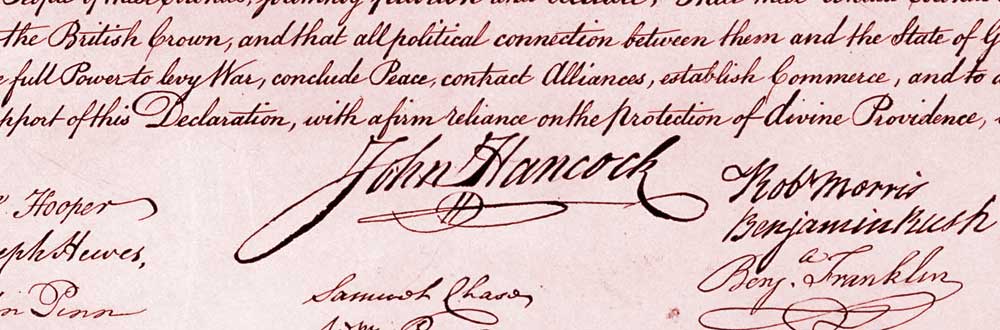
Yeah, you know, most people say, put your John Hancock here.
Have you ever heard him say that?
No, you know, I haven’t.
Oh, really?
Because he’s the guy with the beautiful, huge signature.
Right, right.
On the Declaration of Independence, the first guy to sign it, and he wrote in really big letters and said something to the effect of King George should be able to read that or something like that.
All right. How wonderful.
Yeah. And you see that big old signature when they have ads for the John Hancock Insurance Company, I think.
And I have seen that, yes.
Yeah. Okay. So most people say put your John Hancock there, meaning put your signature there.
But the thing is that the phrase put your John Henry there is also used by more people than just you.
It’s not just a one-off by any means.
But the John Hancock phrase is far more common.
Both of them go back to the early 20th century.
But who do you think of when you think of John Henry?
Well, immediately I thought, you know, it must be a historical figure.
And I even thought that it might be somebody that had signed either the Declaration of Independence or a document of some kind.
But then I thought, well, I’m not sure how sharp I am on my real history anymore.
Well, do you remember those folk songs about John Henry was a steel-driving man, that really strong guy who helped build the railroads back in the late 1900s?
A man ain’t nothing but a man.
Yeah, when John Henry was a little baby.
Wow, I kind of remember that a little bit.
Oh, there’s some really good versions of it on YouTube, I bet.
I know Woody Guthrie has covered it, and pretty much every folk singer of any note has done the version of the song.
Yeah, yeah. So you’re not alone.
Well, that’s good to know, too.
Yeah.
Thanks, Susan.
We’re glad to have you.
Thank you, and I’ll look up that song.
Thanks very much.
Bye-bye.
Okay.
Bye, Susan.
Bye-bye.
Send your emails to words@waywordradio.org.
Another term I learned after going paragliding is cues, C-U-s.
That’s an abbreviation for something?
Yes, also known as cumies, also known as cumulus clouds, because they’re indicators of a good lift.
You can get some altitude that way.
And if you have a line of cumies, that’s known as cloud street.
Oh, cloud street.
Isn’t that great?
How nice is that?
I want to live on cloud street.
I know, right?
Hit us up with the slang from your hobby or pastime on Twitter @wayword, or tell us an email to words@waywordradio.org.
Hello, you have A Way with Words.
Hey, this is David Malky from just up the coast in Los Angeles.
Hi, David. Welcome to the show.
Hi, David.
Thanks so much. Glad to talk with both of you.
What can we do for you?
Well, I thought you might be interested in something that my mom used to say and still does say.
And she is a good church-going lady who does not like swearing.
And in fact, she would always say that when people swore, it would be distracting for her, because people who swear, she would say, don’t notice how much they swear, and people who don’t swear do notice how much they swear.
So it sort of creates an effect that was less than complimentary.
And so what she would do is that she has her own word that she would say when she is frustrated, which is piffle. And I would spell that P-I-F-F-L-E.
So if she’s working on something and something goes wrong, she’d go, oh, piffle.
And so I didn’t know if that was a word that she made up or if that was just some sort of old-timey minced oath of some sort.
But the thing that she always liked about it was that she was able to provoke the opposite reaction in other people because, as she would say, I would get more funny looks with a good piffle than any swear word I could have said.
Absolutely. I agree with her.
And plenty of people use the word piffle, particularly I associate it with Britain.
Yeah, me too. I don’t think that it’s very American.
I mean, it’s definitely used in the United States, but I do.
Yeah.
It’s marked as British.
Yeah, but it’s been around since at least the late 19th century, piffle, and probably comes from just, it’s sort of onomatopoetic, you know, just piffle.
It’s got that plosive sound that lots of good swear words do.
Well, and also, but it’s got the thing where you’re kind of like, it’s a noise of disgust, like pfft.
Sure, sure, sure.
Well, so I wonder if she may have picked it up from watching, you know, Masterpiece Theater or something like that.
She was always a big reader, big PBS fan.
Yeah, it could have been.
And there was actually a show back in the mid-2000s called Balderdash and Piffle.
You can actually find, it’s a wonderful program that was on the BBC.
That involved the editors of the Oxford English Dictionary asking the public to help them find the first citations or the first examples of different words in the dictionary, like earlier examples than what they have, the origins of those words.
Yeah, and you can find those on YouTube.
They’re a lot of fun.
But piffle is, I think, a wonderful word.
I just ran into somebody recently who says, instead of a curse word, they just say, bad word, which I think, again, like piffle, stops down whatever’s going on and calls attention to itself much more than a curse word does.
I think it’s more effective.
Well, so that’s interesting because what you just said and also what my mom said implies that part of the purpose of swearing is to provoke a reaction in a listener, which I think is only a secondary consideration because otherwise we wouldn’t swear when we were alone.
Right. That makes you feel better, too.
Well, yeah, absolutely. It feels like there’s some emotional release that is associated with it.
But maybe if you put a big importance on the notion of swearing, then people reacting to what you’re doing is also more important to you.
Right. I agree with you, David.
There’s definitely the demonstrative use where you’re performing the word in order to draw attention to yourself or to the circumstances.
But then there’s the utterly ordinary linguistic, typical semantic use of it where it’s just part of your speech and part of your vocabulary.
And I would argue that a really skilled cursor is more of the latter and less of the former.
I would agree.
People that you’ve known who can really just reel out the four-letter words often don’t care at all if they have an audience.
It’s just part of their discourse.
I would agree that words that – there are always words that some people might object to, but it doesn’t mean that they’re less useful words if they are part of your language.
So I think in my mom’s case, because she was because she noticed when other people would swear, she took it upon herself to demonstrate in the opposite way so that, you know, she was sort of putting a stake down for not swearing.
Right. But if she got up in the middle of the night and stubbed her toe, would she say piffle?
Oh, 100 percent. Absolutely.
Really?
Absolutely. I think so.
Even if no one was listening. Wow.
Great restraint.
Well, yeah, I just think it’s, you know, for her and the way she was raised and sort of, you know, the moral compass such as it is that happens to include swearing in, you know, a tight-knit church-going family or what have you.
I feel like those things get ingrained at a certain point.
Yeah, you can ingrain the pitfall habit as much as you can ingrain the cursing habit.
David, thank you so much for your call.
We really appreciate it.
Well, I appreciate you looking into it.
Thanks for all the insight.
Yeah, sure.
Take care.
Here is another term I learned from paragliding, and this is a real term.
Okay, yeah.
Biwingual.
Does this mean you also have your pilot’s license?
Well, it means you also have your hang gliding chops.
Oh, and these are different, to be clear.
Yes.
Okay, great.
Yes, yes.
Different equipment.
Paragliding is that sort of dome shape.
It’s a rainbow of fabric kind of held up by the air, right?
And then hang gliding is like the almost paper airplane-shaped thing with a rigid frame, right?
Yes, yes, you’re sort of lying on that.
But if you’re bi-wingual, you go both ways.
Bi-wingual.
Hello, welcome to A Way with Words.
Hi, this is Sarah Hickson.
Hi, Sarah, where are you calling from?
I’m calling from Pirote, Alabama.
What’s going on? What do you want to talk about?
I wonder what in the world does this expression mean.
I’m just happy as Larry.
My sister uses that, and I don’t remember in my childhood ever hearing it,
But she’s used it for many years, and I just don’t know anybody who’s heard of happy as Larry.
Happy as Larry, meaning very happy.
Yeah, everything is just fine.
And Sarah, do you have any idea where she might have picked that up?
Well, my best guess would be England.
My mother was British, and my sister has spent a lot more time in England than I have,
And actually married an Englishman.
So that’s where our experiences differ.
Okay, well, bingo.
Yes.
Yes, that’s a word that we associate with the UK, with Britain and Australia and New Zealand.
Yeah, very much in Australia, yeah.
Yeah, yeah.
Happy is Larry, meaning extremely happy, but nobody knows who Larry is or was.
Or why he’s so happy.
Yeah.
Oh.
But as soon as you said that your sister had this history, this connection to England, our eyes lit up because that’s what we were waiting for.
Yeah, and there are lots of different theories about who Larry might be, but none of them are really satisfying.
I kind of like the theory that the idea is that it’s happy as Lazarus, because that’s been a phrase that’s been around longer than happy as Larry.
So biblical Lazarus who came back from the dead?
I would be pretty happy.
Yeah, he has something to be happy about.
Yes, he does. Yes, he does indeed.
Right, and I could see just making that kind of jocular.
And it’s been around at least 100 years longer than Happy is Larry, which goes back to the beginning of the turn of the last century.
I like, and again, I can’t prove it, but I like the rhyming slang idea that originally it was very happy, rhymed with Larry happy, and then became happy as Larry.
Very lappy.
Happy as Harry.
So I like that one.
But again, very little evidence to prove that that’s the source of it.
We don’t know why Larry’s happy.
But we do know the UK connection is a really strong one, and we’re glad that you mentioned that.
I wish I had more answer about it, but that looks like that’s it.
That’s pretty much it.
I’m wondering if you use it with other folks there in town.
And what do they think?
Well, people that I use it with don’t know what it means.
Hadn’t ever heard it before.
Not surprising.
Where did you hear that?
Yeah.
Well, Sarah, I really appreciate your calling us.
Call us again sometime, all right?
I’ll do that. Thank you so much. Good to talk to you.
Thanks, Sarah. Bye-bye.
Here’s another example of paragliding slang, the locals.
The locals.
You know what the locals are?
Is it like the muggles of the paragliding world, the people who don’t glide?
Who don’t glide.
No, the locals are birds.
Oh, the creatures born with wings.
Right, right.
And if you see them flying, then you know that the thermals are working well and you can go flying.
You run, get your gear and get up there.
Yeah, when I was paragliding, my instructor said, look down.
And I did.
And there was a bird flying underneath my feet.
It was crazy.
Want more A Way with Words? Listen to years of past episodes at waywordradio.org or find the show in any podcast app or on iTunes.
Our toll-free line is always open, so leave us a message at 877-929-9673 and we’ll take a listen.
We’d love to get your messages at words@waywordradio.org or hit us up on Twitter @wayword and look for us on Facebook.
This program would not be possible without you.
Grant and I are out to change the way we listen and think about language,
And you’re making it happen.
Thanks also to senior producer Stefanie Levine,
Director and editor Tim Felten,
Director Colin Tedeschi,
And production assistant Emma Kelman in San Diego.
In New York, we thank quiz guide John Chaneski
And that master of keeping it real, Paul Ruist at Argo Studios.
A Way with Words is an independent production of Wayword, Inc.
From the Recording Arts Center at Studio West in San Diego,
I’m Martha Barnette.
And I’m Grant Barrett.
So long.
Bye-bye.
Paragliding Lingo
 In what sport would you hear the slang terms glass off, speck out, and get flushed? They’re all expressions used in paragliding. Glass-off refers to a smooth, effortless takeoff; to speck out is to go so high that you’re nearly invisible to those on the ground; to get flushed means to lose lift and be forced to make a landing. The United States Hang Gliding and Paragliding Association offers a glossary of the slang of free flight. As promised, here’s video Martha shot while getting flushed toward the end of her first paragliding flight at the Torrey Pines Gliderport in La Jolla, California. The song is “Fear of Flying,” by Pam Delgado, performed by Blame Sally, and is used with permission. (By the way, we have no idea who Cindy is, but we hope she said yes.)
“Roof” Pronunciation
A roofer in Virginia Beach, Virginia, has a dispute with his boss over how to pronounce the word roof. Most people pronounce roof to rhyme with the word proof, but some pronounce like the word rough and some pronounce it to rhyme with hoof.
Worcestershire Pronunciation
A listener in Williamsburg, Virginia, wants to know the correct pronunciation of the condiment known as Worcestershire sauce. The proper pronunciation involves what linguists call haplology, the loss of a syllable next to a similar-sounding one.
News Limericks 2017
This week’s puzzle by Quiz Guy John Chaneski involves limericks based on notable news from 2017. For example, how would you finish this one? “My dependable British authorities / Say the royals have excellent qualities / Like handsome Prince Harry / Who announced he will marry / Meghan Markle who hails from the ________________.”
What People Call a Playground Slide
The piece of playground equipment you slide down goes by several different names, depending on which part of the U.S. you’re from: slide, sliding board, sliding plank, and sliding pond.
Live and Learn and Forget it All
A Fort Worth, Texas, woman remembers her grandfather used to say, “You live and learn, then you die and forget it all.” She wonders if he made it up. Turns out, the phrase goes back to the 1840s and may allude to the brevity of life or to putting trivial matters into perspective.
Toey, an Australianism
Our discussion about finding a word that means both nervous but excited prompted several suggestions from listeners. A listener in Melbourne, Australia, contributed another term used in his part of the world: toey. If you’re toey, you’re full of anxious anticipation — an allusion, perhaps, to a horse pawing at the ground.
Go Out for the Messages
A listener in Huntsville, Alabama, says that in her native Scotland, the phrase send out for messages means to send someone to go shopping. The phrase stems from a time when the person going out to do the shopping or run other errands would also pick up the postal mail, sometimes at the local store.
Al Desko
To eat al desko is a joking term for having lunch at work without leaving the office. It’s a play on al fresco, meaning “in the openair.”
Less Superstitious in Another Language
New research published in the Quarterly Journal of Experimental Psychology suggests that people who speak more than one languagetend to be less superstitious if they’re reading or thinking in a different language.
John Henry Signature
A San Antonio, Texas, woman wonders about the phrase to ask for your John Henry, meaning to ask for your signature. It’s a variant of the far more common phrase, to ask for your John Hancock, a reference to the bold signature of John Hancock, one of the original signers of the U.S. Declaration of Independence.
Cus, Cumies, and Cumulous Clouds
The slang of paragliding includes the terms cus, pronounced like “cues,” and cumies, also known as cumulus clouds, which indicate good lift is available. For paragliders, the term cloud street refers to a line of cumulus clouds that stretches for miles, suggesting ideal conditions for flying.
Piffle Swearing Replacement
A Los Angeles, California, man says his mother studiously avoided swearing. Instead of a curse word, she substituted the word piffle, which was often even more effective than a four-letter word because it was so unexpected. Piffle is most likely onomatopoetic, suggesting a disgusted exhalation through pursed lips. It’s common in the United Kingdom, and figured in the title of the popular 2006 British television program about etymology, Balderdash & Piffle.
Biwingual
Someone does both paragliding and hang gliding is jokingly said to be biwingual. Really!
Happy as Larry Meaning and Origins
A woman in Perote, Alabama, wonders about the phrase happy as Larry, meaning very happy. This expression is commonly heard in Britain and Australia. It may derive from a jocular reference to the biblical Lazarus, who presumably would have been happy to be raised from the dead. Or it might be some sort of rhyming slang that evolved from very happy to Larry happy to happy as Larry. But the truth is no one knows who this particular Larry is or why he’s so pleased.
Gliding with the Locals
Among paragliders, the expression the locals refers not to humans, but to birds. If the locals are able to soar without flapping their wings, then paragliders know that conditions are good for flying.
This episode is hosted by Martha Barnette and Grant Barrett, and produced by Stefanie Levine.
Public domain photo from the National Archives.
Music Used in the Episode
| Title | Artist | Album | Label |
|---|---|---|---|
| The Message | Cymande | Cymande | Janus Records |
| This Very Moment | Ralph Benatar | Beat-Action | RKM |
| Promised Heights | Cymande | Promised Heights | Janus Records |
| Changes | Cymande | Promised Heights | Janus Records |
| Mango Meat | Mandrill | Just Outside Of Town | Polydor |
| Take Care | Douglas Lucas | Beat-Action | RKM |
| Inner City Blues | Reuben Wilson | The Sweet Life | Groove Merchant |
| Brothers On The Slide | Cymande | Promised Heights | Janus Records |
| Bus Ride | Reuben Wilson | Blue Mode | Groove Merchant |
| Volcano Vapes | Sure Fire Soul Ensemble | Out On The Coast | Colemine Records |

