When writing textbooks about slavery, which words best reflect its cold, hard reality? Some historians are dropping the word slave in favor of terms like enslaved person and captive, arguing that these terms are more accurate. And raising a bilingual child is tough enough, but what about teaching them three languages? It’s an ambitious goal, but there’s help if you want to try. Plus, a class of sixth-graders wonders about the playful vocabulary of The Lord of the Rings. Where did Tolkien come up with this stuff? Also, funny school mascots, grawlixes, “that melon’s busted,” attercop, Tomnoddy, purgolders, and dolly vs. trolley vs. hand truck.
This episode first aired December 4, 2015. It was rebroadcast the weekends of October 3, 2106, and June 4, 2018.
Transcript of “Busted Melon (episode #1436)”
You’re listening to A Way with Words, a show about language and how we use it.
I’m Grant Barrett.
And I’m Martha Barnette.
Grant, you will recall our conversation about winged beavers and banana slugs.
Yes.
Mascots, right?
Yes, yes.
Strange mascots.
Yes.
And we put the call out to our listeners to let us know strange mascots they’ve come across.
And we heard from Joyce Sisko in Cody, Wyoming, who wrote this.
I think you’ll enjoy this.
Driving past the high school in a very small rural Montana town for the first time, I noticed a very imposing black metal bat with wings spread across the top of a post.
It looked quite menacing and appeared to have been constructed by the students, perhaps in metal shop.
It took me a few minutes to realize that it was the perfect mascot for a high school in Belfry, Montana.
Oh!
There is a Belfry, Montana. It’s tiny.
It’s tiny.
They have bats in Belfry.
Yes, they do.
And we also heard from CJ in Washington, Connecticut, who points out that in the 1970s, there was a team in Macon, Georgia, an ice hockey team.
Can you guess what they were called?
Macon, Georgia?
Macon Bacon?
I don’t know.
Oh, good guess.
I don’t know.
What?
They were the Macon Whoopie.
Go Whoopies.
Okay.
What is it about mascot names?
I mean, you can’t call them like the evildoers who were slaughtered, you know.
Well, that’s true.
That’s true.
Come to think of it.
Yes, yes.
We heard from Ariel Kershaw from Plainfield, Indiana, who said there the mascot is the Quakers.
So they’re the fighting Quakers.
Sure.
Wait, what?
Fighting Quakers?
You go ahead.
Just clear the way for the goal so they can get there, will you?
Oh, I’m sorry.
I’m in your way.
Oh, I didn’t mean to hit you.
We’d love to hear your comments about any aspect of language.
Or send us an email.
The address is words@waywordradio.org.
Hello, you have A Way with Words.
Hi, this is Shane.
Hi, Shane.
Where are you calling from?
Fort Worth, Texas.
All right.
What’s going on, Shane?
Well, my wife and I have a heated debate going on.
Whenever in the course of conversation I refer to someone who participates in gymnastics, I will refer to them as a gymnast.
She’s very quick to point out, you mean gymnast.
And so I think it’s an issue of she thinks I’m putting the emphasis on the wrong syllable, but I tend to think that gymnast is probably acceptable.
And are you two gymnastics enthusiasts?
Not really.
Or are you gymnastics enthusiasts?
That’s an excellent question.
I think we’re sort of enthusiasts, and we have two small daughters who we want to be participants, and so we don’t want to call them the wrong thing.
Okay, so you say that you’re an enthusiast, and she says that you’re an enthusiast.
Well, that’s the funny thing.
I think I would say enthusiast.
It wouldn’t cross my mind to ever say enthusiast, and the fact that I say gymnast is completely subconscious.
Good Lord.
These differences are so subtle, aren’t they?
Yes, yes.
Yeah.
I was afraid that when you were saying you had a question about the pronunciation of gymnast, that maybe she said gymnast.
Oh, no, thank goodness.
I couldn’t live under those conditions.
Yeah, yeah, those would be terms for divorce, I guess, right?
Well, I ask that because it comes from the Greek word gumnos, which means naked because the ancient Greek athletes used to exercise naked.
And because there are physicians who say gynecologists rather than gynecologists.
Oh, are they? I didn’t know that.
That shocked me.
Yeah, back when I was a medical reporter for a newspaper, I ran into all these—
You didn’t even start about GIF and GIF.
I know.
Oh, that’s right.
Okay.
So now that I’ve turned it into a complete mess—
But let’s focus on gymnast and gymnasts.
Yes, let’s go back there.
So in a nutshell, they’re both right.
Yeah, they’re both right.
There are some people who will say that the pronunciation gymnast was a later development and that it entered dictionaries later and that gymnast is a longer history.
But really, so what?
I mean, they’re so close.
So, Shane, she should not have a problem with your pronunciation.
As a matter of fact, if you go to merriamwebster.com and you look up this word and you click on the icon for the audio pronunciation, it is your pronunciation.
Yes.
However, if you look at the phonetic transcriptions of the two possible pronunciations, the other one is hers.
I’m sorry.
You cut out on that last part.
I’m going to speak with the first thing you said.
And it’s the same for the—if you need another source besides Martha and me and Merriam-Webster, also check the American Heritage Dictionary.
It’s the same there.
Yeah.
Who needs another source besides you guys?
Y’all are the best.
Thank you.
That’s exactly right.
So you’re both fine. You just come from different linguistic traditions, and that’s fine, too.
Perfect. Yeah, I figured that was the case.
And, you know, the problem is she’s beautiful and much smarter than me in every capacity, so I just wanted a small victory for one.
That’s a problem?
I’m going to take it.
If I were you, I would play this for all it’s worth, because I suspect if she is as intelligent as you say she is, you don’t win very often.
It’s a fact. It’s a fact.
Well, she married Shane, so she’s got to have some smarts.
Maybe that’s her one mistake. Who knows?
I always say, yeah, she’s very smart, but she did marry me, so it makes me a little bit smarter probably.
Right. You married up, as we all try to do, right?
Exactly. Exactly.
Well, thank you so much for having me on. It’s an honor.
Sure thing.
Take care, Shane.
So either one, yeah.
Bye-bye. And good luck with those girls and their sports, okay?
Yeah.
I appreciate it. Thank you.
Bye-bye.
Bye.
877-929-9673. Email words@waywordradio.org and talk to us on Twitter @wayword.
Hello, you have A Way with Words.
This is Khaled Tabara. How’s it going?
Khaled? Like K-H-A-L-E-D or something like that?
Absolutely perfect.
Okay, great. Well, welcome to the show, Khaled. How can we help you?
And where are you, by the way?
Yeah, where are you?
I am in Youngstown, Ohio.
Youngstown, all right.
What’s on your mind?
I’m a musician, and we were working on album artwork, and we wanted to put in a swear word, but we wanted to use that symbolic representation of swear words, like in comic books, where there’s an app symbol and a hash and stuff.
And so I started kind of looking into, like, if there was any rules or if there was any system or if they had to correspond a certain way.
And I couldn’t find anything.
I couldn’t even find a list of, like, acceptable symbols.
Like, what are you allowed to use?
You know what I mean?
Can you use, you know, question mark and different ones?
I ran into a word called Grawlix.
Yep.
I couldn’t find much more about what I was kind of looking for, which is basically like, are there any rules?
Is there a specific way to use them?
Or is it just kind of a free-for-all?
So I ran into that word, but I really couldn’t find anything else besides it’s just a word that kind of defines it, if that makes sense.
Yeah, well, Khaled, we can tell you more about Grawlix’s, but I have to ask, what kind of musician are you, and why are you using profanity on the album?
It’s a children’s album, right?
No.
It’s not at all.
No, it’s a rock album, and it would be fine to do it.
But it was actually just inside the cover, and we’re just kind of friendly and just kind of being silly about it.
Okay.
And so I was just trying to figure out how to do it.
It worked totally with the artwork to be kind of quirky and comic book-y.
Okay, okay, kind of retro.
So let’s talk about that word Grawlix for a second.
It’s G-R-A-W-L-I-X.
That’s what you found.
Yeah.
And that refers to the symbols overall.
And it comes from, you probably remember this, Beatle Bailey, the guy who made Beatle Bailey, Mort Walker.
Oh, yeah.
Walker, right?
I do, yeah.
In 1980, he published a book called The Lexicon of Comicana, which talked about all these symbols and the variety of ways that a cartoonist gets across movement and sound and emotion without using words.
So the way that they might do a reflection on, draw a reflection on a windowpane in order to show that it’s actually a windowpane, things like that.
And that came out of years of him encountering people, asking him questions about, what do you call that?
What is the rule for that?
What do you know about that?
So he decided just to make up all these words.
And here we are, 35 years later, and some of those words that he invented have caught on, including the word growlets itself.
But it’s still pretty much up to the cartoonist or the illustrator to use them as they wish.
I think you’re looking for that magical combination that says there is a naughty word here, but we don’t want you to know what it is.
Right. But we just want you to know that there is one.
There’s not exactly a grammar of Growlix’s.
There’s not like one set that means this word and one set that means that word.
And there’s not like a letter for letter code or anything like that.
Letter to symbol code.
The more I thought about it, that started to be that started to make a lot of sense.
Because at first I thought there really should be like, okay, you’re allowed to use one word, one letter at the beginning, one letter at the end.
You know, I was trying to find some kind of system.
And the more I thought about it, I went, well, if there’s a system, isn’t that kind of just swearing?
You know what I mean?
It does the job, right?
Without actually having to know the word.
Right.
One thing to note is that for a long time, a lot of that sort of symbolic cursing in comics wasn’t typography.
It wasn’t a hashtag or necessarily an exclamation mark or the stranger symbols on the keyboard that we don’t use that often.
Instead, it was lightning bolts and clouds and different things like that.
And so it’s when we use the type of…
Like wingdings or whatever they’re called.
Yeah, exactly.
So when we use typography now, we’re actually like in the second or third generation away from what it originally was.
Oh, that’s really cool.
Yeah, but do whatever you want.
Whatever like indicates like we only kind of mean it, but we a little mean it.
And it’s actually not really a bad word, but it’s one that we don’t want to put here.
Yeah, and also just whatever looks good, I think.
Oh, yeah, sure.
You don’t want it to look too much like it either.
Right.
You know what I mean?
Like the at kind of looks like an A or kind of.
Right.
Right.
Or it could be an E or an O.
Right.
The schwach.
Yeah, we just tried it and we just kind of rolled with it and went, yeah, they’re going to know what we mean.
That’s the way to do it.
And if you put it in a speech bubble, then it’s even clearer.
Yeah, exactly.
Exactly.
But do look up that book.
It’s not widely available, the Lexicon of Comic-Con.
You can find it in reprints here and there and used bookstores.
It’s a lot of fun.
And Mort Walker was an interesting cartoonist who was really heavily into the craft of cartooning.
So that’s part of the reason why the words that he invented caught on.
I’d like to see the finished product, Colin, and hear it too.
I’ll have to send you guys some.
Sure.
I honestly, friends of mine, we love the show.
Like literally everyone in the band, we listen to it when we drive and stuff.
We actually have like references.
Like on the new record, we kind of were counting.
There’s like three or four things that are directly influenced.
We’ve listened to every single episode.
We use like Scratch of Dawn in a song and Drop a Dime.
Nice.
There’s lyrics that have worked their way in because we’re all kind of word nerds.
And we all like the show.
So when you hear something that inspires you, you kind of take it and you sneak it into one of your songs.
We’re joking about it when I told everyone I was going to talk to you guys.
They went, oh, you should tell them.
They don’t care.
How cool is that?
Yeah, what’s the name of your band so we can look for it?
It’s called The Zoo.
Z-O-U
The Z-O-U
T-H-E
Z-O-U
The zoo
Z-O-U
All right
Yeah
And send us an MP3 or something too
Maybe the cover art
So we can see how you used those Grawlix
So you can see how we used it
Yeah
Yeah
Yeah
Absolutely
Okay
Thank you very much, Collin
Really nice to talk to you
All right
Take care
Thank you guys
Bye-bye
I love the show
Thank you again
All right
Bye-bye
We’d like to talk with you about language
So call us 877-929-9673
More questions and discussion about language as A Way with Words continues
I look around all I see is no no mountain no ocean no tree
Only hearing all the mumbling ghosts with delusions of simplicity
I close my eyes and I took a long breath
Before I steadily reached for the door
Then explode in a riot of colors
That you never ever seen before
Oh, hey, drop a dime, give me a call
I’ll see you sometime, but never at all
Baby, I knew it could be all this good
To live my life without you
Hey, drop a dime
You’re listening to A Way with Words, the show about language and how we use it.
I’m Grant Barrett.
And I’m Martha Barnette.
And joining us now on the line from New York City is our quiz guide, John Chaneski.
Hi, John.
Hi, Martha.
Hi, Grant.
Hey, buddy.
What’s up?
Well, I’d like, if I may, sing a little song for you.
Oh, yeah, sure.
Great.
It goes like this.
Happy birthday to you.
Happy birthday to you.
Happy birthday, dear playmate.
Happy birthday to you.
If it’s your birthday today, happy birthday.
I can sing you that song, and we don’t have to pay for it because it is no longer copyrighted.
Oh, playmate.
I was—
Well, that’s the urge.
You have to know.
No, I wasn’t going to the you have to know.
However, you must always keep your guard up because you never know what is copyrighted and what is not.
Right.
And some copywriters—copywriters?
Copywriting people can be very litigious.
For example, a while ago I had the idea to begin all of our little quiz sessions with a version of a phrase I learned was copywritten by boxing and wrestling ring announcer Michael Buffer.
Do you know that phrase?
Let’s get ready to rumble.
That one.
Right.
I was too scared to say, let’s get ready to puzzle.
Nope.
So I’m just not going to do it.
You won’t hear me using either of those phrases.
Okay.
I err on the side of caution.
Yes.
Now, here are some more copyright infringements.
Okay.
All right.
It’s time to get started.
Let’s do this.
Every time I burn my tongue on a slice of pizza or look at the sun, I have to keep myself
From uttering a two-word phrase that will just make a hotel heiress even more rich.
That’s hot.
That’s hot.
Yeah.
Oh, is that it?
We can’t say that.
That’s it.
With all those extra T’s, though, right?
That’s hot.
And you can also do, it’s V, V, V, V, V, hot, ta-ta-ta-ta-ta.
Lots of Vs, lots of Ts.
Was that Leona Hemsley?
Taxes are for the little people?
No, that’s Paris Hilton.
Oh.
That’s hot.
She actually sued Hallmark for using it on a greeting card in 2007.
Okay.
Correct.
Right.
Affirmative.
Yes, I can use all of those, but Storage Wars star Dave Hester has registered a certain word
That indicates a positive response, though his usually features a surfeit of use in the middle.
Do you know what that word is?
Yep.
Yeah, that’s it.
You can’t say that.
You can’t say, yep.
I’ve been going, I went to auctions all over the state of Missouri with my father as a boy.
There’s no way he can trademark that.
There’s no way.
Well, again, right, that’s true.
I mean, a lot of, I got to say before we move on, a lot of these are tried and failed and tried and processed and stuff like that.
But yeah, he puts it on a t-shirt.
He’s got it on hats.
Y-U-U-U-U-U-U–P!
Yep.
Won’t be darned.
Okay, here’s the next one.
Wow, you know, you guys got more than two correct, but not yet four correct.
You could say you’ve accomplished a—
Three-peats.
Right.
Well, I’m afraid you can’t use that word.
Oh, no.
LA Lakers coach, former LA Lakers coach and current Miami Heat president Pat Riley copyrighted that. He tried to copyright it. He tried to, yeah. Yeah, there was information that he did not coin it nor invent it nor was it particular to his brand. One of the players coined it, I think, so let’s see what else we have here.
You know, I wanted, speaking of sports, I wanted to invite my friends over for the big game, but there are two words I can’t use in my evite. Otherwise, the NFL will get after me.
Really?
What?
Super Bowl?
No, it’s the…
Super Bowl, yes.
Really?
Super Bowl, you can’t use. If you want a bar.
What?
If you want a bar and you’re going to have like a, you know, a two-for-one wings, you can’t call it a Super Bowl special.
Oh, oh, oh. They’ll get on you for that.
Like a Super Bowl of wings?
You can’t…
Exactly, no.
Oh, wow. We cannot use that.
Okay.
Jeez. That’s fine with me. I don’t care.
Yeah, you’re good with that?
Okay.
That’s fine. Go ahead.
Now, after a quiz like this one, you might want to give me my walking papers, but you don’t have to use that phrase. A certain Republican presidential candidate tried and failed to trademark a two-word phrase about giving someone the pink slip.
You’re fired.
Donald Trump.
You’re fired.
Donald Trump.
That’s right. Well, thanks very much for taking the quiz, guys. Thanks, John. I really appreciate it. We’ll talk to you next week. I’m going to head to court. I’ll see you next week.
Yeah.
Yeah. I’ll appear as a character witness if you want.
Terrific. Thanks.
877-929-9673. Email words@waywordradio.org or hit us up on Twitter at WayWord.
Hello. You have A Way with Words.
Hello. This is Christian in Laramie, Wyoming.
Hey, Christian. Welcome to the show. What’s up?
So I got married a couple months ago, and I have kind of a big hypothetical question for you. My wife and I are planning on having a kid or kids at some point, and she is a native French speaker from Cameroon. I’m a native English speaker who is a Spanish teacher, and we have the idea to try and raise children trilingually. And what I mean by that is try to speak to them as much as possible in French and Spanish in our house and then kind of just let English take care of itself.
So I was wondering if this has been done, if there’s been any studies about it, and any advice that you all might have for us as we try this out.
Interesting. Okay. What good is having kids if you can’t do some linguistic experiments?
Yeah, experimenting on kids, that’s a tried and true tradition with all parents. My wife would let me put my son in a Skinner box, so I was going to try that.
So let’s see, Christian, your wife is from Cameroon.
-huh.
And she speaks French?
She does, yes. Any other languages?
No. She has some for parents’ native language in the home, but she isn’t proficient as a speaker. But she has English as well?
Oh, yes. She does speak English. And actually, she and I primarily speak English with each other.
Okay. And there, right there, that line right there is the whole heart of going to be your difficulty, okay?
-huh.
It’s the two of you trying to avoid talking English to each other in front of the children. Because that is where you’re going to triply, quadruply, even more reinforce English in their minds is the key language that they need to know.
So do you speak French? Did we establish that?
We did not establish that. And I’m working hard. I’m at beginner, intermediate level, I’d say.
Okay. But you’re fluent in Spanish.
Yeah.
Yeah.
Okay. Oh, this is interesting. Give myself, you know, quote-unquote near-native level on Spanish.
So your wife is teaching you French?
She is. Like, I didn’t want to put that entire burden on her, so I’m trying to seek out, you know, some independent French instruction, and then I bring that back home and then try out some conversation with her and stuff like that. So I think that’s the model for us.
Okay. So there’s a lot to say. This is a big one. There’s a lot to say about this. Let me talk about a little bit of what I’ve learned from others who’ve tried to do this. One, when I lived in Paris, I knew an American who his teacher was his father-in-law. And it worked remarkably well. It wasn’t as fraught with tension as you might think. It actually gave them an amazing relationship where they could go to museums together and sporting events together. And I don’t know if your in-laws are accessible to you, but I would recommend something like that if you can. Because they became, like, best friends and this American learned French very well from his father-in-law.
The other thing is—
Kind of a chance to endear myself a little bit to the in-law.
Yeah, I mean, it’s not sucking up so much. It’s just saying—it’s like putting yourself before them saying, I need you. I need you to help me. And everyone loves to be needed in some ways, right?
If you don’t have that, the other alternative is here, just kind of accept from the start that the English is going to win. I hate to say this. The people that I know that have successfully made their children multilingual have split their lives between two or three countries. I know one family where they’re French, Peruvian, and so they speak English, Spanish, and French, and it is a struggle to get that French and Spanish into their kids. It’s really difficult. Even though they go to Peru all the time, they go to France all the time, they consume French media, their kids study French and Spanish in school, the kids are basically English speakers with polite levels of French and Spanish.
And does one parent specifically do French and the other parent specifically does Spanish?
I’m not quite sure of the arrangement. I know that they tried that for a while, but both parents actually speak French fluently, perfectly. One of them speaks Spanish perfectly. So French was kind of the language of the household. And actually French is like the second language before Spanish. But they live in New York, so Spanish is a constant presence there. So that’s kind of helped a little bit.
The other thing that I would say about this is if you can accept that English is going to win out and be the number one language, it’s going to do a lot to take a lot of guilt away from this process. You won’t feel like you have deprived them of their heritage or their opportunities that could come from knowing three languages. But you’re going, I mean, we’re talking having the radio on in French and Spanish all the time. We’re talking television in French and Spanish, French and Spanish books and newspapers. They need to be studying these languages like from as soon as they start school. They need to have like a tutor or classes in these languages. It takes a constant, consistent, expensive effort to pull this off.
Although a couple other things here that may or may not be useful for you. I don’t know what your travel budget is like, but once the kids are old enough to travel easily and kind of not have to be carried or pushed in a stroller, get yourself to the nearest Spanish and French-speaking cities as often as you can. I mean, do, you know, Montreal and I don’t even know, Miami as often as you can.
You know, one other suggestion, Christian, is that you might look for multilingual playgroups. There are such things. In fact, there’s a great website called multilingualchildren.org that gives you tips for forming that kind of playgroup so you can get the kid out of the house and have them interact with kids who are going through the very same thing. So that might be helpful as well.
But good luck with that challenge. It might not be too early to be researching full immersion schools. I assume that Laramie is not that large. But here in San Diego, we have full immersion German, Chinese, and Spanish.
Great. Well, yeah, if we stick around Laramie, that’s probably not a great option. But if we end up in a more urban city, that would certainly be something to look into.
Well, Christian, we admire your goals.
Yeah, and you know what? Call us in a few years when the kids are born. We want to see photos and we want to hear how it’s going.
Yeah, have them call us and talk to us in French.
All right.
I sure will.
I really appreciate it.
Okay.
All right.
Take care.
Bye-bye.
You too.
Bye.
I can’t tell you the number of families that I know that went in it with the best intentions and a full plan.
And by age three or four, the kids are basically English speakers with a few polite words of the other language.
I would love to hear stories from our listeners about this.
Call us and talk to us about that.
877-929-9673 or send your story to words@waywordradio.org.
We would love to hear your experience in trying to raise children to be trilingual, as they suggested.
How did you do it?
Did it work?
Let us know.
I have a couple more Montana mascots that were sent to us by Chuck Johnson in Helena.
There are the Powell County Wardens.
Wardens?
Yeah.
Like prison wardens?
Yes, yes. The school is in Deer Lodge, which is also the home of Montana State Prison.
Okay.
So you have the fighting wardens. And then the Missoula Loyal Sacred Heart Breakers.
Breakers?
Yeah. The Sacred Heart Breakers.
Oh, the Sacred Heart Breakers.
Isn’t that nice?
Nice.
Yeah, it’s a Catholic girl school in Missoula. The Missoula Loyal Sacred Heart Breakers. Go Breakers.
Go Breakers. 877-929-9673. Email words@waywordradio.org.
Hello, you have A Way with Words.
Hi, this is Faye.
I am calling from Heath, just a little bit outside of Dallas.
Okay.
A little city.
Cool.
Excellent.
What’s on your mind?
Well, I was calling because when I was growing up, we’re from Jamaica.
When we were growing up, my mom, she was a fashion designer and hot couturian in specific.
And she used to say a phrase that I have caught myself using quite a bit.
And the phrase is, a man on a galloping horse wouldn’t see it.
And she would use it in particular.
Suppose someone came in and they were fitting on one of their outfits.
And maybe there was a flaw, maybe a little flaw in the material.
Or maybe the hem was a little bit off or something.
And maybe I would notice it.
She would say, oh, a man on a galloping horse wouldn’t see it.
Or, you know, it’s as if she was saying, oh, don’t worry about it.
It’s not very noticeable.
But I have caught myself using it so much more now, even with my, you know, my children.
And I have often wondered what the origin of it is.
Do you guys know anything about it?
Well, we’ve certainly run across that and versions of it before.
The one that I’m most familiar with is It’ll Never Be Seen on a Galloping Horse.
Yeah, and the one that I know is a blind man on a galloping horse.
Yeah, more intensified, yeah.
Yeah, or I’ve also heard somebody say It’ll Never Be Seen on a Galloping Goose.
Galloping Goose.
Somebody called us about that one time.
But you’re absolutely right, Faye, that the idea is just sort of this sort of helpfully absurd image
And something that’s very liberating.
I mean, I’m assuming that when she said it, she was just sort of saying, relax, take it easy, don’t worry about it.
Yes, yes, like as if it was noticeable.
And I know I do have a keen eye for detail, you know, and I usually see things that nobody else sees.
And I think it was maybe her way to kind of trivialize what I was seeing.
Oh, that doesn’t make a big difference to anything.
Oh, don’t worry about it.
That’s right.
Well, I can definitely see using that in fashion.
I like the idea of applying it to everything, whether it’s a messy house or, I mean, how do you use it?
Pretty much the same.
If, you know, the kids, my daughter in particular, she might see, you know, something on her outfit
And might think it’s all, you know, it’s big, everybody will notice it.
And I would say, don’t worry about it.
A man on a galloping horse wouldn’t see it.
Or if she has, I remember using it in particular when she had like a pimple.
Yep.
I was thinking the same thing.
I would say, don’t worry, a man a galloping horse wouldn’t see it.
But I don’t think she got the humor.
Right.
That was probably cold comfort for her, right?
At least there’s one person who won’t notice, right?
Yeah.
But I love that it’s also kind of reflects that we tend to notice the defects in our own appearance
And the work that we’re doing more than other people do.
And there’s a long history on that one.
What, 1800s from the United Kingdom, all over the British Isles.
And I know it still is used in Ireland to a degree today.
Okay.
And the Irish had a long history in Jamaica.
Yes, they did.
And so there’s a chance that that’s the conduit by which you speak it, that you say the expression now.
You know what?
You are probably pretty right about that one.
Because my grandmother, I know we have some mixed heritage somewhere.
So it could easily be that.
I know that the Irish in Jamaica a lot of times were schoolteachers as well.
So it’s possible they could even just be taught in a more formal setting and not necessarily through family.
Okay, okay.
But who says galloping horse nowadays?
Nobody, right?
Well, people who’ve inherited an expression, yeah.
Yes, my daughter used to, you know, with wide open eyes.
My son even started doing that, too, when I would say the words, you know.
A man on a motorcycle wouldn’t notice.
How do we update that?
A galloping horse sounds better to me.
Yeah, me too.
I guess that’s a more modern term, right?
Yes.
Well, Faye, we are so grateful for your calling.
I think you’ve given people a gift here, all of us who are trying not to be so caught up in details like that.
Yes.
Okay, wonderful.
Thank you very much for your call.
Wonderful, Lada.
Thank you so much for your insights, and I love your show.
Thank you very much.
Take care now.
Take care.
All right, then.
Thank you so much.
Bye-bye.
Bye-bye.
So in Jamaica.
In Jamaica.
Interesting.
Yeah, but you’ll still find it in novels in particular coming out of the U.K., far less often in the United States, but here and there.
877-929-9673, email words@waywordradio.org,
And talk to us on Twitter @wayword.
You know, Grant, earlier Christian mentioned that his wife is from Cameroon.
And whenever I hear that name, I always think of shrimp.
Wow, I don’t have that connection.
You don’t?
No, what’s the story?
The story is that the name of that country comes from the Portuguese word Camaroi,
Which means shrimp because early explorers in the 15th century who went there saw that the river there was really full of shrimp.
Oh, interesting.
Yeah, yeah.
So it’s related to camarones in Spanish.
In Spanish.
Yeah.
I always make the mistake of ordering camareros, which is the waiters.
Or at least I don’t always make that mistake, but I used to when I was trying to order in Spanish.
So you have like all these gorgeous people in aprons lined up at your table by the end of the night?
Yes, yes.
Yes, it happens anyway, but Camarones is Spanish for shrimp.
Anyway, I thought that was interesting.
I always picture shrimp.
I like it very much.
One of the things I love about Cameroon is the number of languages they have spoken there,
English and French, and then a lot of regional languages.
It’s a really good example of how you can do multiple languages in a country well.
Interesting.
And maybe that inspired them to raise those kids trilingually.
Good luck with that.
Email words@waywordradio.org.
More conversation about what you say and why you say it. Stay tuned.
You’re listening to A Way with Words,
The show about language and how we use it.
I’m Grant Barrett.
And I’m Martha Barnette.
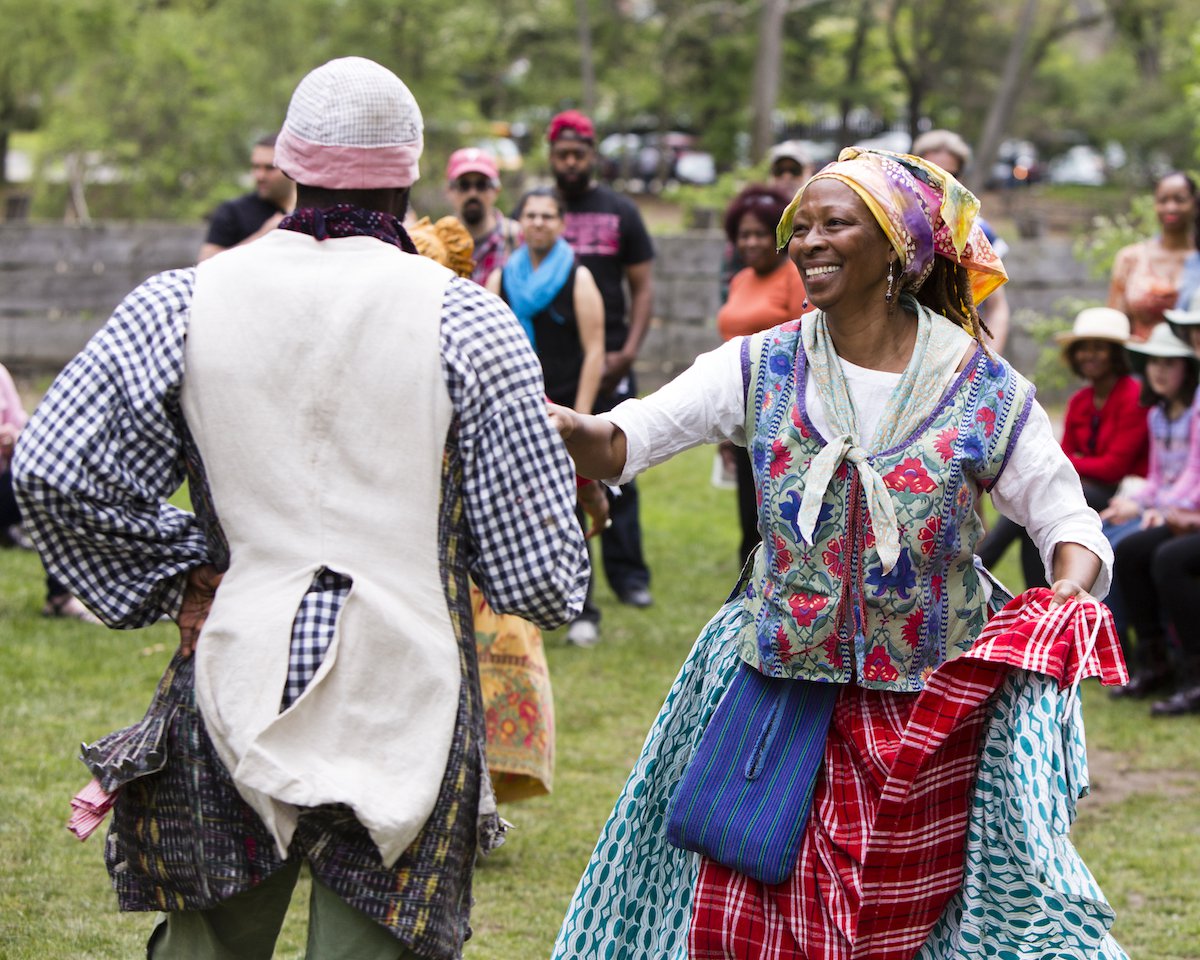
A few weeks ago on this show,
We were talking about Sojourner Truth
And the fact that the first 10 years or so of her life,
She spoke only Dutch.
She learned English later.
And that led me to do a lot of reading about Pinkster,
The Spring Festival. You know what this is, Grant.
Yeah, it’s an African-American holiday, or was.
And the name derives from the Dutch word for Pentecost, and it happens in the late spring.
I was reading about the festival in the early 18th and 19th century on a website called
HudsonValley.org. Now, this is the website of an educational nonprofit that discusses
The historic Hudson Valley. And I wanted to share with you a paragraph from that website and see if anything strikes you the way it struck me. Okay, let’s see. Pinkster was brought to the new world by Dutch settlers in the 1620s and flourished in the areas of heaviest Dutch settlement, the Hudson Valley, northern New Jersey, and western Long Island. These same areas also has significant populations of enslaved Africans from the 1600s until emancipation in New York in 1827. For enslaved people, the year offered few holidays or breaks from tedious and often grueling work. For rural captives in particular, who were often isolated from larger African communities, Pinkster became the most important break in the year. Anything strike you about that?
No? What am I missing?
Well, they never once used the word slave.
They said enslaved.
That’s right. But they never used slave as a noun.
Interesting.
They used enslaved Africans, enslaved people, and rural captives.
And the reason I was thinking about this was that I gave a talk in Fort Worth at Tarrant County College, and a history professor called my attention to the fact that there’s something that happens in your mind if you don’t use the word slave and instead substitute the words enslaved person, enslaved men, enslaved children.
It’s just different.
And I think that there’s a risk of carrying political correctness too far, but I think that this is a really profound way to write and talk about slavery.
I see. I was trying to figure out what, if you thought it was bad writing to leave the word slave out, or if the way that they’ve used enslaved as an adjective was more effective in humanizing the subjects.
And that’s what you’re saying, right?
That’s exactly what I’m saying.
So if we say a slave, what are we thinking about?
We’re thinking about people in a horrific situation, of course, people who didn’t want to be doing what they were doing, but we’re also falling deeply into all these stereotypes of us and them and white and black.
Well, and the presumption that it’s a condition rather than something imposed upon you.
It’s sort of like when you read history books that say slave families were broken up on the auction block.
No.
White people broke up families of enslaved people.
There was an actor there.
Yes.
That passive language is taking away the fact that there was an agent of destruction who did the deed.
That’s what I’m talking about.
I think it’s a very powerful tweak.
So clearly whoever wrote that put some thought into how they wanted to talk about slavery in the right way.
Exactly.
Exactly. It’s really changed the way that I think about and write about that now.
You know, I work in the museum business in my other life.
And I read a museum blog, which is really interesting.
It’s a person who works in a museum on a plantation in the south.
I’ll find it for the website. I’m not recalling the name of it right now.
But what she does is relates the questions and comments that she gets from visitors.
And so many of her visitors want to deny that slavery was real.
Oh, yes, yes. I’ve seen that blog.
They basically said, but they were treated well, weren’t they?
Right, right.
But they were fed and taken care of and given clothing and shelter, right?
Right.
They were singing.
Hello.
Yeah.
It’s just hard for some people to get to that extra understanding.
Like, yes, and if they tried to escape, they would be killed or their family would be killed or they would be branded or they would be mutilated or injury would happen.
Right.
I know we’re far afield on the language topic.
Right.
But it is really at the heart of this, what you brought up is this way that we can either do justice through words or we can do injustice through words.
Very, very well said.
To do justice. Very well said, Grant. We know you’ve got comments about this. 877-929-9673.
Email words@waywordradio.org. Hi there. You have A Way with Words.
Hello. This is David calling in from San Antonio. I had a question about Tolkien’s use of language in The Hobbit.
Oh, great. We’re big Hobbit fans.
Yeah, sure. Big Tolkien fans here. What are you thinking? Are you reading that now?
Yes. Yeah. I’m a teacher and I’m working with a class of sixth graders and we’re working our way through it.
And we were reading the section on flies and spiders, and there’s this great scene where Bilbo’s taunting the giant spiders as he’s trying to rescue the dwarves from their webs.
And he starts shouting out these taunts in a sing-song fashion. And there’s a couple words, Addercop and Tom Noddy, that he’s using as insults for the spiders.
And we were wondering, my class and me, where those words come from and what they mean, because we couldn’t find them in the dictionary.
Addercop, Addercop, down you drop, old Tom Noddy, all big body. Am I remembering it correctly?
Yeah, you are.
Yeah, old Tom Naughty, old big body, old Tom Naughty, chance by me. Got it.
One of the things that Tolkien did, you know, he worked for a time with the Oxford English Dictionary working on etymologies.
So throughout his books, even though it seems like a really fantastical world, he has tried to ground a lot of the language in true language, in true linguistic history, connecting it to older forms of English and Norse and the Germanic languages and so forth.
And so Adderkop actually was at one point a word in English.
If you look in a larger dictionary, like the Oxford English Dictionary, you will find an entry for Addercop.
Also for Tom Noddy and a bunch of the other words that they use.
Addercop is basically just an old-fashioned way of saying spider.
I think it means something like poison head.
Yeah.
This COP, Martha is probably going ding, ding, ding in her mind.
COP is related to the words for head.
Yes, and it’s also related to the word cobweb.
Cobweb, there we go.
And so they’re all in there.
And I want to refer you to a couple resources, not just for those words, but for all of the language that he uses.
First, there’s a really great article on the Oxford University Press website.
It’s called, Why Did Tolkien Use Archaic Language?
And so they just talk about this.
They talk about him personally and his academic career, what he contributed to the Oxford English Dictionary, and then how that played out in his books.
And you can just Google that title, Why Did Tolkien Use Archaic Language, and you’ll find it at OxfordDictionaries.com.
But probably more significantly, there’s two books that I would recommend you find.
One of them is called The Ring of Words.
It’s by three fellows.
One of them is Peter Jelliver, whom I know.
And what they’ve done is not only have they researched Tolkien’s history with the Oxford English Dictionary, they found his actual files.
They found the stuff that he worked with when he was working in language.
And they’ve gone into the archives of the Oxford English Dictionary and kind of like explained it all and tried to connect it again and again to the books and to the language that he uses there.
It’s really academic stuff, but I still think you could probably make it palatable for a class of sixth graders.
And then the other one is online, and it’s free.
It’s by a fellow named Oliver Liu, L-O-O, and it’s TolkienEnglishGlossary.com.
TolkienEnglishGlossary.com.
Now, he also made a book of this, but a lot of this is available on his website.
He’s got an A to Z reference, a lot of front matter and a lot of explanation and stuff, and he just goes into it and talks about all the different words that you might encounter and wonder about.
So Adderkop is literally poison head for spider.
And what was the other one?
Tom Noddy.
Tom Noddy.
Tom Noddy is a foolish or stupid person connected to the word naughty, which was also a fool or stupid person going back as far as the 1500s.
Okay, so just like the name Tom.
Yeah, Tom, which is often used in a variety of combinations.
Yeah.
So, David, what are your students saying about all these strange words that they’re encountering?
Well, they’re really enjoying it.
They were asking specifically about those when they came up, because in the text it even says, and nobody likes being called a Tom Nottie.
So we were wondering what they were.
But they’re especially loving the poetry and the songs.
We memorized the Dwarvish song at the start of the book.
You memorized it? In Dwarvish?
A real treat for them.
Yeah, the ten verses of the Far Over the Misty Mountains.
Oh, I see.
Good Lord, wow.
And are they performing this for somebody?
Yeah, well, at our school, it’s a classical charter school.
We have poetry wars where the different classes memorize poems
And then with a certain theatrical quality to them,
And then we go and we invade their classrooms and perform them for one another.
You invade their classrooms.
This does sound sort of Tolkien-esque.
We march in in the middle of class.
With, like, beards and axes?
Say again?
You march in with beards and axes and take over the classroom?
No beards and axes yet.
Maybe next year, but just with our voices and our poems.
Okay, little hairy feet.
That’s outstanding.
That’s wonderful.
Well, David, congratulations.
It sounds like you’re doing great work there.
Thank you so much for your time.
Thank you.
Take care now.
Okay.
Bye.
Bye.
Tom Noddy.
Atta cop, atta cop, down you drop.
So in the scene, he’s in the Mirkwood, this dark, evil forest fighting off spiders.
Mirkwood, I love that.
And trying to save his dwarvish friends from being eaten.
Well, don’t be a Tom Noddy.
Call us 877-929-9673.
Grant, I met a guy from the Ozarks the other day
Who reminded me that there’s a great expression
That has to do with the idea of,
Well, I think of it as spilled milk, you know, something that’s happened and you can’t go back and fix it.
What’s that?
That melon’s busted.
That melon is busted.
I mean, you can just picture dropping a watermelon or something.
There’s no way you’re putting it back together, right?
No.
It reminds me when my son was very young, one-ish, two-ish.
Yeah?
If he wanted his bananas whole and if they were broken, he would cry and shout, put it, put it.
He wanted the banana put back together.
Putting together a banana is a lot easier than putting a watermelon back together, right?
Yeah.
That melon’s busted.
Sure.
I love that.
Hello.
You have A Way with Words.
Hi.
This is Nathan calling from Abilene, Texas, where I listen to you guys on KACU.
Excellent.
Outstanding.
Glad to hear it.
Welcome to the show, Nathan.
Well, I’ve got an interesting question that kind of involves a travel story.
Oh, good.
A few years ago, I was on a business trip to London, England, and I had a trade show that I was attending and had a bunch of boxes that I was bringing in from the hotel that I was staying at to go to the trade show venue.
And I put them in a taxi and I brought them to the venue and we unloaded them on the side of the road and I’m trying to get them down to my exhibit space.
And so I went into the venue and I walked up to this group of British working men who were there working in the in the bowels of the trade center there.
And I walked up to them and I said, I need a dolly.
And they looked at me like I was speaking a foreign language.
And one of the guys started rocking his arms back and forth and said, you want a dolly, mate?
Like a toy dolly.
Like it was a doll. And I said, no. And they start looking at each other. And it really was
One of those, you know, two people, one people separated by a common language type moment anyway.
So I looked at them and realized that I really was not communicating at all. And I started going
Back through my lexicon of other euphemisms for a dolly. And so I said, okay, I want a two-wheeler,
Which is a name that I’d heard used.
And they kind of looked at me and kind of heads cocked to the side.
And then I said, I want a hand truck, which is another old word that I’ve heard used, describe a dolly.
And they kind of looked at me, and I still wasn’t communicating.
And then finally I said, I want a platform with an axle, with two wheels attached to an axle, with a pole coming up the back that I can slide under some boxes and lean them back and haul them.
And at this point, they look at me and they say, oh, you want a trolley?
And I said, yes, I’d like a trolley then.
And they said, go get the Yanka trolley.
And somebody went off and they got the Yanka trolley.
And I got my boxes and I took it back to them and I said, thank you.
And this was my little moment.
And so which leads me to puzzling for a long time.
Where exactly this, I guess, uniquely American word dolly came from for something that we used to haul furniture and boxes around?
Oh, but I bet they’re still talking about the American who wanted a doll.
The yank.
The yank.
That’s nice.
Oh, Nathan.
It’s not settled in this country either, by the way.
Not at all, Nathan.
There’s not universal agreement on what those devices are called here either.
I mean, it depends on your industry.
In some industries, a dolly is a hand truck.
In other industries, a hand truck is a dolly.
I mean, I grew up with one thing where it’s like a square or rectangular board on four caster wheels.
That’s a dolly.
No handle.
Maybe a rope to pull it.
The one that you were talking about that you moved your boxes with is a hand truck.
And then you’ve got trolley, which is kind of like a cabinet on wheels or like a shelving unit on wheels, maybe with open sides.
But I know that in other industries, it’s very different.
It’s very fixed, for example, in the jargon of some unions.
They have very specific language because that language relates to what they’re permitted to do as for their duty.
So they’ve kind of written it into job descriptions and stuff.
I remember being really struck the first time I heard anybody talking about a dolly, meaning that thing that you sort of lean back and push.
I was really surprised.
Yeah, that’s never been a dolly for me, but I know that it is for other people.
Yeah, so why is it a dolly?
We don’t rock it in our arms.
No, we don’t.
You know, those Brits, by the way, they might have also responded to the word a Raleigh or a Roli, because for a long time that was a word for that device as well, just depending where you were in the country.
You know, I wonder if you’d have gone just a couple miles down the road to another hotel and asked a similar group of workmen if they would have understood, because it is super local, some of this stuff, and very specific to certain trades.
The little bit of research that I did, they came back and said that dolly is basically an American term.
This is something that we use that’s uniquely American and different from anything that the Brits would use.
Well, that’s a case of falling out of favor.
If you look it up in a historical dictionary like the Oxford English Dictionary, you will see many long variations on different devices for carting things around called dollies.
And many of them were used for a long time in the United Kingdom in mining or construction or what have you.
So maybe it remains American, but it didn’t necessarily start as American.
That’s a fun story.
I love those moments.
And I’m glad that you can tell it with a bit of humor in your heart.
Oh, it was a lot of fun, actually.
It’s a great story.
I would just imagine a bunch of burly guys like, what kind of fellow comes up to men and asks for a doll?
Yeah, so we don’t really have a good answer for the origin of dolly.
The only thing I can think of is those three-legged television camera dollies.
I don’t know that term.
Yeah.
But there’s another example of very specific language in a particular trade or profession.
And not the same as other trades or professions.
Right.
Or maybe the whole thing was surreal and it’s a reference to Salvador.
I don’t know.
Yeah, there we go.
But maybe somebody knows.
Yeah, we’d love to hear how you use those words dolly, trolley, hand truck in your business.
Oh, and Two Wheeler, which is one I hadn’t heard before.
Give us a call, 877-929-9673.
Nathan, thank you so much for your story and your call.
Thank you so much.
Have a good one.
Take care.
All right.
Bye-bye.
Here is a really weird mascot.
This one was sent to us by Max Winter Osterhaus, who went to Madison East High School in Wisconsin.
He says, we were the purgolders.
Purgolders.
P-U-R-G-O-L-D-E-R-S.
Purgolders.
That’s a pretzel?
Purgolders.
Is that a pretzel?
No, it sort of looks like a cat, but he said it’s just a mashup of purple and gold.
Oh, I see.
Okay.
Yeah.
We were the purgolders.
Sorry about the name.
I don’t know.
They probably have a great record.
Yeah, there we go.
Call us with your language questions, 877-929-9673.
Send them to our email address, words@waywordradio.org.
Do you want more A Way with Words?
Listen to years of past episodes at waywordradio.org.
Or find the shows in any podcast app or on iTunes.
The toll-free line is always open,
So leave a message for us at 877-929-9673.
We love to get your emails at words@waywordradio.org,
Or you can hit us up on Twitter @wayword,
And look for us on Facebook.
This program would not be possible without you.
Grant and I are out to change the way we listen to each other
And the way we think about language.
And you’re making it happen.
Thanks also to senior producer Stefanie Levine
And director and editor Tim Felten in San Diego.
In New York, we thank production wizard James Ramsey,
Quiz guy John Chaneski,
And that master of keeping it real,
Paul Ruist at Argo Studios.
A Way with Words is an independent production of Wayword, Inc.
From the Recording Arts Center at Studio West in San Diego,
I’m Grant Barrett.
And I’m Martha Barnette.
Bye-bye.
So long. you
Macon Whoopie
 In an earlier episode, we discussed funny school mascot names. Listeners wrote in with more, including the Belfry Bats (the high school mascot of Belfry, Montana) and the Macon Whoopie hockey team, from Macon, Georgia.
Pronouncing Gymnast
A Fort Worth, Texas, couple disagrees about how to pronounce the word gymnast, but both JIM-nist and the more evenly stressed JIM-NAST are fine.
Grammar of Grawlixes
A musician from Youngstown, Ohio, is designing an album cover for his band’s latest release. He wants to use a grawlix, one of those strings of punctuation marks that substitute for profanity. “Beetle Bailey” cartoonist Mort Walker coined the term, but is there a grammar of grawlixes?
Attempted Trademarks Word Quiz
Quiz Guy John Chaneski has a puzzle about words and phrases that people have tried to trademark, including a two-word phrase indicating that someone’s employment has been terminated, which a certain presidential candidate tried unsuccessfully to claim as his own.
Raising Multilingual Children
He’s a native English speaker who’s fluent in Spanish. She grew up in Cameroon speaking French. They’re planning a family, and hoping to raise their children to speak all three. What are the best strategies for teaching children to speak more than two languages? The Multilingual Children’s Association offers helpful tips.
Sacred Heart Breakers
Offbeat mascot names from Montana include the Powell County Wardens (so named because the high school is in the same county as the Montana State Prison), and the Missoula Loyola Sacred Heart Breakers.
Seen From a Galloping Horse
Growing up in Jamaica, a woman used to hear her fashion-designer mother invoke this phrase to indicate that something was good enough, even if it was flawed: “A man on a galloping horse wouldn’t see it.” Variations include “it’ll never be seen on a galloping horse” and “a blind man on a galloping horse wouldn’t see it.” The idea is that the listener should relax and take the long view. The expression has a long history in Ireland and England, and the decades of Irish influence in Jamaica may also account for her mother’s having heard it.
Etymology of Cameroon
The country of Cameroon is so named because a 15th-century Portuguese explorer was so struck by the abundance of shrimp in a local river, he dubbed it Rio dos Camaroes, or “river of shrimp.”
Slave vs. Enslaved
The organization Historic Hudson Valley describes the African-American celebration of Pinkster in an exemplary way. It avoids the use of the word slave and instead uses terms such as enslaved people, enslaved Africans, and captives. It’s a subtle yet powerful means of affirming that slavery is not an inherent condition, but rather one imposed from outside.
The Language of Tolkien
A sixth-grade teacher from San Antonio, Texas, says he and his students are reading The Lord of the Rings. They’re curious about the words attercop, which means “spider” (and a relative of the word cobweb) and Tomnoddy, which means “fool.” Grant recommends the book The Ring of Words, as well as these online resources: Why Did Tolkien Use Archaic Language? and A Tolkien English Glossary.
That Melon’s Busted
If you’re in the Ozarks, you might hear the expression that means the same as water under the bridge or spilled milk: “that melon’s busted.” The idea in all three cases is that something irrevocable has happened, and there’s no going back.
Dolly vs. Trolley
A listener from Abilene, Texas, recounts the incredulous reaction he got when he was in England and asked some burly fellows for a dolly, meaning a wheeled conveyance for moving heavy loads. He asked for a two-wheeler, then a hand truck, and finally learned that they were expecting him to ask for a trolley.
The Madison Purgolders
Madison East High School in Madison, Wisconsin, is the proud home of the Purgolders. That school mascot resembles a golden puma in purple attire, with a portmanteau name that combines those two colors.
This episode is hosted by Martha Barnette and Grant Barrett, and produced by Stefanie Levine.
Photo by mwillms. Used under a Creative Commons license.
Books Mentioned in the Episode
| The Lord of the Rings by J.R.R. Tolkien |
| The Ring of Words by Peter Gilliver |
Music Used in the Episode
| Title | Artist | Album | Label |
|---|---|---|---|
| Drop A Dime | The Zou | Kills Part Two | Hepplewhite Records |
| The Cylinder | Milt Jackson | The Ballad Artistry of Milt Jackson | Atlantic |
| Orange Peel | Reuben Wilson | Blue Break Beats | Blue Note |
| Ronnie’s Bonnie | Reuben Wilson | Blue Break Beats | Blue Note |
| Busride | Reuben Wilson | Blue Break Beats | Blue Note |
| Makin’ Whopee | Milt Jackson | The Ballad Artistry of Milt Jackson | Atlantic |
| Love Bug | Reuben Wilson | Blue Break Beats | Blue Note |
| Blue Mode | Reuben Wilson | Blue Break Beats | Blue Note |
| Volcano Vapes | Sure Fire Soul Ensemble | Unreleased | Colemine Records |