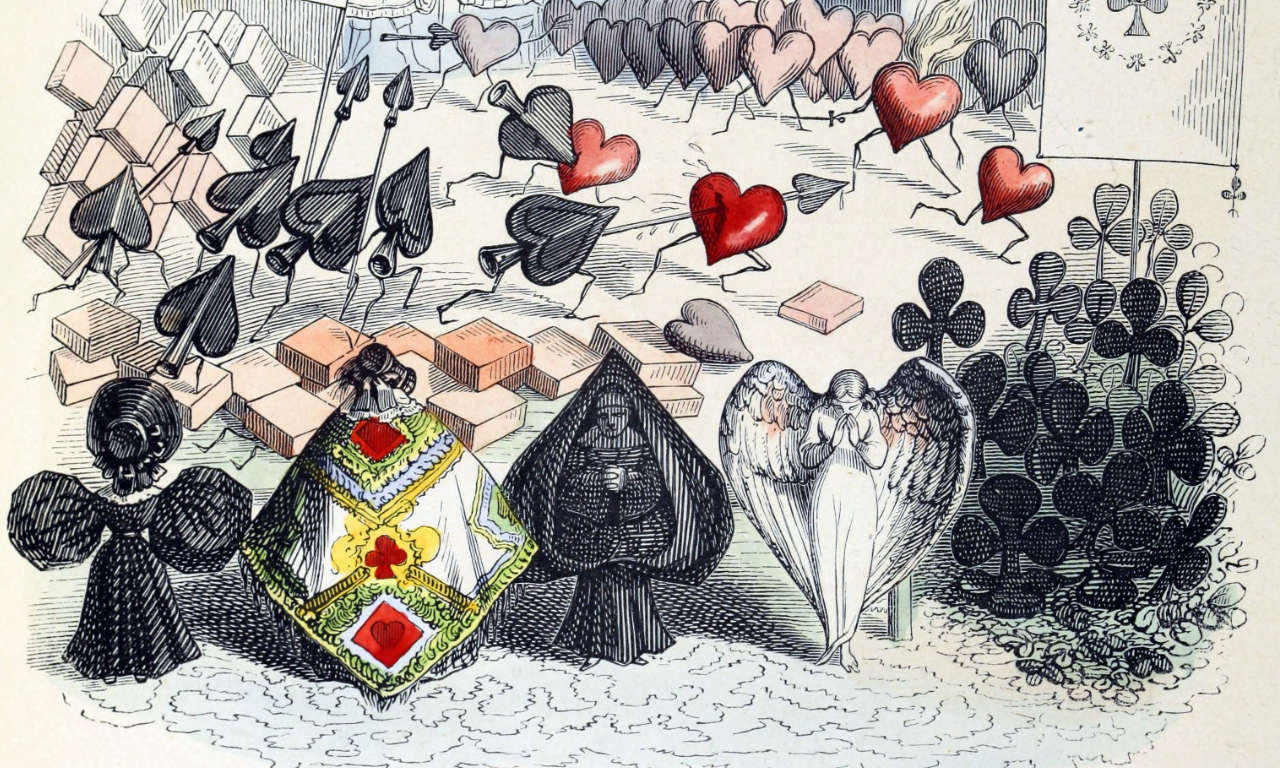
Silence comes in many forms. Writer Paul Goodman says there is, for example, the noisy silence of “resentment and self-recrimination,” and the helpful, participatory silence of actively listening to someone speak. • The strange story behind the English words grotesque and antic: both involve bizarre paintings found in ancient Roman ruins. • The whirring sound of a Betsy bug and a moth’s dusty wings give rise to picturesque English words and phrases. • Also in this episode keysmash, subpar, placer mining, dinklepink and padiddle, machatunim and consuegros, and to clock someone.
This episode first aired October 20, 2018. It was rebroadcast the weekends of June 14, 2020, and July 29, 2023.
Transcript of “Take Tea for the Fever (episode #1508)”
You’re listening to A Way with Words, the show about language and how we use it.
I’m Grant Barrett.
And I’m Martha Barnette.
We got a voicemail from Denise Nyland from Panama City, Florida, and she was asking about a term that she grew up with for moths. Moths, like the little fluttery things.
Yeah, the little fluttery things. Nighttime butterflies, as some people call them.
Oh, really? That’s nice.
So what’s her word for moths?
Miller.
Oh, this is familiar. Why is this familiar? M-I-L-L-E-R.
-huh.
Okay.
Yeah. They called moths Millers, where she grew up, and she wondered if anybody else did. And indeed, plenty of people refer to moths as Millers.
But here’s the really cool thing.
Why?
Why?
Why do they do that?
I bet you know.
I do know, and it’s so great.
You’re bouncing in your chair.
It’s so great. I mean, I’m picturing, you know, being on the front porch down there in Florida, and you got the light bulb, you know, the one light bulb hanging down. There are all these moths there.
But think about it. The moths have these soft wings, and they’re kind of dusty, right? They’re kind of powdery. Moths have been called millers since the 17th century. And that’s because if you were a miller in the 17th century, you had a mill and you were grinding wheat, you’re going to get dusty and powdery.
Right.
And it’s the same idea.
Oh, it’s the dustiness of the moths.
Isn’t that cool?
How about that?
Yeah, that’s beautiful, too.
Yeah. And some people, in fact, call those moths dusty millers, and that’s when I had a light bulb moment because I realized that the plant dusty miller, which is this beautiful sort of silvery gray plant, kind of filigree leaves, is called dusty miller because it’s dusty like a miller.
Isn’t that cool?
I always thought it was called that because there was some botanist named Dusty whose last name was Miller.
But no, it’s like a little Dusty Miller. It’s somebody who grinds flour.
That’s gorgeous.
How about that?
Wow.
Yeah, stories everywhere you look, right?
Everywhere.
Call us or write us with your language questions and comments, jokes and riddles, and something cool that you read. 877-929-9673. words@waywordradio.org or talk to us on Twitter @wayword.
Hi there.
You have A Way with Words.
Hi, this is Elaine calling from Boulder, Colorado.
Hello, Elaine.
We have John Chaneski to thank for my question today. I was listening to the episode called Alverklempt, and in the quiz portion, John talked about accidentally getting hit by the bird in a cuckoo clock. And that got me wondering why we say clock someone to mean hit someone. And I doubt very much that it has to do with getting hit by the cuckoo in a cuckoo clock. So I was hoping you could shed some light on that phrase.
That’s right.
Yeah.
I don’t think there’s a high rate of injury for a cuckoo clock. The CDC does not report that, I think, on their list of injuries.
I feel like I’ve seen that in a cartoon someplace. I saw an OSHA poster over here in the lobby.
Oh, really?
No, I’m kidding. Watch out for the cuckoo clocks.
And you know what? It does relate to clocks, though. It absolutely does because what is on the front of a clock?
The face of the clock.
The face of the clock. So it’s just kind of a little wordplay where the name for the device that we also call a face becomes the name for our own face.
So there’s a variety of different uses. There’s the verb to clock someone, which means just to look at them. There’s the verb to clock someone, which means to punch them in the face. It doesn’t mean to punch them anywhere else. It’s just the face.
And if we look back as early as the late 1800s, there’s the clock noun, meaning the face. And then by the 1920s, the verb shows up, meaning to punch someone in the face. So, and there’s another kind of verb clock, which is to clock somebody doing 60, you know, or clock somebody doing 120. It’s usually a high rate of speed. Means that you’re measuring them against a timing device. We’ve kind of extended that usage.
So you can say, yeah, I clocked him walking across the lobby with the purses that he stole, you know. Meaning I watched him with my own clock and I measured his rate and his progress.
Got it.
Yeah.
Oh, I’m so happy to have an answer for that.
Yeah, it’s a longstanding slang in the U.S. and the U.K. It’s funny. It’s one of those, I like this kind of slang where it just kind of keeps lasting. It’s not particularly spectacular. And yet when you look into it, it seems interesting.
Right, those things that we hear all the time and then we start using them and then we have no idea why.
Oh, well, thank you so much. I really appreciate it.
Yeah, our pleasure. Elaine, thanks for calling.
Thank you.
Thank you so much.
Take care.
Bye-bye.
Bye-bye.
You know, I recently found my digital clock that I haven’t used in years and years.
Does this explain your timing and your arrivals?
No, no, it doesn’t explain it at all.
You have a phone now.
Yeah, this is the one I plug into the wall. And so I decided to use that and put my phone in another room at night, you know, so I don’t have it near me when I’m sleeping. And it’s so weird. I mean, talk about, I forgot what it’s like to have those little numbers there beside the bed. You know, it’s a different kind of clock face, right? It’s not even a face.
That’s right. When we think about all the things that our phones have become, the bedside clock is one of them. I unplug clocks wherever I go in the hotels or Airbnbs or that sort of thing. The bedside clock, I can’t stand. It’s too obvious, a marker of time and progress. And I don’t like the lights.
I don’t either. And I’ve had them wake me up before, accidentally. Like somebody left the alarm on from the previous…
Somebody maliciously said it at a terrible hour.
Oh, do you think it was malicious?
I didn’t even think about that. I think it’s like the people who unscrew the top of the salt shaker so that you put too much salt on your food.
Where are you going?
This doesn’t happen to me.
I live an interesting life.
After the death of the Queen of Soul, Aretha Franklin, her ex-husband, Glenn Terman, said that he would remember her humor and stubbornness. And then he used a delightful phrase. He said she didn’t just take tea for the fever, as the old folks would say.
Oh, I love it. Tea for the fever.
Yeah. Yeah. And that’s in the Dictionary of American Regional English. Not to take tea for the fever means not to put up with any nonsense or not allow oneself to be intimidated.
Outstanding.
It’s a phrase that Langston Hughes used, as a matter of fact. I will not take no tea for the fever. And I’m not sure why it’s not taking tea for the fever. Maybe somebody can explain it to me. But my guess is that if you’ve got a fever, you’re not going to take hot tea for it. Or maybe it’s like not a drink as weak as tea. I don’t know.
I was thinking about the sedatives that you might put in a tea. So you’re not going to be shut down with someone else’s somniferousness.
Somniferousness.
Oh, that’s a nice word. You’re not going to let the opiates that go along with the tea you’re drinking for the fever reduce your ability to react and have an opinion and then be involved and tell them exactly what you think.
Well, maybe somebody can explain it to us.
877-929-9673. Email words@waywordradio.org. And on Twitter @wayword.
Hello, you have A Way with Words.
Hello, this is Jeff Simpson. I’m calling from Huntsville, Alabama. This is kind of an odd thing. About 60 years ago, when my parents were driving the kids around in the backseat, and it’s at nighttime on the freeway, we would play a game. And if you ever saw coming back at you a car that only had one headlight, whoever saw it first would yell, pediddle, and that would enable you to slug your brother or sister in the shoulder. And so my curious question is the word pediddle, if there actually is such a term for a one-eyed car. And just that’s really about it.
Is there such a term, or were you the only family playing that game?
Is that what you’re wondering?
No, I’m pretty sure everybody, you know, lots of people played the game.
They might not have called it the diddle, but it’s like when I described this to my wife, her response was, well, when we did it, they would kiss somebody.
Yeah, that’s what you do with your sweetie when it’s just you and your sweetie, right?
Right.
You don’t have a sweetie.
I guess you just hit the person next to you.
Well, brothers and sisters, it has to be a punch.
Right.
Or brothers and brothers, right?
Right.
Yeah, this game goes back to what, the 1940s?
Easily, surely older than that, though, as long as cars have lost headlights.
Right, right.
Although you wonder if there was a one-eyed horse version back in the day.
Yeah, right.
Or maybe a one-eyed horse named Pediddle or something.
I’m not sure we know the origin of that word, but boy, are there a bunch of variations.
Pediddle and peduncle and pasquaddle.
And cockey and cockeyed peddle.
Piddle as well.
And Popeye.
I’ve seen that one too.
And Dinkle Pink.
Dinkle Pink.
Oh, that’s a good one.
Yeah, it’s one of those sort of a family word that gets passed down and passed around.
And so when you see the one-eyed car coming at you, you can kiss the person next to you.
You can punch the person in the arm.
And some people smack the roof.
Okay.
And then there’s the slug bug version, which is the VW bug, which is similar things.
Usually that one’s punching because it’s got slug right there in the name.
If you see a Volkswagen, or does it have to be a Volkswagen with a Padiddle?
No, just the bug itself.
Just the bug.
Some people say not the van.
Some people say yes to the van.
So who knows?
So this just sounds like a great way to pass the time on one of those long drives.
Well, it was, and it certainly kept the kids busy in the back, that’s for sure.
Well, that means everything, doesn’t it?
Yep.
I wonder if people play it as much now with, you know, iPads and iPhones.
Yeah, DVD players built into the car and all that.
I don’t know.
Yeah.
Maybe.
Kind of odd.
We do.
We play license plate games.
We play all the old games that you used to play in the 50s and 60s.
I bet you play word games with the license plates.
Yeah, we do the word games when you’re driving.
You find, in alphabetical order, words on signs beginning with all the letters of the alphabet.
Oh, there you go.
Yeah, or just looking at somebody’s license plate and making a word.
License plate looking.
Yep.
Yep.
That’s the most that we know.
Hope that helps.
Yeah.
Thanks for this drive down memory lane.
Okay.
Well, thank you.
It’s been a pleasure talking to you both.
All right.
Take care now.
Take care.
Okay.
Bye-bye.
Ba-diddles, another one.
Ba-diddles.
With a B.
Ba-diddle, per-diddle, per-diddle.
And we’re going to get a ton of calls about this.
Every single time we talk about this, the phone lights up, the email blows up, Twitter goes crazy, and by all means, send it all.
We’re just interested in variations and other names and what you might do besides kissing or punching.
Right.
Right.
We always learn something new.
Right, yeah.
When that happens.
That’s the show, right?
You and I are…
That’s the show.
We’re the two students and everyone else are the teachers.
It’s so true.
It’s endless.
Call us, 877-929-9673, or you can send your comments to words@waywordradio.org.
You know when you’re typing an email or a text and you get really frustrated and you want to express that frustration, so you just type FDSA, JKL, semicolon, or something like that?
Yeah, yeah.
You know the term for that?
I don’t know. What?
Key smash.
Oh, yeah, yeah. I didn’t know that. Key smash.
And you use that euphemistically to refer to somebody who just types this long screen with no breaks and no capitalization, right?
Oh, really?
Yeah, that’s also a key smash.
I didn’t know that. Oh.
I read someplace that some people confess to correcting their key smashes.
You know, they just, because they don’t look quite right.
You know, you want a few more, you know, maybe you want to go to the top row and do your key smash.
And accidental words that might appear.
Yeah.
Right.
This show’s about language examined through family, history, and culture.
Stick around.
You’re listening to A Way with Words, the show about language and how we use it.
I’m Grant Barrett.
And I’m Martha Barnette.
And joining us now on the line from New York City is our quiz guy, John Chaneski.
Hi, John.
Hi, Martha.
Hey, buddy.
Hi, Grant.
What’s up?
Hi.
Well, you know what?
I was thinking about this.
This is something I’ve been saying to people lately.
As I get older, I say things to the younger people.
I don’t want to be that old guy that says this, but I do.
When I was growing up, you could watch all of television.
All of it.
You could watch shows in the fall and then catch reruns of shows you missed.
You could learn the theme song for every single show.
Now, there’s just way too much television.
Lucky for me, though, because that means that there have got to be shows that very few people have heard of.
Oh, boy.
For example, I’ll give you an example.
I’m going to give you a show.
Cloak and Dagger.
Now, is that a series about spies in the 1940s or about two superheroes named Cloak and Dagger?
It’s a very, very, very good Marvel television show.
Right.
That’s exactly right.
In the following quiz, you only get one joint answer.
Okay, I’m going to give you a 50-50 on this one.
Odds are you’ll get some of them right.
Now, here we go.
I’m going to give you an interview.
So we’re like manacled together and neither one of us can escape unless we both escape?
Sort of, yes.
It’s like, oh, brother, where art thou?
Here we go.
Now, the first show is called The Resident.
Is it a medical drama about a charming and arrogant med student or a horror anthology series about a haunted house?
It’s the med student, I think, Martha.
I would agree with that.
That sounds right.
It is the medical drama.
Yes.
Very good.
Here’s another one.
Altered Carbon.
Is it a sci-fi series about interchangeable bodies or a drama about a down-on-his-luck chemistry teacher?
Grant’s nodding his head.
Yeah, it’s the interchangeable bodies.
The first one.
Yeah, though Donald’s a chemistry teacher.
I think somebody already did that.
It was called Breaking Bad.
Yeah, I didn’t hear very much about that.
Now, how about Life Sentence?
Is it a drama about a woman who beats a terminal cancer diagnosis or a gritty tale about an English professor wrongly jailed for murder?
Oh, that’s a hard one.
I think it’s the second one, Martha.
I’m going to guess the second one.
It is the first one.
What?
She beats cancer, and then she has to try to find a way to deal with the life that she didn’t think she was going to have.
Oh, my.
Life sentence.
Okay.
How about child support?
Is it a drama about a private eye who rescues kids in dangerous circumstances?
Or a game show where contestants can look to kids for help?
Oh, no.
I have no idea on this.
I like the second one.
I like it.
Let’s choose it.
Yeah.
Yeah.
Good.
You got it.
It is a game show with kids where the kids can support you.
Child support.
Yeah.
This one is called Disenchantment.
Is it a magazine-style show about people who fell out of love or an animated sitcom about an alcoholic princess and an elf?
Princess and elf.
Yeah, I’m going with the princess and elf.
It is A Princess and Elf by Matt Greinig.
It’s a new series from Matt Greinig.
Oh, cool.
I can’t wait.
Adult animated series.
How about this one?
Paid Off.
Is it a comedy game show that draws attention to the student loan debt crisis or is it a detective series about corruption in a small Canadian town?
Well, given that I personally know and am very good friends with one of the writers of that show.
Really?
Yeah, really.
I would choose A.
It is A, yes.
A comedy game show that draws attention to the student loan debt crisis.
Yes, I did work unpaid off and it’s on true TV right now.
Yeah.
And it’s a lot of fun, so I hope you watch it.
Yeah, it looks great.
It looks like a top-notch show.
Congratulations, you guys did good stuff.
Way to go.
Thank you very much, guys.
Thank you.
All right.
Thanks for the quiz, too, John.
We really appreciate it.
Okay.
Thanks, guys.
Take care.
Bye.
Bye, John.
A Way with Words is where we talk about language and not just the boring stuff, but the fun stuff, too.
Give us a call, 877-929-9673.
Email words@waywordradio.org.
Hello.
You have A Way with Words.
Hi.
My name is Cecily, and I’m from Indianapolis, Indiana.
Welcome to the show, Cecily.
How can we help you?
The phrase that my grandmother used to use. She grew up in North Carolina, and she would say, crazy as a Betsy bug.
Crazy as a Betsy bug.
Yes.
And how crazy is that?
That’s the thing, because it was never like if someone made her laugh, she wouldn’t say, oh, you know how some people say, oh, you’re so crazy, or something like that.
She would never use it in that way.
It was if somebody was doing something that she thought was stupid.
Oh.
And then she would say, that person is crazy as a Betsy bug.
And I haven’t heard it much. I spent some time when I was a child in North Carolina.
I heard it there, but as far as the North, I’ve not heard it, even from people who’ve come from the same region.
-huh.
And have you heard the term Betsy bug at all?
No, I have no idea.
I know I should look that up more, but I have no idea what a Betsy bug is.
Well, we can tell you what a Betsy bug is.
It’s a kind of beetle. It also goes by the name patent leather beetle, which kind of gives you an idea.
It’s kind of, you know, about as big as your thumb and black and shiny.
It’s sometimes called a horn beetle, but it’s also called a Betsy bug or a Bess bug or a Bessy bug.
And you see the phrase crazy as a Betsy bug or different variations of that throughout the South.
And nobody really knows why a Betsy bug might be considered crazy, except it does make an interesting sound.
It’s kind of like, you know, when you disturb it, it makes this kind of…
Really?
Like a little…
Like a cat when it gets annoyed with you?
Sort of like that kind of a, you know, kind of a buzzy.
They’re pretty sizable and this beautiful black patent leather looking thing.
Maybe that’s, I guess that’s why it’s crazy because other bugs don’t talk to you.
Yeah, you don’t really see them swarming.
I’ve only seen them, you know, just wandering around kind of by themselves.
Maybe you’re right.
That is so interesting.
Interesting. So that’s where that comes from. And that’s why I wonder, that’s why I can say it wasn’t when she was amused. It was quite the opposite. When she was displeased. That’s wonderful.
I gotta say, I gotta say, Cecily, I was really delighted to take your call. And we’re so happy that you spoke with us today.
Thank you so much. I’m so happy to have spoken with both of you. Keep up the good work. And I’ll keep listening as well.
Okay. Thanks a lot. Bye-bye.
Bye-bye, Cecily.
Hello, you have A Way with Words.
Hello, this is Joseph from Wilson, Wyoming.
Hi, Joseph. Welcome to the show. How can we help you?
I have a question about subpar or underpar.
When it’s used as a golf term, underpar is a desirable thing.
It’s a state that you want to find yourself in.
But in almost every other endeavor that I can think of, being underpar is not something you want to find yourself being.
Right.
Right.
Right. All right. So we can explain this. There are two different scales here, two different measuring scales.
And so what you need to remember is that each sport has its own way of considering something a really great score or a really good score.
For example, if you got a 69 in golf, that’s usually pretty good.
If you got a 69 in basketball, people are like, not a very good game.
You get a 69 in baseball, people are like, they’re carrying you down fifth to have a new New York City, right?
The ticker tape is falling.
That would be historic, I guess.
That would be historic.
So we’re talking about different measuring scales for each part of life, not just sports.
And golf has this really interesting thing where they start with an agreed-upon number.
So let’s say 69, and you go a little bit above or a little bit below.
But that number is considered standard or par, the number that a professional probably could reach on this course, given sufficient time and expertise and some experience on that course at all.
So golf is a scale that’s low to high, with low being better.
And so many other things, most of the rest of things in life, are the scale is high to low, with high being better.
And so it’s just that quirk.
So we’re still talking about par being standard or average or this place that we’re going to compare ourselves against.
It’s just that golf, you need a low score, and everything else, almost, you need a high score.
That’s interesting.
The subpar that we use in everyday life actually doesn’t come from golf.
It’s just golf borrowed its par from regular English, and the regular par is the standard usage of par, where par is a number that you’re going to try to beat and go above.
You’re going to try to surpass.
Joseph, thank you for your call.
We really appreciate it.
Thank you.
Bye-bye.
All righty. Bye-bye.
Language has its quirks, but sports always does this extra thing, doesn’t it?
Sports seems to go one more beyond ordinary in making the language its own for each individual sport.
Right, and adding to our language.
And then cycling it back, yeah.
The feedback loop continues.
It goes back into the mainstream language.
We should say that par comes from the Latin for equal.
And so if you’re on a par with somebody, you’re equal with them.
Sue Schmidt from Rancho Palos Verdes, California, wrote to us with a family word.
Her daughter, Pip, used to enjoy jazz recordings.
She especially loved the singer Elephants Gerald.
Elephants?
Like F-E-N-C?
Elephants.
Elephants Gerald.
Elephants Gerald.
Yeah, I love that.
Hello, you have A Way with Words.
Hello there.
This is Judith Burns.
I’m calling from Newberry Park, California.
Hi, Judith.
How are you doing?
Hi, Judith.
When I was very young, beginning in elementary school, I was a voracious reader.
And just read, read, read, read, read, which is great.
That’s how you learn words and new things.
And so that was super.
But this was well before audiobooks and things like that.
So I didn’t always have the benefit of hearing words out loud.
One summer day, I’m walking with my aunt, who of course happens to be a master’s degree educator.
And we came upon a tree with a huge, gnarly growth on it.
And I just looked at it, and I haughtily replied, oh, that is grotesque.
Not realizing that the word was actually pronounced grotesque.
Oh, no.
I think you’re not alone in that, just so you know.
I think that’s a common error.
Grotesque.
I’ve never heard that one, but I actually like that word a lot.
Yeah.
I know.
It sounds nicer, but that’s how it looked to me from reading it, and I intentionally chose that.
And I thought, oh, I’m going to impress my aunt.
I was probably sixth grade, and I just pulled that word out as if I was, you know, the bee’s knees.
And she, you know, once she could breathe again from laughing so hard, she told me that, no, no, it was grotesque.
That for you, but tell me, how did that word come to be in our daily lives?
Oh, well, I’m glad you asked that because that has a great story behind it.
Back in the Renaissance, when Italians started exploring the ancient Roman ruins around them, they discovered all these murals in places like, I believe it was one of Nero’s palaces.
They discovered all these strange murals that combined human and animal and vegetable forms, these strange flowers and things like that.
And because they were found in what they considered caves, grotte is the Italian word for caves.
They called them grotesca.
And eventually that word found its way into English as meaning something that’s sort of strange looking or fantastical.
And what’s also super cool about this, you get two etymologies for the price of one here.
These murals were so old that in Italy they were called antichi, which means ancient things.
And so any behavior or dress that was associated with these kinds of images on the old mural walls were called antiki because they were really old.
And eventually that came into our language as antic.
So meaning strange and acting funny.
Yeah, yeah.
Originally grotesque or bizarre and then later just kind of playful, funny or absurd.
So grotesque and antic both go back to the idea of these old, funny-looking murals on walls in Italy.
So their word for cave then is like our word grotto, which we also get from Italian.
Right.
Which makes perfect sense, although my assumption was that grotesque was French, just because of the ESQUE.
Yes, it did find its way from Italian into Middle French and then into English that way.
So, yeah, that has the French influence there.
Although I do like your pronunciation of it, gratisqueue.
It sort of sounds like what it is.
It sounds like bad barbecue.
It’s even better coming from a 12-year-old who thinks she’s all that.
Well, yeah, that’s the great part of that story, right?
You thought you were the bee’s knees.
But the other great part, in all seriousness, is that you were reading ahead of your own intelligence, which is what children should be doing.
They should always be pressing themselves just a little bit.
And you were doing that.
And sometimes we make mistakes when we do that.
That’s right, Judith.
I will confess to you that when I was in fourth grade, I got up to read a story to my class.
And I kept talking about this character named Penelope.
And only later realized that it was Penelope.
So you’re not alone.
And the number of people in the world who pronounce the word misled as mizzled is vast.
Oh, I like Penelope. I may copy that.
Yeah, it’s not gratisqueue.
Judith, thank you for your call. We appreciate it.
Thank you. I sure enjoy you both. Thank you so much.
Take care.
All right. Bye-bye.
All right. Bye-bye.
877-929-9673. Email words@waywordradio.org and talk to us on Twitter @wayword.
Hello, you have A Way with Words.
Hi, this is Susan Turner from Traverse City, Michigan.
Hi, Susan.
Welcome to the show.
Hi, Susan.
Hi.
I was wondering if there is such a word that is a name for the relationship between one mother-in-law and another mother-in-law, or a mother-in-law and a father-in-law, father-in-law or a father-in-law.
In other words, we always have to say my daughter’s mother-in-law or father-in-law or my son’s mother-in-law or father-in-law.
And when I refer to my daughter’s mother-in-law, for instance, that’s how I have to put it.
And it seems like there might be a word that is easier than going through the whole mother-in-law business.
So your kids are married, your child is married to their child, and what is a short name for your relationship to them?
And so you just use those mouthfuls that you just mentioned?
Sure. If I have to introduce or if I am talking about one of them, I will say my son’s mother-in-law.
Gotcha. Right.
Of course, that’s easily understood.
And someone had mentioned when I was talking about this with a friend, had mentioned co-mother.
But that has various implications that that could mean anything.
Right. That sounds like a lesbian couple, maybe, or some kind of high rating of raising a baby.
Yeah.
Yeah, this is a perennial frustration for speakers of English because we don’t really have a good word for that.
There are a few technical terms that you might see psychologists or therapists use, like affine, A-F-F-I-N-E, which is a relative by marriage which can be an in-law like that, or co-affine.
Does that come from the word affinity?
It’s related to the word affinity, yes.
Okay.
But, you know, you just you don’t hear that.
And it’s a sort of a confusing sounding word, a fine.
And it’s kind of the same problem with the other languages that do have a word.
We could borrow, but for a very long time, you still would have to explain what that word meant every time you borrow it.
That’s right.
You have to put the brakes on the conversation and say that in Spanish they have the word consuegro.
And in Yiddish there’s machatunim, which is also people related by marriage.
But there’s no common word other than…
Not in English, there isn’t.
No.
Portuguese has it, Italian has it, Greek has it, but English does not.
Yeah, there’s German Gegensvigermutter, but, you know.
Oh, even that is a little bit of a mouthful.
Yeah.
We need a word.
We need a word in English.
We do.
I don’t know that we’re going to be able to make it stick, but we’ll keep our ears and eyes open.
If we come across something that really seems to be sticking to English, we will put this out there because we get this question quite a few times a year.
And people are just like, I’m just tired of saying my daughter’s mother-in-law.
Sure. Okay. And if I hear of anything that sounds appropriate, I’ll let you know.
Outstanding.
Susan, thank you so much for calling in and our best to the other mother-in-law.
Thank you. I appreciate that. It was good talking to you.
All right. Thanks, Susan. Bye-bye.
Okay. Bye-bye.
So Spanish, Italian, Greek, German, Yiddish, Portuguese, they have a word for it.
Tagalog, I believe, has something.
We don’t have a word for it.
Yeah.
Let’s come up with one.
If you have a word that you know is going to catch on for your child’s in-laws, let us know, 877-929-9673.
Or tell us an email, words@waywordradio.org.
You’re listening to A Way with Words, the show about language and how we use it.
I’m Grant Barrett.
And I’m Martha Barnette.
When’s the last time you really listened to silence?
I’ve been thinking about that ever since reading a passage from a book by Paul Goodman called Speaking in Language. Here’s what he has to say about silence.
Not speaking and speaking are both human ways of being in the world, and there are kinds and grades of each. There’s the dumb silence of slumber or apathy, the sober silence that goes with a solemn animal face. The fertile silence of awareness pasturing the soul whence emerge new thoughts. The active silence of alert perception, ready to say this, this. The musical silence that accompanies absorbed activity. The silence of listening to another speak, catching the drift and helping him be clear. The noisy silence of resentment and self-recrimination, loud and sub-vocal speech, but sullen to say it.
Baffled silence.
The silence of peaceful accord with other persons.
Or communion with the cosmos.
And I was so struck by that passage, I just keep thinking about it, because it really lays out lots of different kinds of silence.
And when do we ever get to hear silence to begin with?
True silence, not just less noise, but absolute silence.
Right.
I don’t think we do.
One of the things that I have read about in the last couple of years is the parts of speech that are silence, where we think of language as being the talking part.
But language is also the part where we stop talking.
It’s also the part where we leave a space for ourselves or for others to pick up the thread or to continue the conversation.
That silence is just as important as the utterances.
Yeah, when I do improv, it’s, you know, one has a compulsion to keep talking, but sometimes the most powerful moments are when you’re completely quiet.
Yeah, that compulsion to keep talking is the old cop and journalist trick, right? Where you sit quiet for just a minute because the perp or the interviewee is going to feel like they have to fill it and they’re going to say something that they shouldn’t have said.
Right. The term for that in art is horror vacuoy, you know, a fear of the vacuum.
You know, I have to say that I appreciate silence.
I’m a guy who wears earplugs when I work and when I sleep.
I like quiet a lot.
I mean, a lot, a lot.
But I’m also the guy who, on his podcast player app, sets it to take the silence out of podcasts so that it can fit more into my listening.
You actually speed up the podcast you listen to, right?
I don’t anymore.
I used to do that because you have to give it 100% of your attention when it’s really fast.
Right.
Yeah, I used to.
But now I take out the silence, which helps quite a bit.
You can take, for every 10 hours I listen, I can take out about an hour of silence, depending on the podcast.
Wait, you take out?
Yeah.
You’re not just playing it quickly?
It automatically removes the silence when people pause or there’s a break between segments or that sort of thing.
Oh, man.
I guess it depends on the topic or what podcast you’re listening to.
The thoughtful podcasts become frantic and manic, unfortunately.
So Paul Goodman’s silence in his book, Speaking of Language, that’s the silence that I really want.
Those are the moments that I really appreciate, how rare they are.
I was going to say.
Even in a church, which we think of as being a silent place, there’s still the hum of the air conditioning and the cars outside and the kids in Bible study, right?
Or even at a funeral or someplace like that, there’s music playing in the hallway and quiet, whispered conversations.
There’s no real silence.
Yeah, I guess that’s what meditation is all about too, right?
Just letting those thoughts float through your mind.
We’d love your thoughts on silence as a part of communication and language.
Email words@waywordradio.org.
Hello, you have A Way with Words.
Hi.
Hi.
This is Will calling from Lexington, Kentucky, and I had a question about washing machines and dishwashers.
Yeah, sure.
We’ll get the repair guides out and we’ll get that sorted.
Actually, it’s a bit of a more of a nomenclature question.
So before we moved into the new house that we have here, we did not have one of the automatic dishwashing machines.
We were just doing things by hand.
So I was calling it the washing machine for a while, which apparently is reserved for the clothes washing machine.
So I was just curious two things.
One, why does the clothes washing machine get the official moniker of washing machine, whereas the dishwasher has the specific to it?
And why can’t you call the washing machine the clothes washing machine?
Right, because it’s usually either the washer or the washing machine, and very rarely do you throw in the word clothes or laundry when you’re talking about the device.
I think we can sort some of this out for you, all right?
More importantly, to settle a bit of a disagreement that I may have had with my girlfriend here, is it appropriate to call the clothes washing machine, or is that not allowed?
Oh. Are you both from Kentucky?
No, we’re both from Ohio originally.
We’ve been in Kentucky about two months now, so we haven’t quite picked up the way that they speak here, but we both move around quite a bit.
The guy spent some time in Los Angeles.
She spent some time in Japan, of all places.
Let’s set that second part aside for now.
Martha and I do like to interfere with marriages as much as we can.
It was a friendly dispute, for sure.
Let’s handle the linguistic stuff first.
So the first thing you’ve got to understand is that the machine, the dishwashing machine, replaced people who are already known as dishwashers.
So we call the dishwashing machine the dishwasher because the people who used to do the job are also known as dishwashers.
There’s a clear, like, very long separation between the people dishwasher and the machine dishwasher.
And actually, you can see this happen with the word computer.
We have this device on our desk now called the computer.
The people who used to do that kind of really complicated math were also known as computers.
So this happens again and again in English where the machine that takes over the human job then gets the human name.
So that’s part of the reason why the dishwasher is called the dishwasher.
The other thing is that in washing machine, that word washing referring to the task of cleaning clothes or doing the laundry is centuries old.
Centuries older than any other kind of, how should I put this, lexicalized form of any word related to washing.
Like we have long needed to launder our clothes, and we have called them the washing or the laundry for a very long time.
So washing to mean washing clothes has been ensconced and specialized, that’s the word a linguist might use, specializes this one particular kind of washing since the 1400s.
So even now, because washing, when you say, I’m going to do the washing, most people probably would assume that you were, in the U.S. anyway, would assume that you were talking about the laundry.
In the U.K., they might actually think that you meant the dishes, which is really interesting.
Oh, that is interesting.
And I think the other thing that’s going on here, too, is that dishwashers weren’t part of the everyday household in this country until the 50s or so.
And the washing machines were a little earlier.
Well, the word dishwasher, meaning machine dishwasher, dates to the 1860s.
Right, right.
But I mean, in somebody’s home.
Right, everyday use of it.
Yeah, you had industrial dishwashers or commercial dishwashers.
Right.
So really, we’re just talking kind of an order of events here, which kind of use became more common sooner than the other ones.
It kind of takes the mantle as the definitive meaning for that word.
And you find that again and again in English, where something kind of just wins out.
So, for example, in the U.S., football won out as the meaning for American football.
And in the rest of the world, football won out meaning soccer.
And just they become the definitive meanings of football, although there have for centuries been many other kinds of football.
But if you say football people in their mind, they think of the one specific, more common kind of the ur form of football.
So have we preserved peace in your household?
I guess that’s the bigger question here.
I think so.
But are you able to call it a clothes washer, or is that just redundant?
Well, yeah, you can.
But why?
I mean, is it just out of pure cussedness?
Maybe to a small degree.
I think the one who loads the laundry and presses the button gets to call it whatever they want.
Yeah, so while you’re doing the laundry, you call it whatever you want.
While she’s doing the laundry, she calls it whatever she wants.
That sounds just fine.
All right.
Take care, William.
Thanks for your call.
All right.
Thank you.
Bye.
Bye-bye.
Good, clean fun on this show.
Do you remember the conversation we had about the use of the term gypsy and how a lot of people find that offensive to the Roma people?
We talked about the gypsy robe, which is a tradition on Broadway where it’s among musicals when on opening night they’ll select the person in the chorus who’s been in the most Broadway choruses, and they get this special robe that’s passed around from theater to theater and actor to actor.
And it’s called the Gypsy Robe.
Yes. Well, it was called the Gypsy Robe.
But Iris Bell from New York City wrote to point out to us that the Actors’ Equity Association has changed the name.
It’s now the Legacy Robe.
Oh, nice.
And they did that out of sensitivity to the fact that some people were really bothered by the use of the term gypsy.
Right.
And the gypsy meaning that they had been using was the idea of being itinerant or going from place to place.
Right.
Right.
Somebody who appears in all these different shows is said to lead a gypsy lifestyle, which can be taken offensively.
Right.
But the Actors’ Equity Association voted to come up with a new name.
So now it’s the Legacy Road.
Sounds great.
Sounds like they found a solution.
Mm—
Hello, you have A Way with Words.
Hi, my name is Keith Chambers from Northern Idaho.
Hi, Keith.
And my question was regarding the word PLACER.
PLACER?
Yes.
Okay.
So I grew up in an area that is a mining area.
Naturally, everyone around us uses, when they see that word, they say it as placer, which is placer mining or placer gold.
And we, a few years back, moved to a town that is only about 50 miles away from the area that I grew up in.
But there was a street that was spelled P-L-A-C-E-R.
And so just as an experiment, I would ask people how they would say the name of that road.
And invariably, they would say Placer, just because they had never heard of the word Placer.
And no one really uses that word, Placer.
And just because they’d never been around any kind of a mining area, and they were just far enough away that they didn’t know that word placer, and they just read it phonetically, basically.
So they called it placer, placer street.
And so I didn’t find anyone over there, even though it’s less than an hour away geographically.
No one that I came across pronounced it as placer, and no one knew what the word placer meant.
Yeah, I could see that totally happening in so many parts of this country because that specialized mining use of placer, P-L-A-C-E-R, doesn’t really extend to the rest of the population.
Plus, as you said, our best guess on a word like P-L-A-C-E-R, we’re going to look at that A, we’re going to look at that C as a consonant, we’re going to look at that E, we’re going to say that A has to be long.
And we’re going to say placer like every time unless we’ve heard it said another way.
So I get that.
I totally get that.
Here in California, we have placer county.
So there’s a large part of California that knows that there is another placer out there.
But I don’t know that everyone, you know, we’re a long way from the mining days, the gold rush days.
I’m not sure that everyone knows what a placer is.
Can you tell us what it is?
Placer is usually in, I think it’s alluvial, the word for it.
It’s gold that’s been worn out or whatever mineral that you’re after.
It’s been worn out of the bedrock and is placed in the gravels or sand deposits in a stream.
Right.
So when you pan for gold, you’re looking for placer gold, not bedrock gold, but placer gold.
Right. So you might have a sandy bank along a river.
That’s what you start panning with, and that’s your placer.
Right.
Yeah, the interesting history to that is it ultimately comes from another language altogether,
From Catalan, which is a language spoken in Spain.
And it means something like a shoal or a shore or a bank in Catalan.
And ultimately it goes back to the same word in Latin that we get plaza from
And that we get place from.
So it’s really interesting, all these tangled kind of connections there.
Yeah, and it’s confusing too because if you know Spanish, placer means pleasure.
And so…
It’s different.
Yeah, so when I first saw that word, using that context, I was really confused.
We do have placer as a word in English, but it’s also rare.
They’re both kind of rare in their own way.
Like you might say somebody was the second placer in the hog-calling competition or what have you.
Or a placer is a thing that might keep your place in a book in certain literary or religious traditions.
The only time I’ve heard the word placer is like in construction they have material placers,
Basically machines with big treadmills, and you can place dirt or rocks or whatever.
There you go, yeah.
So anyway, that’s the story between those two pronunciations.
And I suspect that the placer street where you live probably originally was placer,
But I totally understand why it’s placer now.
You’re right, yeah.
All right.
Well, thank you very much.
Keith, thank you for your call.
Really appreciate it.
Have a good day.
Take care.
Twitter @wayword.
Hello.
You have A Way with Words.
Yeah.
Hey.
How you doing?
This is Brian from Tennessee.
Welcome, Brian.
Where in Tennessee are you?
Church Hill.
Church Hill.
Where is that?
It’s a small little town in northeast Tennessee.
Northeast.
Okay, so in the mountains.
Yeah.
Oh, great.
Well, what would you like to talk with us about?
A couple years ago, we started a band, and we called ourselves Smackin’ Bejeebus.
And Brian, what kind of band is this?
It was a kind of a blues, rock, country, just a little bit of anything.
I love that name, man.
I really do.
And what did you play?
I just sang.
Oh, you just sang.
The word bejeebus kind of come up and everybody was like, what in the devil is that?
And growing up, I’m going to smack the bejeebus out of you or scare the bejeebus out of you,
Which is kind of a common thing around this area.
Over the years, it’s kind of faded out, but people started asking me about it, and I thought, well, I’m going to look it up.
So I looked it up and did some research and found out a few things.
And I just thought I’d call and see if you could confirm what I found out or lead me in another direction.
We can square this off for you and show you a little bit more about it.
It goes back to kind of a mild oath by Jesus.
So it’s a way of swearing.
But somewhere along the way, a kind of combined contracted form of bejesus, often spelled B-E-J-E-S-U-S, came to be associated with arrogance or having a really high opinion of oneself.
So if you smack the bejesus out of somebody, because it’s Jesus as in Jesus Christ, if you smack the bejesus out of somebody, you’re smacking the arrogance out of them.
You’re cutting them down to size and leveling them off a little bit and reducing the size of the big head.
And that goes back well into the 1800s.
And some of the experts say that it has a strong connection to the Irish-American tradition,
Although I don’t know that that’s been firmly established.
Certainly, I’ve seen some historical fiction that uses it in the mouths of Irish-Americans
Or fresh off the boat Irish as well.
But I don’t know whether or not…
I think it needs more work to prove that connection.
In any case, a long history of being a mild oath, just a way of swearing without quite swearing.
Okay.
One other thing before we go I wanted to tell you, Brian, is bejesus often is just used as an emphasizeser.
We shot the bejesus out of those tin cans on the post, something like that.
So just a way to say more of the same or done to a high degree.
Our area in the Appalachians is where it seems to be contrary.
I was wondering if anybody else ever used it.
Oh, absolutely. Bejesus is used throughout North America.
It’s very common in the American South, but you will hear it plenty often throughout the country in all regions, all educational groups.
There’s a slight association with Irish Americans, but I think that hasn’t been fully proven.
Okay.
Brian, thank you for your call. I really appreciate it.
All right. Thank you all.
Take care.
All right. Bye-bye.
Want more A Way with Words?
Listen to years of past episodes at waywordradio.org or find the show in any podcast app or on iTunes.
Our toll-free line is always open, so leave us a message at 877-929-9673 and we’ll take a listen.
We’d love to get your messages at words@waywordradio.org or hit us up on Twitter @wayword and look for us on Facebook.
This program would not be possible without you.
Grant and I are out to change the way we listen and think about language, and you’re making it happen.
Thanks also to senior producer Stefanie Levine, director and editor Tim Felten,
Director Colin Tedeschi, and production assistant Emma Kelman in San Diego.
In New York, we thank quiz guide John Chaneski, and that master of keeping it real, Paul Ruist at Argo Studios.
A Way with Words is an independent production of Wayword, Inc.
From the Recording Arts Center at Studio West in San Diego, I’m Martha Barnette.
And I’m Grant Barrett.
So long.
Bye-bye.
Music
Music
Music
Music
Music
Music
Music
Music
Dusty Miller
 Another term for moth is miller or dusty miller, so named the powdery wings of these insects recall the image of a miller — someone who grinds grain — covered in flour. That’s also the inspiration behind the name of the dusty miller plant.
To Clock Someone
Elaine from Boulder, Colorado, wonders: What’s the origin of the slang term to clock someone, meaning to hit them?
To Take Tea for the Fever
After the death of Aretha Franklin, her ex-husband described her as someone who didn’t take tea for the fever. If you don’t take tea for the fever, you refuse to put up with any nonsense. Among many other places, this expression appears in a story by Langston Hughes.
Padiddle, the Hitting-Each-Other Car Game
Jeff from Huntsville, Alabama, remembers playing a game on family road trips called padiddle. If you see a car at night with one headlight out, you say “Padiddle!” The first person to say it gets to punch a fellow passenger. His wife’s family played a variation in which the winner was entitled to a kiss. There are various rules for the game and various names, including perdiddle, perdunkle, pasquaddle, cockeye, cockeye piddle, dinklepink, and popeye. There’s also the slug bug version that specifically involves spotting a Volkswagen.
Keysmash
A keysmash is a random string of letters typed as a way of indicating intense emotion, such as frustration.
A Word Game of Fanciful New Television Shows
There are scores of new television shows out there, which inspired Quiz Guy John Chaneski’s puzzle based on names of TV programs you may not have heard of. For example, is Cloak and Dagger a series about spies in the 1940s, or is it about two superheroes called Cloak and Dagger?
Crazy as a Betsy Bug
Cecily from Indianapolis, Indiana, recalls her North Carolina-born grandmother would describe someone doing something stupid as being crazy as a betsy bug. The phrase alludes to the horned beetle, also known as the patent-leather beetle, a large black insect that makes a whirring noise when disturbed. It’s also called a betsy bug, bess bug, or bessie bug.
Subpar vs. Under Par
Joseph from Wilson, Wyoming, wonders: Why is subpar, or in other words under par, a good thing in golf but nowhere else?
Elephants Gerald
Sue from Rancho Palos Verdes, California, says her daughter Pip used to talk about how much she loved the jazz singer Elephants Gerald.
Antic Antique, Grotesque Grotto
Judith in Newbury Park, California, shares a funny story about how she used to mispronounce the word grotesque with three syllables. This term, meaning strange or unnatural or absurdly exaggerated, goes back to Italian grottesca, having to do with caves, and refers to fantastical subterranean murals discovered in Roman ruins featuring strange and exaggerated figures. Thus grotesque is a linguistic relative of the word grotto. Another English term associated with those bizarre paintings is the word antic, from Italian antica, meaning old, and a relative of the English word antique.
What Do We Call our Children’s In-Laws?
Susan in Traverse City, Michigan, wonders if there’s a single English word that denotes the relationship between two mothers-in-law, two fathers-in-law, or a mother-in-law and father-in-law. Co-mother seems too vague, and the psychologists’ terms affine or co-affin e, from the same root as affinity, aren’t used widely among the rest of the population. In Spanish there’s consuegro, and in Yiddish machatunim, as well as words in Portuguese, Italian, and Greek, but nothing that’s been adopted into English, and the German Gegenschwiegermutter doesn’t seem a likely candidate, either.
Forms of Silence
Silence exists in more than one form. In his book Speaking and Language: Defence of Poetry, Paul Goodman eloquently evokes several of them.
Why Don’t We Call the Washer the Clothes-Washer When We Call the Dish-Washing Machine the Dishwasher?
Will from Lexington, Kentucky, has a long-running dispute with his girlfriend. Is it appropriate to call the machine that launders your clothing a clothes-washing machine rather than just a washing machine? And why do we call the machine that cleans the dishes a dishwasher rather than a dish-washing machine?
The Gypsy Robe Becomes the Legacy Robe
In an earlier conversation, we discussed the term gypsy and its ugly history as a slur against the Roma people. That history prompted the Actors’ Equity Association to choose a new name for its traditional Gypsy Robe. For decades, this garment was awarded to the chorus member in a Broadway musical who has the most production credits. However, it’s now called the Legacy Robe.
Pronouncing “Placer” in Mining
Placer mining is a method of extracting gold from alluvial deposits. You might guess that the word is pronounced with a long a, but used in this context, it’s actually a short vowel, rhyming with gasser. The term derives from a Spanish word for that kind of surface, and goes back to the same Latin root that gives us both plaza and place.
Bejesus
Brian in Church Hill, Tennessee, had a band called Smackin’ Bejeebus. The latter word, more commonly rendered as bejesus, bejeezus, or bejaysus (the latter especially among the Irish), is a mild oath that euphemizes the name Jesus often used for emphasis.
This episode is hosted by Martha Barnette and Grant Barrett, and produced by Stefanie Levine.
Photo by Tony Morris. Used under a Creative Commons license.
Book Mentioned in the Episode
Music Used in the Episode
| Title | Artist | Album | Label |
|---|---|---|---|
| What’s So Good About Saying Goodbye | The Sentiments | What’s So Good About Saying Goodbye 45 | Transistor Sound |
| Light Of My Life | Ben Pirani | How Do I Talk To My Brother? | Colemine Records |
| Dreamin’s For Free | Ben Pirani | How Do I Talk To My Brother? | Colemine Records |
| Little Walter Rides Again | Medeski, Martin, Wood, and Scofield | Out Louder | Indirecto Records |
| That’s What You Mean To Me | Ben Pirani | How Do I Talk To My Brother? | Colemine Records |
| Miles Behind | Medeski, Martin, Wood, and Scofield | Out Louder | Indirecto Records |
| It’s Understanding | Ben Pirani | How Do I Talk To My Brother? | Colemine Records |
| Volcano Vapes | Sure Fire Soul Ensemble | Out On The Coast | Colemine Records |