What happens in a classroom of refugee and immigrant youngsters learning English? Their fresh approach to language can result in remarkable poetry — some of which is collected in the anthology England: Poems from a School. Also, new language among healthcare professionals: the term cohorting describes the act of grouping patients with COVID-19 in designated facilities. But what’s the word for reintegrating them into the general patient population after treatment. Decohorting, maybe? Finally, who can resist all those independent bookstores with tantalizing names like Moon Palace and Mysterious Galaxy? Also, black-hearted buzzard, nesh, livid, muckle, Fiddler’s Green, come go home with us, a confounding puzzle about words containing the letters C-O-N, and more.
This episode first aired August 15, 2020.
Transcript of “Moon Palace (episode #1552)”
You’re listening to A Way with Words, the show about language and how we use it. I’m Grant Barrett.
And I’m Martha Barnette.
One of the more enjoyable Twitter threads I’ve come across recently was started by author and columnist Connie Schultz. She asked people to name their favorite bookshops, and the list of names really, to me, it sort of read like poetry. It was so pleasant and warming to read other people’s favorite names for bookstores.
There’s just something about those carefully chosen names that are not so much brainstormed by a marketing department, but rather sort of handcrafted and curated, almost sort of the naming equivalent of the way that indie bookstore owners hand sell their books.
Yeah, yeah.
It’s kind of like when you ask people on a survey what their favorite word is, they will say love and mother. So there’s heart in the names as well as in the craft.
Selling books. Yeah, and the vision of the owners and a reflection of their personality. And of course, if I mentioned to you the name of an indie bookstore, whether it’s in business or maybe it’s long gone, just that single name evokes so much, you know, so many memories and a feeling of being within their four walls and perusing their shelves and, you know, maybe going to that bookstore on a mission or just browsing until you make a serendipitous discovery. I think, of course, instantly of the tattered cover in Denver. And another one that I really liked in the thread was Wild Rumpus. That’s in Minneapolis. And there’s Moon Palace books in Minneapolis. I love that as well. The idea that here I am on my throne reading a book. Moon Palace? By the light of the moon. Oh, that’s nice.
Yeah. In San Diego, we have Mysterious Galaxy. Guess what they sell a lot of? Fantasy fiction and science fiction.
Of course, regular fiction as well.
Book Catapult, you know they’re just throwing good books into your bag, right?
And Verbatim, I spent so much money there. I think if you search my bank account, you’ll find lots of receipts for Verbatim.
And Run for Cover, which recently closed the shop, but I think they’re doing online orders now.
You and I have gone to so many bookstores on the road, too, when we’ve done our tours and our speaking gigs around the country.
Tin Can Mailman and Arcata, Wild Detectives in Dallas. Guess what I bought a lot of there? Lots of spy novels, of course, and detective novels and mystery fiction.
Oh, yeah.
Yeah, I’m sure you went out with two bags full, right?
At least.
Well, tell us your favorite bookstore names. 877-929-9673 or send them to us in email. That address is words@waywordradio.org.
Hello, you have A Way with Words.
Hi, this is Patricia Davis. I’m calling from Midland, Georgia.
Welcome, Patricia. What can we do for you?
I had a question about the phrase black-hearted buzzard. I’ve heard that phrase all my life. My mom used to use it sometimes when she was referring to an evil person or somebody who was mean-spirited. And I was using it in a conversation with a friend a couple of weeks ago, and she said she had never heard that expression before. And I was just flabbergasted. I thought it was pretty common.
You know, I researched it, and I can’t find the origin of it. I can find black-hearted, but not the phrase black-hearted buzzard. So I thought maybe you could help me with that.
Yeah, I think we might be able to do that. So this was something special to your mother?
No, I’ve heard it before, and I heard it on an episode of the Andy Griffith Show. They were referring to, I don’t know if you watched that show, but the boonies were having an argument. It was a husband and a wife. And he told the husband to call an old black-hearted buzzard. And so I’ve heard it usually referred to women. But I was using it to refer to a man.
So, Martha, a black-hearted buzzard, as far as I know, isn’t really a standard expression. It might be something that just belongs to Patricia’s mother. None of my reference books have it either.
Although, here’s the thing I would do, Patricia, if I were going to, I would break this down into two separate parts. Look at blackhearted and buzzard separately. And there we really have something. There we can really get some history on this term. And if we do that, we find blackhearted to mean someone who has bad intentions or ill will as far back as the 1600s. So we’re talking 400 years or more, which is kind of amazing. And then buzzard goes back to the 1300s as an insult. And it’s probably a minced oath or a euphemism for bastard, just a little more polite way.
And the reason buzzard kind of became a pejorative is it refers to the Latin genus name for the falcon family. But in Europe, there’s a specific type of bird known as a buzzard, which is different than the North American buzzard. It’s a type of falcon that wasn’t good for falconry. It’s kind of slow and heavy. And so it was kind of despised by falconers. And then on top of that, here in North America, you probably know our turkey buzzards, they’re a type of vulture, and vultures are despised and looked down on, right? They go after carrion. They’re not considered clean animals. So there’s like this double historical negativity about buzzards.
Right. Now my mom, when she would reference it, she would usually, you know how children back in the old days, we were seen and not heard. And so we would overhear her using that expression, and it usually referred to a woman who was, and like you said, along the – and my mother was prone to use some expletives. And so I’m sure growing up with her preacher daddy that she would not say the word bastard. She probably would, but, you know, but she referred to it as a woman who was like a homewrecker or some kind of little Jezebel or something. And so I’ve heard my mom would use it in that connotation.
That’s right.
So you’ve nailed the vulture part of that because what do vultures do? They hang around looking to take advantage of a situation, a bad situation, right? They’re there to pick the bones clean, to take anything good that’s left in a situation.
So yeah, there is definitely, at least in North America, that notion that a buzzard is circling, circling, circling, waiting for its moment. So we’re just going to have to put these two together.
Patricia, you know, the great thing about this show is that if there are other people listening who know this expression, they’re going to let us know about it.
Oh boy, do they.
Well, I hope so. I hope it wasn’t just my mom and Andy Griffith that I’ve heard these.
I doubt it.
Yeah, possible not. Although those are two very good sources, however.
Yeah, your mom is the best source ever, right?
Yes, right.
Absolutely.
You take care now, all right?
All right.
Thank you all so very much. Love the show, and I appreciate your time.
Okay, goodbye.
Thanks, Patricia.
Bye-bye.
Okay, bye.
Well, is there a word or phrase that your family uses, and you’ve realized that other people around you don’t use it? Call us about it, 877-929-9673, or send it to us in email. The address is words@waywordradio.org.
Hello, you have A Way with Words.
Hello, this is Rachel. I’m calling from Harrogate, Tennessee. How are you all?
We’re doing great, Rachel. Thanks for calling.
Doing great, Rachel.
Listen, I’ve got a question for you all. I originally grew up in the Cincinnati area, and my friends and all of the people I sort of grew up with were the arty-farty types, musicians and whatnot. And around them, we always use the term B-flat to mean ordinary or normal, everyday, average. And I think it has something to do with the fact that in jazz band and Dixieland music, B-flat is sort of the key that a lot of those songs are played in. But it’s just once I got to high school and into college, I realized that that wasn’t a normal thing to say. And I was curious. I know we have a lot of terms that have come from the jazz age. And I just wanted to know if you all knew anything about this term B-flat.
So you’re saying everybody that worked in the music that you knew in Cincinnati used it, but not anywhere else?
I’m finding that that’s the case. I moved away.
And even when I talk to musicians, you know, as an adult, I still play music.
If I’m talking to even classically trained musicians, nobody really seems to know that term at all.
And I know that Cincinnati has a long music history.
Even the first musicians union was in Cincinnati.
So I guess I was just curious if it was just a local colloquialism or if it was one of those things that, you know, was more widespread, but maybe just from the jazz era.
I have something for you, Rachel.
I know one source from 1938 that has B-flat with that meaning.
I love it. What is it?
It’s called New York Panorama.
This was a guidebook to New York State put out by the Works Progress Administration after the Great Depression.
It was written for part of the Federal Writers Project.
And there’s a section about jazz in New York City.
And there’s a section in that about the language of jazz.
And in there is a very brief part that says B-flat means dull and G-flat means brilliant.
G flat as in George?
Yeah.
Yeah.
That’s the closest I can find.
Now, there are other meanings of B flat that we can talk about in a minute in other slang dictionaries that have nothing to do with music.
Yeah.
But that’s the closest I can find to what you’re talking about.
But what you’re saying about it being kind of like the one key that everyone learns or the one that’s so common in those certain traditions of music, that makes a lot of sense to me.
I could see how that would become generalized as a slang term for ordinary or plain.
What’s interesting is the key of G flat, or that would be the key of F sharp.
It’s super unusual.
Yeah.
Yeah.
It’s interesting that it would mean brilliant.
Okay, I see.
So the other terms, the other meanings for B flat, the most common one that I know is bet bug going back to 1836.
Because B sometimes is an abbreviation for bug.
And also it’s a joke about what you do to a bug.
You make it flat because you smack it.
And, of course, there’s that goofy joke about if you don’t see sharp, you’ll be flat.
Terrible.
I’m sure you know lots of those musician jokes, Rachel, right?
I do. I’m proud, but that’s not one that I know.
My speculation is, Rachel, that your community came up with that B-flat meaning on its own, and it was separately coined from those people in New York in the 1930s.
Because it just seems like, you know, once you’ve got this community of people all doing the same thing, it just seems like your explanation makes a lot of sense, and people would just naturally come up with that a couple of times.
You’re right?
I see.
It makes a lot of sense that it would come up again, and somebody else would have recoined that.
I see.
Okay.
Yeah, I don’t think it traveled to Cincinnati.
But thank you.
If we find out more from our listeners, we’ll share for sure.
We certainly will.
Oh, I would love to learn more.
All right, take care.
Thank you all for the work you do.
Okay, thanks so much.
You’re welcome.
Be well.
Bye-bye.
Bye-bye.
A couple more bookstore names I can really identify with, one of which is Books Are Magic.
That’s in Cobble Hill, Brooklyn.
And also Book People.
There’s one in Austin, Texas, and there’s one in Richmond, Virginia.
There are Book People everywhere, Martha.
I know.
I know.
But don’t you, if you were in Austin or you were in Richmond and you were passing by this store, wouldn’t you walk in because it says Book People?
I’d go in, yeah.
And if they’re closed, I’d look at their website.
Yeah, definitely.
Right there, standing in the street on your phone.
By the way, if your independent bookstore is closed because of current circumstances, a lot of them are doing online ordering, and some of them have put their whole inventory online.
So be sure to check and see if they have what you want, and they can ship it out to you.
And then call us to talk about what you find there.
You’re listening to A Way with Words, the show about language and how we use it.
I’m Martha Barnette.
And I’m Grant Barrett.
And we’re joined by our quiz guy, that man of tall stature, John Chaneski in New York City.
Hi, John.
Hi, Grant.
Hi, Martha.
Like many organizations, by the way, the National Puzzlers League, you know, that organization I belong to, they were forced to cancel their annual convention this year.
Now, luckily, our members are very committed to puzzling, and they’ve managed to put together not one, but two remote conventions via social media.
Now, these conventions were dubbed with a portmanteau of convention and online, and I’m sure you can guess what they were called.
Conline?
Conline, yes. Conline and Conline 2.
Now, since every modern National Puzzlers League convention takes place in a different city, each is christened with its own nickname, which typically relates to the locale.
I wonder if you can guess the one-word nickname of the following conventions, given the clues.
All right?
Okay.
First, the simple ones.
In 1999, the convention was held at the Big Sky Resort near the town of Bozeman.
If you know the northwestern U.S. State where you can find that, you’ll be able to tell me the simple nickname of that gathering.
Contana.
Contana, yes, in Montana. Very good.
Similarly, the 2012 gathering took place in one of our country’s two most famous Portlands.
Can you suss out the state-related nickname?
Conaghan?
Try again.
Kane?
Oricon?
Oricon, yes.
Oricon in Oregon.
MaineCon took place in the other Portland two years later in 2014.
So far, only one convention has resisted a nickname because the word con appears in the state’s name.
In 2018, the organizers simply stated that this con’s in…
Connecticut.
No.
Was it in Milwaukee or Madison?
It was in Milwaukee, so this-cons-in…
Is Wisconsin.
This-cons-in-Wisconsin, yes.
They called it just Wisconsin.
Now, sometimes it references the state, sometimes the city.
The 2011 bash took place in Rhode Island, and the nickname sounded like a word meaning the feeling or belief that one can rely on something or someone.
The feeling or belief that one can rely on something or someone.
Right.
And it referenced a city in Rhode Island.
I don’t know that many cities in Rhode Island.
Do you know the capital of Rhode Island?
I would say confidence, but like providence.
It’s confidence, right.
Which is maybe the opposite of providence?
Confidence?
I don’t know.
The 2019 gathering in Boulder, Colorado, opted for a play on the word boulder and used a two-word phrase you might hear at a concert.
Freebird.
The other thing you hear at a concert.
Yeah.
Rock on.
Thank you, Cleveland.
Rock on, yes.
Rock on in Boulder in 2019.
Oh, Lord.
Again, if you’re near any of these places and you like puzzles and word games and word play, you’re invited to come crash our convention.
Thanks, John.
That was a great puzzle.
We’ll talk to you next week.
Thank you, guys. Talk to you then. Bye-bye.
And like John, we like to talk about puzzles, word games, word play, and language in all its glory.
So join us, 877-929-9673, or send us an email all about it.
The address is words@waywordradio.org.
Hello, you have A Way with Words.
Hi, Martha. Hi, Grant. This is Terry. I’m calling from Traverse City, Michigan.
Hi, Terry. Welcome to the show.
Thank you. I work in healthcare, and as you can imagine, shortly after the start of the new year, we started getting very busy doing work related to the COVID-19 pandemic.
And in March, it really started to accelerate. I started to work with a team of dedicated clinical leaders who have oversight of some of the rapidly changing clinical practices related to COVID-19.
And so early on in this pandemic, our organization made a really smart decision to regionalize some of the care.
And we started to, we created a plan to cohort patients.
And cohort them regionally means that they’ll go to certain facilities and not to others.
And it made sense because it’s a best practice to reduce harm and help us centralize care so we’re good stewards of preserving our critical resources.
So that was really good and very effective, and we flattened the curve.
But we also know we’re in this for the long haul.
And so we started having conversations about the new normal, as people like to refer to it.
And so we went back to that cohorting discussion and talked about whether or not we would decohort.
But we also knew decohorting is not really a word.
So we don’t really know what the opposite of cohorting is.
And that brought us around to you and your smart listeners as we were striving for a word about decohorting.
So to clarify, cohorting is when patients with the same infectious disease are treated either in the same ward or the same facility because they require the same kind of services.
And it means that the same medical professionals can treat them.
And they kind of won’t be exposing as many other professionals to the same kind of risks, right?
Something like that?
Yes.
Yeah, that’s correct.
It lets that team work closely together, and then they can share learning and provide the best care.
And so why don’t you like decohorting?
So decohorting would be to somebody has gone through treatment.
They seem to be on a path to recovery, and now they can be removed from that cohort.
A cohort being a group of people who share common characteristics, right?
That’s correct.
We like the idea, and we’d like to get back to that when patients still be discharged.
But we’re thinking, you know, because we’ll have this disease for a long time.
Until we’re able to have it totally under control.
We at some point might go back to having hospitals serve everyone.
And so that’s where the struggle was.
Like is it decohorting, we didn’t feel like it was a word that captured what we wanted to do.
So what do you say instead of decohorting? Because decohorting is.
Do you want a word that the public can use? Are you looking for a word for medical professionals?
Probably mostly it would be medical professionals. And although I’m surprised at the words that have
Become a part of general vernacular that used to be just healthcare words that are now out there in
The public. You know, I might go for something that there’s a little bit more like normalization
Of care or something like that that suggests stabilization of the system. The system has
Reached perfect capacity or something like that, or optimal capacity or optimal care.
Something like that. Yes, yes. I like that. Terry, I was struck from the very beginning
About what you said about being very busy and also the fact that decohorting sort of
Arose organically, it seems, among people who are extremely busy. I guess what I’m saying is I don’t
Have such a problem with the word decohorting, actually.
Decohorting?
Yeah. I mean, it packs a whole lot of history and information into one word.
Yeah. And it makes sense to us now because we’ve been using cohorting so much that decohorting
Makes sense. Just like some words that we would never use generally, we’re using all the time in
Healthcare, you hear people talking about donning and doffing their personal protective equipment.
And they certainly don’t don anything else. But that’s literally what they say. I’m going to don
My PPE. I’m going to dock my PPE. So that has been interesting watching this evolution of language.
Oh, I’ll bet.
In our industry. Yeah.
I feel a little bit like an outsider here. You mentioned, Terry, the members of the
General public that have worked hard to educate themselves in this time of pandemic. And I’m one
Of those people, but I still only have the surface knowledge, the barest fraction of what you
Professionals have. So I feel a little unqualified to give you a better choice than that. So I think
What I’d like to hear is from our listeners who work in healthcare, who maybe already have a word
For this, Terry, because they’ve gone through it before you. They’re in another state or another
Country, another part of the world where they’ve passed through this stage already, maybe they have
A word that they can lend you or lend their other medical professionals. I think that’d be terrific
Because it’d be nice to all be speaking the same language, but we need to learn from each other.
I think so too. Yeah, I’m done. And thank you very much for working the front lines and thank
You for sharing your experience with us. I really appreciate it. Oh, it’s our pleasure. This is our
Community and we are here to take care of each other. I think we’ll hear a lot of people talking
About that in these uncertain times. We’re in it together. Yeah. Take care of yourself too.
Okay. Thank you. We will. Bye-bye. Thank you, Terry. Call us again sometime.
Will do. Bye-bye. What do you call it when you no longer need to put patients in cohorts
In your area, in your region, in your part of the world? Let us know, 877-929-9673. Email
Words@waywordradio.org, or we invite healthcare professionals to let us know on Twitter @wayword.
I learned a word that was new to me thanks to an email from Ronnie Crowley,
Who wrote to us about the word Nesh. Do you know this word, N-E-S-H, Grant?
No, I don’t know that one.
Yeah, Ronnie grew up in Manchester, England, and apparently it’s a dialectal term that means soft or juicy or tender or delicate or retiring or timid.
Like you might talk about nesh grass in the spring.
Isn’t that a lovely word?
Very good.
Oh, yes, that’s very lovely.
I like that quite a bit.
Yeah, the etymology is murky, but it goes all the way back to Old English.
It’s a really, really old word.
Oh, very good.
Obviously very useful.
Nice to have that one.
Put that in my quiver.
Your word horde. My word horde. 877-929-9673. Hello, you have A Way with Words. Hello,
This is Bill Fosher calling from Surrey, New Hampshire. Hey, Bill, what can we do for you?
I was curious about a phrase that my father used while I was growing up, and I thought for a long
Time it was something that was kind of, you know, one of those family heirlooms that you guys talk
About. But I’ve started since I’ve been sort of cued into it, noticing that a few other people
Around who have no connection to my family also use it. He used to tell me when I needed to get
A hold of something, you know, hold on really hard to something like pulling a rope really tight.
He’d tell me to muckle onto it. It was usually kind of a little bit jocular, like, you know,
Don’t be a wimp, muckle right onto it. So I was curious about it. I’ve looked up the word
Muckle. The only other time I’ve heard anybody else use the word muckle was a Scottish guy who
Came over and was visiting my farm once and he was looking at one of my dogs and called it a
Fine muckle beast, meaning that it was really big. Haven’t heard anyone very often use the phrase
Muckle onto something. Yeah, the Scots English is a good start, but I’m not sure it’s a connection.
Muckle, M-U-C-K-L-E, has a long history in Scots English and in the northern dialects of British
English to mean much or great or to be used as an intensifying or emphatic adverb, but it’s kind
Of a stretch to see how it could become the meaning that you’re using, meaning to really
Apply force or to put your back into it or use everything you’ve got.
That’s kind of what you’re talking about, right?
Yeah.
Although one of the people that used it recently was a friend of mine who was talking about
During the isolation of the pandemic, when she runs into somebody she knows she really
He wants to muckle onto them.
Yeah.
You know, so grab on and not let go kind of thing.
I think we may be talking about different muckles.
We might be talking about three different muckles.
There’s the Scots muckle, which is basically a dialect version of the word much.
And then there’s the military muckle, which as far back as 1900 has been a joking pronunciation of the word muscle.
And you can find uses of it mostly in a military context related to the U.S. Military Academy and West Point.
And it’s sometimes shortened as muck, talking again and again about using your force or mucking something,
Meaning putting your all into it or mucking through or muckling through, meaning just to barrel on through
Or just something is really hard, but you’re going to muckle on through to persevere, basically.
And again so that’s more than 100 years of history but also it pops up interesting enough
In a thesis written in the 1930s about baseball language there’s a there was a trend apparently.
In the 1930s, to kind of in baseball, to jokingly modify words and say them in a funny way, and
Muckle was used to refer to muscle. You know, like muscle a ball or muscle the bat or but
instead of saying muscle, you’d muckle it. But then the third muckle, and I think this is the
one that your friend was talking about, muckling onto someone, I find it is in a hundred-year-old
collection called Dialect Notes, and there’s an entry in the Dictionary of American Regional
English. And it has something to do with to fret or to bother. And another definition is to putter,
as in to work casually.
And it’s reported from around Nantucket and Cape Cod, Massachusetts.
And I think my guess is it might have something to do with an altered meaning
to refer to the way that some people kind of hang about and bother folks,
always finding a reason to putter around in your orbit,
always kind of a satellite moon circling your planet, so to speak.
But that’s just the guess.
Well, that same dictionary entry includes the definition to seize firmly or grasp.
And interestingly enough, they’re all from New England.
Yeah, they are all from New England.
Yeah, but I feel like if I were writing that dictionary entry, I would not have put them under the same definition.
I don’t feel like those citations are related.
I feel like I would have separated them out etymologically.
Yeah, it definitely feels different to me.
I think my friend who was feeling lonely was talking about muckling onto a person the way I would have muckled onto that rope to tie the canoe on the top of the car.
You know, just really grab onto it tight and not let go and not let it slip.
So I think probably that military sense of muckle is more likely what I was encountering.
And that makes sense, too, because my father was a Navy man.
The other family that uses it has a naval history.
And my friend with the pandemic blues, also her father was in the Army.
Well, anyway, there we go.
I think there’s a military connection.
It is possible that the glom on to and the put your back into it senses are related.
Certainly, we know that we’ve got a hundred year history in the military of muckle, and it’s probably not related to the Scots English one.
All right. Thanks.
Thank you for your call.
We really appreciate it.
Thanks, Bill.
All right.
Take care.
Have a good day.
Bye-bye.
I know we’ve got a lot of listeners around the country who’ve served in the military.
If you know muckle and you’ve got more to add, by all means, let us know, 877-929-9673.
Or if you know something about muckle and military use, send it an email to words@waywordradio.org.
We heard from Dan O’Neill in Fairbanks, Alaska, who writes,
What common English word is alternately described as reddish, whitish, and bluish?
Livid.
How did you know that?
L-I-V-I-D.
I think I read it when I was reading Dickens or something as a kid,
and I looked it up, and I was like, wait, how can it mean all these things?
It’s like, English, get your act together.
Yeah.
Livid, L-I-V-I-D.
There’s got to be an etymology here, Martha.
Yeah.
Well, in Latin, it means a bluish color or black and blue like a bruise.
And it came to figuratively mean envious or spiteful or malicious.
But then later on, for some reason in English, it also took on the meaning of ashen or pallid.
And it can also mean reddish.
Oh, yeah.
So if you’re livid with rage, maybe you’re reddish, but also sometimes people’s, all the blood drains from their face when they’re enraged as well, right?
So lots of things can happen when you’re enraged.
Yeah.
So strange word.
I think you’re right.
We should make that our motto.
English, get your act together.
Help us get English’s act together.
Call us 877-929-9673 or tell us where English doesn’t have its act together in email words@waywordradio.org.
You’re listening to A Way with Words, the show about language and how we use it.
I’m Grant Barrett.
And I’m Martha Barnette.
Despite its aspirational name, Oxford Spires Academy is in the impoverished outskirts of
the town that is home to the famous university in England.
About 20% of the teens who attend this school are white.
The vast majority are refugees and economic migrants from all over the world.
They speak a mix of 30 languages.
And according to teacher Kate Clanchy, this creates something magical,
a community without a majority culture or religion,
and a mix so extreme that no one can disappear into their own cultural grouping.
Everyone has to make friends, companions, and enemies across racial and language divides.
Grant, as a result, her students end up writing some remarkable poetry,
and some of it’s collected in a book called England, Poems from a School.
Kate Clanchy believes that one of the things that makes these young writers so good
is actually the process of language loss and change.
All of these students came to English after the age of six,
and whether through migration or deafness or dyslexia, all of them went through a period where they lost their native language,
when, as one of them put it, silence itself was my friend.
And Kate Clanchy writes in her gorgeous introduction to this book,
that lockdown period may be painful, but it feeds the inner voice.
And I’ll give you an example of what I’m talking about.
Here’s a poem by one of her students, Rikia Katun.
It’s called My Mother Country.
I don’t remember her in the summer, lagoon water sizzling, the kingfisher leaping, or even the sweet honey mangoes they tell me I used to love.
I don’t remember her comforting garment, her saps of date trees providing the meager earnings for those farmers out there in the gulf under the calidity of the sun,
or the mosquitoes droning in the monsoon
or the tippa-tappa of the rain on the tin roofs
dripping on the window, I think.
And there are just a lot of lovely poems in that book.
Again, it’s called England, Poems from a School,
edited by Kate Clanchy.
Well, if they’re all as gorgeous as that, Martha,
thank you so much for the recommendation.
And, you know, Martha and I love to hear
your recommendations for poetry and poets
and authors and writing and books that have influenced you,
send them to us at words@waywordradio.org
or tell us on Twitter so we can share them with the world @wayword.
Hello, you have A Way with Words.
Hello, this is Helge Swanson in Tallahassee, Florida,
and I’m thrilled to speak with you all.
I’m a huge fan of the show, so hello to Martha and Grant.
Helge, welcome to the show. Nice to talk to you.
Thanks.
What’s on your mind?
I have kind of a historical question having to do with my childhood and the sudden movement from Laguna Beach, California to near Pensacola, Florida.
That was about 1955.
And my dad, shortly after we arrived, fulfilled a lifelong dream to buy a farm.
And, of course, I found myself early one morning in the very, very rural part of Santa Rosa County, about 30 miles north of Pensacola and just short of the Alabama border.
And my dad was quite a friendly guy, and so he made friends with all the locals who were quite a trip.
That was the first time my schoolteacher ever said, y’all, right?
Well, a welcome, a welcome to Florida.
But the particular thing that sticks in my mind is that neighbors would frequently visit.
And, of course, after every visit, when it was time to leave, they’d get up and say, well, y’all come go home with us here.
Of course, my dad was kind of a literalist.
So he would like, you know, butts around and say, well, gee, you know, we’ve got dinner on or we can’t really go right now and so forth.
And, of course, away they’d go.
And then the next visit, hey, y’all come go home with us here.
And same kind of thing.
And I think eventually it began to dawn on my dad.
It certainly did on me that this is some kind of salutation.
But it stuck with me all these years and was such a strong part of that North Florida rural culture.
But y’all come go home with us.
Find this in much of the South, certainly in Appalachia, either come and go home with me or
come go home with us or come home with us. It’s a lovely nicety, I think. And it’s the kind of
Transitional statement that you need during an evening like that, right? Right. Saying the fun shouldn’t end. I wish it wouldn’t end. You know, if you come home with me, we can have more fun. Let’s just continue this elsewhere. Let’s have a party after the party.
Well, it’s probably a good thing that we didn’t actually get up and say, well, sure, what’s for dinner? That would have created a whole new stir, I’m sure.
Yeah, but these leave-takings, as they’re known, are at a level of formality where you’re right. They’re not meant to be taken literally. They’re not meant to be taken word for word. It’s like when you run into somebody you haven’t seen in a while, and no matter how terrible your life is, if they say, how are you? You say, fine, or something like that, even if your life isn’t fine, because that’s what’s expected of you.
Or I was watching the musical Hamilton when it was released on Disney+, and there’s this part in there where Aaron Burr and Alexander Hamilton are sending vicious letters back and forth, and they sign them, your obedient servant, even though they’re not obedient, nor are they each other’s servants. I have the honor to be your obedient servant. Yeah, I have the honor. No, they’re angry and vicious and mean.
In the South also, the other side of that, what hosts sometimes say is, you ought to just spend the night. Oh, yeah. Or, you know, stay all night. And they don’t mean it necessarily. Yeah, stay all night goes back to at least the 1920s. There are really great entries, by the way, Helga, in the Dictionary of Smoky Mountain English, which is a lovely work that covers more than just the Smoky Mountains. All of Appalachia and much of the South will recognize their language in this book. Just a really fantastic work of reference to the Dictionary of Smoky Mountain English. If you get a chance to browse that or get your own copy, it’s a really wonderful thing to come across.
Well, thanks for sharing that memory with us. Well, sure, that’s my pleasure. And thanks for the analysis. I’m, of course, fascinated by the relationship between language and culture and the variety of meanings that we ascribe to things. Oh, yeah. Humans are just interesting beasts, aren’t they? Thank you. Take care. Y’all come go home with me now. All right. Will do. Thank you so much.
You know, my dad used to get up and rattle his keys in his pocket when it was time to go, and everyone soon learned. Even when he knew they knew what he meant, he kept on doing it. In your family, what were the leave-takings they used to signal it was time to go? What did they say? What was the message? How did they put it? 877-929-9673. Or words@waywordradio.org.
Here’s a word that was new to me, griff, G-R-I-P-H. And it means a puzzling question, a riddle, or an enigma. And I asked around to some people who do puzzles and they’ve never heard this word. It’s obsolete, but I really like it. It goes all the way back to Greek grifos, which means a fishing basket. And it can also mean a dark saying or a riddle. And the only suggestion that I’ve found of the etymology may be that it has to do with a fishing basket or a fishing net being really intricate. Isn’t that weird?
How did you come across this? Browsing a dictionary, believe it or not. You know, there is the word riddle in English, which means, you know, a puzzle or a puzzling question. And there’s also the word riddle in English, which is unrelated but means a sieve. And so I was thinking, oh, does Griff have to do anything with sieve? But I never could find a connection. But isn’t that weird? G-R-I-P-H means a mystery or an enigma? Yes, yes, a puzzling question. How about that? 877-929-9673.
Hello, you have A Way with Words. Hi, my name is Susan Nimmersheim, and I’m calling from northern Kentucky. Right now I’m at work at the Grant County Public Library. Wow, that’s a double whammy. Because, you know, we’re big fans of libraries and librarians, and that’s the Grant County. How can we not love that? I’m a big fan of Grant. What can we do for you?
I was curious about the word please. I was brought up in Tennessee, Arkansas, Southern Kentucky, and, you know, you’d say, please, may I have, or, you know, thank you, please, or whatever. And when I moved to Northern Kentucky and met the love of my life, and first time he said, please, I thought, please what? He used it as a term like I would use, huh, or pardon me, or excuse me. And I guess it just, it seems to only be in Cincinnati. That’s the only place I’ve ever heard it.
So I didn’t know whether you all had any grand ideas about that. So you’re right across the river from Cincinnati then, huh? Yes, right across. We live in Fort Mitchell. So, yes, and Cincinnati is, you know, it’s different because it’s German heritage. So I didn’t know whether it was that or where it came from. Yeah, that is exactly right. And Ohio is especially known for this. They use please as kind of a tag on a sentence where other people would say, excuse me, or come again, or how’s that, to get you to repeat what they didn’t understand.
But it’s not only found in Ohio. There are reports of it in Wisconsin and other places, as you say, that have German heritage because it is what’s known as a calc, C-A-L-C-U-E, from German because Germans will say bitte in the same way. And bitte directly translates into English as please. An interesting thing about Ohio, especially in Cincinnati, has a long history of German heritage. As a matter of fact, at one point, and maybe even still be true, Ohio had more people who are misnamed as the Pennsylvania Dutch than Pennsylvania itself. And there are tons of people there who speak that kind of Deutsch in Ohio than in other states.
So there’s this long history even now of the German influence on English, although, of course, it’s outpaced by Spanish. So, yeah, that’s exactly why it happens, and it’s a real kind of important reminder of that heritage of German and English. Of course, the two world wars stopped a lot of the German speaking in this country, the two world wars against Germany. Otherwise, we might have a lot more people still speaking German, at least as a second or third language.
Well, you know, working in libraries, we always do research, and I used to work at the Kenton County Library. Cincinnati had a German newspaper in German schools up until World War I. Yeah, that was true for a lot of places. And as a matter of fact, Cincinnati, I believe, has a neighborhood called Over the Rhine, just kind of reflecting its German heritage. There’s a joke that goes with this, by the way, with this habit of saying, please, to mean excuse me or come again. And it’s that this person goes to a restaurant and orders a hamburger, but the waiter doesn’t understand. And the waiter says, please. And the person ordering the sandwich says, oh, hamburger, please, thinking that they were being corrected and told to ask more politely.
Or maybe there they were ordering five-way chili, right? Yeah, right? Have you ever had that? No, I haven’t. That’s not German. No, no, it’s just a Cincinnati specialty, right? But you will find that not just in Ohio, you’ll find that in surrounding states or pretty much any place where there was and is this strong German heritage. It’s just how Ohio has kind of become known for it.
Yeah, that’s always interesting to find the history of words, I think. That’s what we’re all about, Susan, and we’re really glad you called to talk about it. Yeah, librarians are our people, and we thank you for keeping the world in books. No problem. Thank you. Our pleasure. Call again sometime, all right? Thanks, Susan. Bye-bye. Bye-bye. Bye-bye.
877-929-9673. Hello, you have A Way with Words. Hi, this is Dave from Coronado, California. Hi, Dave. Welcome to the show. Thank you. I’ve got a nautical question for you. Okay. Yeah, shoot. And it’s the phrase or saying that the fiddler’s green. Now, I know what the, you look up fiddler’s green and the definition is pretty straightforward. This is heaven. This is paradise. This is where sailors go in the afterlife. Sounds like a pub.
But I have heard, and I think this is something I believe to be true, that there is another meaning to the word.
In that the Fiddler’s Green is a grassy area along the shore where the fishermen would spread their nets out to work on them.
But I can find no reference or confirmation of this theory.
But it evolves from a fiddler in this case is a person who uses a fid, a fid being a tool for working ropes and line.
Anyway, I believe this to be true, and I’m hoping you can illuminate me and tell me that I’m right.
Where have you seen the term fiddler used to mean somebody who works with a fid?
Well, I’m not sure where I heard this.
I mean, it’s back in my youth.
I’m old enough that I can remember things but don’t know why I remember them.
So this is something I heard a long time ago, and I believed it to be true.
Yeah.
Huh.
That’s a good one.
So a fid, but there’s a lot of different kinds of fids in sailing ships.
Is the Fid Hole, which is the opening near a master spar, right?
Yes, I’m familiar with that.
I’ll tell you, I’m a volunteer at the Maritime Museum here in San Diego.
Oh, excellent.
I know a lot of nautical stuff, and we play with the nautical language a bit.
So I’m with you on that one.
I know that Fid, and I also know the tool.
And there’s a Fidley, which is a ventilation area, our grading cover.
Mm—
Right.
But, you know, I’m just not seeing the word fiddler used to mean somebody who does something with a fid.
Mm—
Well, the history of Fiddler’s Green is interesting to worth exploring and kind of gets at the heart of why it’s probably a red herring, David.
To use a maritime term.
Yeah.
Any reference I’ve ever seen to Fiddler’s Green just has to do with a place, nothing to do with tools or nets or anything.
That wonderful mythical place where the weather is always fair and there’s plenty of grog and unlimited rum and women and tobacco and just sort of the, I guess, the maritime version of the Elysian fields, right?
Yes.
That kind of paradise, the kind of place that you dream about when you’re out there on the high seas.
I’m with you on that one.
But the very earliest uses of it that show up actually in American newspapers in the early 1820s have The Fiddler’s Green as a kind of lighthearted tale about men and women who are unmarried having to dance in the afterlife for all eternity on The Fiddler’s Green.
So it’s kind of a punishment for being unmarried and not being wedded and having children.
So it’s kind of positive a little bit in that you get to frolic with the opposite sex, but you’re forced to do it.
So over time, it turned into completely positive, but there’s a little bit of a kind of a level of hell tone about it in the earliest mentions.
Wow, I was not aware of that.
Yeah.
David, I’m thinking of that acronym CANUDE. You probably know that one, right?
No, I don’t know that one.
It stands for the conspiracy to attribute nautical origins to everything.
Yes.
Oh, I’ve got a few of those, and I can document some of them.
I mean, you can get things like Slush Fund and Between the Devil and the Deep Blue Sea.
Oh, yeah.
The Wind and those other, those are all that I can pretty much document those, but I’m sure there are others.
Delight to talk to you.
Blue skies and smooth sailing to you.
All right.
Take care.
Bye-bye.
Bye-bye.
Bye, Dave.
Thanks to senior producer Stefanie Levine,
Editor Tim Felten,
And production assistant Rachel Elizabeth Weisler.
You can send us messages,
Subscribe to the podcast and newsletter,
And catch up on hundreds of past episodes at waywordradio.org.
Our toll-free line is always open in the U.S. and Canada,
Or email us words@waywordradio.org.
A Way with Words is an independent production of Wayword, Inc.,
A nonprofit supported by listeners and organizations
Who are changing the way the world talks about language.
Many thanks to Wayword board member and our friend Bruce Rogow
For his help and expertise.
Thanks for listening. I’m Grant Barrett.
And I’m Martha Barnette. Until next time, goodbye.
Bye-bye.
Well-Crafted Bookstore Names
 Just as books at independent bookshops are carefully curated and hand-sold, the names of the stores themselves often reflect the owner’s personal vision and preferences, such as The Wild Detectives in Dallas, Texas; Wild Rumpus and Moon Palace in Minneapolis, Minnesota; Tin Can Mailman in Arcata, California; the Tattered Cover in Denver, Colorado; and in San Diego, such stores as The Book Catapult and Run for Cover, as well as Mysterious Galaxy and Verbatim. When author Connie Schultz asked Twitter users for their favorite independent-bookshop names, readers responded with dozens more.
Black-Hearted Buzzard
Patricia in Midland, Georgia, says her mother always used the phrase black-hearted buzzard to denote someone who was evil or otherwise up to no good. Do other people use that expression?
B-Flat Meaning Ordinary
Rachel from Harrogate, Tennessee, says when she was growing up in the Cincinnati, Ohio, area, she and her fellow musicians used the term B-flat as slang for “ordinary” or “average.” In the 1938 publication New York Panorama, a guidebook to New York State put out by the Works Progress Administration, there’s a section on the language of jazz in New York City, which includes a definition of B-flat as “dull” and another for G-flat, meaning “brilliant.” B-flat is also slang for “bedbug.”
More Bookstore Names
Another evocative indie bookstore name: Books Are Magic in Cobble Hill, Brooklyn. And how can you resist walking into an establishment with a sign outside that says “Book People”? There are at least two stores with that name in the United States: one in Austin, Texas and another in Richmond, Virginia.
Conquer the Con Quiz
Quiz Guy John Chaneski’s game is based on the names of cities and states where the National Puzzlers’ League has held its annual convention over the past few years. Attendees came up with a punny moniker for each that incorporates the con- in convention. For example, the 1999 convention was held at the Big Sky Resort near the town of Bozeman, so puzzlers jokingly called that gathering Contana. The 2012 convention was held in one of two famous Portlands. What state-related nickname did they give to that event?
Opposite of Cohorting
Terry, a health-care worker in Traverse City, Michigan, says she and her colleagues use the term cohorting to describe the act of grouping patients with COVID-19 in designated facilities. But they’re not sure what word to use to denote reintegrating them into the general population after treatment. Normalization? Decohorting?
Nesh
Nesh is a dialectal term in England that means “soft” or “tender.”
Muckle on to Something
Bill in Surrey, New Hampshire, says his father used to tell him to hold tightly to something, such as a rope, by urging him to muckle on to it. He rarely heard the word again until a Scotsman visited his farm and admiringly noted that Bill’s dog was a fine muckle beast. Turns out, those are two different muckles.
The Many Colors of Livid
What common English word can mean “reddish,” “whitish,” or “bluish”? Answer: livid.
Lovely Poetry from English Immigrant Schoolchildren
The vast majority of young students at Oxford Spires Academy in England are refugees and economic migrants. According to teacher Kate Clanchy, this mixture of cultures and languages creates something magical, including some remarkable poetry in English. Clanchy has published some of them in an anthology, England: Poems from a School. They include the wistful, sensuous “My Mother Country” by Rukiya Khatun, a 17-year-old from Bangladesh.
Saying “Come Go Home With Us” When Leaving
In parts of the Southern United States, the leave-taking phrases come and go home with me, come go home with us, and come home with us don’t mean that the departing guest is literally inviting the host to come along. The host’s equivalent is often something like you ought to just spend the night, which usually isn’t a literal invitation, either. Both are simply courteous ways of saying that it’s time for the gathering to wind down even though they sure would like it to continue.
Griph
A griph is an obsolete term for puzzle or enigma. This word’s etymology is a puzzle itself, although it appears to trace back to Ancient Greek griphos, meaning “fishing basket.”
“Please?” to Mean “Excuse Me?”
Susan, a librarian in Grant County, Kentucky, says her spouse, who is from the Cincinnati area, uses the expression Please? to mean “How’s that?” or “Come again?” or “Excuse me?” to get someone to repeat a statement. This dialectal feature is largely associated with Cincinnati and other areas heavily settled by German immigrants. It’s what linguists call a calque, or loan translation, from German, where the word Bitte, or “please,” is used in exactly the same way.
Fiddler’s Green
In nautical lore, Fiddler’s Green is the mythical place where dead mariners go to enjoy a life of leisure, with plenty of song, dancing, flirting, and rum. It may be tempting to connect this expression with mariners’ term fid, or a “tool for splicing rope,” but the two are unrelated.
This episode is hosted by Martha Barnette and Grant Barrett, and produced by Stefanie Levine.
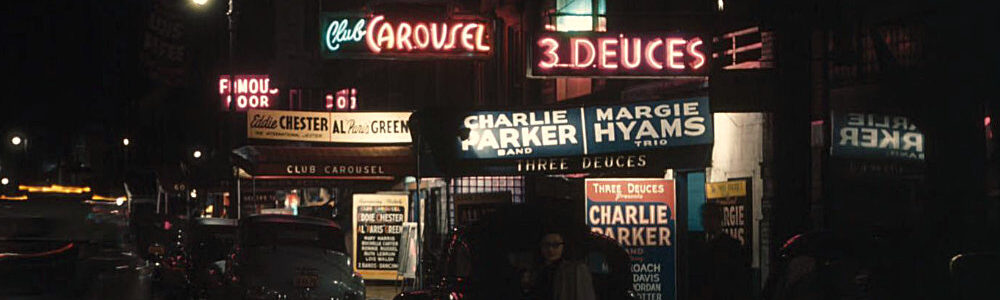
Public domain photo of 52nd Street in New York, New York, in 1948 by William Gottlieb.
Book Mentioned in the Episode
| England: Poems from a School by Kate Clanchy |
Music Used in the Episode
| Title | Artist | Album | Label |
|---|---|---|---|
| What Can You Bring Me | Charles Wright and the Watts 103rd Street Band | You’re So Beautiful | Warner Brothers |
| Root Down | Jimmy Smith | Root Down | Verve |
| Breeding Of Mind | O’Donel Levy | Breeding Of Mind | Groove Merchant |
| Winston Theme | The Winston Brothers | Winston Theme 45 | Colemine |
| Tight Times | Jimmy McGriff | Electric Funk | Blue Note |
| Sommer | The Ironsides | Sommer 45 | Colemine |
| Volcano Vapes | Sure Fire Soul Ensemble | Out On The Coast | Colemine Records |