


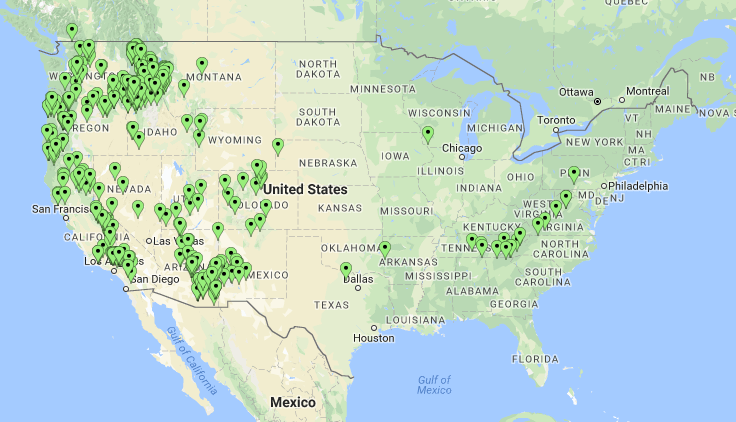
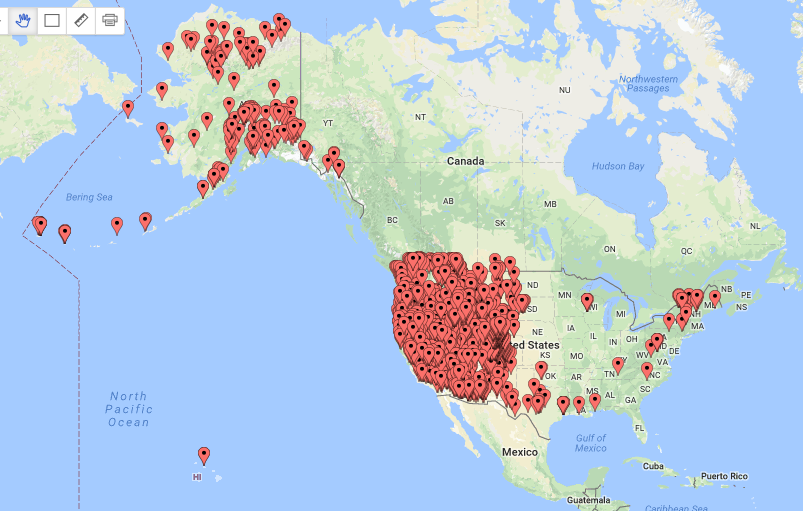
What you call the space between mountains depends on which part of the country you’re in. The word gap is used more in the Southern United States, notch in the Northeast, and saddle or pass in the West. See Grant’s analysis of place names on the maps below.


Transcript of “Gap, Notch, Saddle, and Pass”
Hello, you have A Way with Words.
Hi, this is Kathy calling from Hopkinton, New York.
What would you like to talk with us about?
I have a question about the words. We all agree that we call it a mountain, but the space between is called a gap in the south, and in the northeast it’s called a notch, and then in the west it’s called a saddle. So I was just curious how, you know, we still call it a mountain in Wyoming and Maine, but it’s got a completely different name for what’s in the middle.
So you’re talking that space between two peaks where you can cross over to the other side.
Yeah.
Oh, yeah. And I would throw one more term in there. I would throw in pass, P-A-S-S.
Yeah. So GAP, G-A-P, PASS, P-A-S-S, saddle, like a horse’s saddle, and then notch, N-O-T-C-H.
Yep. If you look this term up, if you look up GAP in the official documents of the U.S. Geological Survey, you will find an entry in there where they define these all as basically the same thing.
So your question is why is it different in different parts of the country, right?
Yeah, kind of. It’s very regional.
Yeah, it is. And you nailed it, by the way. All the different places that you said the term was used, gap in the south and northeast is a notch and saddle in the west, are generally correct. But gap is by far the most common word for this, and it’s widely used in the south and west, but it’s interesting hardly at all in the upper Midwest.
Pass is mostly used in the west, and it’s an incredibly clear-cut line just east of the Rocky Mountains. And the reason I know all this, by the way, I downloaded the place name data set from the U.S. Geological Survey that has the name of every geographic feature in the country. And I did a bunch of manipulation to the data to remove just the items that I wanted with their latitude and longitude. And then I mapped all four of these terms for you.
Because this is what Grant does in his spare time. We will put these maps online later, but it’s really, really interesting stuff. Saddle is mainly used in the American West, but there is a string of saddle place names in the Appalachians.
You know, it wasn’t the purpose for me hiking the Appalachian Trail, and I didn’t pay attention when I did it.
You did it? Wait. 1994, I was 36, and I hiked from Georgia to Maine.
Wow. That’s cool. I didn’t think a thing about the names, really. I was more on a figure-out-the-meaning-a-life walk.
Yeah. What is it, by the way?
I never figured it out. All I ever thought about was food.
Food and blisters, yeah.
You and the bears.
Yeah, I had blisters for 300 miles.
Oh, my gosh. But yeah, food is pretty key.
So what I want to do for you, Kathy, is I’m going to put these maps up on the website so everyone can look at this data. And you’ll see that there is a regional difference. And the explanation is that we are not linguistically monolithic. That is, we don’t all speak the same English. We have different English traditions.
It’s been a number of years, but I believe we talked about this on the show maybe 10 years ago. The same thing happens with the name for small water courses. So creek versus branch versus brook, and I think there are a couple others.
I could do the exact same analysis with this data set from the U.S. Geological Survey, and we could show that creek is more common in one part of the country and brook in another and branch in another.
Wow. I’m impressed. That’s an awesome amount of work. I’m looking forward to looking at that.
Hey, it’s not hiking the Appalachian Trail, though.
No, that’s true. That is pretty darn awesome. I have no blisters on my fingers for doing this.
But, Kathy, thank you for your call. We really appreciate you bringing this to our attention and giving this opportunity to find out more. And now the whole country will know, all right?
Thank you very much. Your show is awesome.
Take care now.
So are you, Kathy. Take care.
Bye-bye.
Bye-bye.
Bye.
Oh, my gosh. We have twin passions here. You’re crunching data, and I’m thinking about hiking the Appalachian Trail. You know, there’s a point in your life when you get old enough that the only thing that excites you really is a big pile of data that needs to be analyzed.
Speak for yourself.
Email us, words@waywordradio.org.

