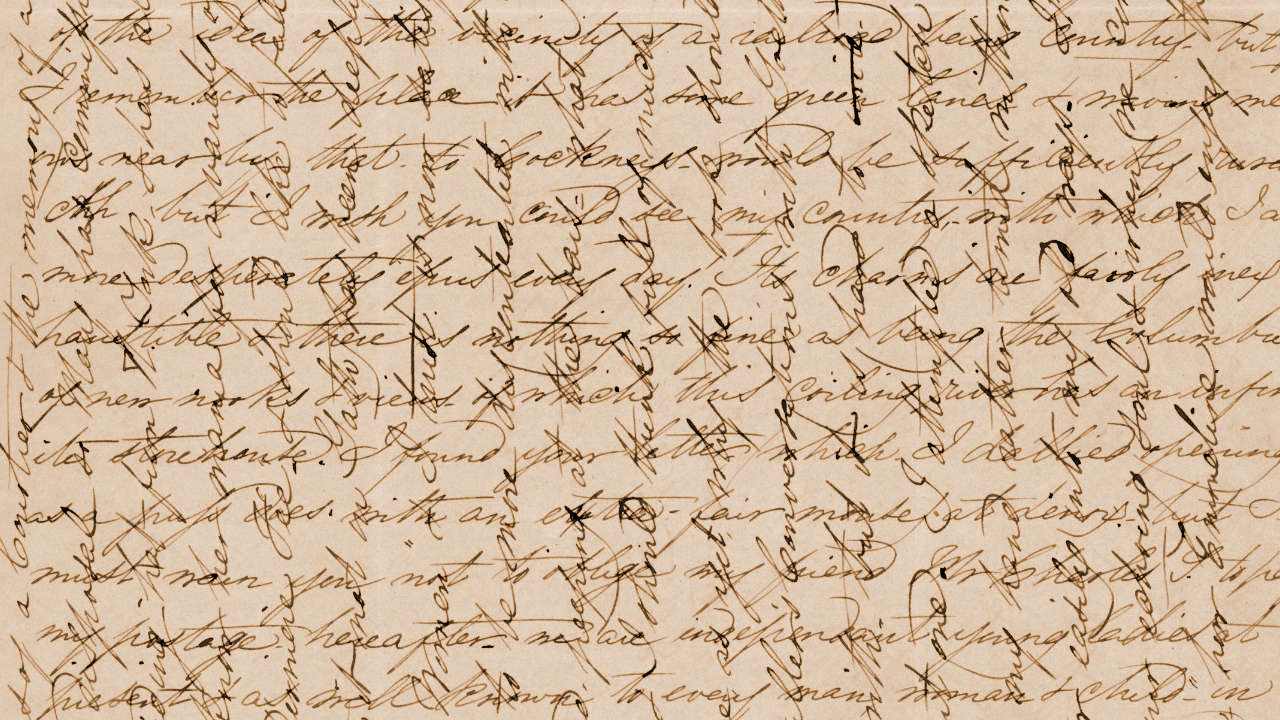
Shadowdabbled. Moon-blanched. Augusttremulous. William Faulkner often used odd adjectives like these. But why? Grant and Martha discuss the poetic effects of compressed language. Also, African-American proverbs, classic children’s books, pore vs. pour, and the double meaning of the word sanction. This episode first aired February 5, 2011.
Transcript of “Eastern Seaboard, West Coast”
Even though you’re listening to this on podcast and not on the air, you can still call our toll-free number 877-929-9673, and you can still send us email to words@waywordradio.org, and you can still find us online at waywordradio.org.
You’re listening to A Way with Words. I’m Martha Barnette.
And I’m Grant Barrett. Martha, one of my favorite times of day comes at bedtime when we put our son to bed and we read his library books. My wife and son spent a great deal of time going to libraries around San Diego. They are impressive consumers of library books. And we have a stack at any time of 10 to 30 books, as many as they can check out.
That’s great. Tons of stuff. So I get to see everything, all the best. You know, you go to the recommended shelf, and usually the librarians have picked out the stuff that’s just really going to work. And we’re not quite to chapter books yet. We still need lots of pictures because he’s not quite four yet. And it’s a fun time.
But I have to say, as much as I love some of the new books, and you’ve heard me talk about them on the show before, there are still some classics that I think need to be brought to the fore. I’m thinking of things like Pippi Longstocking. But I’m also thinking about books like The Wind and the Willows, a classic of British literature, beautifully written. It’s entirely too long for my son. But for me, it’s got a perfect cadence. It’s almost as if it was meant to be read aloud.
And I want to share something from page two. Right from the start, the book grabs you, right? This is where Mole realizes that it’s spring outside. And he’s in his hole trying to do a little spring cleaning. And finally he says, “Oh blow, oh bother,” and he goes up. And then the book starts, “Something up above was calling him imperiously.”
And he made for the steep little tunnel which answered in his case to the graveled carriage drive owned by animals whose residences are nearer to the sun and air. So he scraped and scratched and scrabbled and scrooged. And then he scrooged again and scrabbled and scratched and scraped, working busily with his little paws and muttering to himself, “Up we go, up we go.”
To the last, pop, his snout came out into the sunlight, and he found himself rolling in the warm grass of a great meadow. So from the very start, the scraped and the scratched and the scrabbled and scrooged, it’s wonderful. But also we start the book with a tiniest sense of discovery.
My son responded very well to this, what I’ve read of the book so far. A lot of the vocabulary he doesn’t get. Frankly, there’s vocabulary in there that I don’t get. It’s from 100 years ago, for one thing. Yeah, imperiously. I was thinking a four-year-old is going to—some of it’s in fact. But it makes up for that. You just accept it. It’s great. All that scratching.
So I guess what I’m saying to you, we love libraries. This is a book, The Wind in the Willows, that you need to check out from the library again for yourself or for your children and have a go. The old books still work. They still have power and emotion and movement. And even though he doesn’t understand all of it, he catches on to words like scrabbled and scratched.
And he understands that there’s a mole involved. And he understands what’s happening on the river. And here comes Toad with his fast motor car. And like all of the best books, you leave the page satisfied, no matter how much you read. It’s great. It’s a classic. It doesn’t always have to be the latest thing, right?
No, it doesn’t. Well, this is the place where we talk about books and language and words and how we use them. Call us, 877-929-9673, if you’d like to talk. And you can send us email. The address is words@waywordradio.org.
Hello. You have A Way with Words.
Hi, this is Ellen. I’m in Greenbelt, Maryland.
Hello, Ellen. Welcome.
Thank you. What would you like to talk with us about?
Well, I used to live in California, and in California it’s called the West Coast. And then about 10 years I moved to the East Coast near Washington, D.C. But when I listen to the weather here, they call it the Eastern Seaboard. And I wanted to know why is that and why isn’t it called the Western Seaboard?
Oh, great question. That’s very good. That’s really good. It’s very good. So when people talk about the California coast, the Pacific coast of this continent, North America, they don’t usually call it the Western Seaboard, do they?
I’ve never heard it called that.
No.
Huh. You can look and find people doing it, but it’s so incredibly rare. And then the East, they don’t call it necessarily just the East Coast. It’s the Eastern Seaboard, and they mean all up and down all of the land that borders the Atlantic Ocean, right?
Huh.
Right. You know what the answer is? It’s pretty simple. We are creatures of habit. We just develop these habits of saying things a particular way, and we just keep doing it. We adopt phrases and sentences, and we move our tongues in ways that are familiar to us, and we tend to repeat ourselves and repeat what we hear. So we get these habits.
And Western seaboard is a perfectly fine phrase. We could easily use it. We could. We just don’t. Well, I’m thinking that probably the Eastern Seaboard was established so much earlier than the West. People got used to talking about it.
Let me ask you a question. If I’m in New York City, as I lived there for quite a while, and I say I’m going to the coast, why does everyone understand that I mean California?
Right. I mean, it’s kind of the opposite side of the coin. We develop these habits of referring to places different ways. And even though maybe the opposite isn’t used or parallelism doesn’t exist, we still persist.
I can just see seaboard being a word that was sort of the border between us and the Atlantic and us and England.
That’s exactly what I thought.
Really? That people used that?
That’s the one I was trying to guess.
Yeah, that’s what I’m thinking. That makes sense to me because that word’s been around for a long, long time.
Yeah. Seaboard. And so you would be talking about that, but it took us a long time to get to the West Coast maybe by the time we did.
But why wouldn’t you call it the Pacific seaboard then? Or the Western seaboard?
And why wouldn’t you? Because it’s perfectly accurate to say that. And in fact, you’ll find Western seaboard used in more academic texts. Not just for the Western seaboard of North America, but for the Western seaboard of other continents and other countries.
Right. Right. I think it goes back to what you said about habits of thought.
It’s habits of thought. There’s a lot more persistence for Eastern Seaboard. It became a fixed thing. And it is interesting that it’s a retronym in that it’s seaboard plus Eastern.
One of the most interesting things when it comes to thinking about the way we position ourselves in our language is if you talk to people in a wide variety of cities across the United States about what they mean by downtown and uptown.
Oh, yeah.
And it’s directly related to this. We develop these habits where sometimes downtown is a direction and sometimes it’s a fixed place. And occasionally those two uses collide and you get a lot of confusion. And I think maybe this is, you know, Eastern Seaboard is just fixed. There’s no confusion there. We know what we mean.
Well, you’re always very educational, and I appreciate the new little bit of knowledge.
Oh, well, we’re glad to impart them, and thank you for sharing yours.
Thanks so much.
All right. Bye-bye.
Bye from the West Coast.
Take care.
See you later.
Bye-bye.
That’s interesting.
The coast.
The coast.
Yeah, you would say that, right?
Yeah.
And in New York City proper, you often talk about going to the shore. And you don’t mean any shore. You mean the Jersey Shore.
And I think in the Pacific Northwest, don’t you talk more about going to the coast than going to the beach?
I don’t know about the Pacific Northwest very much.
I think so.
Interesting.
Well, we have our habits and we have our ways. What are your language habits and your language ways?
877-929-9673 or words@waywordradio.org.
Hello. You have A Way with Words.
Hi. My name is Sheila. I live in Indianapolis.
Hi, Sheila. Welcome to the program.
Thank you.
How can we help you?
Well, I had a question.
I was reading a novel recently, and I came across the phrase, poring over, I believe it was a map in this particular case. I paused over it because it was spelled P-O-R-I-N-G, and I’d always envisioned that as being a P-O-U-R-I-N-G. And I mentioned it to my husband, and he’s like, no, it’s the other way. And we just kind of disagreed over it. And I sort of took an informal poll of some of our friends and family, high school English teachers, she thought it should be P-O-U-R. My mother, who’s well-read, everybody thought that. So I’m not sure I understand the P-O-R-E in that context.
Huh.
Well, then what makes you think it’s P-O-U-R, to pour over a book or pour over a map?
Yeah, you know, I’ve always, the mental picture is you’re pouring your own concentration and attention out over onto the…
And I mentioned it to my son who, you know, he’s in college, he’s an English major, he thought the same thing.
Oh, really?
He responded the same way, yeah.
Well, that’s very poetic. I can see why you would think that.
Yeah, but it actually is P-O-R-E.
Well, you know, I did look it up in a dictionary. I guess there is an alternate meaning for porous. You always think of porous, you know, your skin, a hole in a membrane of some sort. But I guess there is an alternate meaning, which I didn’t realize that has to do with concentrating on, you know, something.
Yes, exactly.
Yeah.
I’m not sure I understand how the same word P-O-R-E came to mean both of those either.
Okay.
They’re separate words. That’s the thing. The two P-O-R-E’s have completely different roots. They’re from different sources. They entered English at different times, and they’ve always meant different things.
Right. And same with the other poor, P-O-U-R. Those are three completely separate words. We don’t know the source of the pore where you’re P-O-R-E, where you’re looking at a book intently. It may be related to peer, you know, like to peer at something intently. We don’t know. But the way that I remember it, and it’s just a silly little way, but I think about pores, like the pores in your skin, and think, well, you’d have to look really, really, really closely. You’d have to pore over the book.
Yeah.
Yeah.
Yeah, I mean, it’s sort of like your way of remembering it, only my way is right.
Oh, no.
Yeah, I was everybody I talked to, without exception, except for my husband. Well, I said, what would you put in that? How would you think that was? They thought it was P-O-U-R.
So in the future, you’re going to go to your husband with all your grammar questions?
No.
Why, is he insufferable when he’s right?
Yes. It was awful to have to admit that he was right.
Oh, you poor thing.
Oh, no, let’s not go there.
Well, Sheila, thank you so much for calling. I’m glad we were able to straighten this out for you.
Thank you. I appreciate it.
And thanks for sharing. Your misunderstandings are an everyday part of speaking, reading, and writing English, so don’t worry too much about it, all right?
Thank you so much, Sheila.
Thank you. Have a great day.
Bye-bye.
877-929-9673. words@waywordradio.org.
Martha, remember a couple of episodes ago when we were talking about African-American proverbs?
Well, here are some more. Smiling faces sometimes lie.
It’s true. And that’s the thing about proverbs. They are universal truths. This is why they ring true regardless of your culture or your background, right?
Absolutely, yeah.
Don’t die with the dead.
I think that’s a shorter version of if your friends jumped in a lake, would you jump in the lake too? That is, don’t hang around with dumb people who do dangerous things.
Oh, Ned, that’s interesting because I would think it means carry on with your life after you lose someone.
That makes more sense. I have these without context. I would need to see them in the middle of writing. But I bet your reading is more accurate.
Here’s another one. Tell me what you think of this. There is always a person greater or lesser than yourself.
And it’s easy to forget, right?
Unless you’re listening to the Desiderata, right? You are a child of the universe.
Yeah, you’re right. These are universal.
Universal proverbs.
Call us with your proverbs or share them in email. Send them to words@waywordradio.org or call us on the telephone, 877-929-9673.
Coming up, it’s our weekly word quiz. Stick around for more of A Way with Words.
You’re listening to A Way with Words. I’m Martha Barnette.
And I’m Grant Barrett.
And we’re joined again by John Chaneski, who probably has a quiz for us or two in his pockets.
John, hello.
Hi, Grant.
Hi, Martha.
Hello, John.
I’ll check my pockets.
We can’t see you because you’re on the other side of the continent, but I imagine that you have scrolls just jutting out of every pocket.
I use papyrus.
Papyrus.
Papyrus, yes.
Papyrus scrolls. It’s all on the—
Long ostrich quills, special ink and everything.
Chisel on your tool belt.
Yeah.
Yeah.
I have my pterodactyl actually take dictation while I come up with the puzzles.
Nice.
I use a phoenix for that.
Very sweet.
Sweet.
Hey, you know, here’s a classic concept I borrowed from a great book of wordplay called, appropriately, Wordplay by Joseph Shipley.
I have that book.
Cool.
It’s called twin ends.
Okay?
Twin ends.
Twin ends.
Okay.
Twin ends, yeah.
E-N-D?
E-N-D, right.
Twin ends.
A twin end word is one that begins and ends with the same set of letters.
Okay?
Two or more. For example, the word sense begins with S-E and ends with S-E.
Okay?
Okay, great.
Good.
I’ll give you the middle letters of a word. You must give me the twin pairs that begin and end the word, or sometimes triplets.
Okay.
If you need, I’ll give you a definition. For example, if I gave you U-R, can you tell me what word that might be? And here’s the definition. Place of worship.
Oh, church.
Oh, church.
Church.
That’s right. The answer is church.
Now, you’ll probably need a pencil for this one because it’d be a little easier to write the letters down.
John, I always use a pencil with you.
Oh, good.
Oh, good. Let’s try a few more. Here we go.
Okay.
Very simple. N-O, two letters. Begins and ends with two letters. And the definition is a species of chimpanzee.
Bonobo.
Bonobo.
Very good.
Second one is AT. Begins and ends with two letters. And the definition is one who delivers a speech.
Orator.
Orator.
Very good.
O-R.
Okay. Here’s the next one. The letters are C-A-P-A-D.
Ooh.
C-A-P-A-D.
Yeah, write that down.
Escapades?
Yes, escapades.
Very good. Madcap pranks.
Nice work, Martha.
Thank you.
Here’s the next one. E-E-P-I. The definition is bashful or docile.
Sheepish.
Sheepish.
Very good, Grant. Nice work.
It’s funny. Actually, the longer the letters are in between, kind of the easier it is to get these.
Yeah, I would say.
Here’s the next one. R-A-P-M. Now we’re looking for three letters beginning and ending. Here’s the definition. The defense that a defendant would not have committed a crime if law enforcement had not enticed him to do so.
Oh, excellent, Grant. That’s a good one, John.
Entrapment with E-N-T on it, beginning and end.
Here’s the next one. R-I-O. Beginning and ending with two letters. Definition is a lively dance that resembles the samba or someone from Rio.
Carioca.
Carioca is correct. C-A at the beginning and C-A at the end.
Here’s the next one. I-S-C-O-V-E. I-S-C-O-V-E is in the middle.
Right.
It’s three letters, beginning and end.
Okay.
Rediscovered.
Yes, rediscovered, Brent. Nice work.
Excellent.
Okay, here’s the next one. Y-L-I. Two letters, and the definition is one who works in a salon.
Stylist.
Oh, yes.
Stylist.
Yeah, very good.
Next one is E-R-G-R-O, and we’re looking for three letters beginning, three letters at the end. Clue is where the miners spent most of their time.
Underground.
Underground.
Underground is right. Very good. U-N-D I was looking for. Very good. Good topical clue.
Yes.
And here’s the last one. O-N-O-G-R-A.
O-N-O-G-R-A.
Phonograph.
Phonograph is right.
Oh-ho!
Nice work, Grant.
Good one, Grant.
Thanks, John.
Well, you’ve got the stumpers. How do you come up with your stumpers anyway?
Yeah.
I go to sleep, and when I wake up, they’re sitting on my bed stand.
Elves!
Where are my radio elves?
I think of them in my hypnopompic state.
Nice.
Nice. Nice.
John, thank you so much.
Thank you, guys. Bye-bye.
If you’d like to try to stump us with any kind of question about language, call us 1-877-929-9673. You can always find us on Facebook under Wayword Radio, and you can email us words@waywordradio.org.
Hello, you have A Way with Words.
Hello, this is Ciara from Salt Lake City.
Hello, Ciara. Welcome to the program.
Hello.
Hello.
What can we help you with?
So my question is, I’m wondering about the phrase, that smarts. For example, if I hit my elbow on a countertop or against a wall or something and it kind of hurts, I often say, that smarts. And so, yeah, I never hear anybody else say that, especially anybody my age, and I’m 28. And the only person I ever hear say it is my dad, and he’s 66.
-huh, and that’s all you say, right? Just that smarts? You don’t say anything more colorful?
More earthy, of course. Like I know Grant would.
Yeah, well, that smart to me is like something that kind of hurts, but it’s more instantaneous and goes away pretty fast. Whereas, you know, if something really hurts, you know, I might say something worse.
I see. You know, that’s a very interesting question because now that I think about it, I haven’t heard anybody say that in a long, long time. Have you, Grant?
I don’t hear people say that. I feel that it’s more British.
Really?
Yeah.
That’s interesting. And I don’t know why. I mean, I understand it, but I don’t use it. Do you use it?
I don’t really. But I mean, it sort of calls back echoes of childhood for me.
What, you think one of your parents used it or the older generation?
I’m thinking I used to hear it on a cartoon or something. I don’t know. But it’s interesting that you mention it because it is an extremely old word. It goes back a thousand years or so.
A thousand years.
Yeah. It might be related to the Latin word for bite.
-huh.
But you’re right. I don’t hear it that often. And you don’t have any peers, Sierra, who use it?
No, I’ve never heard anybody say that. And one time I said it when I was getting into the car with my boyfriend, and he just kind of chuckled at me because he had never heard it before, and he didn’t even know what I was talking about.
Oh, really? Really?
I could see you getting a cock-eye from people when you use it. It’s definitely unusual enough that it might sound affected or old-fashioned.
Yeah.
Yeah. But it’s perfectly legitimate and, again, has had that sense for years. And that’s why we have the word smart meaning intelligent. Yeah, it’s the one meaning a sharp pain or just like a keen pain is the older form of it by far. Like smart as a whip, you know?
Yeah.
See, both meaning is coming together there.
Yeah.
That never occurred to me. Smart as a whip. It’s two kinds of smart, right?
Yeah, exactly. Very interesting. So you’re not alone. You’re not unusual. You are speaking English that is more than a thousand years old. So congratulations.
All right, perfect. Just the answer I was looking for. Thanks for calling, Sierra.
All right.
Bye-bye.
Bye-bye.
Thanks.
What made people look at you funny when you opened your mouth? Mother’s like, school pictures. 877-929-9673 or send it all an email to words@waywordradio.org.
Hello, you have A Way with Words.
Yeah, hi. My name’s Eric.
Hi, Eric. I’m from Bozeman, Montana.
All right. Welcome to the program. How are things in Bozeman?
I’ve actually got a word that just got me in a twist. I have not come to terms with, and I’m sorry for the pun, but I cannot come to terms with the word sanction. The word sanction is just so weird because unless I give you some context for that word, you can’t know what I mean if I say the government sanctions your program. It’s got two, apparently, I’d say at least two diametrically opposing meanings.
Very well put. The main thing I want to ask is why? Not even what, but why? It’s like so strange that a word could have two meanings that are entirely the opposite. There are plenty of words that have different meanings, you know, and there are homonyms and all kinds of things. But this word is just strange.
Yeah, I know what you mean. It’s an example of what we call a contronym or a Janus word. Are you familiar with that word, J-A-N-U-S?
I have not heard that. I’ve heard a contrenum, but not Janus.
Janus was the Roman god of portals and doorways and beginnings. And he had two faces, one which faced one way and one faced the other way. And that’s where we get words like janitor and January, which is the opening to the new year.
So Janus words. Yeah, sanction is one of those because exactly as you said, it can mean to penalize somebody or to authorize somebody. Of those meanings comes from a different path from the same source, and that’s where we get the difference, right?
Right. They both go back to a word that has its origins in Latin that has to do with sacredness, sanctifying, sanctuary, that kind of idea. And so originally it was a law, a law that’s sacred. So it could be a law for something or a law against something, right? So in the beginning, there wasn’t necessarily a plus or a minus or any kind of negative or positive value on it.
Right. But these two meanings over time forked and became strong on their own in their own contexts. And here we find them side by side in the dictionary. It looks very odd.
Yeah, you’re exactly right, Eric.
Oh, thank you so much. So, Eric, tell your friends Martha and Grant sanction what you said.
All right.
All right. I will. Whatever that means. Right. We didn’t sanction you, though. We sanctioned what you said, but we didn’t sanction you.
Thanks a lot for solving my mystery.
Sure.
Thank you for calling, Eric.
Bye-bye.
Bye.
Bye.
There’s an article in the language newsletter Verbatim from a number of years ago by David Galeff called The Trouble with Janus Words. We’ll try to link to that on the website. He’s got a lot of detail about these two-faced words.
Yay.
Call us with your questions about words and language, 877-929-9673, or email them to words@waywordradio.org.
A couple of shows ago, we played that game, What Would You Serve?
Oh, yeah, if you come up with a job and then think about a punny thing, kind of food that you might give them.
Right, right. What would you serve? A plumber who comes to dinner and leaks, right? Electrician, currants.
We got some great examples from people who wrote in with their own versions of the game. Leslie Johnson Leach and her husband Tom wrote in and said, what do you serve a golfer?
I don’t know.
Tea?
Or greens?
Either one.
What do you serve twins?
Pairs.
What do you serve a coin collector?
What do you serve a coin collector?
Mints.
Mints, of course.
What do you serve somebody who repairs shoes?
Soul.
I didn’t even think about that. I was thinking cobbler.
Oh, there you go. Cobbler.
One more that I absolutely love from Ken Wenman. What do you serve to Romeo and Juliet?
Cantaloupe.
Ba-dum-bum.
Thank you, Ken and Leslie and Tom. Terrible but funny.
Thanks. Love them, love them. Send more if you’ve got them. words@waywordradio.org or call us up and leave a voicemail, 877-929-9673.
Hello. You have A Way with Words.
Oh, hello. My name is Ellen, and I’m from Carmel, Indiana.
Hi, Ellen.
Hello. I have a question about some language I found in a book I was reading by Faulkner. The book is called A Light in August, or just Light in August. And I kept coming across these combination adjectives that were combined that wouldn’t normally be combined. And I finally started jotting them down because they were so expressive.
-huh. And I guess I had a question about the style, if there’s a name for that style, and if it’s appropriate for anyone else to use it besides Faulkner.
Oh, well, you know what, Ellen? Both Grant and I are big Faulkner fans. Give us some examples.
Okay. Well, these kind of go together. Shadow dappled, and he’s talking about a street or a house, a horse, actually, one time. Shadow-brooded, moon-blanched, and moon-dappled.
Moon-blanched and moon-dappled?
And these are all run in together as single words, with no space and no hyphen.
Yes.
Yeah. Very good. I think the word for that is Faulknerian.
Oh, is it really?
It could be, yeah, definitely.
It’s a style that’s difficult to imitate without people realizing that you are imitating Faulkner. So he kind of has that all to his own.
Oh, I didn’t know.
I thought maybe it was a poetic, maybe you see it in poetry.
You do.
Well, it’s interesting that you say that because his first book that he ever published was a book of poetry.
Oh.
Yeah.
And I also find it really interesting that he dabbled in oil painting. And to me, this kind of writing reminds me of oil painting. You know, it’s not like watercolor where you just sort of do these quick strokes. It’s dab, dab, dab, dab, dab. And that’s how he builds a sentence. One really vivid picture after another. And it reminds me a lot of poetry.
Yes, it’s more than a mental picture. It pulls you in. And I can’t even describe why they work, but they give more of a feeling and a picture. So you get the feeling that you know this person or you’ve been on that street.
That’s interesting.
I hadn’t seen anything like them. And this was my first Faulkner book. Of course, I’m hooked now.
Good, good.
Give us some more examples.
Okay.
Well, August Tremulous Lights. I just love that one.
August Tremulous Lights. What does that connote for you?
That they, well, they’re not, they’re quivering and maybe trembling. And he wrote that about somebody was, one of the main characters was taking a walk and was restless and was about to commit a crime.
That’s interesting.
That was the light that he saw.
Yeah, it’s so much better than just saying just the August light or just a light.
Yeah, I think it’s sort of that shimmering heat in the South. And by pushing the two words together and not separating them, he makes it clear that you’re supposed to be thinking about the intersection of those words, right? One atop the other for a third meaning or almost a third word.
Yes. Oh, that’s good. Yes.
There’s an incredible amount of material that’s been written about this habit of his and this way of writing. And a lot of it is worth reading. But for me, it’s always come down to that I think he felt that English wasn’t doing the job. And he felt that he could build new parts of English from English itself.
That’s the thing about English. It is itself. It becomes itself. And it is created from itself. And so by pushing words together like shadow doppled, he’s basically coining words, but yet they’re completely comprehensible. And then one of the books that I read, and I’ll try to find it so that we can link to it, about Faulkner, mentioned that his habit of doing this was more akin to thinking than it was to writing or reading. And that he was trying to indicate on the printed page the way his own brain worked.
And I don’t know if I buy that, but I thought it wasn’t a bad explanation. So there you go. From a couple of amateurs who thought a little bit about it, that’s our opinion.
Great.
Okay.
Well, thank you very much for your time.
Bye-bye.
All right.
Bye-bye.
Bye-bye.
Well, if you haven’t read Faulkner, make time to do so. You can find him online. You can also find, I should have mentioned this to Ellen, that there is audio of Faulkner reading some of his work online. It’s a real treat. We should link to that on our website as well.
Okay, waywordradio.org. And if you’d like to talk about words or literature, call us 1-877-929-9673 or email us. The address is words@waywordradio.org.
Quite a while back, we did an episode where we talked about U-turn, the phrase U-turn in other languages.
Oh, right. How do you make a U-turn in Hindi?
Yeah, exactly. Because they don’t have the letter U.
Right. They have a different letter. So what did they say?
We got a really nice email from Shula Shinwell, and she speaks Hebrew. And she said in Hebrew, it’s called a horseshoe or a hoof turn.
Interesting, right?
And I don’t speak Hebrew, but she’s written it here, and we’ll post it to the website. And that makes perfect sense. And I wonder how many other languages would use the horseshoe because that’s a natural U-shape that almost everybody’s familiar with, right?
Yeah.
I’d like to know.
Give us a call, 877-929-9673. Words, language, slang, grammar, punctuation, you name it. Send it to the email address, words@waywordradio.org.
We’ll be back with more of your calls when A Way with Words continues.
Support for A Way with Words comes from National University, where flexible online classes let you earn your degree or credential on your schedule. More at nu.edu.
You’re listening to A Way with Words. I’m Martha Barnette.
And I’m Grant Barrett.
Martha, far more has been said about spelling reform than I could possibly summarize here.
But you’re going to try.
No, I want to mention one little aspect of it. In the back of the Century Dictionary, which, as a matter of fact, is more than a century old, there is a list of several thousand words, which they call amended spellings. It can’t mean very much until you understand that these were part of a spelling reform movement from that time period, from the late 1800s to the early 1900s.
Thousands.
Thousands.
Wow.
So William Dwight Whitney and a couple of the editors thought that they had enough influence to change English.
Good luck.
And so they’re not only in the back in an appendix, but they’re also sprinkled throughout the text alphabetically where they would otherwise belong. And so they will direct you if you look up this modified spelling to the more traditional spelling of the word.
And this came to my mind because I was contemplating the influence of Noah Webster, who in his own dictionaries changed the spelling. He decided that American English should break away from British English.
Right.
Lose the U.
And some of it stuck. It didn’t all stick, but some of it stuck. And ever since then, certain dictionary editors and lexicographers have considered that perhaps they too could have as much influence as Noah Webster. And the allure of having that kind of impact on the language that comes out of pens and keyboards and mouths is too much for them to resist.
And of course, absolutely none of these spellings from the Century Dictionary, none of them have caught on.
Not a one.
It’s the usual tripe and claptrap. They think that English is complicated, and if we simplified it and only made it look like it sounds and everything okay. And they always forget the fundamental problem with, of course, they mean their English, the dialect that they speak.
Exactly.
And they’re not taking into account that even in this great continent of ours, we speak a dozen dialects. And they’re very different in some case, maybe more than a dozen if you want to count some of the variations there.
And so I’m looking here in this list, and you’ll love this. This is one of the reasons why the spelling reform movement has never caught on. They do things like this. Their variant spelling of deafened, the traditional spelling is D-E-A-F-E-N-E-D, right? They decide that the new spelling, the amended spelling, is D-E-F-E-N-D.
What?
So they’ve re-spelled an O word to look exactly like another old word.
That’s ridiculous.
It’s senseless. They did it again with banned, B-A-N-N-E-D, like the book was banned. They now spell it, of course, B-A-N-D.
But that’s even more confusing.
That’s exactly my point. In their search for clarity, they have like these 24 rules with the 10 guiding principles. And they’ve got all those great, you know, you could just hear like the stuffiness and the overeducation at work.
Don’t get me wrong. William Dwight Whitney was brilliant. It’s a beautiful dictionary. It’s wonderful. It’s a top work.
It’s a top work.
But this is not representative of their top work. Anyway, so I was thinking about the spelling reform. Noah Webster has had the most influence. There is no other lexicographer or editor that’s come anywhere near it. It’s partly because we are now fractured as a society. We speak differently. We control our own language more. We have more of a personal handhold on it. But partly because the path has been ruined by failed efforts like this.
Call us with your thoughts about language, 1-877-929-9673. Or email us. The address is spelled W-A-Y-W-O-R-D radio dot org.
Hello.
You have A Way with Words.
Hi.
Hi.
Who’s this?
This is Denise Hickey.
Hi, Denise. Where are you calling from?
I’m calling from La Jolla, California.
Well, welcome.
What can we do for you?
So my question has to do with the proper usage of the possessive your versus the contraction your in a certain type of phrase.
For example, Martha and Grant, I appreciate your helping me with my question.
I think your, in that case, should be the contraction, Y-O-U apostrophe R-E, as in Martha and Grant, I appreciate that you’re helping me.
With my question versus Martha and Grant, I appreciate your willingness to help me with my question, which I think is properly the possessive Y-O-U-R. And I noticed it when I would be typing an email. When I say it, I don’t think about it. But in trying to type an email to somebody, I suddenly went, well, which one is it? Is it your contraction or your possessive?
Yes. And you’ve keyed in on it because what you’re doing is a very clever thing. What you’re doing sounds right to somebody who uses Y-O-U-R, the possessive, right?
Right.
I appreciate your calling today. That’s pretty tricky because if I were listening to you, I would think she’s saying it in the preferred way. But if I read it, I wouldn’t think that.
So which is the preferred way?
It would be Y-O-U-R, the possessive, your calling today.
Right, because you’re helping with that question.
Helping is a…
It functions as a noun.
It’s a participle that functions as a noun, which we call a gerund.
The thing about those words that end in ing is they can either function as an adjective, like my driving record is clean.
Driving is the…
It functions as an adjective there.
What kind of record is it?
Driving record.
But you would say, how’s my driving?
And in that case, it’s a noun.
That’s interesting.
I’ve never heard anybody do that.
Well, I’ve had this question a few times, and I can see the argument in favor of Y-O-U apostrophe R-E, or you, I appreciate you are helping me, or that you are helping me.
But to me, it’s not the better choice.
The better choice is I appreciate you’re helping me.
The possessive.
You’re helping.
The helping belongs to you.
It is a thing that belongs to you.
Right.
It is definitely the better choice there.
Interesting.
So as long as we’re just listening to you, it sounds great.
Right, exactly.
Usually I just change my phrase when I’m typing it so that I don’t have to make the choice.
Yeah, that’s always the way, right?
If you’re not sure, rewrite so you don’t have the dilemma.
Exactly.
Well, does that make sense then, Denise?
It does, sort of, yes.
I guess so.
I guess when I think about it, though, as the I appreciate that you are, then it also makes sense with the contraction.
Yeah.
I can see how it makes sense logically.
Yes.
But there are going to be people who read your with the contraction and are going to think, oh, she doesn’t know how to do it.
And that’s the worst.
Exactly.
Yeah.
Super.
Well, I really appreciate it.
Now I won’t have the dilemma.
Thanks for calling, Denise.
All right. We appreciate your calling.
Thank you.
Bye-bye.
Bye-bye.
877-929-9673 or words@waywordradio.org.
Hi. You have A Way with Words.
Good morning. Hi. My name is Greg.
I’m calling from Dallas, Texas, where I’m a, I guess you might call a new transplant to the Dallas-Fort Worth area.
Oh, okay.
From where?
Well, I’ve spent most of my life on the West Coast from Oregon, Washington, California, and just recently came to Dallas about six, eight weeks ago for a new job.
Oh, congratulations on the new gig.
Thank you.
You know, I’ve always sort of been a languageophile. Took college German and actually spent my last year of college in Germany.
Oh, cool.
And, you know, it was no secret, yeah, it was no secret that I was an American and German. And I think it’s also no secret that I’m not a native Texan. And I’m wondering what the best way from a language point of view it is to kind of assimilate into the culture.
You know, I’ve known people who are transplants to Texas and I hear them trying to pick up the vernacular. And it seems kind of contrived at best, almost insulting if, you know, I mean, I would have a hard time saying y’all or all y’all, even though I know that’s in the Dallas lexicon.
And so I’m trying to figure out, you know, what’s the best way to assimilate and not seem like I’m trying to assimilate?
What a great question.
That is really interesting.
You’re trying to be comfortable there, and you want people to be comfortable with you.
Exactly.
And Greg, are you talking more about accent or diction, the words that you use, vocabulary?
Well, I mean, you know, I think if I were to try to imitate accent, that would be extremely contrived. And I think people would see that in a second.
I’m thinking more of the diction and, you know, and how do you use the appropriate amount of diction and, you know, and use the local vocabulary without seeming like you’re going out of your way to try to fit in? Because I think that would be a problem, too.
Right, right.
And you’re wanting to be respectful.
Absolutely.
Of the way that people talk.
I’m betting that you’re going to end up saying y’all before too long just because it’s such a useful word. And it’s going to come naturally to you. You’re not even going to have to worry too much about whether or not you’re going to pick it up. It’s just one day you’re going to realize, oh, I’ve been saying y’all for quite a while now, haven’t I?
Yeah, exactly.
I’m sure of that too.
But I want it to be spontaneous and natural and not forced.
Greg, you’re on a great course here because it sounds like you’re open to changing your own speech and learning the speech of other people.
I would say go with it. You sound like an intelligent person, the natural thing for somebody like you is to just let it ride. Just see what happens.
And people around you, maybe they’ll do a little tease or they’ll introduce you to a new word that they know you don’t know.
I know that some of this stuff is going to come with a little bit of force if you’re in a place where they call shopping carts buggies instead of shopping carts, and it’s not necessarily where you are now, and you say shopping carts, you’re going to start saying buggy pretty fast.
But I don’t imagine a lot of your changes are going to come very quickly. They’re going to come suddenly and slowly. You’ll learn new words at watching the newscast on the television or from the newspaper. You’ll hear different accents at church or in meetings and so forth.
And I think the other thing is that, you know, it goes both ways. I think if you hear somebody saying, I’m fixing to do something, it might not be something that you adopt, but you don’t remark on it either.
I think Martha and I have kind of been slowly circling around to the point, which is that it’s cool that you’re paying attention to this. And just take it easy. Don’t rush it. It will sound contrived. Don’t rush it. Take your time. Learn it as it comes to you. And just appreciate the novelty that you find around you.
Once people find out that you’re interested, once Texans find out that you’re interested in how they speak, they will become your new best buddy and they will teach you everything you need to know really fast.
Absolutely.
That’s a great suggestion.
Thank you.
Because they’re friendly and very proud of the way they talk.
Exactly.
And I didn’t want to insult that. So thank you for your tips.
Yeah, I think they’re lucky to have you there, Greg. And so were we to have you just now. Thank you for this conversation.
Well, thank you very much.
All right.
Take care.
Good luck.
Thank you.
Bye-bye.
Bye-bye.
Call us if you want to talk about language, 1-877-929-9673, or send those emails to words@waywordradio.org.
More African-American Proverbs, Martha.
Okay.
A hard head makes a soft behind.
Ain’t that the truth?
What do you think that means?
If you’re stubborn, it means that you’re lazy and you don’t exercise enough.
I thought it meant if you’re stubborn about something, it’ll come back to…
Kick you in the pants?
Yes, thank you.
Very good. That could work.
I love these. There are so many of these here.
They’re terrific.
If you want to talk about language, call us 877-929-9673 or send an email to words@waywordradio.org.
Hello, you have A Way with Words.
Hey, Martha, this is Asher Streets from Madison, Wisconsin. How are you doing?
Hello, Asher. I’m doing well, and you?
Good, thanks.
Well, hello, Asher. Welcome to the program.
Hey, great. Thank you.
Yeah, so my question for you is sort of a broad topic on what is acceptable nowadays, especially in broadcasting.
In terms of elisions and contractions where dropped letters and syllables are occurring.
And I have two examples.
One is about sort of the digression or devolution of the word probably, where if you actually say the full number of syllables, it sounds very stuttery.
And so there’s sort of four versions that I’ve heard, probably, probably, probably, and pry.
So on the farthest end, when people say a sentence, I’ll probably go, you understand what they’re saying, but you’ve dropped quite a few letters and syllables out.
And the other one is the want to, where if you actually say it with the schwa between the two Ts, it sounds sort of forced and robotic.
And I heard actually that on an announcement on NPR once where it was want to, and I thought, well, that sounds kind of stilted.
And then I also heard on another broadcast somebody say, wanna?
And I thought, well, that kind of sounds a little too far in that direction.
So I guess I’m wondering, you know, those two examples, what do you think?
And just in general, what’s really acceptable nowadays?
Oh, you can hear me sigh because it’s a really big question with a really big answer.
I’m going to try to stick to some of the more clear-cut aspects of it.
Well, I’ve noticed two other pronunciations of probably that you didn’t list, probably and probably.
Probably?
Probably, yeah.
You can hear that all the time.
They all come fairly naturally out of the mouth one way or the other, and you do get what’s intended.
But to stick to wanna, and wanna is part of a family of words like gonna, short for going to, and don’t know, for short for don’t know, and gotta, short for got to.
All of these are part of a family of contractions that are, they’re not part of standard English, that is capital S, standard capital E English, but they are a core part of standard lowercase s, informal English.
They are well chronicled over the history of English.
They are a natural part of speech.
They are a natural part of dialogue in books.
They appear in every medium over as long as the written history, you know, in modern written history, I should say.
They’re pretty standard stuff.
The question that you’re asking really boils down to what is the register in which you choose to speak?
What is the style of your mode of presentation?
On the air.
On the air or even in real life.
Just talk about it.
Juana is perfectly fine when you’re talking to your friends.
Right.
I think his question is about broadcast, though.
Right, right.
But I just want to lead up to the broadcast and say, well, what were you listening to?
If you’re listening to Marketplace, it’s one thing.
If you’re listening to Tom and Ray, it’s another.
Right?
Yep, yep.
They’re casual.
And even though we are supposed to speak perfect English on this program, and believe me, my email tells me that every week, we don’t necessarily because we are informal on this program.
If we were speaking to, as I always say, the president or the queen or the head of General Motors, which would require formal speech, then we might speak, we might say want to, even if it sounded stilted or pretentious.
And you mentioned that.
I mean, it’s kind of a trap, right?
If you over articulate, you sound like a faker.
You sound like a phony.
What I’ve thought over the years is, you know, at some level it sounds pretentious or robotic or haughty, but at the same time you don’t want to be too flippant.
Right.
And what’s the right elocution? And I’ve come across that in, I’ve sung in choirs for a number of years, and some directors want you to pronounce every letter correctly, but especially when you sing in English, it sounds really stupid to sing a spiritual where you’re singing Watcher.
Right.
Don’t want to go.
I just heard a man at the world-famous San Diego Zoo the other day.
He was with his family.
We were in the reptile part of the park, and he kept correcting his family in kind of an awkward way.
They would say, look at the turtle, and he would say, oh, yes, look at the turtle.
Right.
Turtle?
Turtle?
Nobody says turtle.
There may be a T there, but in English, we do what’s called flapping that T.
We turn it into a D sound, just like we do with butter, not butter.
Asher, I don’t know if we’ve helped or not.
Have we?
Or we’ve at least commiserated.
You know, so my takeaway is tailoring it to your audience, yet understanding that pronouncing every syllable and letter perfectly is going to set yourself up for some sort of ostracization of some kind.
Bingo! Bingo!
Can we steal that?
Can we put that on our website?
You’ll be taped to the flagpole.
Asher, I hope you give us a call again when you’ve got another question, all right?
Absolutely, I will. Thanks a lot.
Thanks. Bye-bye.
Take care.
Bye-bye.
If you would like to talk with us, we would like to talk with you.
Call us, 1-877-929-9673.
And if we don’t pick up the phone, leave us a message.
We’ll listen to it.
You can also email us at words@waywordradio.org.
That’s our show for this week.
Don’t forget you can leave us a message even when we’re not on the air.
Call us 877-929-9673 or send us email to words@waywordradio.org.
Stay in touch with us all week on Facebook.
Look for us there under Wayword Radio.
Stefanie Levine is our senior producer.
Our technical director and editor is Tim Felten.
Tim also chooses our music.
We’ve had production help this week from Josette Hurdell and Jennifer Powell.
A Way with Words is independently produced and distributed by Wayword Inc., a non-profit organization.
The show is recorded at Studio West in San Diego, California.
Thanks for listening. I’m Grant Barrett.
And I’m Martha Barnette. So long.
Ciao.
Let’s call the whole thing off.
Oh, if we call the whole thing off, then we must part.
And oh, if we have a part that would break my heart.
So I say, oyster, you say, oyster.
I’m not going to stop eating.
Support for A Way with Words comes from National University, where flexible online classes let you earn your degree or credential on your schedule.
More at nu.edu.
Hey there, podcast listeners.
Just want to let you know that although we give you the show free and we give it free to stations, it does cost something to send these episodes out to hundreds of thousands of listeners across the planet.
Help support our educational mission by going to the website and clicking the donate link.
Ten bucks? A little more? How about as much as you think it’s worth?
Thanks in any case for helping us keep shop.
Classic Children’s Books
 Amid the stacks of new titles at the library, Grant picks out The Wind in the Willows by Kenneth Grahame to read with his son. The hosts discuss the appeal of classic children’s books.
Coast vs. Seaboard
A bi-coastal listener wonders about the terms West Coast and eastern seaboard. Why don’t we say Californians live on the western seaboard?
Pore vs. Pour
Does an avid reader pore or pour over a book?
African-American Proverbs
There is always a person greater or lesser than yourself. Grant shares this and other African-American proverbs.
Twin Ends Word Game
Quiz Guy John Chaneski borrows a classic word game from Joseph Shipley called Twin Ends.
That Smarts
The expression that smarts, meaning “that hurts,” dates back over a thousand years.
Contranyms
Does sanction mean “a penalty” or “an approval”? Well, both. Martha explains the nature of contranyms, also known as Janus words. Here’s an article about them in the periodical Verbatim.
“What Would You Serve” from Listeners
Listeners share their suggestions for the game What Would You Serve? Hosting a golfer for dinner? Tea and greens should be lovely!
Faulknerian Adjectives
William Faulkner used adjectives like shadowdabbled, Augusttremulous, and others that can only be described as, well, Faulknerian. Grant and Martha trade theories about why the great writer chose them. The University of Virginia has an online audio archive of Faulkner, recorded during his tenure as that school’s Writer-in-Residence. Also, check out this splendid 1956 Paris Review interview with Faulkner about the art of writing.
Hoof-Turns
In a previous episode, we wondered how U-turn might translate in different languages. One listener explains that in Hebrew, drivers make a horseshoe or a hoof-turn.
Amended Spellings from 1800s
The Century Dictionary contains a list of amended spellings from the late 1800s that only creates more of the confusion it set out to alleviate.
We Appreciate Your Asking
Which is correct: “We appreciate your asking” or “We appreciate you’re asking”?
Texas Talk
A new transplant to Dallas wants to assimilate into the Texan way of speaking without offending the locals or forcing any new vocabulary.
Over-Enunciating
Ever hear a broadcast where the announcer enunciates a little too precisely? Grant and Martha discuss the effect of softening syllables, such as “prolly” for “probably,” and “wanna” for “want to.”
This episode is hosted by Martha Barnette and Grant Barrett, and produced by Stefanie Levine.
Photo by Donna Tomlinson. Used under a Creative Commons license.
Books Mentioned in the Episode
| The Wind in the Willows by Kenneth Grahame |
| The Century Dictionary |
Music Used in the Episode
| Title | Artist | Album | Label |
|---|---|---|---|
| Hot Thursday | Bei Bei and Shawn Lee | Into The Wind | Ubiquity Records |
| All Wrapped Up | Melvin Sparks | Akilah! | Prestige Records, Inc. |
| Also Sprach Zarathustra | Deodato | Prelude | CTI |
| Kiss The Sky | Shawn Lee’s Ping Pong Orchestra | Voices and Choices | Ubiquity Records |
| Italy 73 | Shawn Lee’s Ping Pong Orchestra | Miles of Styles | Ubiquity Records |
| Heavy Traffic | Ray Shanklin | Heavy Traffic Soundtrack | Fantasy Records |
| September 13 | Deodato | Prelude | CTI |
| Let Me Blow Your Mind | Shawn Lee’s Ping Pong Orchestra | Hits The Hits | Ubiquity Records |
| Let’s Call The Whole Thing Off | Harry Connick Jr. | When Harry Met Sally: Music From The Motion Picture | Sony |