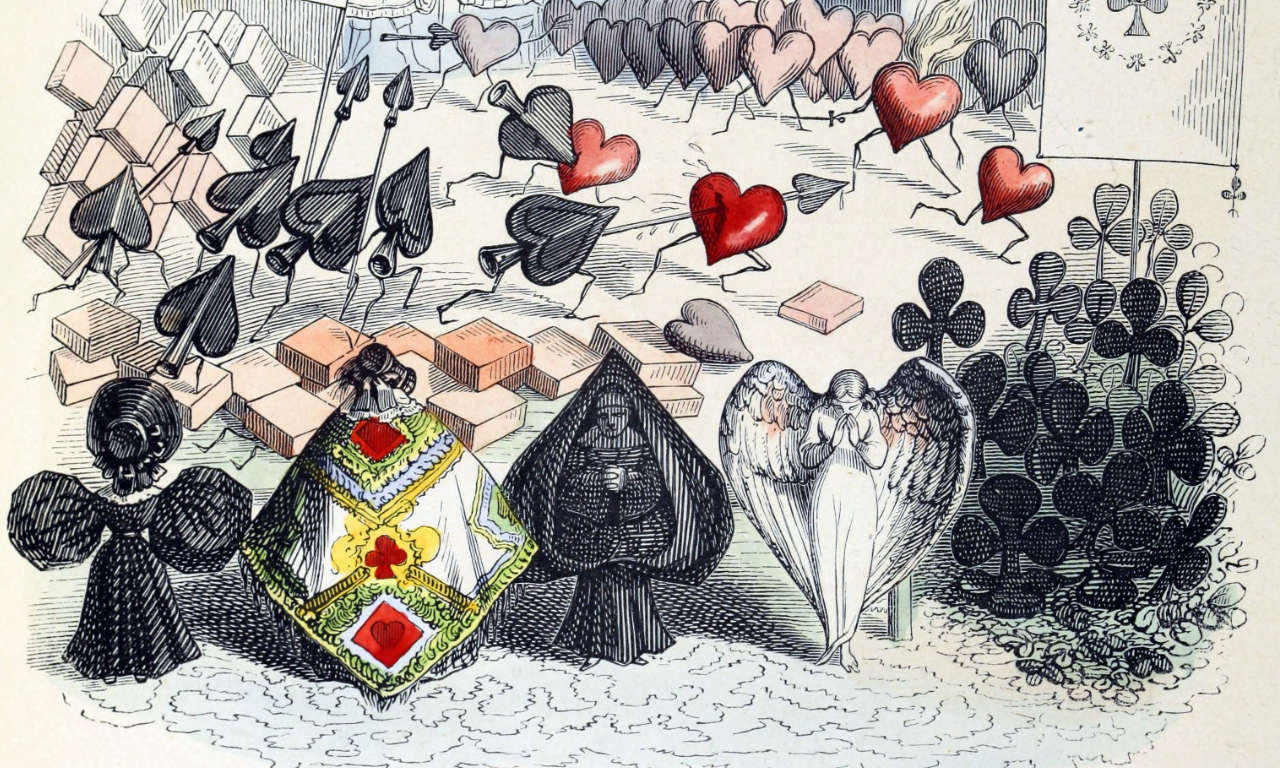
How would you like to be welcomed to married life by friends and neighbors descending on your home for a noisy celebration, tearing off the labels of all your canned foods and scattering cornflakes in your bed? That tradition has almost died out, but such a party used to be called a shivaree. • The expression my name is Legion goes back to a Bible story that also gave us another English word that’s much more obscure. • Tips for reading a book and looking up the words you don’t know — without losing the narrative thread. • Plus, lazy wind, plumb, bucklebuster, squinnies and grinnies, pollyfoxing and bollyfoxing, that smarts!, and hanged vs. hung.
This episode first aired January 27, 2018. It was rebroadcast the weekend of November 18, 2019.
Transcript of “Flying Pickle (episode #1489)”
You’re listening to A Way with Words, the show about language and how we use it.
I’m Grant Barrett.
And I’m Martha Barnette.
On our Facebook page, Rose Carbonella described a cold, blustery day that she spent in the mountains of Virginia.
And she was photographing with a group of people from the UK.
And she writes,
One of the gentlemen in the group turned to me and said,
This is what we call a lazy wind.
It goes through you instead of around you.
That’s nice.
A lazy wind.
A lazy wind.
Oh, I know those winds.
Yeah, right?
And this phrase goes back a couple hundred years.
A lazy wind.
I love it when the language has the jokes embedded in it.
Yeah.
It’s still work after all that time.
And it’s so descriptive, too.
You know that feeling when that wind just goes right through you.
It makes me think of Chicago more than Virginia.
Is there anything that makes you feel more insignificant than the weather that pays you no mind?
When you’re reading and you come across words, make a note and then call us and we can all talk about it.
Email words@waywordradio.org.
Talk to us on Twitter @wayword.
Or join our Facebook group and meet a lot of other Way With Words fans.
Hello, you have A Way with Words.
Hi, this is Brittany calling from Puyallup, Washington.
Hey, Brittany.
Welcome to the show.
Where in Washington?
Seattle?
Puyallup.
Puyallup.
It’s south of Seattle.
Okay, Puyallup.
Cool name.
What’s going on?
So I was going to call and ask you all a question about a word that my husband and I discovered that we say differently a few years ago.
And the way he says it is the way that it’s spelled and that I’ve heard 90% of other people say it.
And the way I say it is the way I’ve only heard my mother say it.
So the word is avocado, and I say it with an L right before the V, and he does not.
And when he and I discovered this, I had never noticed before and thought, oh, I must be wrong because there’s no VL when you spell it.
And so I tried to change the way I say it, which was really difficult.
And then when we made our cross-country move, I started listening to y’all’s show a lot and thought maybe it was regional.
And so I tried to look it up online.
I tried to use the dictionary in regional English, and I couldn’t find anything.
So my husband was like, well, you should call the experts and see what they say.
So just to clarify, this is the wonderful green fruit that becomes guacamole, right?
Yes.
Avocado with an A-L at the beginning instead of just an A-V.
I’ve only heard my mom say it.
Okay.
Okay.
There’s a bunch of stuff to say here.
One is, yeah, if you Google the spelling of avocado with an L as avocado, you will find it out there.
And people use it without remarking upon it.
And actually, if you look in the health apps, like the one where you track the food that you’re eating when you’re trying to be better about your diet and so forth, you will find many entries with avocado spelled A-L-V.
It’s really interesting.
However, they’re all wrong.
Okay.
Included, Brittany?
Well, here’s what’s happening.
I think typing it out is one of those things where leave the L out.
That’s clearly and definitely incorrect.
It does not have an L in it.
Right, exactly.
When you say it, though, there’s this phonetic thing that’s happening because of who you are and where you’re from.
And that’s where you have a little bit of an out here.
I am not surprised to find that people from Texas are doing a little L insertion in this word.
There’s a thing that happens in some regional dialects where the vowels are a little different than other places in the country.
So in those places, the vowel in this word, the first vowel, is more like aw, A-W-E, and less like as in A-H.
And so the aw leaves the mouth and tongue in a position that kind of leads to an L-like sound as the vowel transitions into the consonant.
So what’s happening is, let me just put this a different way.
So instead of the tongue being behind your lower teeth, it’s pulling up towards the roof of the mouth.
And you can hear this in other people who say both as if it’s B-O-L-T-H instead of both.
Okay, yeah, I’ve heard that before.
Okay, yeah.
So a linguist would describe this as it’s moving the backed vowel sound to a consonant at the front of the mouth so that you hit an L along the way.
Okay, that’s awesome.
Yeah, so it’s a physical thing that’s happening in your mouth where your tongue is behaving a little differently because of the way you’re performing the vowel.
Okay, well, I took a linguistic anthropology course once, and they mentioned something like that, so I’m not surprised to find out that’s what I’m doing.
Oh, there you go.
Yeah, and what about the words, say, D-R-A-W-I-N-G?
Oh, nice.
Why don’t you say that one?
Oh, drawing.
Okay, you say drawing.
You don’t say drawing.
I say drawing.
So my mom is a born and bred native Texan and my dad is a Air Force brat who lived all over.
So I seem to pick up some things from him and some things from her.
And so we always have fun picking out like, oh, do you say, you know, towel or towel or like different words.
And so I seem to get different ones from each of them.
I don’t know if that’s a thing, but that seems to be oddness in my pronunciation where it’s different depending on the word.
Yeah, you do pick some stuff up from your parents.
Mostly you pick it up from your peers, the people you go to school with, the people who are your friends.
But yeah.
Oh, okay.
Anyway, so it’s not an accepted pronunciation.
You’re not going to find it recorded in the pronunciation guides of dictionaries.
But there is a way to explain it linguistically.
And I think that’s what we’ve done here.
Okay.
Well, that’s really awesome.
I’m really excited to find that out.
And I will have to tell my mother because she does the same thing I do.
Brittany, thank you so much for calling.
Thank you so much.
I really appreciate it.
It was very fun.
All right.
Bye-bye.
Take care now.
Bye-bye.
Bye-bye.
Thank you.
Now we can talk about almonds.
Almonds.
Or almonds.
Or salmon.
Yeah, how do you pronounce those words?
Give us a call, 877-929-9673, or send your stories about language to words@waywordradio.org.
Hello, you have A Way with Words.
Hi, my name is Leah, and I’m calling from Argyle, Texas.
Leah!
Hello, Leah!
Welcome to the show!
Hi, thank you!
What can we do for you?
Okay, well, one day my sister was getting in the car and she asked my mom,
Can I sit in the front seat?
And my mom was like, no, no, no, no, no, absolutely yes.
And I was wondering, what is, why did she go, no, no, no, yes?
Why is she disagreeing with herself, right?
Yeah.
What do you think the answer is?
I think she just meant yes, and she wanted my sister to believe her.
Yeah.
Oh, that’s so interesting.
You must be really observant, Leah, because a lot of people hear that,
And it just passes over their heads, and they don’t notice that sometimes we do say yes and no in the same sentence,
But there’s not really disagreement there.
There’s not really a conflict between those two words.
So let’s run through this.
So what was happening was you’re in the car with your mom and your sister,
And your sister asked if she could sit in the front?
Yes.
And then your mom said?
She said, no, no, no, no, absolutely yes.
No, no, no, no, no, absolutely yes.
Oh, it’s so perfect.
So there’s this thing where we do where we are agreeing with something at the same time we’re disagreeing with something else.
So the no is a way of saying I’m disagreeing with you that it might be a problem.
I’m saying no, it doesn’t matter to me whether or not you sit in the front or no worries that you sit in the front or no, I don’t care if you sit in the front.
And then you’re saying yes, you can sit in the front.
Yes, it’s fine to sit in the front.
So there’s the surface thing that you’re saying on the top, and there’s the underneath thing that you’re saying behind that.
And so your yes and no work with both parts of that.
Okay.
And do you find yourself doing that too, Leah?
Yeah.
I do it myself too.
Oh, yeah.
Yeah, you know, Leah, I often hear people say, yeah, no.
Yeah, I actually did that this morning.
You did?
What was it?
What were you talking about?
We were actually talking about the podcast, and then I was like, are you going to face up?
And I’m like, yeah, no.
Oh, there we go.
And you’re doing great.
Perfect.
You sound like you have an interest in language and linguistics, huh?
Yeah.
And how old are you, Leah?
I’m nine.
And you’re in, let’s see, third grade, fourth grade?
Third grade, yeah.
Third grade.
All right.
Well, I got to say, you’re brave to call us.
You did super well.
And we’re really happy to take your call.
Thank you.
Call us again sometime, all right?
Okay.
Take care now.
Bye, Leah.
Bye-bye.
This is a show for everyone in the family.
Including kids of any age and adults of any age.
So if you’re a kid of 9 or 92, give us a call, 877-929-9673, or talk to us in email, words@waywordradio.org.
Hello, welcome to A Way with Words.
Hello, my name is Sharon, and I’m from Hemet, California.
Well, welcome to the show, Sharon. How can we help you?
I grew up in a southern family.
I’m an immigrant from Oklahoma to California.
And my mother used to use the phrase, and my father too, of plum crazy.
As a kid, I just didn’t understand it.
What does plum, like the fruit, of course, have to do with being crazy?
Or, you know, that’s just plum stupid.
It usually had a derogatory, you know, ending towards it.
As I grew up, I was in like the construction business.
And the plumb line on a, like a chalk plumb line, where you flick it and you get a straight line on a wall in order to, you know, set up walls or whatever.
That’s called a plumb line.
And I just thought, well, maybe that’s what it meant.
Guess what?
It is a plumb line.
Is a line that has a lead weight at the bottom of it.
And the plum in this case comes from the Latin plumbum, which means lead.
And it makes that line completely, perfectly straight.
And when you’re talking about somebody who’s plum crazy or plum tuckered out, they are completely, absolutely no margin for error, whatever the adjective is.
As a kid growing up, I would ask my parents, what do you mean?
What does that mean?
And they could never come up with it.
As I grew older, I put it together with architectural kind of situations.
I go, I wonder if it just means straight on plum crazy, straight on plum stupid, just straight on.
Sharon, you’re exactly right.
It has nothing to do with the fruit.
It has to do with that heavy weight at the end of the line that makes it completely straight.
Well, maybe it was in the shape of a plum then.
I don’t think so.
No, it has nothing to do with the fruit at all.
It’s just about the lead in it.
The lead weight on the end of the string that makes the string straight.
So, Sharon, thank you so much for calling.
Thank you so much.
Thanks, Sharon.
Bye-bye.
Okay.
Bye-bye.
Bye-bye.
But the crazy is interesting, too.
That was her first question was the word crazy, plum crazy.
I was talking to a dentist recently who was telling me that a crazed tooth is a cracked tooth.
Oh, like a crazed window or a crazed enamel on a pot or something.
That was the original sense of crazy was shattered, cracked.
And we do use cracked as a synonym for insane or having mental health issues.
Same idea with a crazy quilt.
It looks like it’s cracked.
Interesting.
Call us with your language question, 877-929-9673, or send those stories to words@waywordradio.org.
You know what a buckle buster is?
Sunday? Brunch? Twice?
I guess it could be. I guess it could be, but it’s also a theatrical term.
A buckle buster?
When you steal all the costumes and you flee after a failed performance.
I don’t know. And your trunk is busting. I don’t know. I have no idea. Bursting.
Well, say you’re watching a comedy. What is the moment that’s going to be the buckle buster?
Oh, the funniest thing.
Yeah, exactly.
The line you’re working up to, right?
Right, right.
The big laugh line is called a buckle buster.
This show is about language examined through family, history, and culture.
Stay with us.
You’re listening to A Way with Words, the show about language and how we use it.
I’m Grant Barrett.
And I’m Martha Barnette.
And joining us on the line from New York City is our quiz guy, Mr. John Chaneski.
Hi, Martha.
Hi, Grant.
Hi, Mr. Chaneski.
Well, you know, I’ve been kind of surfing the web for interesting ideas.
And speaking of language, maybe you’ve seen this photo going around of a young woman.
She’s wearing pigtails and an atrocious vest and a goofy look on her face.
And she’s holding up several goosebump novels.
Oh, my girl.
You know this one?
Yeah, that’s it.
Now, they added the text, Gershberms, my favorite Berks.
Now, it’s since been revealed that the young lady was intentionally goofing around, but that picture with the added goofy words has become a viral meme, Gershberms.
And that style of talking, if you call it that, has been adapted to lots of memes, like Durbelsturf Erdiers for Double Stuff Oreos.
Now, let’s imagine that young woman got a job at a bookstore.
Oh, my goodness.
If I gave her a list of classic books and she said, Irma Gersh, it’s her version would sound different.
Now, I’ll describe the plot of a book, or Burke, as you tell me what the new title is.
Oh, man.
For example, this is a George Orwell novella about a horse and a duck and a dog and several pigs and how they get rid of people and start their own company.
Animal firm.
Animal firm.
Animal firm.
Irma Gersh.
Animal firm.
Very good.
This Kerouac novel describes how you can’t just go out and travel.
You have to work hard and be worthy of travel.
Irma Gersh, it’s…
Earn the road.
Earn the road.
Earn the road.
Earn the road.
Oh, earn the road.
Okay.
Just one of the words.
It’s too hard not to do that with every word.
It is.
It’s very hard.
Okay.
This Burgess book is about a receptionist at a hotel, his duties, and how his color changes when he eats too many Cheetos.
The clerk work orange.
A clerk work orange, Irma Gersh.
A clerk work orange.
Now, Raymond Chandler writes about a guy eating a bowl of soup and how he takes one giant messy drink of it, Irma Gersh.
It’s…
Something slurp.
Yeah.
Sleep.
The big slurp.
The big slurp, yes.
Nice.
W. Somerset Maugham writes about the patriarch of the Munster family once he is captured and put in chains.
It’s…
It’s not Herman Burndage.
Yes!
Oh, it is?
Of Herman Burndage?
Of Herman Bondage.
Oh, I’m Herman Bondage.
Okay, I get it.
Don’t forget, just the one word, yeah.
Finally, Jack London tells the story of a young hermit who suddenly feels he is summoned to go out and experience the planet outside his hut.
Irma Gersh, it’s The Call of the World.
The Call of the World, Irma Gersh.
Oh, John, that was a challenge.
Oh, thank you, guys.
That was really heard.
It’s pretty heard.
You know, I was prepared.
I have all the Goosebump titles memorized, but you didn’t use a one of them, so I feel misled.
It’s the Night of the Living Dermy.
Thanks, John.
We’ll talk to you next week.
Thank you, guys.
Talk to you next week.
Cheers, bye.
Bye-bye.
Bye-bye.
877-929-9673 or send an email to words@waywordradio.org.
Hello, you have A Way with Words.
Hi, this is Todd Vaneo calling from Dallas, Texas.
Welcome, Todd. What’s going on?
Well, a couple weeks ago, you on your show mentioned looking up words while reading.
And I wanted to know what process you guys use for that.
Because I find myself wanting to look up words while I’m reading, but kind of interrupting the flow to do so always kind of keeps me from doing that.
And so I’m just kind of curious, what techniques do you guys use or you recommend to people while reading to look up words?
Good question, Todd. How do you do it then? Are you there with your phone looking up words or what do you do?
Sometimes, yes, I’m using my phone to look up words. I prefer paper books when I read. And so, you know, I can’t use the technology of an e-reader to look up the words. So depending on the book, I’ll either look it up on my phone or I will jot some notes down, like in the back of the book, assuming it’s not a library book. That’s kind of the technique that I use.
If I’m entirely honest, it’s kind of like flossing. It’s something I should do. But I don’t always. So that’s part of the problem. So while you’re reading, you look them up or you save them to the end?
Usually while I’m reading, I will look them up. But again, there are some books that that’s just not really a conducive method for, you know, like what I read, The Last of the Mohicans. It always took me 20 minutes to kind of get into the flow of the language as it was written then anyway. So stopping to look up words really doesn’t work in a situation like that, in my opinion.
Yeah, that’s interesting. That’s a challenge. And Grant and I may have different approaches here. Yeah, we’ve talked about this. I think we do. Yeah, I read the way you do, Todd, reading books rather than electronically, usually. And I usually have my phone nearby, and I use onelook.com to look up words as I go. And I always make sure to look at the etymologies because I think that way, rather than keeping a list that you look at arbitrarily toward the end, you learn the history of the word and sometimes that can help you recognize it later. So etymologies always help me.
I have tried in the past to make a list of the words and look them up later, but then they’re out of context for me. And it’s hard for me to remember what I was reading about. The only time that I end up reading something all the way through is if I’m reading Spanish. I think there’s something to be said when you’re reading a foreign language for trying to get the gist of something.
Sure. I don’t think we’re that far off. I do what you and Todd do. The whole idea of breaking the narrative, that’s really important to me. If I were reading The Last of the Nohicans, I understand exactly what you’re saying. Just having that interruption to the flow, sometimes not understanding completely is less of a problem than not being able to get back into the narrative. Particularly if you are looking it up in a digital device and you’re distracted by the other things that are happening on your phone outside the dictionary.
Well, there’s that problem, yeah. Right. But I do find that some books it’s easier for me just to make a list or mark the page. I developed this system, if it’s a book that I own, where I fold the lower left or lower right-hand corner down. But I fold it in such a way that the corner point as it’s pointed over either points more to the bottom of the page or more to the upper part of the page. And then tells me when I go back to those bent corners to where to look for the word that I missed. Does that make sense?
So it’s kind of a physically, physically represents where on the page the word is going to be. And then I reread that part and I find it again. And then I can look it up. But it does require, like you were saying, you have to go back and do it and hold yourself to that standard of learning the words.
The other thing I wanted to say, I do agree that onelook.com is great for looking words up. But Martha really hit on something super important, which is when I was making dictionaries and we were working on an advanced online dictionary, we looked into the studies that have been done about people and how they look up words and what happens after they look them up. Most people, when they look up a word, do not remember the definition 30 seconds later.
Interesting. And I catch myself with that as well. And one of the ways I do it, and since I’m old school and read paper books, I also believe in the whole moving your hand to remember things. And so often I will write the word down and a short definition, and that often helps me remember the word. So mendacious has become one of my favorite words of late, and it’s because I wrote down what that definition was when I ran across it.
I will say the digital tools, I love the fact that my Kindle tracks what words I look up. I have long pages of words there. I use an open source app on my phone that looks up things like on WordNet and a few other open source dictionaries. It also keeps track. So I can actually go back, and I do have that running list, and it’s fascinating to see. And one of the things I discovered about myself is I frequently look up words that I think I know just to make sure that I actually know them. So I’ll look into onelook.com and see what that is like as opposed to the dictionary that’s built into my phone. Onlook searches a bunch of dictionaries all at once, which is why it’s great.
Okay. All right. Well, thank you very much for your help. Todd, really appreciate it. Thanks, Todd. Yep. Have a good day. Bye-bye. Bye-bye.
Well, we’d love to hear how you read. What are your strategies for remembering words that you have to look up while you’re reading? Or how do you look up words while you’re reading? Or afterward? Give us a call, 877-929-9673, or send your observations about language in email to words@waywordradio.org.
The other day I had a great time giving a talk to the Southern California chapter of the Special Libraries Association. Special libraries being libraries that aren’t necessarily academic libraries, but maybe they’re associated with a business or, say, the Jet Propulsion Laboratory. It’s a really interesting specialty for librarians. And I was telling somebody else about what a great time I’d had. And they said, well, what’s the collective noun for a group of librarians? And I started thinking about it. Is there one?
Not that I know of, but, well, first I thought of a Dewey of librarians. Yeah, but I understand that the Dewey decimal system is kind of out in the outs. Yeah, it is. It can’t be expanded enough to really encompass all the new ideas. But maybe our listeners have an idea. Yeah, what’s the collective noun for a group of librarians? 877-929-9673 or email words@waywordradio.org.
Hello, you have A Way with Words. Good morning. This is Gwen Chamberlain from San Diego, California. Hi, Gwen. Hi, Gwen. Welcome to the show. Hi. What’s going on?
They say that my grandmother used to use a word called bolly fox. So over the years, my nine sibling and I have played around with it and tossed it back and forth and just came up with it’s a style of walking maybe. No one ever confirmed it, couldn’t find it on the Internet. I grew up in rural Mississippi during the Civil Rights Movement era, and there was a lot of segregation and stuff at that time. So I’m not sure if it’s a culturally segregated word or my grandmother may have heard it someplace, although she was just a stay-at-home Sunday school teacher, I hear. And I don’t think she had a bunch of outside exposure, but we’re talking in, what, the early 30s maybe? I was born during the 50s and grew up during the 60s in Mississippi.
Well, we talk about a sassy way of walking. She said, you had better bolly fox your behind over here. You’ve got a bolly fox on over here. And look at her bolly foxing around. So I said, what the world is Bolly Fox? Is it hyphenated? Is it one word? So, yeah, I’m thinking a gate, a type of walking. And how do you even spell it?
Yeah, how would you spell it? This is how I would spell it. B-O-L-L-Y-F-O-X. You know what? That is exactly how some people have spelled it the few times that it has appeared in print. It actually exists outside of your family. And hold on a second. You said nine siblings? There were 10 kids in the family? Yes. Sainted mother. Yeah, bless her heart.
And she’s blessed her heart.
She was, rest her soul now.
She was a young widow.
Oh.
My father fought in World War II and the Korean War as well.
Wow.
But she did a phenomenal job.
Well, here you are.
Apparently so.
Yes, here I am.
I’ve got to say, Bolly Fox is more commonly given as Polly Fox with a P and not a B.
But what’s interesting, I hear in your use of it, I hear a meaning that’s kind of like a lollygag.
Does that sound about right?
Yes.
It does appear in the Dictionary of American Regional English.
The dictionary definition is to equivocate, procrastinate, beat about the bush, waste time.
And so it fits perfectly with the use that you have in your family.
Yeah, but we also thought because we’ve heard, and then people may have morphed as meaning.
You know, my mom had about, I think, about four or five sisters.
I feel my aunt I had the pleasure of growing up with.
They also, I think, used to say,
Bolly Fox are using in the context of she’s really fancy type, you know,
Sophisticated looking.
Look at her Bolly Foxing around.
So that wouldn’t, to me, make it seem like, oh, she’s playing with sticks now.
I should about to get over here before I…
You know what?
I don’t know.
You might be onto something, Gwen.
There’s one citation, and a citation is when we found a word in print.
There’s one citation from the Journal of American Speech in the 1930s where they’ve defined it.
It’s kind of a, I think it’s an amateur glossary.
They defined it as to move quietly or to pussyfoot.
And I could see somebody that had an elegant manner or kind of walked delicately or as if their shoes were made of glass or, you know, their head high or their nose in the air.
I could see describing that kind of as a way of moving quietly or pussyfooting around.
Yeah.
Yeah.
Yeah.
Yeah.
It’s adding something to the walk.
Yeah.
Some kind of quality to it.
And that citation was recorded from the Ozarks.
We do have others from Mississippi, but they are more of the meaning of wasting time or fooling around.
Quitch fuck, folly fuck.
Yeah, acting silly.
That is too incredible.
You know, I’m looking forward to the calls that we get on this and our emails because we have a lot of listeners in the South, the American South.
And I bet we’re going to get some people going, yeah, I hadn’t thought about that word in a long time.
Decades, yeah.
It’s got the feel to it of one of these words that’s kind of lingering in people’s minds, and it’s going to click for them when they hear you talk about it.
It’s delicious.
Thank you so much for calling.
Thank you both.
It’s our pleasure.
Call us again sometime.
Sure will.
Take care now.
All right.
Bye-bye.
Thank you.
Bye-bye.
All right.
Bye now.
We’re here to answer your questions about language, so call us, 877-929-9673, or send
Them an email to words@waywordradio.org, and we have a very active group on Facebook.
Hello.
You have A Way with Words.
Hi.
Hi.
This is Martha.
This is Martha.
Who’s this?
Hi, Martha. It’s Roger Honeywell calling from Stratford, Ontario, Canada.
Hi, Roger. Welcome to the show.
Hey, thanks.
What’s going on, Roger?
So here’s my question.
I’m an opera singer, and I recently finished a production of La Fanchula del West at the Virginia Opera.
And in this opera, I play a character named Dick Johnson, who is a bandit.
And he’s caught out by a gang of miners, and the miners are about to hang him.
I guess my question to you is, while we were in rehearsal,
I was always wondering if I’m to be hung or I’m to be hanged.
And I’d like to know the difference.
Oh, it’s a good thing. That’s a good question.
What are your instincts telling you?
What is your inner language heart saying to you?
I think the correct one is hanged, but it sounds better to be hung.
Yeah, no pun intended, but yes.
Yeah, they’re both kind of awful options, though.
Right.
Well, listen, my next opera, I’m going to be eaten by a whale.
So I think I’d rather be hanged.
So which part are you playing then?
Captain Ahab.
Yeah, okay, wonderful.
Okay, well, you have a wonderful life.
No, it usually ends pretty badly on stage for me.
I’m either hanged or hung or eaten by whales.
At least rigs aren’t falling down on your head.
This is true. Exactly.
So the division is really clear on hanged and hung, and it’s almost universally agreed upon by usage experts and dictionaries and style guides.
Hanged is used for people who die by hanging, and all other uses are hung.
Okay.
Yeah.
So that’s the clear-cut line there.
And the reason it’s so is because hanged is the much older form, and then somewhere along the way, before the language was fully kind of came anywhere near standardization,
And before they started thinking about regularizing it across all the different dialects, hang had a variety of past tense and past participle uses.
And people thought it should conform to words like sing, sang, sung and make it kind of behave the same way.
But that’s just they added that on afterward and kind of shoehorned it into that kind of shape.
And it didn’t really ever stick.
But the hanged use, because we as humans have been hanging people for a very long time, hanged, hung around and continued to exist and became specialized just for that particular use, to put somebody to death by hanging.
They have been hanged.
Okay.
Very good.
But a picture is hung, okay?
True.
Right.
A picture isn’t hanged.
You can be terribly hung over.
You can’t be terribly hanged over.
That’s right.
Yeah, yeah.
Curtains are hung.
What else is hung?
Banners are hung.
Stockings by the fireplace.
That’s right.
Stockings are hung.
Okay.
Well, thanks for clearing that up.
Now I can have some authority next time I do La Fanchula del West.
Yeah.
Roger, really appreciate the call.
Call us again sometime, all right?
Give us the story of the stage.
Thanks so much.
Really appreciate it.
All right.
Take care now.
Bye-bye.
Bye-bye, Roger.
Bye-bye now.
You’re listening to A Way with Words, the show about language and how we use it.
I’m Grant Barrett.
And I’m Martha Barnette.
I came across a super cool word the other day.
Oh, yeah?
Gadarene.
Gadarene. Spell that for me.
G-A-D-A-R-E-N-E.
E-N-E.
Mm—
Is it the name of the molecule that makes polyester pants?
I don’t know.
I don’t know what it is.
The E-N suggests a chemical of some kind to me or a substance of some kind, but the GAD, I’m not finding anything there.
Okay.
And the definition probably won’t help.
Okay.
Because GADERINE describes a headlong rush towards something.
So, like, you might have a headlong, you might have a GADERINE rush to pass a bill that’s questionable.
Oh, interesting.
I was really wrong.
It’s questionable.
Yeah.
Or you might have a Gadarene rush to get married if you’re really desperate to get married.
The cool thing about Gadarene is that it comes from a story in the New Testament that not only gives us that word, Gadarene, but also gives us a phrase that I think you’ll find more familiar.
The story is that Jesus crossed the Sea of Galilee to the land of the Gadarenes.
And in the land of the Gadarenes, there was a guy who was possessed by demons, all these evil spirits.
And he lived up in this cave and he yelled all the time and he cut himself with stones.
And when Jesus gets there, he’s asked to get these demons out of the guy.
And so Jesus does, but the demons from inside ask to be put in a herd of swine, a herd of pigs.
And so Jesus gets the evil spirits out of this guy, puts these spirits into the swine,
And then the swine go nuts and go running off a cliff into the sea and drown.
So that’s the Gadarene rush.
Yes, yes.
In the 19th century, you start to see references to Gadarene swine,
People that are rushing into something like the Gadarene swine,
And then Gadarene became an adjective describing that kind of headlong rush.
But the other cool thing about this story is that when Jesus addresses the evil spirits inside the guy,
Jesus says, what’s your name?
And the guy replies, my name is Legion.
Oh, there we go.
How about that?
Because there’s so many evil spirits inside of him.
That’s the click.
Yeah, because that’s used so many times in scary movies and science fiction and tons of places.
Yeah, I think there’s a science fiction book that’s titled My Name is Legion.
Yeah, it pops up in comic books all the time.
Yeah.
I was so surprised because I don’t remember hearing that story in Sunday school.
And I came across this word Gadarene.
And I thought, what’s that?
And I started drilling down.
And then I saw My Name is Legion.
That’s outstanding.
Oh, I love this.
You know what we should do?
A radio show about language where we find those distant roots to things we all know so we can be surprised all the time.
Let’s do that.
You have all the best ideas, Grant.
And the phone number of that show might be 877-929-9673.
Maybe the show would have an email address. It’d be words@waywordradio.org.
Hello, you have A Way with Words.
Well, hello.
Hi, who is this?
This is Sue Rusi from Omaha, Nebraska.
Hello, Sue. Welcome to the show.
Hey, Sue. What would you like to talk with us about?
I wanted to ask you about chivalry.
I think it’s probably kind of gone out of fashion now,
But it’s something that they used to do back in the 40s and 50s, I know,
And I think before that.
I wanted to ask you some about that tradition.
What do you know about it?
Chivaree.
Let’s just get that word, make sure everyone hears that.
It’s chivaree.
How would you spell that?
I’ve seen it C-H-A-R-I-V-A-R-I, but it’s pronounced like S-H-I-V-A-R-E-E.
And my folks were chivareed when they were married.
I grew up in a very rural area just south of the Black Hills in South Dakota.
And, it was a tradition that right after a couple was married or soon after they set up housekeeping that a great big noisy group of friends would show up and make a lot of noise and wake the couple up from their marriage bed. And then there were also some pranks and things like that. And in my case, they banged on the windows and carried my dad down to throw him in the creek and generally embarrassed my mother to tears.
Oh, wow.
If it’s supposed to be in honor of the couple,
I think they probably would have gladly forgotten the honor.
But, yeah, it’s all in good fun, right?
I mean, it’s good nature.
It’s supposed to be, yeah.
Yeah, it’s supposed to be, I think.
And sometimes there’s a celebration involved where the men go off to a bar and the women stay and fix up a big meal in the middle of the night?
Have you heard of that?
Well, I expect that they expected to be fed.
So I imagine that while they were carrying my dad down to the creek, the women were probably doing something at the house, fixing a meal or something.
Opening all the canned goods to figure out which is what.
Oh, look, more lima beans.
Putting cornflakes in the bed.
Yeah, this is a longstanding tradition.
In fact, if you ever saw the movie Oklahoma or saw the musical Oklahoma, a chivalry is a very important part of the plot there.
In that case, I don’t know.
Did you see that movie?
I did, but I don’t remember the chivalry.
Yeah, yeah.
At the very end, they chivalry the newlywed couple, Curly and Laurie, and they put them up on a haystack.
And somebody sets the haystack on fire and it’s this big, big to-do, a crucial part of the plot.
Anyway, there’s a long tradition of this kind of teasing, as you put it, of a newlywed couple, usually a little bit after they’re married.
And sometimes it’s specifically directed at a couple that’s a little bit unusual.
Maybe they have an age difference or something like that or they’re from out of town.
But it’s all in good fun, really.
Yeah, you mentioned the spelling C-H-A-R-I-V-A-R-I, which is a word in French that may be the source of it.
Charivari.
It’s spelled the same way as what you described.
Well, it sounds like there was a lot of talk going on.
Yeah, but good-natured chaos.
Yeah.
Great introduction to married life, right?
Anything else has got to be better.
Well, thank you so much for sharing that story, Sue.
And thanks for the information about it.
All righty.
Thanks, Sue. Bye-bye.
Bye-bye.
Bye.
Maybe your family has a story about a chivalry or some other story about language that you’d like to share with us.
Call us 877-929-9673 or send it an email to words@waywordradio.org.
Grant, do you know what a flying pickle is?
A kukenuke.
That’s good.
A doxin with wings.
Dirigible.
Keep going.
This is great.
Part of a food fight.
Could be, but it’s also a whale watching term.
Oh, what’s the word again?
Flying pickle.
Oh, a flying fish.
A fish that breaches.
A whale that breaches.
A little newborn baby humpback whale that’s breaching.
Oh, that’s nice.
You go out on a whale watching tour, they call it a flying pickle.
Flying pickle because it’s a little bit covered in bumps.
Smooth like a pickle.
That’s sweet.
I didn’t think about the bumps, but yeah.
Oh, that’s nice.
Whale watching.
Whale watching is a good thing to do.
It’s that time of year for it.
Right here in San Diego.
Gray whales coming up and down.
Welcome to A Way with Words.
Hi, this is Ryan calling from Abilene, Texas.
How are you guys doing?
Excellent.
Ryan, welcome to the show.
Doing well.
What’s up, Ryan?
Thanks.
Okay, so what I’m calling about is a phrase that I heard.
I think both of my parents said it.
They would use the term, they would say, ow, that’s smart.
Like kind of the times when I heard them use it were mostly my dad.
He and I used to do a lot of woodworking when I was younger.
And most of the time that I would hear it would be times when, you know, we would be working in the garage or in the shop.
And you might, I don’t know, smash your finger with a hammer or something like that.
Or maybe my mom, who’s a seamstress, would, you know, maybe stick herself with a needle or something like that.
Yeah, it’s a really, really, really old term.
And I guess your confusion is why smart when we think of somebody who’s really intelligent is smart.
Is that what you’re wondering about?
Yeah, and I had never really questioned it until, to be honest, until I, you know, was listening to your show.
I listen pretty regularly, and I thought, you know, that’s one thing that I’ve always heard.
I mean, I’ve said it too, just inherently from hearing my parents say it.
Ryan, here’s the really interesting thing.
The word smart is really, really, really old,
And the original sense of it was describing something that was painful or stinging,
Just the kind of thing that you’re describing.
The old English word smeritan meant to sting or to be sharply painful.
And over time, you can kind of see where the idea of something sort of sharp or vigorous or forceful would end up also being used to describe someone who’s intelligent or action that’s intelligent, something that’s smart.
And you use the word sharp, and sharp has kind of gone through the same kind of evolution.
It originally referred to something that was pointy and painful that way.
And now we can talk about, well, my co-host is very sharp.
Sure, okay.
That makes sense.
Yeah.
So how do you like that?
You’re using the oldest meaning of the word.
Yeah, more than a thousand years.
That’s pretty interesting.
I didn’t expect it went back that far.
But, you know, another thing I thought about since I called in about that word was another term that my dad uses.
And he’ll say, you know, oh, rats.
A mild oath.
Yeah.
You know, sometimes when we’d play a card game or something like that, and he’d get, you know, the wrong card or something to that extent.
Oh, rats, you know.
Using rat in that way kind of as a mild oath is a very distant minced oath.
So it starts out as damn, it becomes darn, it becomes drat, it becomes rats.
So that’s kind of the transition pattern of that, how you get from damn to rats.
Huh, okay.
Yeah.
All right.
Well, that makes sense.
Okay, cool.
Ryan, thank you so much.
Really appreciate it.
Yeah, thanks.
Good to help.
Bye.
Bye-bye.
It’s funny how many of those mild oaths do go back to something a little more severe.
Mm—
Yeah, like sounds.
Yeah, yeah.
God’s wounds.
God’s wounds.
It’s terrible.
Are all the different forms of Jesus Christ that become other things, right?
Yeah.
Jiminy.
Jiminy.
Right.
Criminently.
Criminently, yeah.
Grant, would you ever say somebody munched donuts or munched on donuts?
No, I think they need to be hard or crunchy for you to munch them.
I do, too.
Some donuts do have, are crispy, maybe like an apple fritter.
-huh.
Or they have nuts on top, but probably not.
Yeah.
Yeah, I’ve read things where people talk about munched on something soft like that, and I just, it doesn’t strike me as correct.
You munch on chips.
You munch on nuts.
You munch on apples.
Right.
You know me.
I was so disturbed when somebody was talking about munching on donuts that I went and looked it up.
And apparently a lot of people think otherwise.
So the dictionaries have ensconced this idea that munching could happen even for something that’s not crunchy.
Yes.
Dear dictionaries, how dare you include this meaning that I don’t agree with.
I know.
I’m usually pretty permissive about this kind of thing.
But munch, I don’t know.
Well, we have our own learned experience that comes from living life, and we develop our ideolex.
That’s the language that we own.
That’s right.
You know the spiel.
You know the argument for it.
That’s right.
But we are going to run up against the world that disagrees with us pretty much all the time.
And we talk about it here, and you can too.
Call us, 877-929-9673.
Hello.
You have A Way with Words.
Hi.
This is Kavya.
I’m from Des Moines, Iowa.
Hi, Kavya.
Welcome to the show.
Thank you.
What would you like to talk with us about?
Well, I’ve lived on and off in Des Moines my whole life.
And when I was a kid, I thought that I was calling chipmunks the wrong thing because everyone around me called them squinnies, which I assume means mini squirrels or something.
And I’ve never heard anyone from any other state or even any other city, like even in Iowa City, call them that.
And so I was wondering if you know where that came from and why it’s here.
Oh, you really haven’t heard anybody else in Iowa say it?
A lot of people in Des Moines say it.
But, you know, I have a couple friends who live in Iowa City, and I said, have you ever heard them called squinnies?
And they said, what are you talking about?
So just to clarify, squinnies, like S-Q-U-I-N-N-I-E-S?
I’ve never seen it written down, but that’s what I would assume.
And these are, what kind of creatures are these?
They’re chipmunks, three-lined ground squirrels.
Okay.
Okay.
Yeah.
Well, it’s really interesting that you mention that because it is pretty much particular to Iowa.
Oh, really?
Yeah.
Yeah, I don’t see references to it much of any place else besides Iowa.
And it’s a term that indeed means chipmunks or ground squirrels, little bitty squirrels.
And we really don’t know the origin of it.
There’s another term that some people use, grinnies, for the same little animal.
Also, mostly in Iowa, though a few other states also have it.
And that’s when grinnies apparently is far more common.
Yes.
There’s a lot more evidence from it.
Really? I’ve never heard grinnies before.
Oh, you’ve never heard that one?
No.
That’s cute.
Well, I consulted with the Iowa expert in my house, which is my wife who grew up in Grinnell, just down the interstate from you.
And she knows Grinnies, and she insists that it’s only the kind that have the stripes.
If they don’t have the stripes, they’re not a Grinny.
Yeah, it’s the same as Grinnies.
It’s just the chipmunks.
It’s not an actual sport.
Yeah, and names like that for little animals, they’re often kind of variable.
They kind of move from one animal to another, sort of like plants sometimes.
You can have a lot of different plants called daisy, but they might be very different from each other.
Right, right.
But, yeah, squinty.
I always thought, I mean, I’ve run across this word before, and I always assumed it was because they came out of the ground squinting, you know, kind of blinking into the sunlight.
But I don’t think that’s it.
We just don’t know.
We don’t know.
I bet if you went out into the countryside and talked to folks, just go find fish fries and barbecues and yard sales, I bet if you talked to people, you’d find other people who say grinnies and squinties.
Yeah, probably.
It’s cool that it’s just an Iowan thing.
Yeah.
I wish we knew where it came from, but I guess mini squirrels is the best theory that I have.
Yeah, mini squirrels, maybe.
It could be some indigenous word particular to that part of the country.
Yeah, we just don’t know.
We just don’t know.
Yeah.
Kavya, thank you so much for your call.
We really appreciate it.
Yeah, thank you guys.
All right, take care.
Bye-bye.
Thanks.
Squinnies.
Yeah, so squinnies, we don’t have a lot of citational evidence for that.
No.
It’s probably older.
And then Grinny’s we have back to at least the 1920s, but again, probably older.
So you think Grinny’s is older than Squinny’s?
Well, like I was saying, there’s more evidence for it, which usually means it’s more widespread.
People are more likely to put it in letters and diaries and, you know, newspaper columns, that sort of thing.
In 1963, a writer for Life magazine profiled James Baldwin.
There’s a comment in there that Baldwin made that has really stuck with me.
He said, you think your pain and your heartbreak are unprecedented in the history of the world, but then you read.
It was Dostoyevsky and Dickens who taught me that the things that tormented me the most were the very things that connected me with all the people who were alive or whoever had been alive.
Isn’t that the truth?
It is the truth.
You think that you’re suffering alone and you realize that we’re all suffering in similar ways.
Yeah, great reason to read, right?
There was another phrase that he used in this Life magazine profile that I found fascinating.
I did a little bit of digging on it.
He said, fame can lead to just as many disasters as poverty.
Since I got to my grits, I mean since I’ve had enough to eat around two years ago, I’ve been as lonely as I ever was in my life.
And that expression, since I got to my grits.
Have you ever heard that?
No, I haven’t, but it makes sense to me.
Yeah, yeah.
You finally get to where you can support yourself or whatever.
And that’s a phrase that’s been around.
Not just money.
Gillespie used it.
Not just money, but real money.
Just your sustenance, I think.
Just sustenance, right.
I see.
No longer struggling.
Yeah, yeah.
There was an old song called Trying to Get to My Grits.
Trying to get to my grits.
Yeah.
Trying to make enough to get by.
Exactly.
Want more Way With Words?
Listen to years of past episodes at waywordradio.org or find the show on any podcast app or on iTunes.
Our toll-free line is always open, so leave us a message at 877-929-9673 and we’ll take a listen.
We’d love to get your messages at words@waywordradio.org or hit us up on Twitter @wayword and look for us on Facebook.
This program would not be possible without you.
Grant and I are out to change the way we listen and think about language, and you’re making it happen.
Thanks also to senior producer Stefanie Levine, director and editor Tim Felten, director Colin Tedeschi, and production assistant Emma Kelman in San Diego.
In New York, we thank quiz guide John Chaneski and that master of keeping it real, Paul Ruist at Argo Studios.
A Way with Words is an independent production of Wayword, Inc.
From the Recording Arts Center at Studio West in San Diego, I’m Martha Barnette.
And I’m Grant Barrett.
So long.
Bye-bye.
Thank you.
A Lazy Wind
 A listener shared a story in our Facebook group about hearing the term lazy wind, which refers to the kind of wind that’s so bitterly cold that it seems to go straight through you, rather than going around you.
Avocado vs. Alvocado
A woman in Puyallup, Washington, disagrees with her husband about the pronunciation of avocado. She pronounces it as if it were spelled alvocado, with an L, but the standard pronunciation is ah-voh-KAH-doh. A small minority of English speakers insert an l sound in the first syllable, which arises from the way the tongue works inside the mouth when pronouncing such a vowel. Something similar happens with the word awesome, which some people pronounce as awlsome.
Yeah, No, No, Yes
Leah, a nine-year-old from Argyle, Texas, heard her mother answer a question with “No, no, no, absolutely yes.” Why did her mother seem to give contradicting answers at the same time? Short answer: there are two things going on: the surface meaning of sentence and the metanarrative. We’ve talked about yeah, no in 2015 and in in 2009.
Where Does the “Plumb” in “Plumb Crazy” Come From?
A woman in Hemet, California, wonders about plumb crazy, as in totally, completely crazy. The plumb in this case has to do with a plumb line, a line often weighted with lead to determine verticality. This plumb derives from Latin word for the element lead, plumbum, which is abbreviated on the periodic table as Pb. It has no etymological connect to the fruit plum.
Bucklebuster
In theater slang, a bucklebuster is a line that’s sure to get a big laugh.
Ermahgerd! A Word Puzzle!
Quiz Guy John Chaneski’s puzzle this week was inspired by the Gersberms meme, and involves adding R sounds to book titles to create books with entirely different plots. For example what George Orwell novella would be about a horse, a duck, a dog, and several pigs, and how they get rid of people and start their own company?
Is it Better to Look up Unknown Words While You Read or After?
Martha and Grant share tips and tricks for learning unfamiliar words in a book without breaking up the narrative. A handy online resource for quick lookups is OneLook.com, which lets you search several dictionaries at once.
Collective Noun for Librarians?
After Martha gave a presentation to the Special Libraries Association’s Southern California chapter, she was left wondering whether there’s a good collective noun for a group of librarians. A dewey?
Pollyfox, Bollyfox
A San Diego, California, listener recalls that growing up in Mississippi, friends and family would use the terms bollyfox or bollyfoxing, referring to a sassy way of walking. The more common version is pollyfox, meaning to waste time or lollygag.
Is there a Difference Between Hanged and Hung?
An opera singer from Ontario, Canada, just finished a run of La Faniculla del West with the Virginia Opera. His character is put to death by hanging. Is it correct to say his character was hanged? Or was his character hung?
Gadarene
The adjective gadarene describes something headlong or precipitate, such as a gadarene rush to pass legislation. It derives from a story in the gospel of Matthew in which Jesus visits the land of the Gadarenes and casts out demons from someone possessed by them. The exorcised demons invade a herd of swine, driving the animals mad, sending them to plunge to their deaths in the Sea of Galilee. From another version of the story in the Book of Mark comes a phrase that may be more familiar: My name is Legion.
Shivaree, Charivari
A shivaree, also spelled charivari, is a raucous tradition of playing tricks on a newlywed couple. The practice was immortalized in the 1955 musical Oklahoma!
Flying Pickles Roam the Seas
Among whale-watchers, the term flying pickle is used to refer to a newborn baby humpback whale breaching the surface.
That Smarts!
A listener in Abilene, Texas, wonders about the expression that smarts! The verb to smart, meaning to sting or cause sharp pain, goes back more than a thousand years. The adjective smart, meaning intelligent, evolved from that sense of something sharp.
Can You Munch on Yogurt?
Can you munch frozen yogurt, or does the verb to munch imply that whatever’s being eaten has some crunch or resistance to it?
Squinnines and Grinnies
A woman who has spent most of her life in Des Moines, Iowa, says she’s always used the word squinny for chipmunk, but doesn’t hear it outside of her hometown. The term is definitely specific to Iowa, but an even more common word for the same striped animal in that area is grinnie.
James Baldwin Quote
In 1963, the writer James Baldwin was the subject of a profile in LIFE magazine, in which he observed, “You think your pain and heartbreak are unprecedented in the history of the world, but then you read.”
This episode is hosted by Martha Barnette and Grant Barrett, and produced by Stefanie Levine.
Photo by Steve Isaacs. Used under a Creative Commons license.
Music Used in the Episode
| Title | Artist | Album | Label |
|---|---|---|---|
| Compression | I Mark 4 | I Mark 4 | Nelson Records |
| Blues Work | I Mark 4 | I Mark 4 | Nelson Records |
| Soul Melody | R. Dero | Beat-Action | RKM |
| Concussion | Delmar Lamar Organ Trio | Concussion 45rpm | Colemine Records |
| Dirottamento | I Mark 4 | I Mark 4 | Nelson Records |
| Do It | Ralph Benatar | Beat-Action | RKM |
| Won’t Be Coming Back | The Dip | The Sweet Life | Groove Merchant |
| Suoni Distorti | I Mark 4 | I Mark 4 | Nelson Records |
| What A Shame | Jr Thomas and The Volcanoes | What A Shame 45rpm | Colemine Records |
| Volcano Vapes | Sure Fire Soul Ensemble | Out On The Coast | Colemine Records |