

Gerrymandering draws political boundaries to tip elections towards certain political parties. Originally, the word was pronounced “GARY-mandering” with a hard “g.” But why? And why did it change? • Mark Twain and Helen Keller had a devoted friendship. When he heard accusations that she’d plagiarized a story, Twain wrote Keller a fond letter assuring her that there’s nothing new under the sun. • A well-crafted subject line makes email more efficient. One that contains just the word “Question” is almost as useless as no subject line at all. • Plus, flop sweat, vintage clothing, the solfège system, on line vs. in line, groaking, the Hawaiian fish dish called poke, and around the gool.
This episode first aired July 22, 2017. It was rebroadcast the weekends of February 26, 2018, and August 12, 2019.
Transcript of “Flop Sweat (episode #1477)”
You’re listening to A Way with Words, the show about language and how we use it.
I’m Grant Barrett.
And I’m Martha Barnette.
Every once in a while, I’ll find out that a word that I think I’ve understood all this time, I had wrong.
Oh, boy.
A word or a phrase.
And the term that I’m thinking about this time that I just learned about is flop sweat.
Flop sweat.
Yeah.
What did you think?
I thought it was a flop sweat was when you’re really, really sweating, and it’s so much that the drops are just gigantic and they’re just flopping off of you.
Oh, but then you figured out.
I figured out that that’s not the case.
Do you know what it really is?
Flop sweat is when you’re nervous about a situation, right?
Right.
Right?
Let’s say that you’re going up before the Supreme Court and you’ve never been there before and not 100% sure about your case.
I don’t know.
Right.
But a flop sweat is a sweat that breaks out in times of tension.
Right.
But why is it called a flop sweat?
That I don’t know.
Well, this is really cool.
It comes from the world of theater and the fear that your production is going to flop.
Oh, interesting.
Isn’t that cool?
I didn’t know that.
Yeah.
I never stopped to think about why flop.
Right?
Yeah.
There’s that famous scene in broadcast news where Albert Brooks’ character is just, he breaks down into a flop sweat.
But yeah, I’ve traced it back as far back as the 1940s when it was still used in quotes.
And it was used in the theater to talk about actors or producers or writers who were just terrified on, say, opening night.
Oh, my God.
Is this going to be a flop or not?
It’s that frightening.
We all know that feeling, right?
Yes.
Is this big thing, is the proposal going to be accepted?
Will she say yes?
Am I going to get the job?
And we all know, at least I think so, and I’m wondering if our listeners have this experience, when you think you know what a word means and then, you know, you’re a lot older and you realize, oh, I didn’t understand that term at all.
It’s interesting how often a misunderstanding of a word, though, is still operational.
Yes.
You still kind of get by even though you don’t fully know the dimensions of it.
Right. Well, if you had an experience like that, we’d love to hear about it.
You can call us to talk about that or any aspect of language.
The number is 877-929-9673 or send it to us in email.
That address is words@waywordradio.org.
Hello, you have A Way with Words.
Hi, this is Whitney Evans from Dallas, Texas.
Hey, Whitney.
Hi, Whitney. What’s up?
How are you? So good to talk to you both.
We’re doing well. And you?
Good, good.
I had a question, knowing that you all receive thousands of emails, I’m sure 10 times what I receive.
Oh, boy.
Yes.
Right?
If you’ve noticed how people’s use of the subject line varies from a very short, concise subject line that does describe the body of the email to the vague just question.
And then secondly, the use of the R-E colon, which usually tells us that someone’s replying to an email we’ve sent.
But I’ve seen some people using it just as their own regarding in the subject line.
Yes, this is a topic dear to my heart.
And I’m surprised that in the 10 years I’ve been doing this show that I’ve never ranted about bad subject lines.
I don’t pee very much, Whitney.
But I come close on this topic.
Boy, do I.
Right.
So one of the things you said was when people who just put question in the subject line, we get a lot of those.
It doesn’t help.
It doesn’t help to find somebody’s mail or it doesn’t help to make sure that we read it next.
Like it’s not enticing at all.
All the emails we get are questions are mostly.
Yeah.
Exactly.
It’s either going to be the word question or information.
Right.
Or I have a question.
We get that one a lot.
Yeah.
Or a quick question.
That’s my favorite one.
Oh, quick.
Yeah.
It’s a quick question followed by 2,000 words.
Right.
Oh, my gosh.
We’d love our email inbox.
It is one of the ways that we make the show.
We cannot do without it.
We have brilliant, interesting, funny people in the world who send us stuff all the time.
But if there’s one thing, I’m with you.
I just ask that the subject line just be a little more like a headline, just a little more descriptive of the content of the message.
You really have to develop A Way with Words.
Figure out how to condense your topic in the email to just a few words that someone could sort through their inbox and know, oh, I know what that’s about.
So, Martha, you sometimes do something which I love in emails. You send the whole body of the messages in the subject line, and then you put EOM.
Correct. Do you do that, Whitney?
No, I haven’t done that.
Yeah, we do that among ourselves here on the show, EOM standing for end of message, so that they don’t even have to open it up.
But, you know, I’ve been thinking about that.
Sometimes you have to open it up anyway to reply.
Right.
So I don’t know how helpful it is.
It doesn’t really save us any time.
Or it doesn’t get marked red unless you open it, depending on the device or the software that you’re using.
Yeah, R-E-A-D, yeah.
Right.
So, Whitney, do you have a lot of people writing to you with R-E in their original email?
Not many.
And I have thought about this ever since I called you, that it seems like it’s a bit of an older generation that is using that for regarding.
So I’ll even think, oh, that’s interesting.
I didn’t remember emailing you about our software upgrade.
But then I realized it’s not a reply to my email about software upgrade.
It’s regarding the software upgrade, which the email is about anyway, so why use it?
I’ve had that problem as well where I’ve gone, where’s the original message?
What are they replying to?
Because I didn’t send it.
But what we have here is a collision of cultures.
The R-E, believe it or not, is not short for reply or regards or regarding.
It’s its own word from Latin.
Yeah.
And it’s a preposition that basically means regards or referring to or the thing, I think, originally.
R-E-S.
Was it res or something like that?
Yeah, R-E-S.
Yeah.
Yeah, but re is a preposition.
It’s a preposition, yeah.
And I pronounce it re because of Latin.
There we go.
I’ve never said re.
Oh, wow.
Yeah.
Somebody said re in a meeting, and I thought, what?
Yeah.
So people are super surprised.
This is probably the big revelation of this segment of the show.
RE is not an abbreviation.
That is a Latin word.
So it’s a lowercase e then.
Is that right?
Yeah.
So what happens is the software manufacturer many years ago when they were making email, they misunderstood it.
And also because it so naturally can be an abbreviation for reply, they’ve thought of it that way.
And sometimes they’ve written it that way in manuals and books, and people have come to understand that.
But the previous generation, which I think I’m on the cusp of, that learned to type on a typewriter, my schooling straddled both the typewriter world and the computer world quite nicely.
So I got both traditions.
We learned re is something you would put on a letter to literally say, this is the subject of this letter.
Right.
Right?
So you put it at the top.
Right.
So a paper letter that you put in an envelope that’s done with a typewriter.
And so if you are getting re-in the messages from older people, that’s why.
Because they probably learned it in the typing era.
And it just sounds so weird to me.
I was in that typing class, too.
Yeah.
Yeah.
Oh, what an interesting connection to software developers and the use of the reply.
Whitney, you’re a delight.
Call us again sometime.
It was great to talk to you.
All right.
Take care now.
Thank you so much.
Thanks a lot.
Enjoy the show.
Bye.
All right.
Bye-bye.
Join us on Facebook.
We’ve got a great Facebook group.
Just search for A Way with Words or talk to us on Twitter @wayword.
Hello, you have A Way with Words.
Hi, Grant.
This is Clara calling from New York.
Glad to have you here.
What’s up?
I wanted to ask you guys about gerrymandering because I recently learned that the person who it’s named after pronounced his name Gary.
And I wonder why we never said gerrymandering.
Oh, interesting.
And so I’m assuming that they told you that it was originally named for Elbridge Gary.
I’m glad I knew that it was named, and it looked like a salamander.
That’s right, yeah.
Yeah, yeah.
I disagree. I think it looks more like a dragon.
Yeah, yeah. What happened was Elbridge Gerry was the governor of Massachusetts back in the early 1800s, and they did this redistricting to keep his party in power, and it was really kind of laughable.
If you could see a picture of it, you would see that these districts in eastern Massachusetts just form what looks sort of like a snake.
Very sinuous.
Yeah, it’s really kind of ridiculous.
The story goes that a cartoonist added a head and eyes and wings and sort of made it look like this scary monster.
And the word salamander was sometimes used for a mythical beast.
Oh, I didn’t know that.
Yeah, and so it was designed to look like a salamander, I mean, a salamander being a mythical beast in this cartoon.
And somebody said, there’s a salamander for you.
And somebody said, no, it’s a garymander, referring to the governor who had wrought this kind of silly redistricting.
And so for a long time, you were asking, why don’t people say garymander?
And indeed, for a long time, they did say garymander.
Really?
Yeah, yeah.
And the pronunciation changed over time, I think, as the governor became less well-known.
And also, the word itself was transmitted not by sound, but in print.
Okay.
Gary Mandel.
Yeah, you were more likely to learn it from a newspaper or some learned journal than you were from somebody talking to you at the bar or a church or something like that.
That’s funny because I thought of this when I heard you guys talking about the Carnegie episode.
Right, there we go. Perfect.
Instead of Carnegie, Carnegie.
One of the ways that we know that it was pronounced as Garymander is because a few places in the printed record, people talk specifically about this pronunciation of the word.
And there’s a particularly wonderful part of a document from 1850.
It’s Proceedings for the Revision of the Constitution of the State of Indiana.
And one of the participants says, you are constantly gerrymandering the state or gerrymandering, as I maintain, the word should be pronounced, the G being soft.
So we know by the way he’s phrased that that everyone else is saying gerrymander at the time, but he believes it should be gerrymander.
And if we had a time machine, I would go back and tell him he turned out to be right.
That’s so funny.
How about that?
I had no idea.
Well, I’ve decided to take it back and start saying gerrymander.
Oh, you are going to say gerrymander.
And now you’re going to have to explain it to everyone.
They’re going to correct you or just not correct you and think that you’ve got it wrong.
Yeah, and that, I think, is funny.
All right.
Yeah, and you can tell them this story.
I mean, it’s interesting.
That governor went on to have a longer political career.
He was a vice president to James Madison.
Yeah.
Well, I mean, of course, because he gerrymandered his way in, right?
Well, I understand.
But he lost one of his—
Or gerrymandered.
He lost one of his elections, so it didn’t work very long.
Well, thank you so much.
Thank you for a timely question.
Rock on with your bad self.
Thank you for calling.
I really appreciate it.
Have a good day.
Bye.
Bye.
Bye-bye.
We’ll help solve your linguistic disputes.
Just call us about them, 877-929-9673, or send them an email to words@waywordradio.org.
Grant, you and I talk a lot on the show about how texting hasn’t really influenced the language that much.
No, not as much as people were worried that it would.
Right.
But I did find a great example of this recently, of where texting did influence the language.
And it has to do with the World Taekwondo Federation.
Did you see this press release from them?
Their press release says, since 1973, we have been known as the World Taekwondo Federation.
And then it goes on to say, but we know that in such a competitive world, we must always evolve and adapt to stay relevant and appeal to young and modern audiences.
In the digital age, the acronym of our federation has developed negative connotations unrelated to our organization.
And so it was important that we rebranded to better engage with our fans.
And the acronym was?
Well, the World Taekwondo Federation.
They’ve just dropped the federation part.
I see.
So it’s not WTF anymore.
No longer.
So there’s one example.
Yeah, sure.
That’s a great example.
Email words@waywordradio.org.
This show is about language examined through family, history, and culture.
Stick around.
You’re listening to A Way with Words, the show about language and how we use it.
I’m Martha Barnette.
And I’m Grant Barrett.
And we’re joined on the line by John Chaneski, our quiz guy in New York.
Hi, John.
Hi, Grant.
Hi, Martha.
Hi.
You know, I sometimes like to bring a little music into our quizzes.
Oh, boy.
Do, re, mi, fa, so, let’s try this quiz where every answer is a word.
Every answer is a word composed of the syllables of the solfege system, like in the sound of music song, do, re, mi.
Okay?
Solfege.
That’s what it’s called?
Yeah, solfege, solfegeo, yes.
How do you spell it?
I’m probably not saying it all that correctly.
S-O-L-F-E with an accent.
I believe it’s an accent grave.
G-E, solfege.
Solfege, yes.
Yes.
Cool.
Now, we will only use do, re, mi, fa, sol, la, ti, and maybe a do again.
Just as in the song, R-E is re.
Re is R-E.
Mi is M-I.
And T is T-I.
Now, I’ll sort of sing you a clue to a word composed of only those syllables.
For instance, if I said, I must be a silly bird to come up with a silly quiz, a quiz like this.
Soon I’ll be extinct.
Dodo.
I have the answer.
Dodo.
Dodo is right.
Yes, do and do.
I was like, pterodactyl doesn’t work.
No.
So write down those syllables.
It’ll help you figure out these words.
Now, there are a limited number of these words in English, so I think this will be a singular quiz.
We’re probably not likely to do it again.
Here we go.
Okay.
Here is a little more trivia.
Do you remember a little doggie, a Scottish terrier who lived in the White House with FDR?
Fala.
Fala.
Yes.
Very good.
All right.
This quiz is mediocre.
It’s not very good.
No, it’s not very bad.
It’s in the middle.
It’s so so.
It’s so so.
Oh, gosh.
These quizzes take a lot out of me.
I begin to flag.
I become weary like a part of a car.
Exhausted.
No, look at those syllables now.
You should have them written down in front of you.
Yeah, yeah, we both do.
Like part of a car?
Yeah.
You become tired?
Oh, tired.
Tired.
Tired.
Tired, yes.
Tiredo.
Tiredo.
Very tired.
These quizzes tire me so much.
Here we go.
Speaking of which, I need a rest to take a load off.
I’ll find a comfy seat and a upholstered bench.
A sofa.
A sofa.
Where you’ll go do-do, which is the French slang for sleeping.
Oh, very good.
Good.
That was good.
And while I’m resting, I’ll have some soup, a tasty soup of fermented soybean paste from Japan.
Miso.
Miso.
It seems this quiz has put me in a quandary, a state of distress.
It’s rather like a stretch of swampy ground.
It’s a mire.
It’s a mire.
I really should have actually composed music to go with this.
Oh, no, I like the musical improv.
Oh, thank you so much.
I’d better beat a hasty retreat, get on the subway.
But I’m going to need 275 to get on the subway.
With the fare.
That’s my fare.
New York City fare is 275.
Finally, the goda.
By the way, this one is three syllables.
Whoa.
Three syllables?
Perhaps the New York subway won’t get me far enough away.
I’ll go to South Texas to the Rio Grande where I’ll make my escape.
Go to Laredo!
Go to Laredo!
Oh, my Lord.
Good one.
Dude, that was a lot of work.
You earned your pay this time.
We’ll send the $2 check right away.
I can’t wait.
Thanks, John.
With that, I can’t even get in the subway.
We’ll bump it up a little bit.
$2.50 or whatever it is.
$2.75 it is.
$2.75.
All right.
You can just dump the turnstile.
Oh, my goodness gracious.
Well, we talk about lots of other things on the show,
Like word origins and grammar and slang and family sayings
In regional dialects, so call us about that. The number is 877-929-9673, or send your questions
And email to words@waywordradio.org. Hello, you have A Way with Words. Hi, this is Lily Whitney
Calling from San Diego, California. Well, welcome, Lily. What can we do for you?
My question is about the word vintage.
So I am a collector of vintage clothing,
And I was wondering when that word shifted from wineries and vineyards over to just meaning old things.
Good.
Great.
Yeah, tell us about your passion for vintage clothing.
I have for a long time admired the fashions of the 20th century,
And I have attended lots of vintage fashion expositions
And hunted through many thrift stores,
And I am just a connoisseur of old clothing.
So when you talk about the fashions of the 20th century,
Do you mean the clothes that Martha and I used to wear?
I was going to say, you might have bought some of mine.
Well, I’ve recently acquired a pair of go-go boots,
Which I am proud of.
Oh, nice.
Yeah, those aren’t mine.
Yeah.
I never had Google Goats.
I wanted them.
And so how old are you?
I’m 14.
14.
Okay.
Solid question, by the way.
Very solid.
The nice thing about that is that you understood the two parts of it.
One, that it used to come from exclusively mean wineries and wines, and now that it’s moved on to something else.
But I would hesitate to say that vintage now only means old,
Because what you’ve described to us is having taste and discretion,
And you are going through the styles of the past,
And you’re finding things that still have flair and character and sophistication.
There’s some residue left behind of an era where things were made differently,
But they were still beautiful, and they could be transformed into something new.
So that’s not just old, right?
Right.
Yeah, okay.
And so does your family drink a lot of wine?
Is that how you knew the wine connection?
No, my mother and I were discussing it,
And she did tell me about that it originally was the year that a wine was made.
Yeah, and even further back, the vintage was just simply the volume
And the type of wine that was made.
It was just like the wine that had been vented, that is the vintage,
With no particular judgment as to quality.
And then later, of course, when they started to talk about a particular vintage, because wine can keep for a while,
And particular years or vineyards or terroirs start to have a particular cachet,
Then the term really started to acquire this notion that we have still with wine,
Where a good vintage just indicates a wine that is special, sophisticated,
And people with taste, people with culture are going to recognize that.
And then by the early 1900s, we start to see it being branched out and vintage being used for other things that are judged in a similar way where it’s known to have style or quality.
And the first use that I can find of vintage being used outside of wine at any great frequency is with automobiles.
Yeah, and it’s interesting, too.
I mean, we should mention that the word vintage itself goes back to the old Latin word for wine.
You know, it’s like vino in Spanish and vineyard in English.
It has to do with wine originally.
But like a lot of things that happen in English, words are transformed.
They’re moved from one domain to another.
And in this case, yeah, so by the early 19-teens, you can see it pop up where it’s both wine and cars.
The particular quote I saw in one journal in 1919, it was about a man who made a business out of selling used automobiles.
And it says, to begin with, he and his chauffeur knew a vintage car as a bon vivant knows wines.
And I think that we really still see very much with vintage is this idea that you’re only going to appreciate a good vintage automobile or good vintage wine if you’ve got class and style and flair and, you know, all the good things that come from being the upper crust of society.
Lily, is that your sense of the word or do you have more of a sense of just used clothing, secondhand clothing?
Well, I do know there is a connotation of flair and some je ne sais quoi about vintage clothing that you wouldn’t say, oh, that’s old.
You’d say, this is a vintage item, and that would make it special.
So more of a sense of craft and artistry and aesthetics.
Because you could go plunder a closet that hadn’t been opened since the 1960s, and not everything in there is going to meet your definition of vintage, right?
Right.
Yeah, some of it is just going to immediately leap out and you go, this is gorgeous.
This has got something.
If you want to know more about vintage clothing and its history, there’s a really great multi-volume work called the Encyclopedia of Clothing and Fashion from 2005.
And they have several pages on the transformation of the idea of secondhand clothes to the idea of vintage clothes
And talks about kind of before World War I, secondhand clothes that had all these different social connotations.
And vintage doesn’t really start to happen as a trend until the 1960s.
After World War II, the increase in certain kinds of manufacturing, the increase in surplus income,
Everyone having a little more money to spend, it’s really, really interesting.
That’s the Encyclopedia of Clothing and Fashion.
You might be able to find extracts of it online.
I’ll check it out then.
All right.
Well, Lily, thank you so much for calling.
Thank you.
Thank you.
Take care now.
Thank you.
Bye.
Bye.
Bye-bye.
Call us with your language questions, 877-929-9673, or send them to us in email.
That address is words@waywordradio.org.
Hello.
You have A Way with Words.
Hi, Grant.
It’s Leslie in Dallas, Texas.
Hello, Leslie.
Welcome to the show.
Hi, Leslie.
Thank you.
Hi, Martha. I was listening to one of your recent shows, and you guys threw out a question that I thought was fantastic, which was about food items that are named after the technique used to create them.
And I think pickle was the example. And I have one for you, and it’s poke. It’s that Hawaiian chopped tuna dish that has become hugely popular in my neck of the woods, and I’ll bet in your neck of the woods, too.
Oh, yeah, definitely. That’s a great example. So you know a little bit about this, I guess.
Yeah. So I’m a restaurant critic here in Dallas for the Dallas Morning News, and I’ve actually been thinking a lot about poke recently.
I wrote a story about it and so looked into, you know, why it’s called poke.
And from what I understand, you know, my research led me to the idea that it comes from a Hawaiian word that means to cut crosswise.
So I was just wondering what you guys know about this.
You know, it seems so odd that it’s such a, you know, specific, that there’s a word for such a specific cut.
And I was just wondering what you guys know about it, if that’s in fact true or, you know, what you know.
Oh, interesting.
Well, I don’t know much about Hawaiian, but there sure are a lot of words that are, that derive from cutting.
Mozzarella, the cheese is named for, it comes from an Italian word for cut.
And feta cheese is also from a Greek word that means cut, schnitzel.
Interesting.
Wow.
In German, skrad, the word skrad.
As in the fish?
Yeah, the fish.
It comes from a Dutch word that means to slice.
Does schnitzel mean like a cutlet?
Is that, I mean, is it like to cut like a cutlet?
It comes from the German schneiden, which means to cut.
It’s related to the name Schneider, which is literally like tailor in English.
Yeah, so it’s sliced.
And I was going to say one other that comes to mind is dal, you know, the pea dish from India.
I mean, if you really, well, I was going to say if you split hairs,
But it comes from a Sanskrit word ultimately that means split because those legumes are split.
Interesting.
Isn’t that cool?
And now the Hawaiian word we’re talking about here, to go back to the fish dish, is P-O-K-E, pronounced basically as poke, although in the mouths of Anglophones, it usually comes out as pokey or poke. I have seen it have an accent on the E, but that is incorrect. I think people are being influenced by Pokemon, but poke. And if you do look in all the Hawaiian dictionaries, I have like five of them. You will find that generally the word poke means to cut or to slice either fish or wood or other things. And there’s a variety of different longer two-word phrases that have to do with slicing octopus and some other things.
So it’s consistently been chronicled.
But what really is interesting to me is how this left Hawaii and what happened to poke really mirrors the way that words themselves travel even when they’re not food words.
I don’t know what you uncovered when you were writing, but did you happen to see what Rachel Lawden wrote in her book, The Food of Paradise? It’s about Hawaiian cuisine.
I did. I think that’s where I got the etymology. And, yeah, it was really interesting. She really did a great job tracing the history of it.
There’s one paragraph that I think really lays out how surprising this is. She says, neither the most extensive study of Hawaiian uses fish nor the first ethnic cookbook mentions poke as a fish dish, nor does the definition or the definitive Hawaiian dictionary nor the major glossary of pigeon.
But what she says is recipes labeled poke, with P-O-K-E, do not occur in cookbooks published before the mid-1970s.
And locals who left for the mainland in the 1960s returned to the island and are surprised to find the dish that they do not remember ever having had before.
So what we’re looking at here is a dish that just kind of popped up in the 1970s.
Surely they ate fish before. Surely they sliced it up.
But this particular kind of fish salad with seaweed and other things thrown in there was a relatively new creation, say the last 50-ish years or so.
Fascinating.
Yeah.
So cool.
So I love what you just said, though, about how it mirrors what happens to language.
Mm—
Yeah, we find again and again that, like, why are there all those pokey restaurants now? Was there a conference? Did everyone get together and decide this was a thing? How was this idea spread?
Maybe there’s somebody could get to the bottom of it.
Generally, it describes to me the same way that a slang word appears, and everyone starts saying something is lit, and you’re like, don’t know why that caught on, don’t know how that caught on.
All I know is that it caught on.
You know what? We probably could do a whole week of stuff like this.
I’ve got to say, Leslie, you have to call us again when you’ve got another food-language intersection. It’s our sweet spot.
I absolutely will.
Or just come on over to San Diego.
Yeah.
We’ll chat all the pokey restaurants one after the other.
Thank you so much for calling.
Really appreciate it.
Thank you, guys.
That was really fun.
Thanks, Leslie.
Bye-bye.
Okay, bye.
Well, there’s lots to say about language and food, and we’d love to talk with you about it.
So call us 877-929-9673 or send your thoughts and email to words@waywordradio.org.
Hello, you have A Way with Words.
Hey, how’s it going?
I’m Anuj. I’m from New York City and I had a question for you all.
Oh, welcome.
Welcome to the show.
What can we do for you?
So recently, someone at my work who was born and raised in New York brought up a question of whether or not I’d say online, like waiting online versus waiting in line.
I’ve always said waiting in line my whole life, but apparently it’s a thing where some people say online, didn’t hear about that, and asked them what the background meaning of that was.
And he said it related to Ellis Island, where they actually painted lines on the ground, and people would say waiting online because of that.
And I was wondering if there was any validity or expanded reasoning on top of that.
The thing about the Ellis Island thing, it’s fine. So many myths and falsehoods come out of Ellis Island as the starting point for so many great Americans.
Stories. But I would say that there may very well have been lines on the floor that showed you where to stand.
But those lines were used everywhere. It was a standard thing in public places where there was a lot of line forming to put a line on the floor.
You didn’t stand between lines, you stood on the line.
Whether or not that’s the source of it, nobody knows. It’s a plausible theory. We can just go with it.
But we do know that New Yorkers have been saying online for at least 100 years.
You can find it in newspaper stories as far back as 1914.
I know there’s a story talking about people waiting online to send their Christmas parcels at the post office.
A classic place where it would be really crowded and having orderly lines would be desirable, right?
You would want people to be on a line so that you knew who was next and where the line began and ended.
But the Ellis Island story, you know, when you hear something about American history being attributed to starting in Ellis Island, it’s one of the American myth factories, you know?
Yeah, it is pretty romantic.
Yeah, it’s romantic and just, you know, fun to say, but it always needs to be investigated.
And you’ve done that by calling us and there you go.
And Anuj, have you picked up the expression online now?
Absolutely not.
You’re being defiant, right?
Maybe one day I’ll wake up and I’ll start saying it.
I’ve been here for six years so far.
Today, like just recently, was like the first time I even heard about that.
What?
Yeah, it’s hard to hear.
Yeah, that’s crazy.
Yeah, the language in New York changes so much.
When I lived there, it was something like 60% of the people who lived in New York were either born in another state or another country.
So it’s hard for those New York language traditions to pass to the incoming people who are so voluminous.
Usually the traditions exist now in the bridge and tunnel people, people from New Jersey and Long Island and Connecticut.
Who knows?
Maybe there’ll be a new New York English before you know it, and we’ll be chronicling that and talking about it on the show.
Cool.
Yeah, thanks for calling.
I really appreciate it.
Yeah, thanks a lot.
Take care.
All right, bye-bye.
Have a good day.
Bye.
This is a show about words and language and history and culture and family and everything else.
And talk to us on Twitter @wayword.
One language, many voices.
Why We Say What We Say. Stay tuned.
You’re listening to A Way with Words, the show about language and how we use it.
I’m Grant Barrett.
And I’m Martha Barnette.
Helen Keller was born in 1880, and at the age of 19 months, she had an illness that left her unable to see or hear or speak.
And she was given the gift of language later on by the teacher Annie Sullivan, who taught her how to fingerspell, and that just opened all kinds of worlds for her.
And one of the people she became friends with eventually was Mark Twain.
And they had this gorgeous correspondence that I’ve been enjoying reading lately.
And one of the things that they talked about in their correspondence was the fact that she was accused of plagiarism when she was a kid.
You know this story, right?
I remember this story, yeah.
Yeah, she had written this darling story about Jack Frost or King Frost and the origins of the seasons and fairies and why the leaves turn the color they do.
And it was a charming little story.
But what she hadn’t realized at the age of 11 was that somewhere along the way, that story had been told to her by a substitute.
It wasn’t Annie Sullivan, her usual teacher.
And she eventually wrote this story, gave it to the headmaster of her school, and he was so impressed with it that he published it in the alumni magazine.
And what happened was that somebody realized that this story was actually an adaptation of something that had been published before, a very similar story, although I would say Helen Keller’s version of the story was a lot better.
Anyway, at the age of 11, she was accused of plagiarism, and she was just mortified.
Stuck with her her whole life. But eventually she and Mark Twain became friends and reading their correspondence is a real delight. They had such affection for each other. And I wanted to share with you part of the letter that Mark Twain wrote to her when she communicated to him about how painful that experience of being accused of plagiarism was. She was perfectly innocent. She had forgotten that somebody had told her this story. And here’s what Mark Twain said.
Oh dear me, how unspeakably funny and owlishly idiotic and grotesque was that plagiarism farce. As if there is much of anything in any human utterance, oral or written, except plagiarism. The kernel, the soul, let us go farther and say the substance, the bulk, the actual and valuable material of all human utterances is plagiarism. For substantially all ideas are second-hand, consciously or unconsciously drawn from a million outside sources and daily use by the garnerer, with a pride and satisfaction born of the superstition that he originated them.
Whereas there is not a rag of originality about them anywhere except the little discoloration they get from his mental and moral caliber and his temperament, which is revealed in characteristics of phrasing.
When a great orator makes a great speech, you are listening to 10,000 men.
But we call it his speech, and really some exceedingly small portion of it is his.
Wow, that’s so true, right?
Particularly in a case like hers where the plagiarism was not intentional.
It’s 100% forgivable.
Oh, yeah.
And yet people, if I remember correctly, were so willing to come down on her and to doubt the whole rest of her personal story.
Right.
And to doubt that she had come from a place of no communication to full communication.
And they couldn’t believe that she was that brilliant.
And the doubters in the world took that as a sign.
Yes.
And doubted everything about her.
Right.
Right.
And it’s heartbreaking.
I mean, she was brilliant.
She learned French and Latin and Greek eventually.
I mean, I’m just fascinated reading about her story.
And I wanted to share one more thing that she wrote about perceiving character through people’s hands because she wrote it about Mark Twain.
She said, Mark Twain’s hand is full of whimsies and the drollest humors.
And while you hold it, the drollery changes to sympathy and championship.
I just love the way that he championed her.
He saw something in her and their correspondence is gorgeous.
You can find it online.
Wouldn’t you love to have an epitaph like that that she wrote about Twain, right?
Like all the ink that has been spilled on him, that may be the most poignant.
Well, yes.
I think he really valued that friendship above just about every other one.
Yeah, he was a seeker of intellectual minds, and it sounds like he found one.
Yeah, they found each other.
This is a show about words and language and communication and books and reading and writing and literature.
We’d love to talk with you about any of that.
If you’ve got a question or a comment or a joke or a riddle or a story to tell, 877-929-9673.
Email words@waywordradio.org.
Talk to us on Twitter @wayword.
Or talk to our Facebook group where thousands of people like you are talking about language.
Just look for A Way with Words on Facebook.
Hi there. You have A Way with Words.
Hi, this is Nick from San Diego.
Hi, Nick. Welcome.
What can we do for you?
Several years ago, I worked on a cruise ship in the Mediterranean Sea.
So one of the perks of working on a cruise ship is undoubtedly the crew bar, which served us to unwind after a long day.
And one of the perks there was that the drinks were unusually cheap, usually $1 beers.
So a phrase that became common on the ship every evening was, let me buy you a beer, or I’m going to buy you a beer.
And to my French-Canadian boss, this phrase didn’t make sense.
He said, well, that’s silly.
You’re not buying me this beer.
You’re paying me this beer since you’re giving it to me.
And I tried to explain to him why he was wrong, but I couldn’t really come up with anything other than that let me buy you a beer is an odd reconfiguration of the phrase, let me buy a beer for you.
But since I couldn’t come up with a good explanation, we ended up paying each other beers for the rest of the contract.
And big spenders, too, right? A dollar a beer?
Yeah, yeah, that’s right.
You could easily get around for the table you were sitting at without breaking the bank.
I was going to say, you can’t find that in San Diego.
Yeah, that’s for sure.
That’s a really interesting question here.
The easiest thing to say is I think that he just didn’t understand how the indirect object works in English.
Okay.
So you’ve got this phrase, buy you a beer.
Let’s just strip it down to the basics.
You is the indirect object.
A beer is the direct object.
And that’s how English works.
If we were to change the verb and say give you a beer, would he have had a problem with that?
I don’t think so because I guess he had learned the words buy and pay as to exchange something in the former and to receive something in the latter.
So I don’t understand indirect objects enough to be able to explain it to him either.
But that’s all it is, as simple as that.
Yeah, well, an indirect object is just something that’s to or for, to you, for you.
Right.
And I wonder if he ever learned the word purchase.
Let me purchase you a beer.
Well, something, I suspect that his complaint was a little bit tongue-in-cheek anyway.
Oh, of course.
But was he a native English speaker?
Was he fluent in English?
Was he primarily a French speaker?
He was primarily a French speaker.
He spoke many languages.
Oh, cool.
But, yeah, English wasn’t his first language.
I know it’s long past, but if you want to have an interesting conversation with him, if you see him again, ask him about inviter, the French verb for invite, which catches a lot of English speakers of French.
Because in French, if I invite you, it means that I’ve offered to pay for you as well.
Right.
Same thing in Spanish.
So we have all these different catches in our different languages.
And he just found one that perhaps he just didn’t understand it.
But that’s okay.
That’s okay.
You got past that and you got to the celebration at the end of the day.
Yeah, yeah, I thought it was funny too.
Nick, thank you so much for your call.
I really appreciate it.
All right, thanks for taking my call.
Take care, bye.
Thanks, Nick. Bye-bye.
We know you have a story about language, and we would love to hear it.
You can send it to us at words@waywordradio.org or call us 877-929-9673.
Hello, you have A Way with Words.
Hi there.
This is Francisco from Dallas, Texas.
Hi, Francisco.
Welcome to the show.
Welcome.
Thank you.
Good to be on the show.
So I’m coming to you with a word from the Bible that has gotten a lot of currency, at least in my experience.
I travel a lot and was recently in New York, and I was with this group of people who were sort of talking about moving to the city and who’s really from the city and who’s not.
And this young lady at the table mentioned that she was so happy to be in New York City.
And a couple people in the group, especially I think the more local people who have been there a while, said, hey, nobody says that.
No one says they’re from New York City.
What we discovered was that there’s this wonderful thing called a shibboleth.
And I guess as we learned about it, it was sort of a word or phrase that helps you understand whether a person’s from a certain place or it comes out of a culture.
I guess in the Bible, the word originated as a way that a certain group in the Bible used to test whether they had enemies coming into their camp.
That’s right.
Maybe their enemy couldn’t pronounce a certain word or something.
So I’ve just been so intrigued by, you know, modern chivalists today and what kind of examples there are to tell whether someone’s from somewhere of a particular culture.
Other places I’ve thought about as a Texan, too, we have a fair number of shibboleths, I think, that people could use.
We have a funny town here called Mejia, and it’s spelled M-E-X-I-A.
And I think if you’re an out-of-towner or a Yankee, you might be tempted to say Mexia, right? Or some other.
But townspeople call it Mejia.
Oh, that’s a good one.
So the word, just so everyone gets it, is shibboleth, S-H-I-B-B-O-L-E-T-H.
I’m sitting across from a preacher’s daughter who probably knows the story in full.
Right. In the book of Judges, in the Bible, the Gileadites tested, as you said, the Ephraimites to see if they could say the word shibboleth because the Ephraimites couldn’t say shibboleth.
They would say sibileth. And nobody’s quite sure what the word shibboleth meant in Hebrew.
It might mean an ear of corn or rushing water or something like that.
But the point was that if you didn’t pronounce it correctly, then they knew you were the enemy and you got executed on the spot.
Fortunately, shibboleths today aren’t so lethal.
Yeah, the classic one in New York City is Houston Street.
And as a Texan, you probably appreciate that.
Many people from the rest of the country assume that it’s pronounced Houston, as in Sam Houston.
But it isn’t. It’s Houston Street spelled exactly the same way.
The New York, calling New York City just New York or the city is really particular, though.
I lived there for a long time.
And you would say the city if you’re in the surrounding communities, say New Jersey or Long Island or Connecticut.
But much further than that, you probably wouldn’t say it because you’d be misunderstood.
So it’s very particular.
And to call it just New York, you’re probably going to say New York to other people who are living in New York or know New York.
But let me tell you, our upstate New York listeners tell us that they’re very irritated when everyone just assumes that when they say they’re from New York, they mean New York City.
So you have to be super careful with it, and that’s kind of the nature of the shibboleth.
I would encourage you, Francisco, look on our website.
We recently talked about place names that have unexpected pronunciations.
And we received so many different emails from people talking about all their local place names that don’t look like they sound or sound like they look.
So how you say it kind of shows who you are and what group you belong to.
And vocabulary, too.
I mean, when you’re in New Jersey, you don’t talk about going to the beach.
You talk about going to the shore.
Yeah, exactly.
The shore.
Yeah, even in New York, you say down the shore.
I’ll go down the shore.
It specifically means the New Jersey shore, not the shore of Long Island.
All right.
I appreciate the conversation.
Yeah, we appreciate your calling, Francisco.
Thank you very much.
All right.
Bye.
Take care.
Bye-bye.
Somebody in my Facebook feed posted a photo of her dog, and the dog was looking longingly at the food that my friend was eating.
And I said, oh, that dog is groking.
Do you know this word, groking?
No, but I’m about to learn.
You are. You are. It’s spelled either G-R-O-A-K or G-R-O-W-K, and it’s a Scots term.
And if you look it up in the Dictionary of Scots language, it says that grok is to look at someone with a watchful or suspicious eye.
To look longingly at something, especially of a child or dog begging for food.
And the dictionary says that by extension, it’s come to mean to come thoroughly awake after a sleep by focusing the eyes on surrounding objects.
Oh, interesting.
Isn’t that cool?
Groking.
So the dog was groking for the pizza?
Or groking, yeah.
Just groking in general.
Yes.
Handy word, right?
We’ll see about that one.
Hello, you have A Way with Words.
Hi, this is Amy from Moncton, Vermont.
Hi, Amy. Welcome.
Welcome to the show. What can we do for you?
My mom, who is 91 years old, she was born, raised, and lived her whole life in Vermont, has been using a phrase in the last few years that I’ve been unable to find reference to.
So we’ll pick her up, take her for a ride, we’ll leave the house, maybe go around town or a couple towns, and return in a different direction and pull into the yard.
And she’ll say, oh, that was a nice ride around the ghoul.
And so I’ve been trying to figure out what that might be.
I never heard it before and didn’t know if maybe you could give a little insight into that question.
A ride around the ghoul and no idea how she’s spelling that in her mind.
No.
And she just, you know, we say, what did you say? And she’ll repeat it.
And it’s just in the last couple of years, and I checked with local townspeople to see if they’ve heard it, and I’m just not really sure where it came from.
Well, interesting that she’s in Vermont.
Yes, it is.
In one of our favorite reference works of all time, the Dictionary of American Regional English, which you can find at daredictionary.com, they have an entry on Google, G-O-O-L, and the very last citation for it, the most recent one, is somebody from Vermont in 1990.
Using the phrase going around the ghoul and pretty much the same way that your mother uses it.
Oh, no kidding.
And they suggest that it comes from old Scots words and you can follow a trail of dictionaries, including the Scottish National Dictionary, the Dictionary of the Scots Language Online, the Oxford English Dictionary.
But the short version of it is that a lot of these words have to do with a pass or a ravine or a hollow between hills or a defile between mountains, a gap or a hole.
And if you take it even further back, it can have to do with older words referring to the crotch of a human being or the gluteal cleft, which each of us has at the top of our backside.
Back there.
So it just really refers to a pass between mountains or hills.
And so when you talk about riding around the ghoul, you’re just basically talking about riding around the mountains or riding around the hills.
Oh, that makes sense.
Well, she lives on the hollow road.
Oh, there we go.
The hollow road.
Maybe she heard it somewhere.
That’s interesting.
I wonder where she found it.
Well, the thing about it is, I suspect because we have this one other person, unless it was her from 1990, we have the little tiny bit of evidence that is a thing that is now set in Vermont, which reflects the settlement history of people coming from particular regions of the United Kingdom.
That is so awesome.
It is, right?
Yeah, how cool is that?
And so ghoul, in a variety of different spellings, has about 300 or 400 years history at least, and possibly maybe even connects to the French word for mouth, gul, G-E-U-L-E.
Like gullet.
How about that?
That is awesome.
Because I was beginning to wonder, you know, did she make that up?
No, no, it’s legit.
It’s a real thing?
It’s legit.
It’s a real linguistic heirloom you got there.
Well, good for her.
I’ll have to let her know.
Yeah.
Drop us a line if she’s got any more of these gems, all right?
Okay, I will.
Thank you so much.
Amy, thank you so much.
I really appreciate it.
Tell her hi from us.
I will.
Okay.
All right.
Bye-bye.
All right.
Give us a call with your language question, 877-929-9673, or send it to us an email.
The address is words@waywordradio.org.
Want more A Way with Words?
Listen to years of past episodes at waywordradio.org, or find the show on any podcast app or on iTunes.
Our toll-free line is always open, so leave us a message at 877-929-9673 and we’ll take a listen.
We’d love to get your messages at words@waywordradio.org or hit us up on Twitter @wayword and look for us on Facebook.
This program would not be possible without you.
Grant and I are out to change the way we listen and think about language, and you’re making it happen.
Thanks also to senior producer Stefanie Levine, director and editor Tim Felten, director Colin Tedeschi, and production assistant Emma Kelman in San Diego.
In New York, we thank quiz guide John Chaneski and that master of keeping it real, Paul Ruist at Argo Studios.
A Way with Words is an independent production of Wayword, Inc.
From the Recording Arts Center at Studio West in San Diego, I’m Martha Barnette.
And I’m Grant Barrett.
So long.
Bye-bye.
Thank you.
Worries of Failure Cause Flop Sweat
 Someone who’s anxious about performing may break out in a flop sweat. The term comes from the theatre slang, where worries that one’s production is a flop may cause nervous perspiration. In the 1987 film Broadcast News, Albert Brooks’s character breaks into a flop sweat when he finally gets a shot at hosting the newscast, only to be so rattled that he starts sweating heavily, to the point where it soaks right through his shirt.
Re in Email Subject Lines
Re: in an email subject line means “regarding” or “with reference to,” but it’s not an abbreviation for either one of those things. It comes from a form of the Latin word res meaning “matter” or “thing.” The hosts discuss strategies for making an email subject line more efficient.
Pronunciation of Gerrymander
A listener in New York City wonders about how to pronounce gerrymander, which means “to redraw the lines of an electoral district so as to favor a particular political party.” The term comes a joking reference to Massachusetts governor Elbridge Gerry, who in 1812 presided over such a redistricting. Gerry pronounced his name with a hard g (like the G in Grant) and for a while, the gerrymandering retained that pronunciation. In the absence of audible mass media, the name spread, but the pronunciation slowly shifted. By 1850, for example, an Indiana politician alluded to this variation, declaring, “You are constantly gerrymandering the State, or jerrymandering, as I maintain the word should be pronounced, the g being soft.”
Unfortunate Initials of “WTF”
The World Tae Kwan Do Federation has dropped the word Federation from its name, and will no longer be known as the WTF. As the organization’s president explained: “In the digital age, the acronym of our federation has developed negative connotations unrelated to our organization and so it was important that we rebranded to better engage with our fans.”
Solfège Word Quiz
Quiz Guy John Chaneski’s musical puzzle is based on the solfège system of the syllables do, re, mi, fa, so, la, ti. Each answer is composed of combinations or repetitions of those notes. For example, if the musical question is about a bird that’s now extinct, what’s the musical answer?
“Vintage” Moved from Wine to Cars and Clothes
The word vintage, from the Latin word vinum “wine,” originally applied to the yield of vineyard during a specific season or a particular place. Over time, vintage came to be applied to automobiles and eventually to clothing. The term vintage clothing suggests more than simply “old clothes” or “hand-me-downs”; it carries an additional connotation of taste and style and flair.
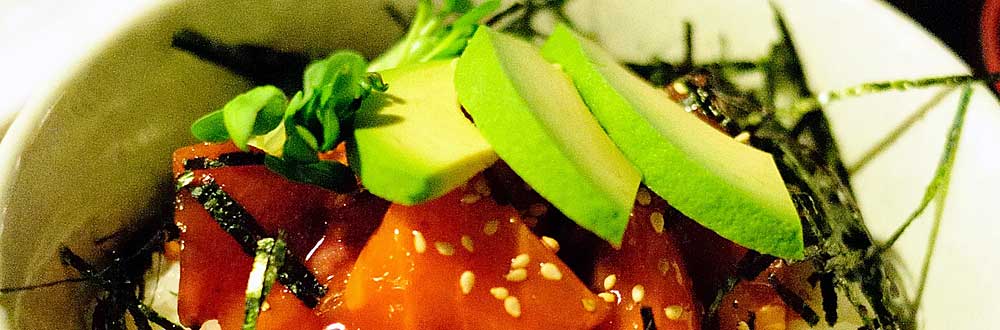
Poke Fish Dish
Dallas Morning News restaurant critic Leslie Brenner has written about the popular fish dish called poke, which takes its name from a Hawaiian word that means “to cut crosswise.” Many other foods take their names for the way they’re sliced, including mozzarella, feta, scrod, schnitzel, and even the pea dish called dahl, which goes back ultimately to a Sanskrit word meaning “to split.” The way poke traveled between Hawaii and the mainland mirrors the migration of many other words.
New Yorkers Stand On Line
A New York City man wonders if there’s any truth to the story that New Yorkers say they stand on line, as opposed to in line, because of lines painted on the floor at Ellis Island. Although such lines are useful for managing large queues, the origin of this usage is uncertain and cannot be traced to Ellis Island. What we do know is that New Yorkers have been using on line in this way for at least 100 years.
Mark Twain and Helen Keller
Mark Twain and Helen Keller enjoyed a close, enduring friendship. When he learned that she was mortified was accused of plagiarism, he sent her a fond letter as touching as it was reassuring.
Buy You A Beer vs. Pay You a Beer
A San Diego, California, man recalls working on a cruise ship with a Canadian who insisted the proper phrase is not Let me buy you a beer, but Let me pay you a beer. Is that construction ever correct?
Shibboleth
We’ve talked before about surprising local pronunciations of things like towns or streets. A term or pronunciation that distinguishes locals from outsiders is called a shibboleth. The word derives from the biblical story of the warring Gileadites and Ephraimites. Gileadites would demand that fleeing Ephraimites pronounce the word shibboleth in a certain way, and if they could not, because their own language pronounced it a different way, they were exposed as the enemy and executed on the spot.
Groak
To groak is an obscure verb that means “to look longingly at something, as a dog begging for food. In the Scots language, it’s more commonly spelled growk.
Around the Gool
A woman in Monkton, Vermont, says that when she and her 91-year-old mother return from a leisurely drive, her mother will proclaim, “That was a nice ride around the gool.” The phrase going around the gool appears in the Dictionary of American Regional English in a 1990 citation from Vermont. It appears to come from an older Scots word that could mean “a hollow between hills” or some sort of “anatomical cleft.”
This episode is hosted by Martha Barnette and Grant Barrett, and produced by Stefanie Levine.
Photo by Michael Saechang. Used under a Creative Commons license.
Book Mentioned in the Episode
Music Used in the Episode
| Title | Artist | Album | Label |
|---|---|---|---|
| Studio 69 | Alan Hawkshaw | The Big Beat | KPM Music |
| Theme For A Hunter | Steve Gray | The Hunter | KPM Music |
| Groove Holmes | Beastie Boys | Check Your Head | Capitol |
| Tough Assignment | Christopher Gunning | Impact | KPM Music |
| Pow | Beastie Boys | Check Your Head | Capitol |
| Exclusive Blend | Keith Mansfield | The Big Beat | KPM Music |
| Volcano Vapes | Sure Fire Soul Ensemble | Out On The Coast | Colemine Records |
