

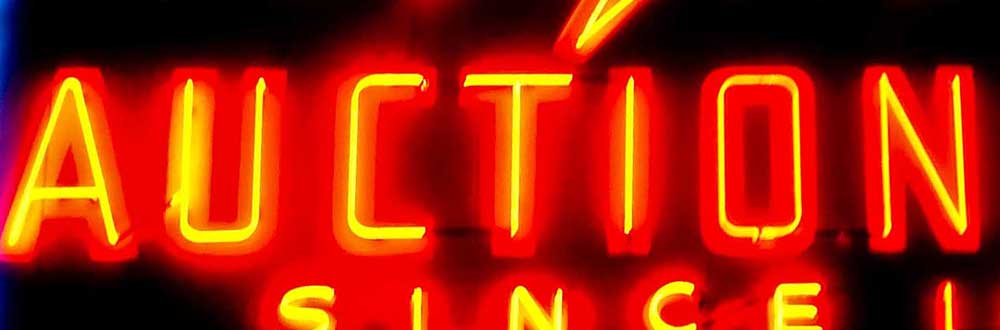
Why do auctioneers talk so fast? Martha and Grant discuss the rapid-fire speech of auctioneers, and how it gets you to bid higher. Also, why so many books have ridiculously long titles, where you’d have sonker for dessert, and an appreciation of that children’s classic, The Phantom Tollbooth. Plus, “different from” vs. “different than,” the origin of suss out, words that apparently entered English in 1937, and the many names for those little gray bugs that roll up into a ball. This episode originally aired November 5, 2011.
Transcript of “Why Do Auctioneers Talk So Fast?”
You’re listening to A Way with Words. I’m Grant Barrett.
And I’m Martha Barnette.
If you’re like me, you probably remember as a child picking up those little gray bugs with lots of legs and watching them roll into a ball.
Roly-polies, right?
Yeah, yeah, that’s what I called them.
But the funny thing is that one of our listeners, Lindsay Klaus, says she grew up calling them bowling ball bugs.
Bowling ball bugs.
Isn’t that great?
That’s a natural word, right?
Yeah, it is.
Of course.
It is.
But she thought that maybe her father made that up because that was the only place that she’d ever heard it.
So like anybody with a language question, Lindsay went to our Facebook page and asked what other names people use for these bugs.
And boy, did she get an earful.
Who knew there were so many names for those little creatures?
I had no idea.
I’ve never heard of sow bug, but Dirk says that they call them that in California.
S-O-W?
Yeah.
They have something to do with pigs?
I don’t know.
I don’t know.
And a fellow calling himself Oso-Walman.
Oso says that he calls them dillo seeds, which I guess is short for armadillo, right?
Oh, that would make sense.
Yeah.
That would make sense because the scientific name for these little creatures is Armadillidae vulgaris.
Because they look like tiny armadillos.
Yeah.
Yeah.
But we also saw the names Wood Lice and Basketball Bug and Chiggy Pig.
There are just so many names for that one.
Pill Bug.
Let’s not forget that.
That’s a common one.
Oh, there was such a long list of them.
And Grant, I tell you, I did not know until after we were talking about this on the Facebook page that there is a scientific word for what those little bugs do when they roll up.
When they protect the soft parts, right?
Yeah, yeah, yeah.
They just roll into those little bowling ball looking things.
There’s a word for that.
The word for that is conglobulation.
Conglobulation.
Happy birthday.
There are mornings when I feel like conglobulating.
Conglobulating.
I love that.
So armadillos, pangolins, which is a scaly anteater, and roly polies.
They all do this.
They all conglobulate.
Who knew?
Well, I love the fact that we have so many common names for common creatures, right?
These insects which are spread across the world, you’re drawn to them, right?
They’re the gateway drug to being an entomologist.
Or etymologist, yeah.
Give us a call, 877-929-9673.
Tell us about what you call the insects, where you’re from, or anything at all.
And send in an email to words@waywordradio.org.
Hello, you have A Way with Words.
Well, hi, how are you guys doing?
Good, who’s this?
Doing well.
This is Carol. I’m calling from Odessa, Texas.
Hi, Carol.
Odessa.
Welcome to the program.
Thank you very much. I appreciate that.
I’m actually in a classroom full of students.
May they say hello to you as well?
Of course.
Yeah.
All right.
Okay.
What a smart bunch of students. How old are they?
They are great. This is a junior high class.
These are actually seventh graders.
Seventh grade.
Well, how can we help the lot of you?
Well, I have a question that has puzzled me for quite some time.
Years ago, I was teaching English at a school, and a fellow English teacher came up and said,
Why is I capitalized?
And I tried to come up with some clever answer, and I had none.
And so I talked with my father about it, who was an English professor.
He said something about maybe the type setting that might be a possibility.
And I’ve never really come across a satisfactory answer, why is I capitalized?
The truth is we don’t have a definitive answer, but the most likely one is what you’re talking about,
That it’s so hard to see.
It’s the thinnest letter in the alphabet, and it had a tendency to get confused in the past.
In fact, we added the dot on top of the small i just because sometimes it just looked like a stray piece of something on the page.
Yeah, and two i’s next to each other, which is common in Latin, look sometimes like a u or an n.
And so you had to really work hard to differentiate these characters.
Sometimes they just looked like a smudge that the scribe had made.
We’re talking pre-printing press.
It really was for visual clarity.
Yeah, there might be some complicating factors, but in general, that’s what people understand.
It’s pretty interesting.
It’s since the 13th century, we’ve been doing it this way, off and on.
And it became really established once the printing press became a reality.
Yeah.
Well, bless your heart.
Bless our hearts.
I appreciate your research.
Well, Carol, yeah, it doesn’t have anything to do with ego or anything like that,
The fact that it’s the only pronoun that we have that we capitalize.
It’s, as you said, for visual clarity.
Yeah.
Okay, well, that had been a possible answer as well that we’d come across,
Maybe because we are so important.
No, I am.
I and I.
That’s right, because as we say in Texas, y’all certainly are.
Hey, Carol, I have a book recommendation for you,
A really fabulous book on the alphabet that I think your students would enjoy.
It’s called Language Visible, Unraveling the Mystery of the Alphabet from A to Z,
And it’s by a guy named David Sachs, S-A-C-K-S, who’s been on our show before.
And he does a little biography of every single letter of the alphabet.
And so you’ll find a lot of this information in there.
It’s a very reader-friendly book about the alphabet and exhaustive.
Yeah.
Well, good.
Listen, thank you so much.
I know you guys spent some time on this, and I appreciate it.
Oh, thank you, Carol, for your work in teaching our students.
May they say goodbye to you now?
Of course.
Yes, please.
I think our bell’s about to ring, too.
So are you ready?
Oh, yeah.
All right.
Bye-bye.
All right. Thank you so much.
Our pleasure.
Thank you, Carol.
All right. Bye-bye.
What are your questions?
They don’t have to be complicated.
They don’t have to be the most difficult.
You don’t have to try to stump us, 877-929-9673.
On the other hand, you can try to stump us.
Send the email to words@waywordradio.org.
Hello. You have A Way with Words.
Hey, this is Jerry McCann from Baltimore.
How are you?
Hi, Jerry.
Jerry McCann. Hi. How are you?
Welcome to the program.
I was cruising cable TV one night and flipped past the collector car auction on ESPN.
And suddenly it struck me that I don’t know what in the world that is that auctioneers do.
That manner of speech of what they do to get the bid up.
Now, I really couldn’t understand what the guy was saying, and it occurred to me,
Any time I’ve heard an auctioneer, the iconic sort of auctioneer in the tobacco barns,
You know, is sort of the classic image that people have of auctioneers,
I can’t understand what he’s saying.
I don’t know what he’s doing.
If I try to do it, I sound like Elmer Fudd.
You know, it’s like, you know, I just…
I don’t know what it is.
And it occurred to me it’s something to do with the words.
So I thought of you guys, and I just know that you’re going to give me this fabulous explanation of where that comes from and what it is they’re doing.
I used to go to estate sales with my father when I was a boy, and it was always about these fast-talking men in these big hats and big boots.
And it seemed like everybody had their foot up on the rear bumper of a pickup truck.
It’s as if they brought the trucks only for that.
And these guys up there selling somebody’s belongings, the family’s long gone, or some old folk had passed on or something.
It’s a strange thing, isn’t it?
Yeah.
But, Jerry, you are right.
It is about the numbers.
It’s all about pushing those numbers higher and higher because the auctioneer gets a cut of however much money comes in.
And it’s also about the numbers because they, as you probably noticed, they sell a whole bunch of things.
I mean, you’re trying to sell a whole bunch of stuff in a very short period of time.
And I’ve done a little reading about this.
It’s actually really cool how they come up with these, you know, like musicians.
They come up with these stock riffs and filler phrases, you know, like dollar bidden or now or would you give me.
And so, you know, you start to learn those patterns and put them together.
And you get something like one dollar bidden now, two now, two, would you give me two, two dollar bidden now, three now, three, would you give me three, three dollar bidden now, four, now, four, would you give me four, three dollar bidden now, four, now, four, would you give me four, four dollar bidden now, five.
Sort of.
I mean, I love this stuff.
And, of course, I’m a big enough nerd that I had to try.
That’s awesome.
How long did it take you to rehearse that?
She’s been practicing her whole life.
The rest of us sing songs in the shower.
This is what she does.
Let me just say, public radio fundraising will never be the same.
Can you imagine?
But Jerry, since you asked, I will tell you that I worked maybe three hours on that.
That’s awesome.
And you start to learn these little patterns.
And the cool thing is that you can go to YouTube.
We should link to this.
You can go to YouTube and some auctioneers will share their secrets.
And then you start to break it down and you realize that they’re emphasizing those numbers.
And they’re always emphasizing the higher number.
So you keep going up and up and up and up.
And once you’re exposed to it, I don’t know how many of these you’ve been to or how many of these shows that you’ve seen.
Once you’ve exposed, even as a boy, I began to understand it.
The numbers will leap out at you even if you can’t understand the rest of it.
And I’ve had it described to me as somebody reading a very fast ticker tape.
These old style machines where the stock quotes are coming in and he’s doing a live play-by-play of that.
He’s got to keep your interest, keep you enthusiastic, move the action along.
And he keeps like, he’ll pop up a word every now and again so that your eye is drawn to him, your ear is drawn to him.
You’ve got to turn to him.
He can’t have you stray.
He can’t have you wander over to the hamburger stand.
Right.
You’ve got to keep your eye on him.
Yeah, and it’s kind of hypnotic, too, don’t you think, Jerry?
Well, yeah, I was always, I was wondering at the same time why we’re so fascinated with it.
Is this an American thing?
Is this an English thing?
I mean, I can’t imagine it being done in German.
That’s a good question.
We should try Spanish.
It is an American thing.
I know that for sure.
It seems to have arisen sometime in the Civil War, but nobody’s really sure why it happened.
I think it was just necessity.
See how revved up I am now?
I’m starting to sound like Grant just talking about this stuff.
I’m excited about life.
But they don’t do it like this in Britain.
I mean, if you look at those, you know, Sotheby’s auctions, they’re not quite like that.
But surely they have estate sales.
Maybe they do the same thing.
Maybe they do.
Well, I’m sure we have some listeners who could tell us.
It’s seductive, though.
Oh, it is.
I bet you watched that channel for far longer than you had to, didn’t you?
Well, I think the real thing is that it is maybe not seductive so much as it’s designed to make you not think so clearly about what you might be doing.
I think you’re right.
You get into this sort of alpha wave state, and then you also, at the same time, have this sense of urgency because it’s moving so quickly.
And there are people around you doing all these things, you know, you don’t want to miss out on it.
I love that.
I think it’s kind of a distraction to try to keep you from thinking about not going higher.
Yeah, about your wallet.
Yeah.
Right.
That’s interesting.
Jerry, what a great topic.
We could go on all day.
We’d have to do it really fast, though.
Thanks for calling, Jerry.
I can’t do it, Martha.
Auctioneer us out, Martha.
Oh, that’s all I know.
I gave you my best.
Thanks for calling, but the short version is, yes, it’s meant to rile you up and get you to buy and keep you excited.
Okay.
Thank you.
All right.
Take care.
Take care, Jerry.
Bye-bye.
We’ll see you.
Bye.
After all these years, one of my favorite sites on the internet is wordorigins.org.
Oh, yeah, Dave Wilton’s site.
Right, Dave runs his site.
He’s, I think he’s a scientist, actually, and a technologist.
He’s very academically oriented.
And his side passion is language.
He’s written a couple books.
But he’s been up to something recently that’s really excited me.
He’s gone through the Oxford English Dictionary and said, for any given year, what are the words that first appear in that year?
So for 1937, for example, four by four, as in the vehicles, four-wheel drive vehicles.
Yeah.
Cliffhanger, you know, a suspenseful movie or episode, actually, of a television show or a serial, right?
Yeah.
I love that idea.
And iffy.
Iffy, he says, was popularized by Franklin Roosevelt, who loved the term.
So he’s got this list of these words from 1937.
And in this list, we have a picture of a year.
Yeah.
You have all these things come to mind.
We think of FDR now, and there’s some stuff related to the Nazis.
And there’s stuff related to automobiles.
And you can just kind of imagine what was in the lingua franca of the year.
I’ll share a few more of these later, but I just love this list.
That’s Dave Wilton’s wordorigins.org.
877-929-9673 is the number to call, or send email to words@waywordradio.org.
Support for A Way with Words comes from the University of San Diego, whose mission since 1949 has been to prepare students for the world as well as to change it.
More about the college and five schools of this independent Catholic university at sandiego.edu.
You’re listening to A Way with Words. I’m Martha Barnette.
And I’m Grant Barrett, and we’re joined by our quiz guide, John Chaneski. Hello, John.
Hi, Martha. Hi, Grant. How are you guys?
The John Chaneski. Hello.
The, the, the official, the one and only, the John Chaneski.
Definite article John Chaneski.
Oh, just me.
The Chaneski.
The Chinesk.
Actually, it sounds like a sophisticated drink I should order the next time I go out.
It does.
I’ll pick a Chaneski, two olives, please.
Mr. Chaneski, what do you have for us today?
Sexy quiz.
I have a puzzle, a little quiz.
You know, I wanted to ask you guys.
You know, when I was a kid, there were two kinds of dogs.
You guys have pets?
Sure.
Yeah, yeah, absolutely.
A couple of dogs.
Okay, when I was a kid, there were two kinds of dogs.
You had purebreds, and you just had mutts.
Mm—
None of this mixed breed.
It was just mutts.
The purebreds had names, and the mutts were mutts, or mongrels, or whatever.
And then I guess someone, to show the pride they have in their mutt, gave their mixed breed some sort of combo name.
And I bet you know what you call a dog that is half Cocker Spaniel and half Poodle.
Oh, yeah.
Cockapoo.
A Cockapoo, that’s right.
And how about a Labrador and a Poodle?
Labradoodle.
Labradoodle.
Yeah, I have a multi-poo.
My favorite is a Puggle.
A Puggle, very sweet.
A Pug and a Beagle.
Very nice.
Well, I’m going to give you two breeds, and you tell me what kind of dog you would get if they mated.
All right?
Okay.
Now, the ones I’ve come up with make sort of combinations that are just like other things you may have heard before.
I’ll give you an example.
If you were a fan of the TV show Lost and you owned a Jack Russell Terrier-German Shepherd mix, what would you call it?
Jack German?
Jack Shepherd.
Jack Shepherd.
You called it Jack Shepherd.
I have a Jack Shepherd.
I’ve never seen the show.
Oh, okay.
But let’s see what else we have in the kennel.
I don’t know if you know this, but Otis Redding owned a dachshund and a Chesapeake Bay Retriever mix.
Dachshund Bay?
It was a dock of the bay.
A dock of the bay, okay.
Very good.
I see where this is going.
Okay.
Now you’re right up to speed.
Roger Ailes owns a Fox Terrier Newfoundland combo.
Do you know what it’s called?
How about Fox News?
A Fox News, yeah.
This is a little Fox News running around there.
What would be the surprising product of a Great Dane and a Scottish Terrier?
I’ll say.
Claire Danes.
Great Scott.
A Great Scott.
Claire Danes.
I don’t know.
Claire Danes, but that would be very surprising, yes.
Some of these, of course, are physically completely impossible, but some of them may want to go out there and try to find one.
Okay.
How about this one?
In the 70s, NASA had a mascot that was part Sky Terrier and part Labrador Retriever.
Sky Lab.
Oh, Sky Lab.
Awesome.
All right, let’s try to go to the next one.
Did you guys know that Santa Claus’s dog is a pointer and a setter mix?
A poinsettia?
A poinsettia.
Why not?
Oh, that’s good.
Arthur Murray owned a Fox Terrier Rottweiler mix.
Foxtrot.
Box Trot.
Do you guys remember Tom Carvel?
Sure, yeah.
No.
Carvel Ice Cream.
Carvel Ice Cream.
Oh.
Stores all across the Northeast.
I remember the ice cream.
At least across the Northeast.
Okay.
He had, his dog was part Chocolate Lab and part Maltese.
Chocolate malted.
Chocolate malted.
I don’t know how much you know about history, but Pliny the Elder owned a dog that was part Pomeranian and part Sharpay.
Pompey.
Pompey.
You know Pompey.
And it’s ash-colored.
Very good.
Ash-colored Pompeii.
Here’s our last one.
Joseph Smith, the founder of the Church of Jesus Christ of Latter-day Saints.
His dog was part Great Dane, part Saluki, and part Lakeland Terrier.
Great Salt Lake.
A Great Salt Lake.
I’ve never heard of a Saluki.
What’s a Saluki?
Oh, it’s a skinny little whippet kind of dog.
Oh, I like those.
They have the winsome faces.
I do want you to know that one of the reasons I came up with this quiz was we just got a dog.
She is half dachshund, half border collie.
So I’ve been trying to work something that’s like docks with borders or something like that.
But it’s just not working out.
But here’s a shout out to Goldie, our new dog.
Goldie.
Thanks, John.
That was a wonderful quiz.
And I think this is a game that we could keep playing online.
Just come up with these mixed breeds over and over, right?
Yeah, send them to us.
If you’ve got some, send them along, words@waywordradio.org.
Try them on our Facebook page or group, or send them in Twitter, or call us, 877-929-9673.
Thanks, John.
You’re my superhero.
Thanks, Chris.
Mine too.
Thank you.
Bye-bye.
Bye.
Hello.
You have A Way with Words.
Hi.
This is Chris from Dallas.
Hi, Chris.
Hi, Chris.
How’s it going?
Pretty good.
How are you all?
Okay.
Doing well.
How can we help?
Well, I’ve noticed recently a trend in book titles that has actually become so prevalent that it’s almost a pet peeve of mine now.
Really long titles annoy me in the first place because I can never remember the whole subtitle that follows the colon.
But lately, I’ve noticed titles that follow a particular pattern.
It’s generally a three- or four-word, pretty catchy title that I think would be fine by itself.
But the subtitle follows a pattern of, like, here’s a particular phenomenon.
We’re going to talk about the topic of the book.
And then they’re going to describe the effect that it has on the world.
So I can give you an example if you want.
On the world.
Okay.
Yeah, just on the world, on the people, how it affects me.
Here’s just one that I’m looking at right now.
Brand washed.
Tricks companies use to manipulate our minds and persuade us to buy.
And actually, if you go onto Amazon.com and you search the phrase and what we can do about it, you will find so many titles.
Oh, really?
Yeah.
That’s interesting.
That’s great.
That’s a great way to find these long, ridiculous titles.
Yeah, and they all end with and what we can do about it or and how we can fix it or how we can bring it back.
It annoys me because they’re so long and unnecessary.
Yeah, that’s pretty funny.
What’s going on there?
I asked some of my friends in publishing about this a while back,
And I’ve asked them recently about this as well.
And it turns out that it’s basically an old form of search engine optimization.
They want to get as much in the title so the whole thing shows up in the card catalogs,
Shows up in the list of recently purchased books.
You just want as much of your title as possible to be as visible as possible
So people know what your book is about.
Get all those keywords out there.
And it’s not that new.
I mean, they’ve been doing it since the Victorian era.
They’ve been doing this kind of thing off and on for centuries.
That was before the internet.
Before the internet, yeah.
But there’s always been this idea that, so you’ve got the great two, three, four word title, fine.
But you still have to sell that short title.
And it’s probably not going to be descriptive enough to tell people what your book is really about.
You’ve got to engage them.
And that’s why that little thing and how to fix it or what to do about it,
Those little lines have been proven to work.
They sell books.
Aha.
Well, that would explain no matter what your politics,
You have to appreciate Dick Morris’ title, which is Fleeced.
And it’s Fleeced, colon,
How Barack Obama Media Mockery of Terrorist Threats,
Liberals Who Want to Kill Talk Radio,
The Do-Nothing Congress,
Companies That Help Iran,
And Washington Lobbies for Foreign Governments
Are Scamming Us and What to Do About It.
Oh, my gosh.
I hadn’t even heard that one.
That’s the worst.
I mean, why read the book?
Well, that’s why Stephen Colbert’s title.
What is Stephen Colbert’s title?
Oh, yeah.
Something I’m great and so are you.
So can you.
So can you.
Yeah.
He’s just gone for this complete play on the highly successful wording that’s used in titles.
They know what works.
We’re probably, maybe we’re past the point of oversaturation.
I don’t know.
But they’re still doing it.
One of the people on Facebook posted this one.
Shock of Grey, the aging of the world’s population and how it pits young against old, child against parent, worker against boss, company against rival, and nation against nation.
Oh, my gosh.
Oh, my gosh.
These are examples of titles.
We’re not necessarily recommending you read them.
You can, your choice.
But maybe that works.
If I just said Shock of Grey, is it fiction?
Is it nonfiction?
Yeah.
Is it about old people?
It could be about abstract art.
It could be anything.
Yeah.
That’s a good point.
Hey, Chris, do you have a word for this annoying phenomenon or a term for it?
Oh, gosh. No, I have no idea. It’s just unnecessarily long titles.
And what to do about them.
Exactly. I mean, about that, though, I guess I can grant a long title. It’s okay with me. And what we can do about it. It kind of makes me cringe.
Clearly you have to write a book about this.
I will write that book.
Good.
I’ll let you know.
I think I’ll call it short titles, how titles and books recently have become so unnecessarily long and inflated, and what we can do about it.
Love it, love it, love it, love it.
Stop listening to your marketing people, for one.
That’s fantastic. Thanks, Chris.
Bye-bye.
Yeah, thank you all so much.
Okay, bye-bye.
Bye.
Hello, you have A Way with Words.
Hi.
Hi, who’s this?
This is John from Hanover, New Hampshire. How are you?
From Hanover, New Hampshire. Well, welcome to the program, John.
Thank you.
Glad to have you. What can we help you with today?
So I was wondering about the difference between the phrase different from and different than.
I had a high school English teacher my sophomore year who always told me different from was correct, different than was not.
He never really explained why, and it kind of makes sense to me in my head, but I really don’t understand why that’s the case.
So I was wondering if you guys could explain that.
Martha?
Yes?
Can you help him?
Yes.
Okay.
Yes, I can help you, John.
You’re right.
A lot of high school teachers will teach you exactly that.
A lot of people have a dilemma.
Is it different from?
Is it different than?
And the short answer to that, the shortest possible answer I can give you is you’re almost always right if you say different from.
Right.
Very good.
And that’s strictly speaking.
That’s what the grammar snobs and the peevers will tell you.
Different from is almost always right.
And different than, you can use that every once in a while.
The difference is that you would use then if there’s a verb later on in the sentence.
So, for example, our economy is different from China’s, but our economy is different now than it used to be.
Because used to be is the verb in there.
Yeah.
Very good.
Yeah.
So that’s really it.
And, you know, there are a lot of people who aren’t bothered by different than.
A lot of people are, I mean, I think that’s changing.
But if you don’t want to ruffle the feathers of the grammar snobs, you want to use different from almost all the time.
And the times that you don’t use different from, your native intuition will probably serve you well.
No, I can understand that.
Cool.
Does that make sense?
Does it help you out, John?
Yeah, it does.
No, that definitely helps.
Okay.
Thanks for calling, man.
Bye-bye.
Bye-bye.
Yeah, some, what was it, 17th century grammarians got all worked up about different from versus different than.
It’s, you know, it’s changing.
I know it’s changing.
Yeah, but different from still works.
I don’t, the cool thing about different from is it’s so safe that it will draw almost no attention if you use it.
Right, right.
People won’t even really notice.
That’s right.
They will understand your meaning without paying attention to your words.
Right.
Different from is the grammatical force field that will protect you from the snobs.
Zzz, zzz, zzz, zzz.
877-929-9673 for your questions or send them an email to words@waywordradio.org.
On a recent show, we were playing that game, Books with a Letter Missing.
Yeah.
Remember that?
Like the spiritual leader who’s looking for love, the Velveteen Rabbi.
Love that.
We got a great email from Terry in Greendale, Wisconsin, who writes, it strikes me that Eric Siegel’s work has unusual potential.
For example, here’s the plot of Love Tory.
Scandalous behavior of British MP brings down conservative government.
Okay.
Then Love Toy.
Sequel reveals that labor has problems of its own.
Then Love Oy.
Romantic angst in Israel.
And Love Why.
Health club encounters lead to romantic bliss.
That’s nice, taking one letter.
And who was that?
That was Terry in Greendale, Wisconsin.
Terry, nice job.
Wonderful stuff.
Yeah, nice work.
Email words@waywordradio.org or find us on Facebook and Twitter.
Hello, you have A Way with Words.
Hi, this is Laura calling from Hamburg, Germany.
Hi there, Laura.
Welcome to the program.
Hamburg, Germany.
It’s nice to be on.
What are you doing there?
I’m actually an English teacher.
Oh, that’s pretty cool.
What can we help you with?
Well, I have a question for you about the term laundry list.
It came up, I was having a chat with my boss, actually, over lunch, and it came up in conversation, and I was just thinking about the fact that although I know the meaning of it, I don’t actually know where it came from.
I don’t know the origins of the term, so I’m curious about that.
You mean in what sense? How would you be using the term?
It comes up when you’re talking about like a long, drawn-out list, a detailed list of something.
Right, yeah.
Generally in kind of negative, it has a negative connotation to it.
I mean, you say that you have like a laundry list of complaints or grievances or something.
Yeah, if it’s not negative, it’s at least really boring, right?
Yeah, also that, yeah, absolutely.
That’s right. You don’t bring somebody a laundry list of compliments, do you?
No, no.
And you don’t say like, oh, I have a laundry list of reasons I want to go to Hawaii or do something nice for myself.
That’s true.
I never thought about that.
I do have a laundry list of reasons.
Bikini, saran, flip flops.
That’s my laundry list.
That’s top of the list then?
Boy.
But why do we use laundry lists?
Because most of us don’t do laundry like that, right?
We don’t need to make a list.
It’s a pile.
I mean, I’ve made things like long shopping lists, long grocery lists.
I’ve never, ever thought about making a laundry list at all.
Here’s the story on this.
In a short kind of little historical nutshell, there was a time when it was far more common for you to send your laundry out to be done if you were of a certain class.
You were probably less likely to have a washer and dryer in your own home, and yet you were of a means that you could afford to send out to have it done.
So just picture this period when washers and dryers weren’t completely the ordinary thing in the home, and yet you still have money.
You’re not going to do your own laundry.
And so the thing is you send your laundry out.
Now, if you’re sending it out to be done just as you would with dry cleaning today, you kind of want to make sure you get all your shirts back, right?
Yeah.
So it’s their job probably.
Sometimes you could do it.
But you can see this all in newspapers and books and everywhere and old books and fiction and nonfiction and so forth.
Usually the laundry person would make a list for you and give it to you, either on the spot, like they would sort through your stuff right there, or at the end, or at some point you’d get a list and you’d know what to look for.
They’d give you the carbon and they would take the master.
So it would be a printed form.
Well, I have one here.
You can find this on Google Books.
And here’s the list.
This is the laundry.
This is your laundry list?
No, it’s a laundry list.
Oh, okay.
In some incredibly boring journal about laundromat, it’s called the Pressman’s Journal or something like that, because people who press pants are called Pressman.
It’s on my nightstand.
No, but he describes it this way.
It’s really interesting.
He’s talking about the carbon forms, and he says they have a surprising uniformity that laundromatists across the country, this is in the 1930s and 40s, are basically all the same.
Breaches, coats, coats, denim, collars, cuffs, drawers.
I love that.
Gloves, handkerchiefs, mattress covers, pillowcases, sheets, shirts, shirts under, meaning under shirts.
I love it.
Shirts, comma, under.
Shirts, comma, W-O-D.
I have no idea what that means.
Shirts, comma, W-O-D.
Any idea?
I have no idea.
Or?
Without, I’m not sure.
I don’t know either.
Without a dickie.
Maybe that’s it.
You remember the dickie?
That was mine.
That was always in the comic, the farcical black and white comic movies.
That was the thing that was always rolling up on these guys’ chest.
Yeah.
Anyway, so it’s a long list of this stuff, and you check off the number that you’ve got, and they put your name on it, and it’s a literal laundry.
So it’s like a sushi menu.
Well, kind of, yeah.
You know, where you mark off the, I mean, it’s already pretty there.
But it is.
If it’s not your laundry, it’s really boring.
Yeah.
You want.
And I can imagine, too, if they’re making that list right in front of you, it’s going to take ages as well.
I can’t wait for my boss to get back from his vacation so I can explain this to him now.
Oh, that’s super.
Laura, thanks for talking with us.
Who knew?
Yeah, not at all.
Thanks for having me on the show.
Drop us online sometime.
Tell us what’s happening in Hamburg.
Will do.
Thanks, Laura.
All right, cheers.
Bye.
Bye.
So the opposite of a laundry list is a wish list, right?
Of course, yeah, yeah.
It’s got the things that you desire most in the world.
Yeah, yeah, yeah, a wish list.
Or maybe even a Christmas list.
Well, if you have questions on your wish list, call us 877-929-9673 or send a whole list of questions in email, words@waywordradio.org.
Here’s three more words from 1937.
This is the list that Dave Wilton is putting together on his wordorigins.org site.
Spam, as in the meat product.
Yeah, 1937.
Telecast, as a television broadcast.
And whoops, as in oops, I see what you did there.
Really?
Yeah.
Interesting.
Oops.
Email us, words@waywordradio.org.
Coming up, the 50th anniversary of the children’s book, The Phantom Tollbooth.
And more of your questions about language.
Stay tuned.
Support for A Way with Words comes from National University, where flexible online classes let you earn your degree or credential on your schedule.
More at nu.edu.
You’re listening to A Way with Words. I’m Grant Barrett.
And I’m Martha Barnette.
Somehow until recently, I’d never read the children’s classic, The Phantom Tollbooth.
Grant, have you read it?
I have read it, yeah, a long time ago.
Well, because I love words, people, of course, have been telling me for years that I would adore this book.
It’s about a boy named Milo who drives a car through a magic toll booth, and then he wanders into all these strange lands.
And he meets strange characters like King Azaz, the unabridged, who lives in Dictionopolis.
I want to move there.
Hey, come to my house.
Yeah, exactly. You’re the king of Dictionopolis.
That’s a place where people literally eat their words.
They feast on goodies like synonym buns.
I did like that.
Oh, nice.
Synonym buns and ragamuffins.
It’s probably the closest thing that American literature has to Alice in Wonderland.
And I finally got around to reading this book just last weekend because I’d heard that there are two brand new 50th anniversary editions out.
One of them is an annotated edition, and another one includes essays by notable people about the effect that the book has had on them.
And Adam Gopnik noted in The New Yorker that this 50th birthday of a good children’s book is really significant because it means that the book hasn’t just been passed down from parent to child,
But from parent to child and on to child again.
He also, in that essay, notes something interesting that shouldn’t surprise fans,
Which is that the author, Norman Juster, grew up with the condition we were discussing recently, synesthesia.
Oh, really?
Where your senses kind of overlap to the point where hearing a sound makes you think of a color
Or seeing shapes make you think of a particular taste.
Right, right.
That explains a lot about this book because it’s pretty crazy, right?
Yeah, it’s either synesthesia or drugs.
Maybe both.
Maybe both.
But in any case, I really like the section where the characters literally devour words.
But you know what, Grant?
My favorite passage wasn’t about words at all.
It involves this character called the Sound Keeper.
And she’s a connoisseur of silence.
Here’s what she says about silence and why she loves it.
She says, do you know that there are almost as many kinds of stillness as there are sounds,
But sadly enough, no one pays any attention to them these days.
Have you ever heard the wonderful silence just before the dawn, or the quiet and calm just as a storm ends, or perhaps you know the silence when you haven’t the answer to
A question you’ve been asked, or the hush of a country road at night, or the expectant pause in a room full of people when someone is just about to speak, or most beautiful of all,
The moment after the door closes and you’re all alone in the whole house. Each one is different,
You know, and all very beautiful, if you listen carefully. It’s nice. Isn’t that nice? I love that.
And The Phantom Tollbooth is this book about listening carefully and looking carefully.
And I just wonder how many of our listeners have read that book and have a favorite passage like that. What part of it sticks with you? Tell us about your favorite literature. We really want to hear about the books that set you on the path for reading for life, 877-929-9673, or tell us in email who shared your favorite book with you, words@waywordradio.org.
Hello, you have a way with words.
Hi, this is Joshua Goosey from Dallas, Texas.
Hi, Joshua. Welcome.
Hey, how you doing?
Thank you. Doing great.
Well, I pastored a congregation in North Carolina. I live in Dallas now, but when I came out of seminary, I pastored a church in rural North Carolina in the Yadkin Valley, which is kind of the northwest corner of the state, just north of Winston-Salem.
And at one of the first meals that I attended, someone asked me if I would like some sonker.
And I thought, what in the world is that?
And I said, sure. And so they gave me some, and they said, would you like some ice cream with that?
And, of course, I took ice cream with it, and it turned out to be peach cobbler, which is what I had called it all of my life.
And so I was curious, where does that word come from?
Is it peculiar to the region?
Right, right.
You weren’t in Surrey County by any chance.
That was my question.
I was in Surrey County.
Oh, yeah.
Imagine that.
A song curry is a lovely dish.
It’s basically cobbler, although you get some people who split hairs and argue that there’s some difference of a half a cup of sugar or something.
More fruit.
Or more fruit that makes it not cobbler.
But as far as we’re concerned, it’s cobbler.
Can I eat it?
Is it yummy?
Okay.
Case closed.
Case closed.
There’s a great description of Sankar from the Mount Airy News.
Mount Airy.
Which you know from up there in the county.
From 1986, they describe a sonker as a pot pie, generally a cobbler, made of fruit, generally blackberries, black raspberries, or huckleberries, and unshaped dough and sweetened with either sorghum, cane, molasses, or sugar.
And then you make a dip of cream, sugar, molasses, and put a few drops of vanilla extract in there.
And then you pour that in a pitcher over the serving.
You pour that mixture of the cream and the sugar and molasses and the vanilla on top of it.
Yum.
That’s a sonker.
Yum.
That’s good times, right?
And then do you sonk out afterward?
That’s exactly what you do because it’s usually on a Sunday afternoon.
Right, right, right.
Dinner on the grounds, right?
You have the chicken, you have the rolls, you have the stuffing, you have the green beans.
That salad with the little marshmallows.
Oh, my God.
But your question about the etymology of this,
I did an entry for this for my official dictionary of unofficial English,
Which is now out of date.
And it should be updated because I found this word since I published that book in 2006,
As far back as 1909 in, of all places, the New York Times.
But they are quoting and making fun of the newspapers in North Carolina.
Oh, no.
In a joshing kind of interregional way, you know, where you make fun of the people somewhere else.
Those snooty provincials in New York.
I know what you’re talking about.
They don’t know from cobbler.
So this word is specific to North Carolina.
I don’t even know if it’s ever crossed in South Carolina.
Probably we’ll get calls and folks will tell us that that’s so.
But what’s interesting is I believe it’s connected to a Scots or a British English word.
There’s two of them, but my favorite is Scots sonker, S-O-N-K-E-R, S-O-N-K-E-R, to simmer or to boil slightly.
Because as I understand it, when you make this dish, that’s what you do with the fruit, right?
Yeah.
You simmer, and then you can pour this cream mixture or whatever, the dough mixture on top afterward,
And the dough cooks while the fruit is still cooking.
I mean, it depends on how you make it.
Again, this is like arguing about barbecue.
How do you make a good cobbler?
Oh, and that’s a big argument in North Carolina.
I know.
Oh, yeah, yeah, yeah.
I know.
Don’t let’s start.
Yeah.
Well, Joshua, you got Grant started here, obviously.
We’re going to go to lunch.
We’ll see you in a couple hours.
It sounds good to me.
Take care.
Thanks for calling.
All right.
Thank you.
Bye-bye.
Bye-bye.
Well, you know how we love language, and you know how we love language about food.
If you got some of both or either, give us a call, 877-929-9673,
Or send your questions and email to words@waywordradio.org.
I was telling you about Dave Wilton’s wordorigins.org site.
Yes.
He’s going through the Oxford English Dictionary looking for words that have their first citations from 1937.
Well, two of them are Yiddish words.
Vupkis, meaning nothing.
I think it means goat droppings originally.
Yes, or beans, yes.
Or beans.
And zaftig, meaning big, which I guess at the time wasn’t particularly derogatory
Because it comes from a word meaning juicy.
Right.
But now there’s some question about whether or not it’s nice or not.
Is it euphemistic for large or is it insulting for large?
It’s just plump and luscious.
Yeah.
You know, a ripe peach.
I don’t know.
Zoftig.
It’s Z-A-F-T-I-G or Z-O-F-T-I-G, depending.
That’s cool.
Yeah, zaftig.
You can call us, 877-929-9673, or email us, words@waywordradio.org.
Hello, you have A Way with Words.
Hi there.
Hi, who’s this?
This is Nathan in Leesburg, Florida.
How are you?
Hi, Nathan.
Welcome to the program.
Hi, Nathan.
The lakefront city.
That’s right.
Have you been to Leesburg?
I have been to Leesburg.
What’s going on there?
Well, I monitor about 20 different podcasts, and that’s how I get your show, too.
Oh, cool.
And so some of the podcasts I listen to are about gadgets because I’m a guy.
One of them recently talked about the phrase sussed out.
And they were talking about a new gadget and whether it did this or that.
And they said, well, we’ll have to see when it comes out and we’ll suss it out.
Like they used in the context of investigate.
But I had never really run across this word before.
And I’m spelling it S-U-S-S, although I don’t know that’s how it’s spelled because I’ve just heard it spoken.
But it doesn’t give me a clue to its origin or anything like that or if that usage of sussing something out or to suss it out.
And Nathan, was this a podcast from the U.K. or from this country?
It was actually one based in California.
-huh.
Okay.
-huh.
Yeah, that makes sense.
The reason I ask is because it was originally British,
And I wonder if you have any suspicions or suspect what the etymology might be.
Well, it sounds a little bit like suspect.
Right! That’s it! Congratulations!
Martha’s the teacher you wish you had.
She gives you the answer to the quiz every time.
And she makes it so easy, too.
She makes it so easy.
So that’s the origin, then, to suspect.
Yeah.
It’s crazy, though, that it should come from the UK.
I have no mental flag at all that says this is foreign to my idiolect or even to the speech around me.
To me, it seems perfectly normal.
Now, I know I’ve read a lot of British.
I was going to say, you have other flags coming out of your head.
Diver down.
No, but I’m just saying, like, usually you have some kind of vague hint in your mind that, oh, I borrowed this.
I learned this late in life, or this came from a particular author, and I don’t have that.
Right.
Now, I’ve listened to a ton of BBC for decades.
I’ve read a ton of British literature for decades.
It doesn’t seem British to me.
Yeah, me either.
What about you, Nathan?
But all the dictionaries say that, right?
Nathan, did you notice that?
Did you look it up and see that all the dictionaries say that it’s originally British?
Well, I just looked it up from the aspect of if it’s proper usage, or that if it’s a proper word.
I thought maybe somebody was a lot of times in American English.
It’s sort of vernacular.
And oftentimes in the tech industry, there are sort of pet words or complicated programming language.
And I thought, well, maybe it has something to do with that.
Yeah, I love it because it seems so active, you know, suss out.
I just feel like I’m putting on a little Sherlock Holmes cap, you know.
Just to be clear what it means here, it means kind of you look into something that you’re unsure about, right?
You investigate and kind of take a forensic approach to figuring out what happened or how it works or what’s taking place.
Yeah, we’re going to suss out the answer to that question.
Yeah, so it’s a great word.
I love it, and we appreciate your calling, Nathan.
Thank you so much.
Thank you, sir.
Thanks for listening.
Take care.
Take care.
Bye-bye.
Well, if you have a question about language, we will suss out the answer.
All you have to do is call us 877-929-9673 or send us an email to words@waywordradio.org.
Grant, would you like to know my new favorite word?
Yes, please.
It’s quisquillious.
Quisquillious.
What’s quisquillious?
It means trashy or worthless, like rubbish.
Quisquillious.
Yeah, yeah. It comes from a Latin word, quisquili, which means droppings and leftover things, you know, the dust bunnies under the bed, just little things lying around.
Quisquilius.
I love it.
I see that there’s a reference in an Australian newspaper.
It says, try calling someone quisquilius, then duck, because it means they’re trashy or worthless.
Share your words with us, something you found, something you loved, 877-929-9673, or email words@waywordradio.org.
Hello, you have A Way with Words.
Hi, this is Jim from Winterlox, Connecticut.
Hi, Jim. Welcome to the show.
Hey, Jim. How are you doing?
Pretty good.
What’s happening?
So about a month ago, I was visiting with an old friend from high school,
And we started to talk about movies, and he asked me about the movie Avatar.
It was that James Cameron movie from a couple of years ago.
And I told him I couldn’t get into the movie because they used this word unobtainium.
And I should say that I’m a mechanical engineer.
I’ve been in the field for about nine years.
And in the engineering world, unobtainium is kind of like an engineering slang.
And it’s used kind of most times in a sarcastic response.
And so unobtainium is this magical material that could do anything.
It could survive any type of temperature or load.
So if a design is not working out well or if you have some unreasonable requirements,
And you usually respond like, oh, well, we can make it up unobtainium.
Then we could make this thing work.
As far as I understand what the word is from, it’s unobtainable.
And eum, it’s like a common ending for metals like titanium, magnesium, lithium.
So you kind of have that together.
It’s like an unobtainable metal.
Right.
Exactly.
Right.
So you had a hard time getting into the movie Avatar because they were talking about unobtainium, right?
Yeah, and it was in such a serious context that I just could never get past that.
So you probably thought they weren’t really flying around either.
No, no. We won’t get into that.
Oh, that’s funny. So that’s jargon from your workplace, and you were totally thrown off by that, right?
What’s your kind of work, Tim?
Mechanical engineer.
I’m a mechanical engineer.
Okay, very good.
Working in the aerospace field.
Yeah, that must have been weird.
I knew the word unobtainium before I saw the movie Avatar, but I didn’t have that disconnect.
I just assumed that they had finally found this metal that had all these amazing properties, you know.
And that’s why they went to the far-flung corners of the universe to destroy people to get it.
Oh, man.
But you must have been laughing every time they mentioned it.
I laughed the first time and then past that it just kept on bothering me and I just can never get into the movie after that.
That makes sense.
It’s got a good history, at least back to the 1950s,
And it pops up in a glossary of words that the Air Force put out.
And it’s described basically as you put it,
Which is it’s a substance having the exact high test properties required for a piece of hardware
Or other item of use, but not obtainable either because it theoretically cannot exist
Or because technology is insufficiently advanced to produce it.
Interesting stuff.
I love these kind of like, I love this sly little engineering humor because it’s just an acknowledgement that we know our limits.
And I guess we work around them or we seek to surpass them.
So what are you going to do?
You’re going to write James Cameron a letter and tell him in the Avatar sequels to knock it off?
Actually, I’m going to call up my friend and tell him that it actually is just an engineering slang.
Because he was pretty resolute that it had to mean something else besides that.
He’s got too much faith in Hollywood.
You’re just saying, just put on your 3D glasses and enjoy the movie.
This is the quiet country.
You tell people about Santa Claus and the Tooth Fairy and the Easter Bunny and Hollywood.
This is number four.
Son, I’ve got something to tell you.
Sit down.
Your mother and I think it’s time you knew.
Great stuff.
We appreciate your calling.
Thanks, man.
Thank you.
Bye.
Bye.
Bye-bye.
If you have a question about language, you can obtain an answer right here, 877-929-9673,
Or send an email to words@waywordradio.org, or drop by our Facebook page.
Grant, you know I love quotations about words and language and writing,
And I was reminded of this one the other day from Steve Martin.
You probably know this one.
Some people have A Way with Words.
Some people not have way.
I like that.
Love it. Love it.
I always quote his, those French have a different word for everything.
Great stuff. I never get tired of it.
Share yours, 877-929-9673, or send it an email to words@waywordradio.org.
Things have come to a pretty pass.
That’s our show for this week.
Don’t forget you can leave us a message.
Even when we’re not on the air.
Call us at 877-929-9673.
Or email us.
The address is words@waywordradio.org.
You can stay in touch with us all week.
On Facebook and Twitter.
And you can listen to all of our past shows.
By downloading them at waywordradio.org.
Or get the podcast on iTunes.
Stefanie Levine is our senior producer.
Our technical director and editor is Tim Felten.
Tim also chooses our music.
We’ve had production help this week from Josette Herdell and James Ramsey.
A Way with Words is independently produced and distributed by Wayword Inc.,
A non-profit organization.
The show is recorded at Studio West in San Diego, California.
Thanks for listening. I’m Grant Barrett.
And I’m Martha Barnette.
Ta luego.
Ciao.
Either, either, neither, neither.
Let’s call the whole thing off.
You like potato and I like potato.
You like tomato and I like tomato.
Potato, potato, tomato, tomato.
Let’s call the whole thing off.
But oh, if we call the whole thing off.
Support for A Way with Words comes from National University, where flexible online classes let you earn your degree or credential on your schedule.
More at nu.edu.
Hey there, podcast listeners.
Just want to let you know that although we give you the show free and we give it free to stations,
It does cost something to send these episodes out to hundreds of thousands of listeners across the planet.
Help support our educational mission by going to the website and clicking the donate link.
Ten bucks? A little more?
How about as much as you think it’s worth?
Thanks in any case for helping us keep shop.
Roly Polies, Sow Bugs, Wood Lice, or What?
 What do you call those little gray bugs that roll up into a ball? They go by lots of names: roly poly bugs, potato bugs, sow bugs, chiggypigs, dillo seeds, basketball bugs, bowling-ball bugs, and wood lice, to name a few.
Why We Capitalize the Pronoun “I”
If you’re wondering why we capitalize the letter “I” when we don’t capitalize the first letters of other pronouns, the answer’s simple. It’s easier to read. Martha recommends a book offering a detailed history of every letter of the alphabet. It’s Language Visible: Unraveling the Mystery of the Alphabet from A to Z, by David Sacks.
Fast-Talking Auctioneers
Why do auctioneers talk so fast? The hosts say it’s partly to put you into a trance, partly to increase the sense of urgency, and partly to sell off lots of items in a short amount of time. More details in an article in Slate magazine. You can learn some of the basics of auctioneering from videos on YouTube.
1937’s Words
On wordorigins.org, etymologist Dave Wilton is going through the Oxford English Dictionary year by year to find the earliest citations for various words, which offer an unusual linguistic glimpse into that particular year. The year 1937, for example, is the first in which we see the terms “four-by-four,” “cliffhanger,” and “iffy.”
Double-Dog-Dare Word Puzzle
Quiz Guy John Chaneski has a puzzle called “Double Dog Dare.”
Long Book Titles
Why are some book titles so incredibly long? A caller complains about book-title inflation, usually consisting of a shorter title followed by a colon and a longer subtitle that seems to sound important and ends with the words “and What To Do About It.” Grant explains that such extra-long book titles have long been a form of search optimization by publishers and marketing departments. The more searchable keywords in the title, the more copies sold.
Different Than vs. Different From
Which is correct: “different from” or “different than”? Martha explains that the grammatically correct choice is almost always “different from.”
More Book Titles With Letters Missing
Martha plays another round of the Books With A Letter Missing game.
Laundry List
A caller in Hamburg, Germany, wants to know where we got the term laundry list. Grant explains that it derives from a time when people of a certain class sent their laundry out to be cleaned. It’s usually associated with a collection of things that are routine or involve drudgery or something negative. Funny how no one ever offers a laundry list of compliments.
More 1937 Words
More words that entered the language around 1937: “Spam,” “telecast,” and “whoops.”
Phantom Tollbooth
The Phantom Tollbooth, the beloved children’s book by Norton Juster and illustrated by Jules Feiffer, turns 50 this year. There are two new 50th anniversary editions of the book. As Adam Gopnik notes in a New Yorker magazine article, the book is the closest thing American literature has to Lewis Carroll’s Alice in Wonderland. Martha shares her favorite passage from the book, a description of various kinds of silence.
Sonker Cobbler
Care for another helping of sonker? That’s another name for deep-dish cobbler. There’s a Sonker Festival each year in Surry County, North Carolina, one of the few places where you’ll hear this regional term.
Even More 1937 Words
More words that entered the lexicon around 1937: Yiddish “bupkes,” meaning “nothing,” and “zaftig” meaning “plump,” “soft,” or “juicy.”
Suss Out
What does the term suss out mean? It’s often heard in police and journalistic jargon, and means to “take a forensic approach to finding out an answer.” It probably derives from the verb “suspect.”
Quisquillious
Quisquillious describes something that’s trashy or worthless. It derives from the Latin for “rubbish.”
Unobtanium
In the movie Avatar, the characters battle over a rare and valuable mineral called unobtanium. A mechanical engineer says he had a hard time getting into the movie because in his world, the word unobtanium means something different.
Not Have Way
Martha quotes Steve Martin’s aphorism about language: “Some people have A Way with Words. Some people not have way.”
Photo by sashafatcat. Used under a Creative Commons license.
Books Mentioned in the Episode
| Language Visible: Unraveling the Mystery of the Alphabet from A to Z by David Sacks |
| Oxford English Dictionary |
| The Phantom Tollbooth by Norton Juster, illustrated by Jules Feiffer |
Music Used in the Episode
| Title | Artist | Album | Label |
|---|---|---|---|
| I Feel The Earth Move | Lonnie Smith | Mama Wailer | Kudu |
| Horny Tickle | Clutchy Hopkins | Walking Backwards | Ubiquity Records |
| Bidi Man | Robert Walter | Spirit of ’70 | Greyboy Records |
| Soul Dream | The Greyboy Allstars | West Coast Boogaloo | Greyboy Records |
| Fried Grease | The Greyboy Allstars | West Coast Boogaloo | Greyboy Records |
| Rocktober | Clutchy Hopkins | Walking Backwards | Ubiquity Records |
| Hardware | Robert Walter | Super Heavy Organ | Magnatude Redcords |
| Rivers of Babylon | Robert Walter | Cure All | Palmetto Records |
| Jan Jan | Robert Walter | Spirit of ’70 | Greyboy Records |
| Let’s Call The Whole Thing Off | Ella Fitzgerald | Ella Fitzgerald Sings the George & Ira Gershwin Song Book | UMG Recordings |

