The autocomplete function on your phone comes in handy, of course. But is it changing the way we write and how linguists study language? Also, suppose you could invite any two authors, living or dead, to dinner. Who’s on your guest list and why? Plus, anchors aweigh! The slang of sailors includes the kind of BOSS you’d better dodge, a barn you sail into, and the difference between the Baja ha-ha and the Baja bash. All that, and a brain game about body parts, conked out and zonked out, synonyms for synonym, ferhunsed, chronopaguous, nemophilist, sea-kindly, smithereens, standing on my own two pins, and more.
This episode first aired June 1, 2019. It was rebroadcast the weekend of January 13, 2024.
Transcript of “Abso-Bloomin-Lutely (episode #1526)”
You’re listening to A Way with Words, the show about language and how we use it.
I’m Grant Barrett.
And I’m Martha Barnette.
Here in sunny San Diego, I’ve been spending time lately with sailing enthusiasts.
And of course, for me, half the fun is just listening to their language.
Right.
For the longest time, they were saying lat-long, and I didn’t know what they were talking about.
Latitude and longitude?
Yes.
Oh, okay.
Yes, what’s the lat-long?
And then I learned the word decastling, which has to do with when you’re pulling the chain on an anchor.
The chain can tend to castle.
It can tend to sort of pile up.
Yeah, yeah.
So you have to de-castle the chain.
Oh, interesting.
Isn’t that cool?
The little mounds of chains.
I can picture that.
Yeah.
And then another word was catenary curve, which just made me fan myself.
Because catenary comes from a Latin word, catena, which means chain, like cadena in Spanish.
And concatenation, which is a chain of events.
And the catenary curve is what you want your anchor chain to look like.
You don’t want it pulled tight.
You want kind of a curve to it.
So I was just thrilled to be having all these conversations with language that I wasn’t familiar with at all.
These folks were planning to sail along the Baja California Peninsula.
And what I learned is if you’re going south from San Diego, it’s relatively easy, and that’s called the Baja Ha Ha.
But if you’re coming up north, you’re going against the current sometimes and going right into the wind, and that’s called the Baja Bash.
Reasons you can’t imagine.
And one of the things that makes it particularly challenging is that there’s always got to be somebody on deck looking out for a boss.
Do you know what a boss is?
A rock sticking up? I don’t know.
It’s a big oncoming steel ship.
Oh, wow. Yes, yes.
It’s like the final boss in a video game.
Right.
And speaking of final, they’re all trying to, if they’re coming up the coast, they’re trying to get back to the barn.
Oh, nice.
I’ve heard that one. That’s great.
So you did, and go down with them all the way to Ensenada or something, or Cabo even?
Gosh, no.
No, I’ve been out in the bay and a little bit beyond that, but that’s for another time, I think.
That’s fantastic.
That’s some great castling.
Yeah, castling.
I used to do that with a chain necklace that I had.
You can stack it in such a way, right?
Oh, I hadn’t thought about that.
It falls one way, one moment, another way, and another moment.
It’s interesting.
Yeah, castling.
We know that you have hobbies and pastimes, and there’s a lot of language.
You don’t think much of it.
Let me tell you, we would love to hear about it.
Email words@waywordradio.org.
And you can talk to us on Twitter @wayword.
Hello, you have A Way with Words.
Hi, this is Callie from Western Kentucky University.
What can we do for you, Callie?
Well, I was wondering about the word zonked.
I think it’s spelled Z-O-N-K-E-D.
Zonked?
Yeah, zonked.
As in, like, I’m so exhausted, I’m just zonked after the busy day.
Yeah, yeah.
I was talking to a friend one day, and I said, man, I’m just zonked.
And she just looked at me like I was crazy.
She’s from more up north of Kentucky, and I’m more from the south near Bowling Green.
I was just wondering if that’s more of a regional word, or where does this wacky word come from?
Yeah, zonked isn’t regional.
It’s fairly widespread.
I wouldn’t say it’s all that common, but the fact that she didn’t hear of it isn’t because she’s from a different place.
It’s just she hadn’t encountered it yet, and now she has through you, right?
Yeah.
There’s a set of words that mean to be really tired or to be really sick or to be really drunk.
And they all have to do with other words that mean being hit on the head.
So, for example, you might say that you’re conked out, right?
You could be conked on the head so that you pass out.
Or you could be conked out, meaning you’re sleeping really heavily.
You could be knocked out.
Oh, yeah, he’s knocked out.
Don’t wake him.
We’re going to let him sleep through the morning, right?
This is the kind of thing you might say around a child.
So there’s a few of these, and zonked is part of that pattern, and it also rhymes with conked, and I don’t think it’s an accident.
I think there’s some otomatopoeia there happening, the sound of, say, a pipe or a bat hitting a skull in the right place to knock somebody out.
It’s definitely referring to the physical act of hitting somebody so that they pass out.
Oh, interesting.
I definitely never used it in the context of being drunk.
But yeah, I’ve always heard the word hitting, especially around older families.
Yeah, it dates back to the 1950s in both the noun and the verb form.
And many of the early uses do have to do with drinking too much or doing too many drugs or just indulging too much in something that’s going to leave you loopy.
And then it kind of transitions by the 1980s to more fully just only being about being exhausted, having worked so hard that you’re tired or having no more energy left or being really sleepy or just sleeping very heavily so that you can’t be awakened.
It reminds me of those words that you see in comic books, you know, when somebody smacks somebody in the face, you know, zonk.
Oh, yeah.
That’s not a bad theory.
If there were a good corpus of comic book writing, I would look and see if it’s in there earlier than the 1950s because it just seems like a perfect match, doesn’t it?
Yeah, it does.
I can just picture it.
So, Kelly, we hope you’re not feeling zonked anymore.
We hope you’re feeling a lot better.
Thank you so much.
Thanks, Kelly.
We appreciate it.
Call us again sometime.
Bye.
Bye-bye.
So, yeah, figuratively, it’s about being tired or sleepy.
But literally, all three of these expressions, conked out, zonked out, and knocked out, have to do with being hit and passing out from that.
Yeah, that makes perfect sense.
And I use all three of them.
Being knocked unconscious.
Yeah, they’re all familiar to me.
But, you know, you and I have this predicament, which is we fiddle around so much with our own language and our own speech, we’re never quite sure if we’re good representations of the typical American speakers.
That’s right.
We fiddle around with our own language and everybody else’s.
And we’d love to take your language questions, so call us 877-929-9673 or send your questions and stories about language to words@waywordradio.org.
Is there a synonym for synonym?
At least two.
At least two. Yes. One of them is pisillinim, which has an odd spelling. It’s P-O-E-C-I-L-O-N-Y-M, which comes from a Greek word that means many colored or varied.
Oh, nice.
And then the other one is polyonym, like poly and nim.
Yeah, polyonym.
Yeah, polyonym.
Which is kind of self-explanatory, right? Many words, basically.
Right.
But neither one of them is all that common.
Right. You usually see it in funny books about language.
Or that kind of thing.
Or, you know, when people say, hey, did you know there’s a synonym for synonym?
Or on Twitter @wayword.
Hello, you have A Way with Words.
Hi, how are you?
Doing well.
Who’s this and where are you?
This is Betsy Madden.
I’m calling from Virginia Beach, Virginia.
Welcome, Betsy.
Hello, Betsy.
What can we do for you?
I’ve got a question about a word that my father and his sister used to use, and I’ve never heard it used outside of our family.
The word was gunas.
I’ve never seen it spelled, so I don’t know if it would be G-O-O-N-U-S or G-O-O-N-E-S-S.
It referred to loose, soft flesh on a person or an animal, sometimes found in folds, like, for instance, a basset hound has a lot of gunas around its face.
Or my great-aunt Dot had gunas under her chin.
When my dad used the word, it was never in any kind of a derogatory sense.
In fact, he frequently would refer to somebody having good goonies.
So, like, our cat had good goonies that hung below his belly when he walked.
Or some babies have really good goonies on their thighs.
And I don’t know if it was just a word that grew out of the family somewhere.
Maybe a young child didn’t know how to pronounce the word goodness.
Or if it’s a word that was actually used back in the early to mid-20th century and has since faded into obscurity.
And where’s your family from?
My father spent all of his 89 years in Norfolk and Virginia Beach, Virginia.
He would spend summers in Kentucky when he was growing up during the Depression because they had more money out there.
I think your theory about it being a contracted form of goodness is a really good one.
And I think there might be some interplay there with gooeyness because we are talking about soft.
But gooey maybe is a little more derogatory.
But gooeyness plus goodness, I could see getting goodness out of that.
A fun family word is what it sounds like to me.
A thing that somebody said on accident and maybe it became a family word forever.
And here you are still talking about it many years later.
It’s certainly a useful word.
Yeah.
Yeah, I could see grabbing a baby’s little fatty rolls and jiggling them and talking about their goodness.
Yeah.
Their Hawaiian rolls.
I always think of the little fat rolls.
Hawaiian rolls?
They look like Hawaiian rolls.
The little fat bulges on baby arms and legs, they look like Hawaiian rolls.
Yeah.
Soft, yummy.
Okay, so this doesn’t show up in the literature.
No, it doesn’t show up in the literature.
But, you know, I’ve got to tell you, here you are on a national radio show, podcast listeners around the world.
Maybe we’re launching this word for your dad.
Well, that would be awesome.
Yeah, it could be, right?
Gunas means…
Maybe one of these days it’ll show up in the dictionary, and then I’ll know how to spell it.
The lovable pudge on people and animals, something like that, right?
Lovable pudge, I like that.
I like that, too.
All right, well, so maybe we have started a movement.
The Gunas movement.
Could be.
I’m for Gunas.
How about you?
You can be the first Grand Marshal of the Goonies Pride Parade.
How about that?
There you go.
Outstanding.
Betsy, thank you for your call.
If anything turns up, we’ll let you know, all right?
Okay.
Thanks for having me on the show.
Take care.
All right.
Bye-bye.
Bye-bye.
My cat definitely has Goonies.
I have Goonies.
Right?
I love the Goonies on cats that just kind of swings as they walk along.
And you’re like, do some ab crunches.
Come on, dude.
Fix that.
They’re saying, no way.
They’re just sleeping 16 hours a day.
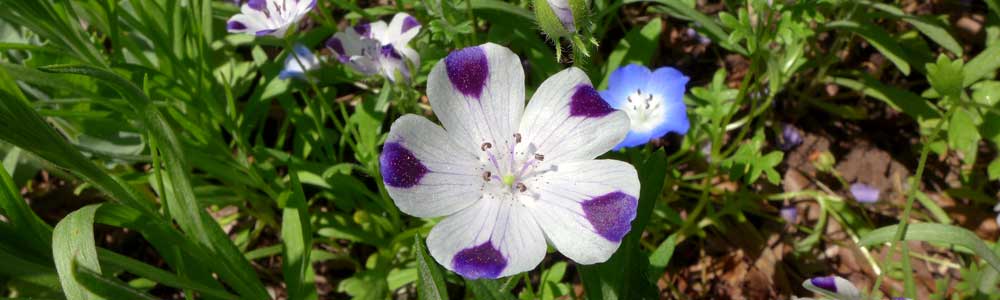
A little earlier this year, we had the super bloom in California, and I was reading about it and reading about a particularly beautiful flower called Nymophila maculata.
And it’s also called the five spot.
And it’s this beautiful little blossom that is sort of white in the middle.
And it’s got petals.
And each of them has a little purple spot at the very end.
So it’s called five spot.
And I was thinking, why would it be called nemophila maculata?
I mean, the maculata is from the Latin word for spot.
Like immaculate is something that’s spotless.
But nemophila, I was thinking of the Latin word nemo, which means nobody.
And so I was thinking it loves nobody.
That doesn’t make any sense.
But as I started digging, I realized that it actually comes from the Greek word for forest, nemos,
Which also gives us the word nemophilist, which is somebody who loves the forest.
A nemophilist.
Yes.
That’s a good word to have.
Yes.
So that was a whole lot of fun drilling down for me.
I will add that to my bio.
Nemophilus.
Nemophilus.
Nemophilus.
Nemophilus?
Yeah.
I am a nemophilus.
You are.
I’m not.
Someone who loves forests.
Don’t ask me for a five spot, though.
I thought you were going to say it looks like a $5 bill.
With the guy in the middle.
I don’t know how they did that, but it was amazing.
It’s all about the Lincolns.
More about what we say and why we say it as A Way with Words continues.
You’re listening to A Way with Words, the show about language and how we use it.
I’m Martha Barnette.
And I’m Grant Barrett, and we’re joined by our quiz guy, John Chaneski.
Hi, John.
Hey, Grant.
Hi, Martha.
Listen, you know, I realized recently that when we try to use language to communicate,
It helps if we have a common point of reference.
And what’s more common than the human body, right?
I’m pretty sure most people have one.
So, just like an episode of Game of Thrones, body parts are everywhere you look in English.
However, if you don’t know your butt from your elbow, well, that’s how you end up with a quiz like this.
I’ll read you a sentence, and your job is to replace the incorrect body part with the correct one.
For example, listen you, stop bothering me or I’m going to give you a toe sandwich.
Knuckle.
Obviously, we want knuckle instead of toe.
Though, to be honest, I don’t think anybody wants a toe sandwich either.
No, no.
No.
All right.
So here we go with our transplants.
When they announced that the old theater would be replaced by a parking garage,
The community was up in kidneys.
Up in arms, of course.
Up in arms, right.
All right, boys.
That was a pretty sorry first half,
But take a shin and we’ll go over our plans for the remainder of the game.
Take a knee?
Take a knee, yes.
Very good.
That escape room was so tough
We just made it out by the hair of our cheek.
This is a double by the way.
The skin of our teeth.
Skin of our teeth.
Yeah another one I think works pretty well.
I’ve hired you three
As my own personal chin trust
To get me out of this PR nightmare.
Brain trust.
Brain trust yes.
Jay Leno chairman.
Nice.
We had been driving for hours
And I just couldn’t ankle his nonstop commentary anymore.
Stomach.
Stomach, yes.
So that’s when I pulled over, kicked him out,
And left him standing on the appendix.
Standing on the…
Shoulder.
Yes, the shoulder. Cool.
You know why kids these days like me so much?
Because I get them.
I like their music, their art, their culture.
I’m back, baby.
Back.
Hip.
I’m hip, baby.
Yeah, very nice.
Cool.
Long story short, that leaky beach house way out in Wildwood,
I managed to lung it off on my brother-in-law.
Pawn it off.
Pawn.
What’d you say?
Pawn.
Pawn is not a body part?
I’m trying to think of hand it off.
Hand it off?
Close.
Actually, you’re in the exact area.
Palm, yes.
I palmed it off on my brother-in-law.
Yes.
Oh, that’s why you wanted to know.
Okay, got it.
Yeah.
All I’m saying is, if a guy is crowding the plate like that,
He’d better be ready to be on the receiving end of some colon music.
Chin music.
Chin music.
Yeah, on second thought, maybe we shouldn’t change these around.
All right, here’s the last one.
Well, you know, that’s the end of the quiz.
I think it’s time for me to thumb out.
To head out.
Head out, yes, very good.
Oh, head out.
And that’s it.
That’s literally time for me to head out.
John, thanks for the quiz.
We’ll talk to you next week.
My pleasure.
Thank you, guys.
We talk about all kinds of language on this show, so join us, 877-929-9673,
Or send us an email.
That address is words@waywordradio.org.
And if you just can’t wait, hit us up on Twitter at Wayword.
Hello, you have A Way with Words.
Hi, this is Mayra calling from Puerto Rico.
Oh, welcome, Mayra.
Mayra, welcome to the show.
How can we help?
Hi. I was born and raised here in Puerto Rico.
So my first language is Spanish, just in case you noticed that accent.
And living here, I love going to the beach and snorkeling.
And I have friends that live in Minnesota.
They come and spend the cold months here from October to April.
And we used to meet at the beach to go snorkeling.
We sat on the sand, chatting and getting ready to go in the water.
And they always say, okay, I’m ready to go out, out to the water.
Then when they were in the water for a while, they always say, okay, I’m ready to go in, as in land.
Now, the way I say it is when I’m ready to go snorkeling or swimming, I say, okay, I’m ready to go in, as into the water.
And then when I’m ready to go out, I’m ready to go out, as out of the water.
Are they right? Am I wrong?
I could see both being correct, depending where you’re standing when you speak and your perspective about what you’re going to do next.
For example, if I’m on a porch or under a roof or in some kind of shade or under an umbrella, I could see saying that I’m going to go out because I feel like I’m leaving shelter and going out to the water.
Does that make sense?
Because it’s always like we’re right there on the shore.
So no shade, no shelter.
No, no shade, no nothing.
It reminds me of the conversations we have about downtown.
What is downtown?
What is uptown?
And it’s different.
It’s uptown, downtown, exactly.
It’s different for a lot of places.
Some places the downtown is very unlike.
It’s not the center of town.
It’s something else.
Yeah, I’m sure as you’ve already found, prepositions are just so tricky.
That’s one of the hardest things to learn when you’re learning another language, right?
Exactly.
And even in the language, they can differ from dialect to dialect.
Absolutely.
English doesn’t always treat prepositions the same across all the different English speakers in the world.
Right.
And, Myra, when you’re getting out of the water and you’re thinking in Spanish, what verb do you use?
Oh, that’s another thing.
The way I speak English is I translate in my mind before I say it.
Yeah.
And I always say, voy a salir del agua.
Right, right.
So it’s just a single word.
I’m going to go out.
Yeah, going to go out of the water.
-huh.
Now, my friends from Minnesota, they live by the lake.
Do lake people have a different language?
Oh, interesting.
Because on a lake, I can see saying going out on the lake, where you might not say I’m going out on the ocean.
Right?
Exactly.
Interesting.
You know what we’re going to do for you, Myra?
We’re going to throw this out to our listeners.
We’re going to get some calls from our people on the coast and people who live by rivers and lakes, and they’re going to let us know what they think about this difference between going out, meaning going out to the water or going out of the water, and going in, where you can mean you’re going in the water or you’re going inland.
It’s very different.
I would like to hear more.
Maima, you’ve posed a pretty little puzzle for us.
Thank you for that.
And I suspect you are not wrong.
Thank you so much.
Thank you.
Bye-bye.
Take care.
Keep listening.
Ciao.
Ciao.
Well, if you can help Myra out, call us.
Let us know what you think.
What’s the preposition, the verb plus preposition that you would use for going into the water or getting out of the water?
Let us know.
Email words@waywordradio.org.
Doug in Louisville left us an interesting message that I wanted to respond to.
He was asking about autocomplete on the phone, you know, when you’re typing and it suggests words.
And he says sometimes it’s not what he wants to say, but he says, sure, and goes with it instead.
And then he wants to know, is this going to have an effect on the way people talk or write?
And what I loved about that question is he’s kind of getting it to one of these core problems that people who study language have.
For example, if I’m looking only at edited texts to see how language is really used and all of those texts use a style guide, then maybe all that I’m getting is the rules of the style guide and not natural unbridled speech, unconscious normal language, which is kind of what you want.
And it’s the same problem with autocomplete. Before there was autocomplete, generally, you could just download everyone’s text messages with their permission and put them into a big database and examine that and say, this is what’s happening with the way people text and type on their phones, right?
But now with autocomplete, we can’t do that because it’s now polluted. There’s poison in the well. And so you have to find text that hasn’t gone through this autocomplete process.
Some program that doesn’t have that feature, for example, and only get from that particular bit of software.
The other thing that’s happening here that he kind of asked about, but I want to address indirectly, is something known as Markov change. Markov was a Russian thinker and scientist that died in the 1920s, Andrei Markov. And basically the way that his ideas are represented today is you have random events when you’re typing.
The computer doesn’t really know what letter is going to follow every other letter. So what happens is every time you type a letter, it runs a series of probability programs to figure out what letter it thinks is going to be next. It bases this on frequency tables. For example, this word is more common than that word, or this letter is never followed by these other letters. So we’re going to just exclude those letters and things like that.
So you can do that fun game on your phone where you type in I, just the personal pronoun I, and accept every word that it suggests in the middle of the suggestion list.
Just keep going and see if you get a comprehensible sentence.
And sometimes you do.
And the reason you do is because Markov chains.
Because of this math and these frequency tables and other sophisticated sources of language data, which tell the computer and tell you, here’s what they might be thinking.
And so, yeah, he’s right.
Doug is absolutely right.
If a lot of people are just saying, that wasn’t what I meant, but that works, and go ahead and say yes, then they are polluting the data for people like me who go in and study that kind of information.
It’s a real problem.
Those kinds of autocomplete errors, so to speak, can change the way you talk with intimates.
We had a call years ago about a guy who tried to type the word cool, and it typed the word book instead.
And so he and all his friends used the word book instead of cool.
And this was a thing for a while.
A bunch of people were doing this.
I believe they’re called Cupertinos after some common Apple errors that were happening in some of their autocomplete.
But now this stuff is so sophisticated that sometimes it’s more right than I am.
I can’t believe how good it is.
It’s amazing, right?
And it does it in multiple languages, too.
If you turn on, say, Spanish on your phone as well as English, those Markov chains are right there helping you decide what comes next in a language that maybe you don’t speak as well as your other language.
Yeah, it can be a little uncanny.
Like, my phone knows what I’m thinking.
It’s typing the word before I say it.
That’s a little creepy, right?
So anyway, Doug, thanks for your call.
We really appreciate that.
The term you want to Google if you want more about this is Markov chains.
It’s M-A-R-K-O-V.
It’s super high-level stuff, but I think you can find some easy explanations on Wikipedia.
Hello.
Welcome to A Way with Words.
You’re talking with Judy Giblin.
Judy, hello.
From Binghamton, New York.
Binghamton, New York.
Welcome to the show.
Hi, Judy.
Thank you.
What’s up?
Hi, Marga.
What can we do for you?
If someone could possibly give me a hint as to what I consider to be a very Pennsylvania Dutch word.
It’s verhunzt.
And I remember my great-aunt using it.
She lived in Reading.
And I remember her using it.
She used it as a word for being confused or, you know, just not understanding what was going on.
So you have a family history in the Pennsylvania Dutch-speaking area?
On my mother’s side, yes.
And what brought it to mind now, after all these years?
Because I still use it.
Oh, you do. Okay.
And so what you say is, how do you put it in a sentence?
Yeah, give us an example.
I don’t understand the situation that’s going on.
I’m for hunts.
I’m for hunts.
Okay, and do you have any idea how to spell for hunts?
I truly do not.
I never saw it written down.
I only ever heard it.
It does come from Pennsylvania Dutch, and it’s often spelled F-A-H-U-N-S-T, meaning teased or disoriented.
Fahunse means to tease or confuse somebody.
It’s really cool.
It goes back to a German word that means to spoil or botch or bungle.
And we think it might go even farther back to the German word hunt, which means hound or dog.
And it’s sort of like it went from scolding a dog or treating a dog badly to spoiling and bungling something and ultimately confusing somebody.
Oh, that’s really cool.
Yeah.
And the verb is also spelled F-E-R-H-O-O-N-S-E.
Verhunds.
But it’s a wonderful word.
It almost sounds Yiddish, doesn’t it?
I’m so verhundst.
Well, I think there’s a connection there.
Yeah.
It’s a German connection for sure.
Yeah, like verklempt.
But the German is spelled differently.
It starts with a V, right?
Yeah.
V-E-R-H something.
H-U-N-Z-E-N.
Right.
Oh, all right.
Yeah.
How about that?
I like that a lot.
Keep that one up.
I wish my mother were still around.
I’d like to tell her, but I’m going to talk to my brothers when I get the chance, and I’m sure they’ve heard it, too, growing up.
Yeah, own that one.
So they’ll be interested in it as well.
Take care of that one.
Keep it close and keep using that one, all right?
Give it some life.
Oh, yeah, absolutely.
Yeah, thanks for sharing it.
Thank you for doing the research.
I appreciate it.
It’s a good one.
Our pleasure.
Call again sometime, all right?
We certainly will.
Thank you so much.
Thanks, Gene.
Have a great day.
Bye-bye.
Bye-bye.
For hunts.
I’m so for hunts.
There are some fairly decent glossaries of Plattdeutsch or Pennsylvania German out there if you want to nose around.
And you’ll be surprised how many of these words kind of click for you as just an English speaker because you can hear the echoes of the related English words.
It’s kind of nice.
Yeah.
And so many of those are just so handy.
Right.
I mean, can you describe being confused or frustrated any better than saying, I’m balanced?
Because the dialect of German spoken there isn’t the sophisticated language of philosophers.
Right.
It’s the sophisticated language of farmers.
Right.
And so it’s got a different perspective.
It’s got that vigor.
And so the words that are more shopworn and kind of carefully modified over a long period of use tend to be about home and family and farm and life and not about the great, great thinkers of the world.
Right.
And leaders in politics and that sort of thing.
Well, if a linguistic question has you for Hunst,
You know where to call 877-929-9673
Or send those emails to words@waywordradio.org.
Hi there.
You have A Way with Words.
Hi.
How are you doing?
This is David from Austin, Texas.
Hey, David.
We’re doing well.
What’s going on?
Well, I want to find out what you guys think about the origins of the word smithereens.
I have a theory and kind of want to see where that went.
So smithereens is the word, right?
Smithereens.
What’s your theory?
Well, it blew up to smithereens, that kind of thing.
It exploded into smithereens.
A small particle of a bigger thing, I guess.
Right.
What’s your theory?
My theory is that it came from blacksmithing.
Little bits of metal that may have been left over after the process of making whatever blacksmiths were making.
And those little bits of metal made, they’re called smithereens just based on the smither or the smith.
It’s an interesting theory.
There’s no evidence to support that, but I like it.
It’s picturesque.
Yeah, it’s picturesque.
So often when it comes to etymology, you can’t trust your eyes.
So when a word looks like another word, you need to be really suspicious and actually look harder to prove your theory wrong than you do to prove your theory right.
Smithereens has an interesting story nonetheless, which is that it may come from Irish English and possibly from Irish Gaelic.
There’s another word called smithers, which basically means the same thing, small pieces, that it may come from with an “-ing suffix.
And so this is all kind of complicated.
I will say this about smithereens.
Regardless of whether or not it is actually Irish, it is firmly owned by the Irish at this point.
The Irish believe it is theirs.
People attribute it to the Irish.
It’s something that appears in Irish literature and Irish poetry, and it’s just firmly Irish.
So it is now owned by the Irish, regardless of its original source, and I’m fine with that.
That’s totally how words work.
I would think so because of the eens part, you know, being Irish.
On the other hand, you know, the eens could have been that diminutive suffix where it’s an even smaller lither.
That kind of thing.
Yeah, there are related words like smattering and smothering and smithering.
That seem to be really similar to this.
But again, we have this real morass of dates
Where the ones that come first
Don’t seem to support the theories
That were long held to be true for smithereen.
And this is a problem.
More evidence is clearly needed.
And I hope that my word research colleagues
Are out there doing it
Because I’ve reached my limits.
I haven’t found anything further on it.
I want to leave you, David, with one more word,
One variant, which I quite like.
For some reason, this word really pleases me,
And it’s shivereen.
And the reason I like it is I like the idea that you’re smashing something to shivers,
Which is kind of a way of smashing it to slivers.
Does it smell like shiver?
Yeah, S-H-I-V-E-R.
Oh, that is good.
Okay, great.
Thank you very much for your help.
Yeah, our pleasure.
Thanks for calling, David.
Thanks.
Bye-bye.
Bye.
Bye, David.
Here’s another bit of nautical slang I didn’t know.
Sea kindly.
It’s a hyphenated term.
Sea kindly.
Can you imagine what sea kindly means?
I don’t know.
Is it as simple as an ocean that treats the boat well?
It’s a boat that’s well adapted to being handled at sea.
It’s an old sense of the word kindly meaning suited.
Oh, nice.
You’re suitable.
So not fiddly at all.
Right, right.
If you’re messing about in boats, this is the boat you want.
Yes.
Sea kindly.
Talk to us on Twitter @wayword.
This show’s about language examined through family, history, and culture.
Stick around.
You’re listening to A Way with Words, the show about language and how we use it.
I’m Grant Barrett.
And I’m Martha Barnette.
At one time or another, you’ve probably played the game of imagining what famous people you’d like to invite to dinner.
Who are the people you’d want to have around your table?
And I’ve been thinking lately more seriously about that in terms of writers specifically.
And I’m finding it’s a really good exercise to ask myself if I could only invite two writers, who would they be and what would we talk about and why?
And one of the people that I would invite is Sappho.
She lived in 600 BC, so I guess we’d need a translator in part because she spoke a dialect of Greek that I’m not familiar with.
And besides, it’s hard to converse in ancient Greek anyway.
But one of the things I would want to know is what she looked like, for one thing.
We have no representations of her whatsoever.
She was this renowned poet in the ancient world.
And supposedly she wrote 10,000 lines of poetry, but we only have 650.
So, of course, I want to know what else did she write?
What is your oomph?
You know, what don’t we understand about you?
And how did we do translating you into English?
Did we miss something?
And then I want to know things about her life, too.
You know, what was life like 1,400 years ago?
How different would she be from somebody like me who grew up in this culture as opposed to hers?
And did she jump off a cliff because some dude broke her heart?
You know, that’s the story.
But I kind of doubt that that was the case.
So what did we miss in her body of work?
There must be something.
There must be many things.
Oh, so many things.
And I also wonder, who were the other women who were writing at that time?
Did she have a rival?
So lots of questions like that because there’s just so much I don’t know.
Sounds like a very long dinner party.
Yeah.
So the premise is good.
And I’m just accepting that there’s some kind of universal translator nearby.
Okay.
And we’re going to skip the obvious William Shakespeare.
I think it’s too much of an obvious one.
Oh, yeah.
He goes to lots of parties.
He’s a freebie, right?
You get him at your party no matter who else is there.
And I’m going to go with a couple outliers.
The first one is Akhenaten.
Really?
Yes.
Okay.
Well, that’d be cool.
So he was a monotheistic leader of Egypt. He died around 1300 BC. And the reason he stands out for me is he was monotheist at a time when polytheists were the going action. That’s what you were. And he broke ranks. And as a matter of fact, he broke ranks so hard that when he died, a lot of his images and a lot of the writing about him were obliterated. And that writing is still here. Some of it survived. And that’s how we know about him.
And so when I think about ancient writing, I do think about Akhenaten and the ancient Egyptians. And I think about how his legacy has kind of continued on despite the best efforts to stomp him out. If you think about, say, the Soviet era when they would edit pictures to eliminate people in them who were no longer in favor with the powers that be. That’s the kind of thing that happened to Akhenaten. And by the way, King Tut was one of his descendants.
Yeah. In common. Right, right. And the art changed a whole lot under him after many, many, many years. Yeah, well, when you think about the Egyptians and the long reign, the many thousands of years, they existed as a force and a power for longer than Western society has existed now. You know, we’re in the year 2019. They existed more in the other direction of the year zero than we have in this side of the year zero, which is crazy, right?
Right. So what would that be like? But I also want to find out what kind of strength the person has to have to break with tradition like that. What gave him the power to do that? What was the personal power and the political power at the time to let him do that? Did he force it upon people? Were they inattentive? Did he have a large army? I don’t know those answers.
We have you, me, Sappho, Akhenaten. And the other person that I want to bring to the party is Toni Morrison. Oh, please. Just because I think she’s one of the greatest writers ever of English. And I love her work. And ideally, she would write about our evening. I would love to see what she makes of the same experience that I’m having. You know, I would just love to see what she writes about. And I’m already stressing about the menu, but for some reason, I just want to serve them both comfort food. And we’ll throw Akhenaten in there, too.
Mine is brief. The other one is Benjamin Franklin, who I think of. I first encountered him through his autobiography when I was a kid and learned that he was in the printing business, which I later got into as a young journalist after a fashion and Poor Richard’s Almanac. And I think of him as a writer, although he was a statesman and a linguist and an inventor. And the other reason I want him there, and maybe the best reason, he was a rascal.
Oh, yeah. And I like rascals at my dinner parties. Yeah, you two would be at the same end of the table. I think that he would turn a few chairs over. I think he would. Well, I love this image, and I would love to hear from our listeners about what their ideal literary dinner party would be. So send us an email and let us know, words@waywordradio.org, or call us 877-929-9673.
I have a friend who’s in her late 80s, and one of my favorite things about talking with her is that every single time she introduces me to a word or phrase that isn’t used very much anymore, but that I’ve never heard before. And the one I heard most recently was she was talking about standing on my own two pins.
Oh, pins for legs. Yeah, pins for legs. I couldn’t figure out if that was the same idea as the pins in an electrical plug or what, but it’s a fairly common term, at least among a certain age of folks. Yeah, maybe the 50s, 40s. You might talk about a dame with nice pens.
Oh, I don’t know about that. A dame with nice pens? Really? Yeah. Okay. On my two pens. 877-929-9673.
Hello. You have A Way with Words. Hi. This is Scott. I’m calling from Wellfleet out on Cape Cod. Cool. Hi, Scott. Welcome to the show.
Well, the other day I was talking with a friend. Maybe it was about politics or something. And he said something like, oh, that’s a whole other issue. I said, oh, yeah, yeah. And later on, I was thinking about it, a whole nother issue. And I’m thinking, nother? Is that a word? Nother? And then I was reminded of Fair Lady when Eliza Doolittle is singing, and she sings, oh, so lovely sitting, absa-bloom and lootly still. I’m thinking, lootly. Is that a word? Absa-bloom and lootly.
So if you say a whole nother or absobloom and lootly are the nother and lootly words. Is that your question? Oh, yeah. What’s going on here? Well, there’s still a part of the word that they’re now distanced from. So nother is still a part of another. It’s still actually a word. And absolutely is still an entire word, even though there’s something inserted in the middle.
If you’ve probably heard of temesis or infixing, do you know these terms? I think I’ve heard of heard of them. Tamesis and infixing are very similar. Linguists have been quibbling and bickering about the difference between the two for a very long time. But by my estimation, tamesis is about inserting something in the middle of a word or a compound that still makes sense, but doesn’t make a new word. So a whole nother is a great example of that. Avoiding crowds is a whole nother problem. Another is still there. The entire word is still present. It’s just got hole in the middle of it.
So infixing is very similar, and it could be considered a kind of temesis. But with infixes, infixes, by the way, are something inserted in the middle. So prefixes at the beginning of a word, suffixes at the end, infix in the middle. With infixes, you’re adding a word or a word part into the middle of another word or compound, probably making a new word or meaning.
So for me, that’s the difference between the two. Infixing usually tends to be naughty in English. And temesis often is naughty. So abso-bloomin-lutely is a minced version of something a little more coarse that we can’t say on the radio, right? Something besides blooming, right?
Yeah, abso-bloomin-lutely. Yeah, that’s right. And there’s a ton of these. There was a paper published in 1980 in the Journal of American Speech by James McMillan. And it’s got the very boring title of infixing and interposing in English. But it’s a glossary of a lot of very naughty words that are involved in fixing or temesis. And a lot of bickering in the text about whose definition of these temesis is correct.
In any case, there’s stuff we can say on there like guaranteed instead of guaranteed or guaranteed instead of the other thing. Abso-positively is a very common one, by the way, that isn’t naughty. A lot of people use that. So there are some exceptions, but generally they’re naughty.
Well, how about this one where you take a verb, let’s say, to take off? Yeah. And then you split it. So you could say, I’m going to take off my hat. Or you could say, I’m going to take my hat off. Is that a similar situation? What we need here is sentence diagramming. The rare case in life where the heroes that know sentence diagramming can come to the rescue.
The verb is still there. To take off is still there. That phrasal verb still exists. It doesn’t matter at all that those other words are inserted between the to and the rest of the verb. It’s still there. It’s still present.
Well, thank you for clearing all of those things up. You are most welcome. It’s our pleasure. I love your show, you guys. Keep up the great work. Thanks for calling. Appreciate it. Bye, Scott. Bye. Take care.
Clearing up all those things or clearing all those things up? I did want to talk about the word temesis. We should spell it. Oh, yes, please. It’s an oddly spelled word. It’s T-M-E-S-I-S. And it goes back to a Greek word that means cutting. Timesis goes back to temno, which means to cut, which is also related to words like atom, which is something that the Greeks thought was uncuttable, which of course it is.
And anatomy, which is all cut up.
You can’t cut an atom, but you sure can split one.
877-929-9673 or share your favorite infixes on Twitter @wayword.
We were talking earlier about a literary dinner party,
And I’m reminded of one of my favorite words, which is dipnosophist.
Dipnosophist. I can’t even begin to break that down, except maybe the first part is two?
No, it’s D-E-I-P-N-O-S-O-P-H-I-S-T.
It comes from a Greek word that means the chief meal or dinner.
And so a diapnosophist is someone who is adept at conversation at the table or a master of dinner table conversation.
Well, that’s a perfect word.
Right.
Diapnosophist.
I’ve got to say, my favorite dinner is me and about two other people.
Yeah.
I can guess.
And a couple of animals running around, maybe.
I don’t know.
I’m just saying.
Email words@waywordradio.org.
Hello.
You have A Way with Words.
This is Joanna from Dallas, Texas.
Welcome.
English is not my first language, so I pick up words in daily conversation from here and there,
But sometimes I don’t have a full grasp of the words.
So my question today is I try to get a better understanding for the relationship of the word event and the eventful.
So to me, the event is something like, to me, it’s more positive, maybe neutral.
So like you guys come into the town for a seminar or like a singer come for concerts.
So kind of the thing I want to go and wish for I can be part of it.
And then one day when I was kind of going to the hospital for surgery and stuff,
So I heard a lady was telling me about it.
She said, oh, good luck on tomorrow’s surgery and I hope it’s not eventful.
So I would think about, okay, so I kind of understand what she meant, but I don’t have a full grasp.
I said, maybe that’s kind of have a negative sense of the eventful there.
And then so she just hope everything goes well.
So then I would just say next time I got the opportunity, I start using that term.
I say, okay, so another lady went for some checkup and stuff.
So I say the same thing.
I say, I hope it’s non-eventful.
So, and then she paused a little bit and say, oh, that’s a good way to put it.
So I was thinking about maybe it’s not right how I use it.
So that’s why I say, let me call them to figure out, you know, what’s the right way to do it.
Oh, that’s a really good question.
So your question, if I can summarize, is eventful usually negative and event kind of neutral?
Yeah, yeah.
You know, we can take both of these words and we can punch them into a big database called a corpus.
And what a corpus is, is a collection of text where a computer program has gone through and marked all the parts of speech, all the nouns and adjectives and verbs and so forth.
And so if I punch these two words, eventful and event, I can see which adjectives are associated with them and whether they’re negative, positive or neutral.
And so I’ve done that.
And what I’ve determined here is that they’re both context dependent, which is usually they’re neutral.
So we had an eventful trip could mean the ski lodge was beautiful and he proposed marriage and the dinner was very good and we caught our train on time.
And an event could be a funeral, but it could also be a wedding, right?
I looked up the negative adjectives to see if eventful was more negative or event was more negative.
And the adjectives are different.
And I think that’s what we’re hearing here.
There are different kinds of negative associated with these words when there’s any kind of negativity at all.
So, for example, eventful is associated with strange, turbulent, tragic, tumultuous, arduous, and chaotic.
An event is associated with unanticipated, reportable, traumatic, and negative.
In short, they’re both generally neutral, but they’re context dependent.
It’s the company that they’re keeping.
So in the hospital, you don’t want an eventful surgery.
You want a boring surgery.
Uneventful would be really good if you’re going to the hospital.
But if you’re on a honeymoon, perhaps you want an eventful honeymoon.
Perhaps you want to get a discount on the boat trip and you want the, you know, free meals at the restaurant and you want somebody to loan you their Cadillac so you can drive around.
I don’t know what an eventful honeymoon is like.
But maybe that’s what I’m going to do.
Great information, yeah.
That gives us very deeper analysis about the words.
I can understand better, and next time I use it, I’m more confident how to use it.
It sounded like you used it just great when you said that in the hospital,
When you repeated that words about you hope they have an uneventful surgery.
That’s exactly right.
That sounds right to me.
And, Joanna, what I love about your question is that I’d never really thought about that before.
And when we get people who speak English as a second or third or fourth language, a lot of times we get these things held up to us that we never had thought about before.
It reminds me when you think your house is clean until your mom comes over and your mom sees your house very differently.
And you do too because you start seeing things.
Through your mom’s eyes.
Yeah.
So thank you so much for calling.
Yeah, thank you.
Thank you so much.
I feel like I hit Lotto to get to talk to you guys.
We’ll call us again sometime.
So do we.
This Lotto is easy to win.
Take care.
Thank you so much, Paul.
Bye-bye.
Bye-bye.
I was talking with a faculty member at an unnamed university the other day,
And he was describing his faculty meetings as chronophagus.
The eat time.
Yes.
Chronos for time and phag is for eating.
Yes.
He was suggesting that he had made up that word.
But yes, perfect, right?
Time meeting.
Chronophagus.
Oh, yeah.
I always called them time sinks.
Time sinks.
A heat sink is something that absorbs heat.
A time sink is something that absorbs time.
Right.
Right.
And chronophagus, of course, from Greek words that mean time, chronos.
And the phagus in chronophagus means to eat or has to do with eating.
For example, a sarcophagus is a stone coffin that eats up the body and it decomposes there.
I also told him that another term for those kinds of meetings is wombat.
What’s that stand for?
Waste of money, brains, and time.
It is not a waste of money, brains, and time to give us a call.
Thanks to senior producer Stefanie Levine, director Colin Tedeschi, editor Tim Felten, and production assistant Tamar Wittenberg.
You can send us a message, subscribe to the podcast, get the newsletter, or catch up on hundreds of past episodes at waywordradio.org.
Our toll-free line is always open in the U.S. and Canada, 877-929-9673.
Or send us your thoughts to words@waywordradio.org.
A Way with Words is an independent production of Wayword, Inc.,
A nonprofit supported by listeners and organizations
Who are changing the way the world talks about language.
We’re coming to you from the Recording Arts Center at Studio West in San Diego, California.
Thanks for listening. I’m Grant Barrett.
And I’m Martha Barnette. Until next time, goodbye.
Bye.
Thank you.
Sailing Slang and Jargon
 After hanging out with San Diego sailing enthusiasts, Martha picked up several bits of slang and jargon. Catenary describes the desirable curve of an anchor chain, from Latin catena, meaning “chain.” A chain that is not pulled up correctly runs the risk of forming castles, irregular piles of links that require untangling or descastling. The route along the coast of Baja California going south from San Diego is usually pleasant and known as the Baja ha-ha (which is also the name of a well-known regatta), but traveling in the opposite direction, from the tip of the peninsula, can be grueling and is known as the Baja bash. One must always be on the lookout for a BOSS, or “big old steel ship,” and sailors approaching their home port like to say they’re nearing the barn.
“Zonked,” Meaning Exhausted
Calley from Bowling Green, Kentucky, wonders about the word zonked, meaning “exhausted.” Like the word conk, as in conked out, meaning “fast asleep,” zonk originally had to do with a blow to the head.
Synonyms for “Synonym”
Is there a synonym for the word synonym? Yes, there are two: polyonym and poecilonym, but they’re rarely seen except in collections of unusual words.
Goonus, That Lovable Pudge
sBetsy in Virginia Beach, Virginia, says her family refers to the lovable pudge on babies as goonus. It’s a fond term that can also refer to such things as the swinging belly fat on a cat. Does anyone else say goonus or is it a family word?
Nemophila maculata, or Fivespot, Etymology
The California superbloom included Nemophila maculata, a white blossom with a dab of purple at the end of each of five petals. It’s also called fivespot. The maculata in the scientific name derives from Latin macula, meaning “spot,” as in immaculate, meaning “spotless.” The Nemophila comes from Greek words meaning “forest-loving.” A nemophilist is someone fond of forests.
Mixed-Up Body Part Word Game
Quiz Guy John Chaneski’s brain teaser involves mixed-up body parts. For example, suppose he says, “Listen you, stop bothering me or I’m going to give you a toe sandwich!” What part of one’s anatomy did he really mean?
Go Out vs. Go In to the Water
Maira lives in Puerto Rico and speaks English as a second language. When friends visiting from Minnesota join her at the beach and are ready to swim out into the surf, they say I’m ready to go out. When they’re ready to go back onto the shore, they say I’m ready to go in. But Maira says just the opposite: I’m ready to go in when she’s about to go swimming, and I’m ready to go out when she stop swimming. Why the difference?
Markov Chains and Your Phone’s Autosuggested Text
Grant responds to a voicemail from Doug in Louisville, Kentucky, who asks whether our phone’s autocomplete function will affect the way we talk and write. The answer is yes, partly because of Markov chains, or models describing a sequence of possible events.
Fahunst, Ferhunsed, Fehoonsed
Judy from Binghamton, New York, remembers her aunt in Redding, Pennsylvania, using the term ferhunsed to mean “confused.” Sometimes spelled fahunst or ferhoonsed, it means “teased” or “mixed up,” and derives from German verhunzen, meaning to “spoil” or “botch” or “bungle.”
Smithereens Origins
David in Austin, Texas, wonders if smithereens, meaning “bits” or “fragments,” as in explode into smithereens, refers to little bits of metal left over from blacksmithing. Actually, the origin of smithereen is uncertain, although it may come from Irish English or Irish Gaelic, but no one’s really sure. It may be related to smithers which also means “small pieces.” A similar-sounding word, shivereens, comes from shiver, meaning “splinter” or “fragment.”
Sea-Kindly
A sea-kindly boat is one that handles well on the ocean. The kindly reflects an old use of the word to mean “suited” or “suitable.”
If You Could Invite Any Two Authors, Living or Dead, for Dinner
Suppose you could invite any two authors, living or dead, to dinner. Who’s on your guest list and why? Deciding that question may say a lot about you. Martha’s choices: Sappho and Toni Morrison. Grant’s: Akhenaten and Ben Franklin.
Standing On Your Own Two Pins
The phrase standing on my own two pins goes back to the 1940s and means “standing on my own two legs.”
Infixing and Tmesis
Scott in Cape Cod, Massachusetts, wonders if the words nother as in a whole nother and abso-bloomin-lutely are real words. Yes, they are! The construction a whole nother is an example of what linguists call tmesis, which involves the insertion of a lexical element that doesn’t make a whole new word. In-fixing, which is quite similar, and might be considered a form of tmesis, involves inserting a lexical element into a word or compound to make a new word. James McMillian’s article in American Speech, “Infixing and Interposing in English,” offers lots of examples.
What is a Deipnosophist?
A deipnosophist is someone skilled in the art of dinner table conversation.
Does “Eventful” Have a Negative Connotation?
Joanna from Dallas, Texas, says English is not her first language, and she’s trying to understand the nuances of the words event and eventful. She wonders if the word eventful carries a less positive connotation than the word event. It depends on context, although eventful often has negative associations. You wouldn’t want your surgery, for example, to be an eventful one.
Chronophagous WOMBAT
Chronophagous is a rare word that means “time-consuming.” WOMBAT is an acronym that stands for Waste of Money, Brains, and Time.
This episode is hosted by Martha Barnette and Grant Barrett, and produced by Stefanie Levine.
Photo by chipmunk_1. Used under a Creative Commons license.
Music Used in the Episode
| Title | Artist | Album | Label |
|---|---|---|---|
| Mode for D.D. | The Awakening | Mirage | Black Jazz |
| Slinky | The Awakening | Mirage | Black Jazz |
| Easy Rhythm | Piero Umiliani | To-Day’s Sound | Luito Records |
| A Day In The Life | Grant Green | Green Is Beautiful | Blue Note |
| Mirage | The Awakening | Mirage | Black Jazz |
| Lady Magnolia | Piero Umiliani | Lady Magnolia | Easy Tempo |
| March | The Awakening | Mirage | Black Jazz |
| Put On Your High Heels Sneakers | Grant Green | Iron City! | Cobblestone |
| Railroad | Piero Umiliani | To-Day’s Sound | Luito Records |
| Mash Theme | Ahmad Jamal | Digital Works | Atlantic |
| Black Talk | Charles Earland | Black Talk! | Prestige |
| Volcano Vapes | Sure Fire Soul Ensemble | Out On The Coast | Colemine Records |